Search
6 resources
6 items
Subject
Early works
-
 Text
TextChrysopassus
Eck, Johann, 1486-1543Summary: A significant treatise on predestination. Johann Eck expounds a view of free will and merit, which was soon to come under attack by Martin Luther and other Protestants.Summary: A significant treatise on predestination. Johann Eck expounds a view of free will and merit, which was soon to come under attack by Martin Luther and other Protestants. -
 Text
TextDe votis monasticis
Luther, Martin, 1483-1546Summary: This is the third printing of Luther's treatise on monastic vows.Summary: This is the third printing of Luther's treatise on monastic vows. -
 Text
TextEyn Gesprech vo[n] de[n] Scheinwercke[n] der Gaistlichen, und yhren gelubde[n] : damit sie zuverlesterung des bluts Christi vermaynen selig zu werden
Sachs, Hans, 1494-1576Summary: One of nine 1524 printings of this short anti-monastic tract by the Nuremberg cobbler and playright Hans Sachs.Summary: One of nine 1524 printings of this short anti-monastic tract by the Nuremberg cobbler and playright Hans Sachs. -
 Text
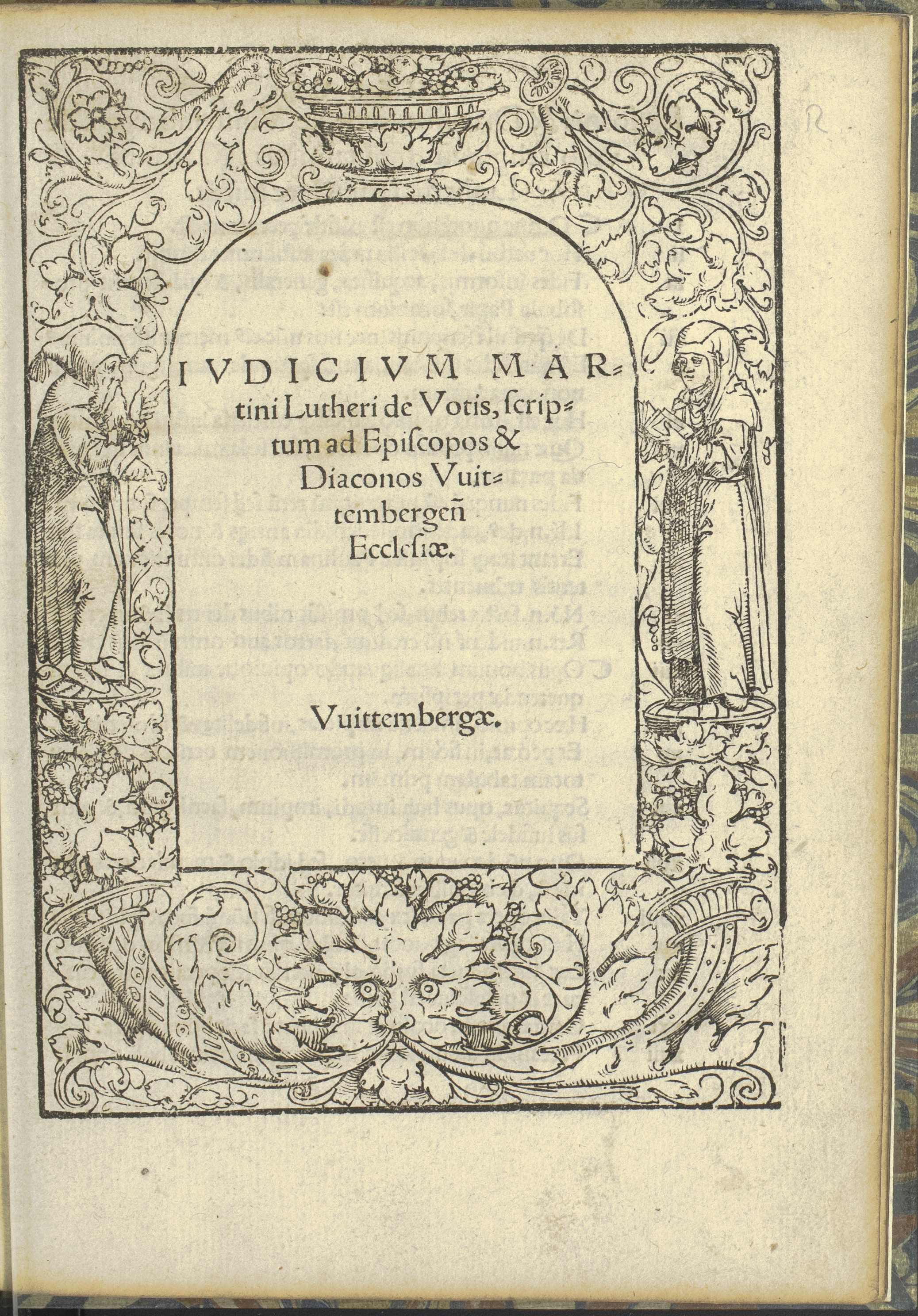
TextIudicium Martini Lutheri de votis : scriptum ad episcopos & diaconos Vuittembergen[sis] ecclesiae
Luther, Martin, 1483-1546Summary: First edition of a short tract written by Luther at Wartburg castle and addressed to the bishop and religious leaders in Wittenberg. In 139 brief statements, Luther warns that religious vows and monastic life do not by themselves bring about the forgiveness of sins.Summary: First edition of a short tract written by Luther at Wartburg castle and addressed to the bishop and religious leaders in Wittenberg. In 139 brief statements, Luther warns that religious vows and monastic life do not by themselves bring about the forgiveness of sins. -
 Text
TextSpeculum passionis domini nostri Ihesu Christi : in quo reluce[n]t hec omnia singulariter vere & absolute, puta omnis [per]fectio yerarchie, Omniu[m] fidelium beatitudo, Omnes virtutes, dona, fructus, et spiritualiu[m] bonoru[m] omnium efficacia, quod in fine prime partis huius speculi manifestissime co[m]probat[um]
Pinder, Ulrich, -1510 or 1519Summary: First edition of Ulrich Pinder's Passion narrative richly illustrated with 77 woodcut images (39 full page). Pinder was medical doctor, who had served as the court physician of the Elector Frederick the Wise of Saxony. After 1493 he was the town physician for the city of Nuremberg, where he also wrote several medical tracts and published a variety of books with the printer Friedrich Peypus. For this work, Pinder employed the services of the engravers Hans Schaufelein, who contributed 39 woodcuts, and Hans Baldung Grien, who contributed 21 woodcuts.Summary: First edition of Ulrich Pinder's Passion narrative richly illustrated with 77 woodcut images (39 full page). Pinder was medical doctor, who had served as the court physician of the Elector Frederick the Wise of Saxony. After 1493 he was the town physician for the city of Nuremberg, where he also wrote several medical tracts and published a variety of books with the printer Friedrich Peypus. For this work, Pinder employed the services of the engravers Hans Schaufelein, who contributed 39 woodcuts, and Hans Baldung Grien, who contributed 21 woodcuts. -
 Text
TextUon denn geystlichen vnd kloster gelubden
Luther, Martin, 1483-1546Summary: One of three 1522 printings of an essay on monastic vows written by Luther during his stay at the Wartburg Castle after the Diet of Worms. It is addressed to monks, whose conscience is troubled by the conflict between their vows and their desire to leave the monastic life. Luther frequently referred to this piece throughout his career, and it became one of his most influential works.Summary: One of three 1522 printings of an essay on monastic vows written by Luther during his stay at the Wartburg Castle after the Diet of Worms. It is addressed to monks, whose conscience is troubled by the conflict between their vows and their desire to leave the monastic life. Luther frequently referred to this piece throughout his career, and it became one of his most influential works.