Search
55 resources
55 items
Subject
Reformation
-
 Text
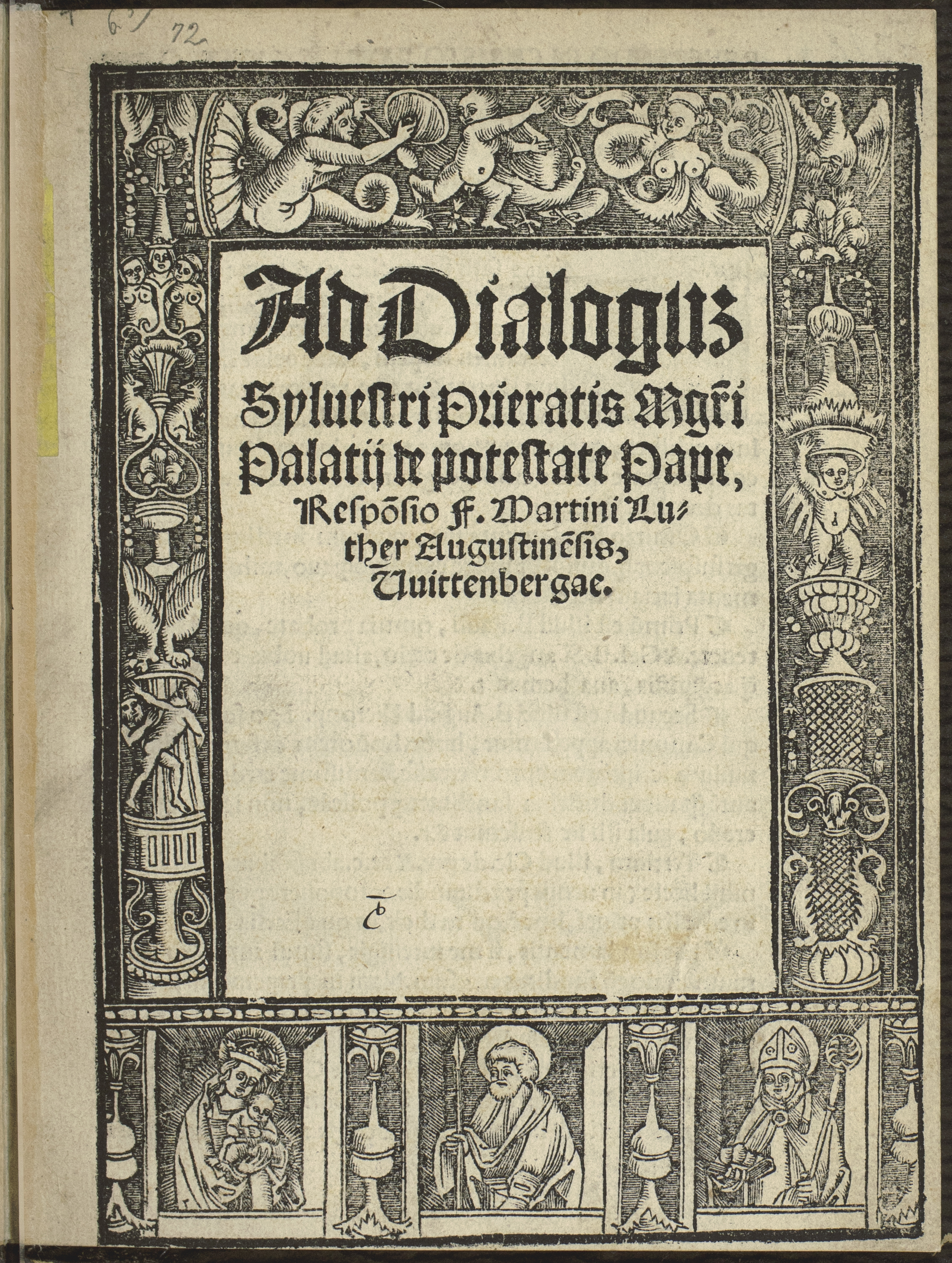
TextAd Dialoguz [i.e. Dialogum] Syluestri Prieratis M[a]g[ist]ri Palatii de potestate Pape Respo[n]sio
Luther, Martin, 1483-1546Summary: When Luther received S. Mazzolini's Dialogue on the 95 Theses, he put it into print at once to show just how weak a piece Mazzolini had written. He followed it up with the present work which includes Mazzolini's text and Luther's reply to it. Even the Pope is said to have been embarrassed by Mazzolini's poor performance in this work. The Dominicans are reported to have bought up the first edition, presumably to prevent its further circulation.Summary: When Luther received S. Mazzolini's Dialogue on the 95 Theses, he put it into print at once to show just how weak a piece Mazzolini had written. He followed it up with the present work which includes Mazzolini's text and Luther's reply to it. Even the Pope is said to have been embarrassed by Mazzolini's poor performance in this work. The Dominicans are reported to have bought up the first edition, presumably to prevent its further circulation. -
 Text
TextAd aegocerotem Emserianum
Luther, Martin, 1483-1546Summary: First edition of Luther's response to Hieronymus Emser's report of the Leipzig Disputation between Martin Luther, Andreas Bodenstein Karlstadt and Johann Eck. Emser, who had been initially sympathetic to Luther's position had accompanied Eck to Leipzig, where he broke with the reformer. In his report, he tried to associate Luther with the Bohemian reformer Jan Hus, who had been burnt at the stake during the Council of Constance in 1415.Summary: First edition of Luther's response to Hieronymus Emser's report of the Leipzig Disputation between Martin Luther, Andreas Bodenstein Karlstadt and Johann Eck. Emser, who had been initially sympathetic to Luther's position had accompanied Eck to Leipzig, where he broke with the reformer. In his report, he tried to associate Luther with the Bohemian reformer Jan Hus, who had been burnt at the stake during the Council of Constance in 1415. -
 Text
TextAd criminatricem Martini Luders Uitte[n]bergen[sis] offensione[m] super iudicio iustissimo facto : ad articulos quosdam per minoritas de obserua[n]tia Reuere[n]dissimo Episcopo Brandenburgen[si] oblatos Eckiana responsio; Quia hactenus abusus est Mar. Luderus modestia Eckiana : tande[m] extorsit, vt mordaci, mordaciter quo[que] responderem ...
Eck, Johann, 1486-1543Summary: Johann Eck responds in this early work to Luther's pamphlet "Contra malignum Iohannis Eccii iudicium."Summary: Johann Eck responds in this early work to Luther's pamphlet "Contra malignum Iohannis Eccii iudicium." -
 Text
TextAin Sermon von den Hayltumben vnnd gezierd mit vberfluss, Vom hailigen Creutz in den kirchen
Luther, Martin, 1483-1546Summary: A sermon by Luther admonishing the directing of one's attentions not to the wealth of the church and its relics, but to the needs of the poor.Summary: A sermon by Luther admonishing the directing of one's attentions not to the wealth of the church and its relics, but to the needs of the poor. -
 Text
TextAin schöner Dialogus wie ain Bawr mit aim Frawe[n] Brůder Münch redt : das er die Kutten von jm würfft, und dem Münch Arbayt zůgeben, lustbarlich und lieblich zů lesen
Summary: Polemical dialogue between a peasant and a monk, who had lost his livelihood after the dissolution of his monastery. The peasant advises the monk to try his hand at "real work".Summary: Polemical dialogue between a peasant and a monk, who had lost his livelihood after the dissolution of his monastery. The peasant advises the monk to try his hand at "real work". -
 Text
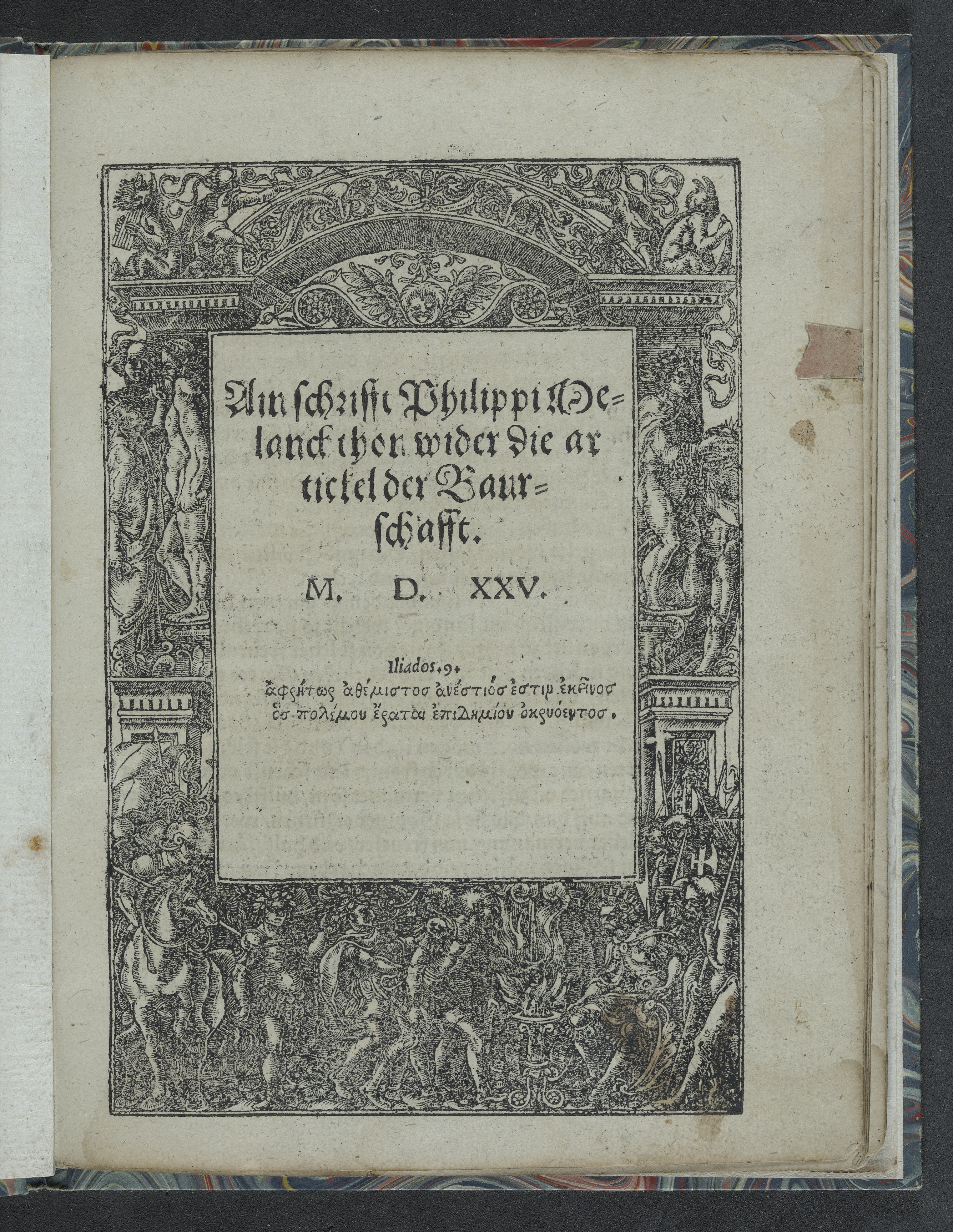
TextAin schrifft Philippi Melanchthon wider die artickel der Baurschafft
Melanchthon, Philipp, 1497-1560Summary: Treatise by Melanchthon against the peasants' revolt of the mid 1520's.Summary: Treatise by Melanchthon against the peasants' revolt of the mid 1520's. -
 Text
TextAinn Sermon oder Predigt von der Aufferstehung Christi
Alber, Matthäus, 1495-1570Summary: First and possibly only edition of a sermon by Mathäus Alber on the resurrection of Christ. Alber was an active reformer in Swabia, particularly in Reutlingen and Esslingen.Summary: First and possibly only edition of a sermon by Mathäus Alber on the resurrection of Christ. Alber was an active reformer in Swabia, particularly in Reutlingen and Esslingen. -
 Text
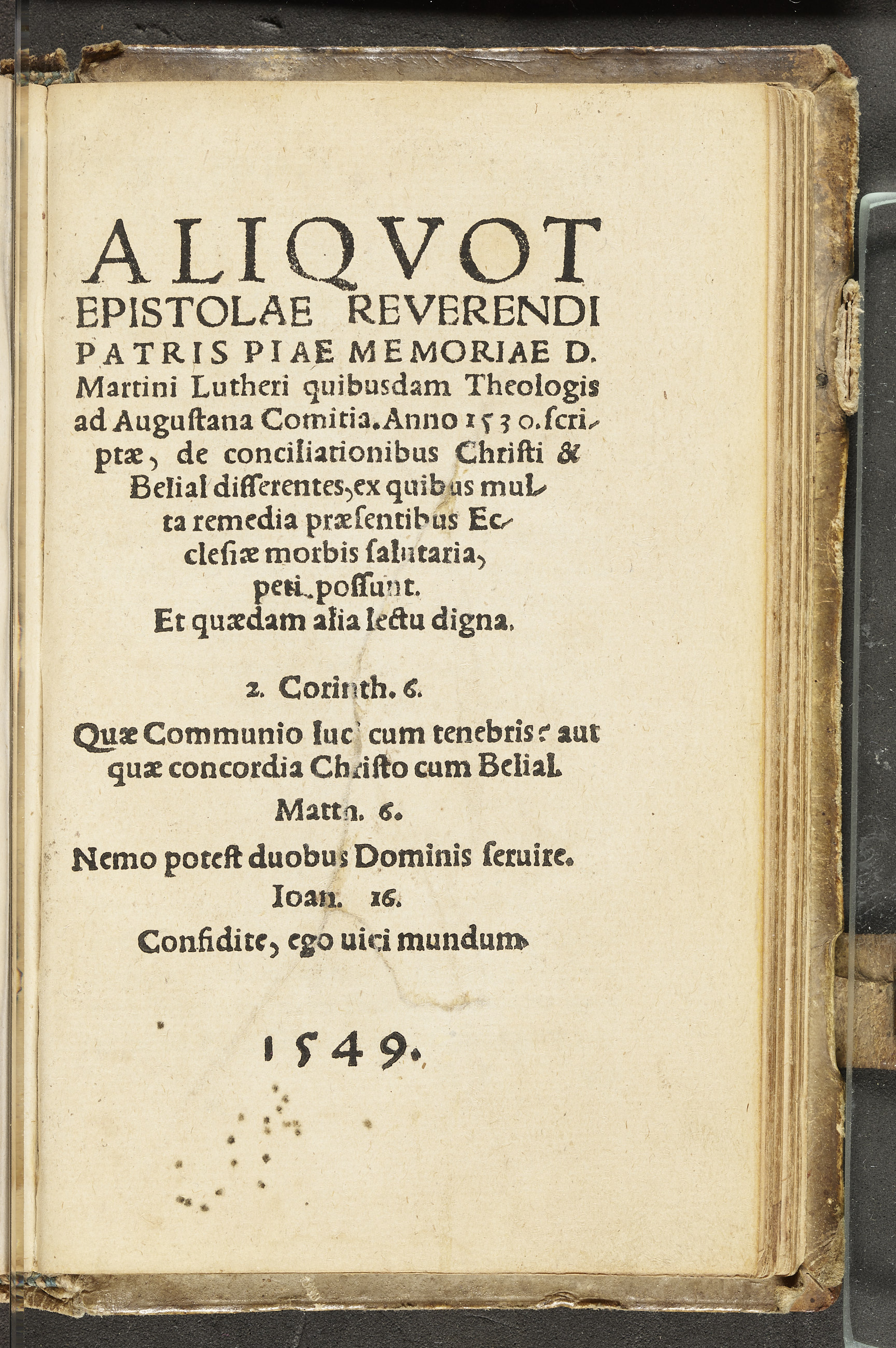
TextAliquot epistolae
Luther, Martin, 1483-1546Summary: M. Flacius Illyricus issued this edition of Luther's letters from Coburg Castle to the theologians at the Diet of Augsburg in an attempt to strengthen the Protestant resolve during the Interim. Intended for the widest possible distribution, both German and Latin versions were provided.Summary: M. Flacius Illyricus issued this edition of Luther's letters from Coburg Castle to the theologians at the Diet of Augsburg in an attempt to strengthen the Protestant resolve during the Interim. Intended for the widest possible distribution, both German and Latin versions were provided. -
 Text
TextAn den Durchleüchtigen Hochgepornen Fürsten vnd Herrn, Herrn Albrechten, Marggraffen zuo Brandenburg, inn Preussen [et]c. Hertzogen [et]c. Ein Sendbrief Doct. Mart. Luth. Wider ettliche Rottengeyster : Wittemberg, M.D.XXXII
Luther, Martin, 1483-1546Summary: Luther's reply to a letter from Duke Albrecht of Brandenburg, concerning the interpretation of John VI with reference to the Lord's Supper.Summary: Luther's reply to a letter from Duke Albrecht of Brandenburg, concerning the interpretation of John VI with reference to the Lord's Supper. -
 Text
TextAn die Herren deütschs Ordens : das sye falsche Keüscheit meyden, und zuor rechten eelichen Keuscheit greiffen, Ermanung
Luther, Martin, 1483-1546Summary: Sixth printing of a letter addressed to Albrecht von Brandenburg (later Albert, Duke of Prussia) the new General of the Teutonic Knights. In response to a question by the general, Luther applies his critique of monastic celibacy to military orders, stressing that it is pleasing to God to have families and to raise children.Summary: Sixth printing of a letter addressed to Albrecht von Brandenburg (later Albert, Duke of Prussia) the new General of the Teutonic Knights. In response to a question by the general, Luther applies his critique of monastic celibacy to military orders, stressing that it is pleasing to God to have families and to raise children. -
 Text
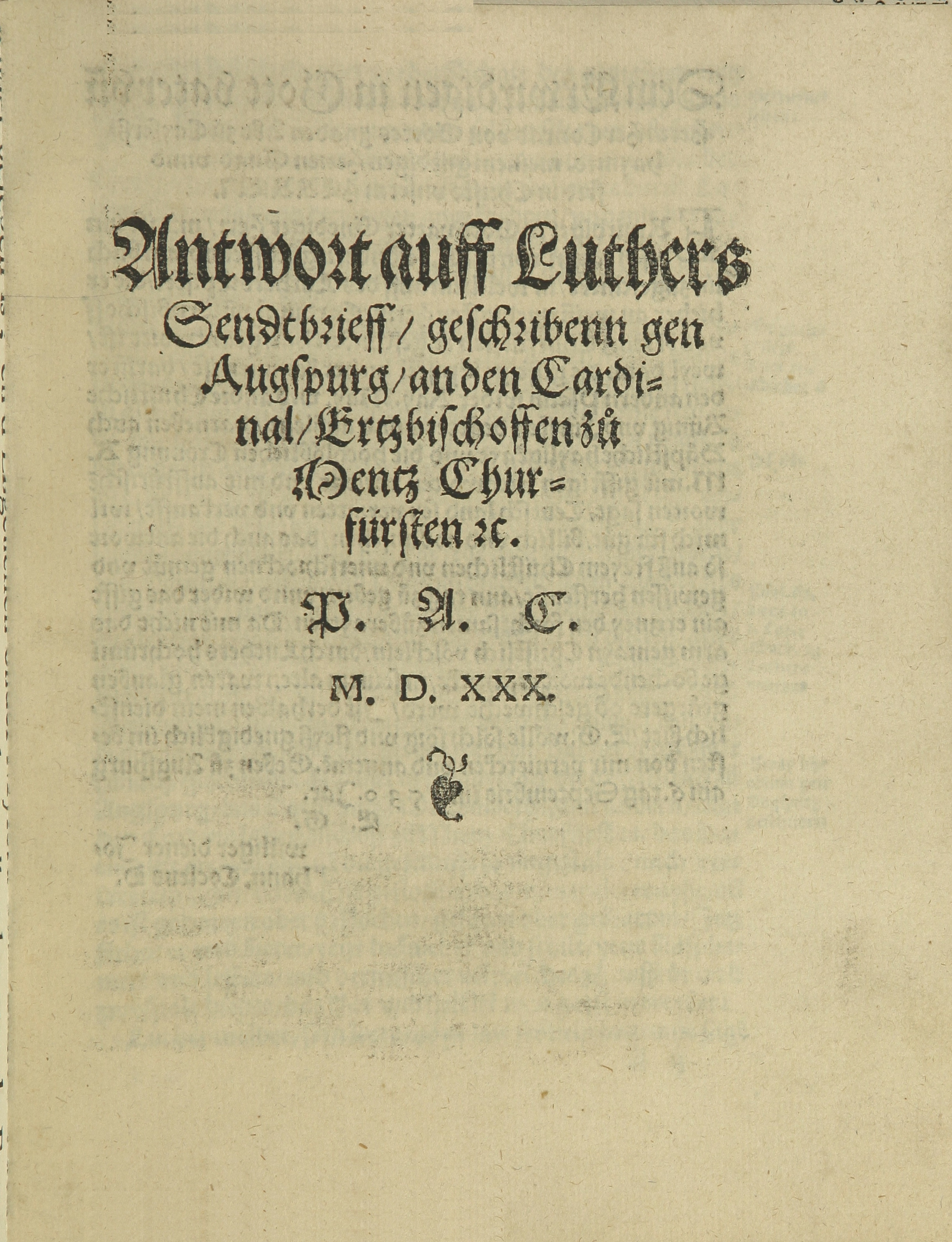
TextAntwort auff Luthers Sendtbrieff, geschribenn gen Augspurg, an den Cardinal, Ertzbischoffen zuo Mentz Churfürsten [et]c.
Bachman, Paul, 1465-1538Summary: Polemical response, by Paul Bachmann, Abbot of Altenzelle, and an early opponent of Luther, to Luther's letter of 1530 to Albert, Archbishop of Mainz. Albert was inclined towards a peaceful solution to the issues of the Reformation.Summary: Polemical response, by Paul Bachmann, Abbot of Altenzelle, and an early opponent of Luther, to Luther's letter of 1530 to Albert, Archbishop of Mainz. Albert was inclined towards a peaceful solution to the issues of the Reformation. -
 Text
TextAuszlegung vnnd Lewterung etzlicher heyligenn Geschrifften : So dem Menschen dienstlich vnd erschieszlich seint zu Christlichem Lebe[n] : kurtzlich berurth vnd angetzeich[n]et in den Figurn vnd Schrifften der Wagen : In Sonderheit, des Creutzes, tzu welchem vnser Goth vnd Herr, den Menschen berufft. Bediengung vnd Vorwort...
Karlstadt, Andreas Rudolff-Bodenstein von, 1486-1541Summary: Only edition of an early work by Karlstadt addressing questions of what constitutes a Christian life.Summary: Only edition of an early work by Karlstadt addressing questions of what constitutes a Christian life. -
 Text
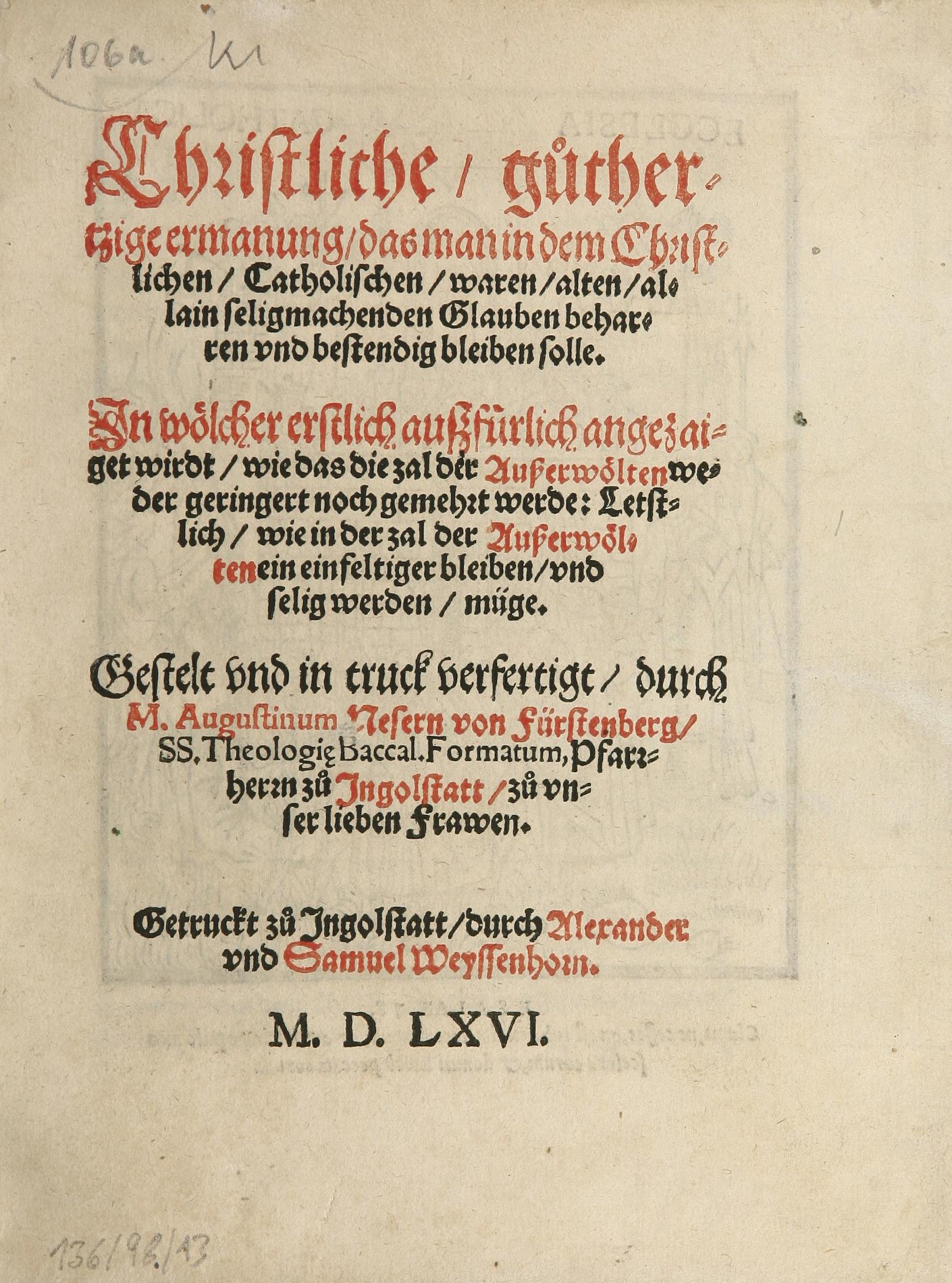
TextChristliche güthertzige Ermanung, das Man in dem Christlichen, Catholischen, waren, alten, allain seligmachenden Glauben beharren vnd bestendig bleiben solle : In wölcher erstlich auszfürlich angezaiget wirdt, wie das die Zal der Ausserwölten weder geringert noch gemehrt werde: letstlich, wie in der Zal der Ausserwölten ein einfeltiger bleiben, vnd selig werden, müge
Neser, AugustinusSummary: Augustinus Neser was a pastor in Ingolstadt. In this hortatory tract he discusses the importance of staying within the Catholic fold.Summary: Augustinus Neser was a pastor in Ingolstadt. In this hortatory tract he discusses the importance of staying within the Catholic fold. -
 Text
TextD. Sebastian Meyers, etwan Predicanten zun Barfussern zu Strassburg, Widerrüffung an eyn löblich Freystat Strassburg. Anno M.D.XXiiij
Meyer, Sebastian, 1465-1545?Summary: Public renunciation of his monastic vows and earlier teachings by Sebastian Meyer, a preacher in the city of Strassburg and an early follower of Martin Luther.Summary: Public renunciation of his monastic vows and earlier teachings by Sebastian Meyer, a preacher in the city of Strassburg and an early follower of Martin Luther. -
 Text
TextDe disputatio[n]e Lipsicensi : quantum ad Boemos obiter deflexa est
Emser, Hieronymus, 1478-1527Summary: A letter by Hieronymus Emser, early opponent of Luther concerning the Leipzig Disputation of 1519, describing Luther's debate with Johann Eck, and Luther's admitting that councils could err.Summary: A letter by Hieronymus Emser, early opponent of Luther concerning the Leipzig Disputation of 1519, describing Luther's debate with Johann Eck, and Luther's admitting that councils could err. -
 Text
TextDe legis litera, siue carne, & spiritu
Karlstadt, Andreas Rudolff-Bodenstein von, 1486-1541Summary: One of two printings of Karlstadt's treatise on the dichotomy of law and grace.Summary: One of two printings of Karlstadt's treatise on the dichotomy of law and grace. -
 Text
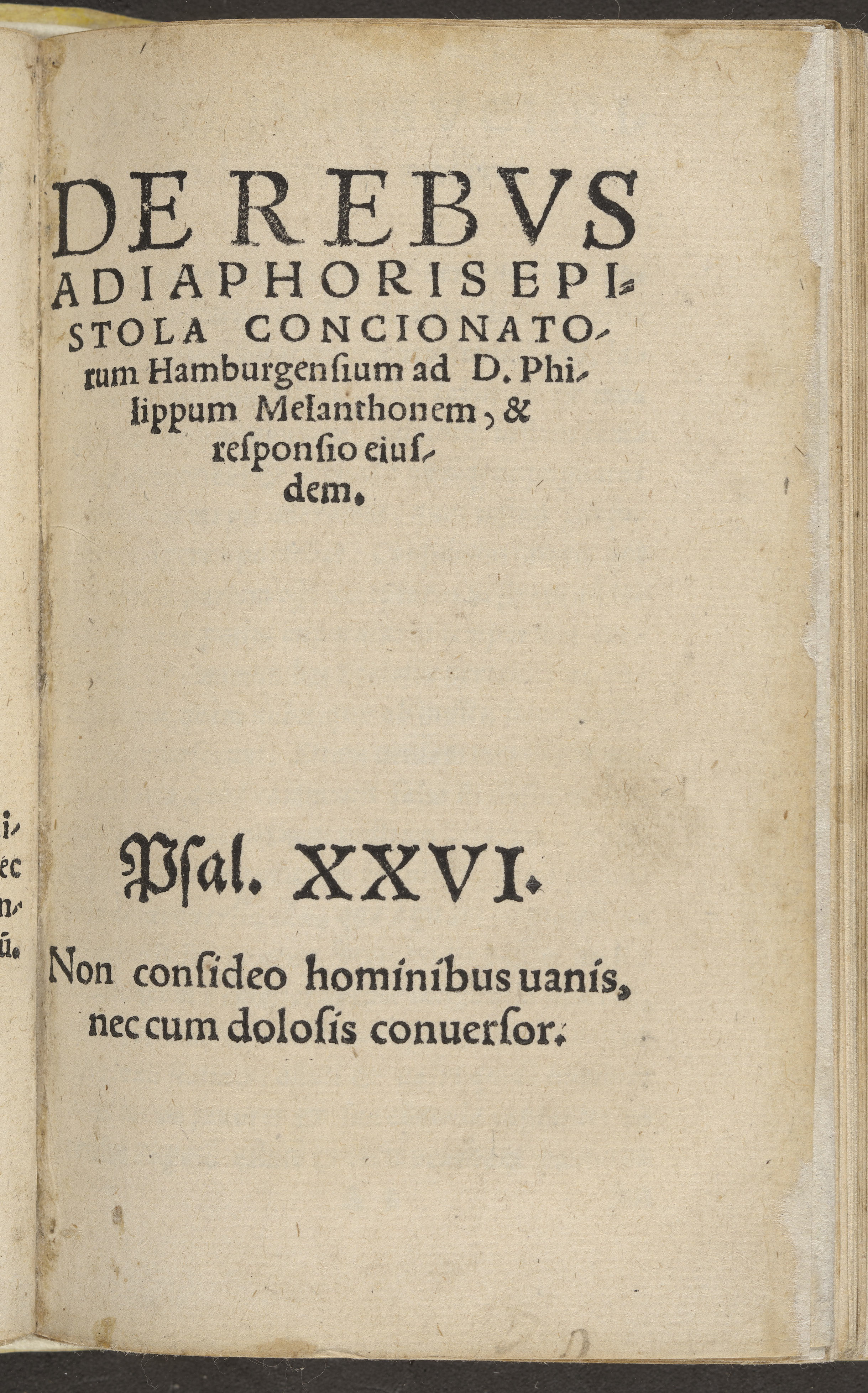
TextDe rebus adiaphoris epistola concionatorum Hamburgensium ad D. Philippum Melanthonem, & responsio eiusdem
Summary: Letter by a counsel of preachers in the city of Hamburg to Philipp Melanchthon regarding the adiaphoristic controversy regarding the re-introduction of some Catholic elements into the liturgy, which Melanchthon viewed as harmless and permissible. Melanchthon's reply is also included in this short booklet.Summary: Letter by a counsel of preachers in the city of Hamburg to Philipp Melanchthon regarding the adiaphoristic controversy regarding the re-introduction of some Catholic elements into the liturgy, which Melanchthon viewed as harmless and permissible. Melanchthon's reply is also included in this short booklet. -
 Text
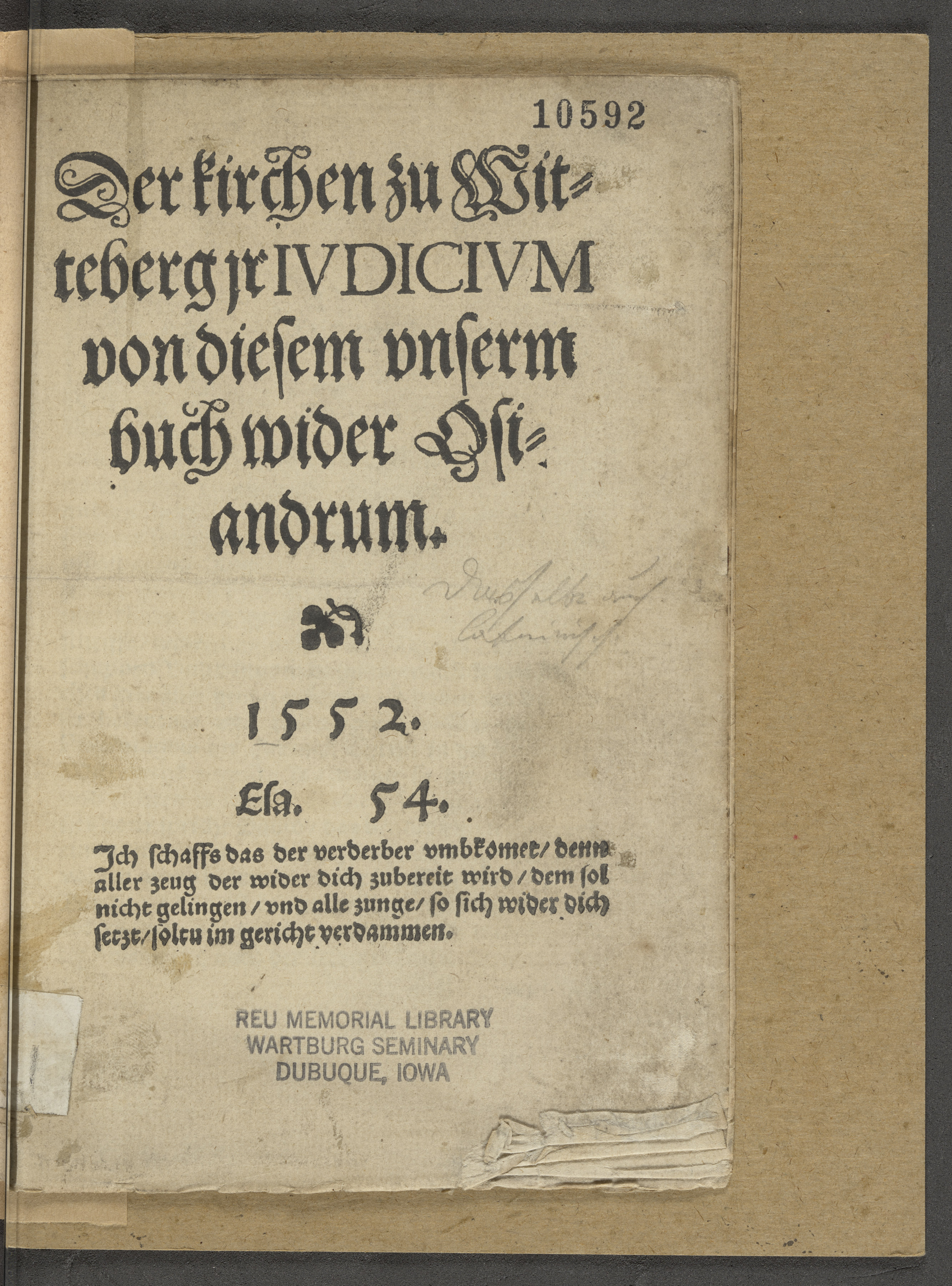
TextDer Kirchen zu Witteberg jr Iudicium von diesem vnserm Buch wider Osiandrum
Mörlin, Joachim, 1514-1571Summary: The only printing of a pamphlet against Andreas Osiander's interpretation of Luther's doctrine of salvation by faith, signed by several theologians and pastors from Wittenberg.Summary: The only printing of a pamphlet against Andreas Osiander's interpretation of Luther's doctrine of salvation by faith, signed by several theologians and pastors from Wittenberg. -
 Text
TextDer Zehen Gebot ein nützliche Erklärung
Luther, Martin, 1483-1546This is a 1523 printing of Martin Luther's popular sermon on the Ten Commandments and the Seven Deadly Sins, first printed in 1520 and reprinted numerous times. The work was originally composed in Latin and was translated into German by the cartographer and Christian Hebraist Sebastian Münster.This is a 1523 printing of Martin Luther's popular sermon on the Ten Commandments and the Seven Deadly Sins, first printed in 1520 and reprinted numerous times. The work was originally composed in Latin and was translated into German by the cartographer and Christian Hebraist Sebastian Münster. -
 Text
TextDisputatio inter Egregios & praelatus virus ac doctores, Joannem Ecci[um] & Martinum Lutherum in p[rae]sentia notariorum habita
Luther, Martin, 1483-1546Summary: Unique printing of the original notarial protocol of the Leipzig Disputation between Andreas Karlstadt and Martin Luther on the one hand, and Johann Eck, on the other. Includes fully two thirds of the several day debate, and all of the famous "duel" between Luther and Eck on authority in the church. The debates were copied by two notaries, and, at the end of each day's sessions, were verified by two witnesses.Summary: Unique printing of the original notarial protocol of the Leipzig Disputation between Andreas Karlstadt and Martin Luther on the one hand, and Johann Eck, on the other. Includes fully two thirds of the several day debate, and all of the famous "duel" between Luther and Eck on authority in the church. The debates were copied by two notaries, and, at the end of each day's sessions, were verified by two witnesses. -
 Text
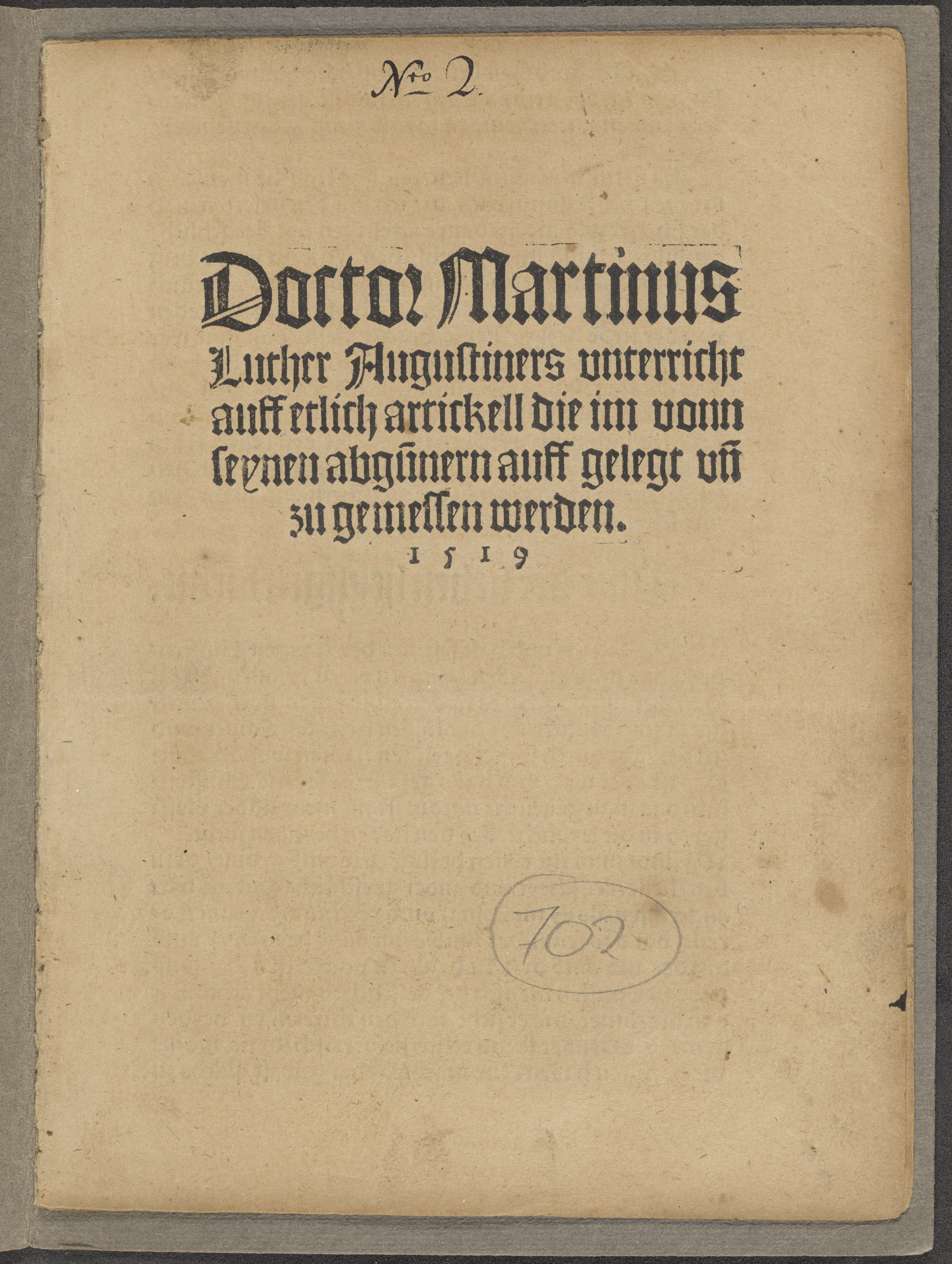
TextDoctor Martinus Luther Augustiners Vnterricht auff etlich Artickell die im vonn seynen Abgūrnern auff gelegt vn[d] zu gemessen werden
Luther, Martin, 1483-1546Summary: Luther was persuaded by Karl von Miltitz to write this public statement as a response to certain charges brought against him by his opponents, in particular Mazzolini da Prierio. In this tract, Luther still supports the invocation of the saints, an idea which he abandoned only shortly after.Summary: Luther was persuaded by Karl von Miltitz to write this public statement as a response to certain charges brought against him by his opponents, in particular Mazzolini da Prierio. In this tract, Luther still supports the invocation of the saints, an idea which he abandoned only shortly after. -
 Text
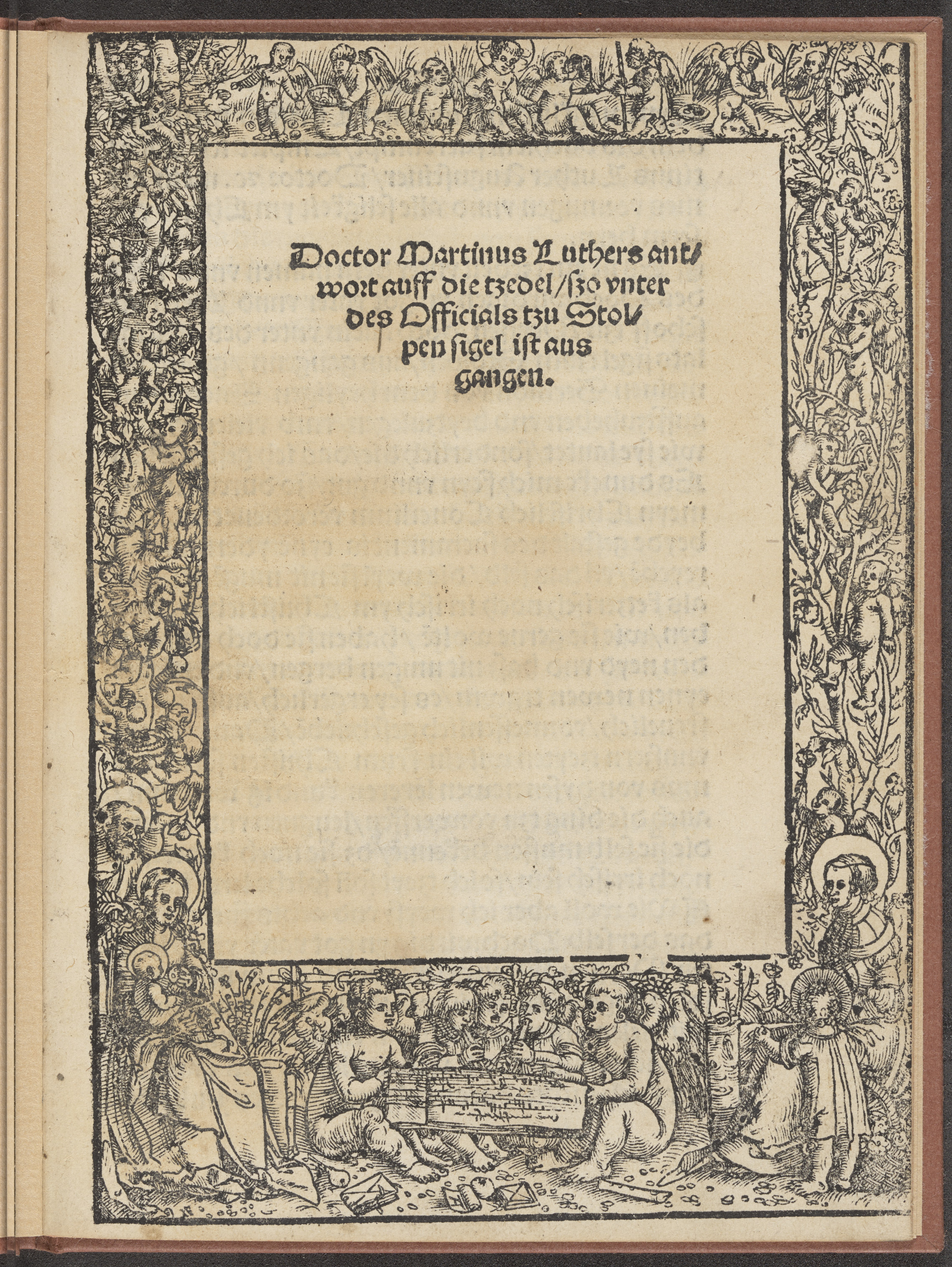
TextDoctor Martinus Luthers antwort auff die tzedel : szo vnter des Officials tzu Stolpen sigel ist ausgangen
Luther, Martin, 1483-1546Summary: The first of five printings in 1520 of an answer to an attack on Luther issued under the seal and authority of Albert, Archbishop of Mainz.Summary: The first of five printings in 1520 of an answer to an attack on Luther issued under the seal and authority of Albert, Archbishop of Mainz. -
 Text
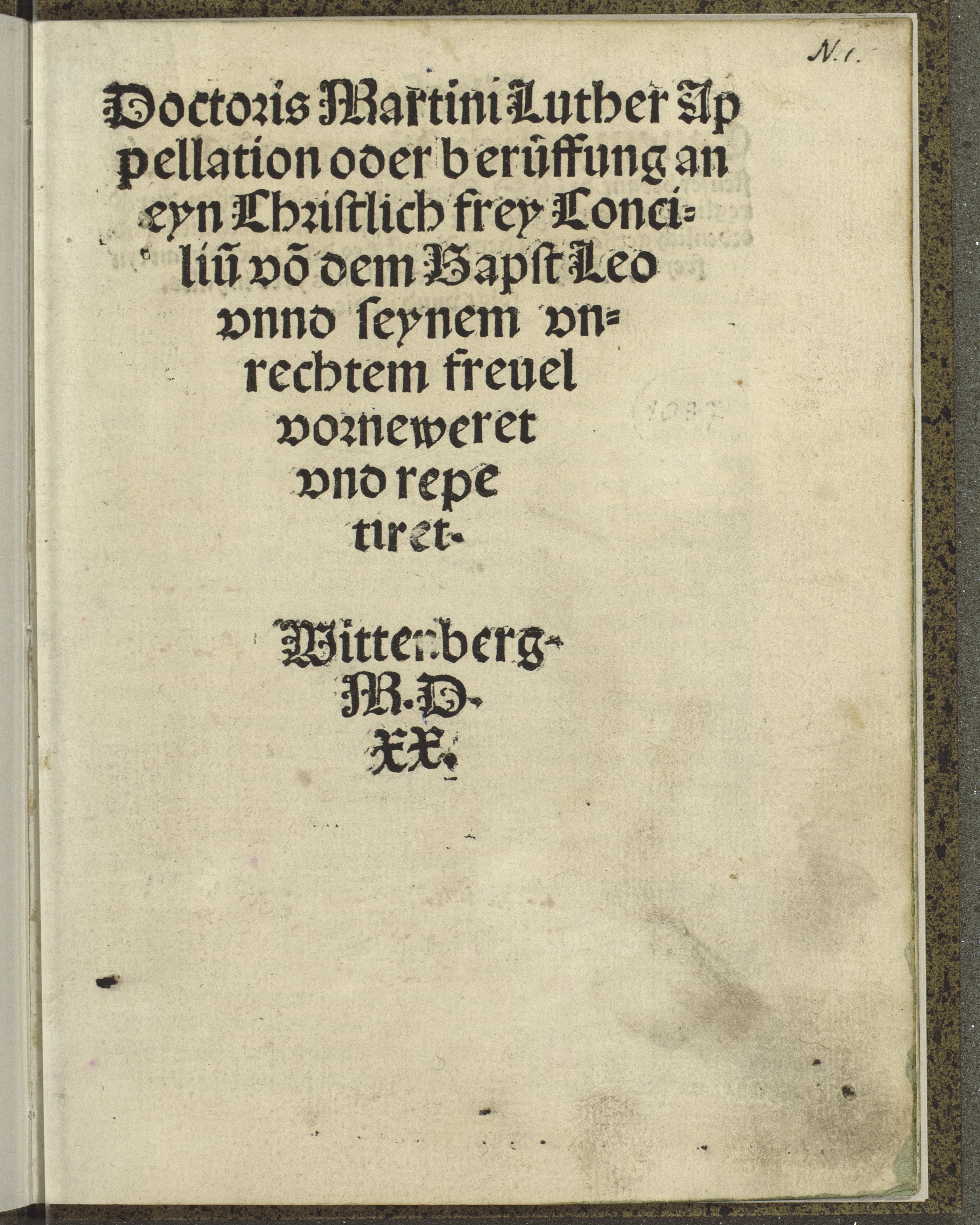
TextDoctoris Martini Luther Appellation oder Berüffung an eyn christlich frey Conciliu[m] vo[n] dem Bapst Leo vnnd seynem vnrechtm Freuel vorneweret vnd repetiret
Luther, Martin, 1483-1546Summary: Despite his lack of success in appealing to the Pope for an Ecumenical Council in 1518, Luther repeats his call in this pamphlet, combining it with a special appeal to the emperor and to the German princes. This is the first printing of this work, produced outside the city of Wittenberg.Summary: Despite his lack of success in appealing to the Pope for an Ecumenical Council in 1518, Luther repeats his call in this pamphlet, combining it with a special appeal to the emperor and to the German princes. This is the first printing of this work, produced outside the city of Wittenberg. -
 Text
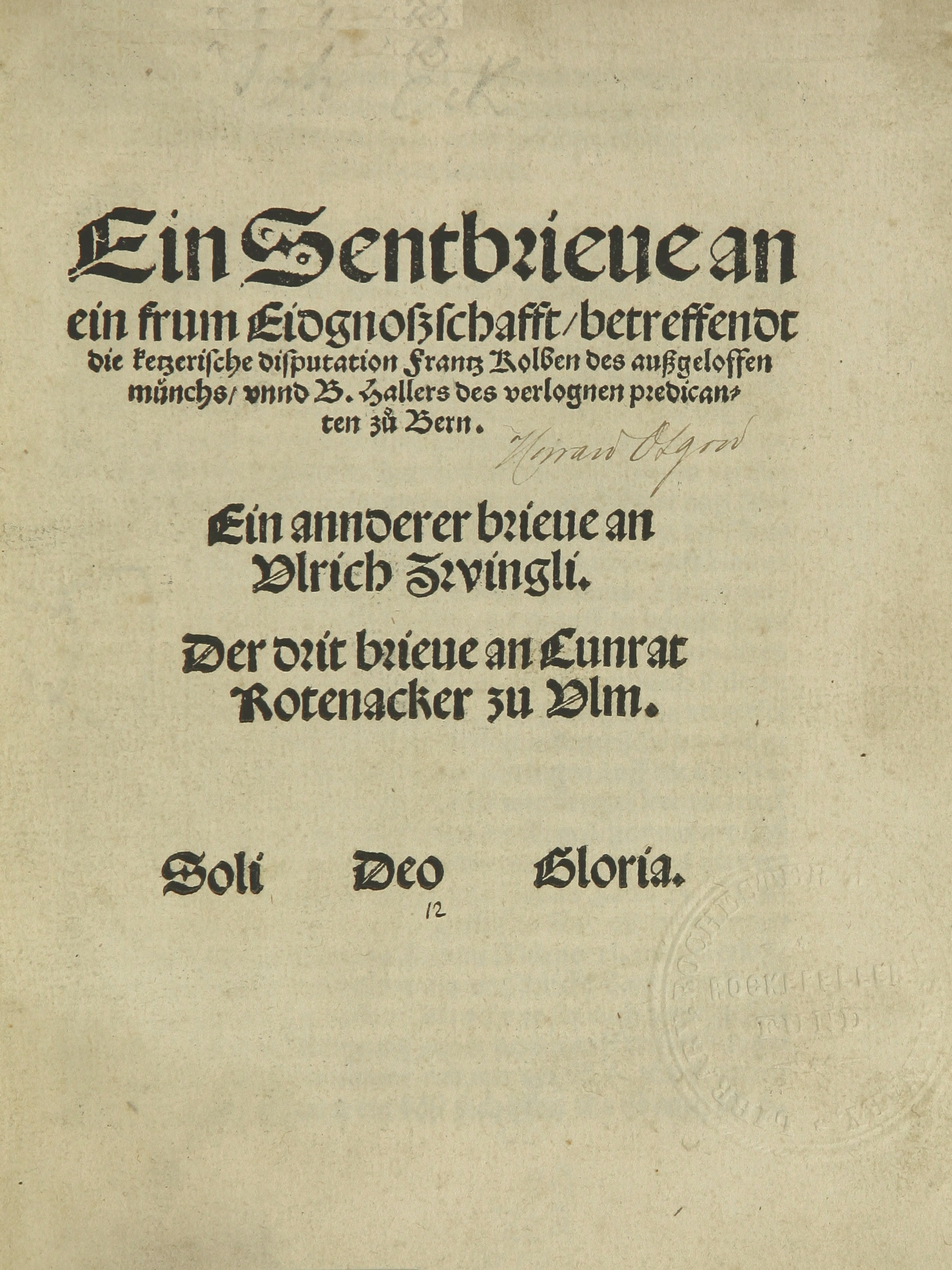
TextEin Sentbreiue an ein frum Eidgnossschafft : betreffendt die ketzerische Disputation Frantz Kolben des aussgeloffen Münchs, vnnd B. Hallers des verlognen Predicanten zu[o] Bern; Ein annderer brieue an Vlrich Zwingli; Der drit brieue an Cunrat Rotenacker zu Vlm; Soli Deo gloria.
Eck, Johann, 1486-1543Summary: First edition of three public letters by Johann Eck. The letters refer to an invitation sent to Eck by Zwingli, Haller and Kolbe, all of them evangelical preachers, to participate in a religious disputation scheduled to take place in Bern. The first letter, addressed to the confederation, explains courteously enough that he, Eck, does not intend to follow the call of the three proven heretics individually, a call not issued by the civic authorities. Not that he is afraid of their arguments; but he insists on an authoritative invitation and presence.Summary: First edition of three public letters by Johann Eck. The letters refer to an invitation sent to Eck by Zwingli, Haller and Kolbe, all of them evangelical preachers, to participate in a religious disputation scheduled to take place in Bern. The first letter, addressed to the confederation, explains courteously enough that he, Eck, does not intend to follow the call of the three proven heretics individually, a call not issued by the civic authorities. Not that he is afraid of their arguments; but he insists on an authoritative invitation and presence. -
 Text
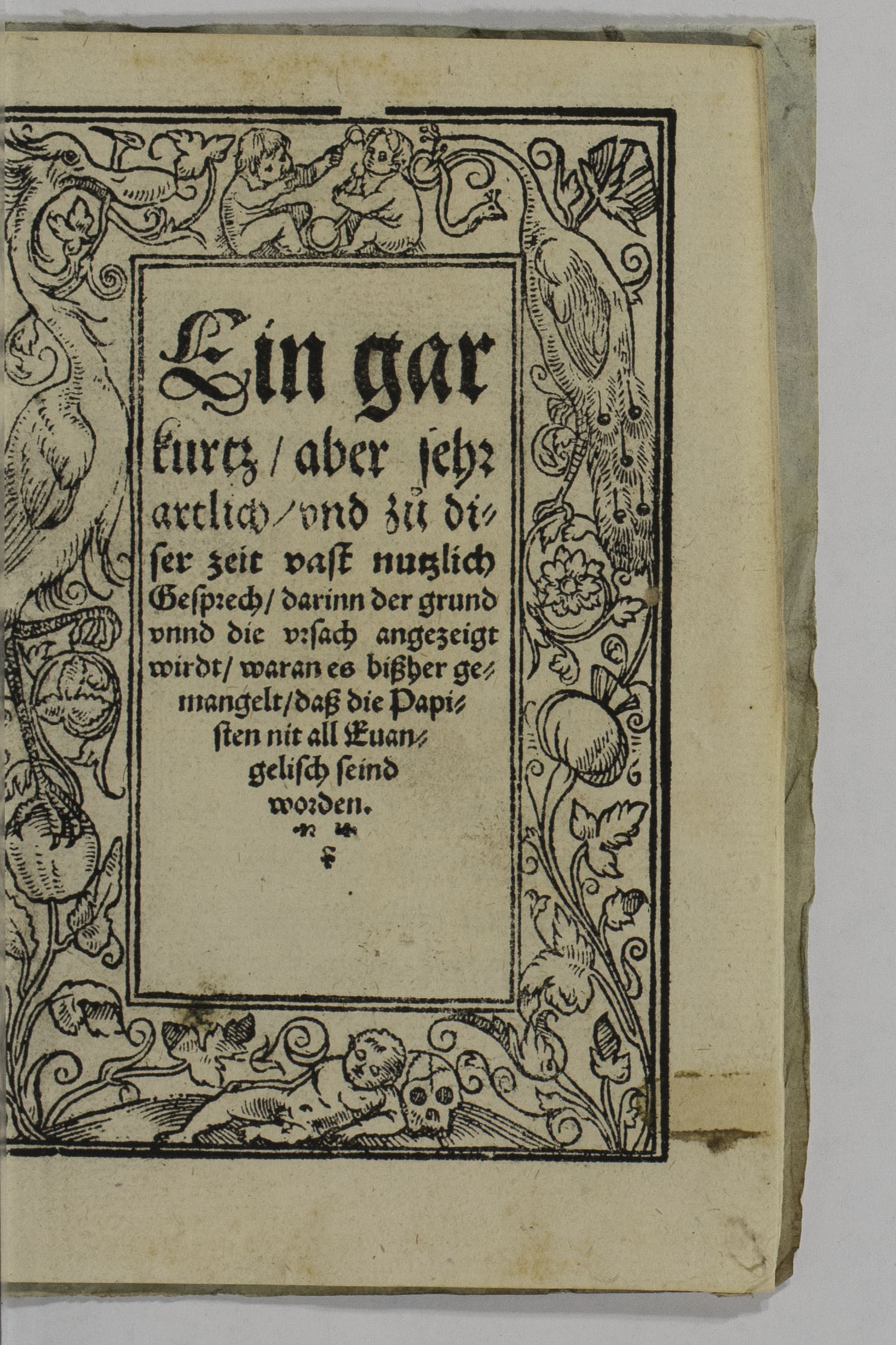
TextEin gar kurtz aber sehr artlich vnd zů diser zeit vast nutzlich Gesprech, darinn der grund vnnd die vrsach angezeigt wirdt waran es bissher gemangelt dass die Papisten nit all Euangelisch seind worden.
Walasser, Adam, -1581Summary: A fictitious dialogue between a Catholic and a Protestant, written by the Catholic theologian Adam Walasser. The discussion includes topics like the authority of tradition outside of Scripture or prayer to the Saints and the Protestant position is presented as reasonable, albeit incorrect by Walasser.Summary: A fictitious dialogue between a Catholic and a Protestant, written by the Catholic theologian Adam Walasser. The discussion includes topics like the authority of tradition outside of Scripture or prayer to the Saints and the Protestant position is presented as reasonable, albeit incorrect by Walasser. -
 Text
TextEin schöner spruch darinn deren von Costantz seltzame Renckh und Abentheür, damit Sy vmbgon begriffen syen.
Treger, Konrad, approximately 1480-1542Summary: Anti-Reformation poem directed at the city of Konstanz. Tregor, an Augustinian Prior, was a leading defender of Catholicism in Switzerland.Summary: Anti-Reformation poem directed at the city of Konstanz. Tregor, an Augustinian Prior, was a leading defender of Catholicism in Switzerland. -
 Text
TextEine Schrifft, wie die Pfarherrn an den Örtern, da man die Papisterey widerumb auffricht, die Euangelisch Lehr, welche sie Lutherisch nennen, verloben vnd verschweren müssen
Summary: An anonymous pamphlet, containing an oath German pastors had to swear to renounce the "Evangelical doctrine, which is called Lutheran" in order to be readmitted to the Roman Catholic Church. The copy of the oath is preceded by two satirical poems regarding the oath, the first one representing the opinion of a wise man, the second one the answer of an unwise man. On the titlepage are two verses from Matthew 10 against the taking of oaths. The work is published by Christian Rödinger, a printer who put his press in service of the Reformation.Summary: An anonymous pamphlet, containing an oath German pastors had to swear to renounce the "Evangelical doctrine, which is called Lutheran" in order to be readmitted to the Roman Catholic Church. The copy of the oath is preceded by two satirical poems regarding the oath, the first one representing the opinion of a wise man, the second one the answer of an unwise man. On the titlepage are two verses from Matthew 10 against the taking of oaths. The work is published by Christian Rödinger, a printer who put his press in service of the Reformation. -
 Text
TextEncomiu[m] Rubij Longipolii apud Lipsim : in errores quos pueriliter co[m]misit adversus Vuittenbergen[ses] : Nemo potest quicquid toto gestatur in orbe rumpere liuores omnia Nemo potest
Montanus, Jacobus, active 1486-1534Summary: It is not certain who wrote this tract on the Leipzig Disputation but J. Montanus or J. Cellarius appear to be the most likely candidates. Montanus became the first Protestant preacher in Westphalia, while Cellarius or Kellner, became the first Protestant Superintendent of Dresden.Summary: It is not certain who wrote this tract on the Leipzig Disputation but J. Montanus or J. Cellarius appear to be the most likely candidates. Montanus became the first Protestant preacher in Westphalia, while Cellarius or Kellner, became the first Protestant Superintendent of Dresden. -
 Text
TextEpistola apologetica Matthiae Flacij Illyrici ad quendam Pastorem : Item Duo Somnia Philippi
Flacius Illyricus, Matthias, 1520-1575Summary: Open letter to an anonymous pastor justifying Matthias Flacius' opposition to the Leipzig interim, and Melanchthon's willingness to compromise with the Catholic Church on matters of liturgy.Summary: Open letter to an anonymous pastor justifying Matthias Flacius' opposition to the Leipzig interim, and Melanchthon's willingness to compromise with the Catholic Church on matters of liturgy. -
 Text
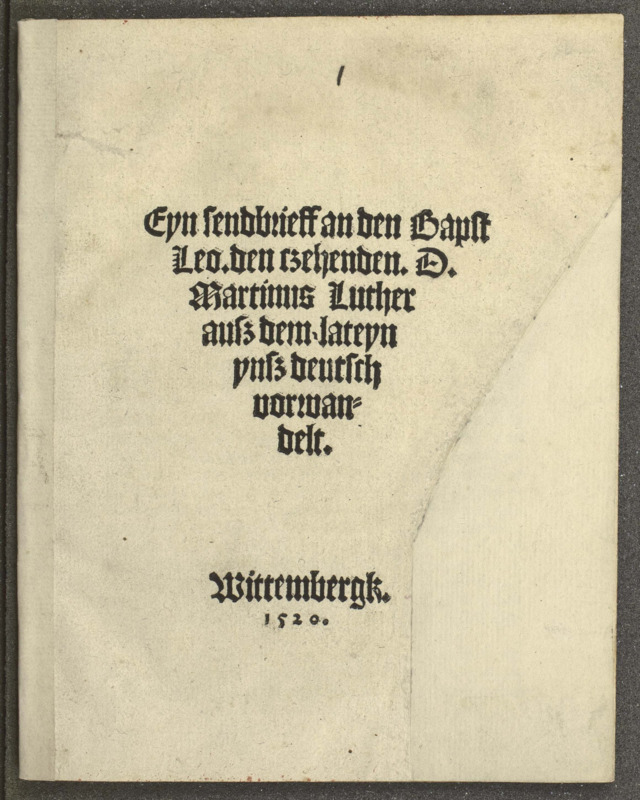
TextEyn Sendbrieff an den Bapst Leo den Czehenden
Luther, Martin, 1483-1546Summary: A letter by Luther to Pope Leo X. Leo had issued his famous bull 'Exsurge Domine' on June 15 1520, demanding that Luther recant his teachings of face excommunication. Luther responded with this letter in September, seeking to explain his position, calling for the church to reform, while emphasizing that his critiques have been directed against abuses within the church, not against the person or office of the pope.Summary: A letter by Luther to Pope Leo X. Leo had issued his famous bull 'Exsurge Domine' on June 15 1520, demanding that Luther recant his teachings of face excommunication. Luther responded with this letter in September, seeking to explain his position, calling for the church to reform, while emphasizing that his critiques have been directed against abuses within the church, not against the person or office of the pope. -
 Text
TextEyn unuberwindtlich Beschirm Buchleyn von Haubt Artickeln, vn[d] furnemlichen Puncten der götlichen Geschrifft, : auss dem Alten vnd Newen Testament, mit Beschlussreden, eynem yden rechten Christe[n] Me[n]schenn zu Handhabung der göttlichen Warheyt, wyder die Verfolger der selben, gar nützlich tzu brauchen
Gretzinger, BenedictSummary: Benedict Gretzinger was a city scribe in the town of Reutlingen. In his only known work, which was however published 17 times between 1523 and 1528, he lists 10 fundamental articles of faith, each with short references to the Bible and explanatory notes. The text is close to the children's catechisms by the Bohemian Brethren, published in 1522, which may itself have been influenced by Martin Luther's "Short form of the 10 commandments".Summary: Benedict Gretzinger was a city scribe in the town of Reutlingen. In his only known work, which was however published 17 times between 1523 and 1528, he lists 10 fundamental articles of faith, each with short references to the Bible and explanatory notes. The text is close to the children's catechisms by the Bohemian Brethren, published in 1522, which may itself have been influenced by Martin Luther's "Short form of the 10 commandments". -
 Text
TextForma Inquisitionis Hispanicae instituta in inferiori Germania anno 1550
Summary: Instructions for inquisitors in the Netherlands (Lower Germany), published by the Lutheran reformer Matthias Flacius to call attention to the persecution of Protestants. Flacius intended this report to underscore his opposition to any compromises with the Catholic Church, even in liturgical matters, as permitted by the Augsburg Interim of 1548.Summary: Instructions for inquisitors in the Netherlands (Lower Germany), published by the Lutheran reformer Matthias Flacius to call attention to the persecution of Protestants. Flacius intended this report to underscore his opposition to any compromises with the Catholic Church, even in liturgical matters, as permitted by the Augsburg Interim of 1548. -
 Text
TextGründtliche anzaygung vnd bericht, ausz was vrsachen (deren fürnemlich siben seind) so mancherley, vnnd vilfaltige Ketzereyen, zwispaltung vnnd jtzthumb in Christlicher Religion, vnd der hailigen Catholischen Kirchen, von anfang biss auff dise zeit erwachsen seind, vnd jren grund genommen haben
Leib, Kilian, 1471-1553Summary: Second printing of a an anti-Protestant tract by Kilian Leib, prior of the Augustinian monastery at Rebdorf. Leib was a Catholic theologian in the humanist tradition who was a firm opponent of Martin Luther's reforms. In 1530 he had participated in drafting the Catholic response to the Augsburg Confession. In this work, Leib outlines 7 causes for the Lutheran heresy, which include among others an unfavorable constellation of the stars, ordained by God to punish humanity.Summary: Second printing of a an anti-Protestant tract by Kilian Leib, prior of the Augustinian monastery at Rebdorf. Leib was a Catholic theologian in the humanist tradition who was a firm opponent of Martin Luther's reforms. In 1530 he had participated in drafting the Catholic response to the Augsburg Confession. In this work, Leib outlines 7 causes for the Lutheran heresy, which include among others an unfavorable constellation of the stars, ordained by God to punish humanity. -
![Summary: This is an early Italian response to Martin Luther, attacking the schismatic monk on his own terms, in the vernacular for the benefit of laymen or simplici, as advertised on the title-page. The work is quite broad in its criticism and aims to refute not only Luther and his followers, but all heretics and even Jews. On the final leaf of text, following the colophon the list of errata, we find a curious addition perhaps intended to be removed from the book and used separately: a "song" satirically composed by "several of Luther's friends in praise of him" [Alcuni amici de Martin Luthero in laude sua cantano], beginning "Te Lutherum damnamus". Evidently a parody of the Te Deum, Fano's hymn condemning Luther to Hell was in fact subsequently set to music by a certain Maistre Jhan (ca. 1485-1538).](https://digital.pitts.emory.edu/files/large/P_300000491804/P_300000491804_P001.jpg) Text
TextIesus Maria Opera vtilissima uulgare co[n]tra le pernitiosissime heresie Lutherane p[er] li simplici
Giovanni, fra., active approximately 1513-1523Summary: This is an early Italian response to Martin Luther, attacking the schismatic monk on his own terms, in the vernacular for the benefit of laymen or simplici, as advertised on the title-page. The work is quite broad in its criticism and aims to refute not only Luther and his followers, but all heretics and even Jews.Summary: This is an early Italian response to Martin Luther, attacking the schismatic monk on his own terms, in the vernacular for the benefit of laymen or simplici, as advertised on the title-page. The work is quite broad in its criticism and aims to refute not only Luther and his followers, but all heretics and even Jews. -
 Text
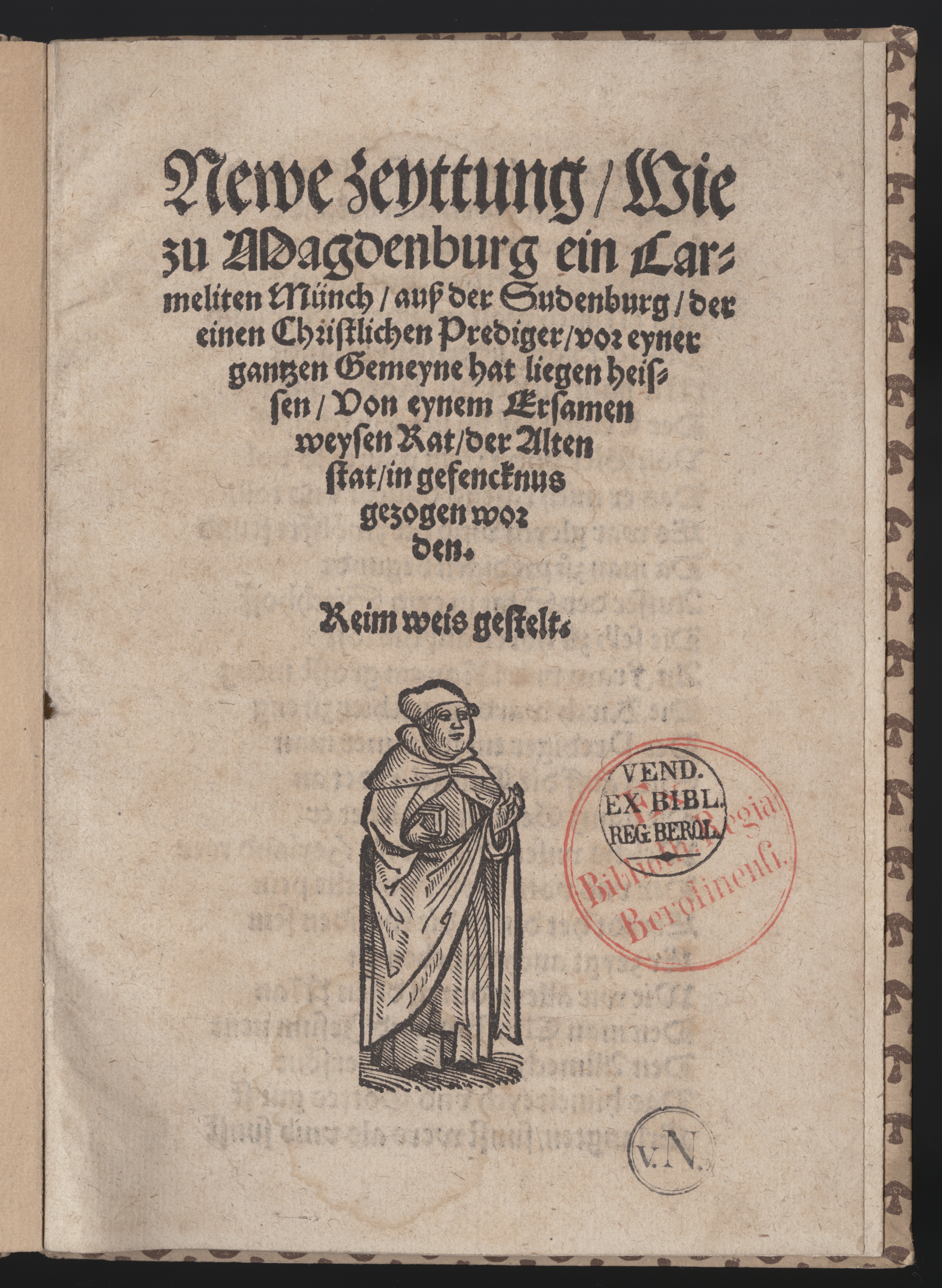
TextNewe zeyttung, Wie zu Magdenburg ein Carmeliten Münch, auss der Sudenburg, der einen Christlichen Prediger, vor eyner gantzen Gemeyne hat liegen heissen, Von eynem Ersamen weysen Rat, der Alten stat, in gefencknus gezogen worden. : Reim weis gestelt.
Summary: Polemic ballad with a total of 142 rhymed lines, relating the story of a drunk Carmelite monk who attends a sermon preached outside the city by a righteous (Lutheran) pastor and who interrupts the preacher, accusing him of lying and misrepresenting Scripture. The people in response rise up and begin to beat him, almost killing him, but the monk is taken away and brought before the city council and the mayor who calls for calm and instructs that the monk should be locked up to await the executioner and thus be placed under God's justice rather than the mob's anger.Summary: Polemic ballad with a total of 142 rhymed lines, relating the story of a drunk Carmelite monk who attends a sermon preached outside the city by a righteous (Lutheran) pastor and who interrupts the preacher, accusing him of lying and misrepresenting Scripture. The people in response rise up and begin to beat him, almost killing him, but the monk is taken away and brought before the city council and the mayor who calls for calm and instructs that the monk should be locked up to await the executioner and thus be placed under God's justice rather than the mob's anger. -
 Text
TextOriginal letters relative to the English Reformation : written during the reigns of King Henry VIII., King Edward VI., and Queen Mary: chiefly from the achives of Zurich
Summary: This volume forms the third series of the Zurich letters, and includes letters from 1531 to 1558.Summary: This volume forms the third series of the Zurich letters, and includes letters from 1531 to 1558. -
Text
Original letters relative to the English Reformation : written during the reigns of King Henry VIII., King Edward VI., and Queen Mary: chiefly from the achives of Zurich
Summary: This volume forms the third series of the Zurich letters, and includes letters from 1531 to 1558.Summary: This volume forms the third series of the Zurich letters, and includes letters from 1531 to 1558. -
 Text
TextQuaedam scripta theologorum VVirtembergicorum & Victorini Strigelij unde liquet, quid illi de ipsius papistica synergia sentiant
Strigel, Victorinus, 1524-1569Summary: Collection of documents issued by theologians in the Duchy of Württemberg and Victorinus Strigel concerning Strigel's Psalms commentary and his position in the synergistic controversy. Strigel supported the Philippist position that human will contributes to salvation, an idea that was rejected by the gnesio-Lutherans and by most of the theologians in Württemberg.Summary: Collection of documents issued by theologians in the Duchy of Württemberg and Victorinus Strigel concerning Strigel's Psalms commentary and his position in the synergistic controversy. Strigel supported the Philippist position that human will contributes to salvation, an idea that was rejected by the gnesio-Lutherans and by most of the theologians in Württemberg. -
 Text
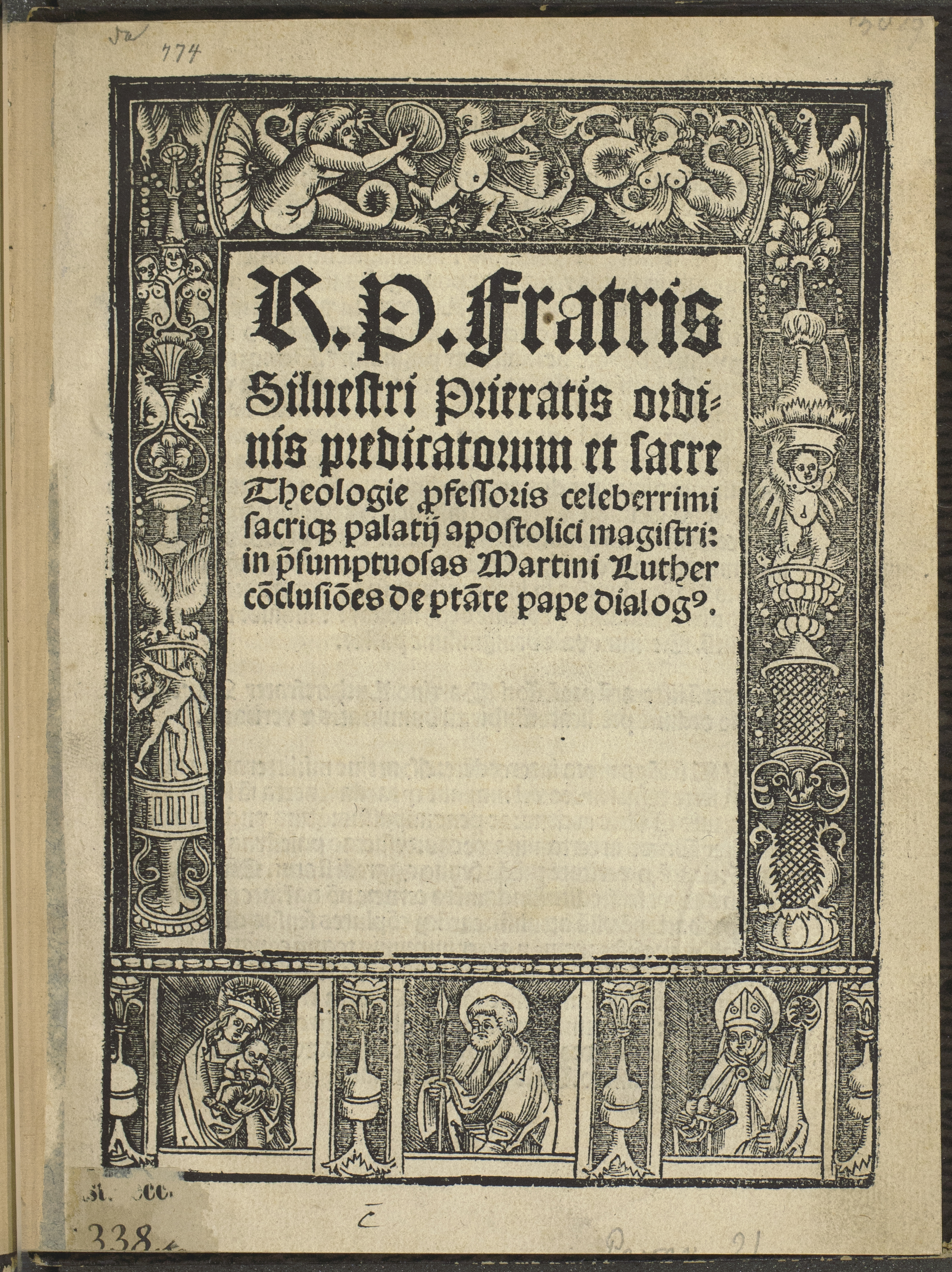
TextR.P. Fratris Siluestri Prieratis ordinis praedicatorum et sacre Theologie p[ro]fessoris celeberrimi sacriq[ue] palatij apostolici magistri: in p[re]sumptuosas Martini Luther co[n]clusio[n]es de p[otes]tate pape dialog[us]
Mazzolini, Silvestro, da Prierio, 1456?-1527?Summary: S. Mazzolini was Master of the Sacred Palace (Vatican) in Rome, censor of books, and one of the first Catholic literary opponents of Luther. This is an early printing of the first work issued in opposition to Luther. Where the printing fits in bibliographically is still a matter of dispute. The work is in dialogue form and contains a refutation of Luther's 95 theses.Summary: S. Mazzolini was Master of the Sacred Palace (Vatican) in Rome, censor of books, and one of the first Catholic literary opponents of Luther. This is an early printing of the first work issued in opposition to Luther. Where the printing fits in bibliographically is still a matter of dispute. The work is in dialogue form and contains a refutation of Luther's 95 theses. -
 Text
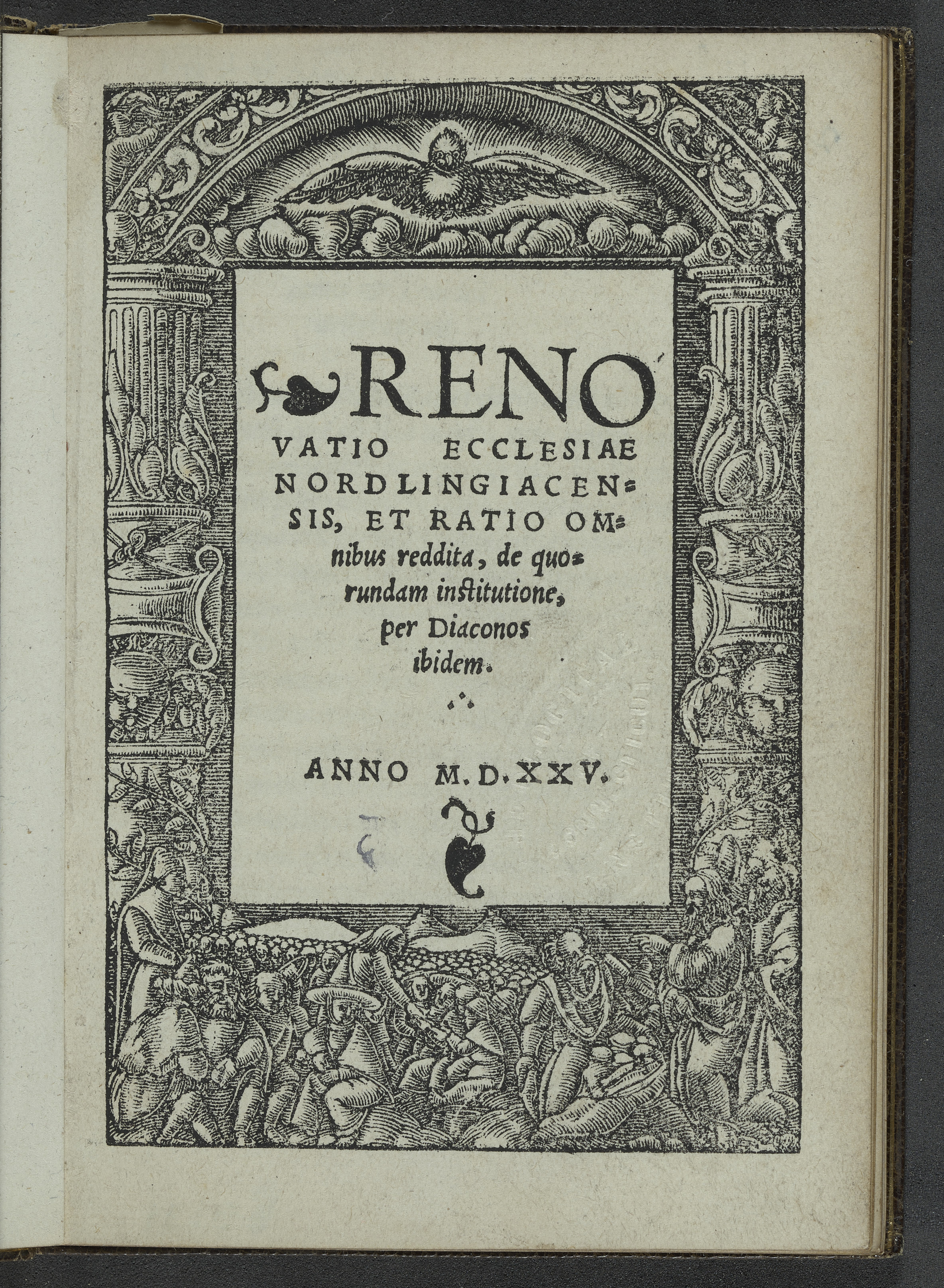
TextRenouatio Ecclesiae Nordlingiacensis, et ratio omnibus reddita, de quorundam institutione
Billican, Theobald, approximately 1490-1554Summary: Theobald Billican was educated at Heidelberg where he became a close friend of Melanchthon. He was drawn to Luther in 1518 when Luther disputed on scholasticism at the University of Heidelberg. This tract on the reformation in Nordlingen attempts to prove that the old "abuses" had been corrected and replaced with "purified" doctrines. Billican consciously constructs his discourse more along Erasmian lines than according to strictly Lutheran models.Summary: Theobald Billican was educated at Heidelberg where he became a close friend of Melanchthon. He was drawn to Luther in 1518 when Luther disputed on scholasticism at the University of Heidelberg. This tract on the reformation in Nordlingen attempts to prove that the old "abuses" had been corrected and replaced with "purified" doctrines. Billican consciously constructs his discourse more along Erasmian lines than according to strictly Lutheran models. -
 Text
TextResolutiones Lutherianae super propositionibus suis Lipsiae disputatis
Luther, Martin, 1483-1546Summary: A clarification of Luther's position regarding the Leipzig disputation, a public debate between the Catholic Johann Eck on the one side and Luther and Andreas Karlstadt on the other. The work is preceded by a long letter to Spalatin, dated 15 Aug., 1519.Summary: A clarification of Luther's position regarding the Leipzig disputation, a public debate between the Catholic Johann Eck on the one side and Luther and Andreas Karlstadt on the other. The work is preceded by a long letter to Spalatin, dated 15 Aug., 1519. -
Text
The Zurich letters : comprising the correspondance of several English bishops and others, with some of the Helvetian reformers, during the early part of the reign of Queen Elizabeth
Robinson, Hastings, 1792?-1866Summary:Summary: -
Text
The Zurich letters : comprising the correspondance of several English bishops and others, with some of the Helvetian reformers, during the early part of the reign of Queen Elizabeth
Robinson, Hastings, 1792?-1866Summary:Summary: -
 Text
TextUrsach vnd anttwortt das iungkfrawe[n] kloster gottlich v[er]lassen muge[n]
Luther, Martin, 1483-1546Summary: The catalyst for this famous Luther letter was the removal by stealth of nine nuns from the cloister of Nimbschen bei Grimma at Easter in the year 1523. Luther names the nine, which include a sister of Johann Staupitz, Luther's father confessor, and Katharina von Bora, who was to become Luther's wife.Summary: The catalyst for this famous Luther letter was the removal by stealth of nine nuns from the cloister of Nimbschen bei Grimma at Easter in the year 1523. Luther names the nine, which include a sister of Johann Staupitz, Luther's father confessor, and Katharina von Bora, who was to become Luther's wife. -
 Text
TextVerba dei : quanto candore & [que] syncere praedicari, quanta[que] solicitudine uniuersi debeant addiscere
Karlstadt, Andreas Rudolff-Bodenstein von,1486-1541.Summary: Only printing of a pamphlet by Karlstadt attacking Johann Eck on issues that emerged during their disputation at Leipzig 1519, in particular the interpretation of scripture and the question of free will and its relation to the grace of God.Summary: Only printing of a pamphlet by Karlstadt attacking Johann Eck on issues that emerged during their disputation at Leipzig 1519, in particular the interpretation of scripture and the question of free will and its relation to the grace of God. -
 Text
TextVerwenung der disputatz zü Zürch
Zwingli, Ulrich, 1484-1531Summary: First edition of a brief report of the first Zurich Disputation followed by the 67 Articles read by Zwingli on January 27, 1523. The 67 Articles are often cited in discussions of Luther's 95 Theses and the Augsburg Confession.Summary: First edition of a brief report of the first Zurich Disputation followed by the 67 Articles read by Zwingli on January 27, 1523. The 67 Articles are often cited in discussions of Luther's 95 Theses and the Augsburg Confession. -
 Text
TextVonn dem Ampt der Fürsten : vnd welcher Gestalt inen das auss Gottes Befelch aufflegen thüe die Abstellung der Missbräuch in den Kirchen
Melanchthon, Philipp, 1497-1560Summary: Tract on the duties and responsibilties of civic leaders, and on the relationship between church and state, first published in Latin a year earlier.Summary: Tract on the duties and responsibilties of civic leaders, and on the relationship between church and state, first published in Latin a year earlier. -
 Text
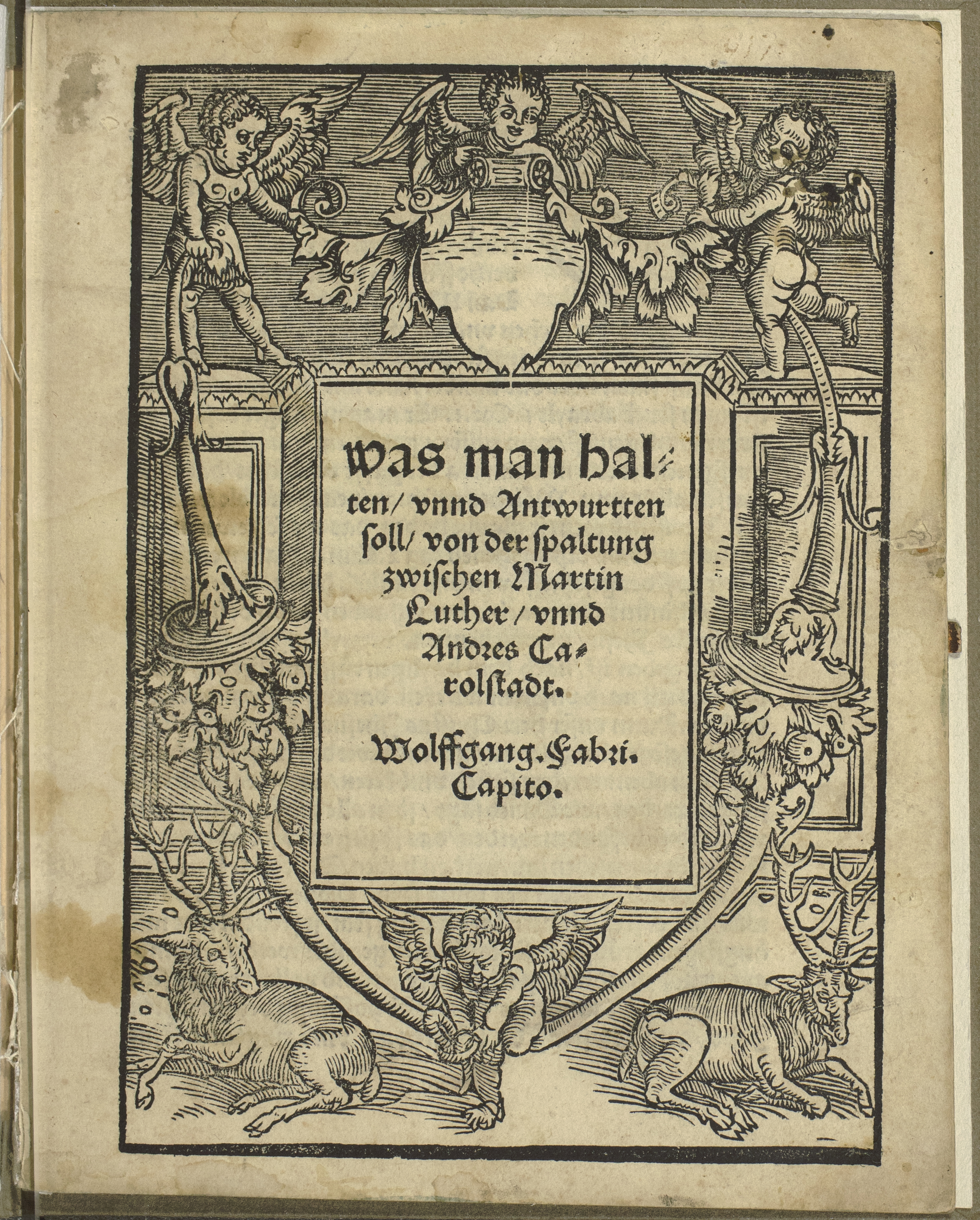
TextWas man halten, vnnd Antwurtten soll, von der spaltung zwischen Martin Luther, vnnd Andres Carolstadt
Capito, Wolfgang, 1478-1541Summary:Summary: -
 Text
TextWes sich D. Martinus Luther. etc. mit Huldrich Zwinglin. etc. der streitigen Articulen halb, vereynet vnd verglichen auff der Conuocation zu[o] Marpurg, den dritten Tag Octob. Im Jar, M. D. xxix
Colloquy of Marburg (1529)Summary: The Colloquy of Marburg was a meeting arranged at the initiative of Philip of Hessen in an attempt to forge religious unity in Germany and mediate theological differences between Lutherans and Zwinglians. Besides Luther and Zwingli, the meeting was also attended by Johannes Agricola, Johannes Brenz, Martin Bucer, Caspar Hedio, Justus Jonas, Philipp Melanchthon, Johannes Oecolampadius, and Andreas Osiander.Summary: The Colloquy of Marburg was a meeting arranged at the initiative of Philip of Hessen in an attempt to forge religious unity in Germany and mediate theological differences between Lutherans and Zwinglians. Besides Luther and Zwingli, the meeting was also attended by Johannes Agricola, Johannes Brenz, Martin Bucer, Caspar Hedio, Justus Jonas, Philipp Melanchthon, Johannes Oecolampadius, and Andreas Osiander. -
 Text
TextWid' die unselige Auffrure Merten Luders von Wolffgango Wulffer un[d] andern Christgleubige[n] euch zw Wittenberg tzugeschribenn.
Wulffer, Wolfgang, -1538Summary: First printing of a rare pamphlet directed against Martin Luther. Wulffer calls Luther a false prophet and claims that his teachings contain no love, but only self-aggrandizement.Summary: First printing of a rare pamphlet directed against Martin Luther. Wulffer calls Luther a false prophet and claims that his teachings contain no love, but only self-aggrandizement. -
 Text
TextWider den newen Taufforden : notwendige Warnung an alle Christgleubigen
Rhegius, Urbanus, 1489-1541Summary: First and only edition of an important source about the early relations between the Lutheran and Anabaptist movements.Summary: First and only edition of an important source about the early relations between the Lutheran and Anabaptist movements. -
 Text
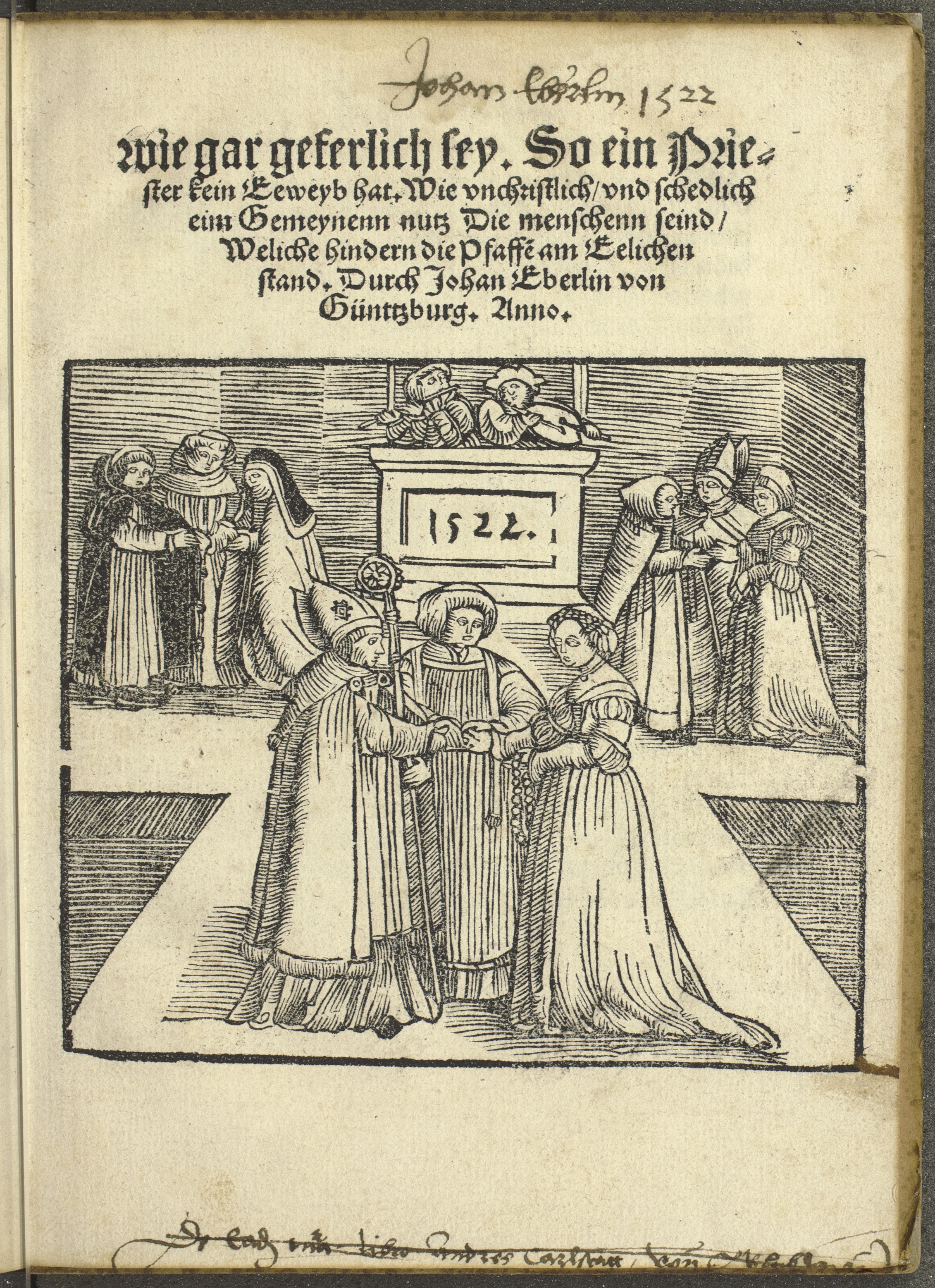
TextWie gar geferlich sey. So ein Priester kein Eeweyb hat : Wie unchristlich, und schedlich eim Gemeynenn nutz die menschenn seind, weliche hindern die Pfaffẽ am Eelichen stand.
Eberlin von Günzburg, Johann, approximately 1470-1533Summary: Johann Eberlin von Günzburg was a former Franciscan who had left the order and joined the Lutheran Reformation in 1521. This is the second edition of his tract on the dangers of priestly celibacy. He himself was married in 1524 and had four children. The title page woodcut shows the wedding of three different priests, including one to a nun.Summary: Johann Eberlin von Günzburg was a former Franciscan who had left the order and joined the Lutheran Reformation in 1521. This is the second edition of his tract on the dangers of priestly celibacy. He himself was married in 1524 and had four children. The title page woodcut shows the wedding of three different priests, including one to a nun. -
 Text
TextWyder den Wittenbergischen Abtgot Martin Luther
Alveldt, Augustin von, active 16th centurySummary: The Franciscan Augustine of Alveldt wrote this polemical tract in response to Luther's pamphlet "Widder den newen Abgott und alten Teuffel" which criticized the recent canonization of Bishop Benno of Mainz.Summary: The Franciscan Augustine of Alveldt wrote this polemical tract in response to Luther's pamphlet "Widder den newen Abgott und alten Teuffel" which criticized the recent canonization of Bishop Benno of Mainz. -
 Text
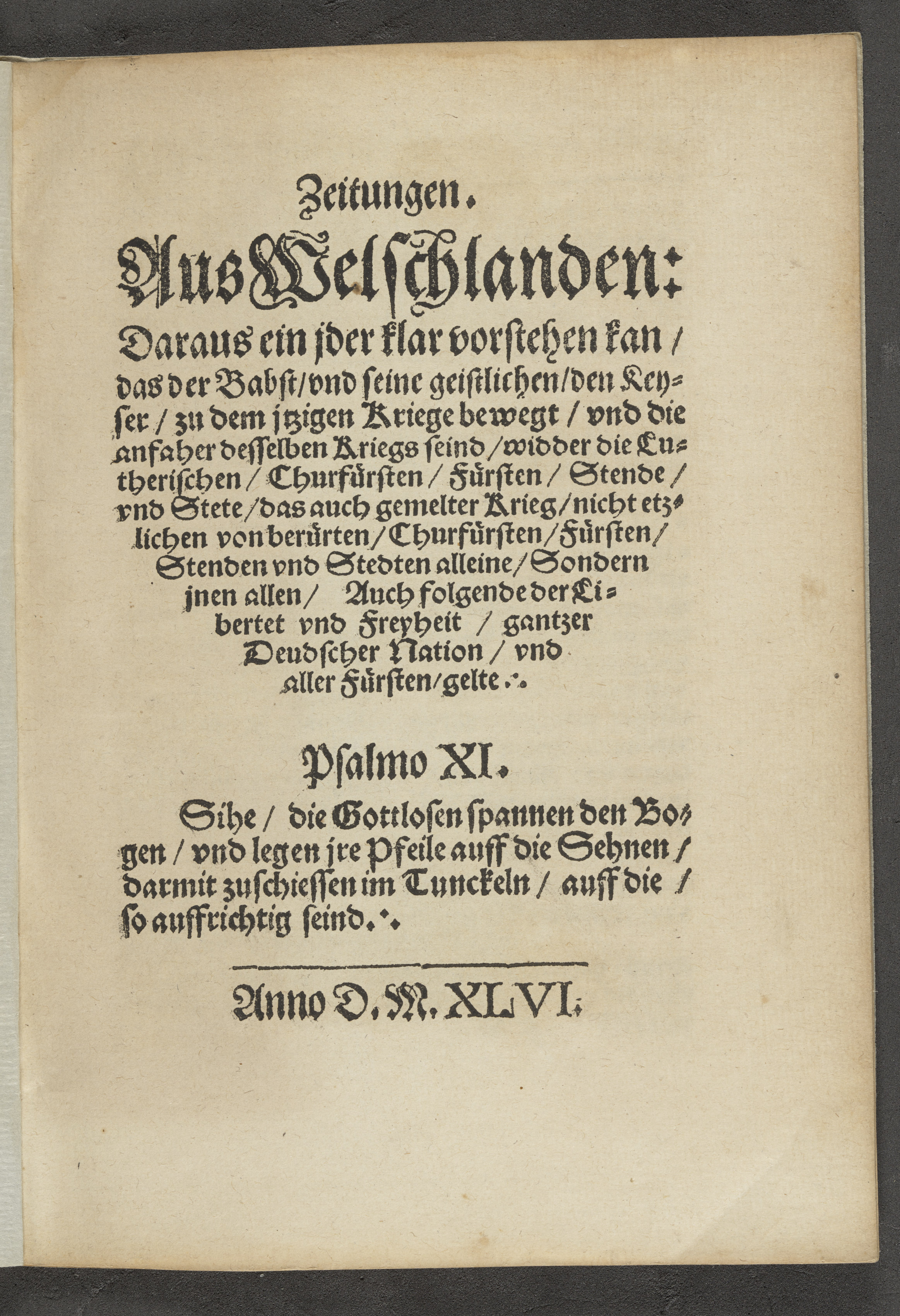
TextZeitungen aus Welschlanden : daraus ein jder klar vorstehen kan, das der Babst vnd seine geistlichen den Keyser zu dem jtzigen Kriege bewegt ...
Summary: Early "newspaper/editorial" accusing the Pope and the Roman clergy of being the true instigators of the Schmalkald War.Summary: Early "newspaper/editorial" accusing the Pope and the Roman clergy of being the true instigators of the Schmalkald War. -
 Text
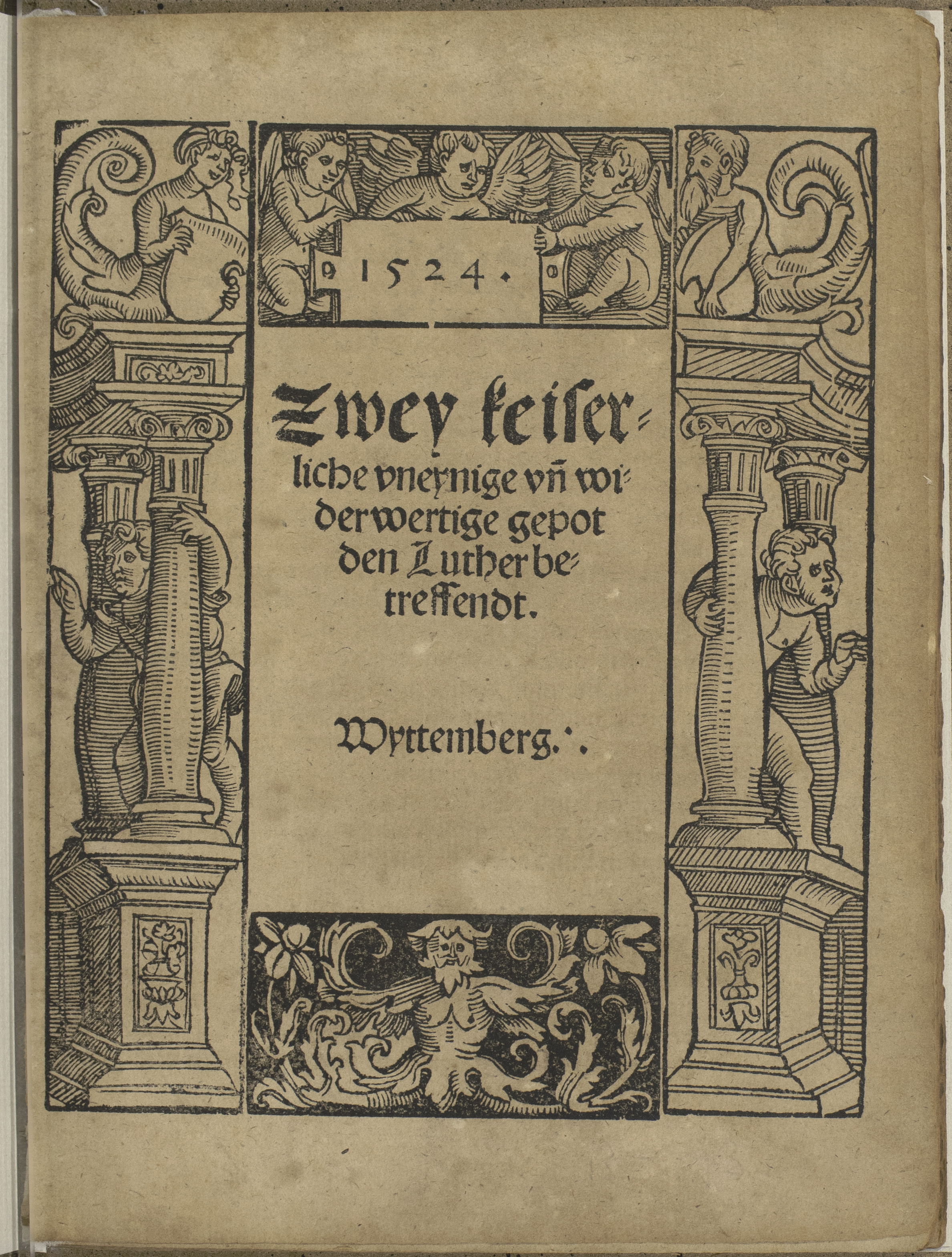
TextZwey keiserliche vneynige vn[d] widerwertige gepot den Luther betreffendt.
Holy Roman Empire. Emperor (1519-1556 : Charles V)Summary: The diet of Nuremberg in 1524 reaffirmed the imperial ban of Luther's person expressed in the edict of Worms, but not the condemnation of his teachings, which were to be addressed at the diet of Speyer. Luther issued both the edict of Worms and the resolutions of the diet of Nuremberg along with his own foreward and comments, in which he calls the emperor a "mad, irrational, senseless, raving and insane fool".Summary: The diet of Nuremberg in 1524 reaffirmed the imperial ban of Luther's person expressed in the edict of Worms, but not the condemnation of his teachings, which were to be addressed at the diet of Speyer. Luther issued both the edict of Worms and the resolutions of the diet of Nuremberg along with his own foreward and comments, in which he calls the emperor a "mad, irrational, senseless, raving and insane fool".