Search
125 resources
125 items
Folio
-
![A depiction of seven notable scholars (real and mythological) from ancient Greece and Rome, including (clockwise from the bottom left): Xenokrates (ΞΕΝΟΚΡΑΤΗς), Pamphilos (ΠΑΜΦΙΛΟς), Machaon (ΜΑΧΑωΝ), Cheiron (ΧΕΙΡωΝ), Nigros or Niger (ΝΙΓΡΟς), [H]erakleides (ΗΡΑΚΛΕΙΔΗς), and Mantias (ΜΑΝΤΙΑς).](https://s3.us-west-2.amazonaws.com/omekacloud-main/large/P_300000109044_P001x/1665LAMB-V2_300000109044_P001x.jpg) Still image
Still imageA Gathering of Greco-Roman Scholars
A depiction of seven notable scholars (real and mythological) from ancient Greece and Rome, including (clockwise from the bottom left): Xenokrates (ΞΕΝΟΚΡΑΤΗς), Pamphilos (ΠΑΜΦΙΛΟς), Machaon (ΜΑΧΑωΝ), Cheiron (ΧΕΙΡωΝ), Nigros or Niger (ΝΙΓΡΟς), [H]erakleides (ΗΡΑΚΛΕΙΔΗς), and Mantias (ΜΑΝΤΙΑς).A depiction of seven notable scholars (real and mythological) from ancient Greece and Rome, including (clockwise from the bottom left): Xenokrates (ΞΕΝΟΚΡΑΤΗς), Pamphilos (ΠΑΜΦΙΛΟς), Machaon (ΜΑΧΑωΝ), Cheiron (ΧΕΙΡωΝ), Nigros or Niger (ΝΙΓΡΟς), [H]erakleides (ΗΡΑΚΛΕΙΔΗς), and Mantias (ΜΑΝΤΙΑς). -
 Still image
Adam and Eve after eating from the Tree of Knowledge
Baldung, Hans, -1545A woodcut decorating the title page of Johan Geiler von Kayersberg's Seelen Paradiss. The woodcut depicts Adam and Eve in the Garden of Eden just after having eaten the fruit of the Tree of Knowledge of Good and Evil. They are shown covering themselves, each holding an apple while God looks on. In the bottom right of the scene, an angel carrying a sword guards the gate to the garden.A woodcut decorating the title page of Johan Geiler von Kayersberg's Seelen Paradiss. The woodcut depicts Adam and Eve in the Garden of Eden just after having eaten the fruit of the Tree of Knowledge of Good and Evil. They are shown covering themselves, each holding an apple while God looks on. In the bottom right of the scene, an angel carrying a sword guards the gate to the garden. -
 Still image
Adrianus VI Papa Traiectensis Belga
Soye, Philippe deAn engraved portrait of Pope Adrian VI, who sat as pope from 1522-1523. The portrait shows Adrian VI wearing elaborate vestments with his coat of arms featured in the upper left corner. The portrait is labeled "ADRIANVS. VI. PAPA. TRAIECTENSIS. BELGA".An engraved portrait of Pope Adrian VI, who sat as pope from 1522-1523. The portrait shows Adrian VI wearing elaborate vestments with his coat of arms featured in the upper left corner. The portrait is labeled "ADRIANVS. VI. PAPA. TRAIECTENSIS. BELGA". -
 Still image
Alexander V Papa Cretensis Graecus
Soye, Philippe deAn engraved portrait of Antipope Alexander V, who was elected by the Council of Pisa during the Western Schism and held the office from 1409-1410. The portrait shows Alexander V wearing a papal miter with his coat of arms featured in the upper left corner. The portrait is labeled "ALEXANDER. V. PAPA. CRETENSIS. GRÆCVS".An engraved portrait of Antipope Alexander V, who was elected by the Council of Pisa during the Western Schism and held the office from 1409-1410. The portrait shows Alexander V wearing a papal miter with his coat of arms featured in the upper left corner. The portrait is labeled "ALEXANDER. V. PAPA. CRETENSIS. GRÆCVS". -
 Still image
Alexander VI Papa Valentinus Hisp.
Soye, Philippe deAn engraved portrait of Pope Alexander VI, who sat as pope from 1492-1503. The portrait shows Alexander VI wearing simple vestments with his coat of arms featured in the upper right corner. The portrait is labeled "ALEXANDER. VI. PAPA. VALENTINVS. HISP".An engraved portrait of Pope Alexander VI, who sat as pope from 1492-1503. The portrait shows Alexander VI wearing simple vestments with his coat of arms featured in the upper right corner. The portrait is labeled "ALEXANDER. VI. PAPA. VALENTINVS. HISP". -
 Still image
Altar of Burnt Offerings and Bronze Laver
Cranach, Lucas, 1472-1553A woodcut depicting the bronze laver for priestly washing (top), the altar of burnt offering made of acacia wood with four horns on its four corners (center), and the bronze implements for tending the altar (bottom).A woodcut depicting the bronze laver for priestly washing (top), the altar of burnt offering made of acacia wood with four horns on its four corners (center), and the bronze implements for tending the altar (bottom). -
 Text
TextAn Account of the reasons of the nobility and gentry's invitation of His Highness the Prince of Orange into England : being a memorial from the English Protestants concerning their grievances : with a large account of the birth of the Prince of Wales
Summary: An appeal by Protestants to William III and Mary II to recognize the grievances of Protestants against Catholicism.Summary: An appeal by Protestants to William III and Mary II to recognize the grievances of Protestants against Catholicism. -
 Still image
Ark of the Covenant and Altar of Incense
Cranach, Lucas, 1472-1553A woodcut depicting the Ark of the Covanent with its lid decorated with two cherubim, and the Altar of Incense with a chalice of burning incense placed on it.A woodcut depicting the Ark of the Covanent with its lid decorated with two cherubim, and the Altar of Incense with a chalice of burning incense placed on it. -
 Text
TextAuslegung der Episteln vnd Euangelien vom Advent an, bis auff Ostern
Luther, Martin, 1483-1546Summary: Luther certainly had his problems with printers, as this edition of his "Winter Postil" testifies. Michael Lotter issued this new edition without Luther's approval. The editors took great labors, but found no favor in Wittenberg, and this edition was never reprinted.Summary: Luther certainly had his problems with printers, as this edition of his "Winter Postil" testifies. Michael Lotter issued this new edition without Luther's approval. The editors took great labors, but found no favor in Wittenberg, and this edition was never reprinted. -
 Text
TextBasilicae s. Mariae Maioris de Urbe a Liberio Papa I usque ad Paulum V Pont. Max. descriptio et delinatio
De Angelis, Paolo, 1580-1647Summary: Important description of S. Maria Maggiore in its unaltered Renaissance state, before extensive renovations of Ferdinand Fuga in 1743.Summary: Important description of S. Maria Maggiore in its unaltered Renaissance state, before extensive renovations of Ferdinand Fuga in 1743. -
 Still image
Bonifacius IX Papa Neapolitanus
Soye, Philippe deAn engraved portrait of Pope Boniface IX, who sat as pope from 1389-1404. The portrait shows Boniface IX wearing a papal miter with his coat of arms featured in the upper left corner. The portrait is labeled "BONIFACIVS. IX. PAPA. NEAPOLITANVS".An engraved portrait of Pope Boniface IX, who sat as pope from 1389-1404. The portrait shows Boniface IX wearing a papal miter with his coat of arms featured in the upper left corner. The portrait is labeled "BONIFACIVS. IX. PAPA. NEAPOLITANVS". -
 Text
TextBreuis et pia explicatio in librum Josuae
Brenz, Johannes, 1499-1570Summary: Johannes Brenz's commentary on the book of Joshua, first published in 1549.Summary: Johannes Brenz's commentary on the book of Joshua, first published in 1549. -
 Still image
Calixtus III Papa Valentinus Hispanus
Soye, Philippe deAn engraved portrait of Pope Callistus III, who sat as pope from 1455-1458. The portrait shows Callistus III wearing elaborate vestments with his coat of arms featured in the upper right corner. The portrait is labeled "CALIXTVS. III. PAPA. VALENTINVS. HISPANVS".An engraved portrait of Pope Callistus III, who sat as pope from 1455-1458. The portrait shows Callistus III wearing elaborate vestments with his coat of arms featured in the upper right corner. The portrait is labeled "CALIXTVS. III. PAPA. VALENTINVS. HISPANVS". -
 Still image
Christ in Glory
Cranach, Lucas, 1472-1553A woodcut depicting Saint John the Apostle's vision from the first chapter of Revelations of a Christ with flaming eyes, surrounded by seven candlesticks and holding seven stars, with a sword emerging from his mouth. The image appears in the September Testament, Martin Luther's first printing of his German New Testament.A woodcut depicting Saint John the Apostle's vision from the first chapter of Revelations of a Christ with flaming eyes, surrounded by seven candlesticks and holding seven stars, with a sword emerging from his mouth. The image appears in the September Testament, Martin Luther's first printing of his German New Testament. -
 Text
TextChrysopassus
Eck, Johann, 1486-1543Summary: A significant treatise on predestination. Johann Eck expounds a view of free will and merit, which was soon to come under attack by Martin Luther and other Protestants.Summary: A significant treatise on predestination. Johann Eck expounds a view of free will and merit, which was soon to come under attack by Martin Luther and other Protestants. -
 Still image
Clemens VII Papa Florentinus
Soye, Philippe deAn engraved portrait of Pope Clement VII, who sat as pope from 1523-1534. The portrait shows Clement VII wearing a simple miter and vestments with his coat of arms featured in the upper right corner. The portrait is labeled "CLEMENS. VII. PAPA. FLORENTINVS".An engraved portrait of Pope Clement VII, who sat as pope from 1523-1534. The portrait shows Clement VII wearing a simple miter and vestments with his coat of arms featured in the upper right corner. The portrait is labeled "CLEMENS. VII. PAPA. FLORENTINVS". -
![A woodcut version of Johann Reuchlin's coat of arms, featured on the title page of his work De arte cabalistica. The coat of arms includes a shield featuring an altar inscribed with "ARACAPNIONIS" (Ara Capnionis, the "altar of Capnion [Reuchlin]"), topped with burning coals, and encircled with three twisted ropes or garlands. Set atop the shield is a helmet with a cross inscribed on the neck, crowned with another three twisted ropes or garlands and a quartered wheel. Surrounding both helmet and shield are stylized vegitation.](https://s3.us-west-2.amazonaws.com/omekacloud-main/large/P_300000152440_P003/P_300000152440_P003_PROD.jpg) Still image
Still imageCoat of Arms of Johann Reuchlin
A woodcut version of Johann Reuchlin's coat of arms, featured on the title page of his work De arte cabalistica. The coat of arms includes a shield featuring an altar inscribed with "ARACAPNIONIS" (Ara Capnionis, the "altar of Capnion [Reuchlin]"), topped with burning coals, and encircled with three twisted ropes or garlands. Set atop the shield is a helmet with a cross inscribed on the neck, crowned with another three twisted ropes or garlands and a quartered wheel. Surrounding both helmet and shield are stylized vegitation.A woodcut version of Johann Reuchlin's coat of arms, featured on the title page of his work De arte cabalistica. The coat of arms includes a shield featuring an altar inscribed with "ARACAPNIONIS" (Ara Capnionis, the "altar of Capnion [Reuchlin]"), topped with burning coals, and encircled with three twisted ropes or garlands. Set atop the shield is a helmet with a cross inscribed on the neck, crowned with another three twisted ropes or garlands and a quartered wheel. Surrounding both helmet and shield are stylized vegitation. -
 Text
TextCristianus ad solitariu[m] quendam De ymagine mundi : Honorio.
Honorius, of Autun, approximately 1080-approximately 1156Summary:Summary: -
 Text
TextDas Allte Testament deutsch
Summary: This is the first printing of the first part of Luther's translation of the Old Testament into idiomatic German. It comprises the Pentateuch, or the five Books of Moses. Scholars long believed that this edition had been destroyed by Luther's friends because of its many printing errors. This printing contains 11 full-page and six initial-figure woodcuts. The volume has been heavily annotated in an early to mid-sixteenth century hand.Summary: This is the first printing of the first part of Luther's translation of the Old Testament into idiomatic German. It comprises the Pentateuch, or the five Books of Moses. Scholars long believed that this edition had been destroyed by Luther's friends because of its many printing errors. This printing contains 11 full-page and six initial-figure woodcuts. The volume has been heavily annotated in an early to mid-sixteenth century hand. -
 Text
TextDas Newe Testament Deůtzsch
Summary: Luther's translation from the original Greek of the New Testament is a landmark in the history of the German language. His forceful style ensured that his Thuringian-Saxon dialect would provide the standard for High German in years to come. From a religious standpoint, Luther's decision to refer to the original Greek rather than merely to translate the Vulgate ensured that the German New Testament would be much more faithful to the original. Erasmus' New Testament provided the basis for the translation.Summary: Luther's translation from the original Greek of the New Testament is a landmark in the history of the German language. His forceful style ensured that his Thuringian-Saxon dialect would provide the standard for High German in years to come. From a religious standpoint, Luther's decision to refer to the original Greek rather than merely to translate the Vulgate ensured that the German New Testament would be much more faithful to the original. Erasmus' New Testament provided the basis for the translation. -
 Text
TextDecades rerum Venetarum
Sabellico, 1436?-1506Summary: A history of Venice.Summary: A history of Venice. -
 Still image
Dedication to Aubertus van den Eede, Bishop of Antwerp
The dedication page of Diego de Saavedra Fajardo's Obras de Don Diego de Saauedra Faxardo Cavallero del Orden de S. Iago, del Consejo de su Magestad en el Supremo de las Indias, y su Embajador plenipotençiario en los treze cantones, &c. : en dos tomos divididas, el primero contiene I. Idea de un principe politico christiano, representada en cien Empresas, honoring Aubertus van den Eede, the Bishop of Antwerp. The bishop's coat of arms is included at the top of the page, featuring a quartered crest and topped with a galero.The dedication page of Diego de Saavedra Fajardo's Obras de Don Diego de Saauedra Faxardo Cavallero del Orden de S. Iago, del Consejo de su Magestad en el Supremo de las Indias, y su Embajador plenipotençiario en los treze cantones, &c. : en dos tomos divididas, el primero contiene I. Idea de un principe politico christiano, representada en cien Empresas, honoring Aubertus van den Eede, the Bishop of Antwerp. The bishop's coat of arms is included at the top of the page, featuring a quartered crest and topped with a galero. -
 Still image
Die eigentliche warhafftige gestalt der Erden und des [...]
A map of the world including Europe, Africa ("Der schwarzen Moren Land"), Asia (Major), America ("Die Newe Welt"), and India Meridionalis (a so called "phantom" peninsula that was often depicted in Medieval and Rennaissance maps). A number of monstrous sea creatures are depicted in the various oceans and seas.A map of the world including Europe, Africa ("Der schwarzen Moren Land"), Asia (Major), America ("Die Newe Welt"), and India Meridionalis (a so called "phantom" peninsula that was often depicted in Medieval and Rennaissance maps). A number of monstrous sea creatures are depicted in the various oceans and seas. -
 Still image
Die ganze Welt in einem [K]leberblat Welches [...] meines lieben Vaterlandes [W]apen
A map of the world including Europe, Africa, and Asia as three leaf or petal shaped continents with America ("Die Newe Welt") draw in the bottom left corner. A ship and numerous sea creatures are depicted in the oceans.A map of the world including Europe, Africa, and Asia as three leaf or petal shaped continents with America ("Die Newe Welt") draw in the bottom left corner. A ship and numerous sea creatures are depicted in the oceans. -
 Text
TextDis schön Buch gena[n]t der Seelen Paradiss : von waren und volkumen Tugenden sagend
Geiler von Kaysersberg, Johann, 1445-1510Summary: Collection of sermons by the Alsatian preacher Geiler von Kaysersberg, delivered between 1503 and 1505 at the convent of the sisters of the order of St. Mary Magdalene. Geiler was one of the most popular preachers of his day and was sometimes called the German Savonarola. He was a close friend of the Strasbourg humanist Jakob von Wimpheling and was greatly respected by Sebastian Brant, Johann Reuchlin and Philipp Melanchthon.Summary: Collection of sermons by the Alsatian preacher Geiler von Kaysersberg, delivered between 1503 and 1505 at the convent of the sisters of the order of St. Mary Magdalene. Geiler was one of the most popular preachers of his day and was sometimes called the German Savonarola. He was a close friend of the Strasbourg humanist Jakob von Wimpheling and was greatly respected by Sebastian Brant, Johann Reuchlin and Philipp Melanchthon. -

-
 Still image
Eugenius IIII Papa Venetus
Soye, Philippe deAn engraved portrait of Pope Eugene IV, who sat as pope from 1431-1447. The portrait shows Eugene IV wearing a simple miter with his coat of arms featured in the upper right corner. The portrait is labeled "EVGENIVS. IIII. PAPA. VENETVS".An engraved portrait of Pope Eugene IV, who sat as pope from 1431-1447. The portrait shows Eugene IV wearing a simple miter with his coat of arms featured in the upper right corner. The portrait is labeled "EVGENIVS. IIII. PAPA. VENETVS". -
 Text
TextEusebium Pamphili De euangelica praeparatione latinum ex graeco beatissime pater iussu tuo effeci...
Eusebius, of Caesarea, Bishop of Caesarea, approximately 260-approximately 340Summary:Summary: -
![Summary: One of four volumes of a 1497 printing of Jerome's commentaries on the Old Testament. This particular volume comprises the prophetic books Isaiah, Jeremiah, Ezekiel, Daniel as well as the 12 minor prophets. It is unique insofar as not all parts of the larger set were bound in the same order or based on the same divisions. It was that was once held by the library of Rebdorf monastery, which developed a renown humanist collection during the tenure of Kilian Leib as the monastery's prior. Signatures: (1,3)(4,5)⁶, A-R⁸, T-Z, AA, BB8, CC6, DD-HH DDD, EEE8, FFF-HHH, DDDD-GGGG6, HHHH4, II8, KK-LL6, a-c8, d10, e8, f6, g-h10, i8, k6, l-y6, x8, y6 [Verify signatures]. Signatures in g run gi-iii, g⁴, giiii. Signature which should be Mii is Nii. L. 194b blank.](https://s3.us-west-2.amazonaws.com/omekacloud-main/large/P_300000491809/P_300000491809_P001.jpg) Text
TextExpositiones Diui Hieronimi in Hebraicas : questiones super Genesim necnon super duodecim Prophetas minores et quatuor maiores nouiter impresse cum priuilegio
Jerome, Saint, -419 or 420Summary: One of four volumes of a 1497 printing of Jerome's commentaries on the Old Testament. This particular volume comprises the prophetic books Isaiah, Jeremiah, Ezekiel, Daniel as well as the 12 minor prophets. It is unique insofar as not all parts of the larger set were bound in the same order or based on the same divisions. It was that was once held by the library of Rebdorf monastery, which developed a renown humanist collection during the tenure of Kilian Leib as the monastery's prior.Summary: One of four volumes of a 1497 printing of Jerome's commentaries on the Old Testament. This particular volume comprises the prophetic books Isaiah, Jeremiah, Ezekiel, Daniel as well as the 12 minor prophets. It is unique insofar as not all parts of the larger set were bound in the same order or based on the same divisions. It was that was once held by the library of Rebdorf monastery, which developed a renown humanist collection during the tenure of Kilian Leib as the monastery's prior. -
 Still image
Felix IIII Dictus V Dux Sabaudiae
Soye, Philippe deAn engraved portrait of Antipope Felix V, who was elected by the Council of Basel-Ferrara-Florence and held the office from 1439-1449. The portrait shows Felix V wearing a papal miter with his coat of arms featured in the upper left corner. The portrait is labeled "FELIX. IIII. DICTVS. V. DVX. SABAVDIAE".An engraved portrait of Antipope Felix V, who was elected by the Council of Basel-Ferrara-Florence and held the office from 1439-1449. The portrait shows Felix V wearing a papal miter with his coat of arms featured in the upper left corner. The portrait is labeled "FELIX. IIII. DICTVS. V. DVX. SABAVDIAE". -
 Still image
Four Horsemen of the Apocalypse
Cranach, Lucas, 1472-1553A woodcut depicting the Four Horsemen of the Apocalypse: the first, a conquerer with a crown and bow, the second, with a sword, tasked with taking peace from the earth, the third holding scales, and the fourth, Death itself. The image appears in the September Testament, Martin Luther's first printing of his German New Testament.A woodcut depicting the Four Horsemen of the Apocalypse: the first, a conquerer with a crown and bow, the second, with a sword, tasked with taking peace from the earth, the third holding scales, and the fourth, Death itself. The image appears in the September Testament, Martin Luther's first printing of his German New Testament. -
 Still image
Frontispiece of Leviathan, or, The matter, forme, & power of a common-wealth ecclesiasticall and civill
Bosse, Abraham, 1602-1676The frontispiece of Thomas Hobbes' Leviathan, or, The matter, forme, & power of a common-wealth ecclesiasticall and civill, the upper portion of which features a large figure representing sovreign authority. The figure's body is composed of individual citizens, is crowned, and holds a sword and crosier. The figure looms over a set of rolling hills in the background and a city in the foreground.The frontispiece of Thomas Hobbes' Leviathan, or, The matter, forme, & power of a common-wealth ecclesiasticall and civill, the upper portion of which features a large figure representing sovreign authority. The figure's body is composed of individual citizens, is crowned, and holds a sword and crosier. The figure looms over a set of rolling hills in the background and a city in the foreground. -
 Still image
Gregorius XII Papa Venetus
Soye, Philippe deAn engraved portrait of Pope Gregory XII, who sat as pope from 1406-1415. The portrait shows Gregory XII wearing a simple miter with his coat of arms featured in the upper left corner. The portrait is labeled "GREGORIVS. XII. PAPA. VENETVS".An engraved portrait of Pope Gregory XII, who sat as pope from 1406-1415. The portrait shows Gregory XII wearing a simple miter with his coat of arms featured in the upper left corner. The portrait is labeled "GREGORIVS. XII. PAPA. VENETVS". -
 Still image
Historiated title page border of Basilicae s. Mariae Maioris di Urbe a Liberio Papa I usque ad Paulum V Pont. Max. descriptio et delinatio
An engraved border for the title page of Paolo di Angelis' Basilicae s. Mariae Maioris di Urbe a Liberio Papa I usque ad Paulum V Pont. Max. descriptio et delinatio printed in 1621. The border consists of a single print with several scenes pertaining to the veneration of and maricles of the Virgin Mary. The top of the border depicts angels and cherubs flanking a depiction of the Virgin Mary with Christ. In the center of the engraving, below the title, is a scene of St. Gregory I the Great leading a crowd in worship as a depiction of Mary is brought forward.An engraved border for the title page of Paolo di Angelis' Basilicae s. Mariae Maioris di Urbe a Liberio Papa I usque ad Paulum V Pont. Max. descriptio et delinatio printed in 1621. The border consists of a single print with several scenes pertaining to the veneration of and maricles of the Virgin Mary. The top of the border depicts angels and cherubs flanking a depiction of the Virgin Mary with Christ. In the center of the engraving, below the title, is a scene of St. Gregory I the Great leading a crowd in worship as a depiction of Mary is brought forward. -
 Still image
Historiated title page border of Luther's German translation of the Old Testament
Lemberger, Georg, 1495?-1540?A woodcut border to Luther's German translation of the Old Testament printed in 1523. The border is composed of one woodcut depicting an architectural arch supported by four columns, a gathering of cherubs (top and sides), and a group of worshipers (?) around a crucified Christ (bottom).A woodcut border to Luther's German translation of the Old Testament printed in 1523. The border is composed of one woodcut depicting an architectural arch supported by four columns, a gathering of cherubs (top and sides), and a group of worshipers (?) around a crucified Christ (bottom). -
 Still image
Historiated title page border of Onuphrii Panuinii Veronensis Fratris Eremitae Augustiniani. XXVII. Pontificum Maximorum elogia et imagines
Soye, Philippe deAn engraved title page to Onuphrii Panuinii Veronensis Fratris Eremitae Augustiniani. XXVII. Pontificum Maximorum elogia et imagines. The engraving depicts a sculpted building facade including a base with two coats of arms and an illustration of a stork standing before a desert city (bottom); two columns with a two coats of arms and four icons featuring a peacock, anvil, burning barrel, and an obelisk (sides); and at the top, two papal crests flanking a woman holding a cross and the Keys of Heaven, while above her is a dove representing the Holy Spirit.An engraved title page to Onuphrii Panuinii Veronensis Fratris Eremitae Augustiniani. XXVII. Pontificum Maximorum elogia et imagines. The engraving depicts a sculpted building facade including a base with two coats of arms and an illustration of a stork standing before a desert city (bottom); two columns with a two coats of arms and four icons featuring a peacock, anvil, burning barrel, and an obelisk (sides); and at the top, two papal crests flanking a woman holding a cross and the Keys of Heaven, while above her is a dove representing the Holy Spirit. -
 Still image
Historiated title page of De Biblie
Altdorfer, Erhard, approximately 1480-approximately 1570The title page of Martin Luther's Low German translation of the Bible featuring a collection of biblical scenes and symbols based on Lucas Cranach the Elder's painting, "Law and Gospel" (or "Sin and Redemption"). On the left of the image are scenes representing Law/Sin, including: a dead tree, Moses receiving the Ten Commandments, Adam and Eve, the brazen serpent, and a corpse lying atop a tomb.The title page of Martin Luther's Low German translation of the Bible featuring a collection of biblical scenes and symbols based on Lucas Cranach the Elder's painting, "Law and Gospel" (or "Sin and Redemption"). On the left of the image are scenes representing Law/Sin, including: a dead tree, Moses receiving the Ten Commandments, Adam and Eve, the brazen serpent, and a corpse lying atop a tomb. -
![The title page of Thomas Netter's Doctrinalis antiquitatu[m] ecclesiae Iesu Christi liber quintus, ac tomus secundus de sacramentis, editus in Vvitcleffistas, & eoru[m] asseclas featuring a central image of a printer's workshop with two men operating the press and a third arranging type. A decorative border surrounds the title and cetral image, including several cherubs, stylized fish, sirens, and armor.](https://s3.us-west-2.amazonaws.com/omekacloud-main/large/P_300000098790_P00X/1521NETT_300000098790_P00X.jpg) Still image
Still imageHistoriated title page of Doctrinalis antiquitatu[m] ecclesiae Iesu Christi liber quintus, ac tomus secundus de sacramentis, editus in Vvitcleffistas, & eoru[m] asseclas
The title page of Thomas Netter's Doctrinalis antiquitatu[m] ecclesiae Iesu Christi liber quintus, ac tomus secundus de sacramentis, editus in Vvitcleffistas, & eoru[m] asseclas featuring a central image of a printer's workshop with two men operating the press and a third arranging type. A decorative border surrounds the title and cetral image, including several cherubs, stylized fish, sirens, and armor.The title page of Thomas Netter's Doctrinalis antiquitatu[m] ecclesiae Iesu Christi liber quintus, ac tomus secundus de sacramentis, editus in Vvitcleffistas, & eoru[m] asseclas featuring a central image of a printer's workshop with two men operating the press and a third arranging type. A decorative border surrounds the title and cetral image, including several cherubs, stylized fish, sirens, and armor. -
 Still image
Historiated title page of Johann Eck's Chrysopassus
A woodcut title page to Johann Eck's Chrysopassus, printed in 1514. The main image depicts God, flanked by angels, reaching down to place a crown on the head of Jacob as his twin brother, Esau, looks on. A dog is seated at Esau's feet. Surrounding the central image is an architectural border featuring the coat of arms of the Holy Roman Emperor in the top left, and the symbol of the city of Augsburg, a pine cone, in the top right.A woodcut title page to Johann Eck's Chrysopassus, printed in 1514. The main image depicts God, flanked by angels, reaching down to place a crown on the head of Jacob as his twin brother, Esau, looks on. A dog is seated at Esau's feet. Surrounding the central image is an architectural border featuring the coat of arms of the Holy Roman Emperor in the top left, and the symbol of the city of Augsburg, a pine cone, in the top right. -
![The title page of Kirche[n] Gesäng : aus dem Wittenbergischen vnd allen andern den besten Gesangbüchern, so biss anhero hin vnd wider aussgangen colligirt vnd gesamlet ; In eine feine richtige vnd gute ordnung gebracht, vnd auffs fleissigest, vnd nach den besten exempla, including a frame with several scenes from the New Testament. The scenes include: the nativity (top), Jesus teaching and healing (top left), Jesus praying in the Garden of Gethsemane and the crucifixion (bottom left), the resurrection (top right), and Pentecost (bottom right). Decorative elements of the frame include cherubs, plants, scrollwork, and an eagle.](https://s3.us-west-2.amazonaws.com/omekacloud-main/large/P_300000363853_P00X/1569KIRC_300000363853_P00X.jpg) Still image
Still imageHistoriated title page of Kirche[n] Gesäng : aus dem Wittenbergischen vnd allen andern den besten Gesangbüchern, so biss anhero hin vnd wider aussgangen colligirt vnd gesamlet ; In eine feine richtige vnd gute ordnung gebracht, vnd auffs fleissigest, vnd nach den besten exempla
The title page of Kirche[n] Gesäng : aus dem Wittenbergischen vnd allen andern den besten Gesangbüchern, so biss anhero hin vnd wider aussgangen colligirt vnd gesamlet ; In eine feine richtige vnd gute ordnung gebracht, vnd auffs fleissigest, vnd nach den besten exempla, including a frame with several scenes from the New Testament. The scenes include: the nativity (top), Jesus teaching and healing (top left), Jesus praying in the Garden of Gethsemane and the crucifixion (bottom left), the resurrection (top right), and Pentecost (bottom right).The title page of Kirche[n] Gesäng : aus dem Wittenbergischen vnd allen andern den besten Gesangbüchern, so biss anhero hin vnd wider aussgangen colligirt vnd gesamlet ; In eine feine richtige vnd gute ordnung gebracht, vnd auffs fleissigest, vnd nach den besten exempla, including a frame with several scenes from the New Testament. The scenes include: the nativity (top), Jesus teaching and healing (top left), Jesus praying in the Garden of Gethsemane and the crucifixion (bottom left), the resurrection (top right), and Pentecost (bottom right). -
![The title page of Diego de Saavedra Fajardo's Obras de Don Diego de Saauedra Faxardo Cavallero del Orden de S. Iago, del Consejo de su Magestad en el Supremo de las Indias, y su Embajador plenipotençiario en los treze cantones, &c. : en dos tomos divididas, el [segundo] contiene II. La republica litteraria. El segundo corona Gothica, Austriaca y Castellana dividida en tres partes featuring the printer's mark of Jan Baptist Verdussen. The mark features a heron feeding its young.](https://s3.us-west-2.amazonaws.com/omekacloud-main/large/P_300000192078_P00X/1681SAAV-V2_300000192078_P00X.jpg) Still image
Still imageHistoriated title page of Obras de Don Diego de Saauedra Faxardo Cavallero del Orden de S. Iago, del Consejo de su Magestad en el Supremo de las Indias, y su Embajador plenipotençiario en los treze cantones, &c. : en dos tomos divididas, el [segundo] contiene II. La republica litteraria. El segundo corona Gothica, Austriaca y Castellana dividida en tres partes
The title page of Diego de Saavedra Fajardo's Obras de Don Diego de Saauedra Faxardo Cavallero del Orden de S. Iago, del Consejo de su Magestad en el Supremo de las Indias, y su Embajador plenipotençiario en los treze cantones, &c. : en dos tomos divididas, el [segundo] contiene II. La republica litteraria. El segundo corona Gothica, Austriaca y Castellana dividida en tres partes featuring the printer's mark of Jan Baptist Verdussen. The mark features a heron feeding its young.The title page of Diego de Saavedra Fajardo's Obras de Don Diego de Saauedra Faxardo Cavallero del Orden de S. Iago, del Consejo de su Magestad en el Supremo de las Indias, y su Embajador plenipotençiario en los treze cantones, &c. : en dos tomos divididas, el [segundo] contiene II. La republica litteraria. El segundo corona Gothica, Austriaca y Castellana dividida en tres partes featuring the printer's mark of Jan Baptist Verdussen. The mark features a heron feeding its young. -
 Still image
Historiated title page of Obras de Don Diego de Saauedra Faxardo Cavallero del Orden de S. Iago, del Consejo de su Magestad en el Supremo de las Indias, y su Embajador plenipotençiario en los treze cantones, &c. : en dos tomos divididas, el primero contiene I. Idea de un principe politico christiano, representada en cien Empresas.
The title page of Diego de Saavedra Fajardo's Obras de Don Diego de Saauedra Faxardo Cavallero del Orden de S. Iago, del Consejo de su Magestad en el Supremo de las Indias, y su Embajador plenipotençiario en los treze cantones, &c. : en dos tomos divididas, el primero contiene I. Idea de un principe politico christiano, representada en cien Empresas featuring the printer's mark of Jan Baptist Verdussen. The mark features a heron feeding its young, flanked by a pair of cherubs holding fruits, with the inscription "SIGNVM AMORIS," translated as "A sign of love."The title page of Diego de Saavedra Fajardo's Obras de Don Diego de Saauedra Faxardo Cavallero del Orden de S. Iago, del Consejo de su Magestad en el Supremo de las Indias, y su Embajador plenipotençiario en los treze cantones, &c. : en dos tomos divididas, el primero contiene I. Idea de un principe politico christiano, representada en cien Empresas featuring the printer's mark of Jan Baptist Verdussen. The mark features a heron feeding its young, flanked by a pair of cherubs holding fruits, with the inscription "SIGNVM AMORIS," translated as "A sign of love." -
 Still image
Historiated title page of Petri Lambecii Hamburgensis Commentariorum de augustissima Bibliotheca Caesarea Vindobonensi liber secundus
The title page of Peter Lambeck's Petri Lambecii Hamburgensis Commentariorum de augustissima Bibliotheca Caesarea Vindobonensi liber secundus featuring the coat of arms of the Holy Roman Empire, guarded from above by an eagle holding a sceptre and a sword. To the left and right of the main coat of arms are an additional two crests, a book and pen, and a helmet.The title page of Peter Lambeck's Petri Lambecii Hamburgensis Commentariorum de augustissima Bibliotheca Caesarea Vindobonensi liber secundus featuring the coat of arms of the Holy Roman Empire, guarded from above by an eagle holding a sceptre and a sword. To the left and right of the main coat of arms are an additional two crests, a book and pen, and a helmet. -
 Text
TextI quattro libri dell'architettura di Andrea Palladio : ne' quali, dopo vn breue trattato de' cinque ordini, & di quelli auertimenti, che sono piu necessarij nel fabricare : si tratta delle cose priuate, delle vie, de' ponti, delle piazze, de' xisti, & de' tempij
Palladio, Andrea, 1508-1580Summary:Summary: -
![An illuminated page from the 1472 printed edition of Honorius of Atun's Cristianus ad solitariu[m] quendam De ymagine mundi. The illumination includes two initial letters "S" accented with floral patterns. The illumination uses blue, green, and red color with gold accents.](https://s3.us-west-2.amazonaws.com/omekacloud-main/large/P_300000154371_P005/P_300000154371_P005_PROD.jpg) Still image
Still imageIlluminated introduction page to Cristianus ad solitaru[m] quendam De ymagine mundi by Honorius of Autun
An illuminated page from the 1472 printed edition of Honorius of Atun's Cristianus ad solitariu[m] quendam De ymagine mundi. The illumination includes two initial letters "S" accented with floral patterns. The illumination uses blue, green, and red color with gold accents.An illuminated page from the 1472 printed edition of Honorius of Atun's Cristianus ad solitariu[m] quendam De ymagine mundi. The illumination includes two initial letters "S" accented with floral patterns. The illumination uses blue, green, and red color with gold accents. -
 Still image
Illuminated introductory Epistola from Sabellico's Decades rerum Venetarum
An illuminated page from the 1487 printing of Sabellico's Decades rerum Venetarum. The illumination includes an initial letter "V" and decorative acorn and oak leaf border. The illumination is done in yellow, brown, green, red, and blue color with gold accents.An illuminated page from the 1487 printing of Sabellico's Decades rerum Venetarum. The illumination includes an initial letter "V" and decorative acorn and oak leaf border. The illumination is done in yellow, brown, green, red, and blue color with gold accents. -
 Still image
Illuminated page from the Letters of Saint Jerome
An illuminated page from the 1480 printed edition of the Letters of Saint Jerome. The illumination includes an initial letter "P" surrounded by floral decorations and surrounding an image of Saint Jerome holding a book. At the bottom of the page is an illumination showing a crest, which features a wolf, surrounded by a laurel wreath bound on the top, bottom, left, and right with decorative string. The illumination uses blue, red, green, brown, and black color with gold accents.An illuminated page from the 1480 printed edition of the Letters of Saint Jerome. The illumination includes an initial letter "P" surrounded by floral decorations and surrounding an image of Saint Jerome holding a book. At the bottom of the page is an illumination showing a crest, which features a wolf, surrounded by a laurel wreath bound on the top, bottom, left, and right with decorative string. The illumination uses blue, red, green, brown, and black color with gold accents. -
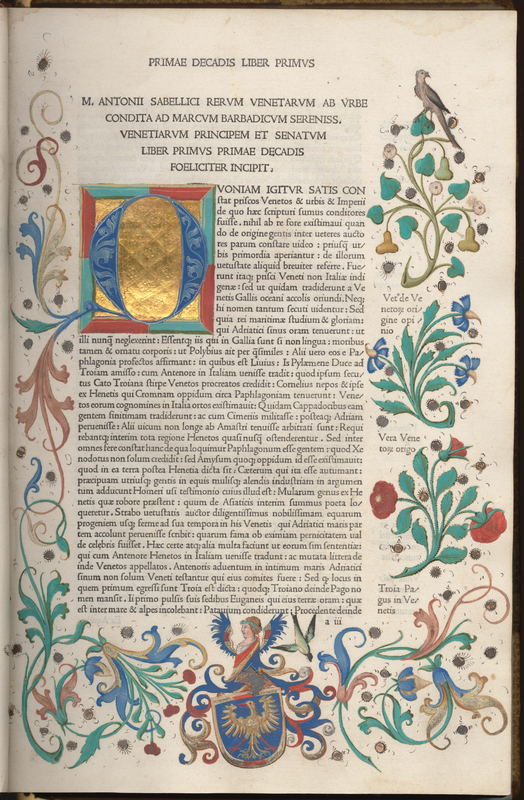 Still image
Illuminated page from the Liber Primus of Sabellico's Decades rerum Venetarum
An illuminated page from the 1487 printing of Sabellico's Decades rerum Venetarum. The illumination includes an initial letter "Q" and decorative border composed of several generic floral patterns, a flowering pear tree branch with a bird perched on it, two different types of flowers, and a coat of arms featuring an eagle, angel, and possibly a swallow. The illumination is done in pink, yellow, black, brown, green, red, and blue color with gold accents.An illuminated page from the 1487 printing of Sabellico's Decades rerum Venetarum. The illumination includes an initial letter "Q" and decorative border composed of several generic floral patterns, a flowering pear tree branch with a bird perched on it, two different types of flowers, and a coat of arms featuring an eagle, angel, and possibly a swallow. The illumination is done in pink, yellow, black, brown, green, red, and blue color with gold accents. -
 Still image
Illuminated page from the Pontificale Romanum
An illuminated page from a 1497 printed edition of the Pontificale Romanum. The illumination includes an initial letter "P" with a full floral border featuring a coat of arms ringed in a laurel wreath in the bottom margin. The illumination is done in red, blue, green, yellow, and black color.An illuminated page from a 1497 printed edition of the Pontificale Romanum. The illumination includes an initial letter "P" with a full floral border featuring a coat of arms ringed in a laurel wreath in the bottom margin. The illumination is done in red, blue, green, yellow, and black color. -
 Still image
Illuminated page from the gospel of Matthew in volume five of the Biblia cum glossa ordinaria
An illuminated page from the gospel of Matthew from volume five of the Biblia cum glossa ordinaria printed in 1498. The central initial letter "L" is done in red, blue, green, yellow, and white/grey with gold accents. There are also two examples of blue and red rubricated initial letter "L"s at the top of the page.An illuminated page from the gospel of Matthew from volume five of the Biblia cum glossa ordinaria printed in 1498. The central initial letter "L" is done in red, blue, green, yellow, and white/grey with gold accents. There are also two examples of blue and red rubricated initial letter "L"s at the top of the page. -
 Still image
Illuminated praefatio from Sabellico's Decades rerum Venetarum
An illuminated page from the 1487 printing of Sabellico's Decades rerum Venetarum. The illumination includes an initial letter "S" and decorative floral border. The illumination is done in pink, brown, green, red, and blue color with gold accents.An illuminated page from the 1487 printing of Sabellico's Decades rerum Venetarum. The illumination includes an initial letter "S" and decorative floral border. The illumination is done in pink, brown, green, red, and blue color with gold accents. -
 Text
TextIn Exodum Mosi commentarii
Brenz, Johannes, 1499-1570Summary: Commentary on the book of Exodus by Johannes Brenz.Summary: Commentary on the book of Exodus by Johannes Brenz. -
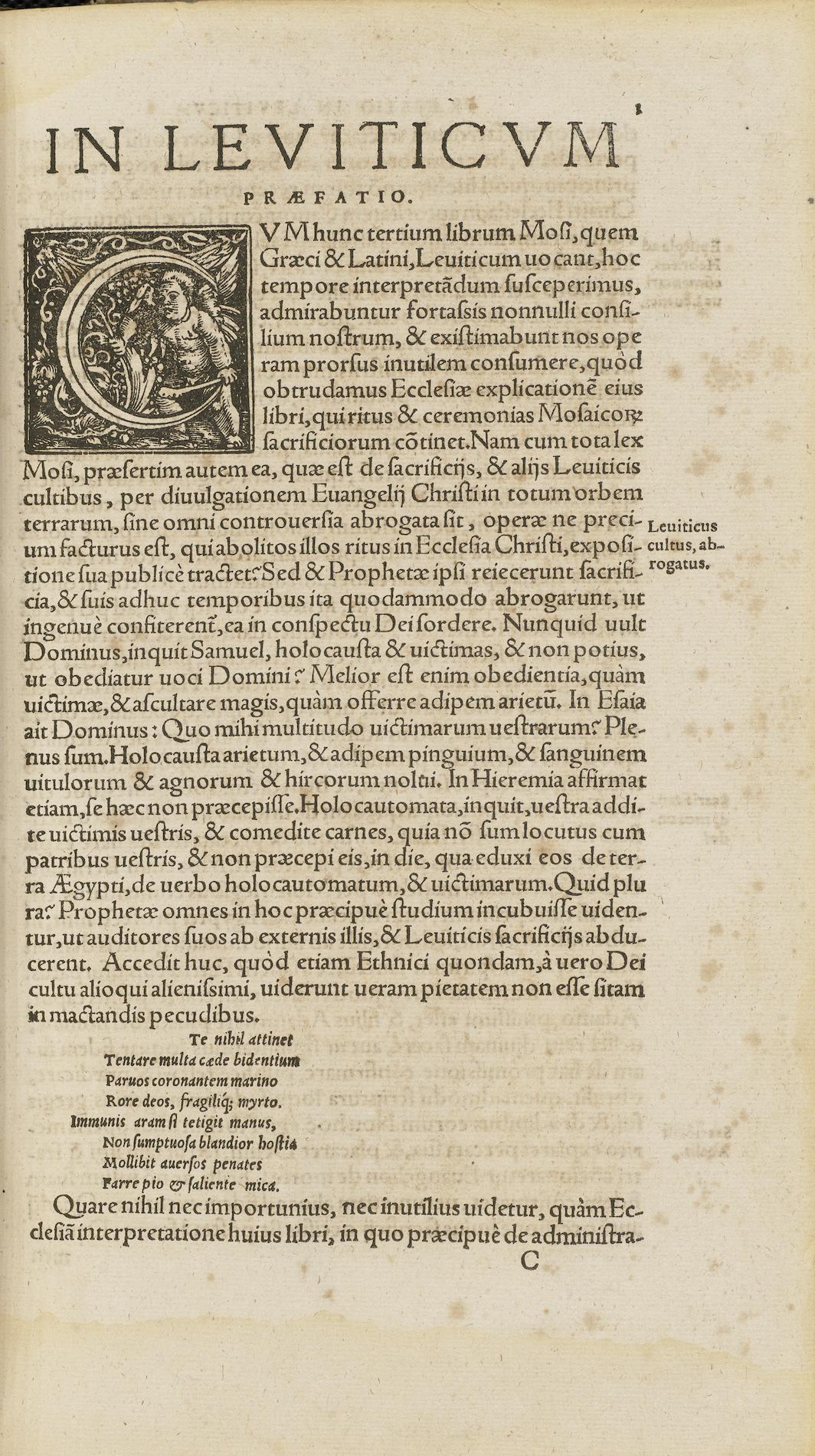 Text
TextIn Leviticum librum Mosi commentarius
Brenz, Johannes, 1499-1570Summary: Commentary on the book of Leviticus by Johannes Brenz.Summary: Commentary on the book of Leviticus by Johannes Brenz. -
 Text
TextIn librum Iudicum et Ruth commentarii
Brenz, Johannes, 1499-1570Summary: Johannes Brenz's commentaries on the books of Judges and Ruth.Summary: Johannes Brenz's commentaries on the books of Judges and Ruth. -
 Text
TextIn prophetam Amos
Brenz, Johannes, 1499-1570Summary: Johannes Brenz's commentary on the book of Amos.Summary: Johannes Brenz's commentary on the book of Amos. -
 Still image
Initial letter with the Three Wise Men
Baldung, Hans, -1545A woodcut initial letter "E" including the scene of the three Wise Men bringing gifts of gold, frankincense, and myrrh to Jesus and the Virgin Mary.A woodcut initial letter "E" including the scene of the three Wise Men bringing gifts of gold, frankincense, and myrrh to Jesus and the Virgin Mary. -
 Still image
Innocentius VIII Papa Genuensis
Soye, Philippe deAn engraved portrait of Pope Innocent VIII, who sat as pope from 1484-1492. The portrait shows Innocent VIII wearing simple vestments with his coat of arms featured in the upper left corner. The portrait is labeled "INNOCENTIVS. VIII. PAPA. GENVENSIS".An engraved portrait of Pope Innocent VIII, who sat as pope from 1484-1492. The portrait shows Innocent VIII wearing simple vestments with his coat of arms featured in the upper left corner. The portrait is labeled "INNOCENTIVS. VIII. PAPA. GENVENSIS". -
 Still image
Innocentus VII Papa Sulmonensis
Soye, Philippe deAn engraved portrait of Pope Innocent VII, who sat as pope from 1404-1406. The portrait shows Innocent VII wearing a papal miter with his coat of arms featured in the upper left corner. The portrait is labeled "INNOCENTIVS. VII. PAPA. SVLMONENSIS".An engraved portrait of Pope Innocent VII, who sat as pope from 1404-1406. The portrait shows Innocent VII wearing a papal miter with his coat of arms featured in the upper left corner. The portrait is labeled "INNOCENTIVS. VII. PAPA. SVLMONENSIS". -
 Still image
Ioannes XXIII Papa Neapolitanus
Soye, Philippe deAn engraved portrait of Antipope John XXIII, who was elected by the Council of Pisa during the Western Schism and held the office from 1410-1415. The portrait shows John XXIII wearing a bishop's miter with his coat of arms featured in the upper left corner. The portrait is labeled "IOANNES. XXIII. PAPA. NEAPOLITANVS".An engraved portrait of Antipope John XXIII, who was elected by the Council of Pisa during the Western Schism and held the office from 1410-1415. The portrait shows John XXIII wearing a bishop's miter with his coat of arms featured in the upper left corner. The portrait is labeled "IOANNES. XXIII. PAPA. NEAPOLITANVS". -
 Text
TextIoannis Revchlin Phorcensis LL. Doc. De arte cabalistica libri tres Leoni X. dicati
Reuchlin, Johann, 1455-1522Summary: Reuchlin had visited Rome in 1490, where he was introduced to Rabbinic literature as well as the cabala.Summary: Reuchlin had visited Rome in 1490, where he was introduced to Rabbinic literature as well as the cabala. -
 Still image
Iulius II Papa Savonensis Ligur
Soye, Philippe deAn engraved portrait of Pope Julius II, who sat as pope from 1503-1513. The portrait shows Julius II sitting in a chair with his coat of arms featured in the upper left corner. The portrait is labeled "IVLIVS. II. PAPA. SAVONENSIS. LIGVR".An engraved portrait of Pope Julius II, who sat as pope from 1503-1513. The portrait shows Julius II sitting in a chair with his coat of arms featured in the upper left corner. The portrait is labeled "IVLIVS. II. PAPA. SAVONENSIS. LIGVR". -
 Still image
Iulius III Papa Arretinus
Soye, Philippe deAn engraved portrait of Pope Julius III, who sat as pope from 1550-1555. The portrait shows Julius III wearing a simple miter and vestments with his coat of arms featured in the upper left corner. The portrait is labeled "IVLIVS. III. PAPA. ARRETINVS".An engraved portrait of Pope Julius III, who sat as pope from 1550-1555. The portrait shows Julius III wearing a simple miter and vestments with his coat of arms featured in the upper left corner. The portrait is labeled "IVLIVS. III. PAPA. ARRETINVS". -
 Still image
Jacob's Dream
Cranach, Lucas, 1472-1553A woodcut depicting God blessing Jacob as he dreams, represented by three angels descending/ascending a ladder linking Heaven and Earth. Above the woodcut is a section of handwritten marginalia.A woodcut depicting God blessing Jacob as he dreams, represented by three angels descending/ascending a ladder linking Heaven and Earth. Above the woodcut is a section of handwritten marginalia. -
 Still image
Joseph interprets Pharaoh's Dream
Cranach, Lucas, 1472-1553A woodcut depicting Joseph beside Pharaoh's bedside (top) explaining the meaning of his dream of seven fat and seven lean cows, and seven good and seven lean stalks, represents seven years of feast and famine that will come to Egypt.A woodcut depicting Joseph beside Pharaoh's bedside (top) explaining the meaning of his dream of seven fat and seven lean cows, and seven good and seven lean stalks, represents seven years of feast and famine that will come to Egypt. -
 Still image
Lampstand and Table with Bread of Presence
Cranach, Lucas, 1472-1553A woodcut depicting the lampstand, table, and bread of presence surrounded by plates, jugs, and bowls.A woodcut depicting the lampstand, table, and bread of presence surrounded by plates, jugs, and bowls. -
 Still image
Leo X Papa Florentinus
Soye, Philippe deAn engraved portrait of Pope Leo X, who sat as pope from 1513-1521. The portrait shows Leo X wearing a simple miter with his coat of arms featured in the upper right corner. The portrait is labeled "LEO. X. PAPA. FLORENTINVS".An engraved portrait of Pope Leo X, who sat as pope from 1513-1521. The portrait shows Leo X wearing a simple miter with his coat of arms featured in the upper right corner. The portrait is labeled "LEO. X. PAPA. FLORENTINVS". -
 Text
TextMagnencij Rabani Mauri de laudi[bus] Sancte Crucis opus. : erudicione versu posa[que] mirificum
Rabanus Maurus, Archbishop of Mainz, 784?-856Summary: De laudibus sanctae crucis (On the praise of the Holy Cross) is a collection of poems and figures, including geometric shapes, letters, drawings and even complex miniatures produced in the early 9th century in the scriptorium of the Abbey at Fulda under the direction of Hrabanus Maurus, archbishop of Mainz, who also provided the commentary found in the work. The book is an important testimony to Carolingian book art.Summary: De laudibus sanctae crucis (On the praise of the Holy Cross) is a collection of poems and figures, including geometric shapes, letters, drawings and even complex miniatures produced in the early 9th century in the scriptorium of the Abbey at Fulda under the direction of Hrabanus Maurus, archbishop of Mainz, who also provided the commentary found in the work. The book is an important testimony to Carolingian book art. -
![A map depicting the Levant region, including Syria, Coele-Syria, Sophene, Ammon, and the regions of five of the twelve tribes fo Israel (Naphtali, Zebulun, Isaschar, Aser, and Gesuri [Manasseh]).](https://s3.us-west-2.amazonaws.com/omekacloud-main/large/P_300000076744_P004x/1536ZIEG_300000076744_P004x.jpg) Still image
Still imageMap of the Ancient Levant Region
A map depicting the Levant region, including Syria, Coele-Syria, Sophene, Ammon, and the regions of five of the twelve tribes fo Israel (Naphtali, Zebulun, Isaschar, Aser, and Gesuri [Manasseh]).A map depicting the Levant region, including Syria, Coele-Syria, Sophene, Ammon, and the regions of five of the twelve tribes fo Israel (Naphtali, Zebulun, Isaschar, Aser, and Gesuri [Manasseh]). -
 Still image
Marcellus II Papa Politianensis Tuscus
Soye, Philippe deAn engraved portrait of Pope Marcellus II, who sat as pope in 1555. The portrait shows Marcellus II wearing elaborate vestments with his coat of arms featured in the upper left corner. The portrait is labeled "MARCELLVS. II. PAPA. POLITIANENSIS. TVSCVS".An engraved portrait of Pope Marcellus II, who sat as pope in 1555. The portrait shows Marcellus II wearing elaborate vestments with his coat of arms featured in the upper left corner. The portrait is labeled "MARCELLVS. II. PAPA. POLITIANENSIS. TVSCVS". -
 Still image
Martinus V Papa Romanus
Soye, Philippe deAn engraved portrait of Pope Martin V, who sat as pope from 1417-1431. The portrait shows Martin V wearing a simple vestments with his coat of arms featured in the upper right corner. The portrait is labeled "MARTINVS. V. PAPA. ROMANVS".An engraved portrait of Pope Martin V, who sat as pope from 1417-1431. The portrait shows Martin V wearing a simple vestments with his coat of arms featured in the upper right corner. The portrait is labeled "MARTINVS. V. PAPA. ROMANVS". -
 Still image
Nicolaus V Papa Sergianensis
Soye, Philippe deAn engraved portrait of Pope Nicholas V, who sat as pope from 1447-1455. The portrait shows Nicholas V wearing a papal miter with his coat of arms featured in the upper right corner. The portrait is labeled "NICOLAVS. V. PAPA. SERGIANENSIS".An engraved portrait of Pope Nicholas V, who sat as pope from 1447-1455. The portrait shows Nicholas V wearing a papal miter with his coat of arms featured in the upper right corner. The portrait is labeled "NICOLAVS. V. PAPA. SERGIANENSIS". -
 Still image
Noah's Ark surviving the flood
Cranach, Lucas, 1472-1553A woodcut depicting Noah's Ark (Der Kaste Noe) safe and afloat amidst the torential rains (center). At the bottom of the image there is a field of fallen trees and dead people and animals left behind by the receeding waters. in the top left of the image there is a dove carrying an olive branch, signalling the receeding of the waters.A woodcut depicting Noah's Ark (Der Kaste Noe) safe and afloat amidst the torential rains (center). At the bottom of the image there is a field of fallen trees and dead people and animals left behind by the receeding waters. in the top left of the image there is a dove carrying an olive branch, signalling the receeding of the waters. -
 Text
TextOeuvre de Jean Holbein; ou, Recueil de gravures d'apres les plus beaux ouvrages de ce fameux peintre
Holbein, Hans, 1497-1543Summary: A collection of engravings made after the work of the painter, Hans Holbein.Summary: A collection of engravings made after the work of the painter, Hans Holbein. -
 Text
TextOnuphrii Panuinii Veronensis Fratris Eremitae Augustiniani. XXVII. Pontificum Maximorum elogia et imagines
Panvinio, Onofrio, 1529-1568Summary:Summary: -
 Still image
Paulus II Papa Venetus
Soye, Philippe deAn engraved portrait of Pope Paul II, who sat as pope from 1464-1471. The portrait shows Paul II wearing elaborate vestments with his coat of arms featured in the upper right corner. The portrait is labeled "PAVLVS. II. PAPA. VENETVS".An engraved portrait of Pope Paul II, who sat as pope from 1464-1471. The portrait shows Paul II wearing elaborate vestments with his coat of arms featured in the upper right corner. The portrait is labeled "PAVLVS. II. PAPA. VENETVS". -
 Still image
Paulus III Pont. Opt. Max.
Soye, Philippe deAn engraved portrait of Pope Paul III, who sat as pope from 1534-1549. The portrait shows Paul III wearing simple vestments with his coat of arms featured in the upper left corner. The portrait is labeled "PAVLVS. III. PONT. OPT. MAX".An engraved portrait of Pope Paul III, who sat as pope from 1534-1549. The portrait shows Paul III wearing simple vestments with his coat of arms featured in the upper left corner. The portrait is labeled "PAVLVS. III. PONT. OPT. MAX". -
 Still image
Paulus IV Papa Neapolitanus
Soye, Philippe deAn engraved portrait of Pope Paul IV, who sat as pope from 1555-1559. The portrait shows Paul IV wearing a simple miter and vestments with his coat of arms featured in the upper left corner. The portrait is labeled "PAVLVS. IV. PAPA. NEAPOLITANVS".An engraved portrait of Pope Paul IV, who sat as pope from 1555-1559. The portrait shows Paul IV wearing a simple miter and vestments with his coat of arms featured in the upper left corner. The portrait is labeled "PAVLVS. IV. PAPA. NEAPOLITANVS". -
 Text
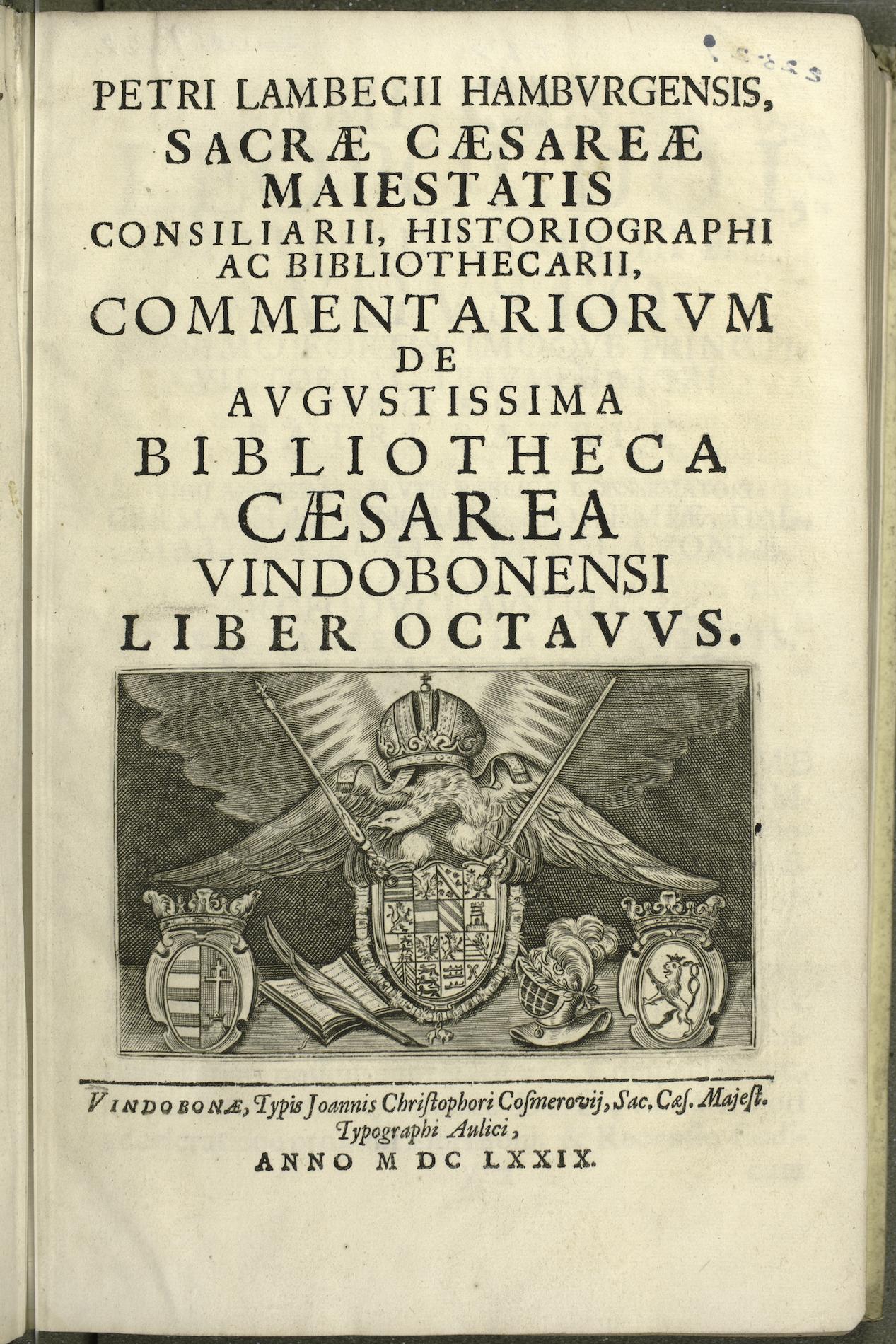
TextPetri Lambecii Hamburgensis Commentariorum de augustissima Bibliotheca Caesarea Vindobonensi liber octavus.
Lambeck, Peter, 1628-1680Summary: A printed catalog of the Hofbibliothek in Vienna, Austria.Summary: A printed catalog of the Hofbibliothek in Vienna, Austria. -
 Still image
Pius II Papa Senensis
Soye, Philippe deAn engraved portrait of Pope Pius II, who sat as pope from 1458-1464. The portrait shows Pius II wearing a papal miter with his coat of arms featured in the upper left corner. The portrait is labeled "PIVS. II. PAPA. SENENSIS".An engraved portrait of Pope Pius II, who sat as pope from 1458-1464. The portrait shows Pius II wearing a papal miter with his coat of arms featured in the upper left corner. The portrait is labeled "PIVS. II. PAPA. SENENSIS". -
 Still image
Pius III Papa Senensis
Soye, Philippe deAn engraved portrait of Pope Pius III, who sat as pope in 1503. The portrait shows Pius III wearing a simple miter with elaborate vestments with his coat of arms featured in the upper left corner. The portrait is labeled "PIVS. III. PAPA. SENENSIS".An engraved portrait of Pope Pius III, who sat as pope in 1503. The portrait shows Pius III wearing a simple miter with elaborate vestments with his coat of arms featured in the upper left corner. The portrait is labeled "PIVS. III. PAPA. SENENSIS". -
 Still image
Pius IV Papa Mediolanensis
Soye, Philippe deAn engraved portrait of Pope Pius IV, who sat as pope from 1559-1565. The portrait shows Pius IV wearing a simple miter and vestments with his coat of arms featured in the upper left corner. The portrait is labeled "PIVS. IV. PAPA. MEDIOLANENSIS".An engraved portrait of Pope Pius IV, who sat as pope from 1559-1565. The portrait shows Pius IV wearing a simple miter and vestments with his coat of arms featured in the upper left corner. The portrait is labeled "PIVS. IV. PAPA. MEDIOLANENSIS". -
 Still image
Pius V Papa Alexandrinus
Soye, Philippe deAn engraved portrait of Pope Pius V, who sat as pope from 1566-1572. The portrait shows Pius V wearing simple vestments with his coat of arms featured in the upper left corner. The portrait is labeled "PIVS. V. PAPA. ALEXANDRINVS".An engraved portrait of Pope Pius V, who sat as pope from 1566-1572. The portrait shows Pius V wearing simple vestments with his coat of arms featured in the upper left corner. The portrait is labeled "PIVS. V. PAPA. ALEXANDRINVS". -
 Text
TextPontificale Romanum
Catholic ChurchSummary: The Pontificale Romanum contains the liturgical rites for the sacraments of confirmation and Holy orders performed by bishops. The work is called "liber pontificalis" (pontifical or papal book) here, as books bearing pontifical authority often were prior to the 16th century, but it should not be confused with the papal annals, also called Liber Pontificalis, which is used by historians of the early Roman ChurchSummary: The Pontificale Romanum contains the liturgical rites for the sacraments of confirmation and Holy orders performed by bishops. The work is called "liber pontificalis" (pontifical or papal book) here, as books bearing pontifical authority often were prior to the 16th century, but it should not be confused with the papal annals, also called Liber Pontificalis, which is used by historians of the early Roman Church -
 Text
TextPostill. Ausslegung der Euangelien, so auff die Sontag, und fürnemste Feste, durchs gantze Jar gepredigt werden. : Mit den Summarien, vnd Register, new hinzů gethan. : Zusampt angehenckter Erklärung der Histori vom Leiden und Sterben vnseres Herrn Jesu Christi, nach Beschreibung der Vier Evangelisten
Brenz, Johannes, 1499-1570Summary: Second German edition of Johannes Brenz' postil or lectionary sermons, presented in three parts. The fourth part is a harmony and interpretation of the four Gospel passion stories.Summary: Second German edition of Johannes Brenz' postil or lectionary sermons, presented in three parts. The fourth part is a harmony and interpretation of the four Gospel passion stories. -
 Still image
Priestly Garments
Cranach, Lucas, 1472-1553A woodcut depicting a preist dressed in the vestments described in Exodus 28, including an elaborate ephod and/or breastpiece, a long robe decorated with pomegranates and bells, and a decorated turban.A woodcut depicting a preist dressed in the vestments described in Exodus 28, including an elaborate ephod and/or breastpiece, a long robe decorated with pomegranates and bells, and a decorated turban. -
 Text
TextPrima [-Sexta] pars biblie cu[m] glosa ordinaria : expositio[n]e Lyre litterali & morali: necno[n] additio[n]ibus ac replicis.
Summary: A Vulgate Latin Bible, with the "glossa ordinaria" of Walafridus Strabo and others, the "glossa interlinearis" of Anselmus Laudunensis, the "postillae" of Nicolaus de Lyra, the "expositiones prologorum" of Guillelmus Brito, the "additiones" of Paulus Burgensis, and the "replicae" of Matthias Doring.Summary: A Vulgate Latin Bible, with the "glossa ordinaria" of Walafridus Strabo and others, the "glossa interlinearis" of Anselmus Laudunensis, the "postillae" of Nicolaus de Lyra, the "expositiones prologorum" of Guillelmus Brito, the "additiones" of Paulus Burgensis, and the "replicae" of Matthias Doring. -
 Still image
Printing Press
An image of an early, Gutenberg style printing press with a pair of ink balls on top of the arranged type. Above the image is the inscription, "EX FVMO IN LVCEM," translated as "from smoke into light."An image of an early, Gutenberg style printing press with a pair of ink balls on top of the arranged type. Above the image is the inscription, "EX FVMO IN LVCEM," translated as "from smoke into light." -
 Text
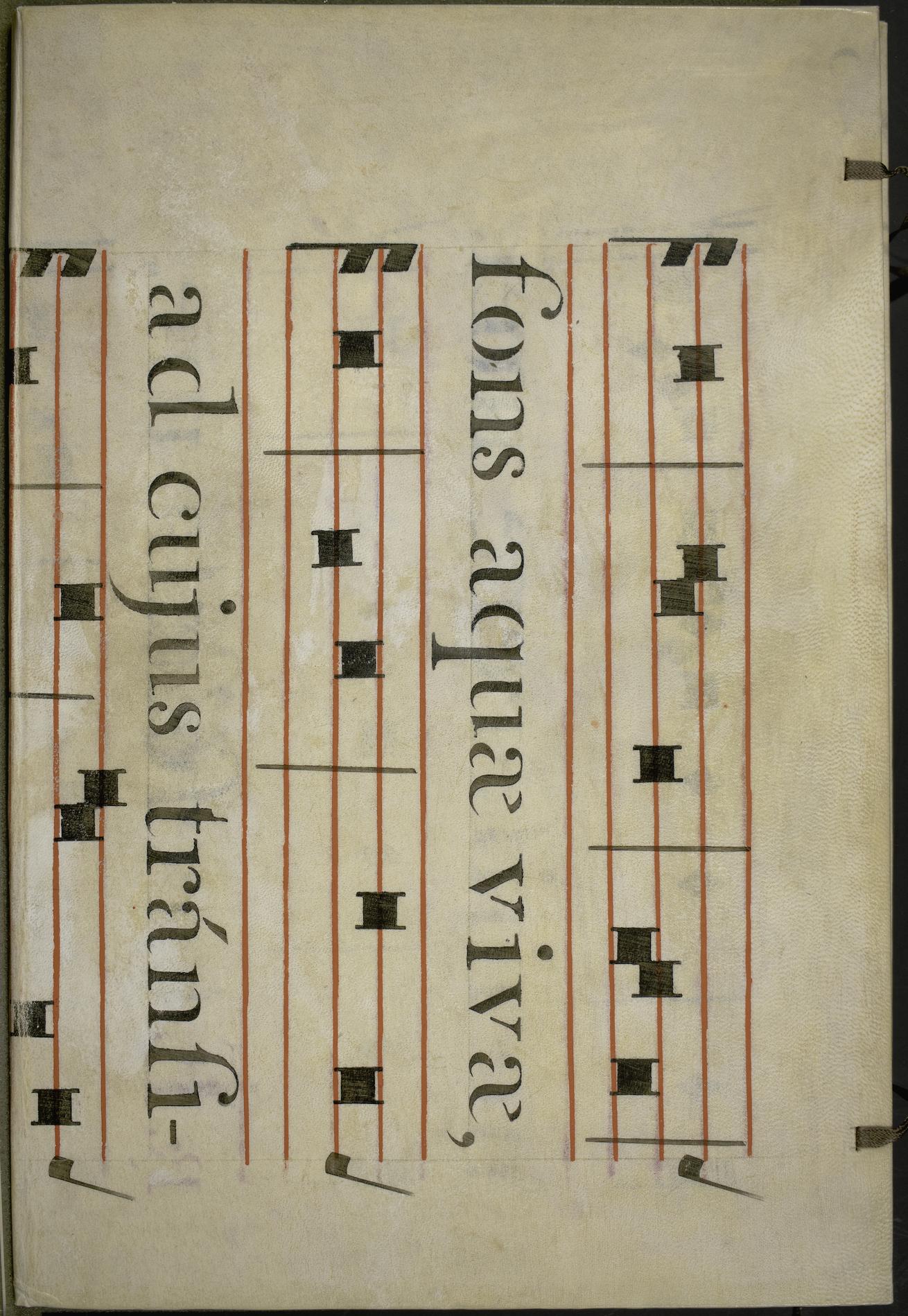
TextPsalmi seu cantica ex sacris literis, : in ecclesia cantari solita, cum hymnis et collectis, veu orationibus pijs, in vsum ecclesiarum & iuuentutis scholasticae
Summary: Choir book, edited by the Lutheran theologian Georg Major (Meier). The work opens with biblical canticles and Psalms of praise, followed by various hymns, prayers and litanies.Summary: Choir book, edited by the Lutheran theologian Georg Major (Meier). The work opens with biblical canticles and Psalms of praise, followed by various hymns, prayers and litanies. -
 Text
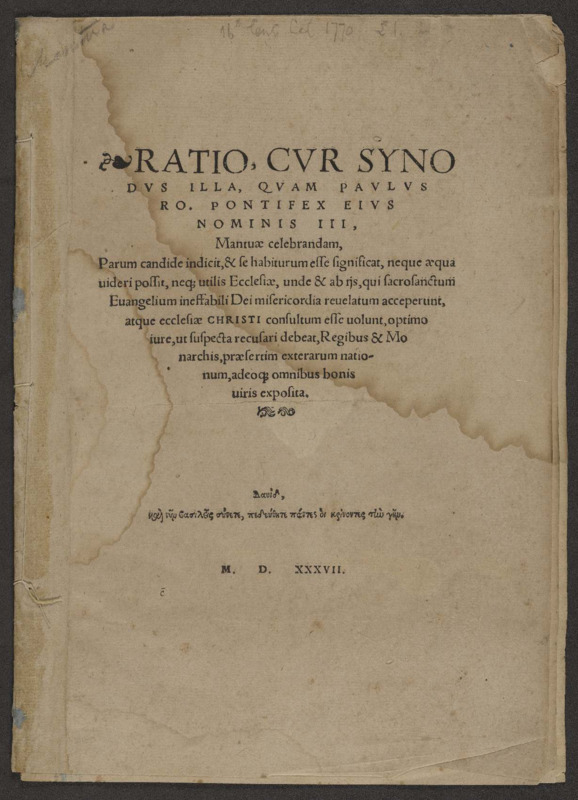
TextRatio, cur synodus illa, quam Paulus Ro. Pontifex eius nominis III, Mantuae celebrandam, parum candide indicit, & se habiturum esse significat, neque aequa inderi possit, neq[ue] utilis Ecclesiae, unde & ab ijs, qui sacrosanctum Euangelium ineffabili Dei
Summary: When Pope Paul III called for a reform council at Mantua in 1536, the Protestants were faced with a dilemma. If they attended the council they would be recognizing the Pope's authority in such matters. If they refused, then it might appear that their calls for a general council had been insincere. The sticky task of responding to the pope's call fell upon Melanchthon. This is an edition of his response.Summary: When Pope Paul III called for a reform council at Mantua in 1536, the Protestants were faced with a dilemma. If they attended the council they would be recognizing the Pope's authority in such matters. If they refused, then it might appear that their calls for a general council had been insincere. The sticky task of responding to the pope's call fell upon Melanchthon. This is an edition of his response. -
 Still image
Sacrifice of Isaac
Cranach, Lucas, 1472-1553A woodcut depicting Abraham preparing to sacrifice his son, Isaac, as a show of faith to God and being stopped by an angel, who provides a ram (center left) for sacrifice in Isaac's place.A woodcut depicting Abraham preparing to sacrifice his son, Isaac, as a show of faith to God and being stopped by an angel, who provides a ram (center left) for sacrifice in Isaac's place. -
 Still image
Sealing of the 144,000 Faithful
Cranach, Lucas, 1472-1553A woodcut depicting an angel sealing the 144,000 faithful as a group of angels hold off the Winds from damaging the Earth. The image appears in the September Testament, Martin Luther's first printing of his German New Testament.A woodcut depicting an angel sealing the 144,000 faithful as a group of angels hold off the Winds from damaging the Earth. The image appears in the September Testament, Martin Luther's first printing of his German New Testament. -
 Text
TextSolitudo, sive, Vitae patrum eremicolarum : per antiquissimu[m] Patrem D. Hieronimu[m] eorundem primarium olim conscripta
Sadeler, Jan, 1550-1600Summary: Series of copper engraved prints after Maarten de Vos' drawings of hermits.Summary: Series of copper engraved prints after Maarten de Vos' drawings of hermits. -
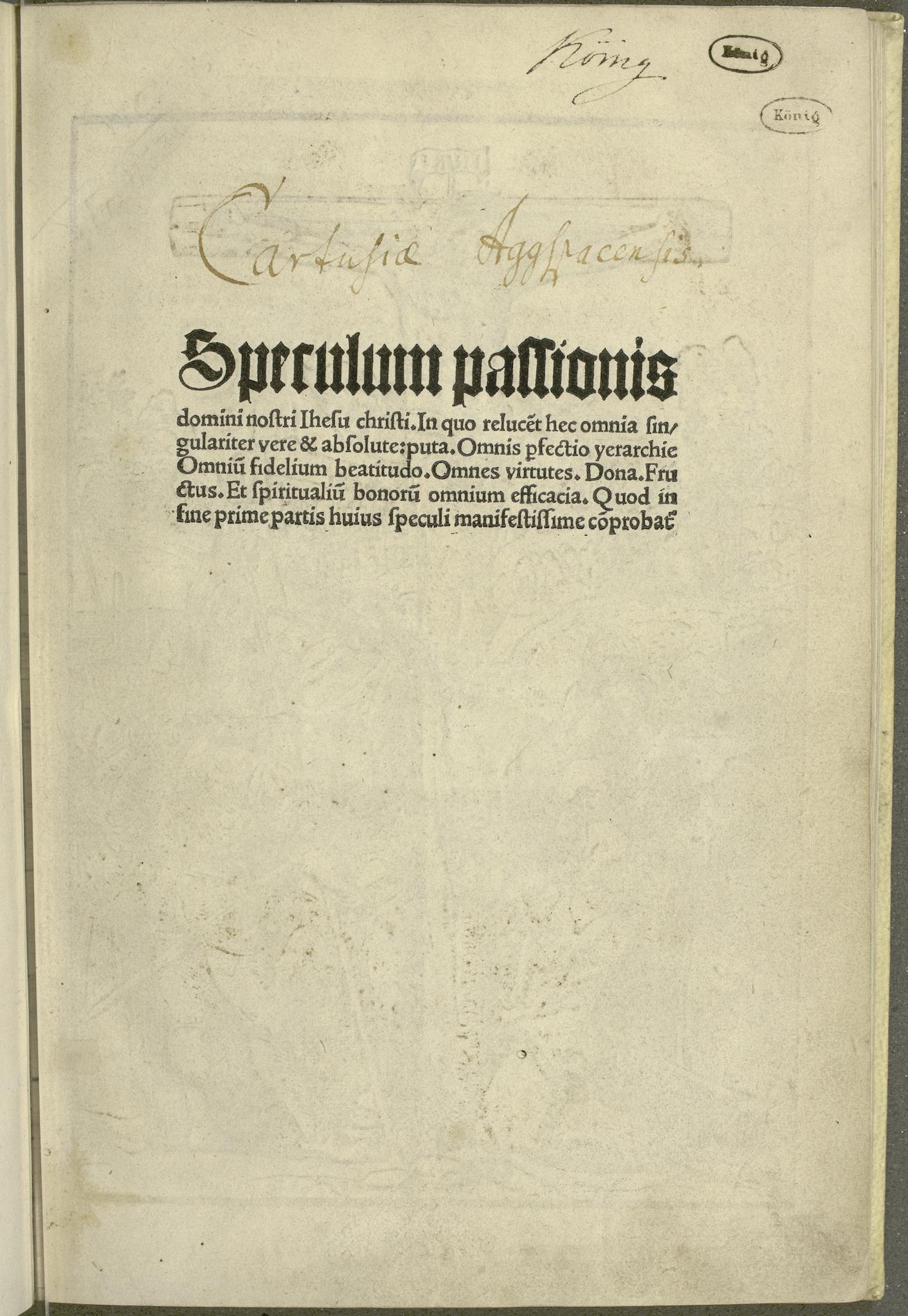 Text
TextSpeculum passionis domini nostri Ihesu Christi : in quo reluce[n]t hec omnia singulariter vere & absolute, puta omnis [per]fectio yerarchie, Omniu[m] fidelium beatitudo, Omnes virtutes, dona, fructus, et spiritualiu[m] bonoru[m] omnium efficacia, quod in fine prime partis huius speculi manifestissime co[m]probat[um]
Pinder, Ulrich, -1510 or 1519Summary: First edition of Ulrich Pinder's Passion narrative richly illustrated with 77 woodcut images (39 full page). Pinder was medical doctor, who had served as the court physician of the Elector Frederick the Wise of Saxony. After 1493 he was the town physician for the city of Nuremberg, where he also wrote several medical tracts and published a variety of books with the printer Friedrich Peypus. For this work, Pinder employed the services of the engravers Hans Schaufelein, who contributed 39 woodcuts, and Hans Baldung Grien, who contributed 21 woodcuts.Summary: First edition of Ulrich Pinder's Passion narrative richly illustrated with 77 woodcut images (39 full page). Pinder was medical doctor, who had served as the court physician of the Elector Frederick the Wise of Saxony. After 1493 he was the town physician for the city of Nuremberg, where he also wrote several medical tracts and published a variety of books with the printer Friedrich Peypus. For this work, Pinder employed the services of the engravers Hans Schaufelein, who contributed 39 woodcuts, and Hans Baldung Grien, who contributed 21 woodcuts. -
 Still image
Tabernacle Court Layout
Cranach, Lucas, 1472-1553A woodcut depicting the full layout of the Tabernacle court, including the altar of burnt offerings, the bronze laver, and the inner tent with the table, lampstand, altar of incense, and the Ark of the Covanent.A woodcut depicting the full layout of the Tabernacle court, including the altar of burnt offerings, the bronze laver, and the inner tent with the table, lampstand, altar of incense, and the Ark of the Covanent. -
 Still image
Tabernacle Frame
Cranach, Lucas, 1472-1553A woodcut depicting the acacia wood frames with silver bases for the tabernacle.A woodcut depicting the acacia wood frames with silver bases for the tabernacle. -
 Still image
Tabernacle's Inner Curtain
Cranach, Lucas, 1472-1553A woodcut depicting one of the inner curtains of the Tabernacle, decorated with cherubim in blue, purple, and scarlet yarn and displayed in the Tabernacle courtyard.A woodcut depicting one of the inner curtains of the Tabernacle, decorated with cherubim in blue, purple, and scarlet yarn and displayed in the Tabernacle courtyard. -
 Still image
The Angel with the Little Book
Cranach, Lucas, 1472-1553A woodcut depicting an angel, robed in clouds with legs of flaming pillars, handing a book to Saint John the Apostle and pointing up at the heavens. The image appears in the September Testament, Martin Luther's first printing of his German New Testament.A woodcut depicting an angel, robed in clouds with legs of flaming pillars, handing a book to Saint John the Apostle and pointing up at the heavens. The image appears in the September Testament, Martin Luther's first printing of his German New Testament. -
 Still image
The Armies of Heaven and Doom for the Beast
Cranach, Lucas, 1472-1553A woodcut depicting the victorious armies of Heaven (top right) routing the opposing forces as the beast is cast into a lake of fire and brimstone. The image appears in the September Testament, Martin Luther's first printing of his German New Testament.A woodcut depicting the victorious armies of Heaven (top right) routing the opposing forces as the beast is cast into a lake of fire and brimstone. The image appears in the September Testament, Martin Luther's first printing of his German New Testament. -
 Still image
The Crucifixion of Jesus Christ
A woodcut of Christ crucified with the Virgin Mary (left) and John the Evangelist (right). A skull sits at the base of the cross and the inscription INRI appears above it.A woodcut of Christ crucified with the Virgin Mary (left) and John the Evangelist (right). A skull sits at the base of the cross and the inscription INRI appears above it. -
 Still image
The Destruction of Babylon
Cranach, Lucas, 1472-1553A woodcut depicting two angels announcing the destruction of Babylon and dropping a millstone into the sea while the city itself is seen in flames below. The image appears in the September Testament, Martin Luther's first printing of his German New Testament.A woodcut depicting two angels announcing the destruction of Babylon and dropping a millstone into the sea while the city itself is seen in flames below. The image appears in the September Testament, Martin Luther's first printing of his German New Testament. -
 Still image
The Dragon Thrown into the Bottomless Pit
Cranach, Lucas, 1472-1553A woodcut depicting an angel locking the dragon, which represents Satan, into a bottomless pit to be bound for a thousand years. The image appears in the September Testament, Martin Luther's first printing of his German New Testament.A woodcut depicting an angel locking the dragon, which represents Satan, into a bottomless pit to be bound for a thousand years. The image appears in the September Testament, Martin Luther's first printing of his German New Testament. -
 Still image
The Fifth Trumpet
Cranach, Lucas, 1472-1553A woodcut depicting the release of the locusts from a bottomless pit by a star following the sounding of the Fifth Trumpet. The image appears in the September Testament, Martin Luther's first printing of his German New Testament.A woodcut depicting the release of the locusts from a bottomless pit by a star following the sounding of the Fifth Trumpet. The image appears in the September Testament, Martin Luther's first printing of his German New Testament. -
 Still image
The First Four Trumpets
Cranach, Lucas, 1472-1553A woodcut depictng God and seven angels with trumpets (top), hail and fire falling into the sea (bottom left), and a burning mountain falling into the sea (bottom right). The image appears in the September Testament, Martin Luther's first printing of his German New Testament.A woodcut depictng God and seven angels with trumpets (top), hail and fire falling into the sea (bottom left), and a burning mountain falling into the sea (bottom right). The image appears in the September Testament, Martin Luther's first printing of his German New Testament. -
 Still image
The Harvest
Cranach, Lucas, 1472-1553A woodcut depicting Jesus seated on a throne and holding a sickle, directing the harvest of grain (bottom right) and that of grapes to be pressed (bottom left). The image appears in the September Testament, Martin Luther's first printing of his German New Testament.A woodcut depicting Jesus seated on a throne and holding a sickle, directing the harvest of grain (bottom right) and that of grapes to be pressed (bottom left). The image appears in the September Testament, Martin Luther's first printing of his German New Testament. -
 Still image
The Holy City, New Jerusalem
Cranach, Lucas, 1472-1553A woodcut depicting an angel gesturing towards the heavenly city of Jerusalem. The image appears in the September Testament, Martin Luther's first printing of his German New Testament.A woodcut depicting an angel gesturing towards the heavenly city of Jerusalem. The image appears in the September Testament, Martin Luther's first printing of his German New Testament. -
 Still image
The Lamb on Mount Zion, the New Song, and the Three Angels
Cranach, Lucas, 1472-1553A woodcut depicting the Lamb of God atop Mount Zion (top) framed by the four beasts described in Ezekiel 1, harpers, and angels holding a book, while below them the city of Babylon is destroyed (bottom). The image appears in the September Testament, Martin Luther's first printing of his German New Testament.A woodcut depicting the Lamb of God atop Mount Zion (top) framed by the four beasts described in Ezekiel 1, harpers, and angels holding a book, while below them the city of Babylon is destroyed (bottom). The image appears in the September Testament, Martin Luther's first printing of his German New Testament. -
 Still image
The Martyrs beneath the Altar
Cranach, Lucas, 1472-1553A woodcut depicting the souls of martyrs laid out beneath an altar (bottom left), being lifted up by angels (mid left), and being dressed in white robes (right). The image appears in the September Testament, Martin Luther's first printing of his German New Testament.A woodcut depicting the souls of martyrs laid out beneath an altar (bottom left), being lifted up by angels (mid left), and being dressed in white robes (right). The image appears in the September Testament, Martin Luther's first printing of his German New Testament. -
 Still image
The Pope with Saints and Biblical Figures
An engraving depicting a scene of the pope (possibly Pope Gregory XIII) enthroned and surrounded by bishops and cardinals, a dove perched on the back of his throne. Surrounding this scene is a series of portraits of saints and biblical figures, including (from top left down, around, and up): Saint Augustine, Saint John, Saint Matthew, Saint Luke, Saint Mark, Saint Paul, Pope Gregory I (Saint), Saint Ambrose, Jeremiah, Isaiah, David, Job, Moses, and Saint Jerome.An engraving depicting a scene of the pope (possibly Pope Gregory XIII) enthroned and surrounded by bishops and cardinals, a dove perched on the back of his throne. Surrounding this scene is a series of portraits of saints and biblical figures, including (from top left down, around, and up): Saint Augustine, Saint John, Saint Matthew, Saint Luke, Saint Mark, Saint Paul, Pope Gregory I (Saint), Saint Ambrose, Jeremiah, Isaiah, David, Job, Moses, and Saint Jerome. -
 Still image
The Seven Last Plagues
Cranach, Lucas, 1472-1553A woodcut depicting angels pouring out the Seven Plagues, including a plague upon the sun, the air, the rivers and fountains, the earth, the sea, the Euphrates, and the seat of the beast, which is sprewing unclean spirits in the form of frogs. The image appears in the September Testament, Martin Luther's first printing of his German New Testament.A woodcut depicting angels pouring out the Seven Plagues, including a plague upon the sun, the air, the rivers and fountains, the earth, the sea, the Euphrates, and the seat of the beast, which is sprewing unclean spirits in the form of frogs. The image appears in the September Testament, Martin Luther's first printing of his German New Testament. -
 Still image
The Sixth Trumpet
Cranach, Lucas, 1472-1553A woodcut depicting the releasing of four angels bound to the Euphrates to lead an army of lion-mounted warriors to destroy a third of the world's population. The image appears in the September Testament, Martin Luther's first printing of his German New Testament.A woodcut depicting the releasing of four angels bound to the Euphrates to lead an army of lion-mounted warriors to destroy a third of the world's population. The image appears in the September Testament, Martin Luther's first printing of his German New Testament. -
 Still image
The Stars Falling to Earth
Cranach, Lucas, 1472-1553A woodcut depicting a series of disasters, including the sun and moon changing, stars falling, and earthquakes. The image appears in the September Testament, Martin Luther's first printing of his German New Testament.A woodcut depicting a series of disasters, including the sun and moon changing, stars falling, and earthquakes. The image appears in the September Testament, Martin Luther's first printing of his German New Testament. -
 Still image
The Temple and the Two Witnesses
Cranach, Lucas, 1472-1553A woodcut depicting Saint John the Apostle measuring the temple of God as two witnesses named by an angel face a snarling beast. The image appears in the September Testament, Martin Luther's first printing of his German New Testament.A woodcut depicting Saint John the Apostle measuring the temple of God as two witnesses named by an angel face a snarling beast. The image appears in the September Testament, Martin Luther's first printing of his German New Testament. -
 Still image
The Two Beasts
Cranach, Lucas, 1472-1553A woodcut depicting two beasts, the first with seven crowned heads and ten horns rising from the sea, and the second in the shape of a lamb with two horns which is accompanied by flames raining from the skies. The image appears in the September Testament, Martin Luther's first printing of his German New Testament.A woodcut depicting two beasts, the first with seven crowned heads and ten horns rising from the sea, and the second in the shape of a lamb with two horns which is accompanied by flames raining from the skies. The image appears in the September Testament, Martin Luther's first printing of his German New Testament. -
 Still image
The Woman and the Beast in the Wilderness
Cranach, Lucas, 1472-1553A woodcut depicting the Whore (Harlot) of Babylon atop the red dragon, a golden cup in hand and a Papal crown upon her head. The image appears in the September Testament, Martin Luther's first printing of his German New Testament.A woodcut depicting the Whore (Harlot) of Babylon atop the red dragon, a golden cup in hand and a Papal crown upon her head. The image appears in the September Testament, Martin Luther's first printing of his German New Testament. -
 Still image
The Woman and the Great Red Dragon
Cranach, Lucas, 1472-1553A woodcut depicting a woman crowned in stars facing down a dragon with ten horns and seven crowns while above her a child is carried to the throne of God by angels. The image appears in the September Testament, Martin Luther's first printing of his German New Testament.A woodcut depicting a woman crowned in stars facing down a dragon with ten horns and seven crowns while above her a child is carried to the throne of God by angels. The image appears in the September Testament, Martin Luther's first printing of his German New Testament. -
 Text
TextThe proceedings and tryal in the case of the Most Reverend Father in God William Lord Archbishop of Canterbury, and the Right Reverend Fathers in God, William Lord Bishop of St. Asaph, Francis Lord Bishop of Ely, John Lord Bishop of Chichester, Thomas Lord Bishop of Bath and Wells, Thomas Lord Bishop of Peterborough, and Jonathan Lord Bishop of Bristol : in the Court of the Kings-bench at Westminster, in Trinity-term in the fourth year of the reign of King James the Second, annoque Dom. 1688.
Sancroft, William, 1617-1693Summary: Proceedings against William Sancroft, Archbishop of Canterbury, and six other bishops for publishing seditious libel against James II.Summary: Proceedings against William Sancroft, Archbishop of Canterbury, and six other bishops for publishing seditious libel against James II. -
 Text
TextThe self-interpreting Bible: containing the sacred text of the Old and New Testaments. : translated from the original tongues, and with the former translations diligently compared and revised. To which are annexed, marginal references and illustrations
Summary: A family Bible which includes the Apocrypha, an introduction, tables, and a list of scubscribers.Summary: A family Bible which includes the Apocrypha, an introduction, tables, and a list of scubscribers. -
 Text
TextTheologia naturalis siue Liber creatura[rum] specialiter de homine [et] de natura eius in qua[n]tum homo. : [et] de his qu[a] sunt ei necessaria ad cognoscendu[m] seip[su]m [et] Deu[m] [et] om[n]e debitu[m] ad q[uo]d ho[mo] tenet[ur] et obligatur tam Deo
Raymond, of Sabunde, -1436Summary: The Spanish scholar Raymond of Sabunde was professor of medicine, philosophy, and theology at the University of Toulouse during the early fifteenth century. His study of natural theology came under the scrutiny of the Council of Trent, which placed its prologue on the index. This particular copy has been censored: the prologue, (leaf A6) has been either inked out or cut away.Summary: The Spanish scholar Raymond of Sabunde was professor of medicine, philosophy, and theology at the University of Toulouse during the early fifteenth century. His study of natural theology came under the scrutiny of the Council of Trent, which placed its prologue on the index. This particular copy has been censored: the prologue, (leaf A6) has been either inked out or cut away. -
 Text
TextTheologia naturalis siue liber creaturarum specialiter de homine et de natura eius inquantum homo, et de his que sunt ei necessaria ad cognoscendum seipsum & deum, et omne debitu[m] ad quod homo tenetur et obligat[ur] tam deo q[uam] p[ro]ximo
Raymond, of Sabunde, -1436Summary: This impotant work on natural theology was written by the Catalan scholar Raymond of Sabunde 1434-1436 and was circulated widely in manuscript form before being printed in Deventer 1484-85 and reprinted numerous times. Raymond places great emphasis on reason and argues that science is not antithetical to faith but that the Bible and the book of Nature should both be seen as divine revelation.Summary: This impotant work on natural theology was written by the Catalan scholar Raymond of Sabunde 1434-1436 and was circulated widely in manuscript form before being printed in Deventer 1484-85 and reprinted numerous times. Raymond places great emphasis on reason and argues that science is not antithetical to faith but that the Bible and the book of Nature should both be seen as divine revelation. -
 Still image
Urbanus VI Papa Neapolitanus
Soye, Philippe deAn engraved portrait of Pope Urban VI, who sat as pope from 1378-1389. The portrait shows Urban VI wearing a papal miter with his coat of arms featured in the upper right corner. The portrait is labeled "VRBANUS. VI. PAPA. NEAPOLITANVS".An engraved portrait of Pope Urban VI, who sat as pope from 1378-1389. The portrait shows Urban VI wearing a papal miter with his coat of arms featured in the upper right corner. The portrait is labeled "VRBANUS. VI. PAPA. NEAPOLITANVS". -
 Still image
Vision of God's Throne
Cranach, Lucas, 1472-1553A woodcut depicting Saint John the Apostle kneeling before a scene where God, seated on a throne and flanked by the four beasts described in Ezekiel 1, hands a book to the Lamb of God as a number of angels surround them and a group of elders kneel, crowns removed with harps and incense in hand. The image appears in the September Testament, Martin Luther's first printing of his German New Testament.A woodcut depicting Saint John the Apostle kneeling before a scene where God, seated on a throne and flanked by the four beasts described in Ezekiel 1, hands a book to the Lamb of God as a number of angels surround them and a group of elders kneel, crowns removed with harps and incense in hand. The image appears in the September Testament, Martin Luther's first printing of his German New Testament. -
 Still image
Xystus IV Papa Savonensis Ligur
Soye, Philippe deAn engraved portrait of Pope Sixtus IV, who sat as pope from 1471-1484. The portrait shows Sixtus IV wearing a simple miter and sitting in a chair with his coat of arms featured in the upper right corner. The portrait is labeled "XYSTVS. IV. PAPA. SAVONENSIS. LIGVR".An engraved portrait of Pope Sixtus IV, who sat as pope from 1471-1484. The portrait shows Sixtus IV wearing a simple miter and sitting in a chair with his coat of arms featured in the upper right corner. The portrait is labeled "XYSTVS. IV. PAPA. SAVONENSIS. LIGVR". -
 Still image
Young Jesus in the Temple
A depiction of a young Jesus standing amongst the teachers at the temple, reading and asking questions. The print is placed before the hymn, "Ein Gefang fur dem anfang der finder predigt oder des Catechismi" by D. Johan Zwick.A depiction of a young Jesus standing amongst the teachers at the temple, reading and asking questions. The print is placed before the hymn, "Ein Gefang fur dem anfang der finder predigt oder des Catechismi" by D. Johan Zwick. -
 Text
Text[Evangelium sanctum Domini Nostri Iesu Christi conscriptum a quatuor Evangelistis sanctis idest, Matthaeo, Marco, Luca, et Iohanne]
Summary: Text of Gospels in Arabic, with interlinear Latin translation.Summary: Text of Gospels in Arabic, with interlinear Latin translation.