Search
-
 Text
TextSt. Peter miniature
An illustration of a figure presented as an archbishop, likely St. Peter, holding a city (possibly Bologna).An illustration of a figure presented as an archbishop, likely St. Peter, holding a city (possibly Bologna). -
 Text
TextBible: Matthew 5-7
A vellum leaf containing the text of Matthew 5-7, written in Gothic script.A vellum leaf containing the text of Matthew 5-7, written in Gothic script. -
 Text
TextBible: Matthew 2
A vellum leaf containing the text of Matthew 2:1-11 and featuring decorative initial letters.A vellum leaf containing the text of Matthew 2:1-11 and featuring decorative initial letters. -
 Text
TextBible: Luke 1
A vellum leaf containing the text of Luke 1:46-55 and featuring decorative initial letters.A vellum leaf containing the text of Luke 1:46-55 and featuring decorative initial letters. -
 Text
TextEpistolary: Matthew 27
A leaf from an epistolary featuring musical annotation and the text of Matthew 27:60-64.A leaf from an epistolary featuring musical annotation and the text of Matthew 27:60-64. -
 Text
TextBook of Hours
A vellum leaf from a Latin Book of Hours. The leaf contains 1/4 panel borders, 1-line and 2-line decoratored initials, and decorated line endings all of liquid gold and tempera.A vellum leaf from a Latin Book of Hours. The leaf contains 1/4 panel borders, 1-line and 2-line decoratored initials, and decorated line endings all of liquid gold and tempera. -
 Text
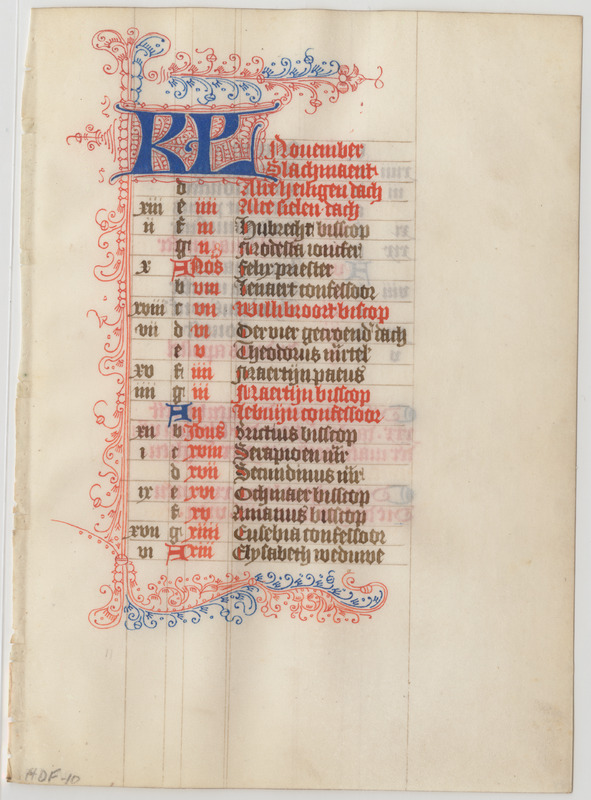
TextLiturgical Calendar
A vellum leaf featuring a liturgical calendar with decorative text, initial letters, and three-sided border all in red and blue inks.A vellum leaf featuring a liturgical calendar with decorative text, initial letters, and three-sided border all in red and blue inks. -
 Text
TextLitany of Saints (Book of Hours)
A vellum leaf from a Latin Book of Hours. The leaf contains 1/4 panel borders of flowers and tree trunks in liquid gold and tempera.A vellum leaf from a Latin Book of Hours. The leaf contains 1/4 panel borders of flowers and tree trunks in liquid gold and tempera. -
 Text
TextWounds of Christ (Book of Hours)
A vellum leaf from a Dutch Book of Hours. The recto and verso have decorated borders, two- and five-line decorated initials, and an angel in the margin of the recto showing wounds on his hands and feet all in red and blue inks.A vellum leaf from a Dutch Book of Hours. The recto and verso have decorated borders, two- and five-line decorated initials, and an angel in the margin of the recto showing wounds on his hands and feet all in red and blue inks. -
 Text
TextAgnus Dei (Book of Hours)
A vellum leaf from a Dutch Book of Hours. The recto and verso have decorated borders; the recto contains a six-line historiated initial “S” depicting the head of Christ, the symbol of the “agnus dei” (lamb of God) in the margin, and two two-line decorated initials all in red and blue inks.A vellum leaf from a Dutch Book of Hours. The recto and verso have decorated borders; the recto contains a six-line historiated initial “S” depicting the head of Christ, the symbol of the “agnus dei” (lamb of God) in the margin, and two two-line decorated initials all in red and blue inks. -
 Text
TextBible: 1 Kings
A vellum leaf containing the partial text of 1 Kings (1 Samuel). The text contains an illuminated zoomorphic initial “F” with a long marginal extender. There is also a decorated letter beginning the first chapter of 1 Kings (1 Samuel).A vellum leaf containing the partial text of 1 Kings (1 Samuel). The text contains an illuminated zoomorphic initial “F” with a long marginal extender. There is also a decorated letter beginning the first chapter of 1 Kings (1 Samuel). -
 Text
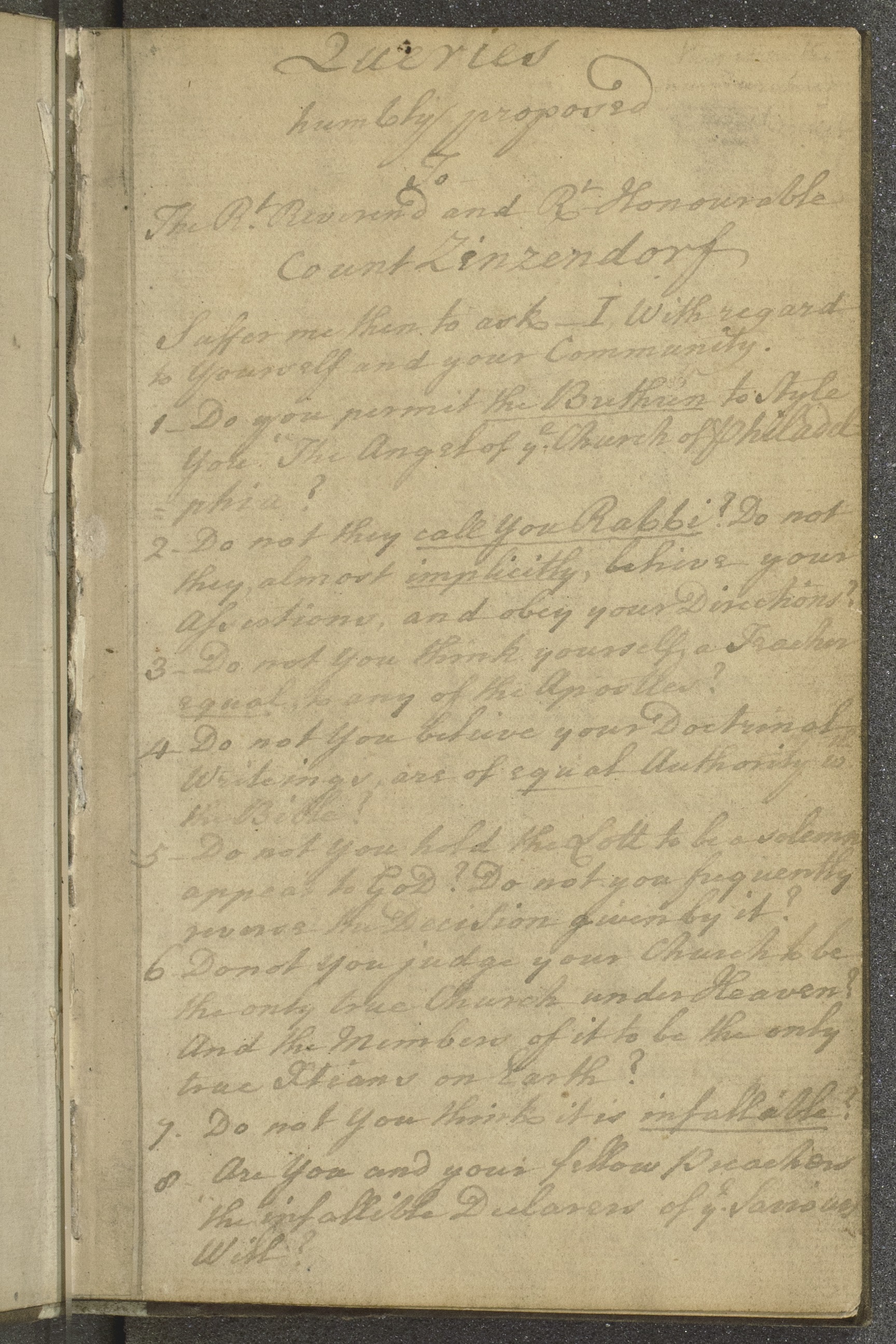
TextQueries humbly proposed to the Rt. Reverend and Rt. Honourable Count Zinzendorf
Bennet, John, 1714-1759Summary: A set of questions written by Bennet, here referred to as queries, posed to Count Niclaus Ludwig graf von Zinzendorf, the founder of the Moravian Church.Summary: A set of questions written by Bennet, here referred to as queries, posed to Count Niclaus Ludwig graf von Zinzendorf, the founder of the Moravian Church. -
 Still image
Effigies Danielis
Ganière, Pierre, 1663-1721An engraving of Daniel, flanked by a lion and lioness, the four beasts from his vision depicted in the sky on either side of his head.An engraving of Daniel, flanked by a lion and lioness, the four beasts from his vision depicted in the sky on either side of his head. -
 Still image
The Vision of the Four Beasts
Doré, Gustave, 1832-1883An engraving of the four beasts which appeared to Daniel in a vision rising from the sea.An engraving of the four beasts which appeared to Daniel in a vision rising from the sea. -
 Still image
Olaudah Equiano of Gustavus Vassa, De Africaan
An engraved portrait of Olaudah Equiano which appears in his autobiography.An engraved portrait of Olaudah Equiano which appears in his autobiography. -
 Still image
Monk Fish
A woodcut depicting a monstrous fish purportedly pulled from the sea in Poland, which had the appearance of a Catholic monk.A woodcut depicting a monstrous fish purportedly pulled from the sea in Poland, which had the appearance of a Catholic monk. -
 Still image
Bishop Fish
A woodcut depicting a monstrous fish purportedly pulled from the sea in Poland, which had the appearance of a Roman Catholic bishop.A woodcut depicting a monstrous fish purportedly pulled from the sea in Poland, which had the appearance of a Roman Catholic bishop. -
 Still image
Map of the Four Beasts from Daniel's Vision
A woodcut depicting the four beasts described in Daniel's vision placed on a map, one each in Europe and Africa, and two in Asia. The beasts are placed in such a way that they surround the holy land.A woodcut depicting the four beasts described in Daniel's vision placed on a map, one each in Europe and Africa, and two in Asia. The beasts are placed in such a way that they surround the holy land. -
 Still image
The Beasts from the Sea and Earth
An engraving of the two beasts mentioned in Revelations. On the left, is the seven-headed beast from the sea. On the hill to the right is the "lamb-horned" beast from the earth.An engraving of the two beasts mentioned in Revelations. On the left, is the seven-headed beast from the sea. On the hill to the right is the "lamb-horned" beast from the earth. -
 Still image
Daniel's Vision of the Four Beasts
An engraving of the four beasts which appeared to Daniel in a vision. Each beast represented a different kingdom and is labeled from left to right: Roma (Rome), Grecia (Greece), Persia, and Asyria.An engraving of the four beasts which appeared to Daniel in a vision. Each beast represented a different kingdom and is labeled from left to right: Roma (Rome), Grecia (Greece), Persia, and Asyria. -
 Still image
Vision que Saint Iean eut du Dragon
Le Clerc, Sébastien, 1637-1714An engraving of the dragon mentioned in Revelations, which granted power and authority to the Beast from the Sea and the Beast from the Earth.An engraving of the dragon mentioned in Revelations, which granted power and authority to the Beast from the Sea and the Beast from the Earth.

Page 204 of 257
