Religion and Freedom in America
Religion and Freedom in America
To Worship According to Our Own Conscience

Introduction
Drawing on the collections of Pitts Theology Library, this exhibition investigates the premise that America is the land of the free through the lens of religious history. The phrase used in the title of the exhibition, “to worship according to our own conscience” comes from a pamphlet in which John Wesley raises doubt about the American pursuit of religious freedom. That tension serves as a starting point for the exhibition, which begins in the colonial period and follows a range of themes, including American independence, slavery, civil rights, and diverse religious traditions and movements. The items on display show how religious convictions, institutions, and identities have shaped American ideas of liberty and its limitations. Rather than presenting freedom as something attained in 1776, the exhibition explores it as an ongoing and contested process. Over the course of 250 years, American freedom has been invoked as a promise, denied to many, and repeatedly challenged and expanded.
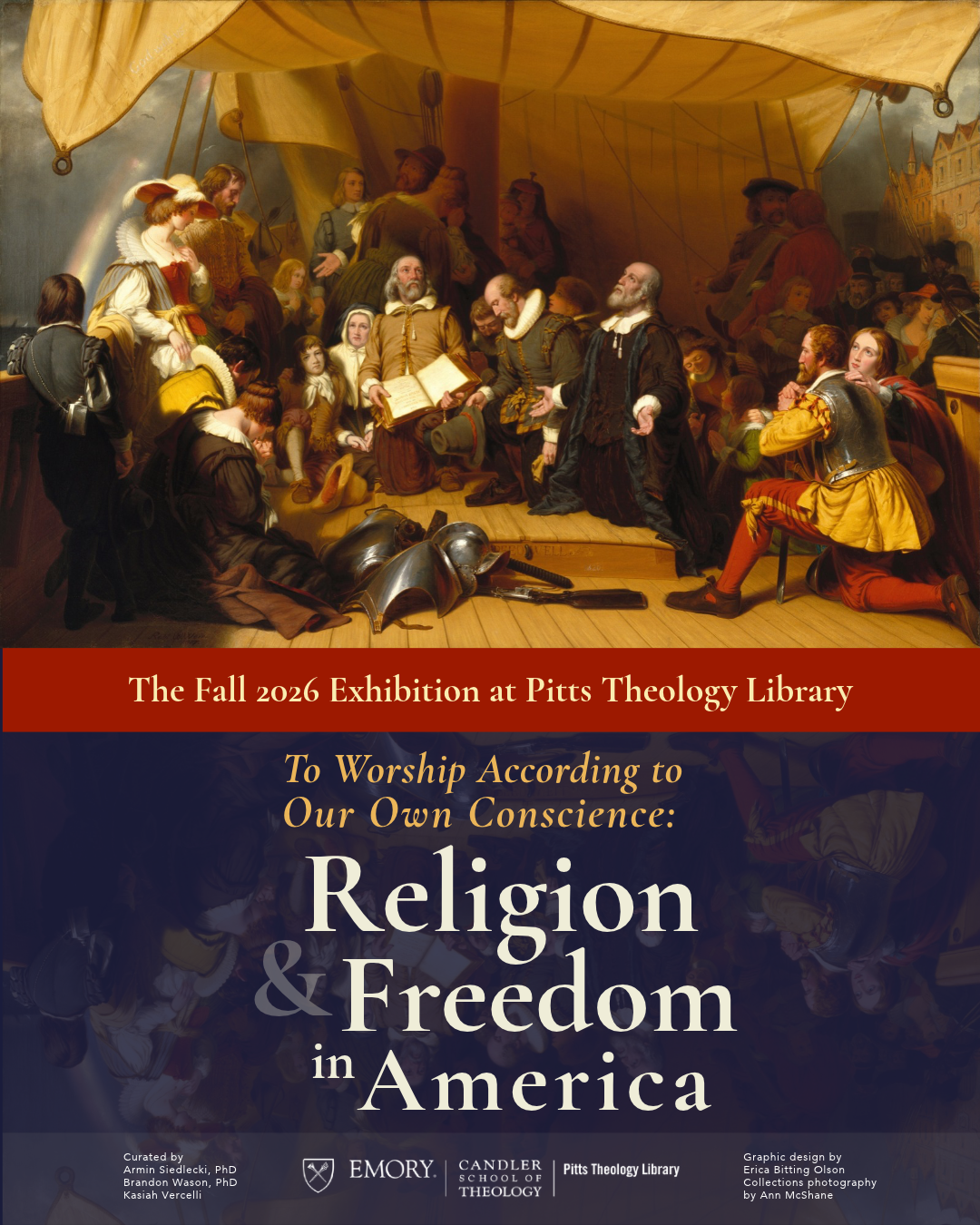
Image: Robert W. Weir (1803-1889), Embarkation of the Pilgrims (oil on canvas, 1843). Weir’s painting, located in the Rotunda of the United States Capitol, depicts English Pilgrims praying aboard the Speedwell in 1620 before departing from Holland for North America. The nineteenth-century painting presents the Pilgrims as they prepare to cross the Atlantic in pursuit of religious freedom, while the rainbow in the background suggests divine favor and foreshadows the anticipated success of their endeavor. Although the Speedwell ultimately failed to complete the voyage, many of its passengers continued their journey aboard the Mayflower and arrived in North America. In this respect, the painting may be interpreted allegorically on the difficult and ongoing nature of the American pursuit of liberty.