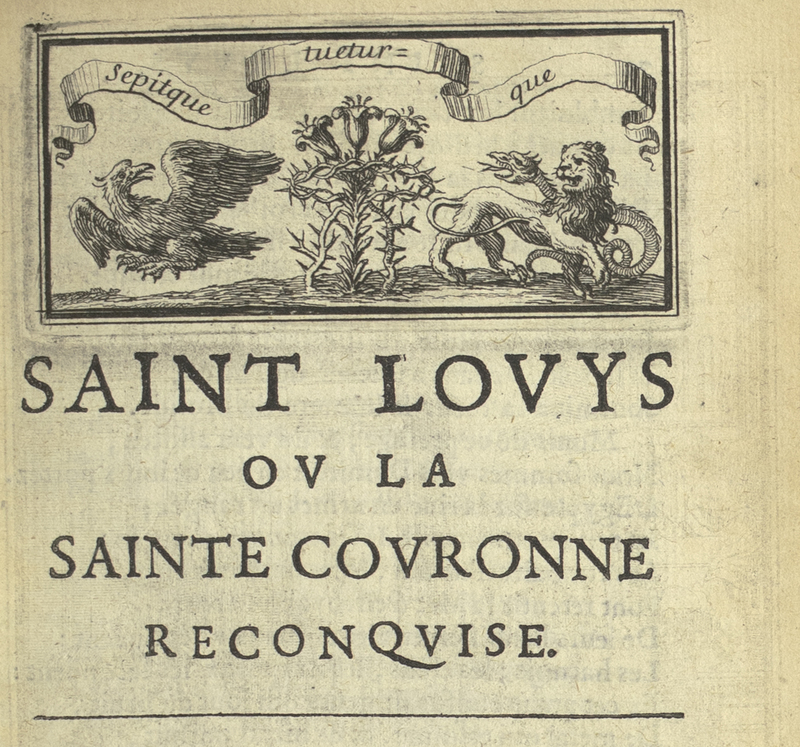
An engraved headpiece to the third, ninth, and fifteenth books of Moyne's epic, "Saint Louys," depicting a pair of thorny vines growing into a crown around three lilies, flanked by an eagle (left) and a lion and snake (right), above which is a banner with the Latin motto, "sepitque tueturque" (it confines/surrounds and protects).
An engraved headpiece to the third, ninth, and fifteenth books of Moyne's epic, "Saint Louys," depicting a pair of thorny vines growing into a crown around three lilies, flanked by an eagle (left) and a lion and snake (right), above which is a banner with the Latin motto, "sepitque tueturque" (it confines/surrounds and protects).
An engraved headpiece to the section "Traite' du poeme heroique" depicting a collection of instruments, including bagpipes, horns, trumpets, and an organ, above which is a banner reading "Spiritus est qui vivificat" (The spirit is that which brings life).
An engraved headpiece to the section "Traite' du poeme heroique" depicting a collection of instruments, including bagpipes, horns, trumpets, and an organ, above which is a banner reading "Spiritus est qui vivificat" (The spirit is that which brings life).
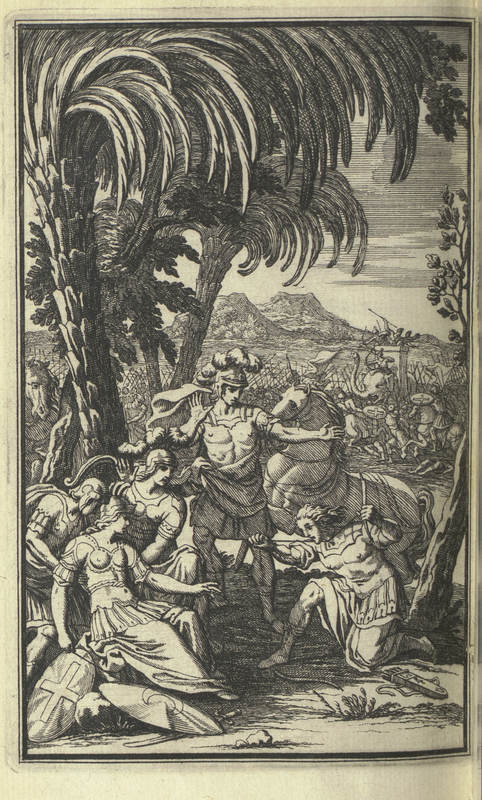
An engraving depicting a scene from the fifteenth book of the epic poem, Saint Louys, in which Alfasel (bottom right), who had accidentally wounded Zahide (bottom left) with a poisoned arrow while aiming for Lisamante, commits suicide. Meanwhile, Zahide is taken prisioner while in the background, the battle between the crusaders and the Saracens continues.
An engraving depicting a scene from the fifteenth book of the epic poem, Saint Louys, in which Alfasel (bottom right), who had accidentally wounded Zahide (bottom left) with a poisoned arrow while aiming for Lisamante, commits suicide. Meanwhile, Zahide is taken prisioner while in the background, the battle between the crusaders and the Saracens continues.
An engraving depicting a scene from the sixth book of the epic poem, Saint Louys, in which Sultan Mélédin (left), who had been preparing to sacrifice his daughter, Zahide (left, kneeling), watches as his son, Prince Muratan (center), stabs himself so that he can be sacrificed in his sister's place. The ene takes place on an altar beside the Nile river, where the Sultan and his children are joined by Mirème, the sorcerer, and a young woman holding a plate (possibly Almasonte, who later saves Zahide when she and her brother fall in the river).
An engraving depicting a scene from the sixth book of the epic poem, Saint Louys, in which Sultan Mélédin (left), who had been preparing to sacrifice his daughter, Zahide (left, kneeling), watches as his son, Prince Muratan (center), stabs himself so that he can be sacrificed in his sister's place. The ene takes place on an altar beside the Nile river, where the Sultan and his children are joined by Mirème, the sorcerer, and a young woman holding a plate (possibly Almasonte, who later saves Zahide when she and her brother fall in the river).
An engraving depicting a scene from the eleventh book of the epic poem, Saint Louys, in which, while in disguse as crusaders, Mélédor and Alzir infiltrate the French camp to rescue Almasonte and Zahide, who they then unknowingly duel, resulting in Zahide killing Mélédor (bottom right), and Alzir killing Almasonte and then committing suicide (center left).
An engraving depicting a scene from the eleventh book of the epic poem, Saint Louys, in which, while in disguse as crusaders, Mélédor and Alzir infiltrate the French camp to rescue Almasonte and Zahide, who they then unknowingly duel, resulting in Zahide killing Mélédor (bottom right), and Alzir killing Almasonte and then committing suicide (center left).
An engraving depicting a scene from the fourth book of the epic poem, Saint Louys, in which a pair of extravagently dressed figures appear riding an elephant, above which hangs a globe or disc representing the Heavens, with the fire of the sun encircling it as a cherub (representing modest love) sits atop it.
An engraving depicting a scene from the fourth book of the epic poem, Saint Louys, in which a pair of extravagently dressed figures appear riding an elephant, above which hangs a globe or disc representing the Heavens, with the fire of the sun encircling it as a cherub (representing modest love) sits atop it.
An engraving depicting a scene from the fourteenth book of the epic poem, Saint Louys, in which the body of the martyred Robert d'Artois, the brother of Saint Louis who fell in battle during the siege of Mansourah, is laid to rest in a tomb decorated with scenes of battle by a group of angels.
An engraving depicting a scene from the fourteenth book of the epic poem, Saint Louys, in which the body of the martyred Robert d'Artois, the brother of Saint Louis who fell in battle during the siege of Mansourah, is laid to rest in a tomb decorated with scenes of battle by a group of angels.
An engraved headpiece to the fourth, tenth, and sixteenth books of Moyne's epic, "Saint Louys," depicting a royal crown decorated with a crown of thorns, sitting atop a cushion on a table decorated with fleur-de-lis. Four monsters with human faces, lion's paws, snake's tails, and wings flank the crown and above the scene is a banner with the Latin motto, "Vincior hac Vincoque" (that which is bound here also conquers).
An engraved headpiece to the fourth, tenth, and sixteenth books of Moyne's epic, "Saint Louys," depicting a royal crown decorated with a crown of thorns, sitting atop a cushion on a table decorated with fleur-de-lis. Four monsters with human faces, lion's paws, snake's tails, and wings flank the crown and above the scene is a banner with the Latin motto, "Vincior hac Vincoque" (that which is bound here also conquers).
An engraving depicting a scene from the seventeenth book of the epic poem, Saint Louys, in which a recovered Zahide sees a vision of the Virgin Mary surounded by angels and holding a cross, and is converted.
An engraving depicting a scene from the seventeenth book of the epic poem, Saint Louys, in which a recovered Zahide sees a vision of the Virgin Mary surounded by angels and holding a cross, and is converted.
 Still image
 Still image
 Still image
 Still image
 Still image
 Still image
 Still image
 Still image
 Still image