Search
68 resources
68 items
Date
1524
-
 Still image
A Monk and a Knight
A woodcut depicting a monk in conversation with a knight. The woodcut appears on the title page of Luther's letter to the head of the Teutonic Order of Knights arguing against the requirement of celibacy.A woodcut depicting a monk in conversation with a knight. The woodcut appears on the title page of Luther's letter to the head of the Teutonic Order of Knights arguing against the requirement of celibacy. -
 Text
TextAin Beweysung, das der war Messias kom[m]en sey, des die Juden noch on Vrsach zůkünfftig sein, warte[n]
Samuel, MarochitanusSummary: German translation by Ludwig Hätzer of Epistola contra Judaeorum, thought to be written in Arabic by Samuel of Marocco, an apostate Jew at the beginning of the 11th century and translated into Latin by the Spanish Dominican Alphonsus Bonihominis in the 14th century and widely disseminated. Bonihominis is likely the real author of the work.Summary: German translation by Ludwig Hätzer of Epistola contra Judaeorum, thought to be written in Arabic by Samuel of Marocco, an apostate Jew at the beginning of the 11th century and translated into Latin by the Spanish Dominican Alphonsus Bonihominis in the 14th century and widely disseminated. Bonihominis is likely the real author of the work. -
 Text
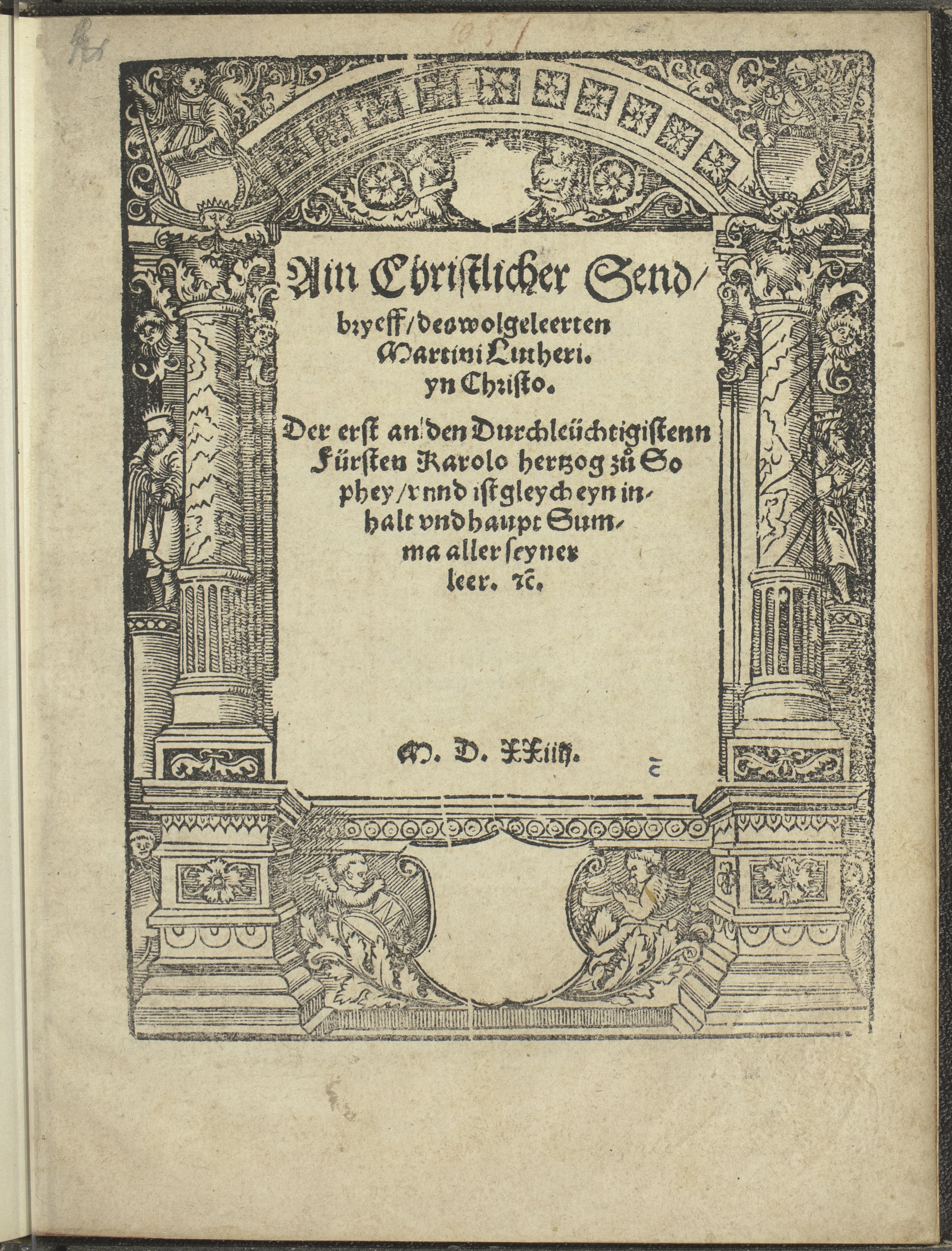
TextAin Christlicher Sendbryeff
Luther, Martin, 1483-1546Summary: This work is an anonymous translation to German from Latin of Luther's letter (Ad inlustrissimum principem Carolum Sabaudiae ducem Epistola) to Duke Charles III of Savoy, dated September 7, 1523.Summary: This work is an anonymous translation to German from Latin of Luther's letter (Ad inlustrissimum principem Carolum Sabaudiae ducem Epistola) to Duke Charles III of Savoy, dated September 7, 1523. -
 Text
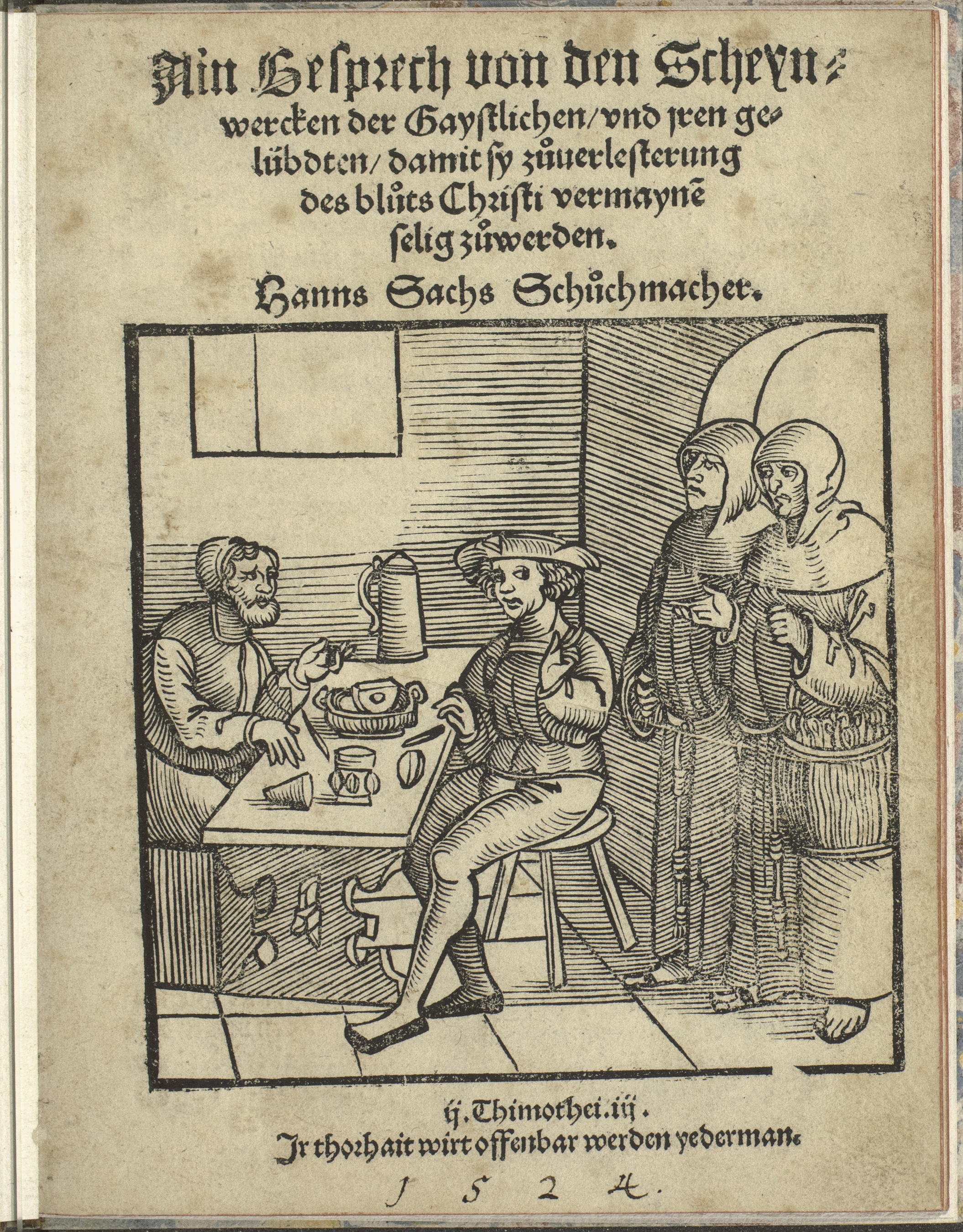
TextAin Gesprech von den Scheynwercken der Gaystlichen, vnd jren gelübdten, : damit sy zuouerlesterung des blouts Christi vermayne[n] selig zuowerden
Sachs, Hans, 1494-1576Summary: H. Sachs the Nuremberg "Master-Singer" and shoemaker became an early and ardent supporter of Luther and the Protestant cause. In this "trio-logue" a baker named Peter, a monk named Heinrich, and a shoemaker named Hans discuss questions relating to monastic life and monastic vows. The work is in prose, a change from Sachs' usual rhymed couplet format. This printing is from the same year as the first printing and re-uses the woodcut from the title page of the first printing.Summary: H. Sachs the Nuremberg "Master-Singer" and shoemaker became an early and ardent supporter of Luther and the Protestant cause. In this "trio-logue" a baker named Peter, a monk named Heinrich, and a shoemaker named Hans discuss questions relating to monastic life and monastic vows. The work is in prose, a change from Sachs' usual rhymed couplet format. This printing is from the same year as the first printing and re-uses the woodcut from the title page of the first printing. -
 Text
TextAin Sermon uon der frucht vnd nutzbarkait des hayligen Sacraments
Luther, Martin, 1483-1546Summary: Sermon preached April 2, 1523 (Maundy Thursday), on the value and efficacy of the Holy Sacrament.Summary: Sermon preached April 2, 1523 (Maundy Thursday), on the value and efficacy of the Holy Sacrament. -
 Text
TextAn die Herren deütschs Ordens : das sye falsche Keüscheit meyden, und zuor rechten eelichen Keuscheit greiffen, Ermanung
Luther, Martin, 1483-1546Summary: Sixth printing of a letter addressed to Albrecht von Brandenburg (later Albert, Duke of Prussia) the new General of the Teutonic Knights. In response to a question by the general, Luther applies his critique of monastic celibacy to military orders, stressing that it is pleasing to God to have families and to raise children.Summary: Sixth printing of a letter addressed to Albrecht von Brandenburg (later Albert, Duke of Prussia) the new General of the Teutonic Knights. In response to a question by the general, Luther applies his critique of monastic celibacy to military orders, stressing that it is pleasing to God to have families and to raise children. -
 Text
TextAn die Radherrn aller stedte deutsches lands : das sie Christliche schulen auffrichten vnd halten sollen
Luther, Martin, 1483-1546Summary: Radical reformers such as Karlstadt believed that education was unnecessary for faith. Luther argued against such a position, asking all cities to set up schools to teach correct doctrine. He also emphasized the need for teaching Latin and Greek as part of Christian education. This is the first printing of this important tract.Summary: Radical reformers such as Karlstadt believed that education was unnecessary for faith. Luther argued against such a position, asking all cities to set up schools to teach correct doctrine. He also emphasized the need for teaching Latin and Greek as part of Christian education. This is the first printing of this important tract. -
 Text
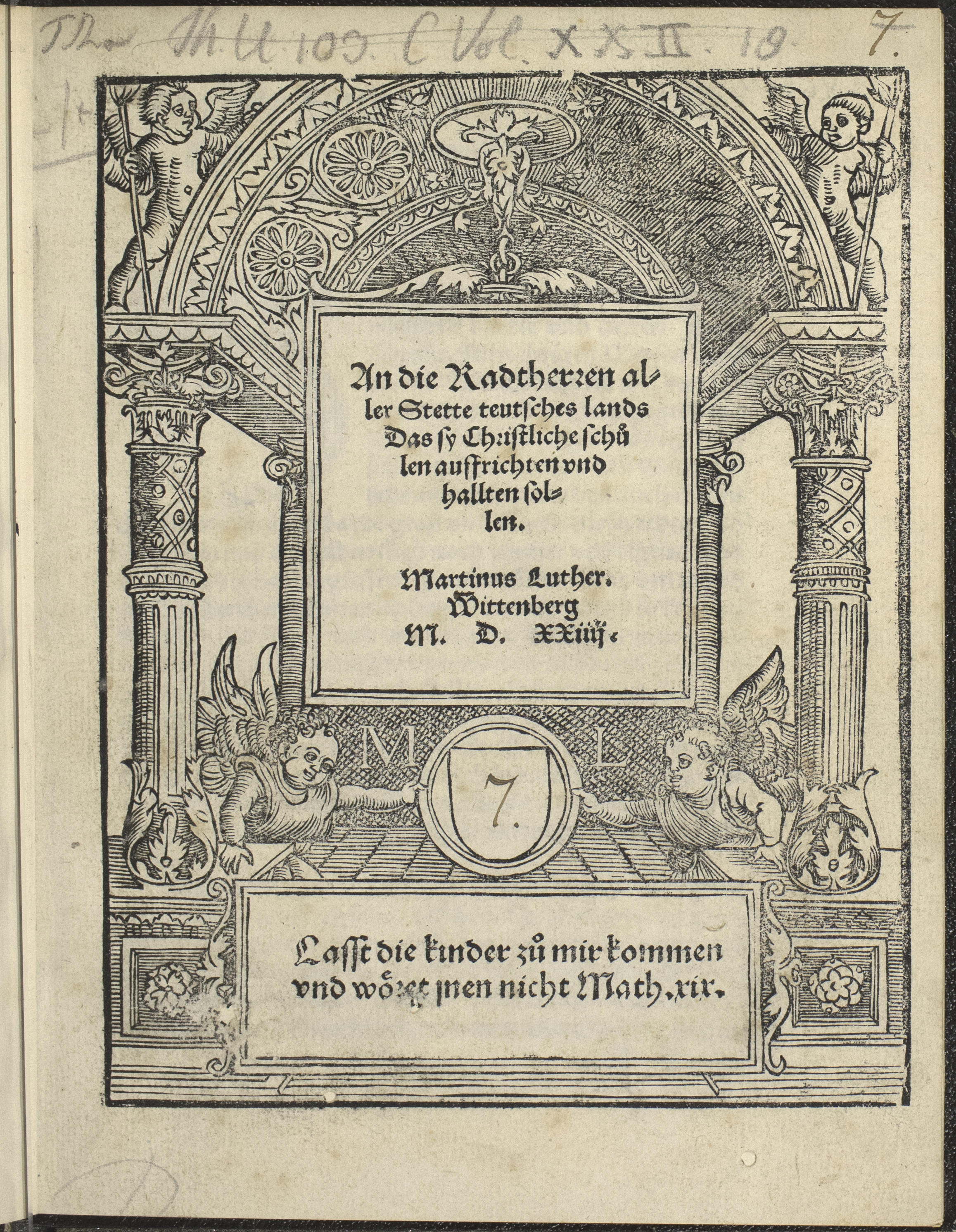
TextAn die Radtherren aller Stette teutsches lands : Das sy Christliche schuolen auffrichten vnd hallten sollen
Luther, Martin, 1483-1546Summary: This is the ninth printing of Luther's treatise addressed top the councilmen of Germany that they should promote the building of schools.Summary: This is the ninth printing of Luther's treatise addressed top the councilmen of Germany that they should promote the building of schools. -
 Text
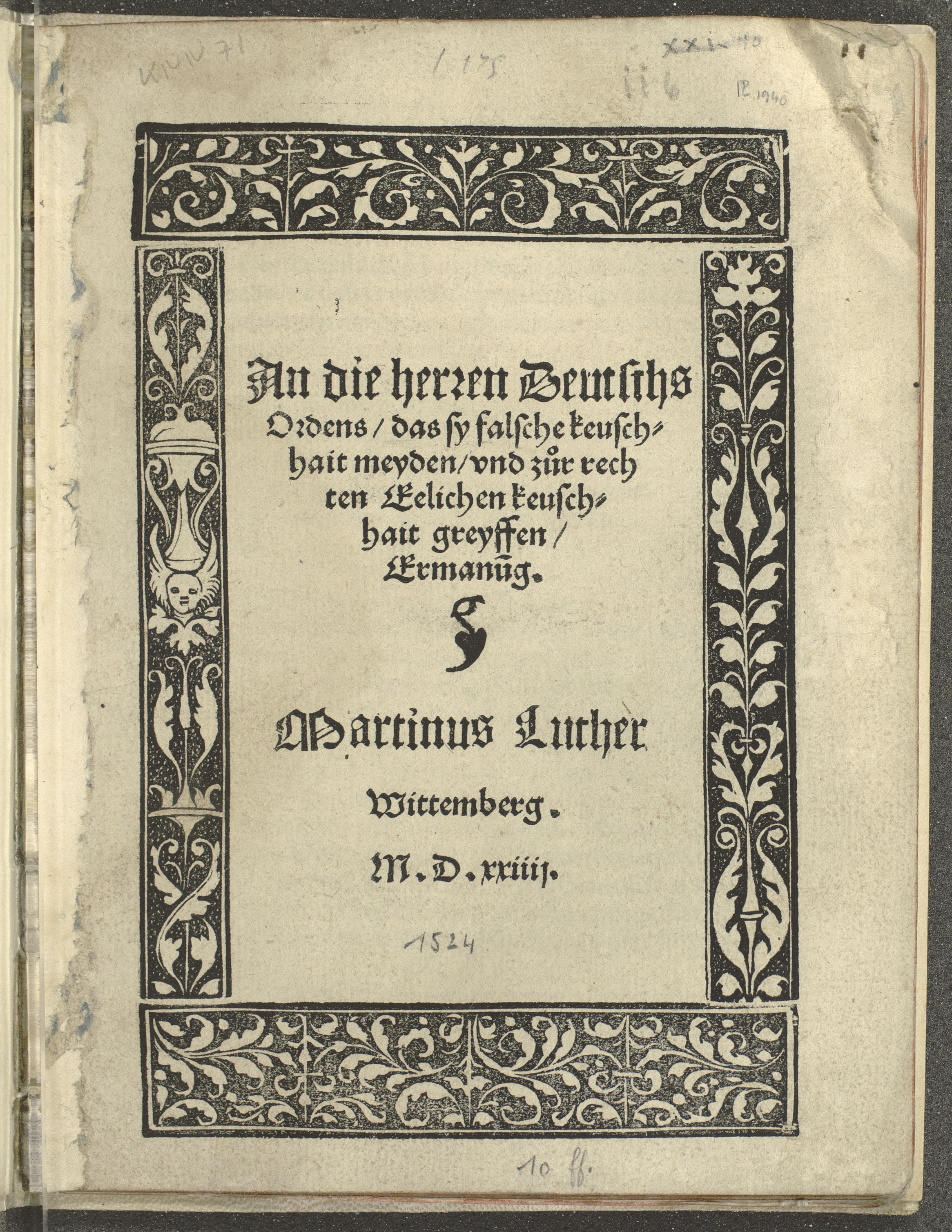
TextAn die herren Deutschs Ordens, das sy falsche keuschhait meyden, : Vnd zuor rechten Eelichen Keuschhait greyffen, Ermanu[n]g
Luther, Martin, 1483-1546Summary: In 1523, Albert of Brandenburg-Ansbach, Grand Master of the Teutonic Knights formerly embraced Lutheranism and secularized the lands of the order in Prussia. Luther was named as his court preacher, and was one of Duke Albert's most trusted advisors. This is a letter to the members of the order, advising them to reject their vows of celibacy and marry.Summary: In 1523, Albert of Brandenburg-Ansbach, Grand Master of the Teutonic Knights formerly embraced Lutheranism and secularized the lands of the order in Prussia. Luther was named as his court preacher, and was one of Duke Albert's most trusted advisors. This is a letter to the members of the order, advising them to reject their vows of celibacy and marry. -
 Text
TextChriste[n]lich Antwurt Burgermeisters vnd radts zů Zürich, dem hochwirdigen [et]c. Herren Hugen, Byschoffe zů Costantz, über die vnderricht beyd[er] articklen der Bilder vn[d] der Messz inen zůgeschickt ...
Zurich (Switzerland). StadtratSummary: This is a response, written by Zwingli and adopted by the Council of Zurich, to a warning letter from Hugo von Hohenlandenberg (1457-1532), Bishop of Constance, about the destruction of images (Simulacra) and the reform of the Holy Mass. The bishop argued that the Bible forbade only heathen images; Christian imagery was entirely licit and its use sanctioned by the Council of Nicaea. The book was circulated at the Diet of Lucerne in April 1524 but did not reach Zurich until early June.Summary: This is a response, written by Zwingli and adopted by the Council of Zurich, to a warning letter from Hugo von Hohenlandenberg (1457-1532), Bishop of Constance, about the destruction of images (Simulacra) and the reform of the Holy Mass. The bishop argued that the Bible forbade only heathen images; Christian imagery was entirely licit and its use sanctioned by the Council of Nicaea. The book was circulated at the Diet of Lucerne in April 1524 but did not reach Zurich until early June. -
 Text
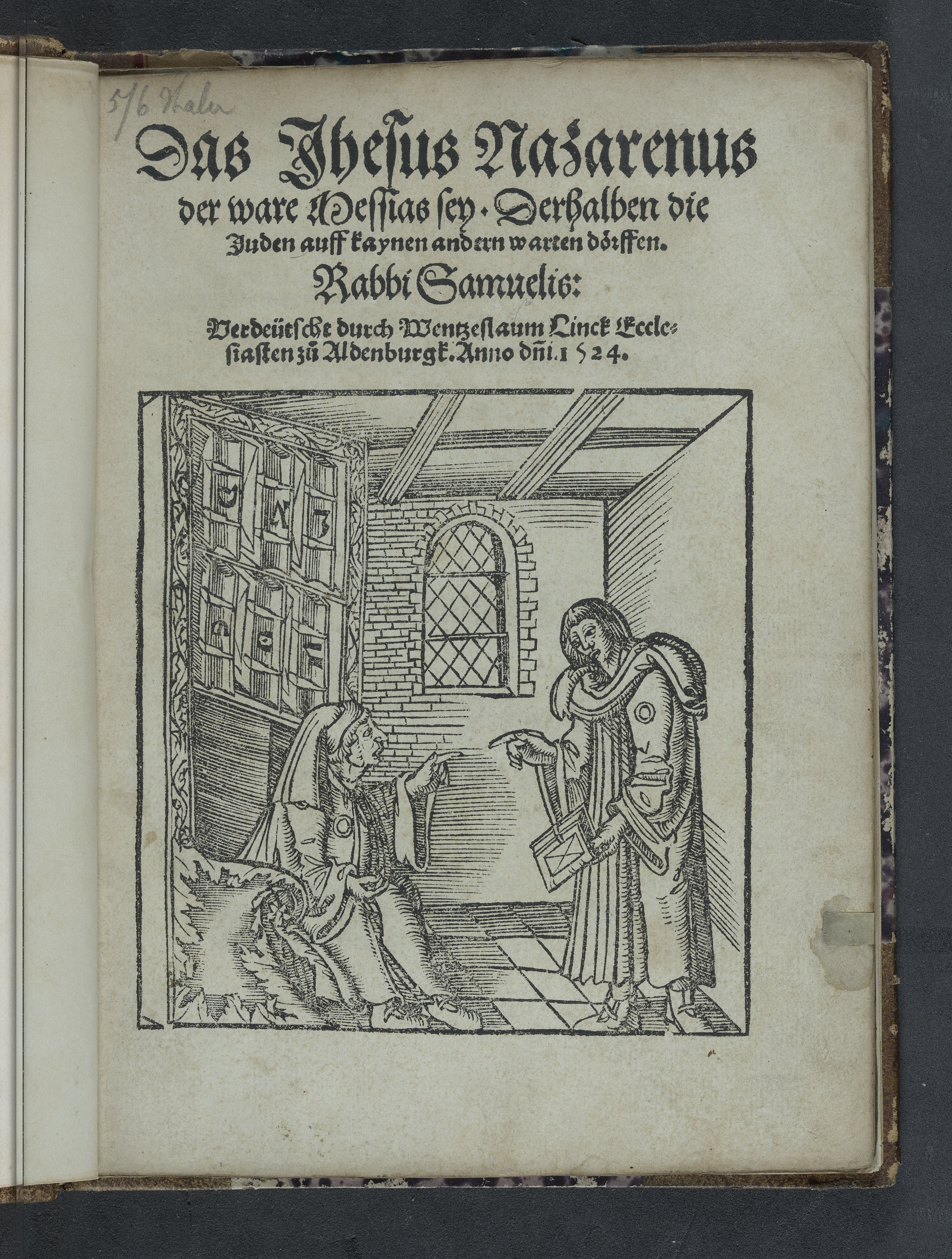
TextDas Jhesus Nazarenus der ware Messias sey : Derhalben die Juden auff kaynen andern warten dörffen
Samuel, MarochitanusSummary: German translation by Wenzeslaus Linck of Epistola contra Judaeorum, thought to be written in Arabic by Samuel of Marocco, an apostate Jew at the beginning of the 11th century and translated into Latin by the Spanish Dominican Alphonsus Bonihominis in the 14th century and widely disseminated. Bonihominis is likely the real author of the work.Summary: German translation by Wenzeslaus Linck of Epistola contra Judaeorum, thought to be written in Arabic by Samuel of Marocco, an apostate Jew at the beginning of the 11th century and translated into Latin by the Spanish Dominican Alphonsus Bonihominis in the 14th century and widely disseminated. Bonihominis is likely the real author of the work. -
 Text
TextDe Libero arbitrio ΔΙΑΤΡΙΒΗ, sive collatio
Erasmus, Desiderius, -1536Summary: Early edition of Erasmus' treatise on free human will and its limits.Summary: Early edition of Erasmus' treatise on free human will and its limits. -
 Text
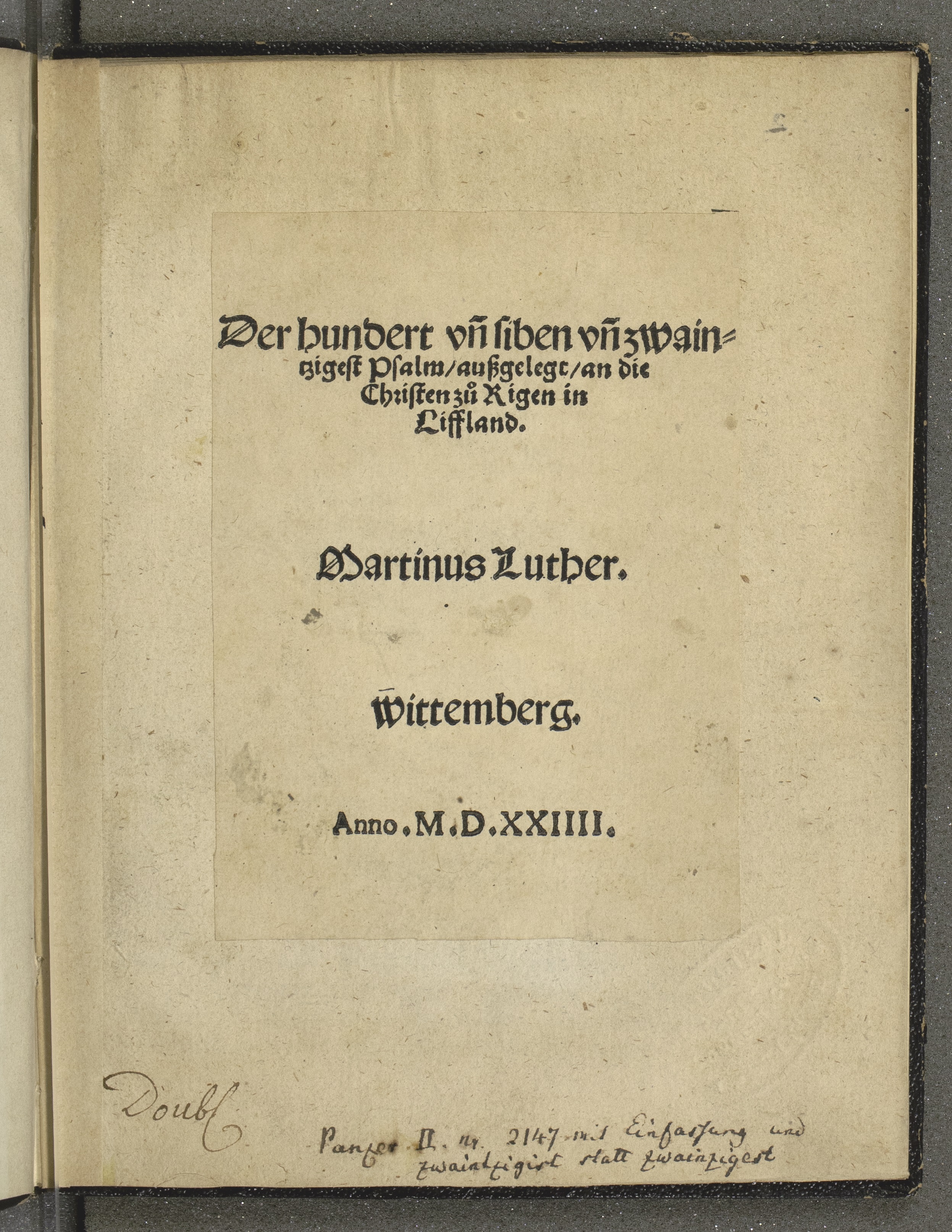
TextDer hundert vn[d] siben vn[d] zwaintzigest Psalm ausgelegt, an die Christen zu Rigen in Liffland
Luther, Martin, 1483-1546Summary: Luther's first attempts to communicate with the Protestants at Riga were unsuccessful. Later, communications were established, and this commentary on Psalm 127 was the result of their request for something edifying. This is the seventh printing of the work.Summary: Luther's first attempts to communicate with the Protestants at Riga were unsuccessful. Later, communications were established, and this commentary on Psalm 127 was the result of their request for something edifying. This is the seventh printing of the work. -
 Text
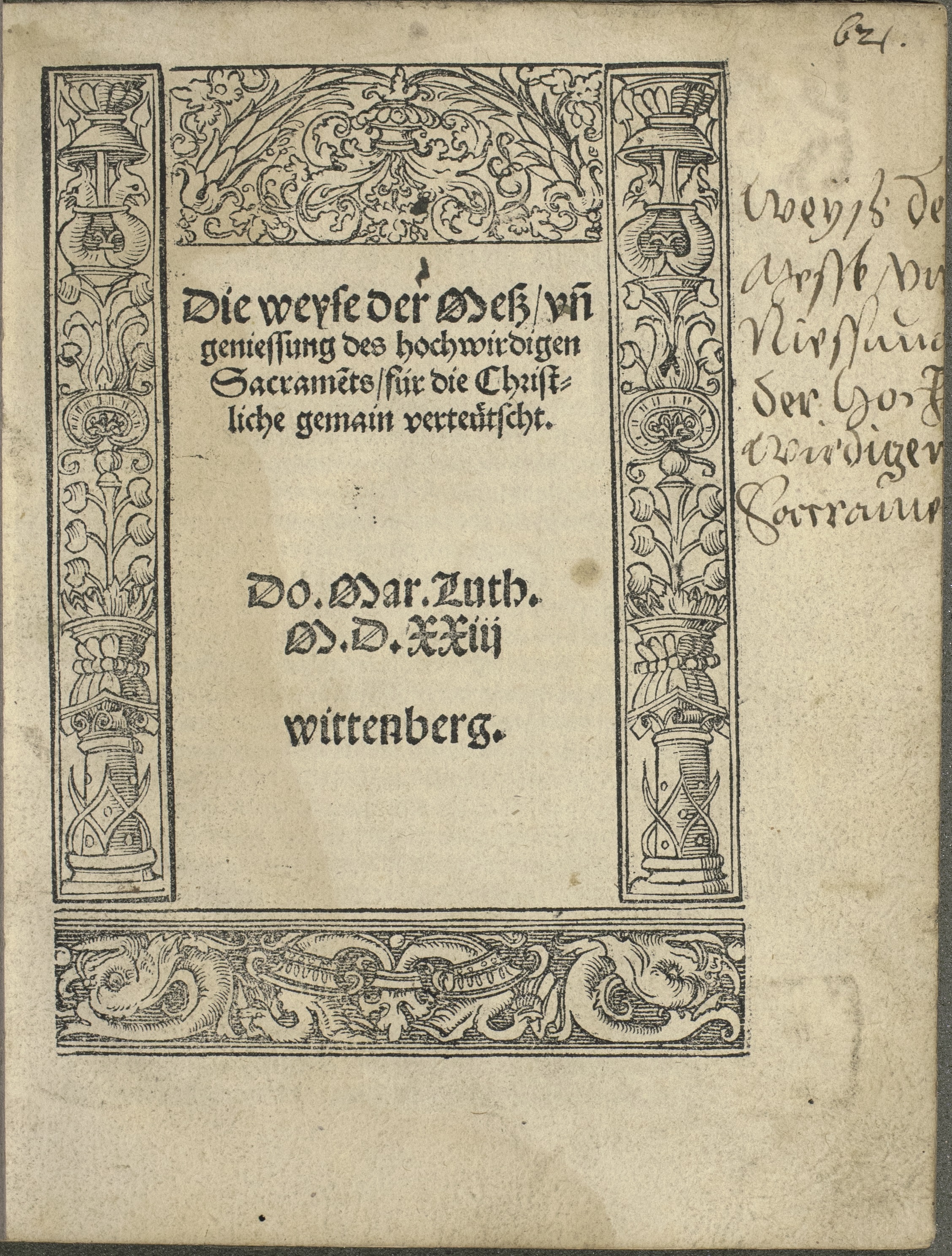
TextDie weyse der Mess, vn[d] geniessung des hochwirdigen Sacrame[n]ts, für die Christliche gemain verteütscht
Luther, Martin, 1483-1546Summary: First published in Latin in 1523, Luther defines in this tract the order of the Sunday worship service and the distribution of communion. This pamphlet is an important forerunner of Luther's "Deutsche Messe" (German Mass) published in 1526.Summary: First published in Latin in 1523, Luther defines in this tract the order of the Sunday worship service and the distribution of communion. This pamphlet is an important forerunner of Luther's "Deutsche Messe" (German Mass) published in 1526. -
 Text
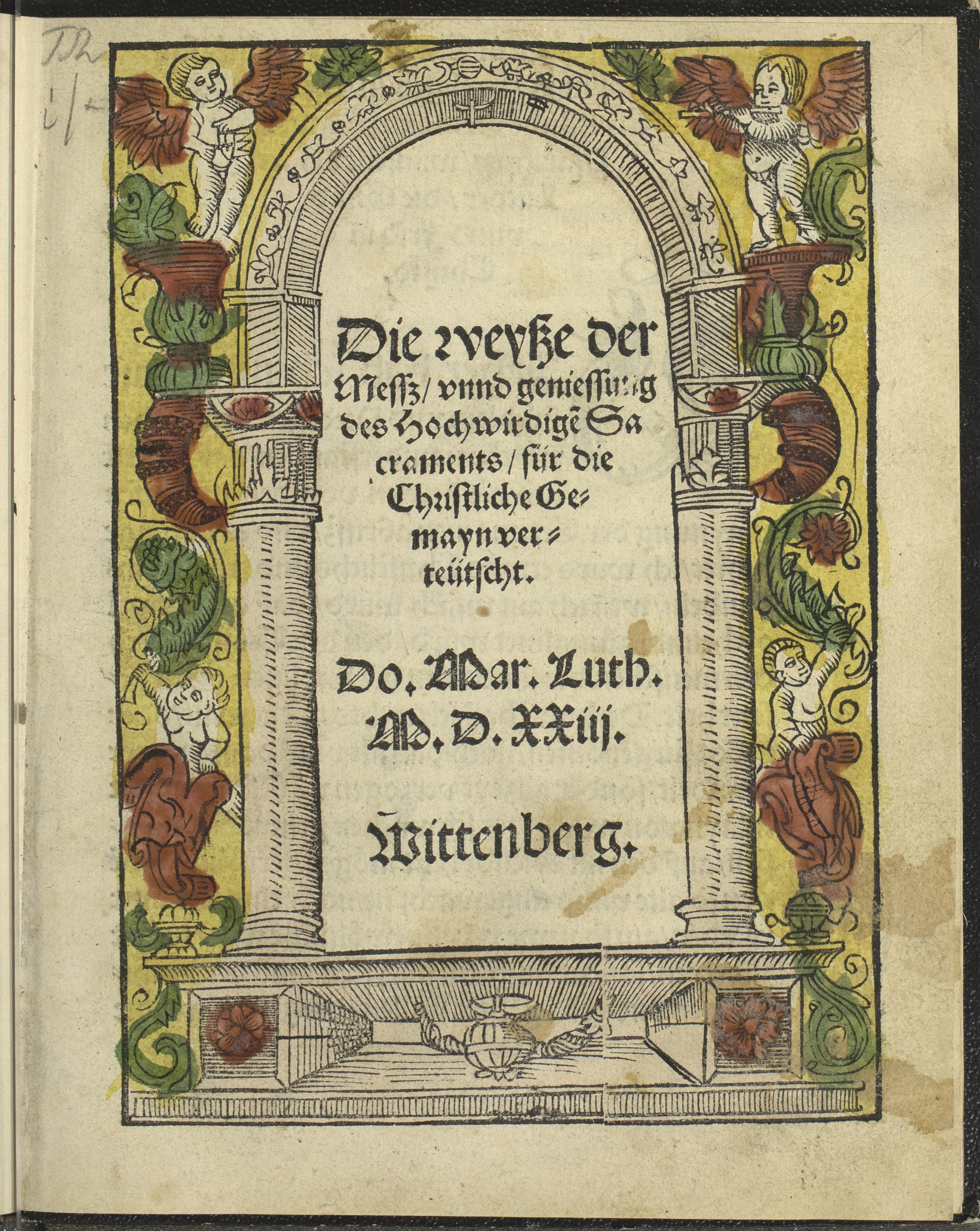
TextDie weysse der Messz, : vnnd geniesung des Hochwirdigen Sacraments, für die Christliche Gemayn verteütscht
Luther, Martin, 1483-1546Summary: Luther wrote his "Formula of the Mass and Communion" in 1523 at the insistence of N. Hausmann, the preacher at the Marienkirche, in Zwickau. Hausmann then wanted a German version to be used in his church. P. Speratus supplied one, and an unnamed Nuremberg translator supplied another. This is that Nuremberg work's first printing.Summary: Luther wrote his "Formula of the Mass and Communion" in 1523 at the insistence of N. Hausmann, the preacher at the Marienkirche, in Zwickau. Hausmann then wanted a German version to be used in his church. P. Speratus supplied one, and an unnamed Nuremberg translator supplied another. This is that Nuremberg work's first printing. -
 Text
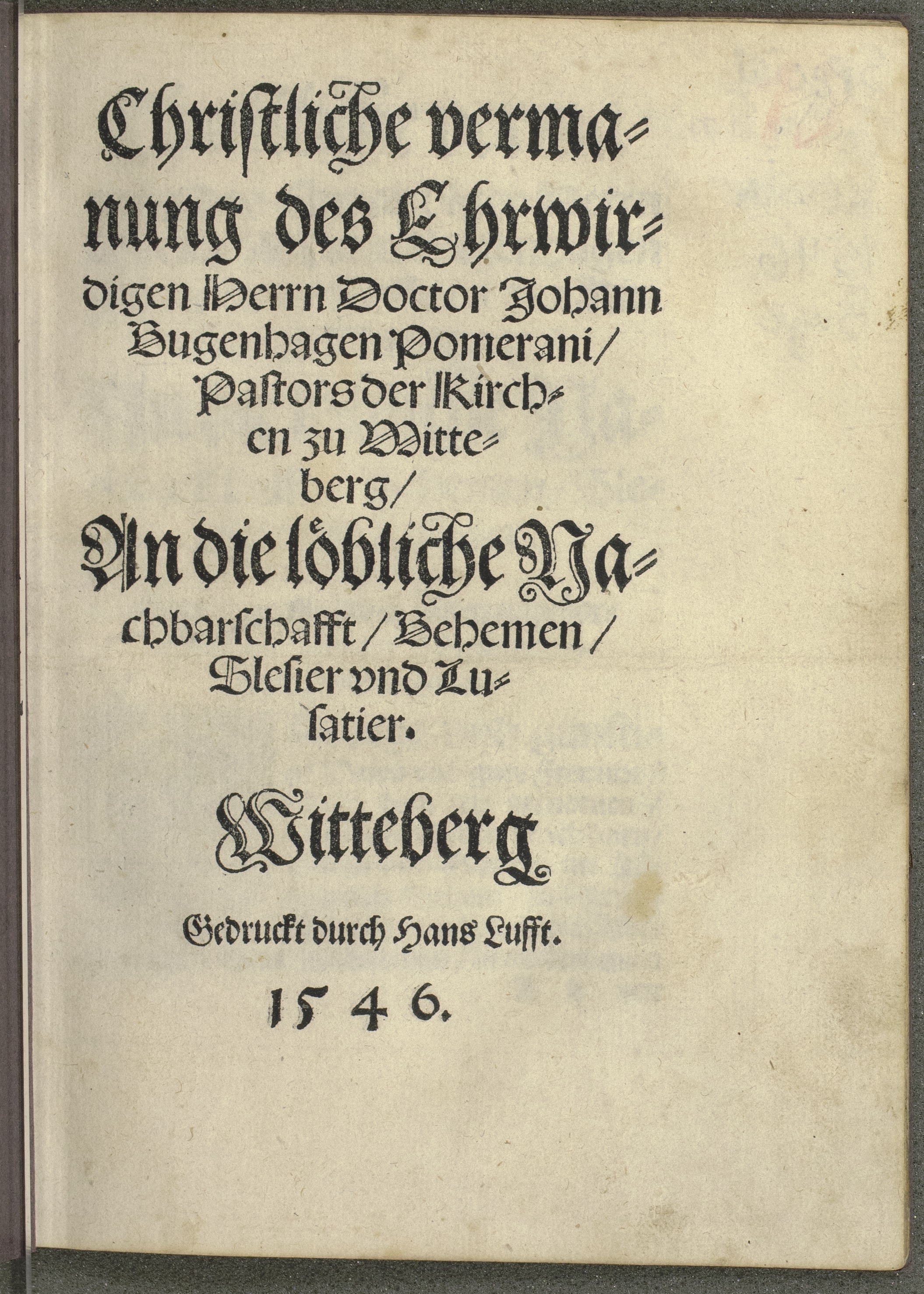
TextDoctor Martinus Lutthers [sic] verteutschte schrifft an das capitel zuo Witte[n]berg : Wie man die ceremonie[n] der kirchen bessern soll allen hohen vnnd Nydern Stifften ser dienstlich. Wittemberg. M.D.xxiiij.
Luther, Martin, 1483-1546Summary: Luther's letter to the provost, dean and canons of All Saints' Church in Wittenberg, written August 19, 1523, discussing the nature of the mass and his reasons for abolishing masses for the dead and for saints.Summary: Luther's letter to the provost, dean and canons of All Saints' Church in Wittenberg, written August 19, 1523, discussing the nature of the mass and his reasons for abolishing masses for the dead and for saints. -
 Text
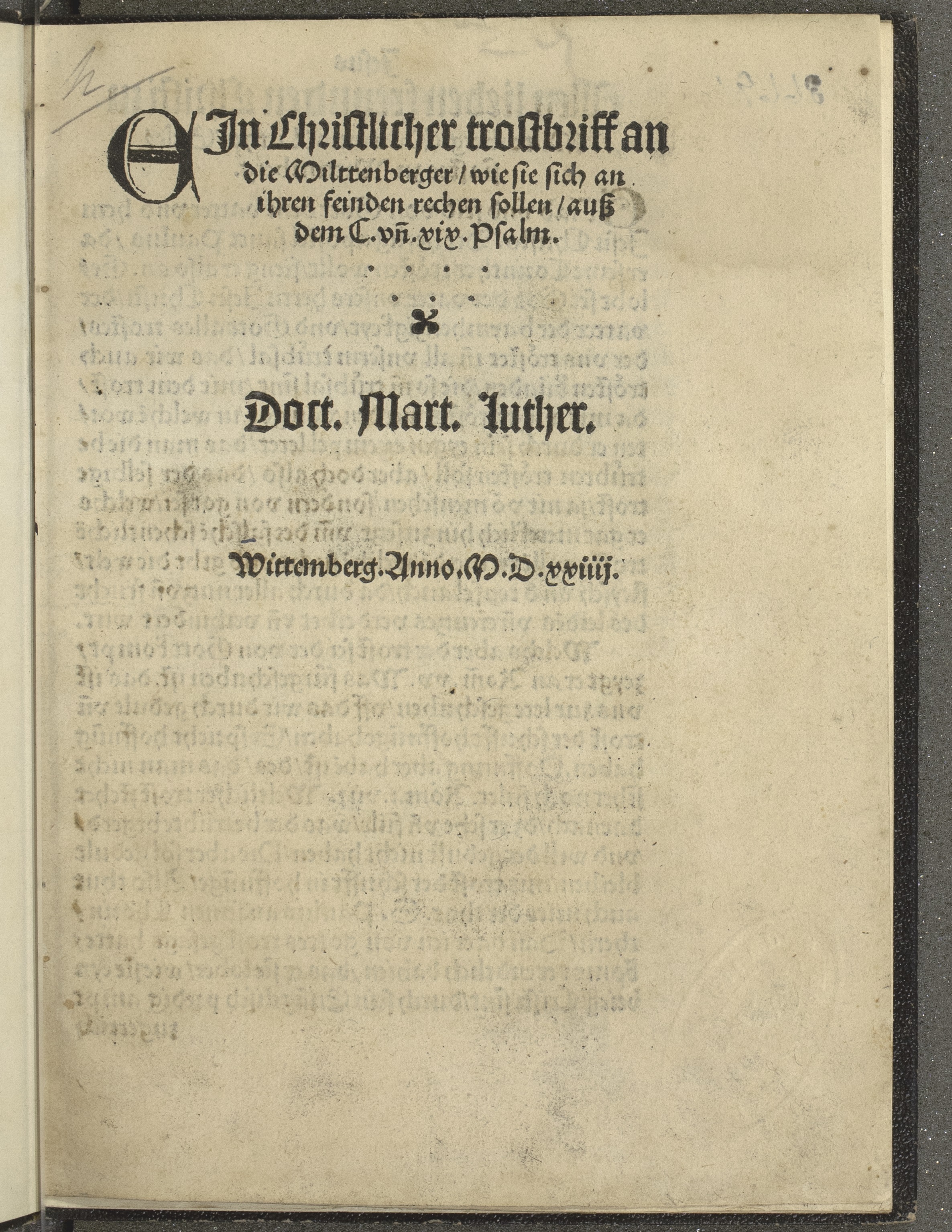
TextEin Christlicher trostbriff an die Milttenberger, : wie sie sich an ihren feinden rechen sollen, auss dem C. vn[d] xix. Psalm.
Luther, Martin, 1483-1546Summary: This is the sixth printing of Luther's letter of consolation to the citizens of Miltenburg. Text in German includes Luther's German translation of Psalms CXX from the Hebrew O.T.Summary: This is the sixth printing of Luther's letter of consolation to the citizens of Miltenburg. Text in German includes Luther's German translation of Psalms CXX from the Hebrew O.T. -
 Text
TextEin Sermon vnd eingang in das Erst buoch Mosi, das ist, in das buoch der Schöpfung, : darin grüntlich an zaygt wirt, der Artickel des glaube[n]s so wir sprechen, Ich glaub in got vater almechtigen, schöpffer himel vnd erdtrichs
Luther, Martin, 1483-1546Summary: This sermon on Genesis 1:1-5, was preached March 15, 1523. It is the first sermon that lasted until autumn, 1524. The entire series was not printed until 1527.Summary: This sermon on Genesis 1:1-5, was preached March 15, 1523. It is the first sermon that lasted until autumn, 1524. The entire series was not printed until 1527. -
 Text
TextEtlich Cristlich lider Lobgesang, vn[d] Psalm : dem reinen wort Gottes gemess, auss der heylige[n] schrifft, durch mancherley hochgelerter gemacht, in der Kirchen zu sigen, wie es dann zum tayl berayt zuo Wittenberg in übung ist
Summary: This is the first volume of printed hymns for church use ever compiled. Jobst Gutknecht, the Nuremberg printer, gathered eight broadside hymns into one collection, thus making the world's first church hymnal. Four hymns are by Luther, three are by Paul Speratus, and one is anonymous.Summary: This is the first volume of printed hymns for church use ever compiled. Jobst Gutknecht, the Nuremberg printer, gathered eight broadside hymns into one collection, thus making the world's first church hymnal. Four hymns are by Luther, three are by Paul Speratus, and one is anonymous. -
 Text
TextEyn Brieff an die Fürsten zu Sachsen von dem auffrurischen Geyst
Luther, Martin, 1483-1546Summary: Fourth printing of an open letter by Martin Luther to the princes of Saxony, in which he calls on them to monitor the actions of Thomas Müntzer in order to prevent the outbreak of violence. When war did break out the following year, Luther was one of the harshest critics of the rebelling peasants.Summary: Fourth printing of an open letter by Martin Luther to the princes of Saxony, in which he calls on them to monitor the actions of Thomas Müntzer in order to prevent the outbreak of violence. When war did break out the following year, Luther was one of the harshest critics of the rebelling peasants.
