Search
17 resources
17 items
Date
1529
-
 Text
TextAnnotationes Hieronimi Emsers, vber Luthers Newe Testame[n]t : ytzt tzum vierden mal vbersehen, welche auch mit dem Newen Testament, so Emser seliger verdeutschet, vnd am Jüngsten gedruckt, aussgangen sind, ym 1529 yhar.
Emser, Hieronymus, 1478-1527Summary: In this volume, Hieronymous Emser, who had himself translated the New Testament from Greek into German, provides a chapter by chapter commentary and critique on Martin Luther's translation of the New Testament.Summary: In this volume, Hieronymous Emser, who had himself translated the New Testament from Greek into German, provides a chapter by chapter commentary and critique on Martin Luther's translation of the New Testament. -
 Still image
Architectural historiated title page of Deudsch Catechismus
An architectural historiated woodcut border on the title page of Luther's German Catechism. The border consists of a decorative arch, topped with a pair of cherubs supporting a roundel with the Luther rose on the left and a crest with the Lamb of God on the right. At the bottom of the page, the scene of the Crucifixion is depicted with Jesus in the center, flanked by the two thieves, however as the bottom right corner of the page is torn away, the second thief is missing.An architectural historiated woodcut border on the title page of Luther's German Catechism. The border consists of a decorative arch, topped with a pair of cherubs supporting a roundel with the Luther rose on the left and a crest with the Lamb of God on the right. At the bottom of the page, the scene of the Crucifixion is depicted with Jesus in the center, flanked by the two thieves, however as the bottom right corner of the page is torn away, the second thief is missing. -
 Text
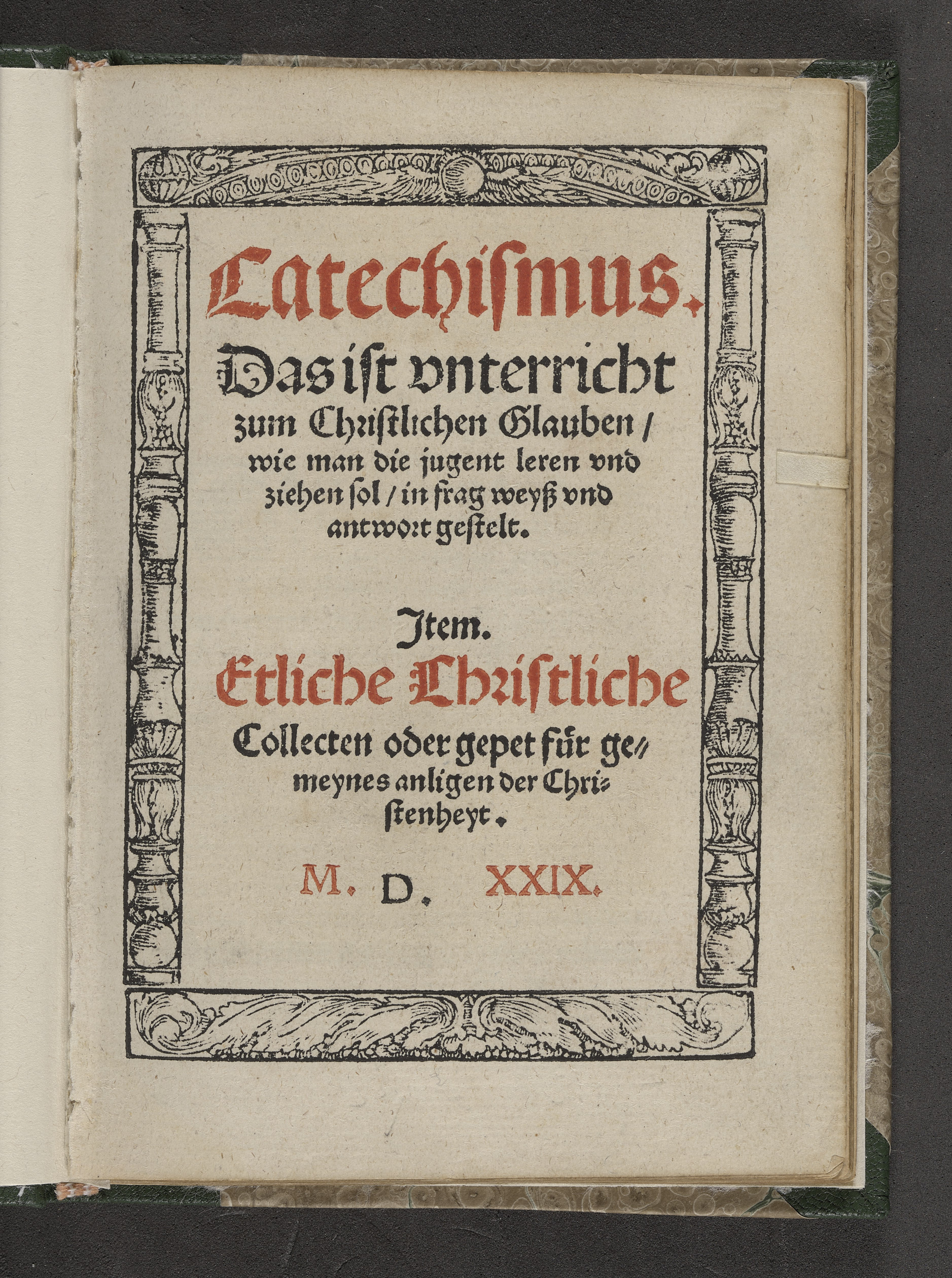
TextCatechismus. Das ist Vnterricht zum christlichen Glauben wie man die Jugent leren vnd ziehen sol, in Frag Weyss vnd Antwort gestelt : Jtem etliche christliche Collecten oder Gepet für gemeynes Anligen der Christenheyt
Althamer, Andreas, approximately 1500-1539Summary: Third printing of the Ansbach Catechism by Andreas Althamer and Johannes Rurer, commissioned by Margrave Georg of Brandenburg. It has been called the first regional catechism of the Protestant movement. It contains 92 questions and answers as well as an appendix with 18 prayers.Summary: Third printing of the Ansbach Catechism by Andreas Althamer and Johannes Rurer, commissioned by Margrave Georg of Brandenburg. It has been called the first regional catechism of the Protestant movement. It contains 92 questions and answers as well as an appendix with 18 prayers. -
![Summary: First edition of the second Latin translation of Luther's Large Catechism, published earlier the same year. This translation was done Vincentius Opsopäus (Vinzenz Heidecker). Issued with it is the first Latin edition of Johann Brenz's catechism, first published in German in 1528 under the title "Fragstuck des christlichen Glaube[n]s für die Jugend zu Schwebische[n] Hall]."](https://digital.pitts.emory.edu/files/large/P_300000218139/00000001.jpg) Text
TextD. Martini Lutheri theologi, catechismus, lećtu dignissimus, latinus faćtus per Vincentium Obsopoeum : Huic adiećti sunt alij quo[que] gemini Catechismi,Iohannis Brentij ecclesiastae Hallensis, eodem interprete
Luther, Martin, 1483-1546Summary: First edition of the second Latin translation of Luther's Large Catechism, published earlier the same year. This translation was done Vincentius Opsopäus (Vinzenz Heidecker). Issued with it is the first Latin edition of Johann Brenz's catechism, first published in German in 1528 under the title "Fragstuck des christlichen Glaube[n]s für die Jugend zu Schwebische[n] Hall]."Summary: First edition of the second Latin translation of Luther's Large Catechism, published earlier the same year. This translation was done Vincentius Opsopäus (Vinzenz Heidecker). Issued with it is the first Latin edition of Johann Brenz's catechism, first published in German in 1528 under the title "Fragstuck des christlichen Glaube[n]s für die Jugend zu Schwebische[n] Hall]." -
 Still image
Dog and Pig
An ornamental woodcut depicting a dog and a pig nose to nose with the back half of what might be a goat on the left.An ornamental woodcut depicting a dog and a pig nose to nose with the back half of what might be a goat on the left. -
 Still image
Grapes and grapevines
An ornamental woodcut depicting bunches of grapes on the vine.An ornamental woodcut depicting bunches of grapes on the vine. -
 Still image
Initial Letter A
A woodcut initial letter "A" depicting a trio of figures leaning agains and through the letter.A woodcut initial letter "A" depicting a trio of figures leaning agains and through the letter. -
 Still image
Initial Letter I
A woodcut initial letter "I" depicting a pair of naked figures holding poles or spears.A woodcut initial letter "I" depicting a pair of naked figures holding poles or spears. -
 Still image
Initial Letter V
A woodcut initial letter "V" depicting a horse or hound head with plant decorations.A woodcut initial letter "V" depicting a horse or hound head with plant decorations. -
 Still image
Initial Letter V
A woodcut initial letter "V" depicting a figure standing on the back of a second holding out a bunch of grapes.A woodcut initial letter "V" depicting a figure standing on the back of a second holding out a bunch of grapes. -
![A woodcut depicting Martin Luther as a seven-headed monster, critiquing his deviation from Catholicism. Each head is labeled (from left to right): Doctor, Martinus, Luther, Ecclesiast, Schwirmer [Schwärmer], Visitieter, and Barrabas. This was a classic piece of Catholic propaganda, portraying Luther not only as a Doctor and Churchman, but as a Turk, a wild enthusiast (Schwarmer) and "Barrabas."](https://digital.pitts.emory.edu/files/large/P_000015280452_P005/P_000015280452_P005_PROD.jpg) Still image
Still imageMartinus Luther Sieben Kopff
A woodcut depicting Martin Luther as a seven-headed monster, critiquing his deviation from Catholicism. Each head is labeled (from left to right): Doctor, Martinus, Luther, Ecclesiast, Schwirmer [Schwärmer], Visitieter, and Barrabas. This was a classic piece of Catholic propaganda, portraying Luther not only as a Doctor and Churchman, but as a Turk, a wild enthusiast (Schwarmer) and "Barrabas."A woodcut depicting Martin Luther as a seven-headed monster, critiquing his deviation from Catholicism. Each head is labeled (from left to right): Doctor, Martinus, Luther, Ecclesiast, Schwirmer [Schwärmer], Visitieter, and Barrabas. This was a classic piece of Catholic propaganda, portraying Luther not only as a Doctor and Churchman, but as a Turk, a wild enthusiast (Schwarmer) and "Barrabas." -
 Still image
Martinus Lutherus Septiceps
A woodcut depicting Martin Luther as a seven-headed monster, critiquing his deviation from Catholicism. Each head is labeled (from left to right): Doctor, Martinus, Lutherus, Ecclesiastes, Suermerus, Visitactor, and Barrabas. This was a classic piece of Catholic propaganda, portraying Luther not only as a Doctor and Churchman, but as a Turk, a wild enthusiast (Suermerus) and "Barrabas."A woodcut depicting Martin Luther as a seven-headed monster, critiquing his deviation from Catholicism. Each head is labeled (from left to right): Doctor, Martinus, Lutherus, Ecclesiastes, Suermerus, Visitactor, and Barrabas. This was a classic piece of Catholic propaganda, portraying Luther not only as a Doctor and Churchman, but as a Turk, a wild enthusiast (Suermerus) and "Barrabas." -
 Still image
Ornamental woodcut
An ornamental woodcut depicting a pair of capped figures riding hippocampi and holding shields, flanking a cherub's head.An ornamental woodcut depicting a pair of capped figures riding hippocampi and holding shields, flanking a cherub's head. -
 Still image
Ornamental woodcut
An ornamental woodcut depicting a pair of cherubs amongst some vines. The cherub on the left is riding a stick horse and holding an item similar to a pinwheel. On the right of the image, there is an arm holding an arrow which might be part of another cherub.An ornamental woodcut depicting a pair of cherubs amongst some vines. The cherub on the left is riding a stick horse and holding an item similar to a pinwheel. On the right of the image, there is an arm holding an arrow which might be part of another cherub. -
![A woodcut depicting Martin Luther as a seven-headed monster, critiquing his deviation from Catholicism. Each head is labeled (from left to right): Doctor, Martinus, Luther, Ecclesiast, Schwirmer [Schwärmer], Visitieter, and Barrabas. This was a classic piece of Catholic propaganda, portraying Luther not only as a Doctor and Churchman, but as a Turk, a wild enthusiast (Schwarmer) and "Barrabas."](https://digital.pitts.emory.edu/files/large/P_300000132224_P005/P_300000132224_P005-cr_PROD.jpg) Still image
Still imageSieben Köpffe Martini Luthers vom hochwirdigen Sacrament des Altars
A woodcut depicting Martin Luther as a seven-headed monster, critiquing his deviation from Catholicism. Each head is labeled (from left to right): Doctor, Martinus, Luther, Ecclesiast, Schwirmer [Schwärmer], Visitieter, and Barrabas. This was a classic piece of Catholic propaganda, portraying Luther not only as a Doctor and Churchman, but as a Turk, a wild enthusiast (Schwarmer) and "Barrabas."A woodcut depicting Martin Luther as a seven-headed monster, critiquing his deviation from Catholicism. Each head is labeled (from left to right): Doctor, Martinus, Luther, Ecclesiast, Schwirmer [Schwärmer], Visitieter, and Barrabas. This was a classic piece of Catholic propaganda, portraying Luther not only as a Doctor and Churchman, but as a Turk, a wild enthusiast (Schwarmer) and "Barrabas." -
 Text
TextTeütsche Letaney, vmb alles anligen der Cristenlichen gemayn
Luther, Martin, 1483-1546Summary: This is Luther's reinstatement of the Litany of "All Saints", containing both the musical notation and German text of the antiphons.Summary: This is Luther's reinstatement of the Litany of "All Saints", containing both the musical notation and German text of the antiphons. -
 Text
TextWes sich D. Martinus Luther. etc. mit Huldrich Zwinglin. etc. der streitigen Articulen halb, vereynet vnd verglichen auff der Conuocation zu[o] Marpurg, den dritten Tag Octob. Im Jar, M. D. xxix
Colloquy of Marburg (1529)Summary: The Colloquy of Marburg was a meeting arranged at the initiative of Philip of Hessen in an attempt to forge religious unity in Germany and mediate theological differences between Lutherans and Zwinglians. Besides Luther and Zwingli, the meeting was also attended by Johannes Agricola, Johannes Brenz, Martin Bucer, Caspar Hedio, Justus Jonas, Philipp Melanchthon, Johannes Oecolampadius, and Andreas Osiander.Summary: The Colloquy of Marburg was a meeting arranged at the initiative of Philip of Hessen in an attempt to forge religious unity in Germany and mediate theological differences between Lutherans and Zwinglians. Besides Luther and Zwingli, the meeting was also attended by Johannes Agricola, Johannes Brenz, Martin Bucer, Caspar Hedio, Justus Jonas, Philipp Melanchthon, Johannes Oecolampadius, and Andreas Osiander.