Summary: Radical reformers such as Karlstadt believed that education was unnecessary for faith. Luther argued against such a position, asking all cities to set up schools to teach correct doctrine. He also emphasized the need for teaching Latin and Greek as part of Christian education. This is the first printing of this important tract.
Summary: Radical reformers such as Karlstadt believed that education was unnecessary for faith. Luther argued against such a position, asking all cities to set up schools to teach correct doctrine. He also emphasized the need for teaching Latin and Greek as part of Christian education. This is the first printing of this important tract.
Parental consent was an issue during the Reformation. Catholic orthodoxy demanded parental consent of the bridal couple as it impacted property. Luther saw value in both sides, arguing that while parents ought not to be able to compel children to marry or prevent weddings, the children ought to seek their parents' consent.
Parental consent was an issue during the Reformation. Catholic orthodoxy demanded parental consent of the bridal couple as it impacted property. Luther saw value in both sides, arguing that while parents ought not to be able to compel children to marry or prevent weddings, the children ought to seek their parents' consent.
Summary: Early sixteenth century Europe experienced a serious agrarian crisis, resulting in widespread discontent among the peasants. Luther often had to defend his views, as he does in a letter to the Saxon princes, against accusations that his writing influenced "the spirit of rebellion."
Summary: Early sixteenth century Europe experienced a serious agrarian crisis, resulting in widespread discontent among the peasants. Luther often had to defend his views, as he does in a letter to the Saxon princes, against accusations that his writing influenced "the spirit of rebellion."
Summary: First printing of F. von Oberweimar's narrative of her escape from the convent of New-Helfta. She came to Luther in Wittenberg in 1524, and he published her explanation of her actions.
Summary: First printing of F. von Oberweimar's narrative of her escape from the convent of New-Helfta. She came to Luther in Wittenberg in 1524, and he published her explanation of her actions.
A woodcut border to Luther's An die Radherrn aller stedte deutsches lands : das sie Christliche schulen auffrichten vnd halten sollen printed in 1524. The border is composed of a single woodcut depicting an architectural archway supported by Corinthian columns (all), a pair of cherubs holding staves (top corners), and a pair of cherubs holding a medallion with a shield featuring a Luther rose (bottom).
A woodcut border to Luther's An die Radherrn aller stedte deutsches lands : das sie Christliche schulen auffrichten vnd halten sollen printed in 1524. The border is composed of a single woodcut depicting an architectural archway supported by Corinthian columns (all), a pair of cherubs holding staves (top corners), and a pair of cherubs holding a medallion with a shield featuring a Luther rose (bottom).
A woodcut border to Luther's Eyn brieff an die Fürsten zu Sachsen von dem auffrurischen geyst printed in 1524. The border is composed of a single woodcut and depicts a cherub flanked by two deer (bottom), decorative plants (sides), and a cherub holding a blank shield flanked by two other cherubs (top).
A woodcut border to Luther's Eyn brieff an die Fürsten zu Sachsen von dem auffrurischen geyst printed in 1524. The border is composed of a single woodcut and depicts a cherub flanked by two deer (bottom), decorative plants (sides), and a cherub holding a blank shield flanked by two other cherubs (top).
A woodcut border to Luther's Eyn geschicht wie Got eyner Erbarn kloster Jungfrawe[n] ausgeholffen hat printed in 1524. The border is composed of a single woodcut and depicts a cherub flanked by two deer (bottom), decorative plants (sides), and a cherub holding a blank shield flanked by two other cherubs (top).
A woodcut border to Luther's Eyn geschicht wie Got eyner Erbarn kloster Jungfrawe[n] ausgeholffen hat printed in 1524. The border is composed of a single woodcut and depicts a cherub flanked by two deer (bottom), decorative plants (sides), and a cherub holding a blank shield flanked by two other cherubs (top).
Summary: The catalyst for this famous Luther letter was the removal by stealth of nine nuns from the cloister of Nimbschen bei Grimma at Easter in the year 1523. Luther names the nine, which include a sister of Johann Staupitz, Luther's father confessor, and Katharina von Bora, who was to become Luther's wife.
Summary: The catalyst for this famous Luther letter was the removal by stealth of nine nuns from the cloister of Nimbschen bei Grimma at Easter in the year 1523. Luther names the nine, which include a sister of Johann Staupitz, Luther's father confessor, and Katharina von Bora, who was to become Luther's wife.
 Text
Text Text
Text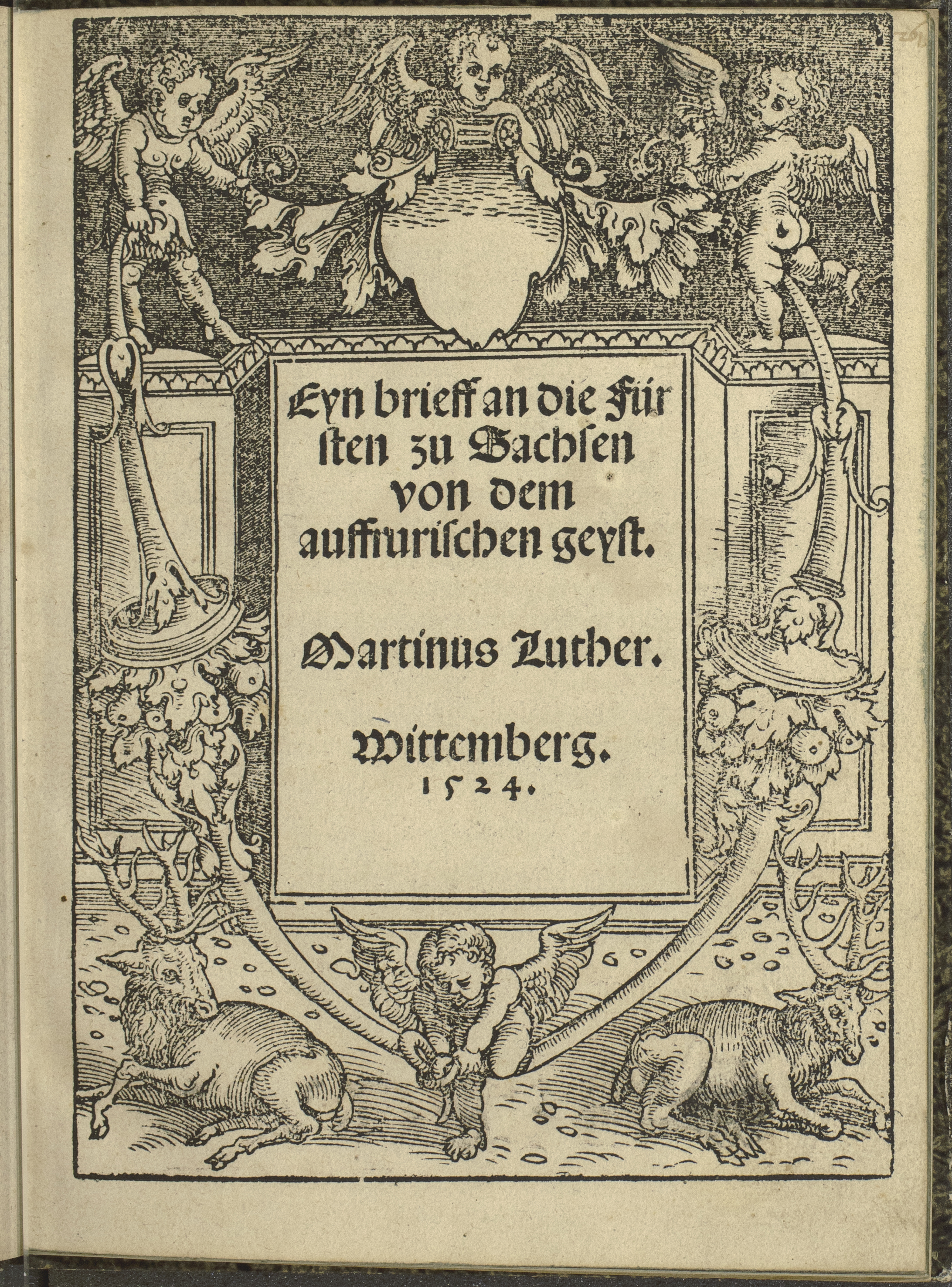 Text
Text Text
Text Still image
 Still image
![A woodcut border to Luther's Eyn geschicht wie Got eyner Erbarn kloster Jungfrawe[n] ausgeholffen hat printed in 1524. The border is composed of a single woodcut and depicts a cherub flanked by two deer (bottom), decorative plants (sides), and a cherub holding a blank shield flanked by two other cherubs (top).](https://digital.pitts.emory.edu/files/large/P_000015291127_P003/P_000015291127_P003_PROD.jpg) Still image
Still image Text
Text