Search
48 resources
48 items
Publisher
Lotter, Melchior, approximately 1490-
-
 Still image
Altar of Burnt Offerings and Bronze Laver
Cranach, Lucas, 1472-1553A woodcut depicting the bronze laver for priestly washing (top), the altar of burnt offering made of acacia wood with four horns on its four corners (center), and the bronze implements for tending the altar (bottom).A woodcut depicting the bronze laver for priestly washing (top), the altar of burnt offering made of acacia wood with four horns on its four corners (center), and the bronze implements for tending the altar (bottom). -
 Text
TextAn den Christlichen Adel deutscher Nation : von des Christlichen standes besserung
Luther, Martin, 1483-1546Summary: First edition and first printing of Luther's address "To the Christian nobility of the German nation" is the first of three great Reformation booklets Luther wrote 1520. This piece was completed in August and divided into three parts: (1) an attack on the Papacy and denial of its claims, (2) a list of abuses by the papacy and curia, and (3) a list of necessary reforms.Summary: First edition and first printing of Luther's address "To the Christian nobility of the German nation" is the first of three great Reformation booklets Luther wrote 1520. This piece was completed in August and divided into three parts: (1) an attack on the Papacy and denial of its claims, (2) a list of abuses by the papacy and curia, and (3) a list of necessary reforms. -
 Still image
Ark of the Covenant and Altar of Incense
Cranach, Lucas, 1472-1553A woodcut depicting the Ark of the Covanent with its lid decorated with two cherubim, and the Altar of Incense with a chalice of burning incense placed on it.A woodcut depicting the Ark of the Covanent with its lid decorated with two cherubim, and the Altar of Incense with a chalice of burning incense placed on it. -
 Still image
Christ in Glory
Cranach, Lucas, 1472-1553A woodcut depicting Saint John the Apostle's vision from the first chapter of Revelations of a Christ with flaming eyes, surrounded by seven candlesticks and holding seven stars, with a sword emerging from his mouth. The image appears in the September Testament, Martin Luther's first printing of his German New Testament.A woodcut depicting Saint John the Apostle's vision from the first chapter of Revelations of a Christ with flaming eyes, surrounded by seven candlesticks and holding seven stars, with a sword emerging from his mouth. The image appears in the September Testament, Martin Luther's first printing of his German New Testament. -
 Text
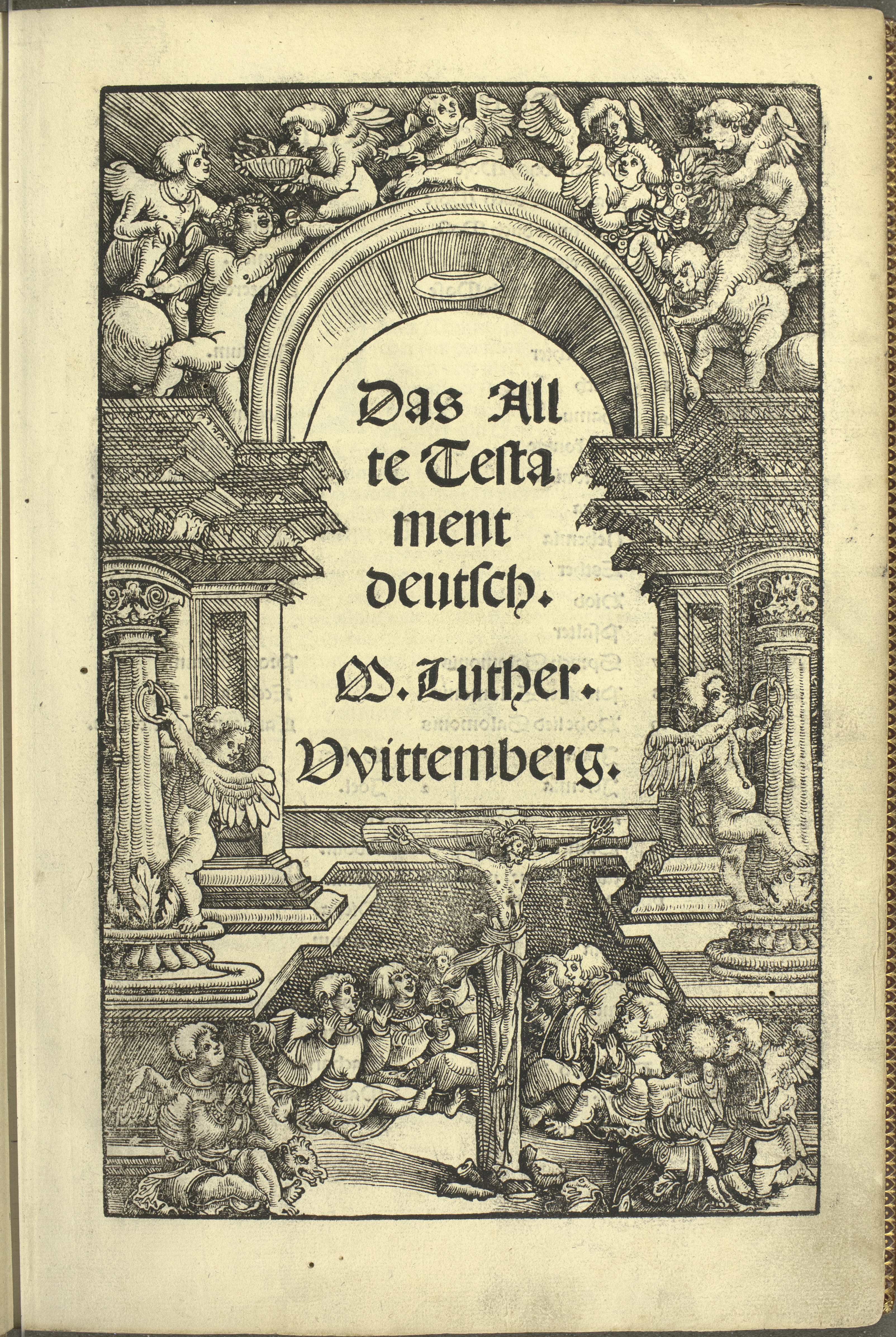
TextDas Allte Testament deutsch
Summary: This is the first printing of the first part of Luther's translation of the Old Testament into idiomatic German. It comprises the Pentateuch, or the five Books of Moses. Scholars long believed that this edition had been destroyed by Luther's friends because of its many printing errors. This printing contains 11 full-page and six initial-figure woodcuts. The volume has been heavily annotated in an early to mid-sixteenth century hand.Summary: This is the first printing of the first part of Luther's translation of the Old Testament into idiomatic German. It comprises the Pentateuch, or the five Books of Moses. Scholars long believed that this edition had been destroyed by Luther's friends because of its many printing errors. This printing contains 11 full-page and six initial-figure woodcuts. The volume has been heavily annotated in an early to mid-sixteenth century hand. -
 Text
TextDas Magnificat Vorteutschet vnd auszgelegt
Luther, Martin, 1483-1546Summary: Luther wrote this exposition of the Magnificent (Luke 1:46-55) in March 1521. He dedicated it to Duke Johann Frederich of Saxony as a token of his thanks to the Duke for his support and encouragement after Luther's condemnation by Pope Leo X. Text in German includes Luther's German translation of the Magnificat from the N.T. Greek of St. Luke's Gospel.Summary: Luther wrote this exposition of the Magnificent (Luke 1:46-55) in March 1521. He dedicated it to Duke Johann Frederich of Saxony as a token of his thanks to the Duke for his support and encouragement after Luther's condemnation by Pope Leo X. Text in German includes Luther's German translation of the Magnificat from the N.T. Greek of St. Luke's Gospel. -
 Text
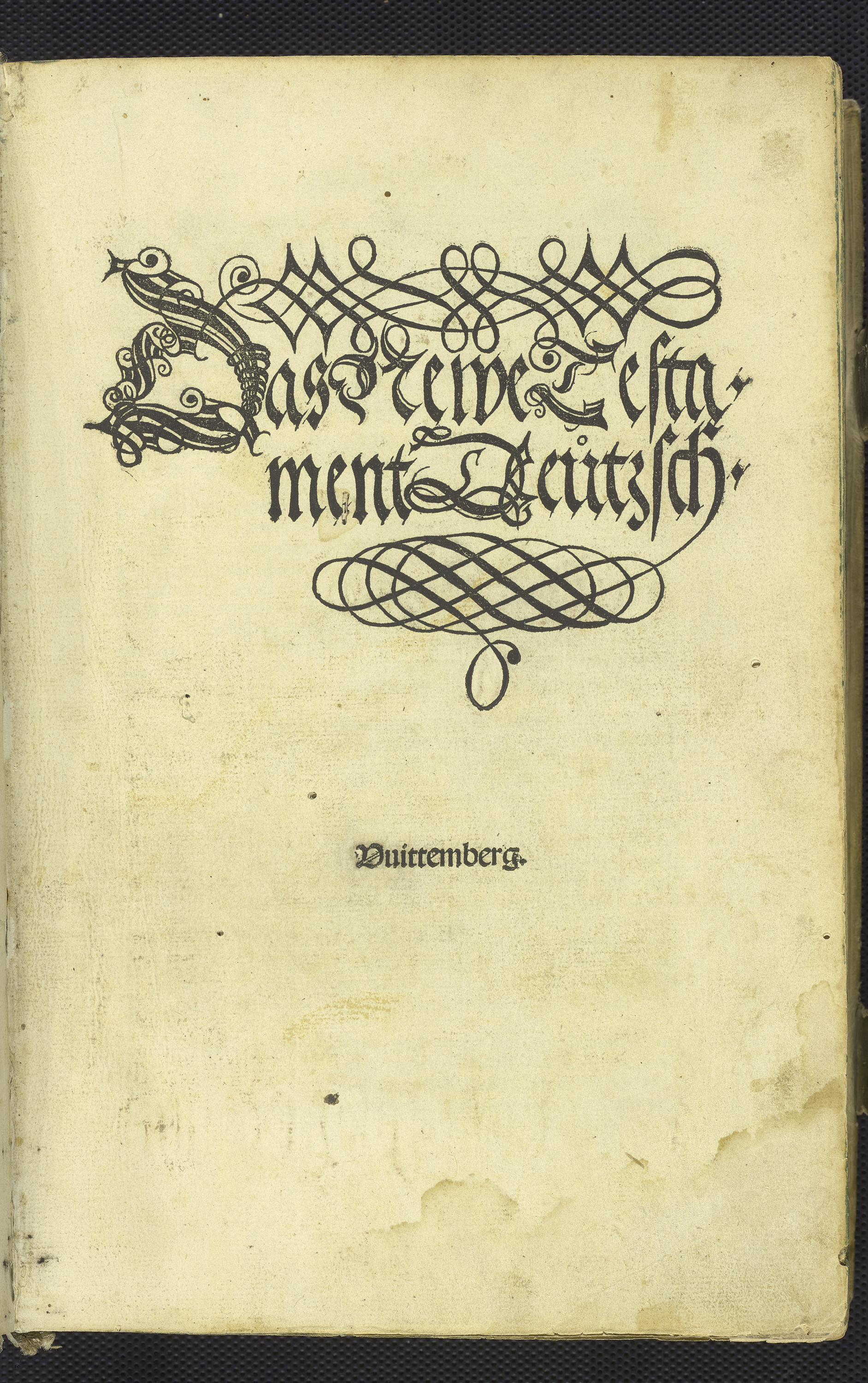
TextDas Newe Testament Deůtzsch
Summary: Luther's translation from the original Greek of the New Testament is a landmark in the history of the German language. His forceful style ensured that his Thuringian-Saxon dialect would provide the standard for High German in years to come. From a religious standpoint, Luther's decision to refer to the original Greek rather than merely to translate the Vulgate ensured that the German New Testament would be much more faithful to the original. Erasmus' New Testament provided the basis for the translation.Summary: Luther's translation from the original Greek of the New Testament is a landmark in the history of the German language. His forceful style ensured that his Thuringian-Saxon dialect would provide the standard for High German in years to come. From a religious standpoint, Luther's decision to refer to the original Greek rather than merely to translate the Vulgate ensured that the German New Testament would be much more faithful to the original. Erasmus' New Testament provided the basis for the translation. -

-
 Still image
Four Horsemen of the Apocalypse
Cranach, Lucas, 1472-1553A woodcut depicting the Four Horsemen of the Apocalypse: the first, a conquerer with a crown and bow, the second, with a sword, tasked with taking peace from the earth, the third holding scales, and the fourth, Death itself. The image appears in the September Testament, Martin Luther's first printing of his German New Testament.A woodcut depicting the Four Horsemen of the Apocalypse: the first, a conquerer with a crown and bow, the second, with a sword, tasked with taking peace from the earth, the third holding scales, and the fourth, Death itself. The image appears in the September Testament, Martin Luther's first printing of his German New Testament. -
 Still image
Historiated title page border of Luther's German translation of the Old Testament
Lemberger, Georg, 1495?-1540?A woodcut border to Luther's German translation of the Old Testament printed in 1523. The border is composed of one woodcut depicting an architectural arch supported by four columns, a gathering of cherubs (top and sides), and a group of worshipers (?) around a crucified Christ (bottom).A woodcut border to Luther's German translation of the Old Testament printed in 1523. The border is composed of one woodcut depicting an architectural arch supported by four columns, a gathering of cherubs (top and sides), and a group of worshipers (?) around a crucified Christ (bottom). -
 Still image
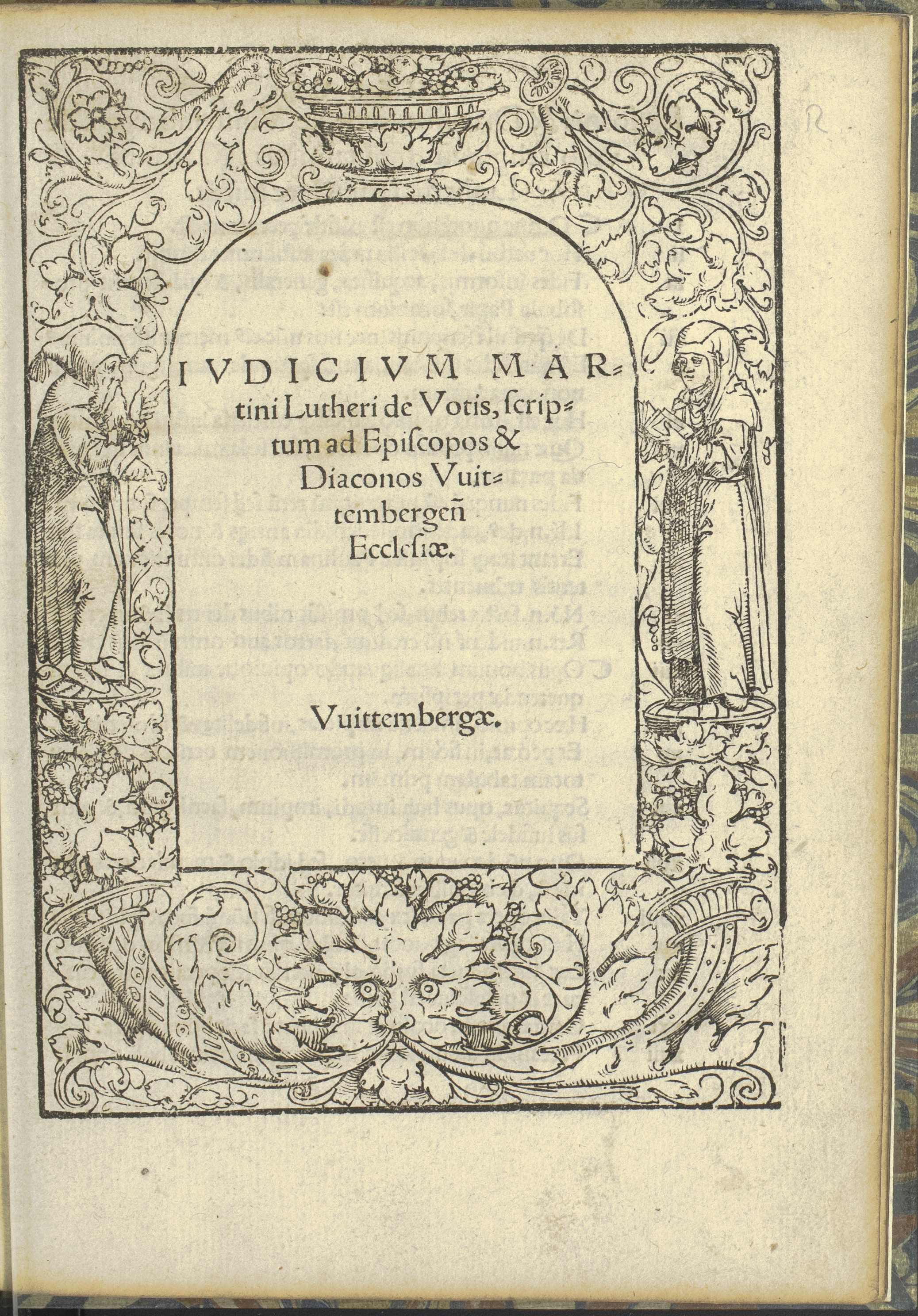
Historiated title page of Luther's Iudicium de votis
Cranach, Lucas, 1472-1553A woodcut border on the title page of Luther's Iudicium de votis printed in 1521. The border is done as a single woodcut depicting a monk (left), a nun (right), a Green Man of pagan and Christian lore (bottom), and a bowl of fruit (top). The intermediate spaces are filled with floral and plant decorative motifs.A woodcut border on the title page of Luther's Iudicium de votis printed in 1521. The border is done as a single woodcut depicting a monk (left), a nun (right), a Green Man of pagan and Christian lore (bottom), and a bowl of fruit (top). The intermediate spaces are filled with floral and plant decorative motifs. -
 Still image
Initial letter with God creating the world
Lemberger, Georg, 1495?-1540?A woodcut initial letter "A" depicting God creating the world. the arch of the "A" is made from a bent over plam tree.A woodcut initial letter "A" depicting God creating the world. the arch of the "A" is made from a bent over plam tree. -
 Still image
Initial letter with Moses delivering his farewell
Lemberger, Georg, 1495?-1540?A woodcut initial letter "D" illustrated with the scene of Moses delivering his farewell discourse while God looks down from Heaven. Moses is depicted with horns, a common practice in Western art before the Renaissance.A woodcut initial letter "D" illustrated with the scene of Moses delivering his farewell discourse while God looks down from Heaven. Moses is depicted with horns, a common practice in Western art before the Renaissance. -
 Still image
Initial letter with Moses delivering his farewell
Lemberger, Georg, 1495?-1540?A woodcut initial letter "D" illustrated with the scene of Moses delivering his farewell discourse while God looks down from Heaven. Moses is depicted with horns, a common practice in Western art before the Renaissance.A woodcut initial letter "D" illustrated with the scene of Moses delivering his farewell discourse while God looks down from Heaven. Moses is depicted with horns, a common practice in Western art before the Renaissance. -
 Still image
Initial letter with Moses kneeling before God
Lemberger, Georg, 1495?-1540?A woodcut initial letter "U" depicting Moses praying before God in Heaven, who is holding a globus cruciger. Moses is here depicted with horns, which was common before the Renaissance. The shape of the "U" includes two cherubs atop pillars and a bound bird.A woodcut initial letter "U" depicting Moses praying before God in Heaven, who is holding a globus cruciger. Moses is here depicted with horns, which was common before the Renaissance. The shape of the "U" includes two cherubs atop pillars and a bound bird. -
 Still image
Initial letter with a sheep on an altar
Lemberger, Georg, 1495?-1540?A woodcut initial letter "U" depicting a woman and a man kneeling before an altar with a sheep on it. The bottom and right curve of the "U" is made from the image of a dragon.A woodcut initial letter "U" depicting a woman and a man kneeling before an altar with a sheep on it. The bottom and right curve of the "U" is made from the image of a dragon. -
 Still image
Initial letter with the transfigured Christ
Lemberger, Georg, 1495?-1540?A woodcut initial letter "D" depicting Jesus Christ transfigured in the presence of Peter, James, and John.A woodcut initial letter "D" depicting Jesus Christ transfigured in the presence of Peter, James, and John. -
 Text
TextIudicium Martini Lutheri de votis : scriptum ad episcopos & diaconos Vuittembergen[sis] ecclesiae
Luther, Martin, 1483-1546Summary: First edition of a short tract written by Luther at Wartburg castle and addressed to the bishop and religious leaders in Wittenberg. In 139 brief statements, Luther warns that religious vows and monastic life do not by themselves bring about the forgiveness of sins.Summary: First edition of a short tract written by Luther at Wartburg castle and addressed to the bishop and religious leaders in Wittenberg. In 139 brief statements, Luther warns that religious vows and monastic life do not by themselves bring about the forgiveness of sins. -
 Still image
Jacob's Dream
Cranach, Lucas, 1472-1553A woodcut depicting God blessing Jacob as he dreams, represented by three angels descending/ascending a ladder linking Heaven and Earth. Above the woodcut is a section of handwritten marginalia.A woodcut depicting God blessing Jacob as he dreams, represented by three angels descending/ascending a ladder linking Heaven and Earth. Above the woodcut is a section of handwritten marginalia. -
 Still image
Joseph interprets Pharaoh's Dream
Cranach, Lucas, 1472-1553A woodcut depicting Joseph beside Pharaoh's bedside (top) explaining the meaning of his dream of seven fat and seven lean cows, and seven good and seven lean stalks, represents seven years of feast and famine that will come to Egypt.A woodcut depicting Joseph beside Pharaoh's bedside (top) explaining the meaning of his dream of seven fat and seven lean cows, and seven good and seven lean stalks, represents seven years of feast and famine that will come to Egypt. -
 Still image
Lampstand and Table with Bread of Presence
Cranach, Lucas, 1472-1553A woodcut depicting the lampstand, table, and bread of presence surrounded by plates, jugs, and bowls.A woodcut depicting the lampstand, table, and bread of presence surrounded by plates, jugs, and bowls.