Search
17 resources
17 items
Publisher
Petri, Adam, 1454-1527
-
 Still image
Adam and Eve after eating from the Tree of Knowledge
A woodcut depicting Adam and Eve eating from the Tree of Knowledge as God looks on from Heaven. To the right, they are expelled from Eden by an angel wielding a sword. A set of four decorative woodcuts create a border around the main image and depict plants and birds.A woodcut depicting Adam and Eve eating from the Tree of Knowledge as God looks on from Heaven. To the right, they are expelled from Eden by an angel wielding a sword. A set of four decorative woodcuts create a border around the main image and depict plants and birds. -
 Text
TextBreuissima maximque compendiaria consiciendaru[m] epistolarum formula
Erasmus, Desiderius, -1536Summary: A short tract by Erasmus on the composition of letters.Summary: A short tract by Erasmus on the composition of letters. -
 Text
TextContra Henricum regem Angliae
Luther, Martin, 1483-1546Summary: This is the second and much expanded edition of Luther's reply to Henry VIII's Assertion of the Seven Sacraments. Luther replies quite moderately (for him) to what he feels to be the King's unwarranted assertions on the Catholic Sacraments. This is the second printing of this edition.Summary: This is the second and much expanded edition of Luther's reply to Henry VIII's Assertion of the Seven Sacraments. Luther replies quite moderately (for him) to what he feels to be the King's unwarranted assertions on the Catholic Sacraments. This is the second printing of this edition. -
 Text
TextDas Jesus Christus ein geborner Jude sey
Luther, Martin, 1483-1546Summary: Luther was accused by Ferdinand (brother of Charles V) of teaching that Jesus was the seed of Abraham and that Mary was not a virgin either before or after the birth of Jesus. Luther replied with this booklet that demonstrated the human and divine natures of Jesus and showed sensitivity to Jesus' Jewish background. Luther hoped that books like this could be used to convert Jews from their erroneous beliefs.Summary: Luther was accused by Ferdinand (brother of Charles V) of teaching that Jesus was the seed of Abraham and that Mary was not a virgin either before or after the birth of Jesus. Luther replied with this booklet that demonstrated the human and divine natures of Jesus and showed sensitivity to Jesus' Jewish background. Luther hoped that books like this could be used to convert Jews from their erroneous beliefs. -
 Text
TextDer .x. gebot ein nutzliche erklerung
Luther, Martin, 1483-1546Summary: Early book on the Ten Commandments and the Seven Deadly Sins by Martin Luther. Originally written in Latin, it is here translated into German by Sebastian Münster, a young Franciscan teacher/scholar, soon to become famous as one of the great Christian Hebraists of his time. This is the first printing of the German translation.Summary: Early book on the Ten Commandments and the Seven Deadly Sins by Martin Luther. Originally written in Latin, it is here translated into German by Sebastian Münster, a young Franciscan teacher/scholar, soon to become famous as one of the great Christian Hebraists of his time. This is the first printing of the German translation. -
 Text
TextEin Predig von de[m] eelichen Stand
Luther, Martin, 1483-1546Summary: One of several printings of Luther's own revision of a sermon on the subject of marriage, printed without his approval earlier the same year.Summary: One of several printings of Luther's own revision of a sermon on the subject of marriage, printed without his approval earlier the same year. -
 Still image
Historiated title page border of Luther's Das Jesus Christus ein geborner Jude sey
A woodcut border to Luther's Das Jesus Christus ein geborner Jude sey printed in 1523. The border is composed of four woodcuts depicting a pair of cherubs flanking decorative scrollwork (top), floral patterns (sides), and decorative fish design (bottom).A woodcut border to Luther's Das Jesus Christus ein geborner Jude sey printed in 1523. The border is composed of four woodcuts depicting a pair of cherubs flanking decorative scrollwork (top), floral patterns (sides), and decorative fish design (bottom). -
 Still image
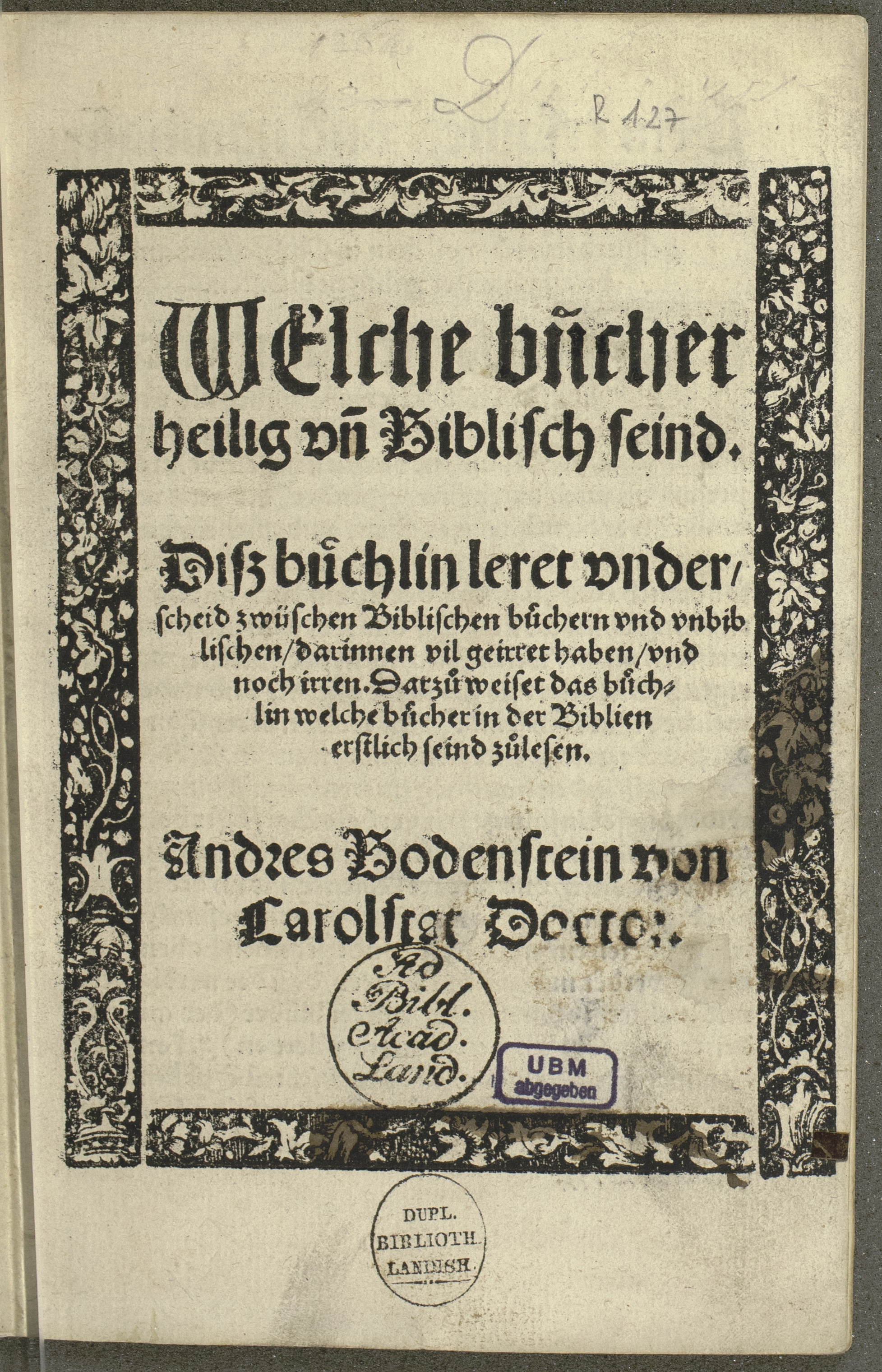
Historiated title page of Karlstadt's treatise on canonical books
A woodcut border on the title page of Karlstadt's treatise on which books should be considered canonical alongside the Bible. The border is made up of four separate woodcuts, all with unique floral designs.A woodcut border on the title page of Karlstadt's treatise on which books should be considered canonical alongside the Bible. The border is made up of four separate woodcuts, all with unique floral designs. -
 Still image
Historiated title page of Luther's Sermon von dem ehelichen Stand
A woodcut border on the title page to Luther's Sermon von dem ehelichen Stand printed in 1519. The border depicts a series of cherubs, including two carrying another on a ram's pelt litter while it plays a horn and carries a standard.A woodcut border on the title page to Luther's Sermon von dem ehelichen Stand printed in 1519. The border depicts a series of cherubs, including two carrying another on a ram's pelt litter while it plays a horn and carries a standard. -
 Still image
Historiated title page of Luther's Von Menschenlehre zu meiden
A woodcut border on the title page to Luther's Von Menschenlehre zu meiden printed in 1522. The border depicts a series of cherubs, including two carrying another on a ram's pelt litter while it plays a horn and carries a standard.A woodcut border on the title page to Luther's Von Menschenlehre zu meiden printed in 1522. The border depicts a series of cherubs, including two carrying another on a ram's pelt litter while it plays a horn and carries a standard. -
 Still image
Historiated title page of Luther's Von der Beicht, ob die der Papst Macht habe zu gebieten
A woodcut border on the title page of Luther's Von der Beicht, ob die der Papst Macht have zu gebieten printed in 1522. The border is composed of four woodcuts designed to create a single, cohesive design of decorative plants and a pair of cherubs.A woodcut border on the title page of Luther's Von der Beicht, ob die der Papst Macht have zu gebieten printed in 1522. The border is composed of four woodcuts designed to create a single, cohesive design of decorative plants and a pair of cherubs. -
 Text
TextLutheri, Melanch. Carolostadii &c. Propositiones, Wittembergae uiua uoce tractatae, in hocq[ue] pleraeq[ue] aeditae ab auctoribus, ut uel nos absentes cum ipsis agamus, uel certe ut ueritatis, et seductionum admonea[n]tur boni.
Luther, Martin, 1483-1546Summary: It was the practice at Wittenberg for the students to sharpen their logical and debating skills by responding to a set of theses proposed by the professor in the discipline in which they were working. These theses were often collected into book form for the use of the students and for the study of the topics by interested non-students. This group is from the early years of the Reformation, 1521-1522. Theses proposed in the Universität Wittenberg for the granting of doctoral degrees. In most cases the "respondents" are not indicated.Summary: It was the practice at Wittenberg for the students to sharpen their logical and debating skills by responding to a set of theses proposed by the professor in the discipline in which they were working. These theses were often collected into book form for the use of the students and for the study of the topics by interested non-students. This group is from the early years of the Reformation, 1521-1522. Theses proposed in the Universität Wittenberg for the granting of doctoral degrees. In most cases the "respondents" are not indicated. -
 Still image
The Ten Commandments and the Golden Calf
A woodcut depicting Moses receiving the Ten Commandments from God (upper right) as the the people of Israel worship the Golden Calf (lower left). On the right, Mount Sinai and Mount Horeb are labeled, as well as the figures of Moses and Joshua.A woodcut depicting Moses receiving the Ten Commandments from God (upper right) as the the people of Israel worship the Golden Calf (lower left). On the right, Mount Sinai and Mount Horeb are labeled, as well as the figures of Moses and Joshua. -
 Text
TextVon Mensche[n] Leren zu[o] meiden
Luther, Martin, 1483-1546Summary: Luther addresses the monastic rules of fasting, obedience and celibacy, arguing that they have no foundation in scripture and that a transgression of these rules is therefore no sin. At the same time, Luther warns that a transgression of monastic rules in itself is by no means a sign of faith or internalized piety.Summary: Luther addresses the monastic rules of fasting, obedience and celibacy, arguing that they have no foundation in scripture and that a transgression of these rules is therefore no sin. At the same time, Luther warns that a transgression of monastic rules in itself is by no means a sign of faith or internalized piety. -
 Text
TextVon der Beycht, ob die der Bapst macht habe zuo gebieten
Luther, Martin, 1483-1546Summary: Second Basel printing of an early Luther treatise on Penance, together with a translation and exposition of Psalm 118.Summary: Second Basel printing of an early Luther treatise on Penance, together with a translation and exposition of Psalm 118. -
 Text
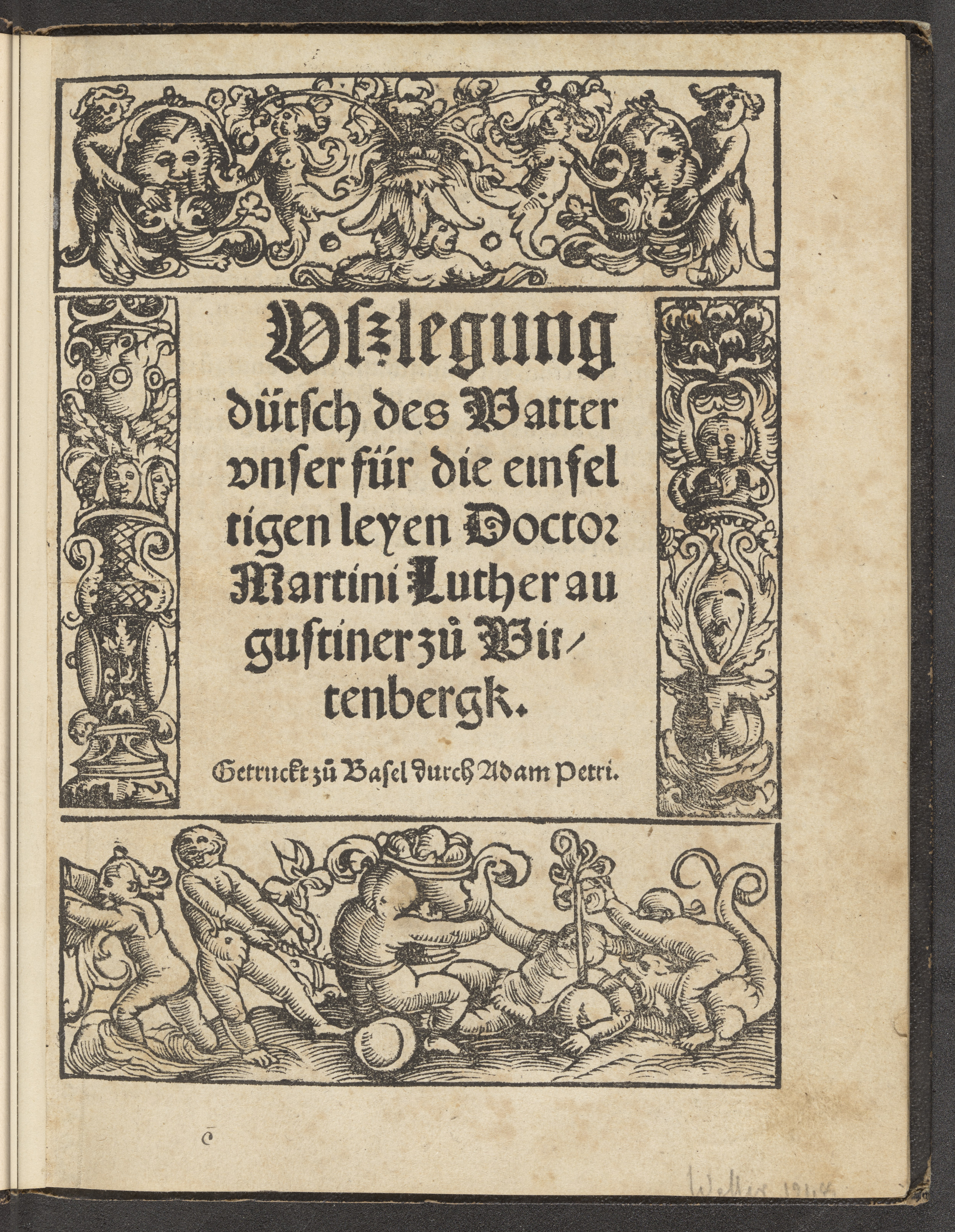
TextVszlegung dütsch des Vatter vnser für die einfeltigen leyen
Luther, Martin, 1483-1546Summary: This exposition of the Lord's Prayer had its origins in a series of sermons preached by Luther during Lent, 1517. J. Agricola published his transcripts of these sermons. Luther was dissatisfied with Agricola's edition, however, and re-edited the work. This example is from the seventh printing of Luther's edition.Summary: This exposition of the Lord's Prayer had its origins in a series of sermons preached by Luther during Lent, 1517. J. Agricola published his transcripts of these sermons. Luther was dissatisfied with Agricola's edition, however, and re-edited the work. This example is from the seventh printing of Luther's edition. -
 Text
TextWElche [sic] bücher heilig vn[d] Biblisch seind : Disz büchlin leret vnderscheid zwüschen Biblischen büchern vnd vnbiblischen, darinnen vil geirret haben, vnd noch irren : Darzuo weiset das büchlin welche bücher in der Biblien erstlich seind zu[o]lesen
Karlstadt, Andreas Rudolff-Bodenstein von, 1486-1541Summary: Treatise on which books are to be considered canonical, by Andreas Rudolff-Bodenstein von Karlstadt, Luther's more radical Wittenberg colleague.Summary: Treatise on which books are to be considered canonical, by Andreas Rudolff-Bodenstein von Karlstadt, Luther's more radical Wittenberg colleague.