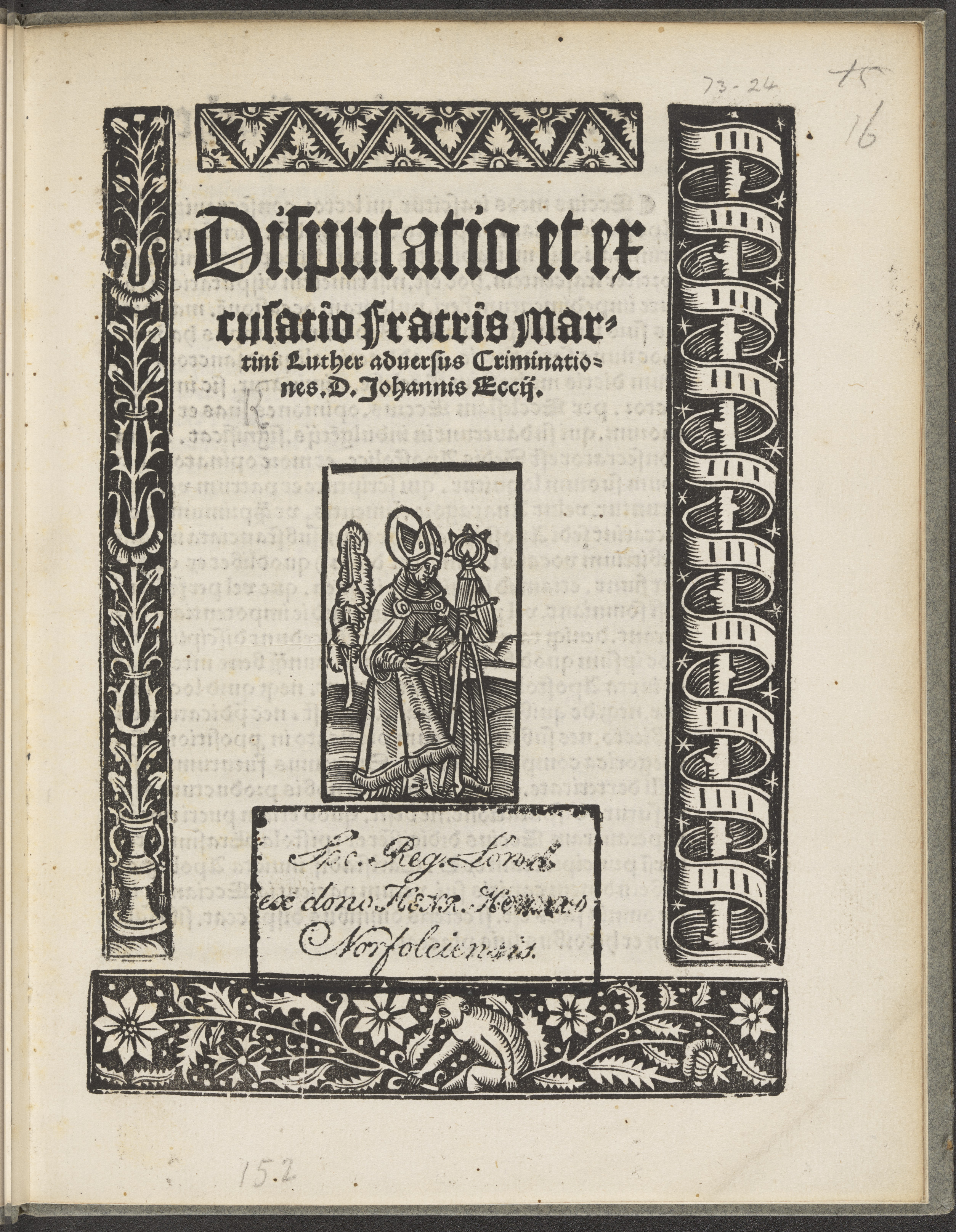
Summary: First edition of Luther's response to Hieronymus Emser's report of the Leipzig Disputation between Martin Luther, Andreas Bodenstein Karlstadt and Johann Eck. Emser, who had been initially sympathetic to Luther's position had accompanied Eck to Leipzig, where he broke with the reformer. In his report, he tried to associate Luther with the Bohemian reformer Jan Hus, who had been burnt at the stake during the Council of Constance in 1415.
Summary: First edition of Luther's response to Hieronymus Emser's report of the Leipzig Disputation between Martin Luther, Andreas Bodenstein Karlstadt and Johann Eck. Emser, who had been initially sympathetic to Luther's position had accompanied Eck to Leipzig, where he broke with the reformer. In his report, he tried to associate Luther with the Bohemian reformer Jan Hus, who had been burnt at the stake during the Council of Constance in 1415.
Albert, of Brandenburg, Archbishop and Elector of Mainz, Cardinal, 1490-1545
Indulgences were issued to defray the cost of building the basilica of St. Peter in Rome. Their distribution was often linked to the sacrament of penance, as believers were granted spiritual merits in exchange for financial donations. This particular indulgence, believed to be the only specimen of its kind thus far recovered, was issued specifically to clergy, granting them liturgical benefits in exchange for their contributions.
Indulgences were issued to defray the cost of building the basilica of St. Peter in Rome. Their distribution was often linked to the sacrament of penance, as believers were granted spiritual merits in exchange for financial donations. This particular indulgence, believed to be the only specimen of its kind thus far recovered, was issued specifically to clergy, granting them liturgical benefits in exchange for their contributions.
Summary: A letter by Hieronymus Emser, early opponent of Luther concerning the Leipzig Disputation of 1519, describing Luther's debate with Johann Eck, and Luther's admitting that councils could err.
Summary: A letter by Hieronymus Emser, early opponent of Luther concerning the Leipzig Disputation of 1519, describing Luther's debate with Johann Eck, and Luther's admitting that councils could err.
Summary: It is not certain who wrote this tract on the Leipzig Disputation but J. Montanus or J. Cellarius appear to be the most likely candidates. Montanus became the first Protestant preacher in Westphalia, while Cellarius or Kellner, became the first Protestant Superintendent of Dresden.
Summary: It is not certain who wrote this tract on the Leipzig Disputation but J. Montanus or J. Cellarius appear to be the most likely candidates. Montanus became the first Protestant preacher in Westphalia, while Cellarius or Kellner, became the first Protestant Superintendent of Dresden.
Summary: A report on the Leipzig Disputation of 1519, ostensibly between Karlstadt and Johann Eck, but with the active participation of Luther both in preparation and in delivery. It was at this formal disputation that Eck was successful in pushing Luther to admit that not only popes, but councils, as well, had erred. This was an important point in Eck's favor, since Luther had, up to this point, appealed from the authority of the Pope to that of an ecumenical council.
Summary: A report on the Leipzig Disputation of 1519, ostensibly between Karlstadt and Johann Eck, but with the active participation of Luther both in preparation and in delivery. It was at this formal disputation that Eck was successful in pushing Luther to admit that not only popes, but councils, as well, had erred. This was an important point in Eck's favor, since Luther had, up to this point, appealed from the authority of the Pope to that of an ecumenical council.
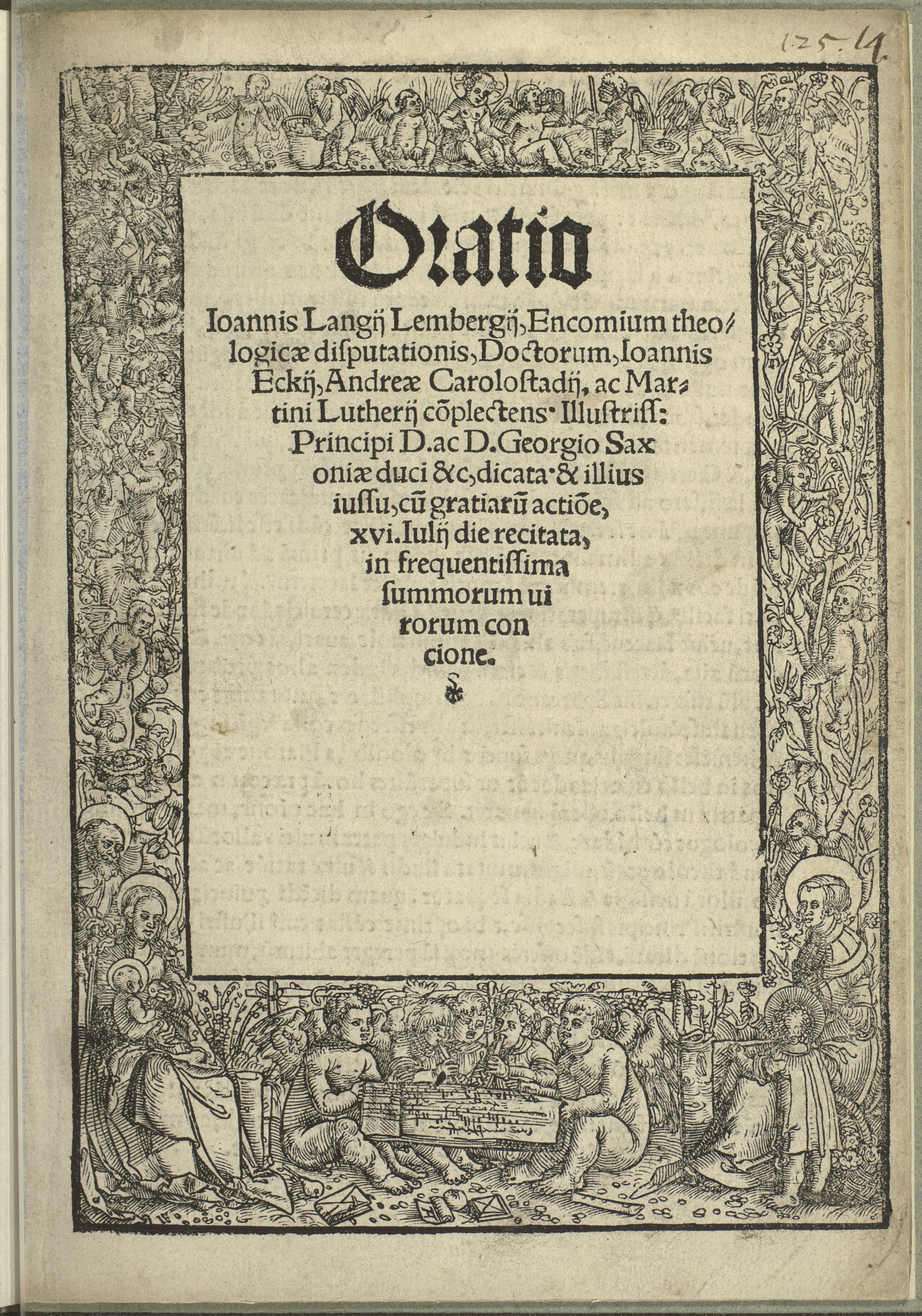
Summary: This is the speech by J. Lange von Lemberg, Rector of the University of Leipzig, given at the end of the Leipzig Disputation. Lange von Lemberg takes no sides in the Disputation but praises all the contestants, especially Luther. This is the only printing of the work.
Summary: This is the speech by J. Lange von Lemberg, Rector of the University of Leipzig, given at the end of the Leipzig Disputation. Lange von Lemberg takes no sides in the Disputation but praises all the contestants, especially Luther. This is the only printing of the work.
Summary: One of the thorniest issues raised in the Leipzig Disputation was the historical precedence of papal authority. Eck argued that from earliest times, the authority of the bishop of Rome was accepted by the other bishops. Luther's thirteenth proposition argued that only much later did the church in Rome claim precedence over the other churches.
Summary: One of the thorniest issues raised in the Leipzig Disputation was the historical precedence of papal authority. Eck argued that from earliest times, the authority of the bishop of Rome was accepted by the other bishops. Luther's thirteenth proposition argued that only much later did the church in Rome claim precedence over the other churches.
Summary: A clarification of Luther's position regarding the Leipzig disputation, a public debate between the Catholic Johann Eck on the one side and Luther and Andreas Karlstadt on the other. The work is preceded by a long letter to Spalatin, dated 15 Aug., 1519.
Summary: A clarification of Luther's position regarding the Leipzig disputation, a public debate between the Catholic Johann Eck on the one side and Luther and Andreas Karlstadt on the other. The work is preceded by a long letter to Spalatin, dated 15 Aug., 1519.
 Text
 Text
 Text
 Text
 Text
 Text
 Text
 Text
 Text
 Text