Search
33 resources
33 items
Spatial coverage
Rome (Italy)
-
 Still image
Aguglia del Popolo, Aguglia di San. Pietro, Santi Apostoli, et C. Traj[an]
A pair of engravings depicting four obelisks (Vatican Obelisk, Lateran Obelisk, Flaminio Obelisk, and the Esquiline Obelisk), the Santi Apostoli, and Trajan's Column. All of these were part of Pope Sixtus V's urban reform program.A pair of engravings depicting four obelisks (Vatican Obelisk, Lateran Obelisk, Flaminio Obelisk, and the Esquiline Obelisk), the Santi Apostoli, and Trajan's Column. All of these were part of Pope Sixtus V's urban reform program. -
 Text
TextAlbertus Dei et Apostolice Sedis gratia Maguntinen[sis] [sic] et Magdeburgen[sis] Archiepiscop[us] ac Halberstaten[sis] ecclesiar[m] Administrator, Germanie Primas ... Indulgence
Albert, of Brandenburg, Archbishop and Elector of Mainz, Cardinal, 1490-1545Indulgences were issued to defray the cost of building the basilica of St. Peter in Rome. Their distribution was often linked to the sacrament of penance, as believers were granted spiritual merits in exchange for financial donations. This particular indulgence, believed to be the only specimen of its kind thus far recovered, was issued specifically to clergy, granting them liturgical benefits in exchange for their contributions.Indulgences were issued to defray the cost of building the basilica of St. Peter in Rome. Their distribution was often linked to the sacrament of penance, as believers were granted spiritual merits in exchange for financial donations. This particular indulgence, believed to be the only specimen of its kind thus far recovered, was issued specifically to clergy, granting them liturgical benefits in exchange for their contributions. -
 Still image
Algerius, Etudiant de Padoue, brulé à Rome, A. 1557
Luiken, Jan, 1649-1712An engraving depicting the execution of Algerius, a student from Padua. The image shows Algerius being drenched in boiling oil as he stands before a prepared stake and pyre while a monk attempts to convince him to repent.An engraving depicting the execution of Algerius, a student from Padua. The image shows Algerius being drenched in boiling oil as he stands before a prepared stake and pyre while a monk attempts to convince him to repent. -
 Still image
Arnaldus, Lecteur à Brixen, brulé comme héretique à Rome, A. 1145
Luiken, Jan, 1649-1712An engraving depicting the body of Arnaldo of Brescia, who was burned at the stake for heresy. The image shows two men using tongs to push the Arnoldo's remaining bones into the flames as a monk and the pope watch.An engraving depicting the body of Arnaldo of Brescia, who was burned at the stake for heresy. The image shows two men using tongs to push the Arnoldo's remaining bones into the flames as a monk and the pope watch. -
 Text
TextBasilicae s. Mariae Maioris de Urbe a Liberio Papa I usque ad Paulum V Pont. Max. descriptio et delinatio
De Angelis, Paolo, 1580-1647Summary: Important description of S. Maria Maggiore in its unaltered Renaissance state, before extensive renovations of Ferdinand Fuga in 1743.Summary: Important description of S. Maria Maggiore in its unaltered Renaissance state, before extensive renovations of Ferdinand Fuga in 1743. -
 Still image
Cruaictez horibles exercées contre les Chrétiens, sous Diocletien et Maximien, A. 301
Luiken, Jan, 1649-1712An engraving depicting various tortures and executions of Christians during the persecutions ordered under Emperors Diocletian and Maximian. The image shows five different methods of crucifixion (right), people being burned at the stake (center, background), a man being beaten (center), a figure being attacked by dogs (bottom left), and a figure being stabbed, covered in oil, and burned (left), all while the Emperors watch (top left, background).An engraving depicting various tortures and executions of Christians during the persecutions ordered under Emperors Diocletian and Maximian. The image shows five different methods of crucifixion (right), people being burned at the stake (center, background), a man being beaten (center), a figure being attacked by dogs (bottom left), and a figure being stabbed, covered in oil, and burned (left), all while the Emperors watch (top left, background). -
 Text
TextDe donatione Constantini quid ueri habeat, eruditorum quorundam iudicium, ut in uersa pagella uidebis
Summary: The Donation of Constantine was a work that told of how the Emperor Constantine I gave secular domination over Italy to the Bishops of Rome. Although purported to have been written in the fourth century, the humanist scholar Lorenzo Valla proved the work, long suspect to be an eighth century forgery. Vall's treatise was one of the first important works of comparative philology, a method invaluable to later biblical scholars and translators.Summary: The Donation of Constantine was a work that told of how the Emperor Constantine I gave secular domination over Italy to the Bishops of Rome. Although purported to have been written in the fourth century, the humanist scholar Lorenzo Valla proved the work, long suspect to be an eighth century forgery. Vall's treatise was one of the first important works of comparative philology, a method invaluable to later biblical scholars and translators. -
 Still image
Del Ponte, & Arco Trionfale
An engraving depicting a Roman triumphal procession passing through a triumphal gate and accross the triumphal bridge (Pons Neronianus/Vaticanus) along the triumphal way (Via Triumphale) across the Tiber River. Above the scene, an angel flies, blowing on a trumpet that is draped with a flag bearing a crest with "S.P.Q.R." on it. The accompanying text discusses sources that claim St. Peter was buried near the Via Triumphale.An engraving depicting a Roman triumphal procession passing through a triumphal gate and accross the triumphal bridge (Pons Neronianus/Vaticanus) along the triumphal way (Via Triumphale) across the Tiber River. Above the scene, an angel flies, blowing on a trumpet that is draped with a flag bearing a crest with "S.P.Q.R." on it. The accompanying text discusses sources that claim St. Peter was buried near the Via Triumphale. -
 Still image
Der Bapstesel zu Rom
A woodcut depicting the "Papal Ass," a monster purported to have been pulled from the Tiber in Rome as a portent of the corruption of the Roman Catholic Church.A woodcut depicting the "Papal Ass," a monster purported to have been pulled from the Tiber in Rome as a portent of the corruption of the Roman Catholic Church. -
 Still image
Disegno et sito del Sontovoso Giardino et Palazzo del Ser.mo Gran Duva di Toscana in Roma
Raphael, 1483-1520An engraving depicting the Villa Medici and gardens in Rome.An engraving depicting the Villa Medici and gardens in Rome. -
 Text
TextEpitoma Decadum quattuordecim T. Liuii Patauini historici : in centum et quadraginta libros distinctum
LivySummary:Summary: -
 Still image
Felicitas, mise à mort avec ses 7 fils à Rome, A. 164
Luiken, Jan, 1649-1712An engraving depicting the martyrdom of Saint Felicitas and her seven sons. The image shows five of the seven sons already dead, with one beheaded and another kneeling as the executioner prepares to behead him (left). On the right, Felicitas watches with her final son bound behind her (left).An engraving depicting the martyrdom of Saint Felicitas and her seven sons. The image shows five of the seven sons already dead, with one beheaded and another kneeling as the executioner prepares to behead him (left). On the right, Felicitas watches with her final son bound behind her (left). -
 Still image
Giardino de gl'Ill.mi Sig.ri Mattei
Raphael, 1483-1520An engraving depicting the Villa Mattei, now known as Villa Celimontana, in Rome and the gardens surrounding.An engraving depicting the Villa Mattei, now known as Villa Celimontana, in Rome and the gardens surrounding. -
 Still image
Giardino del Emi.mo Card. Montalto
Raphael, 1483-1520An engraving depicting the gardens and palace of Villa Montalto (also known as Villa Montalto Peretti, Villa Montalto Peretti Massimo, and Villa Negroni) in Rome. The entire complex was leveled to make room for the Roma Termini.An engraving depicting the gardens and palace of Villa Montalto (also known as Villa Montalto Peretti, Villa Montalto Peretti Massimo, and Villa Negroni) in Rome. The entire complex was leveled to make room for the Roma Termini. -
 Still image
Historiated title page border of Descrizione di Roma moderna formata nvovamente
An engraved border to Descrizione di Roma moderna formata nvovamente. The engraving depicts a pair of figures, one holding a cross and chalice and the other holding an anchor flanking a crest with three bees (the Barberini family) crowned by a galero (bottom), a pair of cherubs with shields (one with the papal keys and the other with S.P.Q.R.An engraved border to Descrizione di Roma moderna formata nvovamente. The engraving depicts a pair of figures, one holding a cross and chalice and the other holding an anchor flanking a crest with three bees (the Barberini family) crowned by a galero (bottom), a pair of cherubs with shields (one with the papal keys and the other with S.P.Q.R. -
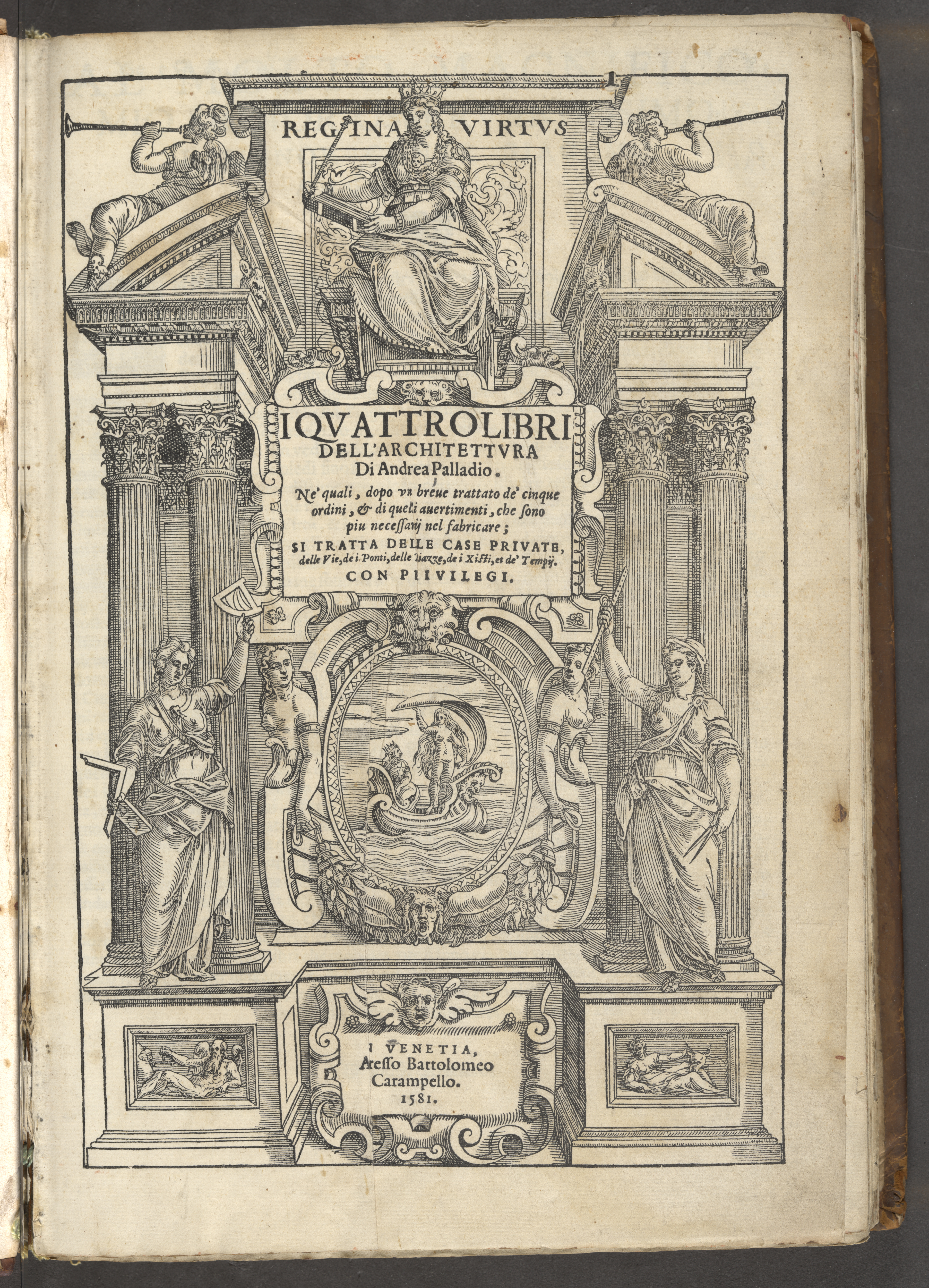 Text
TextI quattro libri dell'architettura di Andrea Palladio : ne' quali, dopo vn breue trattato de' cinque ordini, & di quelli auertimenti, che sono piu necessarij nel fabricare : si tratta delle cose priuate, delle vie, de' ponti, delle piazze, de' xisti, & de' tempij
Palladio, Andrea, 1508-1580Summary:Summary: -
 Still image
Lateran Palace and the Lateran Obelisk
An engraving depicting the Lateran Palace (left) with the Lateran Obelisk (foreground), with the Archbasilica of Saint John Lateran (right) visible with the Baptistry on its right.An engraving depicting the Lateran Palace (left) with the Lateran Obelisk (foreground), with the Archbasilica of Saint John Lateran (right) visible with the Baptistry on its right. -
 Still image
Obeliscus Pamphilius
An engraving depicting detailed representations of the four sides of the Obelisk of Domitian, which had been moved by Pope Innocent X from the Via Appia to his family home, the Palazzo Pamphilj. Between the four sides, there is a small representation of the obelisk with a decorative ribbon proclaiming it the "Obelisus Pamphilius" (bottom), a cherub holding a pair of medallions with a portrait of Innocent X (left) and the obelisk (right) (middle), and an angel lying on a cloud supporting Innocent X's coat of arms.An engraving depicting detailed representations of the four sides of the Obelisk of Domitian, which had been moved by Pope Innocent X from the Via Appia to his family home, the Palazzo Pamphilj. Between the four sides, there is a small representation of the obelisk with a decorative ribbon proclaiming it the "Obelisus Pamphilius" (bottom), a cherub holding a pair of medallions with a portrait of Innocent X (left) and the obelisk (right) (middle), and an angel lying on a cloud supporting Innocent X's coat of arms. -
 Still image
Peter Faces Martyrdom
Raphael, 1483-1520An engraving depicting a story in the New Testament apocryphal writing "Acts of Peter". In it Peter, having kindled the wrath of the powerful, is asked by his fellow Christians to flee Rome so that his ministry may continue. As he leaves the city he sees Christ walking towards Rome carrying a cross. Peter asks where he is going. Christ tells him he is going to Rome to be crucified again. Hearing this Peter returns to Rome convinced his time has come.An engraving depicting a story in the New Testament apocryphal writing "Acts of Peter". In it Peter, having kindled the wrath of the powerful, is asked by his fellow Christians to flee Rome so that his ministry may continue. As he leaves the city he sees Christ walking towards Rome carrying a cross. Peter asks where he is going. Christ tells him he is going to Rome to be crucified again. Hearing this Peter returns to Rome convinced his time has come. -
 Still image
Pope Dining in the Lateran Palace
A woodcut depicting the pope, bisops, and cardinals dining at the Lateran Palace. The pope sits at his own table, with cardinals on his right, and bishops on his left. The scene is flanked by ornamental scroll work featuring masks. The woodcut is reused throughout the work.A woodcut depicting the pope, bisops, and cardinals dining at the Lateran Palace. The pope sits at his own table, with cardinals on his right, and bishops on his left. The scene is flanked by ornamental scroll work featuring masks. The woodcut is reused throughout the work. -
 Still image
Prisoners taken to Castel Sant'Angelo and the Nightly Patrol
A pair of woodcuts with captions depicting guards taking prisoners to Castel Sant'Angelo (while others are left alone) (top) and a depiction of the nightly patrol that occurs during the Conclave in Rome (bottom).A pair of woodcuts with captions depicting guards taking prisoners to Castel Sant'Angelo (while others are left alone) (top) and a depiction of the nightly patrol that occurs during the Conclave in Rome (bottom).