Search
66 resources
66 items
Subject
Controversial literature
-
 Text
TextEin Sermon oder Predig von dem ablasz vnd gnade
Luther, Martin, 1483-1546Summary: An early sermon by Luther on Indulgences and Grace. First appearing in 1518, this work went through fully fourteen printings in that year alone.Summary: An early sermon by Luther on Indulgences and Grace. First appearing in 1518, this work went through fully fourteen printings in that year alone. -
 Text
TextEin kurtze vnterricht, den Pfarherrn vnd Predigern Inn meiner gnedigen Herrn der Marggraffen zu Branndenburg. [et]c. Fürstenthumen vn[d] Landen, hieniden in Francken vnd auff dem Gebirg verordent : wes sie das volck wider etliche verfürische lere, der widertauffer, an den Feyertägen auff der Canntzel zum getreulichsten vnd besten auss Götlicher schrifft vermanen, vnd vnterrichten sollen
Georg, Margrave of Brandenburg-Ansbach, 1484-1543Summary: A decree against the Anabaptists by the Lutheran prince, Georg, Margrave of Brandenburg-Ansbach, to be read from the pulpits of his territory.Summary: A decree against the Anabaptists by the Lutheran prince, Georg, Margrave of Brandenburg-Ansbach, to be read from the pulpits of his territory. -
 Text
TextEin schöner spruch darinn deren von Costantz seltzame Renckh und Abentheür, damit Sy vmbgon begriffen syen.
Treger, Konrad, approximately 1480-1542Summary: Anti-Reformation poem directed at the city of Konstanz. Tregor, an Augustinian Prior, was a leading defender of Catholicism in Switzerland.Summary: Anti-Reformation poem directed at the city of Konstanz. Tregor, an Augustinian Prior, was a leading defender of Catholicism in Switzerland. -
 Text
TextEine Schrifft, wie die Pfarherrn an den Örtern, da man die Papisterey widerumb auffricht, die Euangelisch Lehr, welche sie Lutherisch nennen, verloben vnd verschweren müssen
Summary: An anonymous pamphlet, containing an oath German pastors had to swear to renounce the "Evangelical doctrine, which is called Lutheran" in order to be readmitted to the Roman Catholic Church. The copy of the oath is preceded by two satirical poems regarding the oath, the first one representing the opinion of a wise man, the second one the answer of an unwise man. On the titlepage are two verses from Matthew 10 against the taking of oaths. The work is published by Christian Rödinger, a printer who put his press in service of the Reformation.Summary: An anonymous pamphlet, containing an oath German pastors had to swear to renounce the "Evangelical doctrine, which is called Lutheran" in order to be readmitted to the Roman Catholic Church. The copy of the oath is preceded by two satirical poems regarding the oath, the first one representing the opinion of a wise man, the second one the answer of an unwise man. On the titlepage are two verses from Matthew 10 against the taking of oaths. The work is published by Christian Rödinger, a printer who put his press in service of the Reformation. -
 Text
TextEnchiridion locorum communium aduersus Lutheranos
Eck, Johann, 1486-1543Summary: In 1521, Melanchthon wrote the first Protestant dogmatics, the "Loci Communes." Eck countered in 1525 with his "handbook on Theological Topics". Possibly the most widely reprinted Catholic critique of Lutheran doctrine (Metzler lists 91 contemporary editions). Eck uses the same topical procedure and cites the Bible, Church Fathers, Councils, and Popes heavily in the presentation of his arguments.Summary: In 1521, Melanchthon wrote the first Protestant dogmatics, the "Loci Communes." Eck countered in 1525 with his "handbook on Theological Topics". Possibly the most widely reprinted Catholic critique of Lutheran doctrine (Metzler lists 91 contemporary editions). Eck uses the same topical procedure and cites the Bible, Church Fathers, Councils, and Popes heavily in the presentation of his arguments. -
 Text
TextEpistolae duae
Haner, Johannes, active 1524-1544Summary: This pamphlet contains two letters on Lutheranism by converts to Catholicism. Witzel's publication of Haner's letter led to the latter's expulsion from the city of Nuremberg.Summary: This pamphlet contains two letters on Lutheranism by converts to Catholicism. Witzel's publication of Haner's letter led to the latter's expulsion from the city of Nuremberg. -
 Text
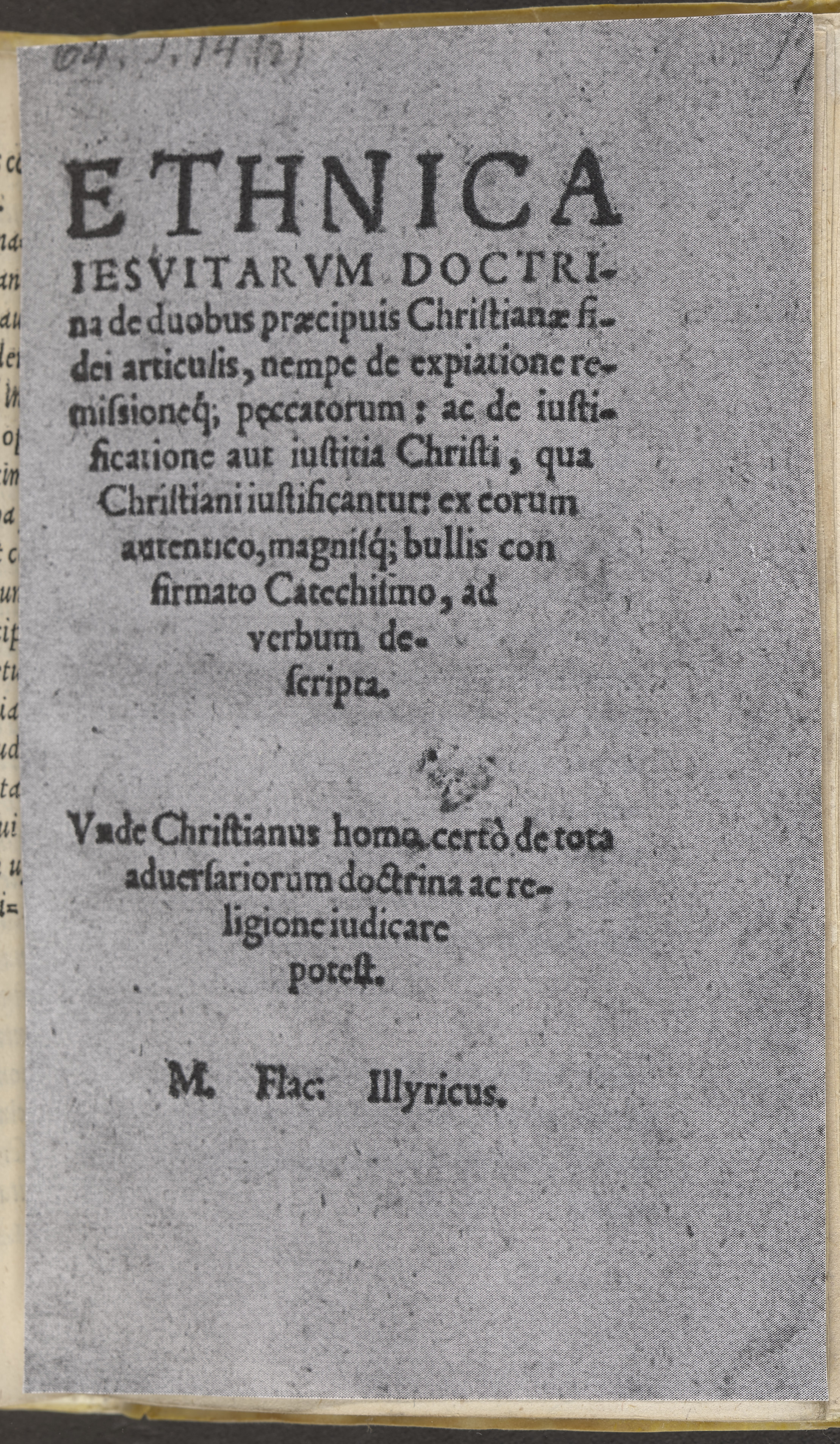
TextEthnica Iesvitarum doctrina de duobus praecipuis Christianae fidei articulis, : nempe de expiatione remissioneq[ue] peccatorum: ac de iustificatione aut iustitia Christi, qua Christiani iustificantur: ex eorum autentico, magnisq[ue] bullis confirmato Catechismo, ad verbum descripta ...
Flacius Illyricus, Matthias, 1520-1575Summary: Peter Canisius was a Dutch Jesuit working to restore the Catholic church in Germany during the Reformation. Matthias Flacius criticized Canisius's catechism, first published in 1555. In this tract, he specifically attacks the Jesuit's views on the expiation of sin and the justification in Christ.Summary: Peter Canisius was a Dutch Jesuit working to restore the Catholic church in Germany during the Reformation. Matthias Flacius criticized Canisius's catechism, first published in 1555. In this tract, he specifically attacks the Jesuit's views on the expiation of sin and the justification in Christ. -
 Text
TextEyn Gesprech vo[n] de[n] Scheinwercke[n] der Gaistlichen, und yhren gelubde[n] : damit sie zuverlesterung des bluts Christi vermaynen selig zu werden
Sachs, Hans, 1494-1576Summary: One of nine 1524 printings of this short anti-monastic tract by the Nuremberg cobbler and playright Hans Sachs.Summary: One of nine 1524 printings of this short anti-monastic tract by the Nuremberg cobbler and playright Hans Sachs. -
 Text
TextEyn Gesprech vo[n] den Scheinwercke[n] der Gaystlichen, vnd jren gelübdten : damit sy zuouerlesterung des bluots Christi vermaynen selig zuowerden
Sachs, Hans, 1494-1576Summary: One of nine 1524 printings of this short anti-monastic tract by the Nuremberg cobbler and playright Hans Sachs.Summary: One of nine 1524 printings of this short anti-monastic tract by the Nuremberg cobbler and playright Hans Sachs. -
 Text
TextEyn Widerruff vom Fegefeur
Luther, Martin, 1483-1546Summary: Refutation, by Luther, of the teaching of Purgatory.Summary: Refutation, by Luther, of the teaching of Purgatory. -
 Text
TextEyn Wyderrueff vom Fegfewr
Luther, Martin, 1483-1546Summary: One of several 1530 editions of a tract in which Luther rejects the Catholic doctrine of purgatory, a topic not addressed in the Augsburg Confessions.Summary: One of several 1530 editions of a tract in which Luther rejects the Catholic doctrine of purgatory, a topic not addressed in the Augsburg Confessions. -
 Text
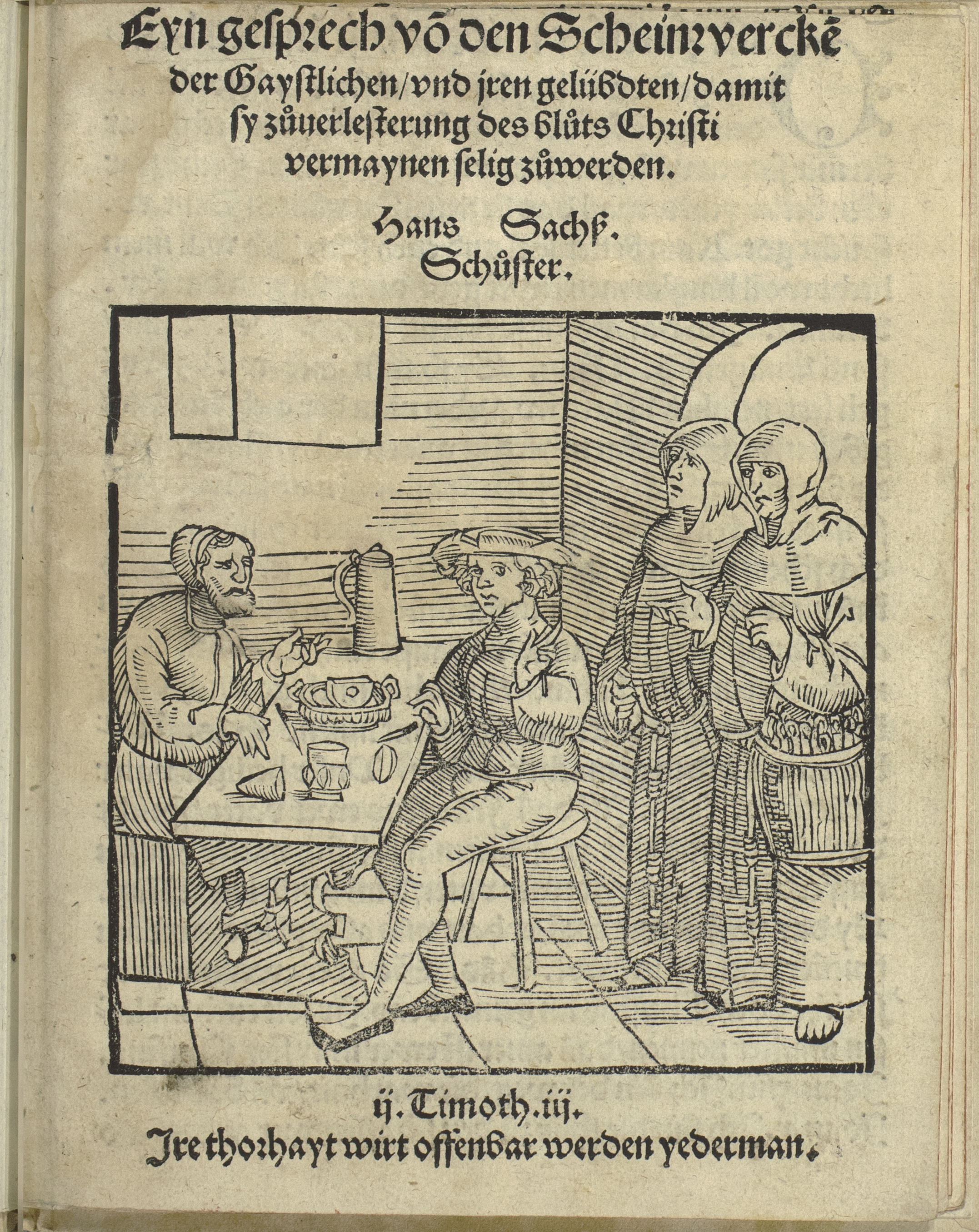
TextEyn gesprech vo[n] den Scheinwercke[n] der Gaystlichen, vnd jren gelübdten : damit sy zuouerlesterung des bluots Christi vermaynen selig zuowerden
Sachs, Hans, 1494-1576Summary: Anti-monastic tract by Hans Sachs, shoemaker, poet, and dramatist of Nürnberg, and strong supporter of Luther.Summary: Anti-monastic tract by Hans Sachs, shoemaker, poet, and dramatist of Nürnberg, and strong supporter of Luther. -
 Text
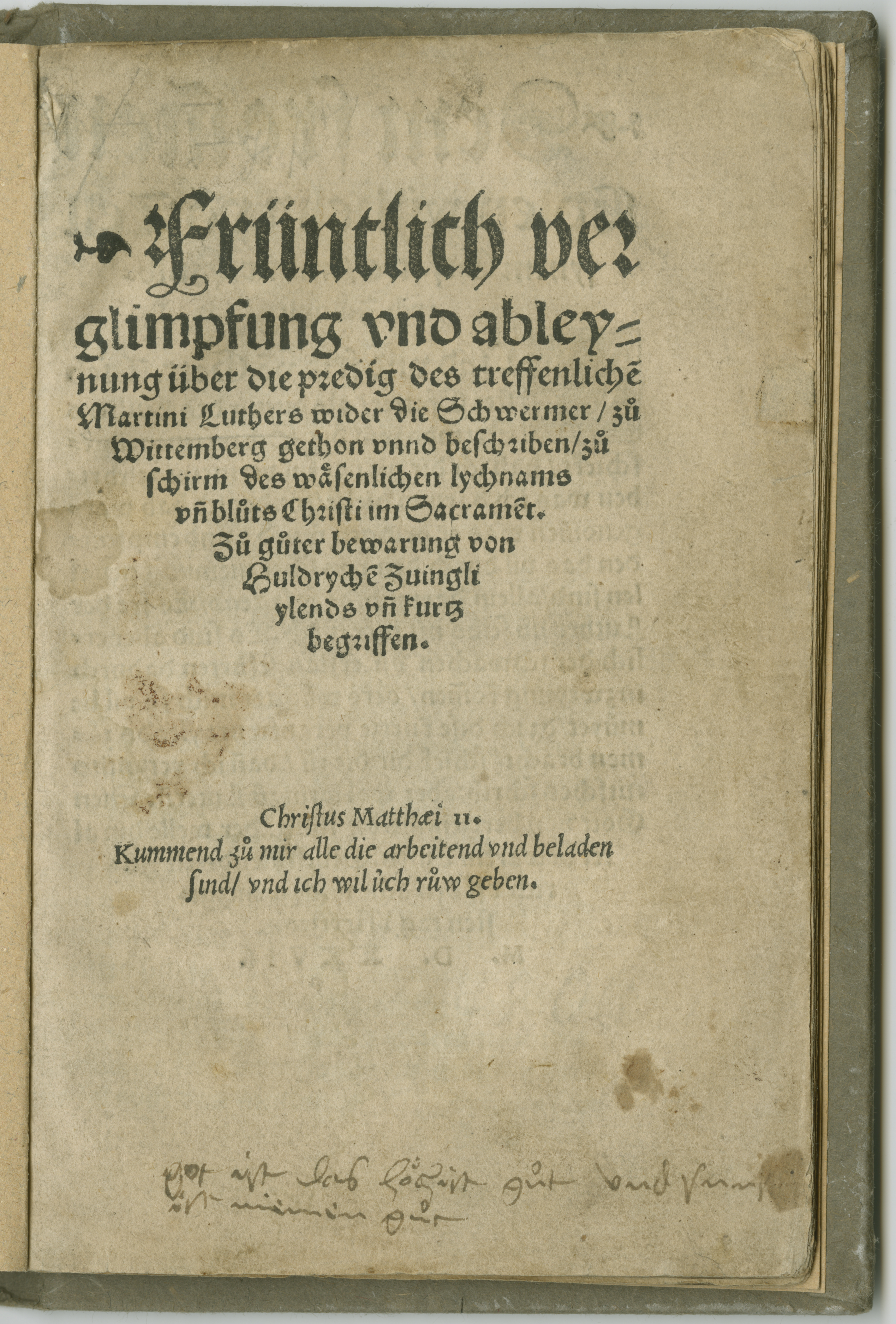
TextFrüntlich verglimpfung vnd ableynung über die predig des treffenliche[n] Martini Luthers wider die Schwermer : zuo Wittemberg gethon vnnd beschriben zuo schirm des wäsenlichen lychnams vn[d] bluts Christi im Sacrame[n]t
Zwingli, Ulrich, 1484-1531Summary: In a sermon against religious fanatics (Wider die Schwärmer), Luther had asserted the real presence of Christ in the eucharist. Zwingli responds by affirming the Reformed position that the practice of communion is to be seen as a symbolic act.Summary: In a sermon against religious fanatics (Wider die Schwärmer), Luther had asserted the real presence of Christ in the eucharist. Zwingli responds by affirming the Reformed position that the practice of communion is to be seen as a symbolic act. -
 Text
TextGründtliche anzaygung vnd bericht, ausz was vrsachen (deren fürnemlich siben seind) so mancherley, vnnd vilfaltige Ketzereyen, zwispaltung vnnd jtzthumb in Christlicher Religion, vnd der hailigen Catholischen Kirchen, von anfang biss auff dise zeit erwachsen seind, vnd jren grund genommen haben
Leib, Kilian, 1471-1553Summary: Second printing of a an anti-Protestant tract by Kilian Leib, prior of the Augustinian monastery at Rebdorf. Leib was a Catholic theologian in the humanist tradition who was a firm opponent of Martin Luther's reforms. In 1530 he had participated in drafting the Catholic response to the Augsburg Confession. In this work, Leib outlines 7 causes for the Lutheran heresy, which include among others an unfavorable constellation of the stars, ordained by God to punish humanity.Summary: Second printing of a an anti-Protestant tract by Kilian Leib, prior of the Augustinian monastery at Rebdorf. Leib was a Catholic theologian in the humanist tradition who was a firm opponent of Martin Luther's reforms. In 1530 he had participated in drafting the Catholic response to the Augsburg Confession. In this work, Leib outlines 7 causes for the Lutheran heresy, which include among others an unfavorable constellation of the stars, ordained by God to punish humanity. -
![Summary: This is an early Italian response to Martin Luther, attacking the schismatic monk on his own terms, in the vernacular for the benefit of laymen or simplici, as advertised on the title-page. The work is quite broad in its criticism and aims to refute not only Luther and his followers, but all heretics and even Jews. On the final leaf of text, following the colophon the list of errata, we find a curious addition perhaps intended to be removed from the book and used separately: a "song" satirically composed by "several of Luther's friends in praise of him" [Alcuni amici de Martin Luthero in laude sua cantano], beginning "Te Lutherum damnamus". Evidently a parody of the Te Deum, Fano's hymn condemning Luther to Hell was in fact subsequently set to music by a certain Maistre Jhan (ca. 1485-1538).](https://digital.pitts.emory.edu/files/large/P_300000491804/P_300000491804_P001.jpg) Text
TextIesus Maria Opera vtilissima uulgare co[n]tra le pernitiosissime heresie Lutherane p[er] li simplici
Giovanni, fra., active approximately 1513-1523Summary: This is an early Italian response to Martin Luther, attacking the schismatic monk on his own terms, in the vernacular for the benefit of laymen or simplici, as advertised on the title-page. The work is quite broad in its criticism and aims to refute not only Luther and his followers, but all heretics and even Jews.Summary: This is an early Italian response to Martin Luther, attacking the schismatic monk on his own terms, in the vernacular for the benefit of laymen or simplici, as advertised on the title-page. The work is quite broad in its criticism and aims to refute not only Luther and his followers, but all heretics and even Jews. -
 Text
TextIohannes Fabri, episcopi Constantiensis In spiritualibus uicarii responsiones duae : quinquagesimaquinta uidelicet, & CXXVI. ex grandi eius uolumine excerptae & selectae, quarum prior est : De Antilogiis seu contradictionibus Martini Lutheri, altera, De Sacramentis scripturisq[ue] & fide.
Faber, Johannes, 1487-1541Summary: This rare anti-Lutheran tract was directed chiefly against Luther's views on the power of the Papacy, but includes material on the Word and Sacraments as well.Summary: This rare anti-Lutheran tract was directed chiefly against Luther's views on the power of the Papacy, but includes material on the Word and Sacraments as well. -
 Text
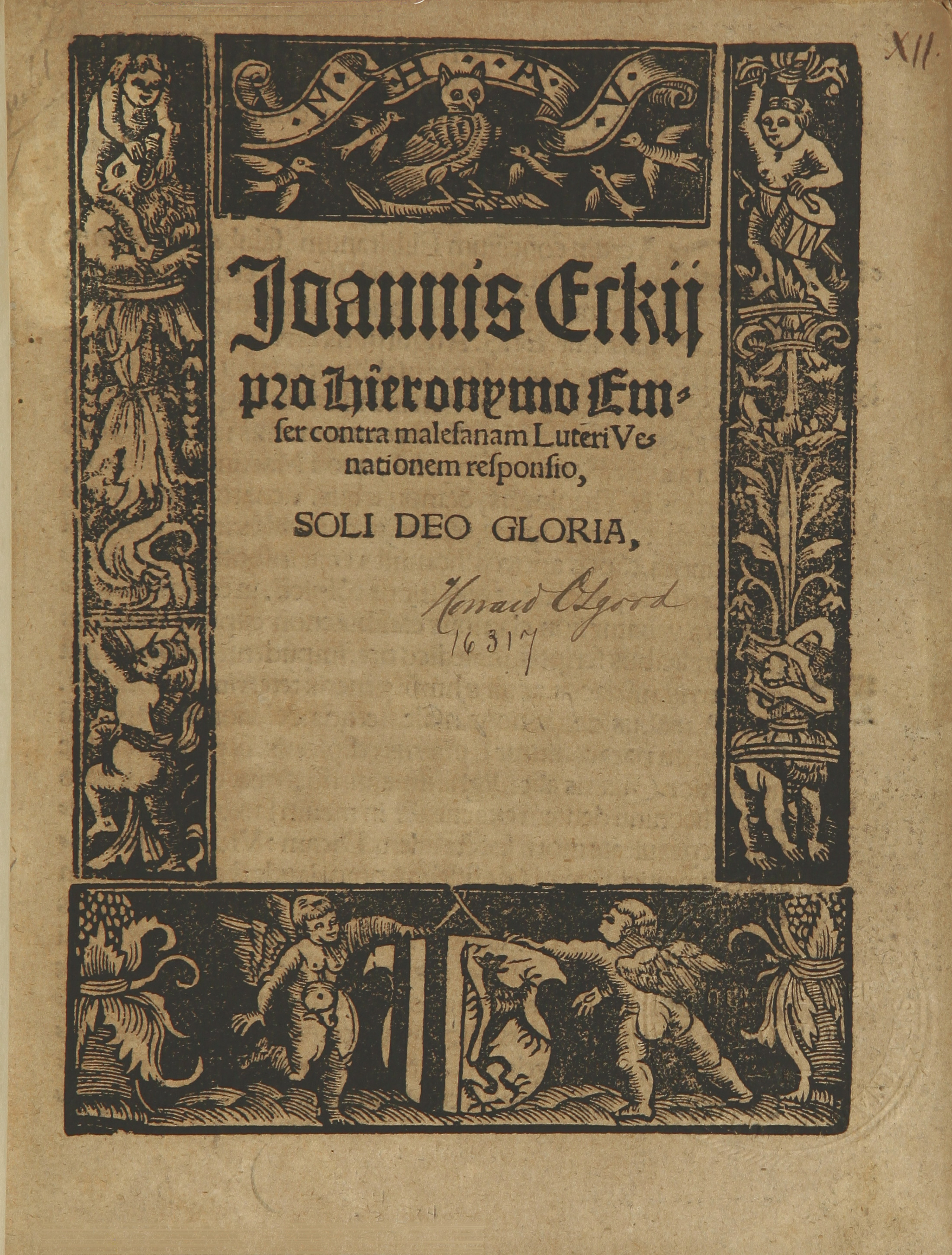
TextJoannis Eckij pro Hieronymo Emser : contra malesanam Luteri venationem responsio, Soli Deo gloria.
Eck, Johann, 1486-1543Summary: First printing of the first edition of a pamphlet by Johann Eck in support of Hieronymus Emser, a theologian in Leipzig and one of Luther's most vehement early opponents.Summary: First printing of the first edition of a pamphlet by Johann Eck in support of Hieronymus Emser, a theologian in Leipzig and one of Luther's most vehement early opponents. -
 Text
TextMultiloquus de co[n]citata ex dictis Lutheri seditio[n]e, : ad Inuictissimu[m] & optimu[m] Imperatore[m] ac multo[rum] regno[rum] Rege[m] inclitu[m] etc[etera]. Carolu[m] S.
Dungersheim, Hieronymus, 1465-1540Summary: H. Dungersheim had had a long academic career before the Reformation started. He proved to be a determined foe of Luther. In this rare book he presents "over a hundred" citations from Luther's books written before the Peasants' War (1525) to prove that Luther was a teacher of sedition and tumult.Summary: H. Dungersheim had had a long academic career before the Reformation started. He proved to be a determined foe of Luther. In this rare book he presents "over a hundred" citations from Luther's books written before the Peasants' War (1525) to prove that Luther was a teacher of sedition and tumult. -

-
 Text
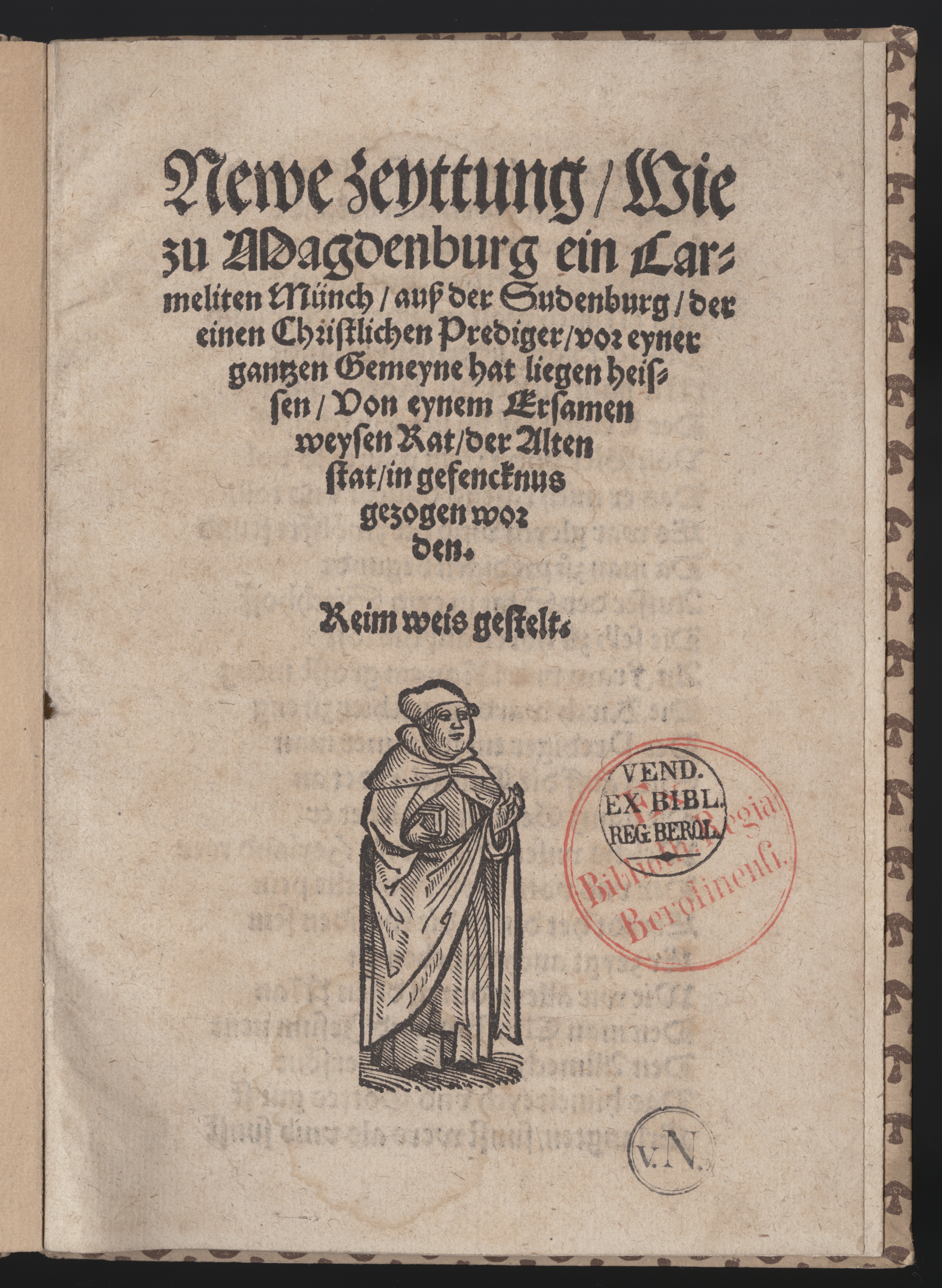
TextNewe zeyttung, Wie zu Magdenburg ein Carmeliten Münch, auss der Sudenburg, der einen Christlichen Prediger, vor eyner gantzen Gemeyne hat liegen heissen, Von eynem Ersamen weysen Rat, der Alten stat, in gefencknus gezogen worden. : Reim weis gestelt.
Summary: Polemic ballad with a total of 142 rhymed lines, relating the story of a drunk Carmelite monk who attends a sermon preached outside the city by a righteous (Lutheran) pastor and who interrupts the preacher, accusing him of lying and misrepresenting Scripture. The people in response rise up and begin to beat him, almost killing him, but the monk is taken away and brought before the city council and the mayor who calls for calm and instructs that the monk should be locked up to await the executioner and thus be placed under God's justice rather than the mob's anger.Summary: Polemic ballad with a total of 142 rhymed lines, relating the story of a drunk Carmelite monk who attends a sermon preached outside the city by a righteous (Lutheran) pastor and who interrupts the preacher, accusing him of lying and misrepresenting Scripture. The people in response rise up and begin to beat him, almost killing him, but the monk is taken away and brought before the city council and the mayor who calls for calm and instructs that the monk should be locked up to await the executioner and thus be placed under God's justice rather than the mob's anger.
