Search
190 resources
190 items
Subject
Early works to 1800
-
 Text
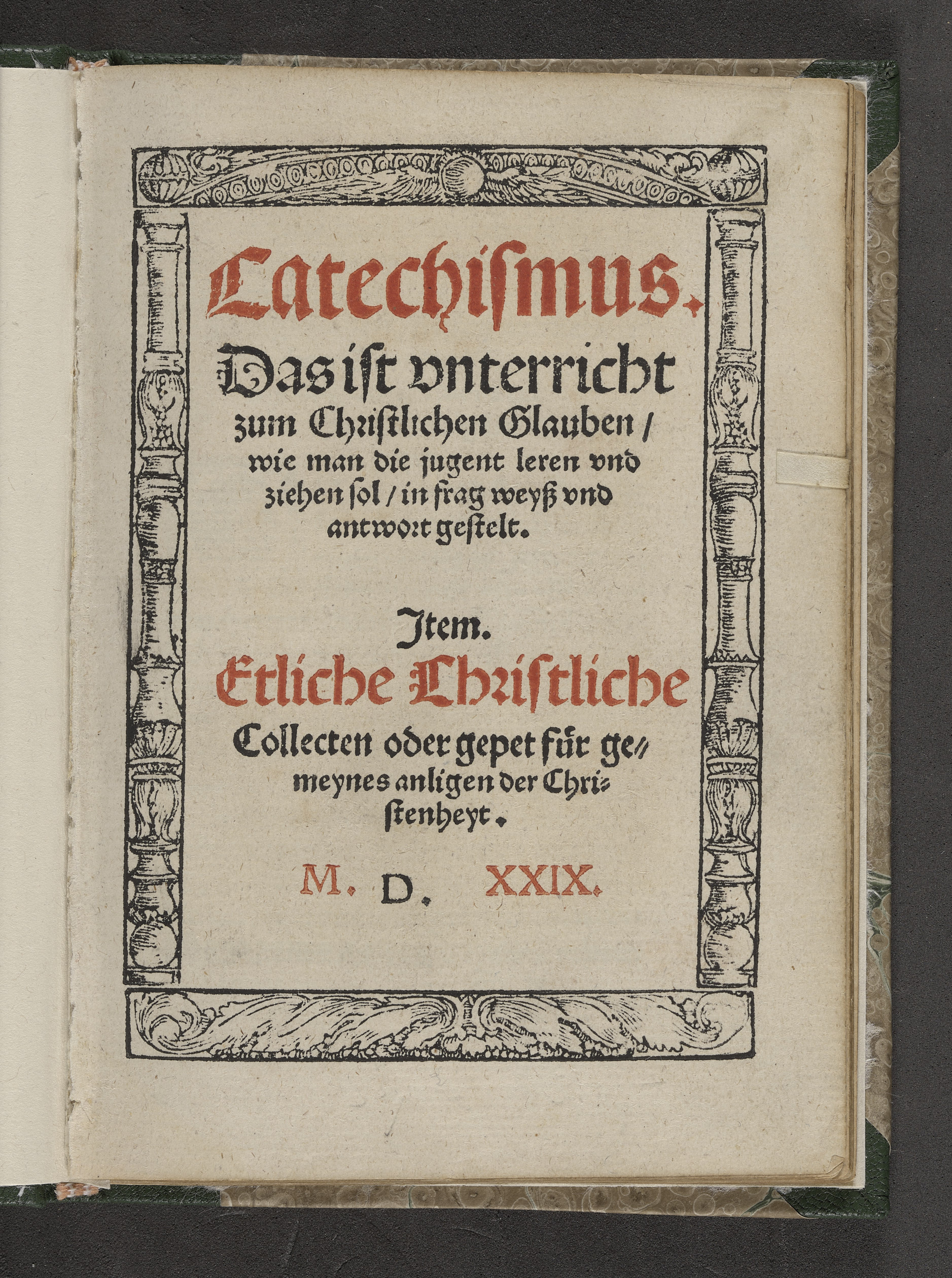
TextCatechismus
Brenz, Johannes, 1499-1570Summary: Johannes Brenz had written the first Protestant catechism in 1527, two years before Luther issued his large and small catechisms. This is a 1552 printing of the work.Summary: Johannes Brenz had written the first Protestant catechism in 1527, two years before Luther issued his large and small catechisms. This is a 1552 printing of the work. -
 Text
TextCatechismus. Das ist Vnterricht zum christlichen Glauben wie man die Jugent leren vnd ziehen sol, in Frag Weyss vnd Antwort gestelt : Jtem etliche christliche Collecten oder Gepet für gemeynes Anligen der Christenheyt
Althamer, Andreas, approximately 1500-1539Summary: Third printing of the Ansbach Catechism by Andreas Althamer and Johannes Rurer, commissioned by Margrave Georg of Brandenburg. It has been called the first regional catechism of the Protestant movement. It contains 92 questions and answers as well as an appendix with 18 prayers.Summary: Third printing of the Ansbach Catechism by Andreas Althamer and Johannes Rurer, commissioned by Margrave Georg of Brandenburg. It has been called the first regional catechism of the Protestant movement. It contains 92 questions and answers as well as an appendix with 18 prayers. -
 Still image
Christ in the garden of Gethsemane
Graf, Urs, approximately 1485-approximately 1527A woodcut by Urs Graf depicting Christ in the garden of Gethsemane. The image was taken from a 1506 harmony of the Gospel texts of the Passion, edited by Matthias Ringmann, translated by Geiler von Keysersberg and printed by Johann Knobloch in Strasbourg.A woodcut by Urs Graf depicting Christ in the garden of Gethsemane. The image was taken from a 1506 harmony of the Gospel texts of the Passion, edited by Matthias Ringmann, translated by Geiler von Keysersberg and printed by Johann Knobloch in Strasbourg. -
 Still image
Christ is carrying his cross
Graf, Urs, approximately 1485-approximately 1527A woodcut by Urs Graf depicting Christ carrying the Cross. The image was taken from a 1506 harmony of the Gospel texts of the Passion, edited by Matthias Ringmann, translated by Geiler von Keysersberg and printed by Johann Knobloch in Strasbourg.A woodcut by Urs Graf depicting Christ carrying the Cross. The image was taken from a 1506 harmony of the Gospel texts of the Passion, edited by Matthias Ringmann, translated by Geiler von Keysersberg and printed by Johann Knobloch in Strasbourg. -
 Still image
Christ is scourged and crowned with a crown of thorns
Graf, Urs, approximately 1485-approximately 1527A woodcut by Urs Graf depiicting Christ being scourged and crowned with thorns. The image was taken from a 1506 harmony of the Gospel texts of the Passion, edited by Matthias Ringmann, translated by Geiler von Keysersberg and printed by Johann Knobloch in Strasbourg.A woodcut by Urs Graf depiicting Christ being scourged and crowned with thorns. The image was taken from a 1506 harmony of the Gospel texts of the Passion, edited by Matthias Ringmann, translated by Geiler von Keysersberg and printed by Johann Knobloch in Strasbourg. -
 Still image
Clemens VII Papa Florentinus
Soye, Philippe deAn engraved portrait of Pope Clement VII, who sat as pope from 1523-1534. The portrait shows Clement VII wearing a simple miter and vestments with his coat of arms featured in the upper right corner. The portrait is labeled "CLEMENS. VII. PAPA. FLORENTINVS".An engraved portrait of Pope Clement VII, who sat as pope from 1523-1534. The portrait shows Clement VII wearing a simple miter and vestments with his coat of arms featured in the upper right corner. The portrait is labeled "CLEMENS. VII. PAPA. FLORENTINVS". -
 Still image
Coelvm empyrevm immobile
An Aristotelean diagram of the solar system featureing the earth at the center surrounded by water, air, and fire. Additional celestial bodies are shown in order moving outward from Earth. In order, they are listed as: Lunae (Moon), Mercurii, Veneris (Venus), Solis (Sun), Martis (Mars), Iovis (Jupiter), Saturni, Aplanes seu firmamentum, crystallinum unum, crystalinum alterum, and Primum mobile.An Aristotelean diagram of the solar system featureing the earth at the center surrounded by water, air, and fire. Additional celestial bodies are shown in order moving outward from Earth. In order, they are listed as: Lunae (Moon), Mercurii, Veneris (Venus), Solis (Sun), Martis (Mars), Iovis (Jupiter), Saturni, Aplanes seu firmamentum, crystallinum unum, crystalinum alterum, and Primum mobile. -
 Text
TextCommonefactio De periculis horum temporum : proposita scholasticis Academiae Vuitebergensis, XII. Cal. IXbris, Anno M.D.LXV. Rectore Micaelo Teubero , I.V. doctore
Peucer, Kaspar, 1525-1602Summary: Lecture delivered to the faculty and students of the University of Wittenberg on "the perils of these times" by Kaspar Peucer, Philipp Melanchthon's son-in-law. The perils to which he refers are the military threat of the Turks to the east, and the plague.Summary: Lecture delivered to the faculty and students of the University of Wittenberg on "the perils of these times" by Kaspar Peucer, Philipp Melanchthon's son-in-law. The perils to which he refers are the military threat of the Turks to the east, and the plague. -
 Text
TextContra haereticum dikaeusistam de dicto Ioannis: Spiritus arguet munde iustitia uado ad Patrem
Flacius Illyricus, Matthias, 1520-1575Summary: Response by Mathias Flacius Illyricus, among the strictest of the Lutheran theologians of his time, to the views of the early Reformer of Nürnberg, Andreas Osiander, on Justification. Osiander emphasized the believer's being made righteous, as opposed to being declared righteous through Christ. Flacius reports on the title page that he had shared his views on this issue privately in writing with friends, but that they had been published without his permission and in a form unacceptable to him. This edition represents the official response by Flacius.Summary: Response by Mathias Flacius Illyricus, among the strictest of the Lutheran theologians of his time, to the views of the early Reformer of Nürnberg, Andreas Osiander, on Justification. Osiander emphasized the believer's being made righteous, as opposed to being declared righteous through Christ. Flacius reports on the title page that he had shared his views on this issue privately in writing with friends, but that they had been published without his permission and in a form unacceptable to him. This edition represents the official response by Flacius. -
 Text
TextCristianus ad solitariu[m] quendam De ymagine mundi : Honorio.
Honorius, of Autun, approximately 1080-approximately 1156Summary:Summary: -
 Text
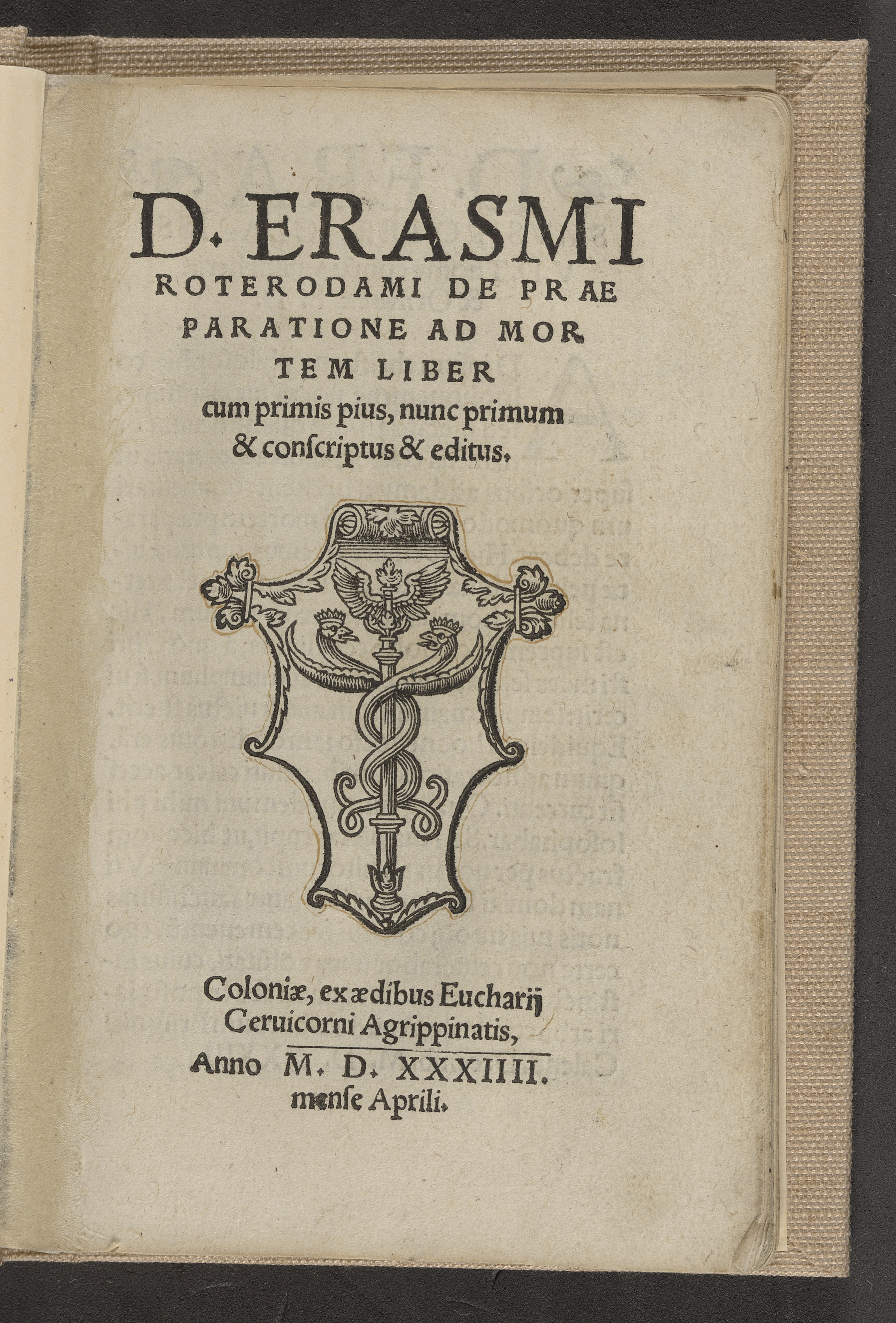
TextD. Erasmi Roterodami De praeparatione ad mortem liber : cum primis pius, nunc primum & conscriptus & editus
Erasmus, Desiderius, -1536Summary: Composed by Erasmus of Rotterdam, at the latest, in 1533, this tract on preparing for death first appeared in printed form in Basel at the beginning of 1534. This printing was followed by the Cologne printing in April. It is dedicated to Thomas Boleyn, Earl of Wiltshire and Ormond (1477-1539), the father of Henry VIII's second wife, Anne Boleyn.Summary: Composed by Erasmus of Rotterdam, at the latest, in 1533, this tract on preparing for death first appeared in printed form in Basel at the beginning of 1534. This printing was followed by the Cologne printing in April. It is dedicated to Thomas Boleyn, Earl of Wiltshire and Ormond (1477-1539), the father of Henry VIII's second wife, Anne Boleyn. -
 Text
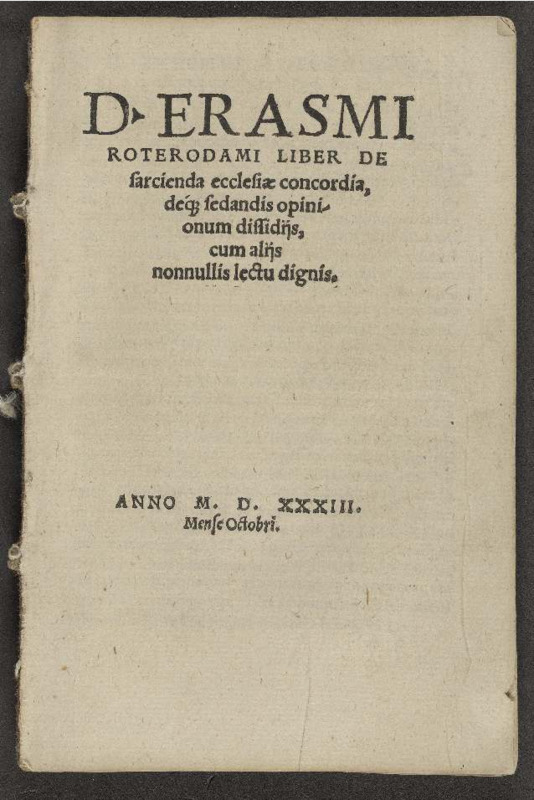
TextD. Erasmi Roterodami Liber de sarcienda ecclesiae concordia deq[ue] : sedandis opinionum dissidijs, cum alijs nonnullis lectu dignis
Erasmus, Desiderius, -1536Summary: A call for concord and harmony in the church by one of the great Humanists of the time.Summary: A call for concord and harmony in the church by one of the great Humanists of the time. -
![Summary: First edition of the second Latin translation of Luther's Large Catechism, published earlier the same year. This translation was done Vincentius Opsopäus (Vinzenz Heidecker). Issued with it is the first Latin edition of Johann Brenz's catechism, first published in German in 1528 under the title "Fragstuck des christlichen Glaube[n]s für die Jugend zu Schwebische[n] Hall]."](https://digital.pitts.emory.edu/files/large/P_300000218139/00000001.jpg) Text
TextD. Martini Lutheri theologi, catechismus, lećtu dignissimus, latinus faćtus per Vincentium Obsopoeum : Huic adiećti sunt alij quo[que] gemini Catechismi,Iohannis Brentij ecclesiastae Hallensis, eodem interprete
Luther, Martin, 1483-1546Summary: First edition of the second Latin translation of Luther's Large Catechism, published earlier the same year. This translation was done Vincentius Opsopäus (Vinzenz Heidecker). Issued with it is the first Latin edition of Johann Brenz's catechism, first published in German in 1528 under the title "Fragstuck des christlichen Glaube[n]s für die Jugend zu Schwebische[n] Hall]."Summary: First edition of the second Latin translation of Luther's Large Catechism, published earlier the same year. This translation was done Vincentius Opsopäus (Vinzenz Heidecker). Issued with it is the first Latin edition of Johann Brenz's catechism, first published in German in 1528 under the title "Fragstuck des christlichen Glaube[n]s für die Jugend zu Schwebische[n] Hall]." -
 Text
TextDas Elltern die Kinder zuo der Ee nicht zwinge[n] noch hindern : Vnd die Kinder on der Elltern willen sich nicht verloben sollen
Luther, Martin, 1483-1546Open letter to Hans Schott, Knight, by Luther on the subject of filial piety in marriage, i.e. to what extent the wishes of the parent must be taken into account in the choice of a life partner. Parental consent was an issue during the Reformation. Catholic orthodoxy demanded parental consent of the bridal couple as it impacted property. Luther saw value in both sides, arguing that while parents ought not to be able to compel children to marry or prevent weddings, the children ought to seek their parents' consent.Open letter to Hans Schott, Knight, by Luther on the subject of filial piety in marriage, i.e. to what extent the wishes of the parent must be taken into account in the choice of a life partner. Parental consent was an issue during the Reformation. Catholic orthodoxy demanded parental consent of the bridal couple as it impacted property. Luther saw value in both sides, arguing that while parents ought not to be able to compel children to marry or prevent weddings, the children ought to seek their parents' consent. -
 Text
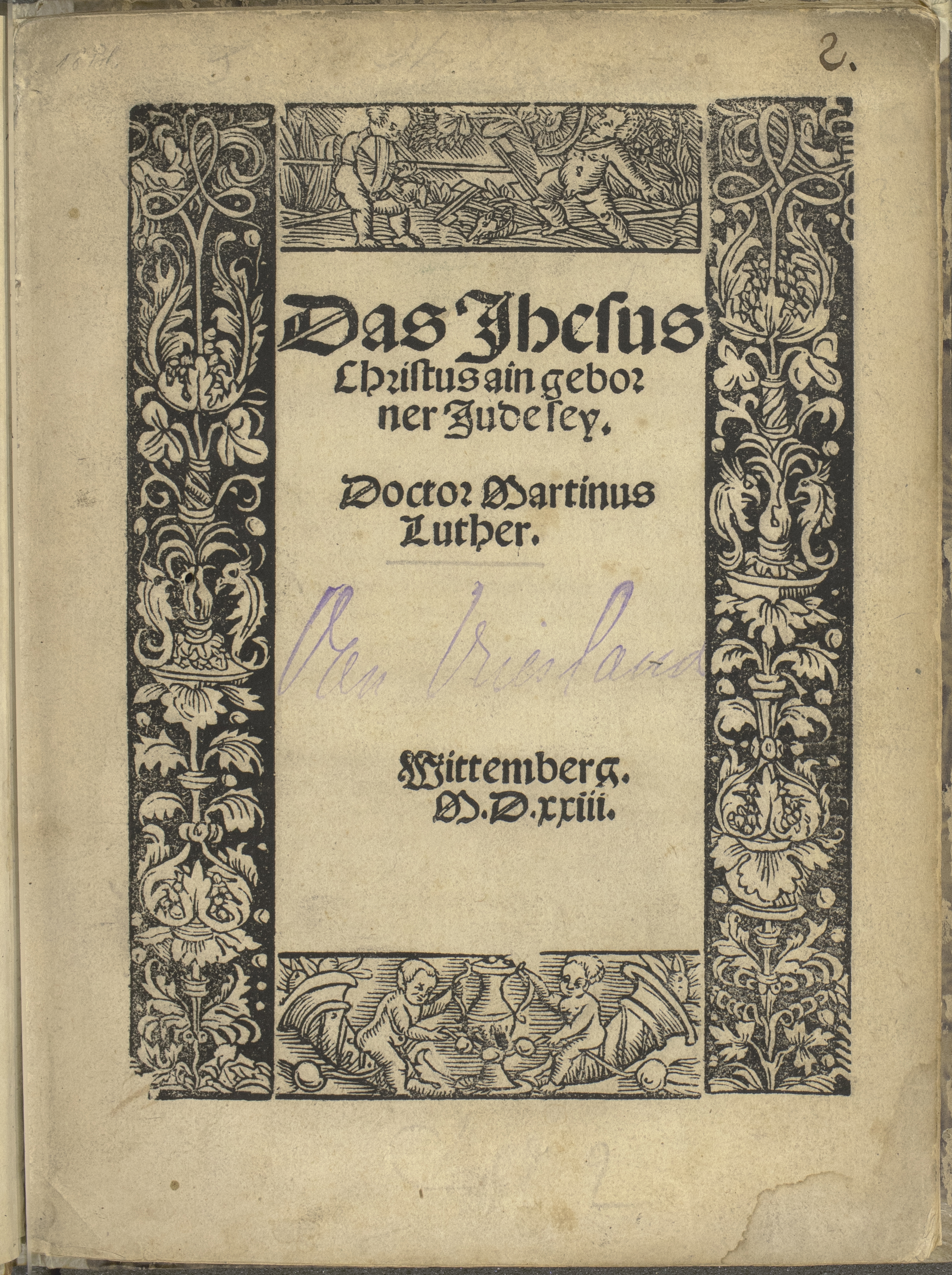
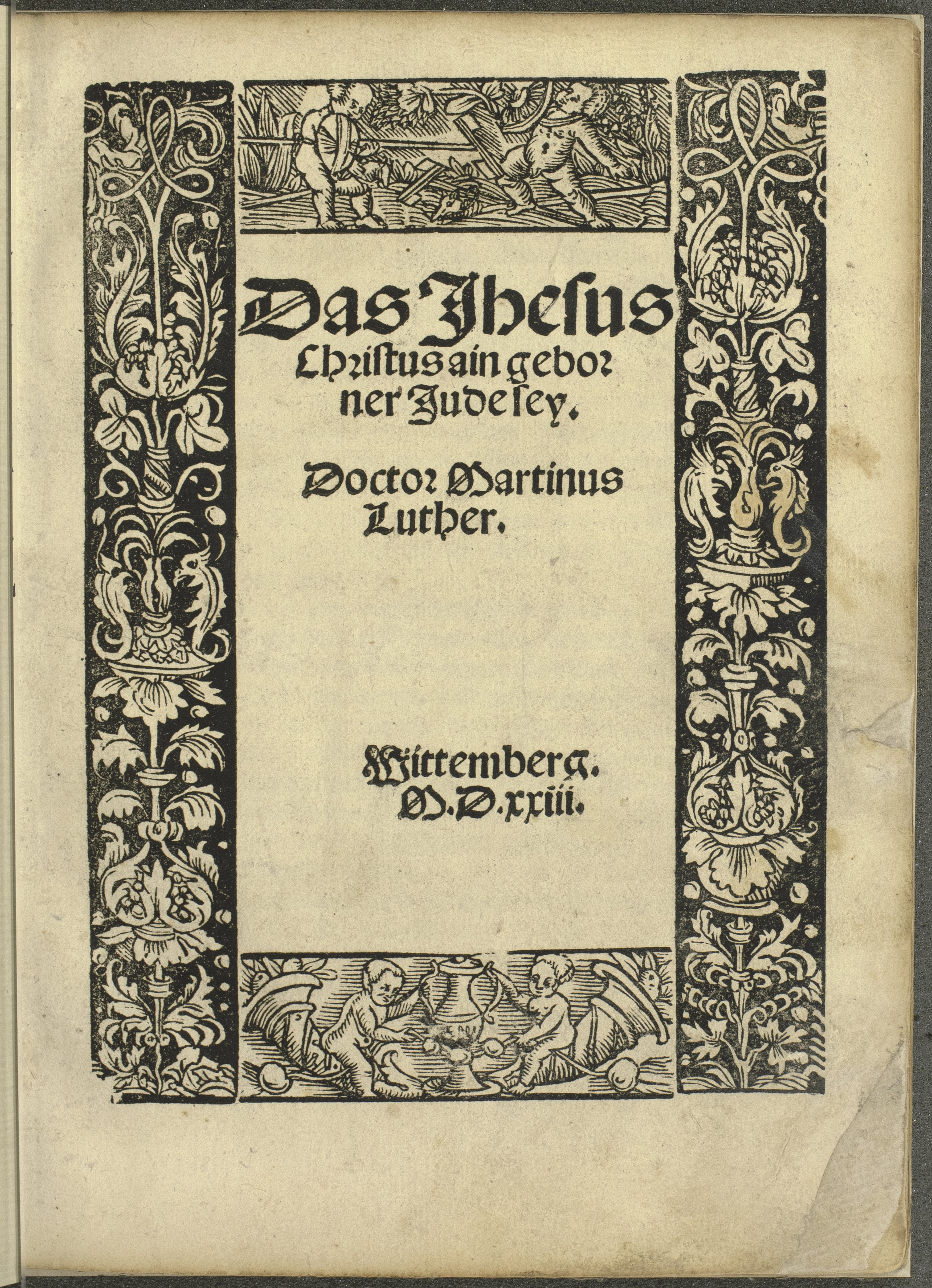
TextDas Ihesus Christus ain geborner Iude sey
Luther, Martin, 1483-1546Summary: The sixth printing (of ten in 1523) of Luther's early treatise, "That Jesus Christ was born a Jew", in which he denies the charges made against him that he did not believe in the Virgin Birth, but rather that Jesus was a naturally born child of Joseph and Mary. In this tract, Luther confesses that he believes that Jesus was born a Jew of the Virgin Mary. He also hopes that his teaching will bring more Jews to convert to Christianity.Summary: The sixth printing (of ten in 1523) of Luther's early treatise, "That Jesus Christ was born a Jew", in which he denies the charges made against him that he did not believe in the Virgin Birth, but rather that Jesus was a naturally born child of Joseph and Mary. In this tract, Luther confesses that he believes that Jesus was born a Jew of the Virgin Mary. He also hopes that his teaching will bring more Jews to convert to Christianity. -
 Text
TextDas Ihesus Christus ain geborner Iude sey
Luther, Martin, 1483-1546Summary: The fifth printing of Luther's early treatise, "That Jesus Christ was born a Jew", in which he denies the charges made against him that he did not believe in the Virgin Birth, but rather that Jesus was a naturally born child of Joseph and Mary. In this tract, Luther confesses that he believes that Jesus was born a Jew of the Virgin Mary. He also hopes that his teaching will bring more Jews to convert to Christianity.Summary: The fifth printing of Luther's early treatise, "That Jesus Christ was born a Jew", in which he denies the charges made against him that he did not believe in the Virgin Birth, but rather that Jesus was a naturally born child of Joseph and Mary. In this tract, Luther confesses that he believes that Jesus was born a Jew of the Virgin Mary. He also hopes that his teaching will bring more Jews to convert to Christianity. -
 Text
TextDas der frey will nichts sey : Anntwort D. Martini Luther ann Erasmum Rotherdam
Luther, Martin, 1483-1546Summary: German translation by Martin Luther's colleague, Justus Jonas, of "De servo arbitrio". "De servo arbitrio (Concerning the Enslaved Will)" is considered one of Luther's greatest literary productions, and among the most important writings of the Reformation. In it, he defends the idea of the complete inability of the human being to please God, apart from Divine grace.Summary: German translation by Martin Luther's colleague, Justus Jonas, of "De servo arbitrio". "De servo arbitrio (Concerning the Enslaved Will)" is considered one of Luther's greatest literary productions, and among the most important writings of the Reformation. In it, he defends the idea of the complete inability of the human being to please God, apart from Divine grace. -
 Still image
Das erst general - inhaltend die beschzeibung [und] den [circtel] des gantzen erdtreichs und m[o]rcs.
A map of the world including latitude and longitude markers. Personifications of the winds are depicted withing croulds surrounding the map and various monstrous creatures are depicted within the oceans.A map of the world including latitude and longitude markers. Personifications of the winds are depicted withing croulds surrounding the map and various monstrous creatures are depicted within the oceans. -
 Text
TextDe Libero arbitrio ΔΙΑΤΡΙΒΗ, sive collatio
Erasmus, Desiderius, -1536Summary: Early edition of Erasmus' treatise on free human will and its limits.Summary: Early edition of Erasmus' treatise on free human will and its limits. -

