Search
297 resources
297 items
Subject
Jesus Christ
-
 Still image
Crucifixion
Illuminated painting depicting the Crucifixion. Jesus hangs on the cross with blood coming from the nails in his hands. A man watches on the right of the image, while two women—one appearing to be his mother, Mary—watch from the left. A small soldier pierces his side with a spear, and a sun and moon with faces appear in the sky over the cross.Illuminated painting depicting the Crucifixion. Jesus hangs on the cross with blood coming from the nails in his hands. A man watches on the right of the image, while two women—one appearing to be his mother, Mary—watch from the left. A small soldier pierces his side with a spear, and a sun and moon with faces appear in the sky over the cross. -
 Text
Dan. Heinsii Lof-sanck van Iesus Christus den eenigen ende eeuwigen Sone Godes: ende zyne andere nederduytse poemata
Heinsius, Daniel, 1580-1655Signatures: A-T⁸ (T8 blank).Signatures: A-T⁸ (T8 blank). -
 Text
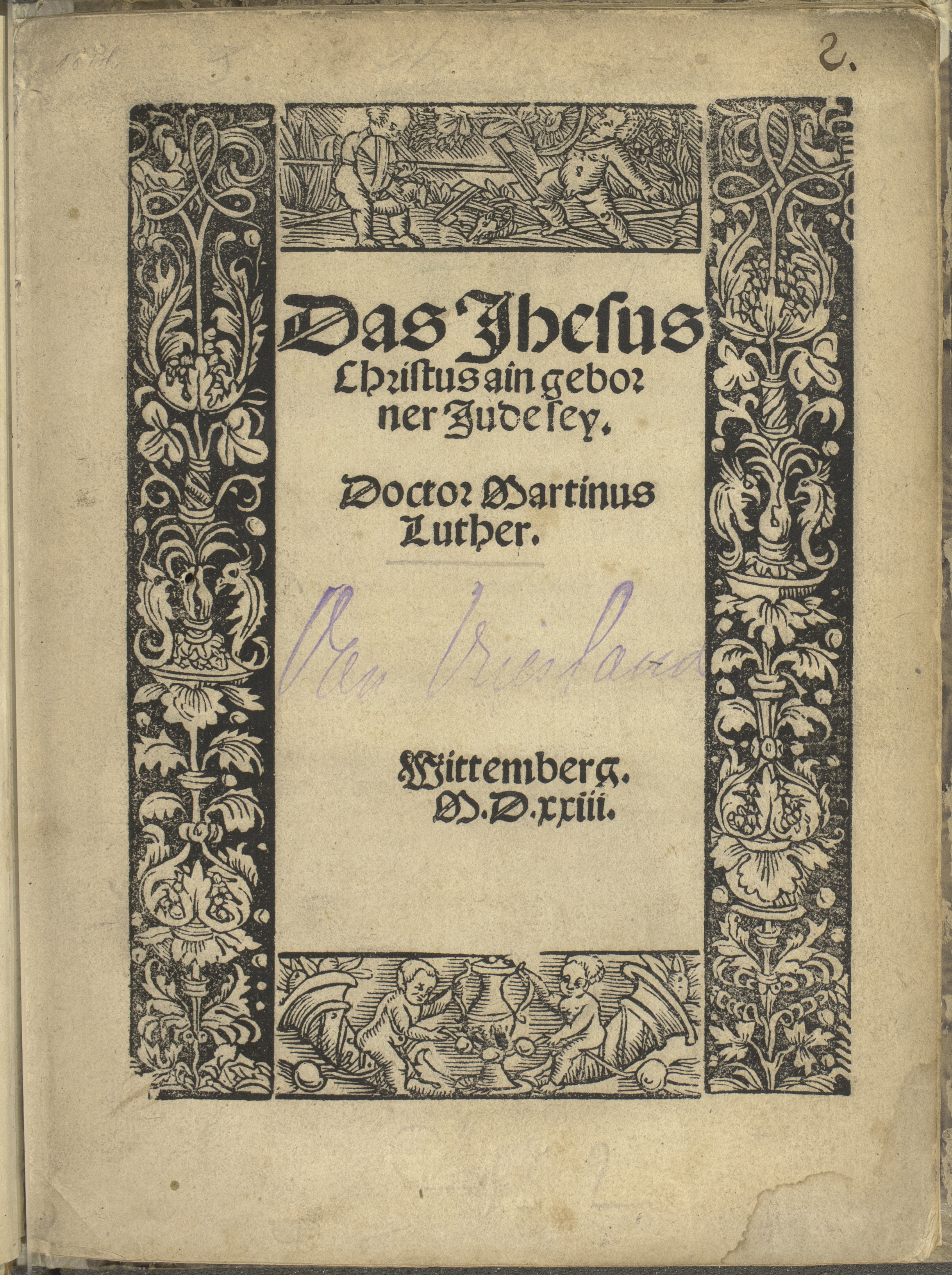
Das Ihesus Christus ain geborner Iude sey
Luther, Martin, 1483-1546Summary: The sixth printing (of ten in 1523) of Luther's early treatise, "That Jesus Christ was born a Jew", in which he denies the charges made against him that he did not believe in the Virgin Birth, but rather that Jesus was a naturally born child of Joseph and Mary. In this tract, Luther confesses that he believes that Jesus was born a Jew of the Virgin Mary. He also hopes that his teaching will bring more Jews to convert to Christianity.Summary: The sixth printing (of ten in 1523) of Luther's early treatise, "That Jesus Christ was born a Jew", in which he denies the charges made against him that he did not believe in the Virgin Birth, but rather that Jesus was a naturally born child of Joseph and Mary. In this tract, Luther confesses that he believes that Jesus was born a Jew of the Virgin Mary. He also hopes that his teaching will bring more Jews to convert to Christianity. -
 Text
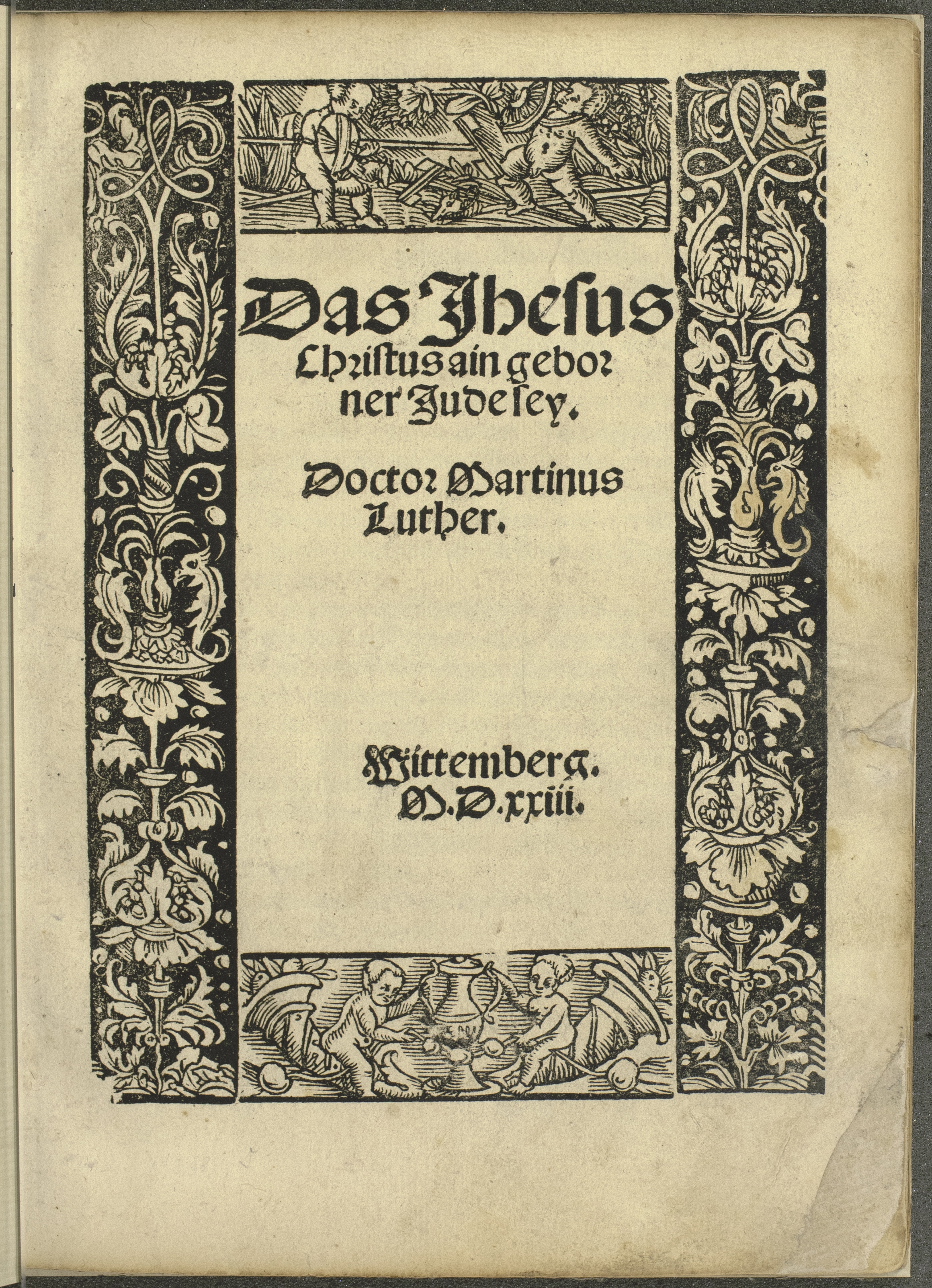
Das Ihesus Christus ain geborner Iude sey
Luther, Martin, 1483-1546Summary: The fifth printing of Luther's early treatise, "That Jesus Christ was born a Jew", in which he denies the charges made against him that he did not believe in the Virgin Birth, but rather that Jesus was a naturally born child of Joseph and Mary. In this tract, Luther confesses that he believes that Jesus was born a Jew of the Virgin Mary. He also hopes that his teaching will bring more Jews to convert to Christianity.Summary: The fifth printing of Luther's early treatise, "That Jesus Christ was born a Jew", in which he denies the charges made against him that he did not believe in the Virgin Birth, but rather that Jesus was a naturally born child of Joseph and Mary. In this tract, Luther confesses that he believes that Jesus was born a Jew of the Virgin Mary. He also hopes that his teaching will bring more Jews to convert to Christianity. -
 Text
Das Jesus Christus ein geborner Jude sey
Luther, Martin, 1483-1546Summary: Luther was accused by Ferdinand (brother of Charles V) of teaching that Jesus was the seed of Abraham and that Mary was not a virgin either before or after the birth of Jesus. Luther replied with this booklet that demonstrated the human and divine natures of Jesus and showed sensitivity to Jesus' Jewish background. Luther hoped that books like this could be used to convert Jews from their erroneous beliefs.Summary: Luther was accused by Ferdinand (brother of Charles V) of teaching that Jesus was the seed of Abraham and that Mary was not a virgin either before or after the birth of Jesus. Luther replied with this booklet that demonstrated the human and divine natures of Jesus and showed sensitivity to Jesus' Jewish background. Luther hoped that books like this could be used to convert Jews from their erroneous beliefs. -
 Text
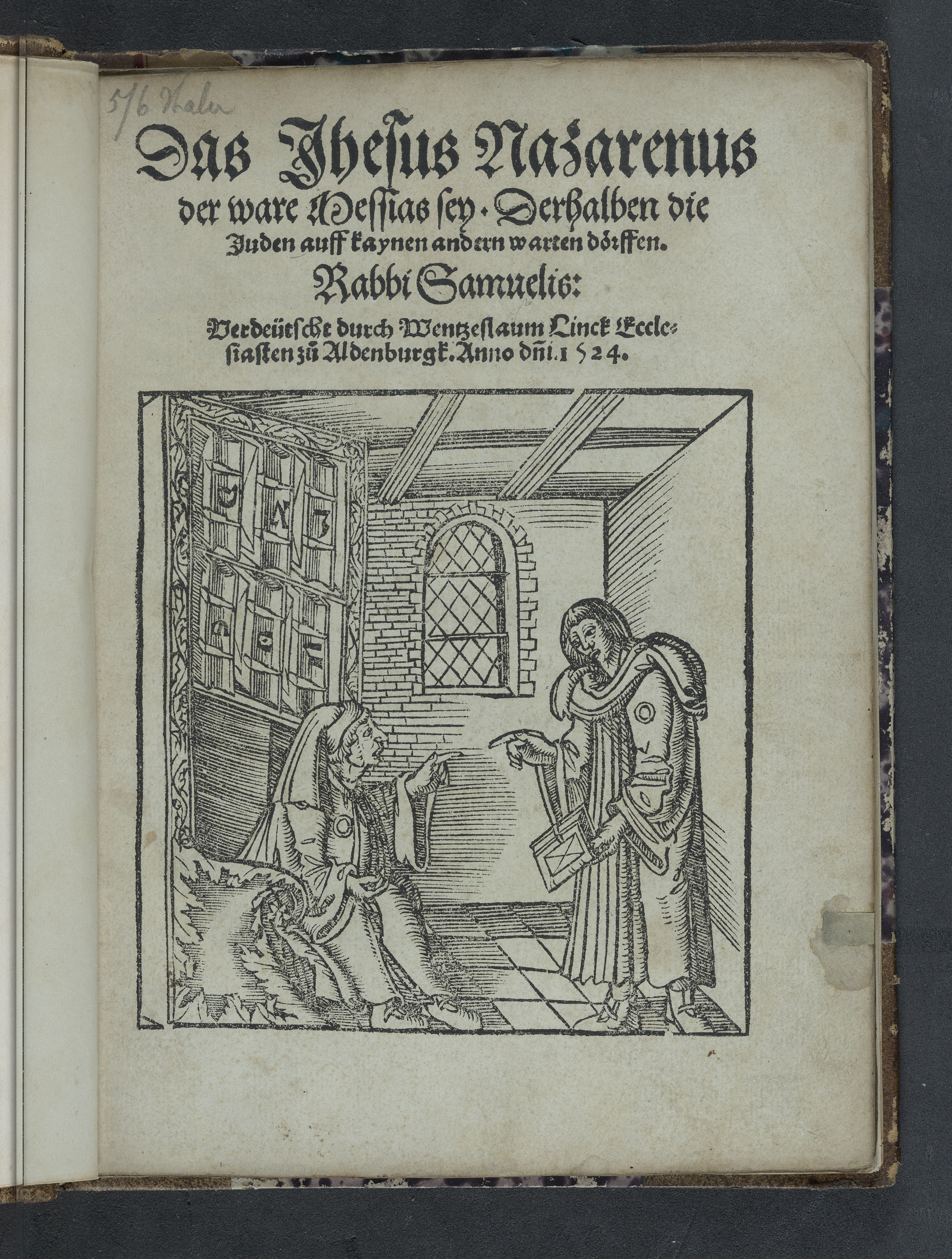
Das Jhesus Nazarenus der ware Messias sey : Derhalben die Juden auff kaynen andern warten dörffen
Samuel, MarochitanusSummary: German translation by Wenzeslaus Linck of Epistola contra Judaeorum, thought to be written in Arabic by Samuel of Marocco, an apostate Jew at the beginning of the 11th century and translated into Latin by the Spanish Dominican Alphonsus Bonihominis in the 14th century and widely disseminated. Bonihominis is likely the real author of the work.Summary: German translation by Wenzeslaus Linck of Epistola contra Judaeorum, thought to be written in Arabic by Samuel of Marocco, an apostate Jew at the beginning of the 11th century and translated into Latin by the Spanish Dominican Alphonsus Bonihominis in the 14th century and widely disseminated. Bonihominis is likely the real author of the work. -
 Still image
Deposition and Burial
Illuminated painting depicting the Deposition and Burial. The cross appears in the center of the image with two torches burning behind it. At the foot of the cross, two men carry Jesus' body, which is wrapped in burial clothes.Illuminated painting depicting the Deposition and Burial. The cross appears in the center of the image with two torches burning behind it. At the foot of the cross, two men carry Jesus' body, which is wrapped in burial clothes. -
 Still image
Der ungläubige Thomas
Dürer, Albrecht, 1471-1528Thomas touches the pierced side of Jesus while the apostles gather around.Thomas touches the pierced side of Jesus while the apostles gather around. -
 Still image
Die Auferstehung
Dürer, Albrecht, 1471-1528Dürer's depiction of the resurrection of Christ focuses on Matthew's account: Christ emerges from the tomb while the guards shook in fear and became as dead men.Dürer's depiction of the resurrection of Christ focuses on Matthew's account: Christ emerges from the tomb while the guards shook in fear and became as dead men. -
 Still image
Die Dornenkrönung
Dürer, Albrecht, 1471-1528Christ is seated while the guards beat him and apply a crown of thorns to his head, while the Jewish leader look on from the left.Christ is seated while the guards beat him and apply a crown of thorns to his head, while the Jewish leader look on from the left. -
 Still image
Die Fußwaschung
Dürer, Albrecht, 1471-1528Jesus washes Peter's feet in the foreground while in the background the rest of the apostles are contemplating this event.Jesus washes Peter's feet in the foreground while in the background the rest of the apostles are contemplating this event. -
 Text
Discourse for Palm Sunday; Matthew 21:5
Archer, James, 1751-1834This sermon cautions against accepting Jesus Christ into your heart under false pretenses, but that all good Christians must accept him fully as their Lord and give up their sinful desires.This sermon cautions against accepting Jesus Christ into your heart under false pretenses, but that all good Christians must accept him fully as their Lord and give up their sinful desires. -
 Text
Discourse for the 1st Sunday of Lent; Matthew 1:4
Archer, James, 1751-1834This sermon celebrates the manner in which Jesus Christ could understand the word of God, describing different calamities and symbols and their significance in the bible.This sermon celebrates the manner in which Jesus Christ could understand the word of God, describing different calamities and symbols and their significance in the bible. -
 Still image
Dubitantibus recte consulere
Galle, Philippe, 1537-1612The act of guiding the doubtful to the correct path, illustrated and accompanied by scriptural reference.The act of guiding the doubtful to the correct path, illustrated and accompanied by scriptural reference. -

-
 text
Ein schone sermon vber das Euangelion Matthei. xxij. : Wie Christus warer Got vnd mensch sey, sitzent bey der gerechte[n] seines vaters, welcher jm Teufel, Sündt vnd Welt, sampt jhrem gewalt vnd anschlegen, täglich zum fuossschemel macht, gepredigt zuo
Luther, Martin, 1483-1546Summary: Sermon preached in August 3, 1531, on Matthew 22:41-46 (Whose son is Christ?).Summary: Sermon preached in August 3, 1531, on Matthew 22:41-46 (Whose son is Christ?). -
 Still image
Elector Joachim II of Brandenburg Kneeling before a Crucifix
Friedrich, Franz, approximately 1520-1584A woodcut containing a portrait of Elector Joachim II of Brandenburg kneeling before a crucifix. This woodcut likekly originated as a broadsheet since there are no signs of letterpress on the back. The same woodcut appeared in Grabriel Schnellboltz' Wahrhafftige Bildnisse etlicher Fuersten (Wittenberg, 1562) and the Augspurgische Confession (Frankfurt an der Oder:, Eichorn, 1572).A woodcut containing a portrait of Elector Joachim II of Brandenburg kneeling before a crucifix. This woodcut likekly originated as a broadsheet since there are no signs of letterpress on the back. The same woodcut appeared in Grabriel Schnellboltz' Wahrhafftige Bildnisse etlicher Fuersten (Wittenberg, 1562) and the Augspurgische Confession (Frankfurt an der Oder:, Eichorn, 1572). -
 Still image
Elector John Frederick the Magnanimous with Book and Crucifix
Cranach, Lucas, 1515-1586A woodcut containing a portrait of John Frederick (Johann Friedrich) reading a book and praying before a crucifix. Frederick was a leader of the Schmalkaldic League and fought for Luther's cause against the Imperial troops. The league was defeated in the Battle of Muehlberg in April of 1547. Frederick was wounded by a slash across his left cheek, captured, condemned to death, but ultimately pardoned and reinstated as duke in Weimar. After 1547, however, the Electoral power had fallen to the rivalling Albertininian line of the dynasty residing in Dresden.A woodcut containing a portrait of John Frederick (Johann Friedrich) reading a book and praying before a crucifix. Frederick was a leader of the Schmalkaldic League and fought for Luther's cause against the Imperial troops. The league was defeated in the Battle of Muehlberg in April of 1547. Frederick was wounded by a slash across his left cheek, captured, condemned to death, but ultimately pardoned and reinstated as duke in Weimar. After 1547, however, the Electoral power had fallen to the rivalling Albertininian line of the dynasty residing in Dresden. -
 Still image
Entry into Jerusalem
Illuminated painting depicting the Entry into Jerusalem. In the center of the image, Jesus rides a donkey, the path below them showing green with branches. There is a crowd around him, and a small figure in the foreground places a garment on the ground before Jesus.Illuminated painting depicting the Entry into Jerusalem. In the center of the image, Jesus rides a donkey, the path below them showing green with branches. There is a crowd around him, and a small figure in the foreground places a garment on the ground before Jesus.