Search
932 resources
932 items
Time Period
Sixteenth century
-
 Text
TextDialogus ad Martinu[m] Lutherum : pro responsione ad impertinentem quanda[m] ipsius epistolam super posita[m] veluti collocutoris vice intermixtam
Dungersheim, Hieronymus, 1465-1540Summary: H. Dungersheim had exchanged several letters with Luther before he wrote this dialogue. It was his first formal controversialist tract, written in 1520, but not published until 1531. Luther burned a manuscript copy of this work when he burned the bull Exsurge Domine on December 10, 1520.Summary: H. Dungersheim had exchanged several letters with Luther before he wrote this dialogue. It was his first formal controversialist tract, written in 1520, but not published until 1531. Luther burned a manuscript copy of this work when he burned the bull Exsurge Domine on December 10, 1520. -
 Still image
Die Auferstehung
Dürer, Albrecht, 1471-1528Dürer's depiction of the resurrection of Christ focuses on Matthew's account: Christ emerges from the tomb while the guards shook in fear and became as dead men.Dürer's depiction of the resurrection of Christ focuses on Matthew's account: Christ emerges from the tomb while the guards shook in fear and became as dead men. -
 Still image
Die Dornenkrönung
Dürer, Albrecht, 1471-1528Christ is seated while the guards beat him and apply a crown of thorns to his head, while the Jewish leader look on from the left.Christ is seated while the guards beat him and apply a crown of thorns to his head, while the Jewish leader look on from the left. -
 Text
TextDie Epistel S. Paul an die Galater
Luther, Martin, 1483-1546Summary: In August 1523, a second revision of Luther's 1519 Galatians commentary was issued by Luther himself. V. Heydnecker (who may have been V. Obsopaeus) prepared this German translation of the work. Text in German includes M. Luther's translation of St. Paul's Epistle to the Galatians from the Greek N.T. Text is translated from M. Luther's Latin work: In epistolam Sancti Pauli ad Galatas commentarius (1519) by V. Heydnecker, who some scholars believe was V. Obsopäus. Text is translation of the 2nd version of Luther's work.Summary: In August 1523, a second revision of Luther's 1519 Galatians commentary was issued by Luther himself. V. Heydnecker (who may have been V. Obsopaeus) prepared this German translation of the work. Text in German includes M. Luther's translation of St. Paul's Epistle to the Galatians from the Greek N.T. Text is translated from M. Luther's Latin work: In epistolam Sancti Pauli ad Galatas commentarius (1519) by V. Heydnecker, who some scholars believe was V. Obsopäus. Text is translation of the 2nd version of Luther's work. -
 Still image
Die Fußwaschung
Dürer, Albrecht, 1471-1528Jesus washes Peter's feet in the foreground while in the background the rest of the apostles are contemplating this event.Jesus washes Peter's feet in the foreground while in the background the rest of the apostles are contemplating this event. -
 Text
TextDie Sieben puszpsalm mit deutscher auszlegu[n]g nach dem schrifttlichen synne tzu Christi vn[d] gottis gnaden, neben seyns selben. ware erkentniss gru[n]dlich gerichtet.. 1517
Luther, Martin, 1483-1546Summary: The first edition of Martin Luther's first book, this is Luther's commentary on the seven penitential Psalms (Psalms 6, 32, 38, 51, 102, 130, and 143) based on his lectures at the University of Wittenberg and published in March1517, six months before his 95 Theses. The Reformer's understanding of repentance, penance and grace, influenced by the medieval mystic Johannes Tauler, became central to his theology and underlies his later critique of indulgences. Luther revised this commentary in 1525.Summary: The first edition of Martin Luther's first book, this is Luther's commentary on the seven penitential Psalms (Psalms 6, 32, 38, 51, 102, 130, and 143) based on his lectures at the University of Wittenberg and published in March1517, six months before his 95 Theses. The Reformer's understanding of repentance, penance and grace, influenced by the medieval mystic Johannes Tauler, became central to his theology and underlies his later critique of indulgences. Luther revised this commentary in 1525. -
 Text
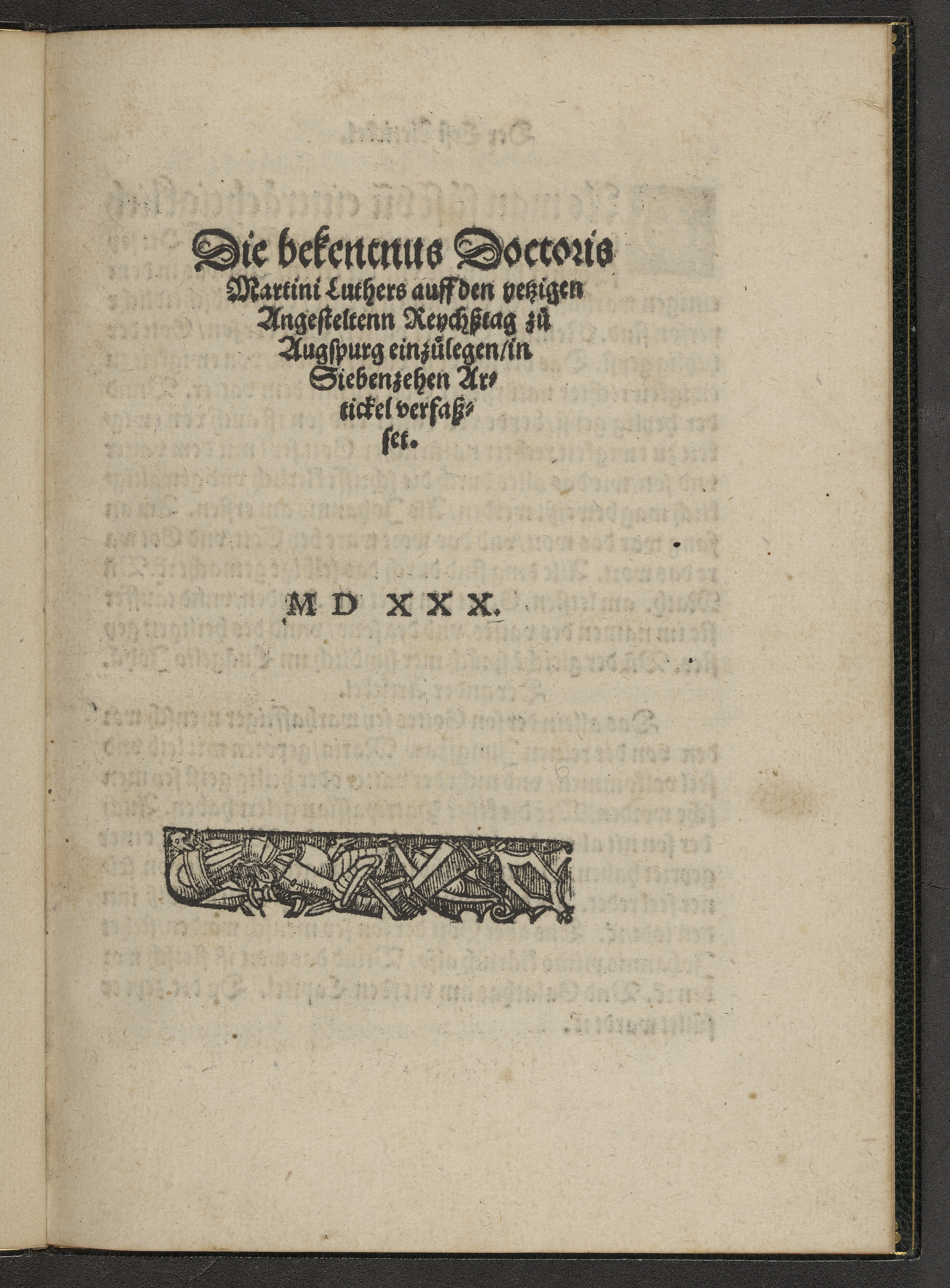
TextDie bekentnus Doctoris Martini Luthers auff den yetzigen Angesteltenn Reychstag zu Augspurg einzuolegen : in Siebenzehen Artickel verfasset
Luther, Martin, 1483-1546Summary: One of at least 11 printings produced in 1530 of the Schwabach Articles, 17 articles of faith composed by Luther 1529 in Schwabach. It became one of the foundational documents for the Augsburg Confession.Bound in modern dark green morocco, bordered, blind- and gilt-tooled, with inside dentelles, gold spine title, and gilt edges. Upper board scratched.Summary: One of at least 11 printings produced in 1530 of the Schwabach Articles, 17 articles of faith composed by Luther 1529 in Schwabach. It became one of the foundational documents for the Augsburg Confession.Bound in modern dark green morocco, bordered, blind- and gilt-tooled, with inside dentelles, gold spine title, and gilt edges. Upper board scratched. -
 Still image
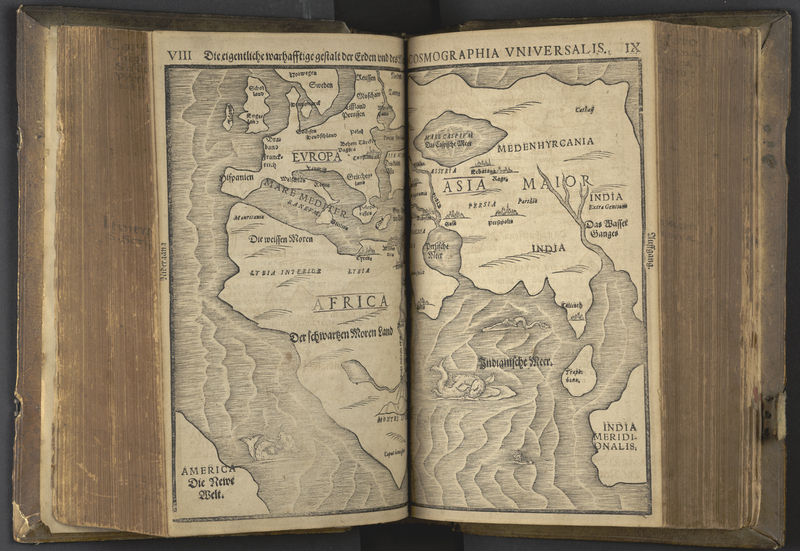
Die eigentliche warhafftige gestalt der Erden und des [...]
A map of the world including Europe, Africa ("Der schwarzen Moren Land"), Asia (Major), America ("Die Newe Welt"), and India Meridionalis (a so called "phantom" peninsula that was often depicted in Medieval and Rennaissance maps). A number of monstrous sea creatures are depicted in the various oceans and seas.A map of the world including Europe, Africa ("Der schwarzen Moren Land"), Asia (Major), America ("Die Newe Welt"), and India Meridionalis (a so called "phantom" peninsula that was often depicted in Medieval and Rennaissance maps). A number of monstrous sea creatures are depicted in the various oceans and seas. -
 Still image
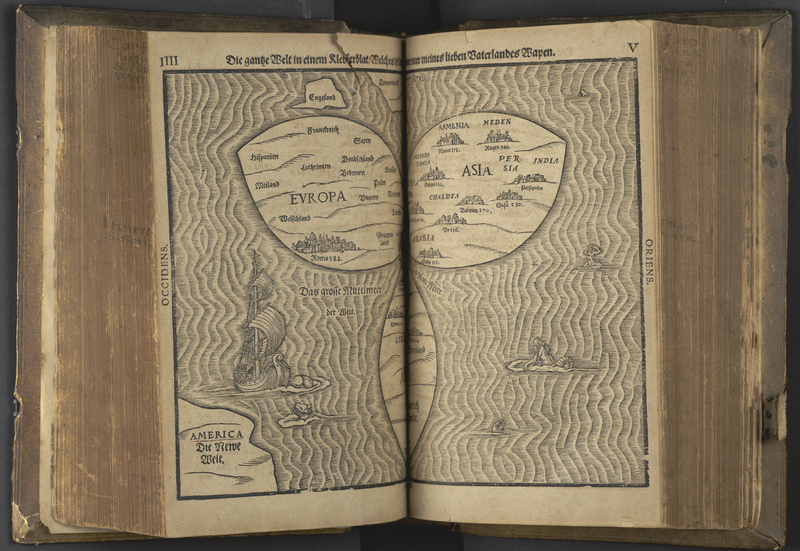
Die ganze Welt in einem [K]leberblat Welches [...] meines lieben Vaterlandes [W]apen
A map of the world including Europe, Africa, and Asia as three leaf or petal shaped continents with America ("Die Newe Welt") draw in the bottom left corner. A ship and numerous sea creatures are depicted in the oceans.A map of the world including Europe, Africa, and Asia as three leaf or petal shaped continents with America ("Die Newe Welt") draw in the bottom left corner. A ship and numerous sea creatures are depicted in the oceans. -
 Still image
Die neuwen Inseln - so hinder Hispanien gegen Orient bey dem land Indic ligen.
A map of the western hemisphere, identified as the New World, and the western coast of Asia. A spanish style galleon ship is depicted sailing in the Pacific ocean, and a rough shelter built of sticks featureing a dismembered leg is depicted in the general region of Brazil with the label, "Canibali".A map of the western hemisphere, identified as the New World, and the western coast of Asia. A spanish style galleon ship is depicted sailing in the Pacific ocean, and a rough shelter built of sticks featureing a dismembered leg is depicted in the general region of Brazil with the label, "Canibali". -
 Text
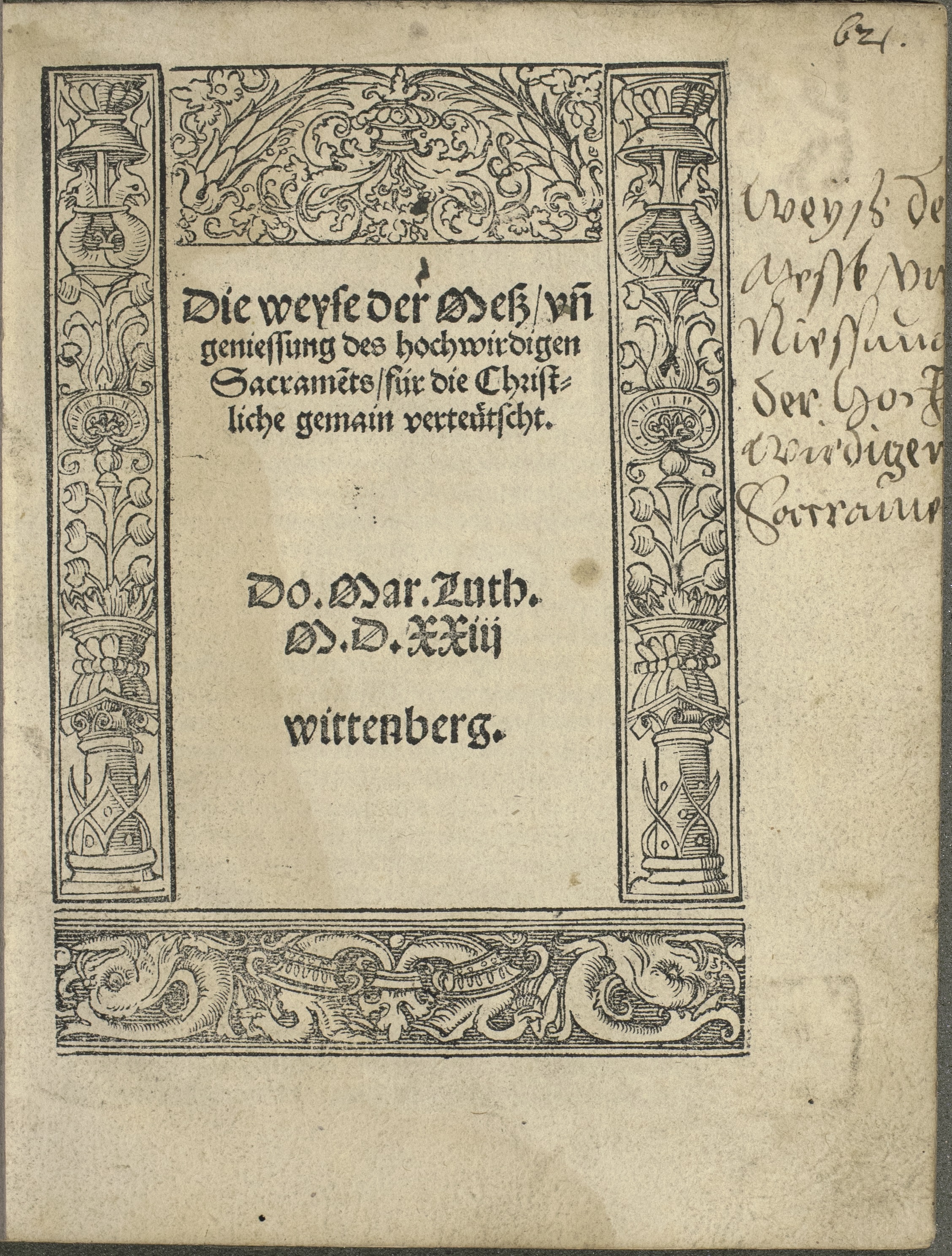
TextDie weyse der Mess, vn[d] geniessung des hochwirdigen Sacrame[n]ts, für die Christliche gemain verteütscht
Luther, Martin, 1483-1546Summary: First published in Latin in 1523, Luther defines in this tract the order of the Sunday worship service and the distribution of communion. This pamphlet is an important forerunner of Luther's "Deutsche Messe" (German Mass) published in 1526.Summary: First published in Latin in 1523, Luther defines in this tract the order of the Sunday worship service and the distribution of communion. This pamphlet is an important forerunner of Luther's "Deutsche Messe" (German Mass) published in 1526. -
 Text
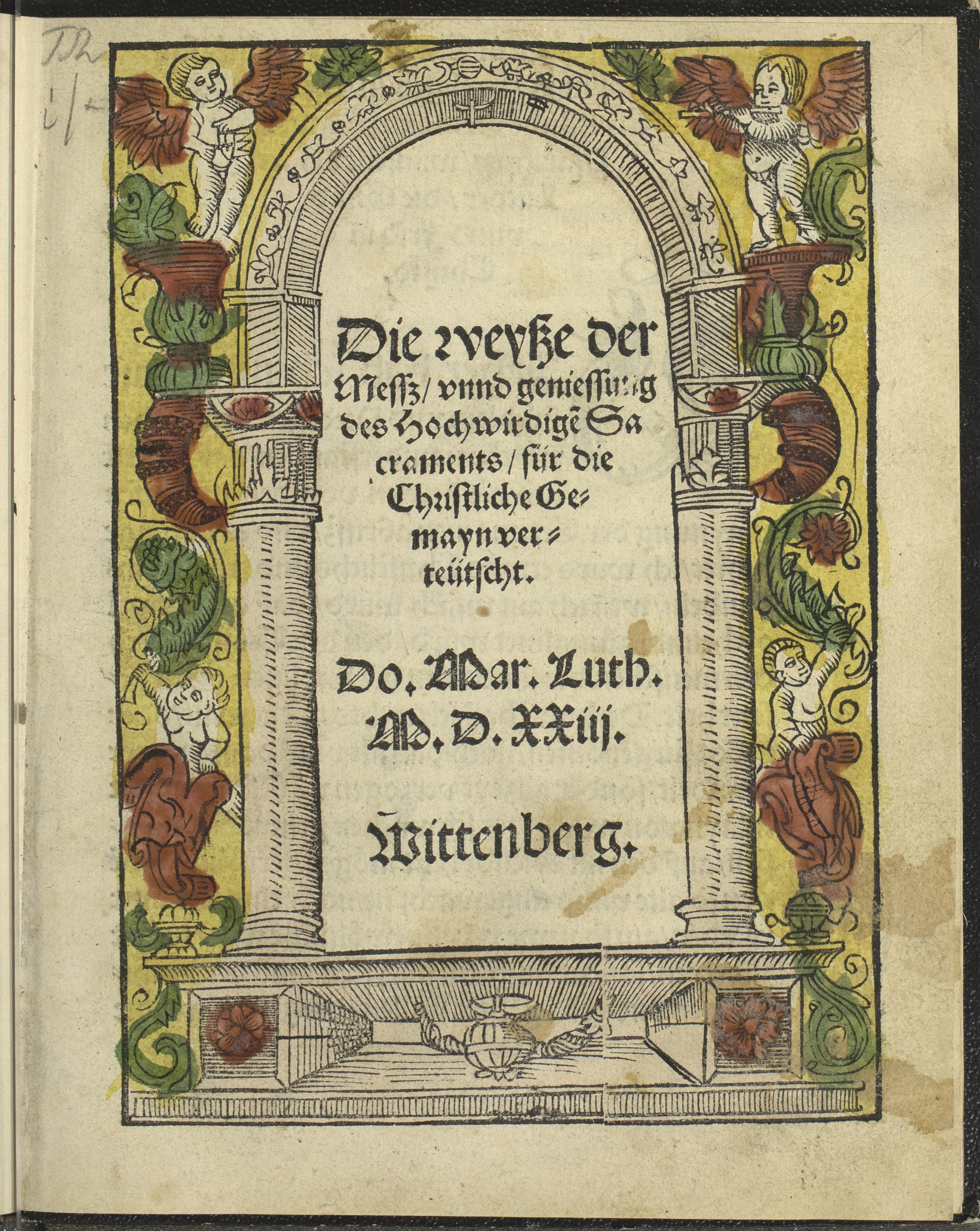
TextDie weysse der Messz, : vnnd geniesung des Hochwirdigen Sacraments, für die Christliche Gemayn verteütscht
Luther, Martin, 1483-1546Summary: Luther wrote his "Formula of the Mass and Communion" in 1523 at the insistence of N. Hausmann, the preacher at the Marienkirche, in Zwickau. Hausmann then wanted a German version to be used in his church. P. Speratus supplied one, and an unnamed Nuremberg translator supplied another. This is that Nuremberg work's first printing.Summary: Luther wrote his "Formula of the Mass and Communion" in 1523 at the insistence of N. Hausmann, the preacher at the Marienkirche, in Zwickau. Hausmann then wanted a German version to be used in his church. P. Speratus supplied one, and an unnamed Nuremberg translator supplied another. This is that Nuremberg work's first printing. -
 Text
TextDis schön Buch gena[n]t der Seelen Paradiss : von waren und volkumen Tugenden sagend
Geiler von Kaysersberg, Johann, 1445-1510Summary: Collection of sermons by the Alsatian preacher Geiler von Kaysersberg, delivered between 1503 and 1505 at the convent of the sisters of the order of St. Mary Magdalene. Geiler was one of the most popular preachers of his day and was sometimes called the German Savonarola. He was a close friend of the Strasbourg humanist Jakob von Wimpheling and was greatly respected by Sebastian Brant, Johann Reuchlin and Philipp Melanchthon.Summary: Collection of sermons by the Alsatian preacher Geiler von Kaysersberg, delivered between 1503 and 1505 at the convent of the sisters of the order of St. Mary Magdalene. Geiler was one of the most popular preachers of his day and was sometimes called the German Savonarola. He was a close friend of the Strasbourg humanist Jakob von Wimpheling and was greatly respected by Sebastian Brant, Johann Reuchlin and Philipp Melanchthon. -
 Text
TextDisputaciones circulatim expediendae
Luther, Martin, 1483-1546Summary: This disputation centered around the question of whether the German princes could offer armed resistance to the Emperor, and whether they ought to support him in his war against the Turks. Luther came to believe that any support of the Emperor when he was acting in a religious capacity (in league with the pope) was wrong, because the pope was acting contrary to the Gospel. This is the first (and only) printing of this revised version of these theses. It contains 91 theses, whereas the first version (written before the Emperor and princes had come to terms) contained only 70 theses.Summary: This disputation centered around the question of whether the German princes could offer armed resistance to the Emperor, and whether they ought to support him in his war against the Turks. Luther came to believe that any support of the Emperor when he was acting in a religious capacity (in league with the pope) was wrong, because the pope was acting contrary to the Gospel. This is the first (and only) printing of this revised version of these theses. It contains 91 theses, whereas the first version (written before the Emperor and princes had come to terms) contained only 70 theses. -
 Text
TextDisputatio D. Iohannis Eccij et P. Martini Luther in Studio Lipsensi. futura
Luther, Martin, 1483-1546Summary: Response by Luther to the theses of Johann Eck, who had previously been in debate with Luther's colleague, Karlstadt. The face to face clash would come some six months later at the end of June, 1519.Summary: Response by Luther to the theses of Johann Eck, who had previously been in debate with Luther's colleague, Karlstadt. The face to face clash would come some six months later at the end of June, 1519. -
 Text
TextDisputatio domini Johannis Eccij et P. Martini Luther in Studio Lipsiensi futura
Luther, Martin, 1483-1546Summary: This is Luther's first public attack on Johannes Eck. Included in this volume are Eck's letter of Dec. 24, 1518 in which he records his theological differences with Karlstadt, and Eck's own 12 theses with Luther's response.Summary: This is Luther's first public attack on Johannes Eck. Included in this volume are Eck's letter of Dec. 24, 1518 in which he records his theological differences with Karlstadt, and Eck's own 12 theses with Luther's response. -
 Text
TextDisputatio et excusatio
Luther, Martin, 1483-1546Summary: A response by Luther to the accusations leveled at him at the Leipzig Disputation by his opponent, Johann Eck.Summary: A response by Luther to the accusations leveled at him at the Leipzig Disputation by his opponent, Johann Eck. -
 Text
TextDisputatio inter Egregios & praelatus virus ac doctores, Joannem Ecci[um] & Martinum Lutherum in p[rae]sentia notariorum habita
Luther, Martin, 1483-1546Summary: Unique printing of the original notarial protocol of the Leipzig Disputation between Andreas Karlstadt and Martin Luther on the one hand, and Johann Eck, on the other. Includes fully two thirds of the several day debate, and all of the famous "duel" between Luther and Eck on authority in the church. The debates were copied by two notaries, and, at the end of each day's sessions, were verified by two witnesses.Summary: Unique printing of the original notarial protocol of the Leipzig Disputation between Andreas Karlstadt and Martin Luther on the one hand, and Johann Eck, on the other. Includes fully two thirds of the several day debate, and all of the famous "duel" between Luther and Eck on authority in the church. The debates were copied by two notaries, and, at the end of each day's sessions, were verified by two witnesses. -
 Text
TextDisputatio. Secundum, & Octauum Decalogi praecepta, thesibus theologicis explicata, : quae publicè ad disputandum proponentur, pridiè idus Septemb. Quando reuerentia, dignitate, & eruditione praestanti uiro, D. Ioanni Schauppio Eckio, liberalium disciplinarum magistro, et ss. theologiae Licentiato, Officiali Passauiensi, etc. Supremus in professione theologica gradus decernetur.
Theander, Georg, 1508-1570Summary: An academic disputation presented Georg Theander, professor at the University of Ingolstadt, and defended by Sebastian Haydlauff, priest at the church of St. Moritz in Ingolstadt. The disputation was based on 30 theses on the 2nd and 8th commandments.Summary: An academic disputation presented Georg Theander, professor at the University of Ingolstadt, and defended by Sebastian Haydlauff, priest at the church of St. Moritz in Ingolstadt. The disputation was based on 30 theses on the 2nd and 8th commandments. -
 Text
TextDiss ist ain Anzayg: ainem meinem, etwann vertrawten Gesellen, über seyne harte Widerpart, des Sacrament vnd annders betreffend
Langenmantel, Eitelhans, -1528Summary: Since the city of Augsburg was fairly evenly divided between Catholic and Protestant in the early 1520s, several Anabaptists hoped that their movement might benefit from this stalemate. Eitelhans Langenmantel attacks both Catholics and Lutherans, whom he called neo-Papists. His critique in this pamphlet focuses on the eucharist, which Langenmantel views in Zwinglian terms as a symbolic commemoration of the Last Supper. Like many other Anabaptists in Augsburg, Langenmantel was arrested and executed in 1527.Summary: Since the city of Augsburg was fairly evenly divided between Catholic and Protestant in the early 1520s, several Anabaptists hoped that their movement might benefit from this stalemate. Eitelhans Langenmantel attacks both Catholics and Lutherans, whom he called neo-Papists. His critique in this pamphlet focuses on the eucharist, which Langenmantel views in Zwinglian terms as a symbolic commemoration of the Last Supper. Like many other Anabaptists in Augsburg, Langenmantel was arrested and executed in 1527. -
 Text
TextDisticha de uita et praecipuis rebus gestis uiri Dei et...
Stoltz, Johann, circa 1514-1556Twenty distichs (couplets) inspired by important events in the life of Martin Luther. The couplets, in Latin, were composed ca. 1550 and are written on paper. The author's name is found at the end of the piece as is his dedication of it to Johann Kestner. Pencil markings of a later owner are located in the upper left corner of the first page. Originally part of a signature, each of the two leaves has been encapsulated in Mylar for protection.Twenty distichs (couplets) inspired by important events in the life of Martin Luther. The couplets, in Latin, were composed ca. 1550 and are written on paper. The author's name is found at the end of the piece as is his dedication of it to Johann Kestner. Pencil markings of a later owner are located in the upper left corner of the first page. Originally part of a signature, each of the two leaves has been encapsulated in Mylar for protection.