Search
932 resources
932 items
Time Period
Sixteenth century
-
 Text
TextAin säligs newes jar. : Von der lieb gottes
Staupitz, Johann von, -1524Summary: This is possibly the first printing of J. von Staupitz's tract on the love of God. Written as a New Year's greeting for some of Staupitz's friends, the work was highly valued by Luther and became a spiritual classic, frequently reprinted and re-edited.Summary: This is possibly the first printing of J. von Staupitz's tract on the love of God. Written as a New Year's greeting for some of Staupitz's friends, the work was highly valued by Luther and became a spiritual classic, frequently reprinted and re-edited. -
 Text
TextAin schöner Dialogus wie ain Bawr mit aim Frawe[n] Brůder Münch redt : das er die Kutten von jm würfft, und dem Münch Arbayt zůgeben, lustbarlich und lieblich zů lesen
Summary: Polemical dialogue between a peasant and a monk, who had lost his livelihood after the dissolution of his monastery. The peasant advises the monk to try his hand at "real work".Summary: Polemical dialogue between a peasant and a monk, who had lost his livelihood after the dissolution of his monastery. The peasant advises the monk to try his hand at "real work". -
 Text
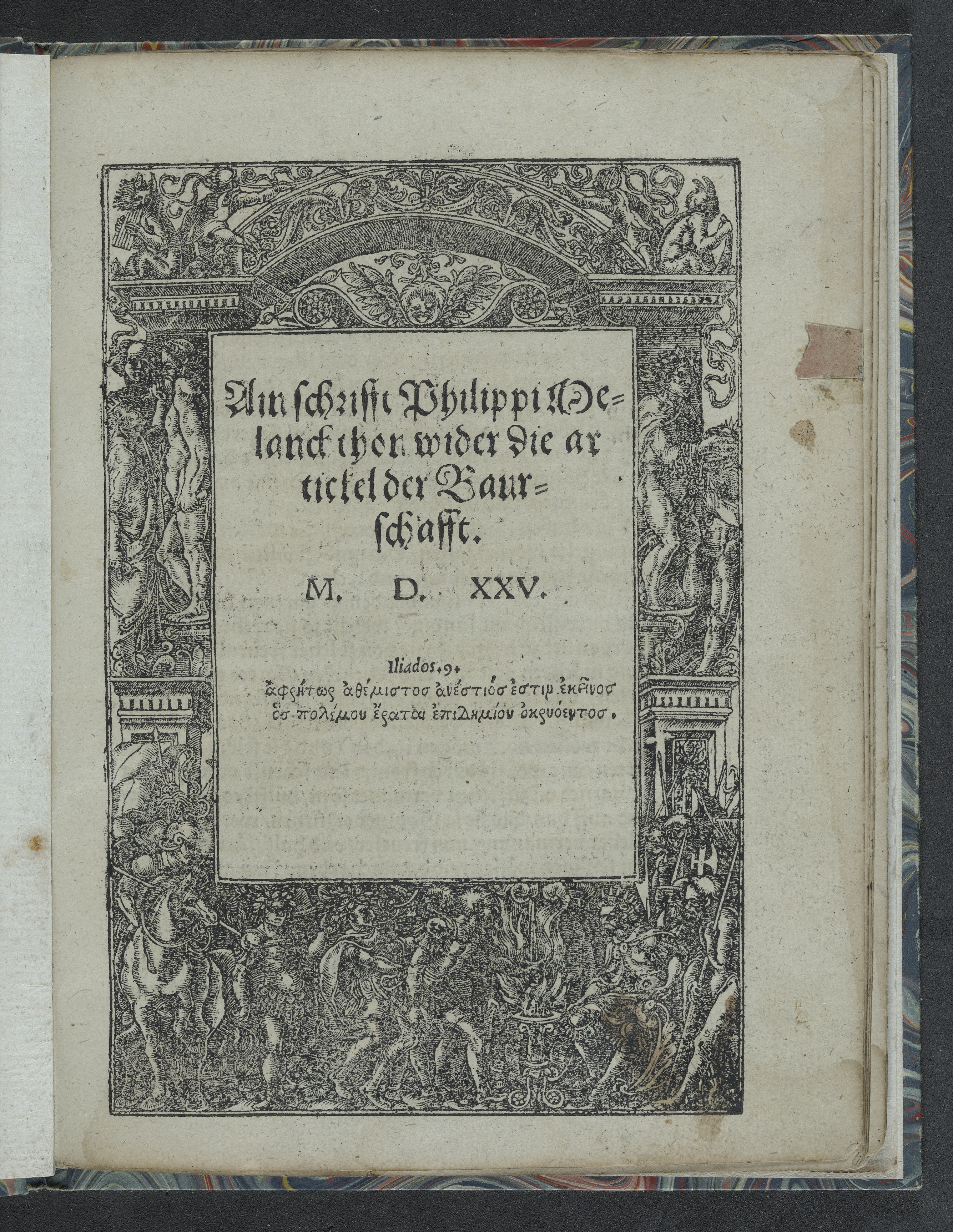
TextAin schrifft Philippi Melanchthon wider die artickel der Baurschafft
Melanchthon, Philipp, 1497-1560Summary: Treatise by Melanchthon against the peasants' revolt of the mid 1520's.Summary: Treatise by Melanchthon against the peasants' revolt of the mid 1520's. -
 Text
TextAin sermon vo[n] der Beraitung tzüm sterbe[n]
Luther, Martin, 1483-1546Summary: Early sermon of Luther's on preparing for death. One of twenty-two German printings to appear in six years.Summary: Early sermon of Luther's on preparing for death. One of twenty-two German printings to appear in six years. -
 Text
TextAinn Sermon oder Predigt von der Aufferstehung Christi
Alber, Matthäus, 1495-1570Summary: First and possibly only edition of a sermon by Mathäus Alber on the resurrection of Christ. Alber was an active reformer in Swabia, particularly in Reutlingen and Esslingen.Summary: First and possibly only edition of a sermon by Mathäus Alber on the resurrection of Christ. Alber was an active reformer in Swabia, particularly in Reutlingen and Esslingen. -
 Text
TextAlbertus Dei et Apostolice Sedis gratia Maguntinen[sis] [sic] et Magdeburgen[sis] Archiepiscop[us] ac Halberstaten[sis] ecclesiar[m] Administrator, Germanie Primas ... Indulgence
Albert, of Brandenburg, Archbishop and Elector of Mainz, Cardinal, 1490-1545Indulgences were issued to defray the cost of building the basilica of St. Peter in Rome. Their distribution was often linked to the sacrament of penance, as believers were granted spiritual merits in exchange for financial donations. This particular indulgence, believed to be the only specimen of its kind thus far recovered, was issued specifically to clergy, granting them liturgical benefits in exchange for their contributions.Indulgences were issued to defray the cost of building the basilica of St. Peter in Rome. Their distribution was often linked to the sacrament of penance, as believers were granted spiritual merits in exchange for financial donations. This particular indulgence, believed to be the only specimen of its kind thus far recovered, was issued specifically to clergy, granting them liturgical benefits in exchange for their contributions. -
 Still image
Alexander V Papa Cretensis Graecus
Soye, Philippe deAn engraved portrait of Antipope Alexander V, who was elected by the Council of Pisa during the Western Schism and held the office from 1409-1410. The portrait shows Alexander V wearing a papal miter with his coat of arms featured in the upper left corner. The portrait is labeled "ALEXANDER. V. PAPA. CRETENSIS. GRÆCVS".An engraved portrait of Antipope Alexander V, who was elected by the Council of Pisa during the Western Schism and held the office from 1409-1410. The portrait shows Alexander V wearing a papal miter with his coat of arms featured in the upper left corner. The portrait is labeled "ALEXANDER. V. PAPA. CRETENSIS. GRÆCVS". -
 Still image
Alexander VI Papa Valentinus Hisp.
Soye, Philippe deAn engraved portrait of Pope Alexander VI, who sat as pope from 1492-1503. The portrait shows Alexander VI wearing simple vestments with his coat of arms featured in the upper right corner. The portrait is labeled "ALEXANDER. VI. PAPA. VALENTINVS. HISP".An engraved portrait of Pope Alexander VI, who sat as pope from 1492-1503. The portrait shows Alexander VI wearing simple vestments with his coat of arms featured in the upper right corner. The portrait is labeled "ALEXANDER. VI. PAPA. VALENTINVS. HISP". -
 Text
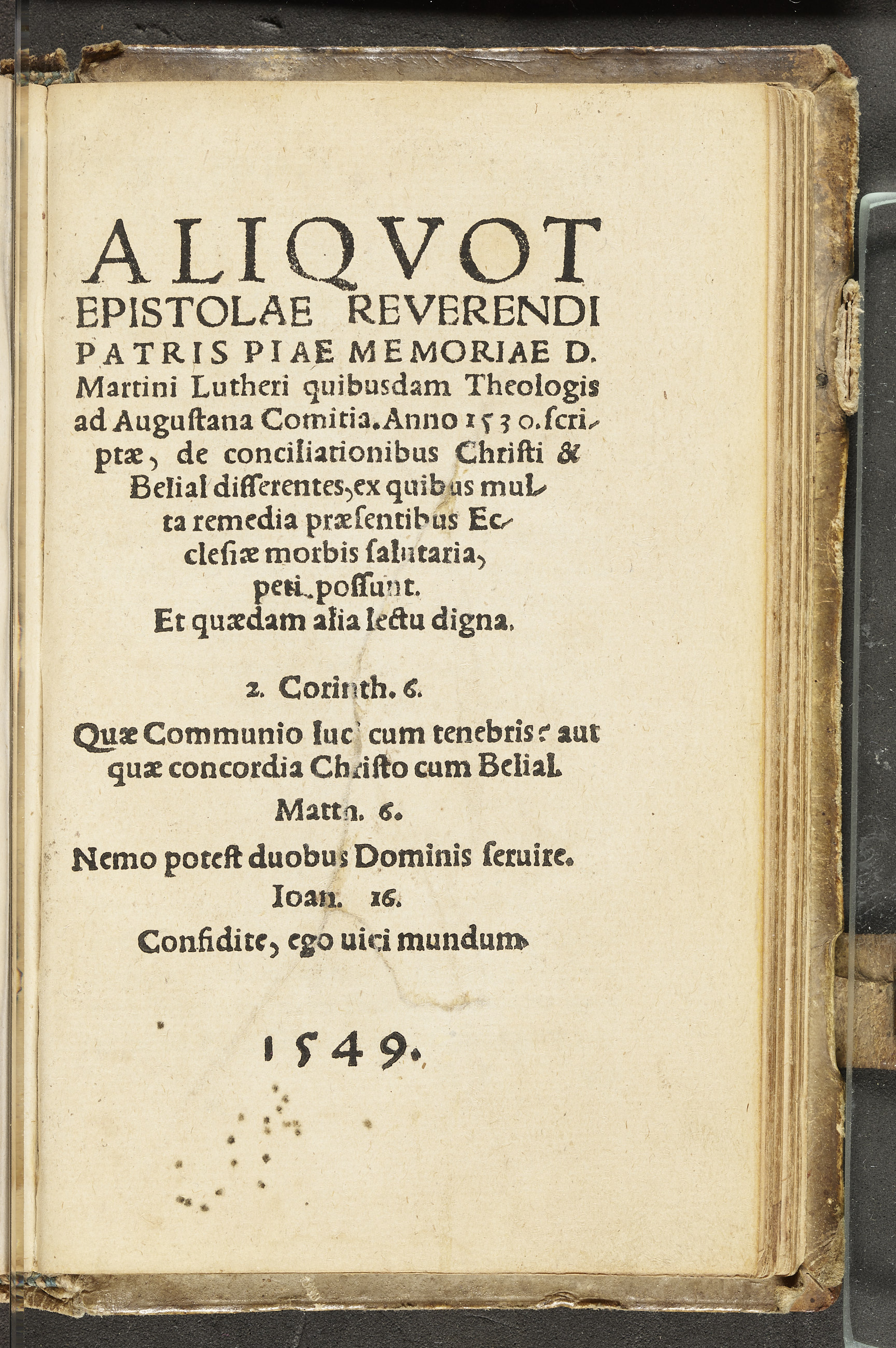
TextAliquot epistolae
Luther, Martin, 1483-1546Summary: M. Flacius Illyricus issued this edition of Luther's letters from Coburg Castle to the theologians at the Diet of Augsburg in an attempt to strengthen the Protestant resolve during the Interim. Intended for the widest possible distribution, both German and Latin versions were provided.Summary: M. Flacius Illyricus issued this edition of Luther's letters from Coburg Castle to the theologians at the Diet of Augsburg in an attempt to strengthen the Protestant resolve during the Interim. Intended for the widest possible distribution, both German and Latin versions were provided. -
 Still image
Altar of Burnt Offerings and Bronze Laver
Cranach, Lucas, 1472-1553A woodcut depicting the bronze laver for priestly washing (top), the altar of burnt offering made of acacia wood with four horns on its four corners (center), and the bronze implements for tending the altar (bottom).A woodcut depicting the bronze laver for priestly washing (top), the altar of burnt offering made of acacia wood with four horns on its four corners (center), and the bronze implements for tending the altar (bottom). -
 Text
TextAm. [sic] Sermon. Am Pfingstmontag das Evangelium. Joan. iij. : Also hat got die welt lieb gehabt. rc.
Luther, Martin, 1483-1546Summary: Sermon preached June 9, 1522, on John 3:16 (God So Loved The World).Summary: Sermon preached June 9, 1522, on John 3:16 (God So Loved The World). -
 Text
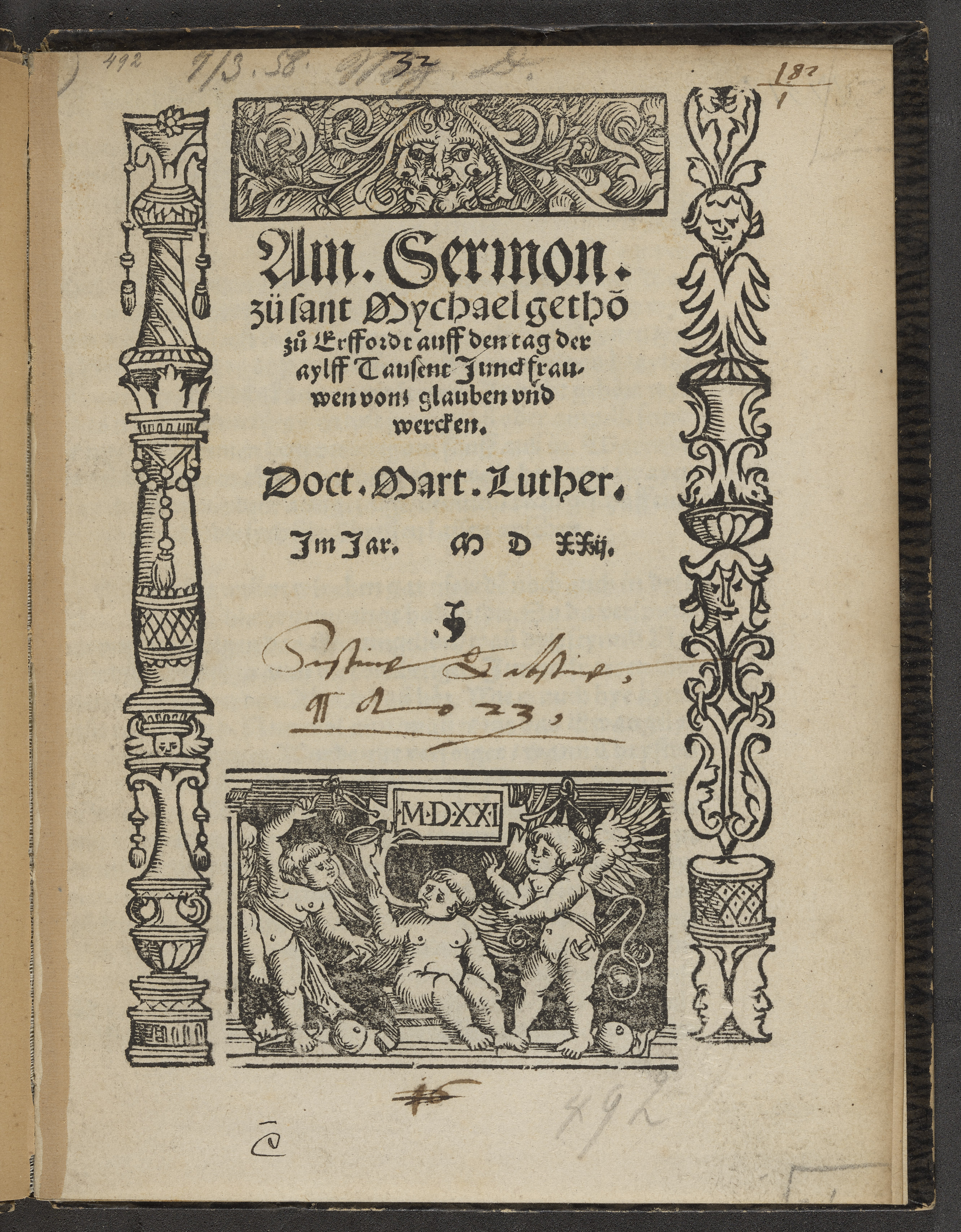
TextAm. [sic] Sermon. zü sant Mychael getho[n] zu Erffordt auff den tag der aylff Tausent junckfrauwen vom glauben vnd wercken
Luther, Martin, 1483-1546Summary: Sermon preached in Erfurt, October 21, 1522, on Matthew 25:1ff. (Wise and Foolish Virgins).Summary: Sermon preached in Erfurt, October 21, 1522, on Matthew 25:1ff. (Wise and Foolish Virgins). -
 Text
TextAmbrosii Catharini olim La[n]cinoti co[n]tra Martinu[m] Lutherum super his verbis, Tu es Petrus [et cetera], Et tibi dabo claues regni celorum [et cetera], Mathei xvi. : Dialogus [i?]n minus disertus qua[m] elegans et festiuus : Roffensis Episcopi loca qu[a]edam quibus predicta[m] auctoritate[m] cu[m] duabus alijs Matthei scz xviij. & Ioa[n]nis xx. eiusdem monet[a]e, sed no[n] eiusdem valoris comparat, & discrimen earu[m] euidenti scripturaru[m] testimonio declarat.
Ambrosius Catharinus, Archbishop of Conza, 1484-1553Summary: A selection of criticisms of Luther's views on the spiritual origins of the Papacy by one of his early opponents, Ambrosius Catharinus, edited by another of his early opponents, Hieronymus Emser, and dedicated by Emser to a third Luther opponent, Paul Bachmann, Abbot of Altenzelle.Summary: A selection of criticisms of Luther's views on the spiritual origins of the Papacy by one of his early opponents, Ambrosius Catharinus, edited by another of his early opponents, Hieronymus Emser, and dedicated by Emser to a third Luther opponent, Paul Bachmann, Abbot of Altenzelle. -
 Text
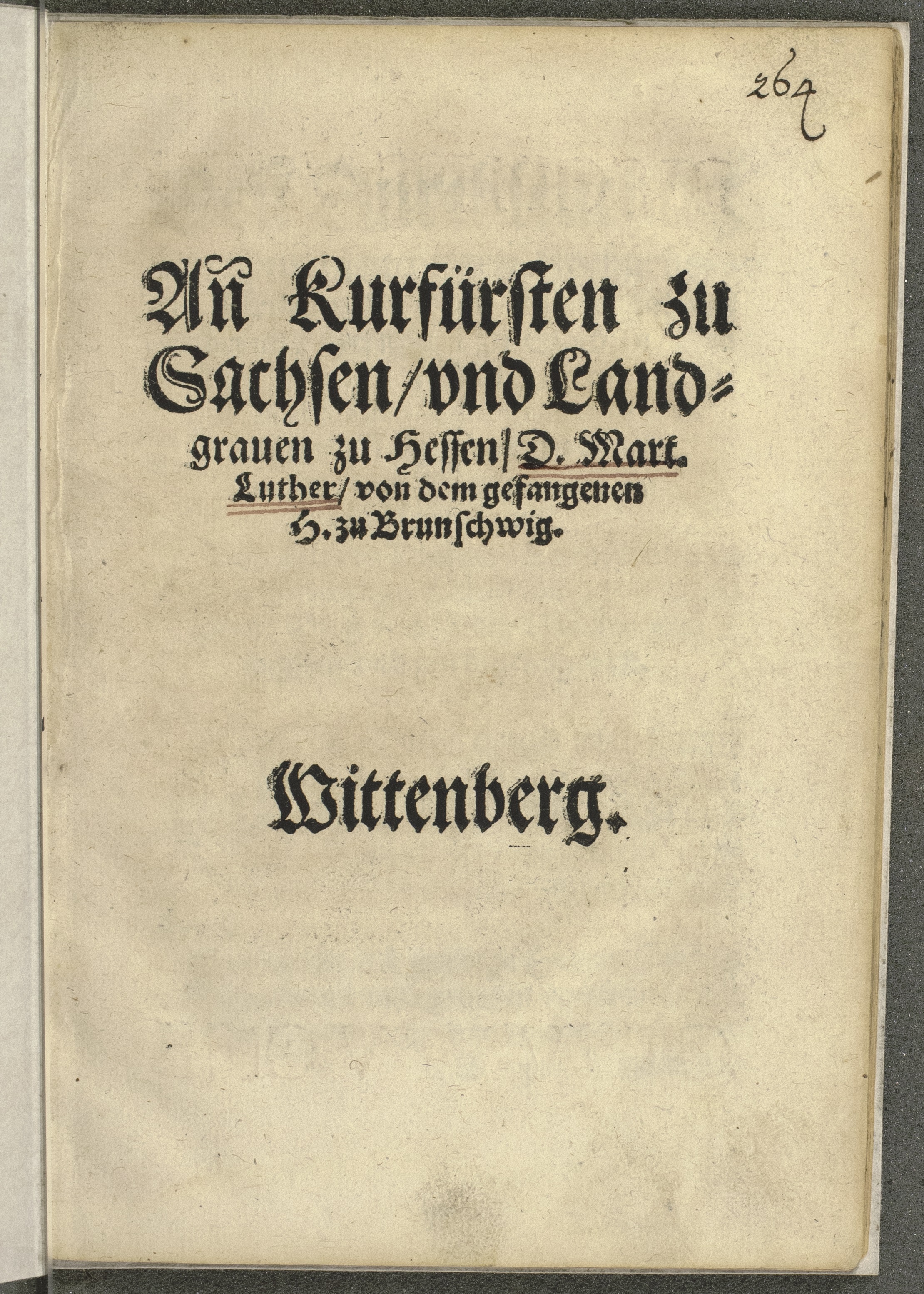
TextAn Kurfürsten zu Sachsen vnd Landgrauen zu Hessen
Luther, Martin, 1483-1546Summary: Addressed to Johann Friedrich of Saxony and Philipp of Hesse, relating to the imprisonment of Heinrich of Brunswick as a prisoner of war.Summary: Addressed to Johann Friedrich of Saxony and Philipp of Hesse, relating to the imprisonment of Heinrich of Brunswick as a prisoner of war. -
 Text
TextAn answer in defense of the truth against the Apology of private mass
Cooper, Thomas, 1517?-1594Summary:Summary: -
Text
An answer to Sir Thomas More's Dialogue : The supper of the Lord after the true meaning of John VI. and 1 Cor. XI. And Wm. Tracy's Testament expounded
Tyndale, William, -1536Summary:Summary: -
 Text
TextAn den Christlichen Adel deutscher Nation : von des Christlichen Standes Besserung
Luther, Martin, 1483-1546Summary: Fourth edition of the "Address to the Christian Nobility of the German Nation," one of Luther's most important pamphlets, in which he develops some of the central ideas of his theology, including the principle of universal priesthood. He also discusses the possibility of a German national church.Summary: Fourth edition of the "Address to the Christian Nobility of the German Nation," one of Luther's most important pamphlets, in which he develops some of the central ideas of his theology, including the principle of universal priesthood. He also discusses the possibility of a German national church. -
 Text
TextAn den Christlichen Adel deutscher Nation : von des Christlichen standes besserung
Luther, Martin, 1483-1546Summary: First edition and first printing of Luther's address "To the Christian nobility of the German nation" is the first of three great Reformation booklets Luther wrote 1520. This piece was completed in August and divided into three parts: (1) an attack on the Papacy and denial of its claims, (2) a list of abuses by the papacy and curia, and (3) a list of necessary reforms.Summary: First edition and first printing of Luther's address "To the Christian nobility of the German nation" is the first of three great Reformation booklets Luther wrote 1520. This piece was completed in August and divided into three parts: (1) an attack on the Papacy and denial of its claims, (2) a list of abuses by the papacy and curia, and (3) a list of necessary reforms. -
 Text
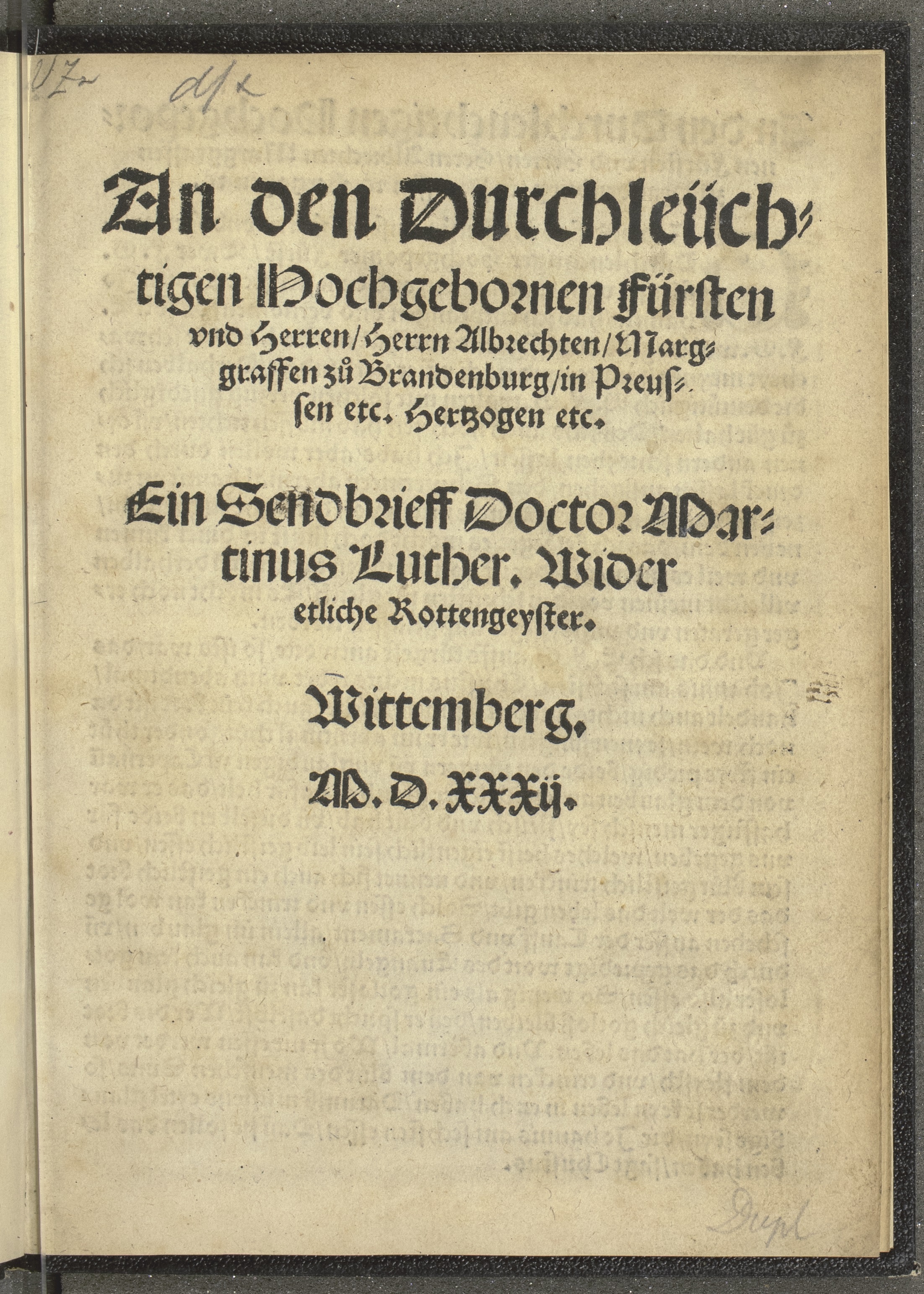
TextAn den Durchleüchtigen Hochgebornen Fürsten vnd Herren. Herrn Albrechten, Marggraffen zuo Brandenburg, in Preussen etc. Hertzogen etc.
Luther, Martin, 1483-1546Summary: After Albrecht, Duke of Prussia and last of the Masters of the Teutonic Knights, became a Protestant, he sought out preachers to fill the pulpits in his territory. Some were Lutherans, others were followers of Schwenckfeld. Luther here warns Albrecht about the heretical tendencies of the Schwenckfelders. Albrecht came increasingly under the influence of F. Von Heideck (a Schwenckfelder) and was not especially impressed by Luther's arguments against the use of John 6 in the interpretation of the Lord's Supper.Summary: After Albrecht, Duke of Prussia and last of the Masters of the Teutonic Knights, became a Protestant, he sought out preachers to fill the pulpits in his territory. Some were Lutherans, others were followers of Schwenckfeld. Luther here warns Albrecht about the heretical tendencies of the Schwenckfelders. Albrecht came increasingly under the influence of F. Von Heideck (a Schwenckfelder) and was not especially impressed by Luther's arguments against the use of John 6 in the interpretation of the Lord's Supper. -
 Text
TextAn den Durchleüchtigen Hochgepornen Fürsten vnd Herrn, Herrn Albrechten, Marggraffen zuo Brandenburg, inn Preussen [et]c. Hertzogen [et]c. Ein Sendbrief Doct. Mart. Luth. Wider ettliche Rottengeyster : Wittemberg, M.D.XXXII
Luther, Martin, 1483-1546Summary: Luther's reply to a letter from Duke Albrecht of Brandenburg, concerning the interpretation of John VI with reference to the Lord's Supper.Summary: Luther's reply to a letter from Duke Albrecht of Brandenburg, concerning the interpretation of John VI with reference to the Lord's Supper. -
 Text
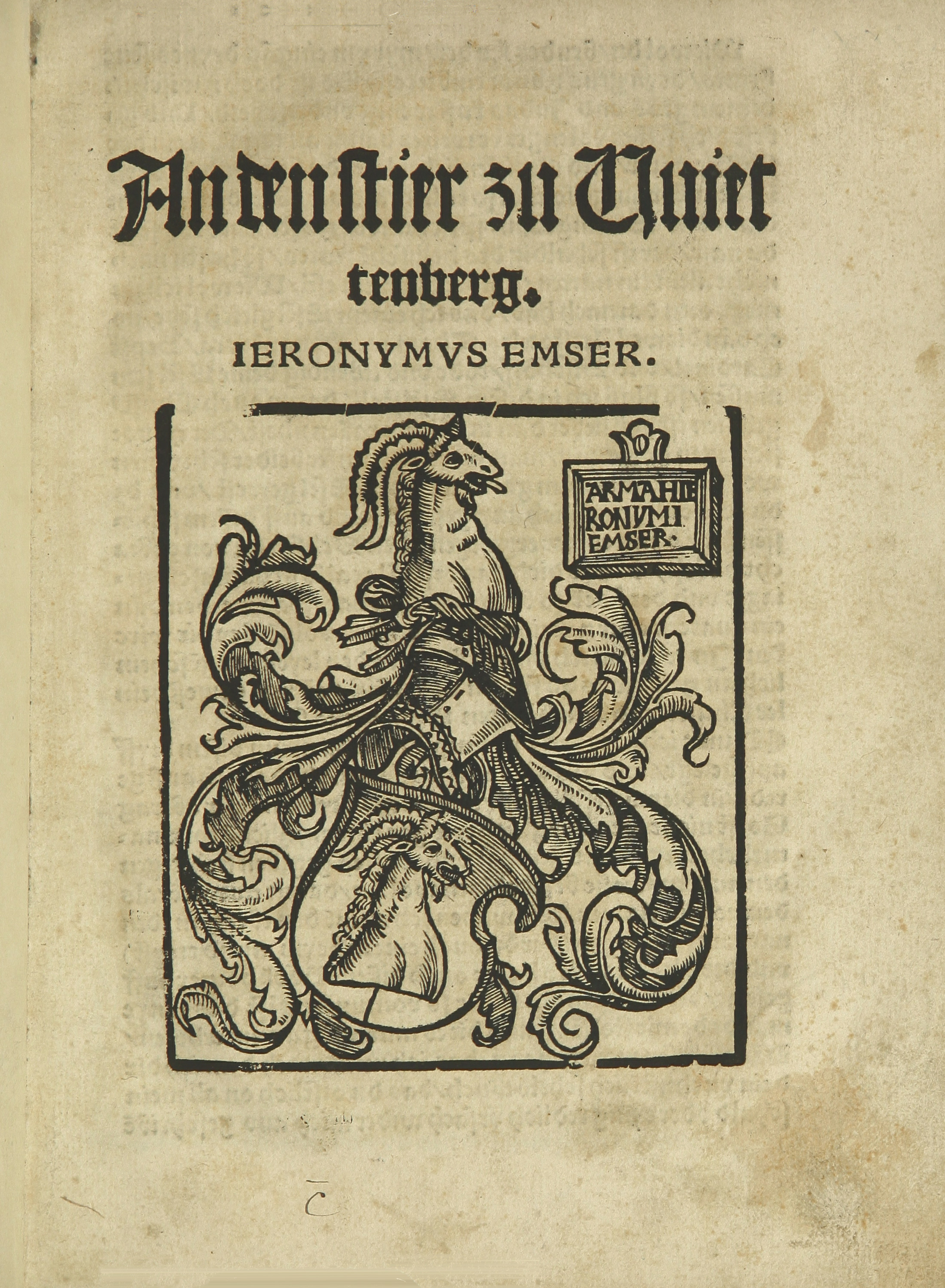
TextAn den Stier zu Uuittenberg
Emser, Hieronymus, 1478-1527Summary: A reply to Martin Luther's "An den Bock zu Leipzig."Summary: A reply to Martin Luther's "An den Bock zu Leipzig."