Search
741 resources
741 items
Collection
Richard C. Kessler Reformation Collection
-
 Text
TextVo[n] dem elichen sta[n]dt widder Bruder Martin Luter Doctor tzu Witte[n]berg
Alveldt, Augustin von, active 16th centurySummary: This is a copy of A. von Alveld's defense of the Catholic Church's doctrine of clerical celibacy.Summary: This is a copy of A. von Alveld's defense of the Catholic Church's doctrine of clerical celibacy. -
 Text
TextVom Hochwirdigisten Sacrament des zarte[n] fronleichnams Christi. : Vnnd widerlegung ettlicher Argument, so jn ainem newlich aussgegange[n] irrigen vn[d] verfüerischen [sic] büechlin [sic] widers opffer [der] Mess gemacht sind
Schatzgeyer, Kaspar, 1463 or 1464-1527Summary: C. Schatzgeyer here writes a treatise on the Catholic understanding of the Lord's Supper as exemplified by the Corpus Christi festival. The work grew out of Schatzgeryer's conflicts with Andrea Osiander, the Nuremberg reformer. This is the first printing of this book.Summary: C. Schatzgeyer here writes a treatise on the Catholic understanding of the Lord's Supper as exemplified by the Corpus Christi festival. The work grew out of Schatzgeryer's conflicts with Andrea Osiander, the Nuremberg reformer. This is the first printing of this book. -
 Text
TextVon Ehesachen
Luther, Martin, 1483-1546Summary: Second edition of the last of Luther's four tracts on marriage and married life. Luther addresses in particular the issue of secret or private engagements and their status in cases in which one of the parties enters into a public engagement.Summary: Second edition of the last of Luther's four tracts on marriage and married life. Luther addresses in particular the issue of secret or private engagements and their status in cases in which one of the parties enters into a public engagement. -
 Text
TextVon Mensche[n] Leren zu[o] meiden
Luther, Martin, 1483-1546Summary: Luther addresses the monastic rules of fasting, obedience and celibacy, arguing that they have no foundation in scripture and that a transgression of these rules is therefore no sin. At the same time, Luther warns that a transgression of monastic rules in itself is by no means a sign of faith or internalized piety.Summary: Luther addresses the monastic rules of fasting, obedience and celibacy, arguing that they have no foundation in scripture and that a transgression of these rules is therefore no sin. At the same time, Luther warns that a transgression of monastic rules in itself is by no means a sign of faith or internalized piety. -
 Text
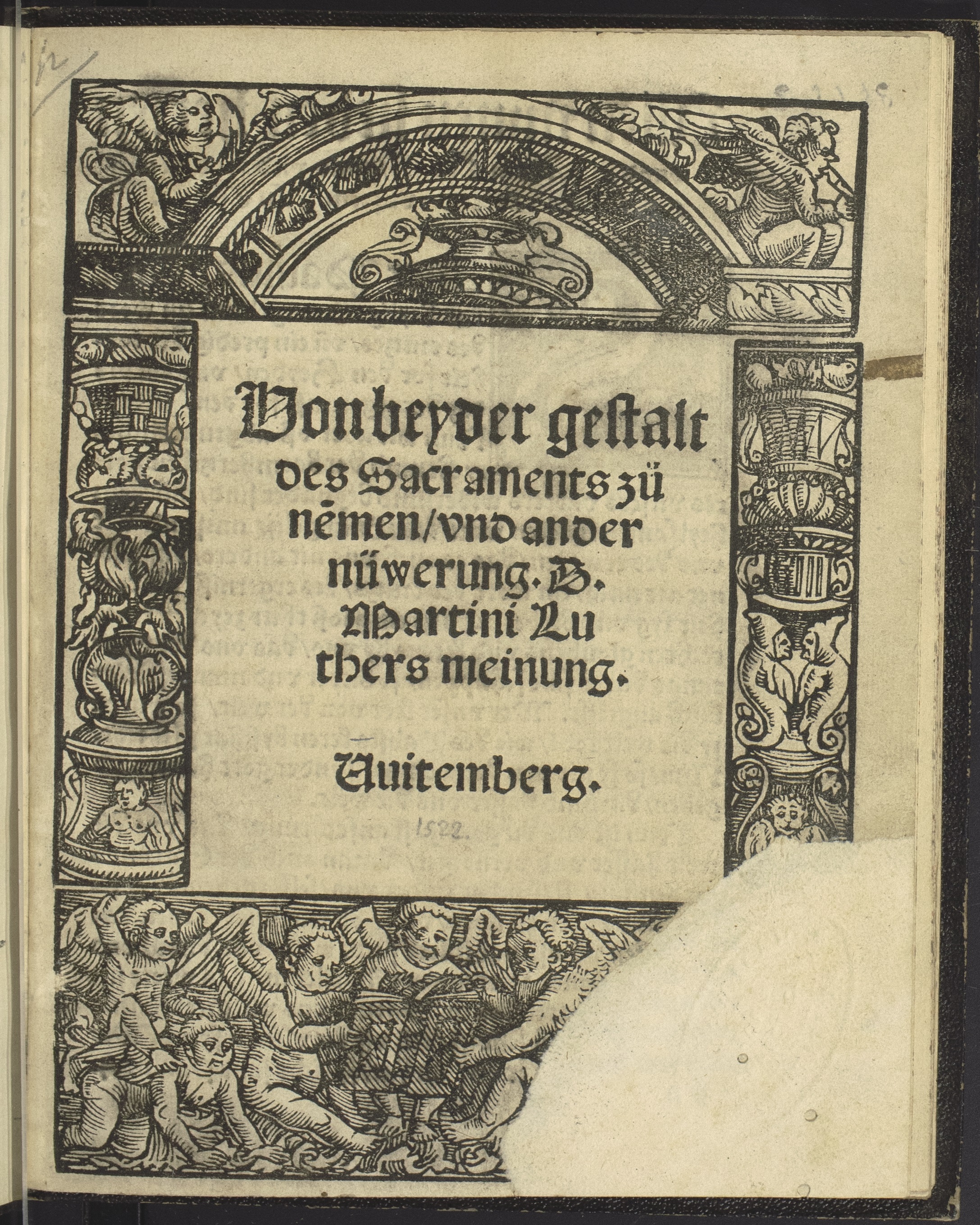
TextVon beyder gestalt des Sacraments zü nem[m]en : vnd ander nüwerung
Luther, Martin, 1483-1546When Luther returned from Wartburg Castle, he preached a series of Eight Sermons in an attempt to restore order in Wittenberg. This tract epitomizes the contents of these sermons.When Luther returned from Wartburg Castle, he preached a series of Eight Sermons in an attempt to restore order in Wittenberg. This tract epitomizes the contents of these sermons. -
 Text
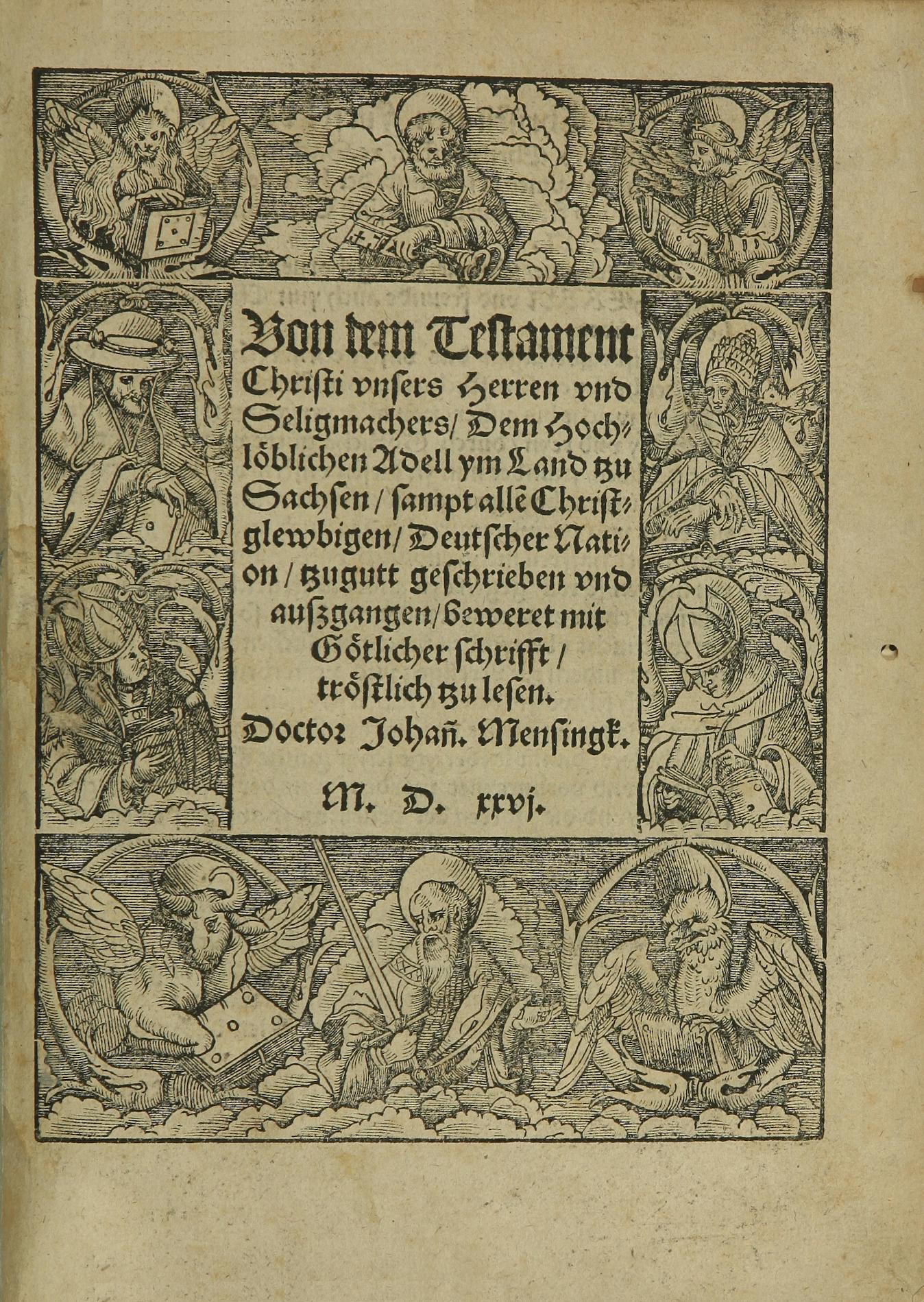
TextVon dem Testament Christi vnsers Herren vnd Seligmachers : Dem Hochlöblichen Adell ym landt zu Sachsen, sampt alle[n] Christglewbigen, Deutscher Nation, tzugutt geschriben vnd auszgangen, beweret mit Götlicher schrifft, tröstlich zu lesen
Mensing, Johannes, active 1495-1541Summary: J. Mensing was a Dominican opponent of Luther. Born in either Mageburg or Zutphen, Holland, he studied in Wittenberg and Frankfurt an der Oder, where he took his doctorate. He preached at Mageburg Cathedral 1522-1524 against the Reformers. In 1530, he was one of the Confutators of the Augsburg Confession. In 1534, he became provincial of the Dominicans, and in 1539, suffragan-bishop of Halberstedt. In this tract, Mensing defends Catholic interpretation of the Lord's Supper through references to scripture.Summary: J. Mensing was a Dominican opponent of Luther. Born in either Mageburg or Zutphen, Holland, he studied in Wittenberg and Frankfurt an der Oder, where he took his doctorate. He preached at Mageburg Cathedral 1522-1524 against the Reformers. In 1530, he was one of the Confutators of the Augsburg Confession. In 1534, he became provincial of the Dominicans, and in 1539, suffragan-bishop of Halberstedt. In this tract, Mensing defends Catholic interpretation of the Lord's Supper through references to scripture. -
 Text
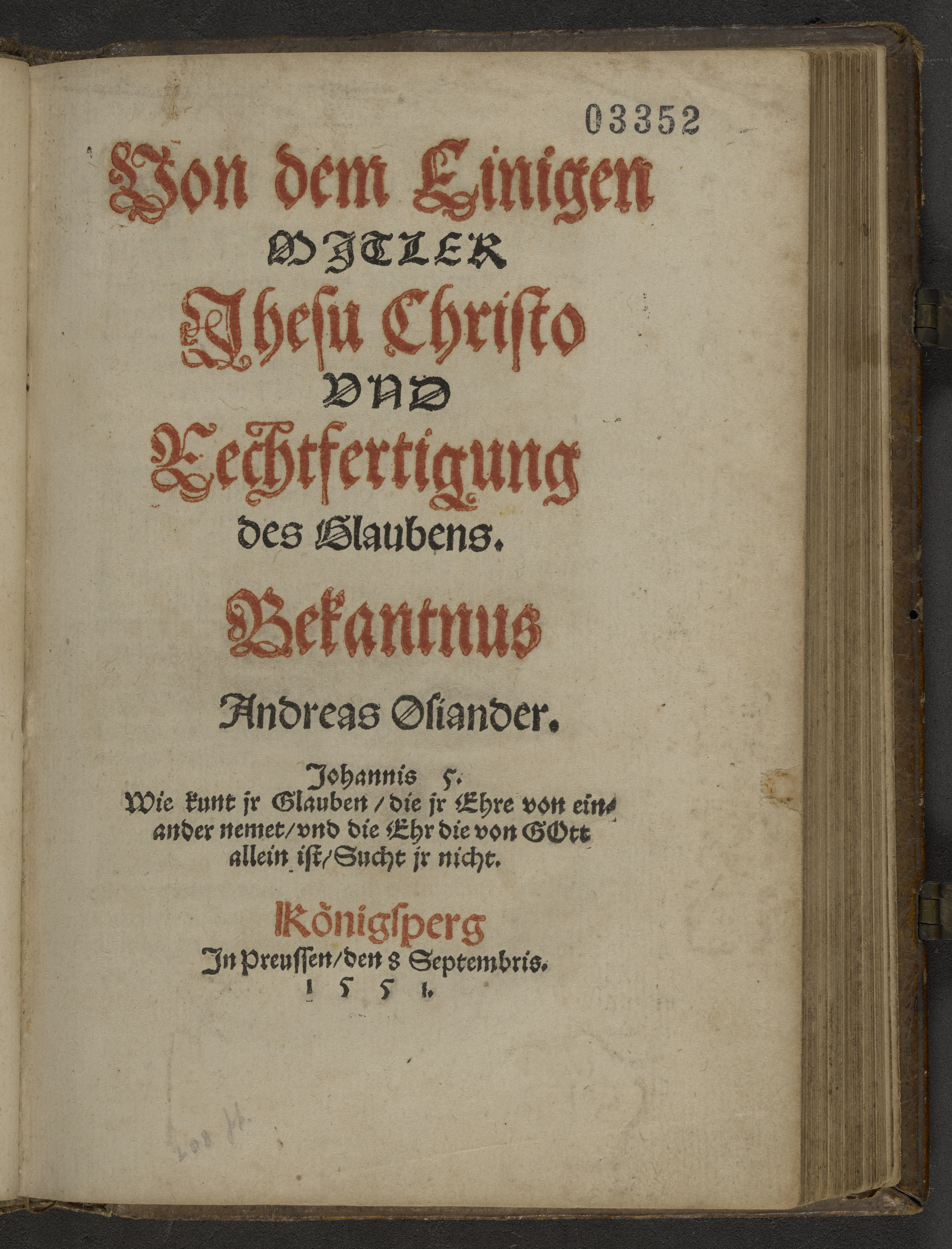
TextVon dem einigen Mitler Jesu Christo und Rechtfertigung des Glaubens
Osiander, Andreas, 1498-1552Summary: First edition of a tract by Andreas Osiander on the subject of justification and Christ's role as mediator.Summary: First edition of a tract by Andreas Osiander on the subject of justification and Christ's role as mediator. -
 Text
TextVon dem falschen Blut vnd Abgott im Thum zu Schwerin. : mit einer schönen Vorrede
Faber, Aegidius, approximately 1490-1558Summary: A. Faber was a Lutheran pastor in Schwerin when he wrote this book in 1533 against the false "blood of Christ" and the "idol" (i.e., the shrine in which the blood was kept) in the Cathedral at Schwerin. Such Holy blood miracles made for exceedingly popular pilgrimage sites in pre-Reformation Germany.Summary: A. Faber was a Lutheran pastor in Schwerin when he wrote this book in 1533 against the false "blood of Christ" and the "idol" (i.e., the shrine in which the blood was kept) in the Cathedral at Schwerin. Such Holy blood miracles made for exceedingly popular pilgrimage sites in pre-Reformation Germany. -
 Text
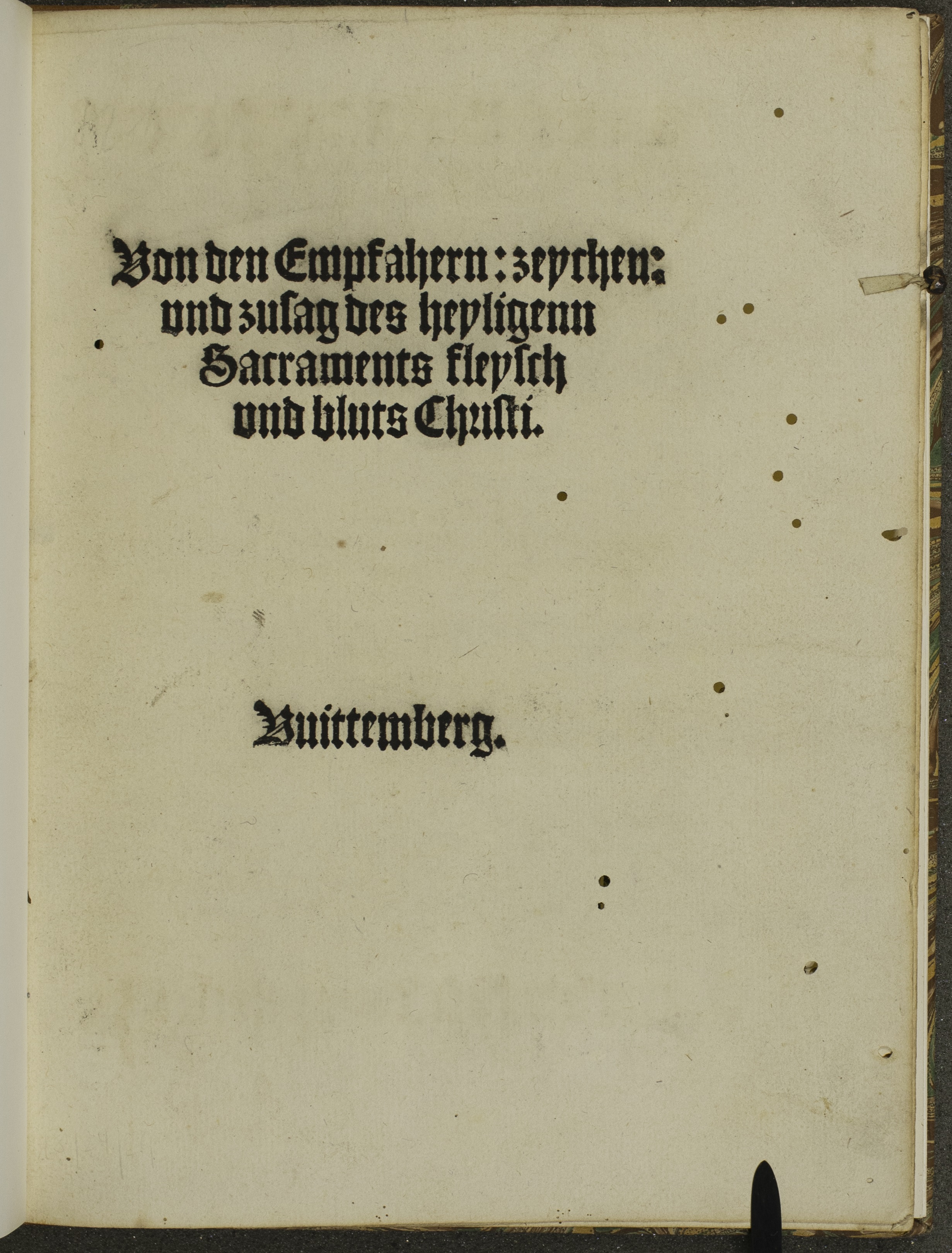
TextVon den Empfahern, zeychen, vnd zusag des heyligenn Sacraments fleysch vnd bluts Christi
Karlstadt, Andreas Rudolff-Bodenstein von, 1486-1541Summary: Karlstadt wrote numerous tracts on the reception of the sacrament in both kinds. This tract deals especially with those who receive the sacrament, what the signs of the sacrament signify, and what promises are given to those who partake.Summary: Karlstadt wrote numerous tracts on the reception of the sacrament in both kinds. This tract deals especially with those who receive the sacrament, what the signs of the sacrament signify, and what promises are given to those who partake. -
 Text
TextVon den heiligen Engeln : aus der göttlichen Schrifft vnd Gezeugnissen der lieben Veter gar nötiger vnd christlicher Vnterricht allen Christen in diesen gefehrlichen Zeiten nützlich vnd tröstlich zu lesen mit Vleis collegirt vnd gefasset
Garcaeus, Johann, 1530-1574Summary: Johannes Garcaeus (Gartze) was a Lutheran theologian at the University of Greifswald. He is also known for his work in astrology. This work deals with the biblical and early Christian teaching about angels.Summary: Johannes Garcaeus (Gartze) was a Lutheran theologian at the University of Greifswald. He is also known for his work in astrology. This work deals with the biblical and early Christian teaching about angels. -
 Text
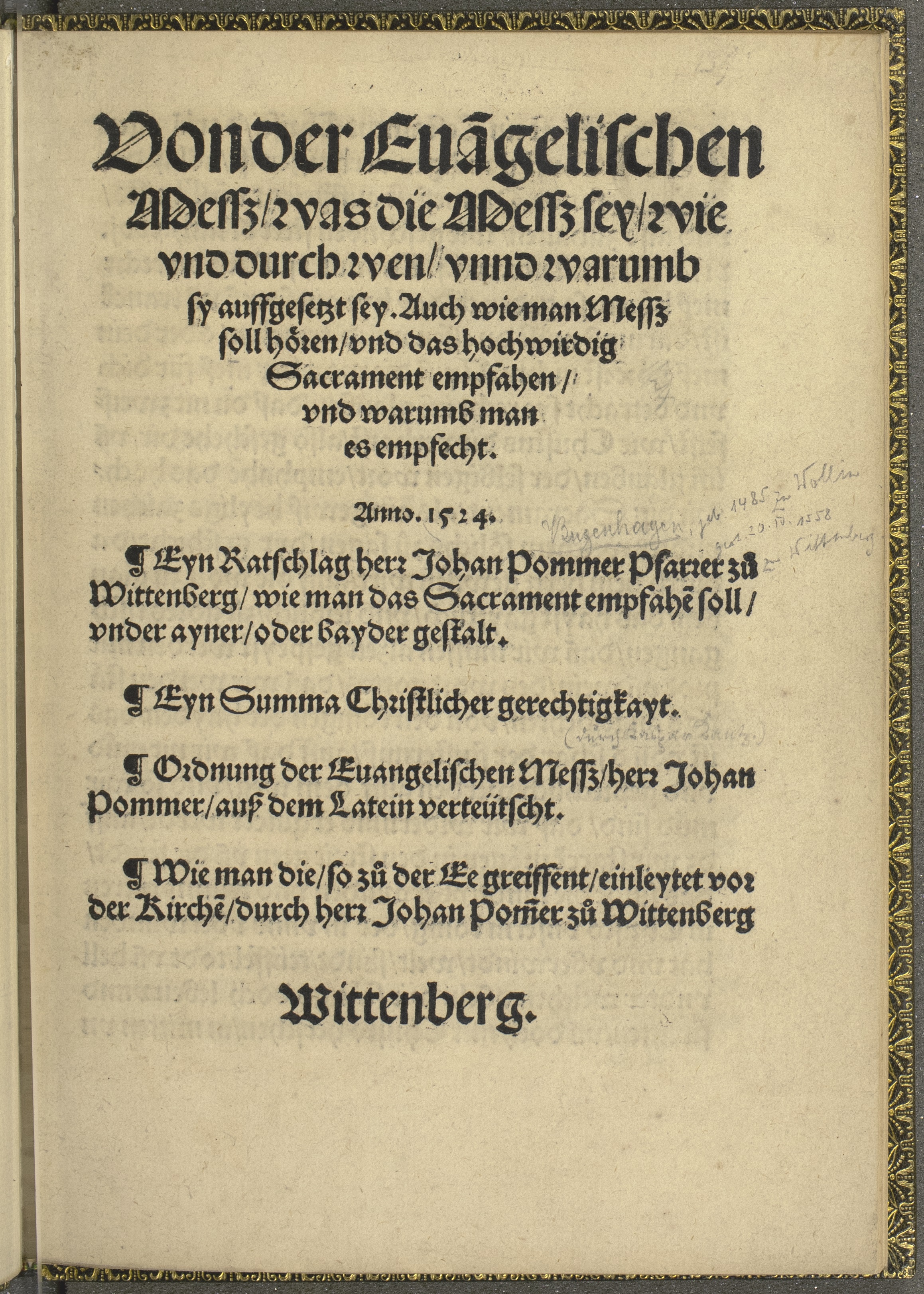
TextVon der Eua[n]gelischen Messz : was die Messz sey, wie vnd durch wen, vnnd warumb sy auffgesetzt sey. : Auch wie man Messz sol hören, vnd das hochwirdig sacrament empfahen, vnd warumb man es empfecht. Anno 1524
Bugenhagen, Johann, 1485-1558Summary: The term "Evangelical Mass" was coined by the Lutherans as their attempt to shop that it was they and not the Catholics who were the preservers of the true tradition of the Lord's Supper. Bugenhagen was, next to Melanchthon, Luther's closest ally in the Protestant struggle. This tract indicates which attributes the Lutherans believed to be necessary for worthy reception of the Lord's Supper.Summary: The term "Evangelical Mass" was coined by the Lutherans as their attempt to shop that it was they and not the Catholics who were the preservers of the true tradition of the Lord's Supper. Bugenhagen was, next to Melanchthon, Luther's closest ally in the Protestant struggle. This tract indicates which attributes the Lutherans believed to be necessary for worthy reception of the Lord's Supper. -
 Text
TextVon der Freyhayt Aines Christen menschen
Luther, Martin, 1483-1546Summary: This is the third of Luther's three great reformation tracts of 1520. Addressed to Pope Leo X, this work is a discourse on the freedom of the will, turning on the paradox: A Christian is free, lord over all things, subject to no one. A Christian is a bounden servant of all, and subject to everyone. This is the fourth printing of Luther's own German translation.Summary: This is the third of Luther's three great reformation tracts of 1520. Addressed to Pope Leo X, this work is a discourse on the freedom of the will, turning on the paradox: A Christian is free, lord over all things, subject to no one. A Christian is a bounden servant of all, and subject to everyone. This is the fourth printing of Luther's own German translation. -
 Text
TextVon der Papisten Tauff : vnd andern Caeremonien oder Kirchendiensten ob die nach erkanter vnd angenomener Warheit durch jemand Christlich zu besuchen vnd zu gebrauchen sein
Summary: Only printing of a Lutheran pamphlet by an anonymous preacher from Southern Germany on the subject of baptism and other ceremonies in the Catholic church, with an introduction by Nicolaus Gallus.Summary: Only printing of a Lutheran pamphlet by an anonymous preacher from Southern Germany on the subject of baptism and other ceremonies in the Catholic church, with an introduction by Nicolaus Gallus. -
 Text
TextVon eynsetzung vnnd ordnung der diener der Kirchen, das ist der gemaine, : An den Ersamen vn[d] weysen Rathe der Stat Prage des Böhemishcen Landes: auss dem Lateyn in das Teütsch gebracht vnnd gezogen jm Jar 1524.
Luther, Martin, 1483-1546Summary: Translation into German by M. Reinhard of Luther's Latin work: "De instituendis ministris ecclesiae." The attribution of the translation to M. Reinhard is questioned.Summary: Translation into German by M. Reinhard of Luther's Latin work: "De instituendis ministris ecclesiae." The attribution of the translation to M. Reinhard is questioned. -
 Text
TextVon gelubden unterrichtung
Karlstadt, Andreas Rudolff-Bodenstein von, 1486-1541Summary: The question of the value and validity of monastic vows arose in Wittenberg because of Luther's tract, On the Freedom of a Christian, as well as because of his advice to monks to leave their monasteries. Karlstadt here argues that vows of monastic obedience prevent men and women from following God's commands. Karlstadt was the first of the Protestant Reformers to repudiate the validity of monastic vows.Summary: The question of the value and validity of monastic vows arose in Wittenberg because of Luther's tract, On the Freedom of a Christian, as well as because of his advice to monks to leave their monasteries. Karlstadt here argues that vows of monastic obedience prevent men and women from following God's commands. Karlstadt was the first of the Protestant Reformers to repudiate the validity of monastic vows. -
 Text
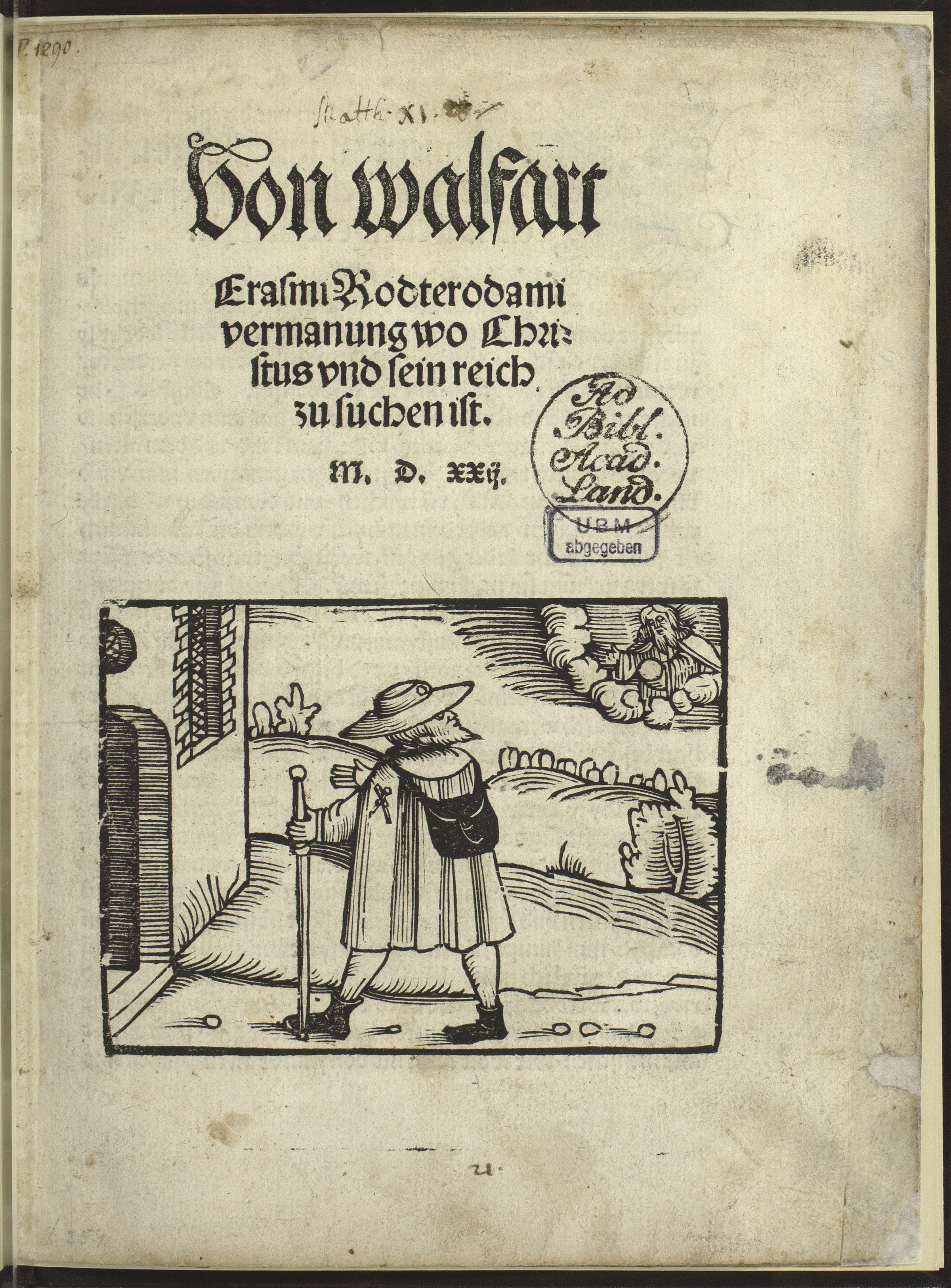
TextVon walfart
Erasmus, Desiderius, -1536Summary: Interpretive pamphlet by Erasmus on the true nature of pilgrimage, as espoused by Jesus in Matthew XI, 28. Erasmus says that true pilgrimage is undertaken with spiritual, and not with physical feet, and, that Jesus receives all sincere pilgrims equally, whether they be clergy or lay, rich or poor, etc.Summary: Interpretive pamphlet by Erasmus on the true nature of pilgrimage, as espoused by Jesus in Matthew XI, 28. Erasmus says that true pilgrimage is undertaken with spiritual, and not with physical feet, and, that Jesus receives all sincere pilgrims equally, whether they be clergy or lay, rich or poor, etc. -
 Still image
Von wunderbarlichen dingen so in Morlande gefunden werden
A woodcut depicting a group of monstrous beings purported to be found in Africa, including a dog-headed being (cynocephalus) and a cyclops, both likely drawn from classical influences. This woodcut is also used to depict the same creatures in the section on India, where the purportedly also reside.A woodcut depicting a group of monstrous beings purported to be found in Africa, including a dog-headed being (cynocephalus) and a cyclops, both likely drawn from classical influences. This woodcut is also used to depict the same creatures in the section on India, where the purportedly also reside. -
 Text
TextVonn dem Ampt der Fürsten : vnd welcher Gestalt inen das auss Gottes Befelch aufflegen thüe die Abstellung der Missbräuch in den Kirchen
Melanchthon, Philipp, 1497-1560Summary: Tract on the duties and responsibilties of civic leaders, and on the relationship between church and state, first published in Latin a year earlier.Summary: Tract on the duties and responsibilties of civic leaders, and on the relationship between church and state, first published in Latin a year earlier. -
 Text
TextVonn dem grewel der stillmesse, so man den Canon nennet
Luther, Martin, 1483-1546Summary: Luther here offers his translation of the Canon of the Mass together with a brief treatise against the practice of private masses. Text in German includes Luther's German translation of the Canon from the Latin.Summary: Luther here offers his translation of the Canon of the Mass together with a brief treatise against the practice of private masses. Text in German includes Luther's German translation of the Canon from the Latin. -
 Text
TextVorclerung Doctoris Martini Luther etlicher Artickell : ynn seynem Sermon von dem heyligenn sacrament
Luther, Martin, 1483-1546Summary: Fuller explanation of Luther's 1519 sermon: Vom Sakrament des Leichnams Christi und von den Bruderschaften.Summary: Fuller explanation of Luther's 1519 sermon: Vom Sakrament des Leichnams Christi und von den Bruderschaften. -
 Text
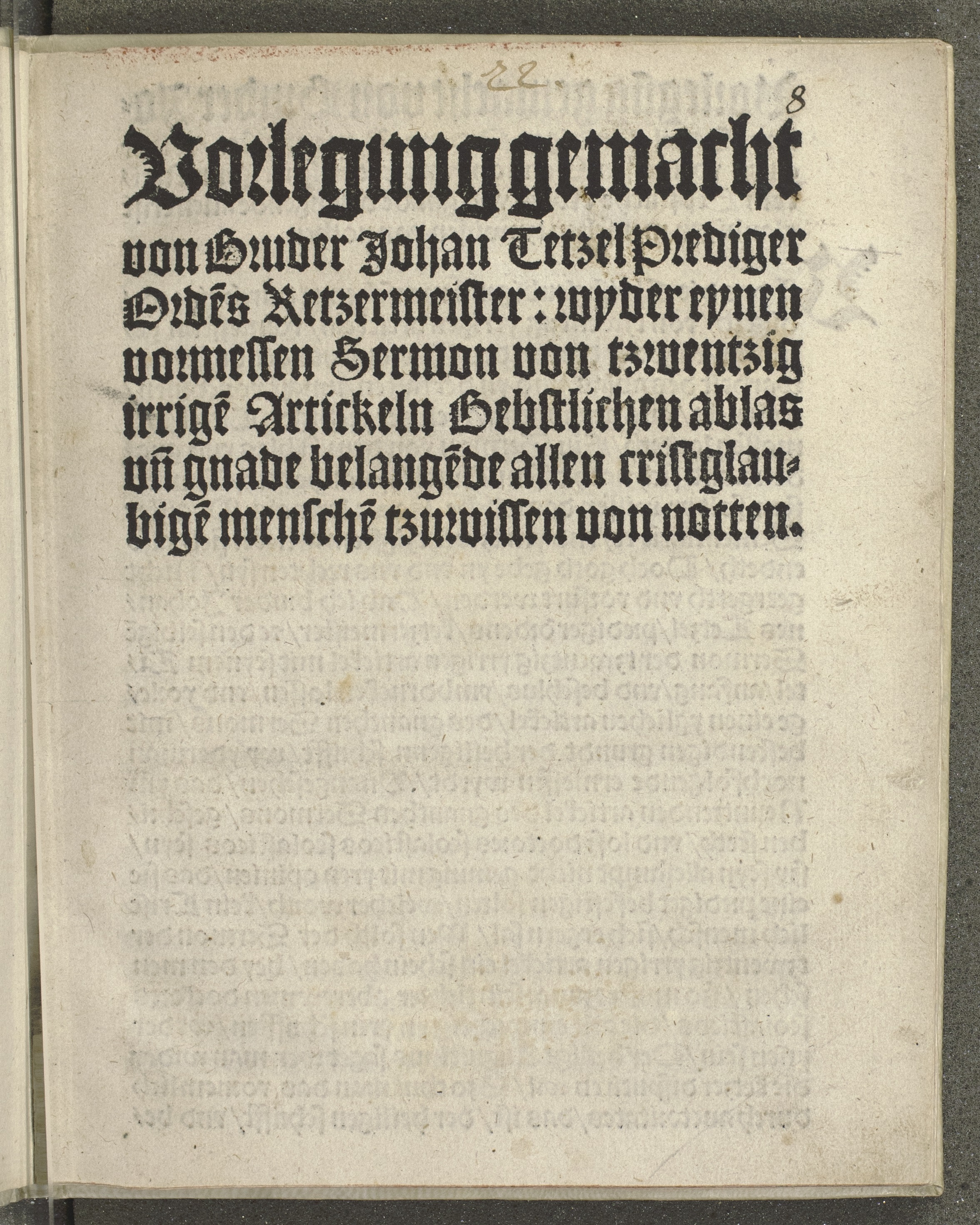
TextVorlegung gemacht von Bruder Johan Tetzel Prediger Orde[n]s Ketzermeister : wyder eynen vormessen Sermon von tzwentzig irrige[n] Artickeln Bebstlichen Ablas vn[d] Gnade belange[n]de allen cristglaubige[n] Mensche[n] tzuwissen von Notten
Tetzel, Johann, 1460-1519Summary: First attack on Luther's "Sermon von dem Ablass und Gnade" (Sermon on indulgences and grace) by Johan Tetzel, a refutation of Luther's position.Summary: First attack on Luther's "Sermon von dem Ablass und Gnade" (Sermon on indulgences and grace) by Johan Tetzel, a refutation of Luther's position.