A map of the world including latitude and longitude markers. Personifications of the winds are depicted withing croulds surrounding the map and various monstrous creatures are depicted within the oceans.
A map of the world including latitude and longitude markers. Personifications of the winds are depicted withing croulds surrounding the map and various monstrous creatures are depicted within the oceans.
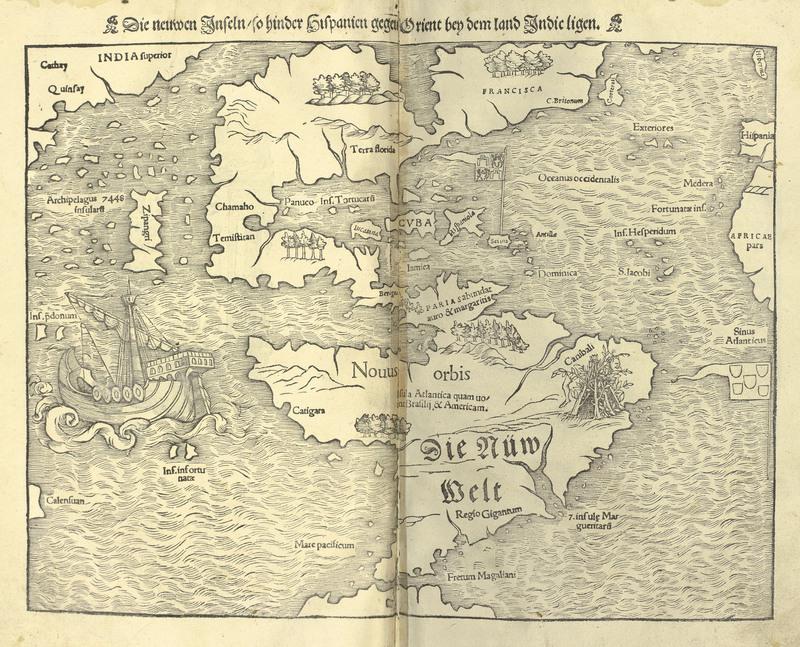
A map of the western hemisphere, identified as the New World, and the western coast of Asia. A spanish style galleon ship is depicted sailing in the Pacific ocean, and a rough shelter built of sticks featureing a dismembered leg is depicted in the general region of Brazil with the label, "Canibali".
A map of the western hemisphere, identified as the New World, and the western coast of Asia. A spanish style galleon ship is depicted sailing in the Pacific ocean, and a rough shelter built of sticks featureing a dismembered leg is depicted in the general region of Brazil with the label, "Canibali".
A woodcut depicting a hairy, bipedal beast, labeled as the "spook of the evil ghost," which is found in a vast desert beyond India in the land of Cathay. This type of ghost is said to lead travellers astray by mimicking the voices of their travelling companions.
A woodcut depicting a hairy, bipedal beast, labeled as the "spook of the evil ghost," which is found in a vast desert beyond India in the land of Cathay. This type of ghost is said to lead travellers astray by mimicking the voices of their travelling companions.
A map of the world with latitude and longitude markers as it was known during the Ptolemaic period, including mountain ranges and rivers and spanning from Europe, to central Africa, and over to India. Personifications of the winds are depicted within the clouds surrounding the map.
A map of the world with latitude and longitude markers as it was known during the Ptolemaic period, including mountain ranges and rivers and spanning from Europe, to central Africa, and over to India. Personifications of the winds are depicted within the clouds surrounding the map.
A woodcut of a creature labeled as "Salamandra" (Salamander), which is described as preferring to live in fire and can be found on a mountain in the land of Chinchital in the New World.
A woodcut of a creature labeled as "Salamandra" (Salamander), which is described as preferring to live in fire and can be found on a mountain in the land of Chinchital in the New World.
A woodcut depicting a being with three heads: a frog representing France, an eagle representing Rome, and a lion representing Germany. This creature preceeded the arrival of Marcomirus, a Sicambrian king who took control of a region of Gaul after moving from the Danube region into the low countries (Gelders and Holland).
A woodcut depicting a being with three heads: a frog representing France, an eagle representing Rome, and a lion representing Germany. This creature preceeded the arrival of Marcomirus, a Sicambrian king who took control of a region of Gaul after moving from the Danube region into the low countries (Gelders and Holland).
A woodcut depicting a group of monstrous beings purported to be found in Africa, including a dog-headed being (cynocephalus) and a cyclops, both likely drawn from classical influences. This woodcut is also used to depict the same creatures in the section on India, where the purportedly also reside.
A woodcut depicting a group of monstrous beings purported to be found in Africa, including a dog-headed being (cynocephalus) and a cyclops, both likely drawn from classical influences. This woodcut is also used to depict the same creatures in the section on India, where the purportedly also reside.
A woodcut containing a view of Wittenberg in Saxony-Anhalt. The woodcut was excerpted from from the German edition of Sebastian Münster's Cosmographia (Basel: Heinrich Petri, 1572). The reverse side depicts a jousting battle scene.
A woodcut containing a view of Wittenberg in Saxony-Anhalt. The woodcut was excerpted from from the German edition of Sebastian Münster's Cosmographia (Basel: Heinrich Petri, 1572). The reverse side depicts a jousting battle scene.
 Still image
 Still image
 Still image
![Map of Jerusalem taken from Sebastian Münster's Cosmographia (Basel: Heinrich Petri, 1544), YY4-5 (pages [1015]-1018).](https://s3.us-west-2.amazonaws.com/omekacloud-main/large/P_MSS400_B001_F003_I001/P_MSS400_B001_F003_I001_P001_PROD.jpg) Still image
Still image Still image
 Still image
 Still image
 Still image
 Still image