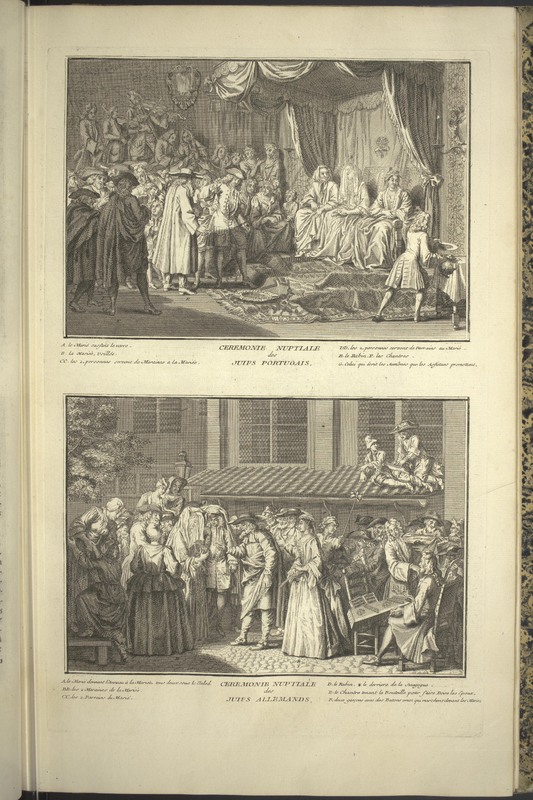
A pair of engravings depicting Jewish weddings in Portugal (top) and Germany (bottom). The Portugese wedding shows a gathering indoors, the bride sitting beneath a canopy on a dais as the groom raises a glass to toss it down and break. The German wedding shows a gathering outdoors, the bride and groom trading rings beneath a tallit as the rabbi guides them.
A pair of engravings depicting Jewish weddings in Portugal (top) and Germany (bottom). The Portugese wedding shows a gathering indoors, the bride sitting beneath a canopy on a dais as the groom raises a glass to toss it down and break. The German wedding shows a gathering outdoors, the bride and groom trading rings beneath a tallit as the rabbi guides them.
An engraving depicting liturgical objects associated with Jewish religious practice, including a tallit katan (prayer shawl), tassels, a Sabbath lamp, matsah, the Four Species (a palm frond, brnaches from a myrtle and a willow tree and a citron, waved during the celebration of the harvest festival Sukkot), a shofar (a ram’s horn blown on the holidays of Rosh Hoshanah andYom Kippur), and a mezuzah (a scroll with specific Hebrew verses from the Torah, placed on doorposts of Jewish homes).
An engraving depicting liturgical objects associated with Jewish religious practice, including a tallit katan (prayer shawl), tassels, a Sabbath lamp, matsah, the Four Species (a palm frond, brnaches from a myrtle and a willow tree and a citron, waved during the celebration of the harvest festival Sukkot), a shofar (a ram’s horn blown on the holidays of Rosh Hoshanah andYom Kippur), and a mezuzah (a scroll with specific Hebrew verses from the Torah, placed on doorposts of Jewish homes).
An engraving depicting elements of Jewish ritual garments, including a Jewish prayer shawl with tassels (top), phylacteries (small black leather boxes including verses from the Torah), and a Jew wearing both for worship (bottom right).
An engraving depicting elements of Jewish ritual garments, including a Jewish prayer shawl with tassels (top), phylacteries (small black leather boxes including verses from the Torah), and a Jew wearing both for worship (bottom right).
An engraving depicting a group of German Jews performing physical penitence within the synagogue, theoretically in observance of Yom Kippur. Two men are shown whipping two other men while a fifth man to the right is removing his coat, presumably to take his turn. Other men are shown around the synagogue reading the Torah while wearing tallitot.
An engraving depicting a group of German Jews performing physical penitence within the synagogue, theoretically in observance of Yom Kippur. Two men are shown whipping two other men while a fifth man to the right is removing his coat, presumably to take his turn. Other men are shown around the synagogue reading the Torah while wearing tallitot.
A pair of engravings depicting a kohen (priest descended directly from Aaron) reciting prayers in the synagogue (top) and a rabbi lifting the Torah scroll for the gathered worshipers to see (bottom). The top engraving shows the kohen on the right with worshipers gathered around wearing tallitot and is labeled as "Synagogue des Juifs Portugais a la Haye" (the Synagogue of the Portuguese Jews in the Hague). The bottom engraving shows a gathering of Jewish worhipers, most wearing tallitot, looking on as a rabbi raises the Torah scroll.
A pair of engravings depicting a kohen (priest descended directly from Aaron) reciting prayers in the synagogue (top) and a rabbi lifting the Torah scroll for the gathered worshipers to see (bottom). The top engraving shows the kohen on the right with worshipers gathered around wearing tallitot and is labeled as "Synagogue des Juifs Portugais a la Haye" (the Synagogue of the Portuguese Jews in the Hague). The bottom engraving shows a gathering of Jewish worhipers, most wearing tallitot, looking on as a rabbi raises the Torah scroll.
 Still image
 Still image
 Still image
 Still image
 Still image