Search
5 resources
5 items
Date
1529
-
 Text
TextAnnotationes Hieronimi Emsers, vber Luthers Newe Testame[n]t : ytzt tzum vierden mal vbersehen, welche auch mit dem Newen Testament, so Emser seliger verdeutschet, vnd am Jüngsten gedruckt, aussgangen sind, ym 1529 yhar.
Emser, Hieronymus, 1478-1527Summary: In this volume, Hieronymous Emser, who had himself translated the New Testament from Greek into German, provides a chapter by chapter commentary and critique on Martin Luther's translation of the New Testament.Summary: In this volume, Hieronymous Emser, who had himself translated the New Testament from Greek into German, provides a chapter by chapter commentary and critique on Martin Luther's translation of the New Testament. -
 Text
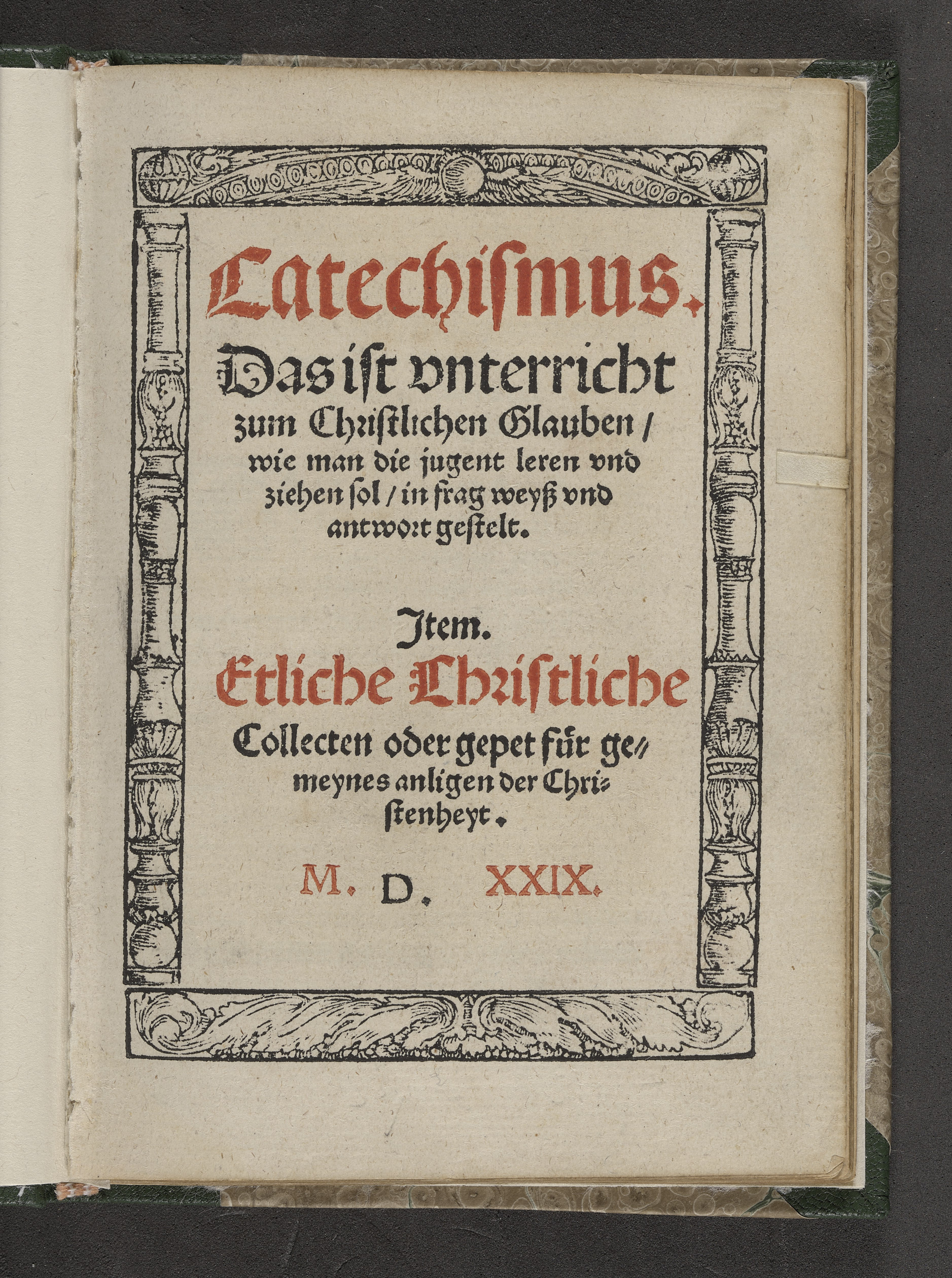
TextCatechismus. Das ist Vnterricht zum christlichen Glauben wie man die Jugent leren vnd ziehen sol, in Frag Weyss vnd Antwort gestelt : Jtem etliche christliche Collecten oder Gepet für gemeynes Anligen der Christenheyt
Althamer, Andreas, approximately 1500-1539Summary: Third printing of the Ansbach Catechism by Andreas Althamer and Johannes Rurer, commissioned by Margrave Georg of Brandenburg. It has been called the first regional catechism of the Protestant movement. It contains 92 questions and answers as well as an appendix with 18 prayers.Summary: Third printing of the Ansbach Catechism by Andreas Althamer and Johannes Rurer, commissioned by Margrave Georg of Brandenburg. It has been called the first regional catechism of the Protestant movement. It contains 92 questions and answers as well as an appendix with 18 prayers. -
![Summary: First edition of the second Latin translation of Luther's Large Catechism, published earlier the same year. This translation was done Vincentius Opsopäus (Vinzenz Heidecker). Issued with it is the first Latin edition of Johann Brenz's catechism, first published in German in 1528 under the title "Fragstuck des christlichen Glaube[n]s für die Jugend zu Schwebische[n] Hall]."](https://digital.pitts.emory.edu/files/large/P_300000218139/00000001.jpg) Text
TextD. Martini Lutheri theologi, catechismus, lećtu dignissimus, latinus faćtus per Vincentium Obsopoeum : Huic adiećti sunt alij quo[que] gemini Catechismi,Iohannis Brentij ecclesiastae Hallensis, eodem interprete
Luther, Martin, 1483-1546Summary: First edition of the second Latin translation of Luther's Large Catechism, published earlier the same year. This translation was done Vincentius Opsopäus (Vinzenz Heidecker). Issued with it is the first Latin edition of Johann Brenz's catechism, first published in German in 1528 under the title "Fragstuck des christlichen Glaube[n]s für die Jugend zu Schwebische[n] Hall]."Summary: First edition of the second Latin translation of Luther's Large Catechism, published earlier the same year. This translation was done Vincentius Opsopäus (Vinzenz Heidecker). Issued with it is the first Latin edition of Johann Brenz's catechism, first published in German in 1528 under the title "Fragstuck des christlichen Glaube[n]s für die Jugend zu Schwebische[n] Hall]." -
 Text
TextTeütsche Letaney, vmb alles anligen der Cristenlichen gemayn
Luther, Martin, 1483-1546Summary: This is Luther's reinstatement of the Litany of "All Saints", containing both the musical notation and German text of the antiphons.Summary: This is Luther's reinstatement of the Litany of "All Saints", containing both the musical notation and German text of the antiphons. -
 Text
TextWes sich D. Martinus Luther. etc. mit Huldrich Zwinglin. etc. der streitigen Articulen halb, vereynet vnd verglichen auff der Conuocation zu[o] Marpurg, den dritten Tag Octob. Im Jar, M. D. xxix
Colloquy of Marburg (1529)Summary: The Colloquy of Marburg was a meeting arranged at the initiative of Philip of Hessen in an attempt to forge religious unity in Germany and mediate theological differences between Lutherans and Zwinglians. Besides Luther and Zwingli, the meeting was also attended by Johannes Agricola, Johannes Brenz, Martin Bucer, Caspar Hedio, Justus Jonas, Philipp Melanchthon, Johannes Oecolampadius, and Andreas Osiander.Summary: The Colloquy of Marburg was a meeting arranged at the initiative of Philip of Hessen in an attempt to forge religious unity in Germany and mediate theological differences between Lutherans and Zwinglians. Besides Luther and Zwingli, the meeting was also attended by Johannes Agricola, Johannes Brenz, Martin Bucer, Caspar Hedio, Justus Jonas, Philipp Melanchthon, Johannes Oecolampadius, and Andreas Osiander.