Richard C. Kessler Reformation Collection
The Richard C. Kessler Reformation Collection was established in 1987, when Richard and Martha Kessler donated their private collection of Reformation imprints and manuscripts to Emory University. These materials were combined with Reformation holdings at the Pitts Theology Library, and an effort was launched to enlarge and sustain this collection in the years to come. An advisory committee of Lutheran laypersons and clergy and of Candler School of Theology faculty and administrators oversees the nurture of the collection and its programs. The Reformation Notes newsletter provides semiannual updates on the growth of the collection, and the Reformation Day at Emory program of music and lectures each October celebrates the collection and its contributions to music, history, and theology.
In the sixteenth century the social and theological movements of central Europe, known collectively as the Reformation, critically shaped religion, law, education and other institutions in the West, and their long shadow has extended even to the present. The purpose of the Kessler Collection is to document these changes by collecting print and manuscript materials down to 1570 by Martin Luther (1483-1546) and those whom he influenced or engaged in debate. In this way historians and theologians will be able to hear the full range of voices that were raised in this dynamic period.
The holdings of the collection now exceed 4,000 items, a mark approximated by only two other libraries in North America; no American library approaches the Kessler Collection's 1,000+ publications by Luther himself.
-
 Text
TextEin Sermon
Alveldt, Augustin von, active 16th centurySummary: Augustinus Alveldt, a Franciscan teacher, and later provincial head of the order, here responds to Luther's tract, "Von dem Papsttum zu Rom," in which Luther explains his views on the Papacy.Summary: Augustinus Alveldt, a Franciscan teacher, and later provincial head of the order, here responds to Luther's tract, "Von dem Papsttum zu Rom," in which Luther explains his views on the Papacy. -
 Text
TextDe disputatione lipsicensi quantum ad Boemos obiter deflexa est Epistola
Emser, Hieronymus, 1478-1527Summary: This volume includes both Emser's letter on the Leipzig Disputation, and Luther's sharp reply. Luther and Emser became lifelong enemies, a situation only exacerbated by Emser's use of Luther's New Testament as a basis for his own German translation in which he attacks Luther and Lutheranism. The woodcut on the title page shows Emser's coat-of-arms with the prominent goat, which gave Luther the title of his work, "To the Goat in Leipzig." The manuscript note on the title page says the book was purchased in 1520.Summary: This volume includes both Emser's letter on the Leipzig Disputation, and Luther's sharp reply. Luther and Emser became lifelong enemies, a situation only exacerbated by Emser's use of Luther's New Testament as a basis for his own German translation in which he attacks Luther and Lutheranism. The woodcut on the title page shows Emser's coat-of-arms with the prominent goat, which gave Luther the title of his work, "To the Goat in Leipzig." The manuscript note on the title page says the book was purchased in 1520. -
 Text
TextAd criminatricem Martini Luders Uitte[n]bergen[sis] offensione[m] super iudicio iustissimo facto : ad articulos quosdam per minoritas de obserua[n]tia Reuere[n]dissimo Episcopo Brandenburgen[si] oblatos Eckiana responsio; Quia hactenus abusus est Mar. Luderus modestia Eckiana : tande[m] extorsit, vt mordaci, mordaciter quo[que] responderem ...
Eck, Johann, 1486-1543Summary: Johann Eck responds in this early work to Luther's pamphlet "Contra malignum Iohannis Eccii iudicium."Summary: Johann Eck responds in this early work to Luther's pamphlet "Contra malignum Iohannis Eccii iudicium." -
 Text
TextExcusatio eckij : ad ea que falso sibi Philippus Melanchton gra[m]maticus Vuittenbergen[sis] super theologica disputatione lipsica adscripsit.
Eck, Johann, 1486-1543Summary: The participants in the Leipzig Disputation promised not to print their positions before the faculties of Paris and Louvain had issued their verdicts in the case. Both sides broke their promise. Melanchthon apparently got into print first, for this is Eck's reply to Melanchthon. This is the second printing of the work.Summary: The participants in the Leipzig Disputation promised not to print their positions before the faculties of Paris and Louvain had issued their verdicts in the case. Both sides broke their promise. Melanchthon apparently got into print first, for this is Eck's reply to Melanchthon. This is the second printing of the work. -
 Text
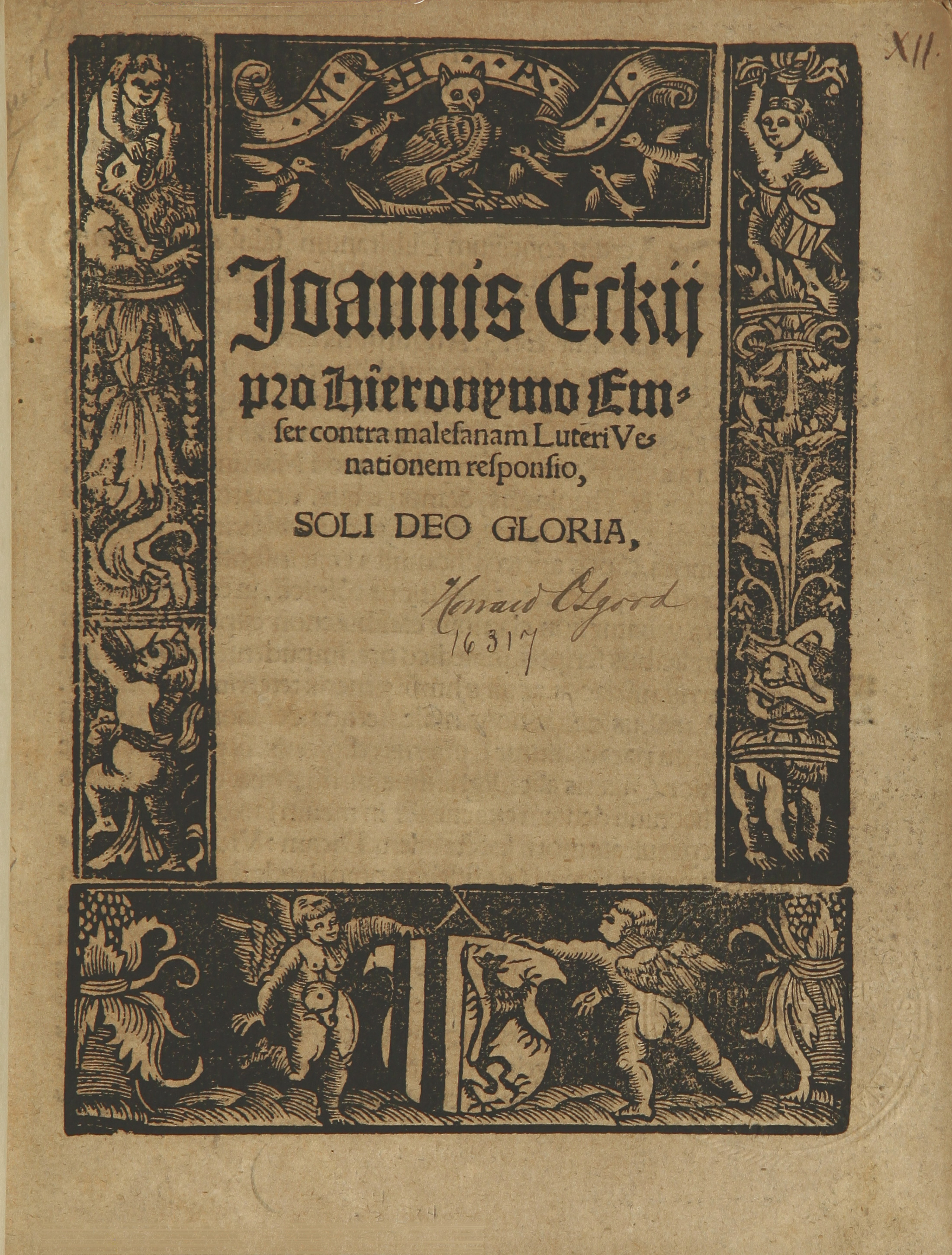
TextJoannis Eckij pro Hieronymo Emser : contra malesanam Luteri venationem responsio, Soli Deo gloria.
Eck, Johann, 1486-1543Summary: First printing of the first edition of a pamphlet by Johann Eck in support of Hieronymus Emser, a theologian in Leipzig and one of Luther's most vehement early opponents.Summary: First printing of the first edition of a pamphlet by Johann Eck in support of Hieronymus Emser, a theologian in Leipzig and one of Luther's most vehement early opponents. -
 Text
TextReplica F. Sylvestri Prieriat[is] : sacri Palatii Apostolici Magistri, ad F. Martinum Luther Ordinis Eremitaru[m] ; Martinus Luther, optimo lectori salutem ...
Mazzolini, Silvestro, da Prierio, 1456?-1527?Summary: When Luther received the replies of S. Mazzolini, the first man to take up the cudgels against Luther, he found the best course of reply to be a reprinting with notes of Mazzolini's inept rejoinders. Even the Catholics had to admit that Mazzolini's answers simply did not meet Luther's objections. This is the second printing of the work.Summary: When Luther received the replies of S. Mazzolini, the first man to take up the cudgels against Luther, he found the best course of reply to be a reprinting with notes of Mazzolini's inept rejoinders. Even the Catholics had to admit that Mazzolini's answers simply did not meet Luther's objections. This is the second printing of the work. -
 Text
TextAlbertus Dei et Apostolice Sedis gratia Maguntinen[sis] [sic] et Magdeburgen[sis] Archiepiscop[us] ac Halberstaten[sis] ecclesiar[m] Administrator, Germanie Primas ... Indulgence
Albert, of Brandenburg, Archbishop and Elector of Mainz, Cardinal, 1490-1545Indulgences were issued to defray the cost of building the basilica of St. Peter in Rome. Their distribution was often linked to the sacrament of penance, as believers were granted spiritual merits in exchange for financial donations. This particular indulgence, believed to be the only specimen of its kind thus far recovered, was issued specifically to clergy, granting them liturgical benefits in exchange for their contributions.Indulgences were issued to defray the cost of building the basilica of St. Peter in Rome. Their distribution was often linked to the sacrament of penance, as believers were granted spiritual merits in exchange for financial donations. This particular indulgence, believed to be the only specimen of its kind thus far recovered, was issued specifically to clergy, granting them liturgical benefits in exchange for their contributions. -
 Text
TextTürkenkriege -- Verzeichnis der personen vnd knechte, so zu widerstandt des Türcken : auff bewilligung der stende des Reichs von dem Churfürsten zu Sachsen etc. zu Zwickau gemustertt (...), 1542 May 10
This manuscript is handwritten in German and dated May 10, 1542. It lists people from Zwickau, Saxony (Germany) who enlisted or were paid to participate in the field campaign against the Turkish invasion of Marseille.This manuscript is handwritten in German and dated May 10, 1542. It lists people from Zwickau, Saxony (Germany) who enlisted or were paid to participate in the field campaign against the Turkish invasion of Marseille. -
 Text
TextProtestatio facta in Dieta Augustana 1550 circa conciliu[m] p[er] oratores electoris Ducis Mauritij saxonici, Augsburg
Maurice, Elector of Saxony, 1521-1553A contemporary report of a remonstration against the Imperial policy of Charles V for participation in the recently convened ecumenical Council of Trent on terms proposed by the new Pope Julius III (del Monte). The Elector Maurice, of the Ernestine branch of the Wettin family of the duchies of Saxony, was one of the great and enigmatic figures of German history in the mid 16th century.A contemporary report of a remonstration against the Imperial policy of Charles V for participation in the recently convened ecumenical Council of Trent on terms proposed by the new Pope Julius III (del Monte). The Elector Maurice, of the Ernestine branch of the Wettin family of the duchies of Saxony, was one of the great and enigmatic figures of German history in the mid 16th century. -
 Text
TextException of Royal Powers in the Church from Infringement
Spain. Sovereign (1556-1598: Philip II)A contemporary official text, in Spanish, of the famous royal cedula by which the reluctant King Philip II at last promulgated the Catholic Church's reply to the Protestant revolt from the church. This ratifies for the Spanish dominions, the profound reforms of the great Council meeting at Trent from 1545 to 1552 and finally in 1562-1563.A contemporary official text, in Spanish, of the famous royal cedula by which the reluctant King Philip II at last promulgated the Catholic Church's reply to the Protestant revolt from the church. This ratifies for the Spanish dominions, the profound reforms of the great Council meeting at Trent from 1545 to 1552 and finally in 1562-1563. -
 Text
TextLetter from Kaspar Cruciger to Viet Dietrich, July 8, 1544
Cruciger, Kaspar, 1504-1548This letter was written by Cruciger on July 8, 1544 to Veit Dietrich, pastor of St. Sebald’s Church at Nuremberg. In the letter Cruciger discussed personal matters related to himself, Dietrich, Martin Luther, and Philipp Melanchthon. He also writes about the collection of Luther’s sermons he and Dietrich were to publish together in the following year.This letter was written by Cruciger on July 8, 1544 to Veit Dietrich, pastor of St. Sebald’s Church at Nuremberg. In the letter Cruciger discussed personal matters related to himself, Dietrich, Martin Luther, and Philipp Melanchthon. He also writes about the collection of Luther’s sermons he and Dietrich were to publish together in the following year. -
 Text
TextLetter from Albert of Brandenburg to Julius Plug, July 30, 1540
Albrecht, of Brandenburg, Archbishop and Elector of Mainz, Cardinal, 1490-1545A signed letter in German from Albert of Brandenburg to Julius Plug, dated 30th July 1540. The letter is a request to translate from Latin into German some articles on religion by Luther.A signed letter in German from Albert of Brandenburg to Julius Plug, dated 30th July 1540. The letter is a request to translate from Latin into German some articles on religion by Luther. -
 Text
TextLetter from Georg Spalatin to Duke Magnus III of Mecklenburg, May 3, 1534
Spalatin, Georg, 1484-1545A cover letter, dated May 3, 1534, for a manuscript which Spalatin had promised to Duke Magnus III of Mecklenburg regarding the justification used by Henry VIII for his divorce from Catherine of Aragon, which was never recognized by Rome. Henry had married Anne Boleyn in January of 1533 and on May 23 1534, Pope Clement VII invalidated Henry's divorce and remarriage, which led to England's final break with Rome and the foundingn of the Anglican Church.A cover letter, dated May 3, 1534, for a manuscript which Spalatin had promised to Duke Magnus III of Mecklenburg regarding the justification used by Henry VIII for his divorce from Catherine of Aragon, which was never recognized by Rome. Henry had married Anne Boleyn in January of 1533 and on May 23 1534, Pope Clement VII invalidated Henry's divorce and remarriage, which led to England's final break with Rome and the foundingn of the Anglican Church. -
 Text
TextLetter from Georg Spalatin to Heinrich von Einsiedel, January 9, 1536
Spalatin, Georg, 1484-1545A letter written to Heinrich von Einsiedel and an enclosed with a copy of a sermon by Philipp Melanchthon. Within the body of the letter, Spalatin entreats Einsiedel to "exert your goodwill on the work's behalf". The letter is dated 1536.A letter written to Heinrich von Einsiedel and an enclosed with a copy of a sermon by Philipp Melanchthon. Within the body of the letter, Spalatin entreats Einsiedel to "exert your goodwill on the work's behalf". The letter is dated 1536. -
![A letter written to the "Noble and Right worthy Heinrich von Einsiedel" in Gnansteyn. The matter being addressed is the refusal of Brosius Berger to take an oath, thus hindering Katharina Gockritz from getting married. Mention of consultation with Doctor Martin [Luther] is in the letter. With the exception of the upper right corner which is missing, the paper is in good condition. The date "1528" appears in the upper left corner in a different ink.](https://digital.pitts.emory.edu/files/large/P-MSS122_B001_F001_I001/P-MSS122_B001_F001_I001_P001_PROD.jpg) Text
TextLetter from Georg Spalatin to Heinrich von Einsiedel, October 7, 1528
Spalatin, Georg, 1484-1545A letter written to the "Noble and Right worthy Heinrich von Einsiedel" in Gnansteyn. The matter being addressed is the refusal of Brosius Berger to take an oath, thus hindering Katharina Gockritz from getting married. Mention of consultation with Doctor Martin [Luther] is in the letter. With the exception of the upper right corner which is missing, the paper is in good condition. The date "1528" appears in the upper left corner in a different ink.A letter written to the "Noble and Right worthy Heinrich von Einsiedel" in Gnansteyn. The matter being addressed is the refusal of Brosius Berger to take an oath, thus hindering Katharina Gockritz from getting married. Mention of consultation with Doctor Martin [Luther] is in the letter. With the exception of the upper right corner which is missing, the paper is in good condition. The date "1528" appears in the upper left corner in a different ink. -
 Text
TextLetter from Johannes Cochlaeus to Julius von Pflug
Cochlaeus, Johannes, 1479-1552This letter was written by Cochlaeus on June 6, 1547 to Julius von Pflug, the last Prince Bishop of Naumburg. Cochlaeus congratulates von Pflug on his reinstatemnnt into his office following the defeat and capture of Elector John Frederick of Saxony in the Schmalkald War. The letter also contains a reference by Cochlaus to the transfer to Bologna of the meetings that became known as the Council of Trent.This letter was written by Cochlaeus on June 6, 1547 to Julius von Pflug, the last Prince Bishop of Naumburg. Cochlaeus congratulates von Pflug on his reinstatemnnt into his office following the defeat and capture of Elector John Frederick of Saxony in the Schmalkald War. The letter also contains a reference by Cochlaus to the transfer to Bologna of the meetings that became known as the Council of Trent. -
 Still image
Effigies Reverendi Viri, D. Philippi Melanchthonis, Expressa VVitebergae Anno M. D. LXIII
Cranach, Lucas, 1515-1586An impression done in 1564 of a woodcut made in 1561 depicting Philipp MelanchthonAn impression done in 1564 of a woodcut made in 1561 depicting Philipp Melanchthon -
 Text
TextPaulus Spricht zu den Colossern
Melanchthon, Philipp, 1497-1560An unpublished manuscript signed and dated (1551) by Philipp Melanchthon. Written on three sides of two sheets, it is a meditation on the Third Chapter of Paul's Letter to the Colossians. The two leaves on which the meditation is written (19 x 29 cm.) show signs of insect damage and have been repaired with Japanese paper. The verso of the title page holds the inscription "C. S. V. R. mit Galt" near the top with a less readable second line. Near the bottom is the inscription "1551 mit Galt". For their protection, both pieces were encapsulated in mylar.An unpublished manuscript signed and dated (1551) by Philipp Melanchthon. Written on three sides of two sheets, it is a meditation on the Third Chapter of Paul's Letter to the Colossians. The two leaves on which the meditation is written (19 x 29 cm.) show signs of insect damage and have been repaired with Japanese paper. The verso of the title page holds the inscription "C. S. V. R. mit Galt" near the top with a less readable second line. Near the bottom is the inscription "1551 mit Galt". For their protection, both pieces were encapsulated in mylar. -
 Text
TextReceipt for 20 Gulden salary to Jonas Justus from the City Council of Erfurt
Jonas, Justus, 1493-1555This collection consists of a single receipt, on paper, for 20 Gulden which Jonas received as salary from the City Council of Erfurt. Our research has so far been unable to determine just why Jonas was being paid by the City Council. The fact that he uses the word "Zinse" (interest income, or, income from a benefice) suggests that it was for services rendered as a preacher in that City. It is also known that he was considering returning to Erfurt as a preacher after the debacle at Halle. The receipt is signed by Justus Jonas and is dated the 2nd February 1549.This collection consists of a single receipt, on paper, for 20 Gulden which Jonas received as salary from the City Council of Erfurt. Our research has so far been unable to determine just why Jonas was being paid by the City Council. The fact that he uses the word "Zinse" (interest income, or, income from a benefice) suggests that it was for services rendered as a preacher in that City. It is also known that he was considering returning to Erfurt as a preacher after the debacle at Halle. The receipt is signed by Justus Jonas and is dated the 2nd February 1549. -
 Text
TextLetter from John, Elector of Saxony, to Duke Albrecht of Bavaria
John, Elector of Saxony, 1468-1532A signed (letter contains notation in his own hand), handwritten letter, in German, on paper. The letter addresses John's unwillingness to provide aid in a dispute against his relative, Duke Albrecht of Bavaria.A signed (letter contains notation in his own hand), handwritten letter, in German, on paper. The letter addresses John's unwillingness to provide aid in a dispute against his relative, Duke Albrecht of Bavaria. -
 Text
TextNote on Old Testament Chronology
Luther, Martin, 1483-1546A manuscript in Martin Luther's own hand, "Notes on Two Chronological Difficulties in the Old Testament" (see Weimar Edition of The Works of Martin Luther, Volume 60, page 163). The document is a seven line author's note written in 1541, in which Luther discussed the accuracy of the computations in his 1541 work, Computation of the Years of the World. (Weimar Edition of The Works of Martin Luther, Volume 53, pages 177-182).A manuscript in Martin Luther's own hand, "Notes on Two Chronological Difficulties in the Old Testament" (see Weimar Edition of The Works of Martin Luther, Volume 60, page 163). The document is a seven line author's note written in 1541, in which Luther discussed the accuracy of the computations in his 1541 work, Computation of the Years of the World. (Weimar Edition of The Works of Martin Luther, Volume 53, pages 177-182).

