Search
-
 Still image
The Martyrdom of Saint Catherine
Dürer, Albrecht, 1471-1528A depiction of the martyrdom of Saint Catherine of Alexandria.A depiction of the martyrdom of Saint Catherine of Alexandria. -
 Still image
The Crucifixion
Dürer, Albrecht, 1471-1528A depiction of the crucifixion including Mary in the foreground and angels collecting the blood of Christ. The leaf includes descriptive text on the verso in Latin.A depiction of the crucifixion including Mary in the foreground and angels collecting the blood of Christ. The leaf includes descriptive text on the verso in Latin. -
 Still image
Der ungläubige Thomas
Dürer, Albrecht, 1471-1528Thomas touches the pierced side of Jesus while the apostles gather around.Thomas touches the pierced side of Jesus while the apostles gather around. -
 Still image
Christus in Emaus
Dürer, Albrecht, 1471-1528Albrecht Dürer's woodcut presents Christ seated at the table in Emmaus with the two disciples from the road and two hosts. Christ breaks the bread and thus this image captures the moment just prior to his disappearance from their sight.Albrecht Dürer's woodcut presents Christ seated at the table in Emmaus with the two disciples from the road and two hosts. Christ breaks the bread and thus this image captures the moment just prior to his disappearance from their sight. -
 Still image
Die Auferstehung
Dürer, Albrecht, 1471-1528Dürer's depiction of the resurrection of Christ focuses on Matthew's account: Christ emerges from the tomb while the guards shook in fear and became as dead men.Dürer's depiction of the resurrection of Christ focuses on Matthew's account: Christ emerges from the tomb while the guards shook in fear and became as dead men. -
 Still image
Die Dornenkrönung
Dürer, Albrecht, 1471-1528Christ is seated while the guards beat him and apply a crown of thorns to his head, while the Jewish leader look on from the left.Christ is seated while the guards beat him and apply a crown of thorns to his head, while the Jewish leader look on from the left. -
 Still image
Die Fußwaschung
Dürer, Albrecht, 1471-1528Jesus washes Peter's feet in the foreground while in the background the rest of the apostles are contemplating this event.Jesus washes Peter's feet in the foreground while in the background the rest of the apostles are contemplating this event. -
 Text
TextRoll Book (members in full connection)
Methodist Episcopal Church. Georgia ConferenceA roll book with rosters of active members (by year) of the Georgia Conference of the Methodisc Episcopal Church.A roll book with rosters of active members (by year) of the Georgia Conference of the Methodisc Episcopal Church. -
 Text
TextTelugu Mahābhārata. Udyōga Parva
Vīrarāghavakavi, Kōṭikalapūḍi, 1663-1712This work was written on a palm-leaf manuscript (dried palm leaves were used as a medium for writing in South Asia). There is a total of 143 palm leaves in the manuscript. Each leaf is roughly 35mm x 430mm and is inscribed on both sides. There are also two holes in each leaf and the leaves are bound together with a cord running through the two holes and the whole manuscript is encased with wooden ends. Rounded scripts (such as Telugu) were used on palm-leaf manuscripts because angular letters split the leaves.This work was written on a palm-leaf manuscript (dried palm leaves were used as a medium for writing in South Asia). There is a total of 143 palm leaves in the manuscript. Each leaf is roughly 35mm x 430mm and is inscribed on both sides. There are also two holes in each leaf and the leaves are bound together with a cord running through the two holes and the whole manuscript is encased with wooden ends. Rounded scripts (such as Telugu) were used on palm-leaf manuscripts because angular letters split the leaves. -
 Text
TextNorth Dutch Book of Hours
Catholic ChurchUsed at Utrecht between 1470 and 1500, the North Dutch Book of Hours includes the "Hours of the Eternal Wisdom," by Gerard Groot (a member of the Brothers of the Common Life), Hours of the Virgin, and Penitential Psalms.Used at Utrecht between 1470 and 1500, the North Dutch Book of Hours includes the "Hours of the Eternal Wisdom," by Gerard Groot (a member of the Brothers of the Common Life), Hours of the Virgin, and Penitential Psalms. -
 Still image
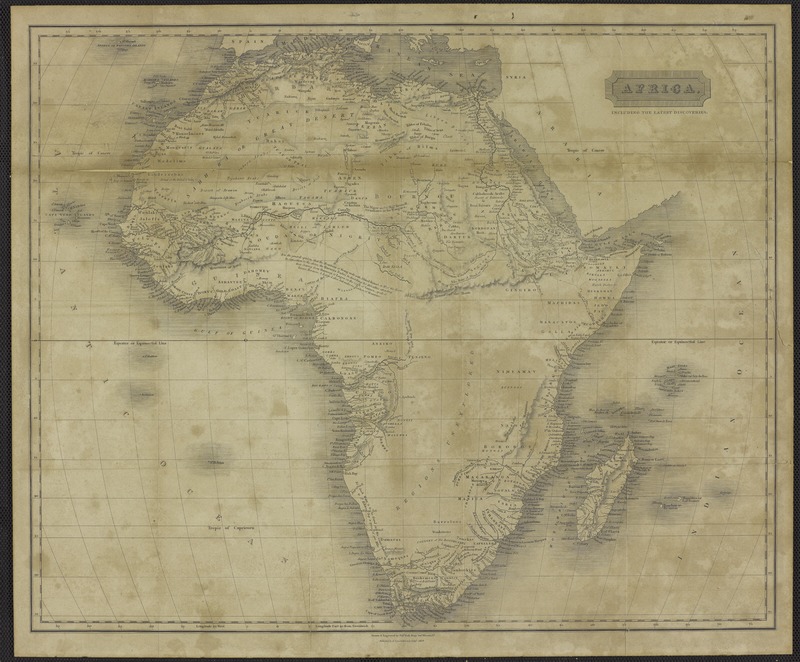
Africa including the latest discoveries
Hall, SidneyA map of Africa depicting locations explored by Europeans up to the early 19th century, including the Sahara, Madagascar, and the Ivory Coast.A map of Africa depicting locations explored by Europeans up to the early 19th century, including the Sahara, Madagascar, and the Ivory Coast. -
 Text
TextAlbertus Dei et Apostolice Sedis gratia Maguntinen[sis] [sic] et Magdeburgen[sis] Archiepiscop[us] ac Halberstaten[sis] ecclesiar[m] Administrator, Germanie Primas ... Indulgence
Albert, of Brandenburg, Archbishop and Elector of Mainz, Cardinal, 1490-1545Indulgences were issued to defray the cost of building the basilica of St. Peter in Rome. Their distribution was often linked to the sacrament of penance, as believers were granted spiritual merits in exchange for financial donations. This particular indulgence, believed to be the only specimen of its kind thus far recovered, was issued specifically to clergy, granting them liturgical benefits in exchange for their contributions.Indulgences were issued to defray the cost of building the basilica of St. Peter in Rome. Their distribution was often linked to the sacrament of penance, as believers were granted spiritual merits in exchange for financial donations. This particular indulgence, believed to be the only specimen of its kind thus far recovered, was issued specifically to clergy, granting them liturgical benefits in exchange for their contributions. -
 Text
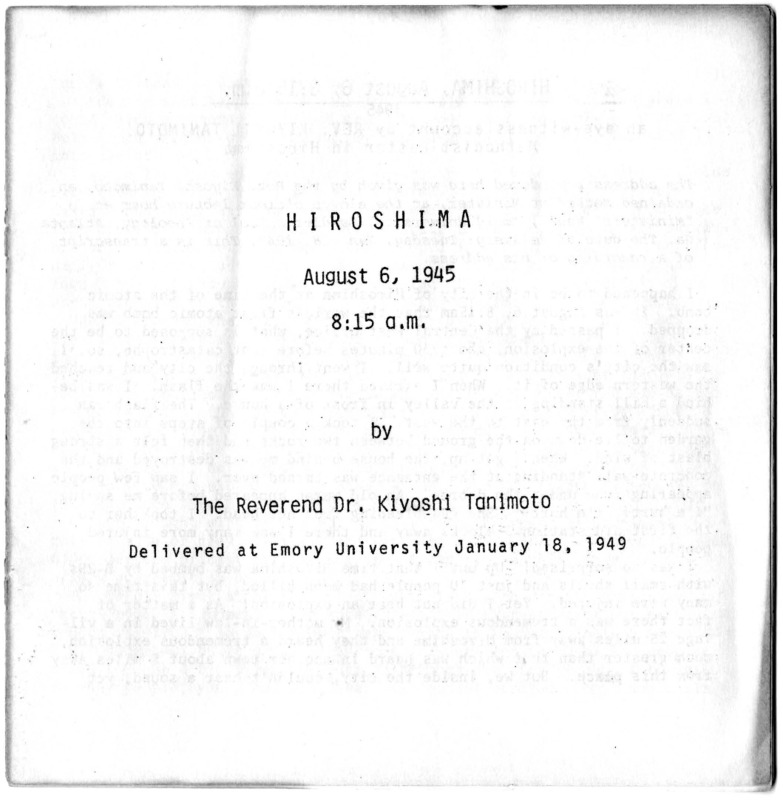
TextHiroshima, August 6, 1945, 8:15 a.m.
Tanimoto, Kiyoshi, 1909-1986An address given by the Rev. Kiyoshi Tanimono, Methodist minister, during Minister's Week at Emory University giving an eye-witness account of the bombing of Hiroshima on August 6, 1945.An address given by the Rev. Kiyoshi Tanimono, Methodist minister, during Minister's Week at Emory University giving an eye-witness account of the bombing of Hiroshima on August 6, 1945. -
 Text
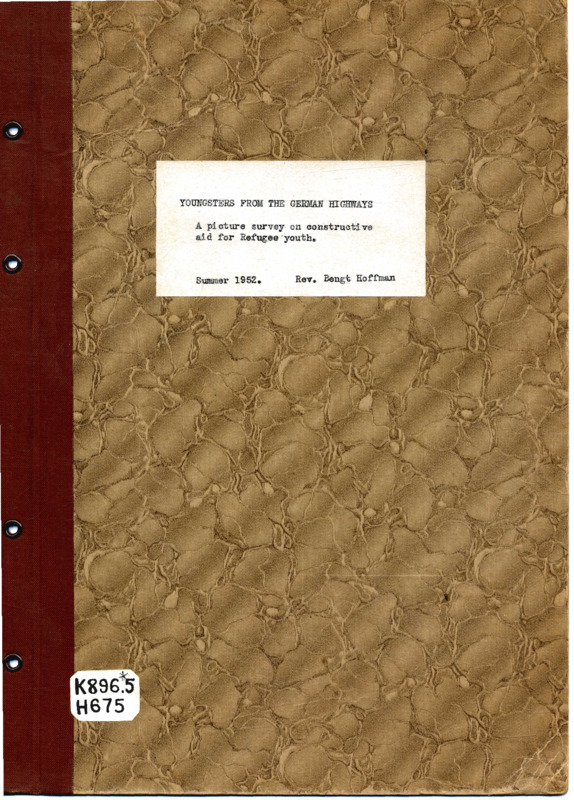
TextYoungsters from the German Highways: a picture survey on constructive aid for Refugee youth
Hoffman, Bengt Runo, 1913-1997This item is a scrapbook produced while Hoffman was serving as Secretary for Germany and Austria for the World Council of Churches. It contains sixty black-and-white photographs depicting the lives of young refugees in West Germany after World War II. In English, the captions and narrative describe church relief work among the refugees. Much of this document is an appeal for more funds and resources to help Protestant churches continue their relief efforts in the boarding houses and schools for refugees, who were mainly from West Germany although some were from East Germany.This item is a scrapbook produced while Hoffman was serving as Secretary for Germany and Austria for the World Council of Churches. It contains sixty black-and-white photographs depicting the lives of young refugees in West Germany after World War II. In English, the captions and narrative describe church relief work among the refugees. Much of this document is an appeal for more funds and resources to help Protestant churches continue their relief efforts in the boarding houses and schools for refugees, who were mainly from West Germany although some were from East Germany. -
 Text
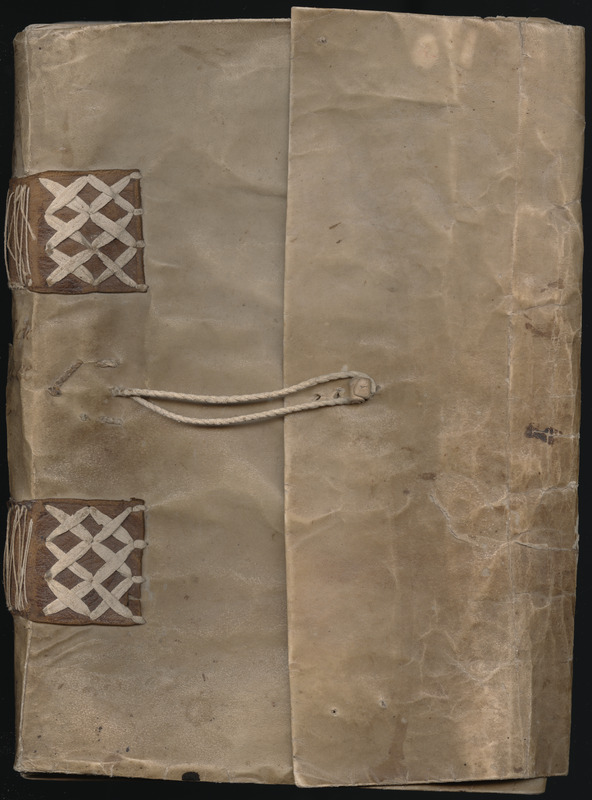
TextTribunal of the Inquisition at Barcelona records
Inquisidor General de EspañaOriginal records of seventy-nine trials at the Inquisition in Barcelona, Spain signed by the inquisitors. The text contains their declarations, confessions and the testimonies of witnesses. Crimes include pacts with the devil, sorcery, witchcraft, sodomy, traffic with ghosts, etc.Original records of seventy-nine trials at the Inquisition in Barcelona, Spain signed by the inquisitors. The text contains their declarations, confessions and the testimonies of witnesses. Crimes include pacts with the devil, sorcery, witchcraft, sodomy, traffic with ghosts, etc. -
 Text
TextWax Rubbing of the Nestorian Tablet of Sian-fu
A wax rubbing of the tablet, done in sections on four different pieces of tissue paper. The inscription is primarily in Chinese, but there are several Syriac words; and there is a bilingual list of proper names in both languages.A wax rubbing of the tablet, done in sections on four different pieces of tissue paper. The inscription is primarily in Chinese, but there are several Syriac words; and there is a bilingual list of proper names in both languages. -
 Text
TextTürkenkriege -- Verzeichnis der personen vnd knechte, so zu widerstandt des Türcken : auff bewilligung der stende des Reichs von dem Churfürsten zu Sachsen etc. zu Zwickau gemustertt (...), 1542 May 10
This manuscript is handwritten in German and dated May 10, 1542. It lists people from Zwickau, Saxony (Germany) who enlisted or were paid to participate in the field campaign against the Turkish invasion of Marseille.This manuscript is handwritten in German and dated May 10, 1542. It lists people from Zwickau, Saxony (Germany) who enlisted or were paid to participate in the field campaign against the Turkish invasion of Marseille. -
 Text
TextProtestatio facta in Dieta Augustana 1550 circa conciliu[m] p[er] oratores electoris Ducis Mauritij saxonici, Augsburg
Maurice, Elector of Saxony, 1521-1553A contemporary report of a remonstration against the Imperial policy of Charles V for participation in the recently convened ecumenical Council of Trent on terms proposed by the new Pope Julius III (del Monte). The Elector Maurice, of the Ernestine branch of the Wettin family of the duchies of Saxony, was one of the great and enigmatic figures of German history in the mid 16th century.A contemporary report of a remonstration against the Imperial policy of Charles V for participation in the recently convened ecumenical Council of Trent on terms proposed by the new Pope Julius III (del Monte). The Elector Maurice, of the Ernestine branch of the Wettin family of the duchies of Saxony, was one of the great and enigmatic figures of German history in the mid 16th century. -
 Text
TextException of Royal Powers in the Church from Infringement
Spain. Sovereign (1556-1598: Philip II)A contemporary official text, in Spanish, of the famous royal cedula by which the reluctant King Philip II at last promulgated the Catholic Church's reply to the Protestant revolt from the church. This ratifies for the Spanish dominions, the profound reforms of the great Council meeting at Trent from 1545 to 1552 and finally in 1562-1563.A contemporary official text, in Spanish, of the famous royal cedula by which the reluctant King Philip II at last promulgated the Catholic Church's reply to the Protestant revolt from the church. This ratifies for the Spanish dominions, the profound reforms of the great Council meeting at Trent from 1545 to 1552 and finally in 1562-1563. -
 Text
TextLetter from Kaspar Cruciger to Viet Dietrich, July 8, 1544
Cruciger, Kaspar, 1504-1548This letter was written by Cruciger on July 8, 1544 to Veit Dietrich, pastor of St. Sebald’s Church at Nuremberg. In the letter Cruciger discussed personal matters related to himself, Dietrich, Martin Luther, and Philipp Melanchthon. He also writes about the collection of Luther’s sermons he and Dietrich were to publish together in the following year.This letter was written by Cruciger on July 8, 1544 to Veit Dietrich, pastor of St. Sebald’s Church at Nuremberg. In the letter Cruciger discussed personal matters related to himself, Dietrich, Martin Luther, and Philipp Melanchthon. He also writes about the collection of Luther’s sermons he and Dietrich were to publish together in the following year. -
 Text
TextLetter from Albert of Brandenburg to Julius Plug, July 30, 1540
Albrecht, of Brandenburg, Archbishop and Elector of Mainz, Cardinal, 1490-1545A signed letter in German from Albert of Brandenburg to Julius Plug, dated 30th July 1540. The letter is a request to translate from Latin into German some articles on religion by Luther.A signed letter in German from Albert of Brandenburg to Julius Plug, dated 30th July 1540. The letter is a request to translate from Latin into German some articles on religion by Luther.

Page 240 of 257
