His Royal Highness Albert Edward, Prince of Wales, later Edward VII of England, and his retinue, including local guides, riding camels and posed before the Pyramids of Giza. The photo is angled looking southwest and shows the Great Pyramid (Pyramid of Khufu) with the Pyramid of Khafre behind and to the left.
His Royal Highness Albert Edward, Prince of Wales, later Edward VII of England, and his retinue, including local guides, riding camels and posed before the Pyramids of Giza. The photo is angled looking southwest and shows the Great Pyramid (Pyramid of Khufu) with the Pyramid of Khafre behind and to the left.
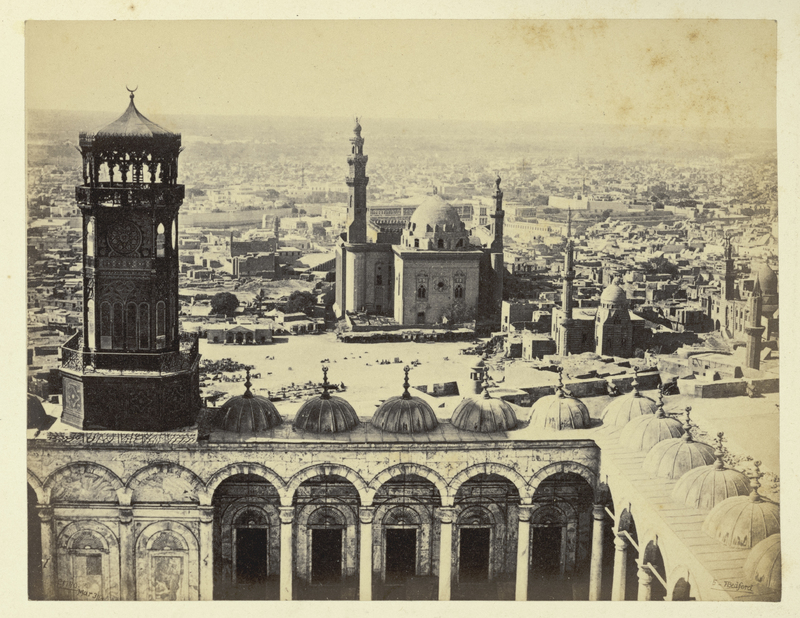
A view of the city of Cairo taken looking northwest from the Mosque of Muhammad Ali Pasha within the Citadel of Saladin towards the Mosque of Sultan Hassan across Salah al-Din Square. The photo features the courtyard (sahn) and clocktower of the Mosque of Muhammad Ali Pasha in the foreground.
A view of the city of Cairo taken looking northwest from the Mosque of Muhammad Ali Pasha within the Citadel of Saladin towards the Mosque of Sultan Hassan across Salah al-Din Square. The photo features the courtyard (sahn) and clocktower of the Mosque of Muhammad Ali Pasha in the foreground.
The partially excavated Sphinx taken looking northwest towards the Great Pyramid (Pyramid of Khufu) with two of the subsidary pyramids visible to the right. Several figures sit on the chest/shoulder of the Sphinx while others look on, one minding a camel.
The partially excavated Sphinx taken looking northwest towards the Great Pyramid (Pyramid of Khufu) with two of the subsidary pyramids visible to the right. Several figures sit on the chest/shoulder of the Sphinx while others look on, one minding a camel.
A view of a pair of colossal statues depicting Amenhotep III which flank the entrance to the ruins of the Mortuary Temple of Amenhotep III at the Theban Necropolis looking north. Inscriptions in Greek and Latin associate these statues with the mythological king Memnon, giving them their common name. A group of people in Egyptian dress are gathered around the base of the statues.
A view of a pair of colossal statues depicting Amenhotep III which flank the entrance to the ruins of the Mortuary Temple of Amenhotep III at the Theban Necropolis looking north. Inscriptions in Greek and Latin associate these statues with the mythological king Memnon, giving them their common name. A group of people in Egyptian dress are gathered around the base of the statues.
The main gateway, the first pylon, of the Temple of Horus and Hathor at Idfū (Edfu), decorated with reliefs depicting Ptolemy XII defeating his enemies in the presence of Horus and Hathor. Through the entryway, the entrance to the hypostyle vestibule can be seen through the open center of the Court of Offerings.
The main gateway, the first pylon, of the Temple of Horus and Hathor at Idfū (Edfu), decorated with reliefs depicting Ptolemy XII defeating his enemies in the presence of Horus and Hathor. Through the entryway, the entrance to the hypostyle vestibule can be seen through the open center of the Court of Offerings.
The colonade of the mammisi (birth house), a small interior temple dedicated to the infant Horus, built alongside the Temple of Isis at Philae. The columns feature varied vegetation designs and Hathor-headed capitals. The spaces in between each column are decorated with carved, decorative reliefs, dating at their earliest to the reign of Ptolemy III, with later additions during the reigns of Ptolemy VIII and Ptolemy XII, and the Roman period.
The colonade of the mammisi (birth house), a small interior temple dedicated to the infant Horus, built alongside the Temple of Isis at Philae. The columns feature varied vegetation designs and Hathor-headed capitals. The spaces in between each column are decorated with carved, decorative reliefs, dating at their earliest to the reign of Ptolemy III, with later additions during the reigns of Ptolemy VIII and Ptolemy XII, and the Roman period.
A view of the first pylon leading into the temple at Luxor (Thebes) looking south. A pair of partially exposed statues depicting Ramesses II flank the entrance. Reliefs are carved into the walls of the pylon depicting Ramesses II in battle. Through the gap in the pylon, the minaret of the Abu Haggag Mosque which was established in 640 in a part of the temple previously converted into a Roman church in 395.
A view of the first pylon leading into the temple at Luxor (Thebes) looking south. A pair of partially exposed statues depicting Ramesses II flank the entrance. Reliefs are carved into the walls of the pylon depicting Ramesses II in battle. Through the gap in the pylon, the minaret of the Abu Haggag Mosque which was established in 640 in a part of the temple previously converted into a Roman church in 395.
 Still image
 Still image
 Still image
 Still image
 Still image
 Still image
 Still image
 Still image
 Still image
 Still image
 Still image
 Still image
 Still image
 Still image