A woodcut depicting a trial with a judge, a woman kneeling (the accused), and a man delivering a (presumably false) witness statement, representing a violation of the Eighth Commandment (in the Lutheran tradition), "Thou shalt not bear false witness against thy neighbor."
A woodcut depicting a trial with a judge, a woman kneeling (the accused), and a man delivering a (presumably false) witness statement, representing a violation of the Eighth Commandment (in the Lutheran tradition), "Thou shalt not bear false witness against thy neighbor."
A woodcut depicting a man murdering two individuals with an axe, thereby representing a violation of the Fifth Commandment (in the Lutheran tradition), "Thou shalt not murder."
A woodcut depicting a man murdering two individuals with an axe, thereby representing a violation of the Fifth Commandment (in the Lutheran tradition), "Thou shalt not murder."
A woodcut depicting a violation of and proper following of the First Commandment (in the Lutheran tradition), "Thou shalt have no other god before me." On the right, a group of worshipers gather around the crucified Christ thereby following the First Commandment. In contrast, on the left, a group worships an "idol" in the form of a horned figure on a pedestal.
A woodcut depicting a violation of and proper following of the First Commandment (in the Lutheran tradition), "Thou shalt have no other god before me." On the right, a group of worshipers gather around the crucified Christ thereby following the First Commandment. In contrast, on the left, a group worships an "idol" in the form of a horned figure on a pedestal.
A woodcut depicting a son and daughter washing the feet of their mother and father respectively, thereby representing the Fourth Commandment (in the Lutheran tradition), "Honor thy father and thy mother."
A woodcut depicting a son and daughter washing the feet of their mother and father respectively, thereby representing the Fourth Commandment (in the Lutheran tradition), "Honor thy father and thy mother."
A pair of woodcuts depicting a man kneeling beside a woman (left) and a two men in a building while a third sits at a table possibly counting money or grain (right), representing the Ninth and Tenth Commandments (in the Lutheran tradition), "Thou shalt not covet thy neighbor's wife, or his slaves, or his animals, or anything of thy neighbor."
A pair of woodcuts depicting a man kneeling beside a woman (left) and a two men in a building while a third sits at a table possibly counting money or grain (right), representing the Ninth and Tenth Commandments (in the Lutheran tradition), "Thou shalt not covet thy neighbor's wife, or his slaves, or his animals, or anything of thy neighbor."
A woodcut depicting a man stealing from another's purse as the victim carries on a conversation, representing a violation of the Seventh Commandment (in the Lutheran tradition), "Thou shalt not steal."
A woodcut depicting a man stealing from another's purse as the victim carries on a conversation, representing a violation of the Seventh Commandment (in the Lutheran tradition), "Thou shalt not steal."
A woodcut depicting a man and woman in bed together, thereby representing a violation of the Sixth Commandment (in the Lutheran tradition), "Thou shalt not commit adultry."
A woodcut depicting a man and woman in bed together, thereby representing a violation of the Sixth Commandment (in the Lutheran tradition), "Thou shalt not commit adultry."
A woodcut depicting Moses receiving the Ten Commandments from God (upper right) as the the people of Israel worship the Golden Calf (lower left). On the right, Mount Sinai and Mount Horeb are labeled, as well as the figures of Moses and Joshua.
A woodcut depicting Moses receiving the Ten Commandments from God (upper right) as the the people of Israel worship the Golden Calf (lower left). On the right, Mount Sinai and Mount Horeb are labeled, as well as the figures of Moses and Joshua.
A woodcut depicting a congregation gathered around a crucified Christ to hear the preaching of the Christian faith, thereby representing the Third Commandment (in the Lutheran tradition), "Remember the sabbath day, to keep it holy."
A woodcut depicting a congregation gathered around a crucified Christ to hear the preaching of the Christian faith, thereby representing the Third Commandment (in the Lutheran tradition), "Remember the sabbath day, to keep it holy."
Karlstadt, Andreas Rudolff-Bodenstein von,1486-1541.
Summary: Only printing of a pamphlet by Karlstadt attacking Johann Eck on issues that emerged during their disputation at Leipzig 1519, in particular the interpretation of scripture and the question of free will and its relation to the grace of God.
Summary: Only printing of a pamphlet by Karlstadt attacking Johann Eck on issues that emerged during their disputation at Leipzig 1519, in particular the interpretation of scripture and the question of free will and its relation to the grace of God.
Summary: This is the third of Luther's three great reformation tracts of 1520. Addressed to Pope Leo X, this work is a discourse on the freedom of the will, turning on the paradox: A Christian is free, lord over all things, subject to no one. A Christian is a bounden servant of all, and subject to everyone. This is the fourth printing of Luther's own German translation.
Summary: This is the third of Luther's three great reformation tracts of 1520. Addressed to Pope Leo X, this work is a discourse on the freedom of the will, turning on the paradox: A Christian is free, lord over all things, subject to no one. A Christian is a bounden servant of all, and subject to everyone. This is the fourth printing of Luther's own German translation.
Summary: When the time stipulated in the Pope's bull of excommunication had elapsed on December 10, 1520, Luther and some of his students burned the bull and copies of the canon law. This pamphlet details their reasons for doing so. This is the third (of three) printings of the first edition.
Summary: When the time stipulated in the Pope's bull of excommunication had elapsed on December 10, 1520, Luther and some of his students burned the bull and copies of the canon law. This pamphlet details their reasons for doing so. This is the third (of three) printings of the first edition.
 Still image
 Still image
 Still image
 Still image
 Still image
 Still image
 Still image
 Still image
 Still image
 Text
Text Text
Text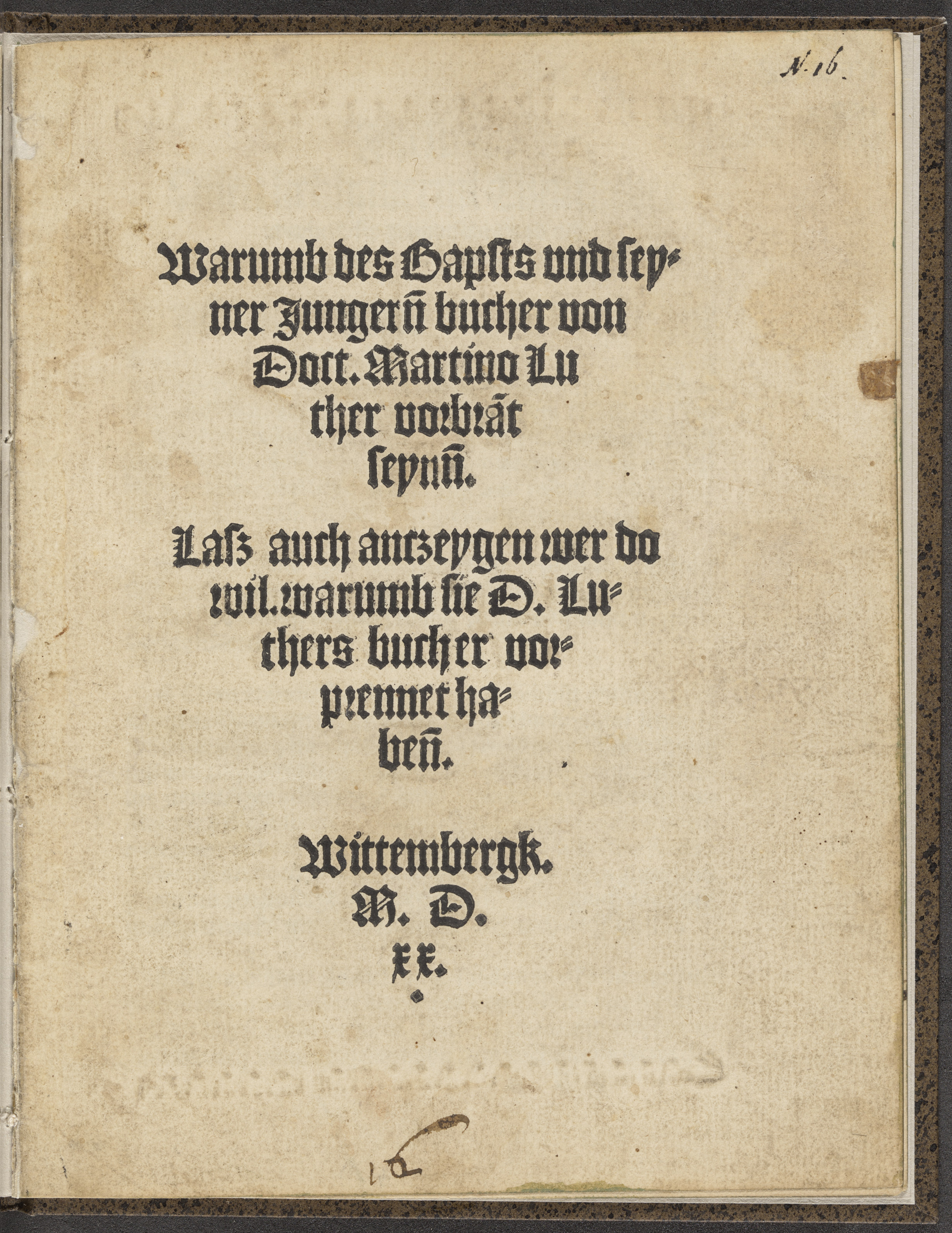 Text
Text