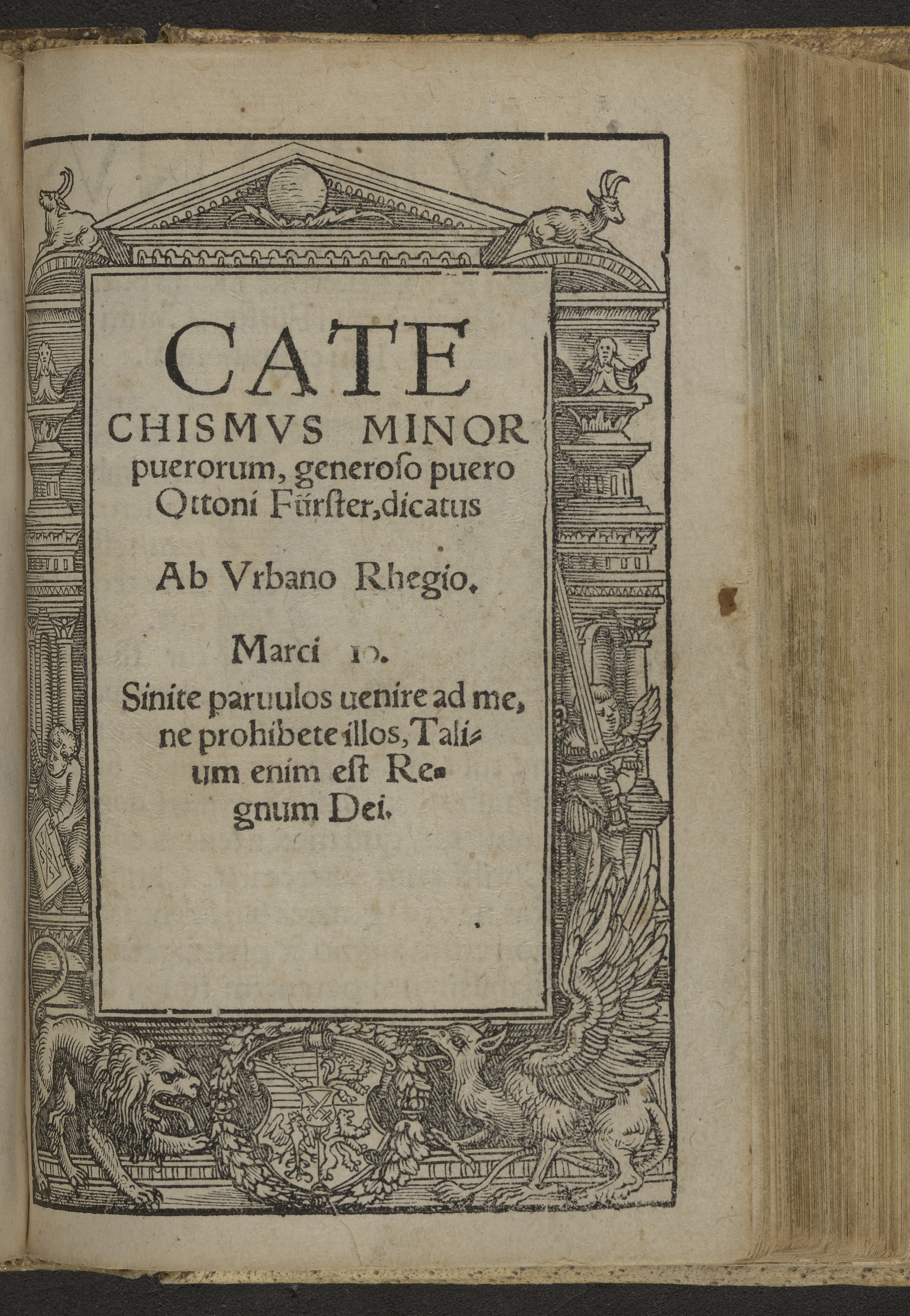
Summary: Rhegius was a Reformer, active throughout Germany promoting Lutheran unity in the Holy Roman Empire. In 1530 at the Diet of Augsburg he was befriended by Ernest I, Duke of Brunswick-Luneburg, under whose patronage he returned to Brunswick where he wrote the present work for Ernest's son, Francis Otto (1530-1559). Like many 16th c. catechisms, Rhegius' is in the form of a dialogue, in this instance between the teacher and the pupil (paedagogus et discipulus).
Summary: Rhegius was a Reformer, active throughout Germany promoting Lutheran unity in the Holy Roman Empire. In 1530 at the Diet of Augsburg he was befriended by Ernest I, Duke of Brunswick-Luneburg, under whose patronage he returned to Brunswick where he wrote the present work for Ernest's son, Francis Otto (1530-1559). Like many 16th c. catechisms, Rhegius' is in the form of a dialogue, in this instance between the teacher and the pupil (paedagogus et discipulus).
Summary: Essay on the historical and Scriptural foundations of clerical marriage, written following the marriage of Wolfgang Reissenbusch, Praeceptor of the Collegial Church of St. Antonius in Lichtenberg.
Summary: Essay on the historical and Scriptural foundations of clerical marriage, written following the marriage of Wolfgang Reissenbusch, Praeceptor of the Collegial Church of St. Antonius in Lichtenberg.
Summary: Melanchthon wrote three versions of his book on dialectic, considering only the third to be truly successful. This is a printing from 1534 of the second (1528) version.
Summary: Melanchthon wrote three versions of his book on dialectic, considering only the third to be truly successful. This is a printing from 1534 of the second (1528) version.
Summary: This disputation centered around the question of whether the German princes could offer armed resistance to the Emperor, and whether they ought to support him in his war against the Turks. Luther came to believe that any support of the Emperor when he was acting in a religious capacity (in league with the pope) was wrong, because the pope was acting contrary to the Gospel. This is the first (and only) printing of this revised version of these theses. It contains 91 theses, whereas the first version (written before the Emperor and princes had come to terms) contained only 70 theses.
Summary: This disputation centered around the question of whether the German princes could offer armed resistance to the Emperor, and whether they ought to support him in his war against the Turks. Luther came to believe that any support of the Emperor when he was acting in a religious capacity (in league with the pope) was wrong, because the pope was acting contrary to the Gospel. This is the first (and only) printing of this revised version of these theses. It contains 91 theses, whereas the first version (written before the Emperor and princes had come to terms) contained only 70 theses.
Summary: Joseph Klug printed the first collection of hymns that Luther prepared specifically for congregational use in Wittenberg in 1529. It followed the church year closely and was revised and reprinted several times. The renowned hymnal printed by Valentin Bapst (Geystlicher Lieder'; Leipzig, 1545) may be seen as a later edition of the Klug hymnal. (Robin Leaver, "Hymnals," in 'The Oxford Encyclopedia of the Reformation' (1996) 2:286-89.)
Summary: Joseph Klug printed the first collection of hymns that Luther prepared specifically for congregational use in Wittenberg in 1529. It followed the church year closely and was revised and reprinted several times. The renowned hymnal printed by Valentin Bapst (Geystlicher Lieder'; Leipzig, 1545) may be seen as a later edition of the Klug hymnal. (Robin Leaver, "Hymnals," in 'The Oxford Encyclopedia of the Reformation' (1996) 2:286-89.)
A woodcut border to Johan Bugenhagen's De coniugio episcoporum et diaconorum : ad venerandum doctorem VVolffgangum Reissenbusch monasterij Lichtembergensis Praeceptorem printed in 1525. The border is composed of one woodcut depicting a group of dancing cherubs (sides and bottom) and a group of cherubs playing instruments (top).
A woodcut border to Johan Bugenhagen's De coniugio episcoporum et diaconorum : ad venerandum doctorem VVolffgangum Reissenbusch monasterij Lichtembergensis Praeceptorem printed in 1525. The border is composed of one woodcut depicting a group of dancing cherubs (sides and bottom) and a group of cherubs playing instruments (top).
Summary: This is the original Latin version of Melanchthon's funeral oration for Luther, preached in Wittenberg, February 22, 1546. The friendship between Luther and Melanchthon was almost legendary, even in their own lifetimes, and this deeply moving oration is an eloquent testimony to the depth of Melanchthon's feelings for his friend of twenty-eight years.
Summary: This is the original Latin version of Melanchthon's funeral oration for Luther, preached in Wittenberg, February 22, 1546. The friendship between Luther and Melanchthon was almost legendary, even in their own lifetimes, and this deeply moving oration is an eloquent testimony to the depth of Melanchthon's feelings for his friend of twenty-eight years.
 Text
Text Text
Text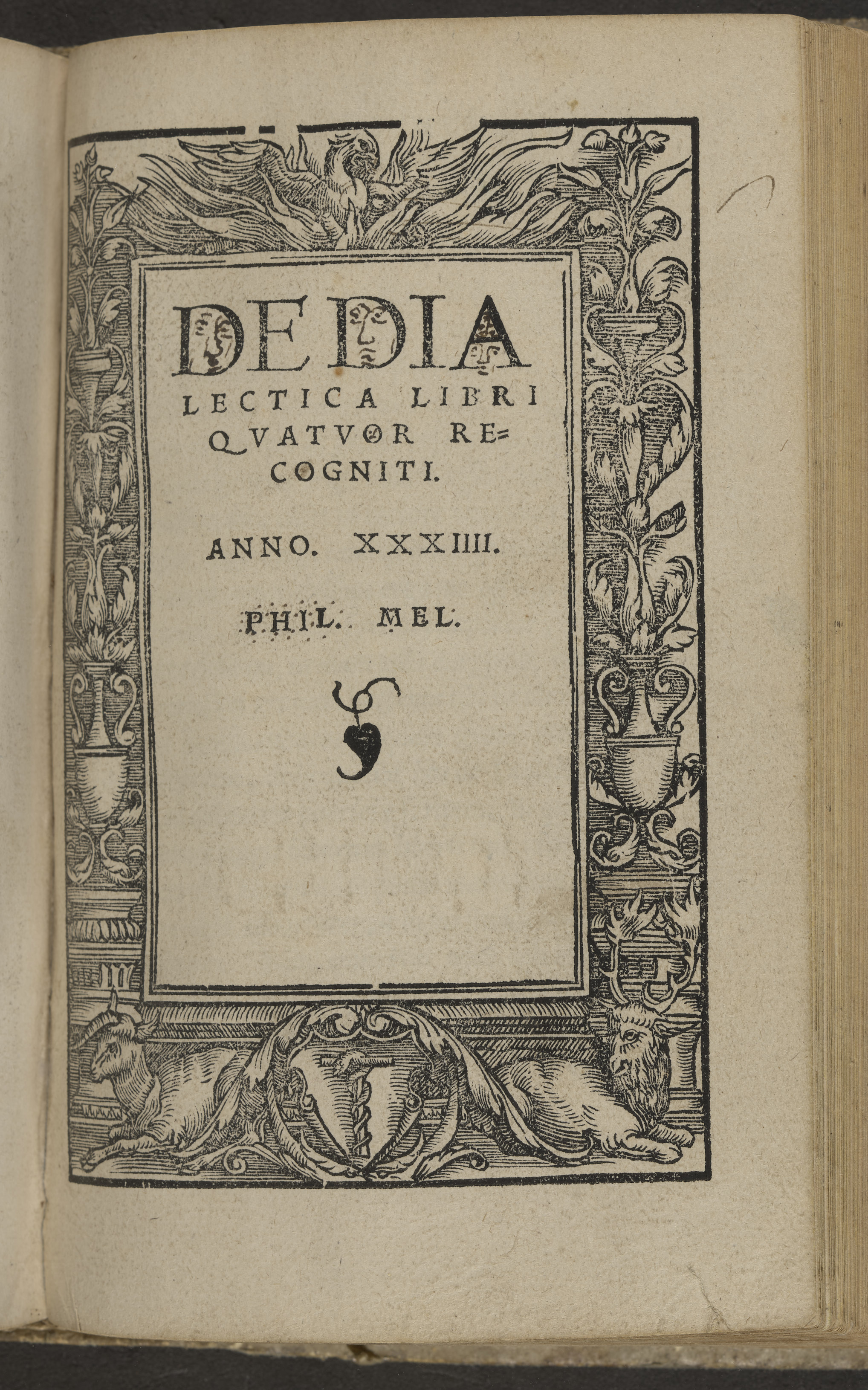 Text
Text Text
Text Text
Text Still image
 Text
Text