Search
190 resources
190 items
Subject
Early works to 1800
-
 Still image
Innocentius VIII Papa Genuensis
Soye, Philippe deAn engraved portrait of Pope Innocent VIII, who sat as pope from 1484-1492. The portrait shows Innocent VIII wearing simple vestments with his coat of arms featured in the upper left corner. The portrait is labeled "INNOCENTIVS. VIII. PAPA. GENVENSIS".An engraved portrait of Pope Innocent VIII, who sat as pope from 1484-1492. The portrait shows Innocent VIII wearing simple vestments with his coat of arms featured in the upper left corner. The portrait is labeled "INNOCENTIVS. VIII. PAPA. GENVENSIS". -
 Still image
Innocentus VII Papa Sulmonensis
Soye, Philippe deAn engraved portrait of Pope Innocent VII, who sat as pope from 1404-1406. The portrait shows Innocent VII wearing a papal miter with his coat of arms featured in the upper left corner. The portrait is labeled "INNOCENTIVS. VII. PAPA. SVLMONENSIS".An engraved portrait of Pope Innocent VII, who sat as pope from 1404-1406. The portrait shows Innocent VII wearing a papal miter with his coat of arms featured in the upper left corner. The portrait is labeled "INNOCENTIVS. VII. PAPA. SVLMONENSIS". -
 Text
TextInstitutiones rhetoricae
Melanchthon, Philipp, 1497-1560Summary: One of three reprints from the year of its first publication, this work by Melanchthon is one of the earliest textbooks for the study of rhetoric as an integral part of an education in the liberal arts.Summary: One of three reprints from the year of its first publication, this work by Melanchthon is one of the earliest textbooks for the study of rhetoric as an integral part of an education in the liberal arts. -
 Still image
Ioannes XXIII Papa Neapolitanus
Soye, Philippe deAn engraved portrait of Antipope John XXIII, who was elected by the Council of Pisa during the Western Schism and held the office from 1410-1415. The portrait shows John XXIII wearing a bishop's miter with his coat of arms featured in the upper left corner. The portrait is labeled "IOANNES. XXIII. PAPA. NEAPOLITANVS".An engraved portrait of Antipope John XXIII, who was elected by the Council of Pisa during the Western Schism and held the office from 1410-1415. The portrait shows John XXIII wearing a bishop's miter with his coat of arms featured in the upper left corner. The portrait is labeled "IOANNES. XXIII. PAPA. NEAPOLITANVS". -
 Text
TextIoannis Revchlin Phorcensis LL. Doc. De arte cabalistica libri tres Leoni X. dicati
Reuchlin, Johann, 1455-1522Summary: Reuchlin had visited Rome in 1490, where he was introduced to Rabbinic literature as well as the cabala.Summary: Reuchlin had visited Rome in 1490, where he was introduced to Rabbinic literature as well as the cabala. -
 Still image
Iulius II Papa Savonensis Ligur
Soye, Philippe deAn engraved portrait of Pope Julius II, who sat as pope from 1503-1513. The portrait shows Julius II sitting in a chair with his coat of arms featured in the upper left corner. The portrait is labeled "IVLIVS. II. PAPA. SAVONENSIS. LIGVR".An engraved portrait of Pope Julius II, who sat as pope from 1503-1513. The portrait shows Julius II sitting in a chair with his coat of arms featured in the upper left corner. The portrait is labeled "IVLIVS. II. PAPA. SAVONENSIS. LIGVR". -
 Still image
Iulius III Papa Arretinus
Soye, Philippe deAn engraved portrait of Pope Julius III, who sat as pope from 1550-1555. The portrait shows Julius III wearing a simple miter and vestments with his coat of arms featured in the upper left corner. The portrait is labeled "IVLIVS. III. PAPA. ARRETINVS".An engraved portrait of Pope Julius III, who sat as pope from 1550-1555. The portrait shows Julius III wearing a simple miter and vestments with his coat of arms featured in the upper left corner. The portrait is labeled "IVLIVS. III. PAPA. ARRETINVS". -
![The digital edition of an introduction to and translation of Johan Tetzel's "Vorlegung gemacht von Bruder Johan Tetzel Prediger Orde[n]s Ketzermeister : wyder eynen vormessen Sermon von tzwentzig irrige[n] Artickeln Bebstlichen Ablas vn[d] Gnade belange[n]de allen cristglaubige[n] Mensche[n] tzuwissen von Notten," originally published by Melchior Lotter in Leipzig, Germany, in 1518, including facsimile reproductions. The original text is the first attack on Luther's "Sermon von dem Ablass und Gnade" (Sermon on indulgences and grace) by Johan Tetzel, a refutation of Luther's position.](https://digital.pitts.emory.edu/files/large/P_CSTA005_BD002_300000422352/P_CSTA005_BD002_2012_300000422352_KRAMER.jpg) Text
TextJohann Tetzel's Rebuttal against Luther's Sermon on Indulgences and Grace
Tetzel, Johann, 1460-1519The digital edition of an introduction to and translation of Johan Tetzel's "Vorlegung gemacht von Bruder Johan Tetzel Prediger Orde[n]s Ketzermeister : wyder eynen vormessen Sermon von tzwentzig irrige[n] Artickeln Bebstlichen Ablas vn[d] Gnade belange[n]de allen cristglaubige[n] Mensche[n] tzuwissen von Notten," originally published by Melchior Lotter in Leipzig, Germany, in 1518, including facsimile reproductions.The digital edition of an introduction to and translation of Johan Tetzel's "Vorlegung gemacht von Bruder Johan Tetzel Prediger Orde[n]s Ketzermeister : wyder eynen vormessen Sermon von tzwentzig irrige[n] Artickeln Bebstlichen Ablas vn[d] Gnade belange[n]de allen cristglaubige[n] Mensche[n] tzuwissen von Notten," originally published by Melchior Lotter in Leipzig, Germany, in 1518, including facsimile reproductions. -
 Still image
Judas receives 30 pieces of silver for his betrayal ot Christ
Graf, Urs, approximately 1485-approximately 1527A woodcut by Urs Graf depicting Judas receiving thirty pieces of silver for his betrayal of Christ. The image was taken from a 1506 harmony of the Gospel texts of the Passion, edited by Matthias Ringmann, translated by Geiler von Keysersberg and printed by Johann Knobloch in Strasbourg.||This woodcut was acquired through the generous subvention of Mrs. Carol A. Jeschke, October 2020.A woodcut by Urs Graf depicting Judas receiving thirty pieces of silver for his betrayal of Christ. The image was taken from a 1506 harmony of the Gospel texts of the Passion, edited by Matthias Ringmann, translated by Geiler von Keysersberg and printed by Johann Knobloch in Strasbourg.||This woodcut was acquired through the generous subvention of Mrs. Carol A. Jeschke, October 2020. -
 Text
TextKirchen Postilla, das ist, Auslegung der Episteln vnd Euangelien an Sontagen vnd furnemesten Festen
Luther, Martin, 1483-1546Imprint: Name of printer from colophon to first pt. Colophon, "Gedruckt zu Wittemberg durch Peter Seitzen Erben."Imprint: Name of printer from colophon to first pt. Colophon, "Gedruckt zu Wittemberg durch Peter Seitzen Erben." -
 text
textKirchen Postilla, das ist, Auslegung der Euangelien an den furnemesten Festen der Heiligen
Luther, Martin, 1483-1546Imprint: Separate t.p. for v. 2.Imprint: Separate t.p. for v. 2. -
 Text
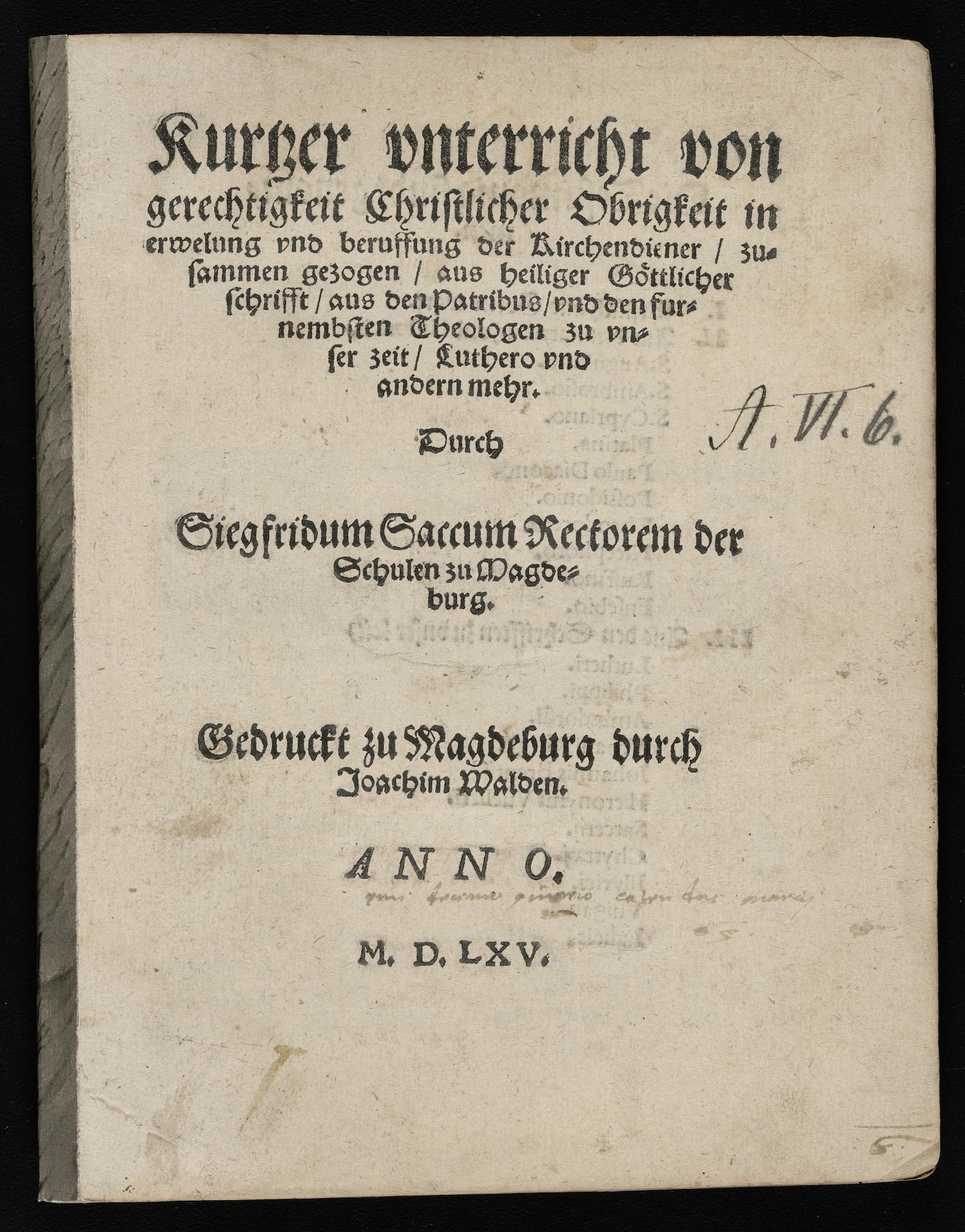
TextKurtzer vnterricht von gerechtigkeit Christlicher Obrigkeit in erwelung vnd beruffung der Kirchendiener : zusammen gezogen, aus heiliger Göttlicher schrifft, aus den Patribus, vnd den furnembsten Theologen zu vnser zeit, Luthero vnd andern mehr
Saccus, Siegfried, 1527-1596Summary: Formal opinion of Siegfried Saccus, schoolmaster at Magdeburg and later its first Lutheran cathedral preacher, concerning the right of the city government to appoint clergy. As a follower of the strict Lutheran Nicholas von Amsdorff, he steered a careful path between the views of the local Catholic hierarchy on the one hand, and those of the Münster Anabaptists, on the other. Although Magdeburg became a refuge of the strict Lutheran party following the Schmalkald War, the city council was late in making an official decision for or against the Reformation.Summary: Formal opinion of Siegfried Saccus, schoolmaster at Magdeburg and later its first Lutheran cathedral preacher, concerning the right of the city government to appoint clergy. As a follower of the strict Lutheran Nicholas von Amsdorff, he steered a careful path between the views of the local Catholic hierarchy on the one hand, and those of the Münster Anabaptists, on the other. Although Magdeburg became a refuge of the strict Lutheran party following the Schmalkald War, the city council was late in making an official decision for or against the Reformation. -
 Text
TextLa Biblia Vulgata Latina
Additional details: From the collection of C.J. Stewart, bookseller (lot 537 of Sotheby, Wilkinson and Hodge, Catalogue of the First Portion of the Extensive and Valuable Stock of Theological and Miscellaneous Books of Mr. C. J. Stewart, June 1882)Additional details: From the collection of C.J. Stewart, bookseller (lot 537 of Sotheby, Wilkinson and Hodge, Catalogue of the First Portion of the Extensive and Valuable Stock of Theological and Miscellaneous Books of Mr. C. J. Stewart, June 1882) -
 Still image
Leo X Papa Florentinus
Soye, Philippe deAn engraved portrait of Pope Leo X, who sat as pope from 1513-1521. The portrait shows Leo X wearing a simple miter with his coat of arms featured in the upper right corner. The portrait is labeled "LEO. X. PAPA. FLORENTINVS".An engraved portrait of Pope Leo X, who sat as pope from 1513-1521. The portrait shows Leo X wearing a simple miter with his coat of arms featured in the upper right corner. The portrait is labeled "LEO. X. PAPA. FLORENTINVS". -
 Text
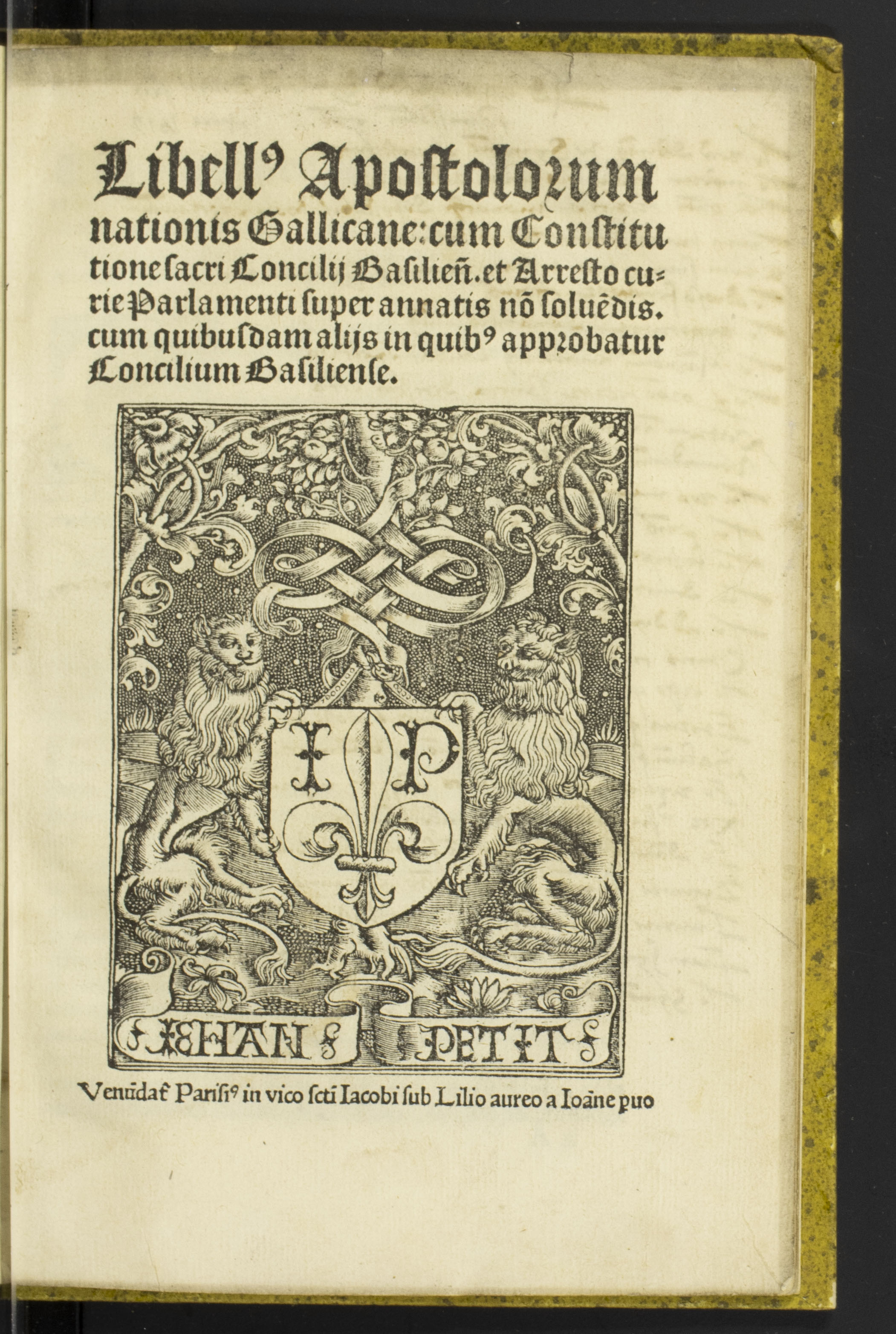
TextLibell[us] Apostolorum nationis Gallicane: cum Constitutione Sacri Concilij Basilien[sis] et arresto curie parlamenti supper annatis no[n] solve[n]dis, cum quibusdam alijs in quib[us] approbatur Concilium Basiliense.
Summary: The Second Council of Pisa (1511-1512), also known as the Conciliabulum of Pisa, was a French initiative to limit the power of Pope Julius II and to strengthen the power of the conciliarists. Pope Julius II condemned the meeting and in response convoked the Fifth Lateran Council, which secured papal authority over conciliarism. This is the first edition of a record of the council published by Jean Petit for a French readership.Summary: The Second Council of Pisa (1511-1512), also known as the Conciliabulum of Pisa, was a French initiative to limit the power of Pope Julius II and to strengthen the power of the conciliarists. Pope Julius II condemned the meeting and in response convoked the Fifth Lateran Council, which secured papal authority over conciliarism. This is the first edition of a record of the council published by Jean Petit for a French readership. -
 Text
TextLiber
Sacro Bosco, Joannes de, active 1230Summary: J. de Sacro Bosco was an English mathematician who taught in Paris after 1230. This work on astronomy was only the second by a Western scholar based on Arabic researches to be printed (1472). The book was frequently reprinted as here with a commentary by a famous modern scholar, in this case Melanchthon. Melanchthon's interest in astrology is well known, so it was natural for him to edit this material.Summary: J. de Sacro Bosco was an English mathematician who taught in Paris after 1230. This work on astronomy was only the second by a Western scholar based on Arabic researches to be printed (1472). The book was frequently reprinted as here with a commentary by a famous modern scholar, in this case Melanchthon. Melanchthon's interest in astrology is well known, so it was natural for him to edit this material. -
 Text
TextLoci communes seu hypotyposes theologicae
Melanchthon, Philipp, 1497-1560Summary: A 1525 printing of this most famous of all Melanchthon's theological works, first published in Wittenberg in 1521. The Loci Communes represent the most comrehensive systematic theology of the Lutheran reformation. Melanchthon continued to revise this work throughout his life.Summary: A 1525 printing of this most famous of all Melanchthon's theological works, first published in Wittenberg in 1521. The Loci Communes represent the most comrehensive systematic theology of the Lutheran reformation. Melanchthon continued to revise this work throughout his life. -
 Text
TextMaggots: or, Poems on several subjects, never before handled
Wesley, Samuel,1662-1735Signatures: A-G¹², H¹¹ (A₁, frontispiece; A₉, verso, advertisements)Signatures: A-G¹², H¹¹ (A₁, frontispiece; A₉, verso, advertisements) -
 Text
TextMagnencij Rabani Mauri de laudi[bus] Sancte Crucis opus. : erudicione versu posa[que] mirificum
Rabanus Maurus, Archbishop of Mainz, 784?-856Summary: De laudibus sanctae crucis (On the praise of the Holy Cross) is a collection of poems and figures, including geometric shapes, letters, drawings and even complex miniatures produced in the early 9th century in the scriptorium of the Abbey at Fulda under the direction of Hrabanus Maurus, archbishop of Mainz, who also provided the commentary found in the work. The book is an important testimony to Carolingian book art.Summary: De laudibus sanctae crucis (On the praise of the Holy Cross) is a collection of poems and figures, including geometric shapes, letters, drawings and even complex miniatures produced in the early 9th century in the scriptorium of the Abbey at Fulda under the direction of Hrabanus Maurus, archbishop of Mainz, who also provided the commentary found in the work. The book is an important testimony to Carolingian book art. -
 Still image
Marcellus II Papa Politianensis Tuscus
Soye, Philippe deAn engraved portrait of Pope Marcellus II, who sat as pope in 1555. The portrait shows Marcellus II wearing elaborate vestments with his coat of arms featured in the upper left corner. The portrait is labeled "MARCELLVS. II. PAPA. POLITIANENSIS. TVSCVS".An engraved portrait of Pope Marcellus II, who sat as pope in 1555. The portrait shows Marcellus II wearing elaborate vestments with his coat of arms featured in the upper left corner. The portrait is labeled "MARCELLVS. II. PAPA. POLITIANENSIS. TVSCVS". -
 Text
TextMargarita theologica, continens praecipuos locos doctrinae Christianae, per quaestiones breuiter & ordine explicatos : Omnibus pastoribus, verbi praeconibus, & ecclesiae ministris summè utilis & necessaria
Spangenberg, JohannSummary: Popular doctrinal theology by the Lutheran reformer Johann Spangenberg, based on Melanchthon's Loci Communes, and written for use by pastors and ministers. The work was first published in 1540 and was re-issued and translated numerous times.Summary: Popular doctrinal theology by the Lutheran reformer Johann Spangenberg, based on Melanchthon's Loci Communes, and written for use by pastors and ministers. The work was first published in 1540 and was re-issued and translated numerous times.