Albert, of Brandenburg, Archbishop and Elector of Mainz, Cardinal, 1490-1545
Indulgences were issued to defray the cost of building the basilica of St. Peter in Rome. Their distribution was often linked to the sacrament of penance, as believers were granted spiritual merits in exchange for financial donations. This particular indulgence, believed to be the only specimen of its kind thus far recovered, was issued specifically to clergy, granting them liturgical benefits in exchange for their contributions.
Indulgences were issued to defray the cost of building the basilica of St. Peter in Rome. Their distribution was often linked to the sacrament of penance, as believers were granted spiritual merits in exchange for financial donations. This particular indulgence, believed to be the only specimen of its kind thus far recovered, was issued specifically to clergy, granting them liturgical benefits in exchange for their contributions.
Single sheet woodcut depicting Pope Leo X on a throne that is about to topple. Behind him are priests and monks and below them a group of Jesuits, who are trying to support the toppling throne. Leo's key, the symbol of the Petrine office is crumbling in the pope's hands. Facing Leo is Martin Luther holding an open Bible. Below him is a group of reformers led by Philipp Melanchthon, each holding a book (Bible). In the center below Leo is Friedrich Staphylus depicted as Judas Iscariot. Staphylus was a student of Philipp Melanchthon's, who rejoined the Catholic Church in 1553.
Single sheet woodcut depicting Pope Leo X on a throne that is about to topple. Behind him are priests and monks and below them a group of Jesuits, who are trying to support the toppling throne. Leo's key, the symbol of the Petrine office is crumbling in the pope's hands. Facing Leo is Martin Luther holding an open Bible. Below him is a group of reformers led by Philipp Melanchthon, each holding a book (Bible). In the center below Leo is Friedrich Staphylus depicted as Judas Iscariot. Staphylus was a student of Philipp Melanchthon's, who rejoined the Catholic Church in 1553.
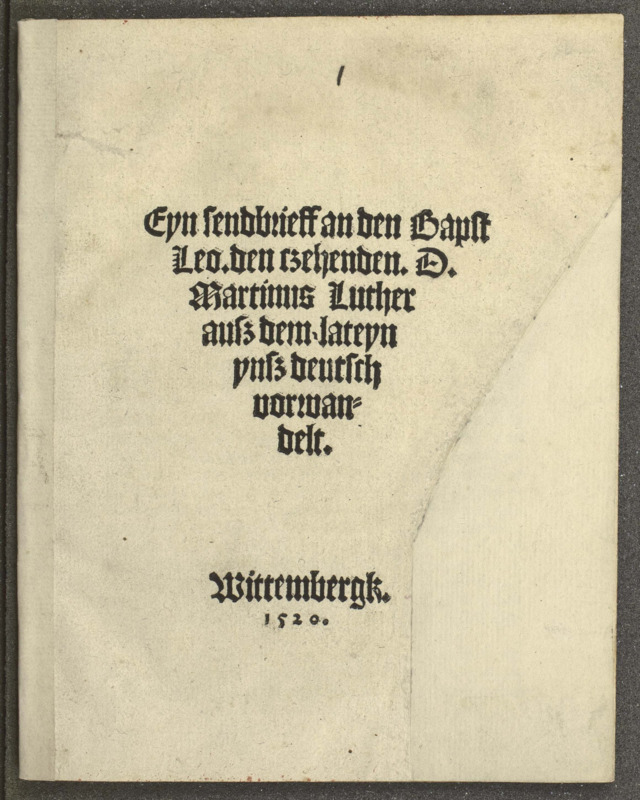
Summary: A letter by Luther to Pope Leo X. Leo had issued his famous bull 'Exsurge Domine' on June 15 1520, demanding that Luther recant his teachings of face excommunication. Luther responded with this letter in September, seeking to explain his position, calling for the church to reform, while emphasizing that his critiques have been directed against abuses within the church, not against the person or office of the pope.
Summary: A letter by Luther to Pope Leo X. Leo had issued his famous bull 'Exsurge Domine' on June 15 1520, demanding that Luther recant his teachings of face excommunication. Luther responded with this letter in September, seeking to explain his position, calling for the church to reform, while emphasizing that his critiques have been directed against abuses within the church, not against the person or office of the pope.
An engraved portrait of Pope Leo X, who sat as pope from 1513-1521. The portrait shows Leo X wearing a simple miter with his coat of arms featured in the upper right corner. The portrait is labeled "LEO. X. PAPA. FLORENTINVS".
An engraved portrait of Pope Leo X, who sat as pope from 1513-1521. The portrait shows Leo X wearing a simple miter with his coat of arms featured in the upper right corner. The portrait is labeled "LEO. X. PAPA. FLORENTINVS".
A woodcut depicting Martin Luther, in the garb of an Augustinian monk, debating a gathering of Catholic clergy members, including the Pope, a cardinal, a bishop, and a monk. This woodcut appears on the title page of a popular anonymous account of Luther's debate before the Diet of Worms in 1521.
A woodcut depicting Martin Luther, in the garb of an Augustinian monk, debating a gathering of Catholic clergy members, including the Pope, a cardinal, a bishop, and a monk. This woodcut appears on the title page of a popular anonymous account of Luther's debate before the Diet of Worms in 1521.
The title page of a printed version of the papal bull against Martin Luther featuring the papal arms of Leo X which incorporates the Medici family crest.
The title page of a printed version of the papal bull against Martin Luther featuring the papal arms of Leo X which incorporates the Medici family crest.
A woodcut of Pope Leo X's coat of arms, appearing on the title page of the official papal bull excommunicating Martin Luther. The coat of arms features the crossed keys to the kingdom of Heaven and the Papal crown, the traditional symbols of the Papacy, and the coat of arms of the Medici family, to which Pope Leo X belonged.
A woodcut of Pope Leo X's coat of arms, appearing on the title page of the official papal bull excommunicating Martin Luther. The coat of arms features the crossed keys to the kingdom of Heaven and the Papal crown, the traditional symbols of the Papacy, and the coat of arms of the Medici family, to which Pope Leo X belonged.
Summary: This is the third of Luther's three great reformation tracts of 1520. Addressed to Pope Leo X, this work is a discourse on the freedom of the will, turning on the paradox: A Christian is free, lord over all things, subject to no one. A Christian is a bounden servant of all, and subject to everyone. This is the fourth printing of Luther's own German translation.
Summary: This is the third of Luther's three great reformation tracts of 1520. Addressed to Pope Leo X, this work is a discourse on the freedom of the will, turning on the paradox: A Christian is free, lord over all things, subject to no one. A Christian is a bounden servant of all, and subject to everyone. This is the fourth printing of Luther's own German translation.
 Text
Text Still image
 Text
Text Still image
 Still image
 Still image
 Still image
 Text
Text