A woodcut by Urs Graf depicting Christ in the garden of Gethsemane. The image was taken from a 1506 harmony of the Gospel texts of the Passion, edited by Matthias Ringmann, translated by Geiler von Keysersberg and printed by Johann Knobloch in Strasbourg.
A woodcut by Urs Graf depicting Christ in the garden of Gethsemane. The image was taken from a 1506 harmony of the Gospel texts of the Passion, edited by Matthias Ringmann, translated by Geiler von Keysersberg and printed by Johann Knobloch in Strasbourg.
A woodcut by Urs Graf depicting Christ carrying the Cross. The image was taken from a 1506 harmony of the Gospel texts of the Passion, edited by Matthias Ringmann, translated by Geiler von Keysersberg and printed by Johann Knobloch in Strasbourg.
A woodcut by Urs Graf depicting Christ carrying the Cross. The image was taken from a 1506 harmony of the Gospel texts of the Passion, edited by Matthias Ringmann, translated by Geiler von Keysersberg and printed by Johann Knobloch in Strasbourg.
A woodcut by Urs Graf depiicting Christ being scourged and crowned with thorns. The image was taken from a 1506 harmony of the Gospel texts of the Passion, edited by Matthias Ringmann, translated by Geiler von Keysersberg and printed by Johann Knobloch in Strasbourg.
A woodcut by Urs Graf depiicting Christ being scourged and crowned with thorns. The image was taken from a 1506 harmony of the Gospel texts of the Passion, edited by Matthias Ringmann, translated by Geiler von Keysersberg and printed by Johann Knobloch in Strasbourg.
A woodcut containing a portrait of Elector Joachim II of Brandenburg kneeling before a crucifix. This woodcut likekly originated as a broadsheet since there are no signs of letterpress on the back. The same woodcut appeared in Grabriel Schnellboltz' Wahrhafftige Bildnisse etlicher Fuersten (Wittenberg, 1562) and the Augspurgische Confession (Frankfurt an der Oder:, Eichorn, 1572).
A woodcut containing a portrait of Elector Joachim II of Brandenburg kneeling before a crucifix. This woodcut likekly originated as a broadsheet since there are no signs of letterpress on the back. The same woodcut appeared in Grabriel Schnellboltz' Wahrhafftige Bildnisse etlicher Fuersten (Wittenberg, 1562) and the Augspurgische Confession (Frankfurt an der Oder:, Eichorn, 1572).
A woodcut containing a portrait of John Frederick (Johann Friedrich) reading a book and praying before a crucifix. Frederick was a leader of the Schmalkaldic League and fought for Luther's cause against the Imperial troops. The league was defeated in the Battle of Muehlberg in April of 1547. Frederick was wounded by a slash across his left cheek, captured, condemned to death, but ultimately pardoned and reinstated as duke in Weimar. After 1547, however, the Electoral power had fallen to the rivalling Albertininian line of the dynasty residing in Dresden.
A woodcut containing a portrait of John Frederick (Johann Friedrich) reading a book and praying before a crucifix. Frederick was a leader of the Schmalkaldic League and fought for Luther's cause against the Imperial troops. The league was defeated in the Battle of Muehlberg in April of 1547. Frederick was wounded by a slash across his left cheek, captured, condemned to death, but ultimately pardoned and reinstated as duke in Weimar. After 1547, however, the Electoral power had fallen to the rivalling Albertininian line of the dynasty residing in Dresden.
Summary: First edition of a short tract written by Luther at Wartburg castle and addressed to the bishop and religious leaders in Wittenberg. In 139 brief statements, Luther warns that religious vows and monastic life do not by themselves bring about the forgiveness of sins.
Summary: First edition of a short tract written by Luther at Wartburg castle and addressed to the bishop and religious leaders in Wittenberg. In 139 brief statements, Luther warns that religious vows and monastic life do not by themselves bring about the forgiveness of sins.
A woodcut by Urs Graf depicting Judas receiving thirty pieces of silver for his betrayal of Christ. The image was taken from a 1506 harmony of the Gospel texts of the Passion, edited by Matthias Ringmann, translated by Geiler von Keysersberg and printed by Johann Knobloch in Strasbourg.||This woodcut was acquired through the generous subvention of Mrs. Carol A. Jeschke, October 2020.
A woodcut by Urs Graf depicting Judas receiving thirty pieces of silver for his betrayal of Christ. The image was taken from a 1506 harmony of the Gospel texts of the Passion, edited by Matthias Ringmann, translated by Geiler von Keysersberg and printed by Johann Knobloch in Strasbourg.||This woodcut was acquired through the generous subvention of Mrs. Carol A. Jeschke, October 2020.
Schäufelein, Hans, approximately 1480-approximately 1539
A colorized woodcut by Hans Schäufelein taken from a 16th century devotional work, "Speculum passionis Domini Nostri Ihesu Christi," by the Nuremberg doctor and publisher Ulrich Pinder (1507 PIND), which depicts the scourging of Christ.
A colorized woodcut by Hans Schäufelein taken from a 16th century devotional work, "Speculum passionis Domini Nostri Ihesu Christi," by the Nuremberg doctor and publisher Ulrich Pinder (1507 PIND), which depicts the scourging of Christ.
Satirical wood-engraving from the workshop of Lucas Cranach, depicting the pope, with ears of an ass, sitting on a wooden throne at the mouth of hell, on the title page.
Satirical wood-engraving from the workshop of Lucas Cranach, depicting the pope, with ears of an ass, sitting on a wooden throne at the mouth of hell, on the title page.
A woodcut containing a view of Wittenberg in Saxony-Anhalt. The woodcut was excerpted from from the German edition of Sebastian Münster's Cosmographia (Basel: Heinrich Petri, 1572). The reverse side depicts a jousting battle scene.
A woodcut containing a view of Wittenberg in Saxony-Anhalt. The woodcut was excerpted from from the German edition of Sebastian Münster's Cosmographia (Basel: Heinrich Petri, 1572). The reverse side depicts a jousting battle scene.
 Still image
 Still image
 Still image
 Still image
![A woodcut containing a portrait of John Frederick (Johann Friedrich) reading a book and praying before a crucifix. Frederick was a leader of the Schmalkaldic League and fought for Luther's cause against the Imperial troops. The league was defeated in the Battle of Muehlberg in April of 1547. Frederick was wounded by a slash across his left cheek, captured, condemned to death, but ultimately pardoned and reinstated as duke in Weimar. After 1547, however, the Electoral power had fallen to the rivalling Albertininian line of the dynasty residing in Dresden. The print depicts Frederick with the scar on his cheek. The book contains the words, "Hilf Got[t]" (help me God). Cranach marked the woodcut plate with his device and dated it to 1552, but the broadsheet in its current manifestation was printed in 1557.](https://digital.pitts.emory.edu/files/large/P_MSS400_B001_F005_I001/P_MSS400_B001_F005_I001_P001_PROD.jpg) Still image
Still image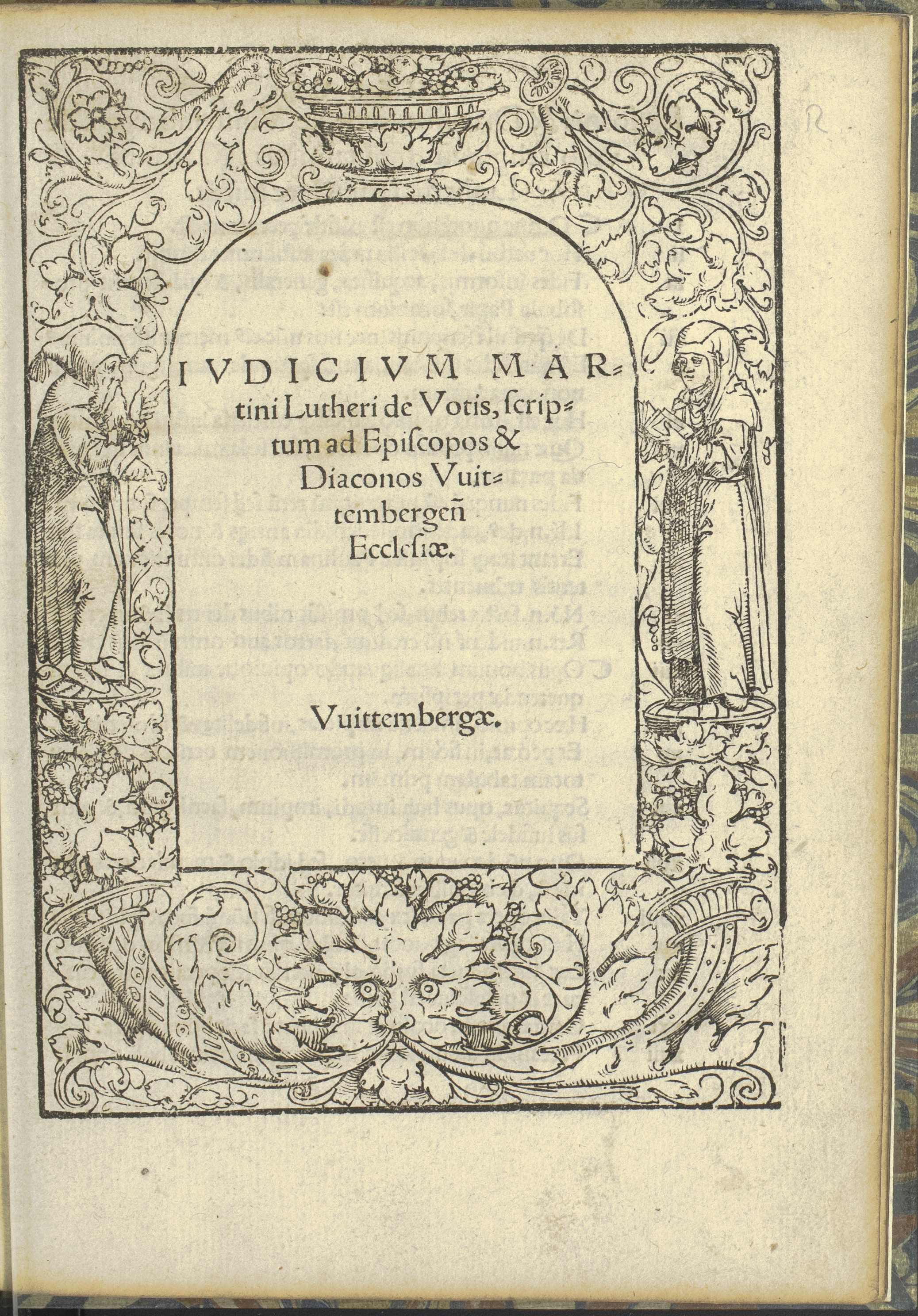 Text
Text Still image
 Still image
 Still image
 Still image