Search
16 resources
16 items
Date
1518
-
 Text
TextActa f. Martini Luther august. apud D. legatu[m] apostolicu[m] Augustae recognitum
Luther, Martin, 1483-1546Summary: In 1518 Luther was summoned to Rome. He appealed to Frederick, Elector of Saxony who was attending the imperial Diet in Augsburg. Frederick negotiated with the Papal Legate Cajetan who finally agreed to a hearing in Augsburg. Luther went there with an imperial escort and then returned safely to Wittenberg. This is Luther's report of what took place in Augsburg. It is the fifth printing of the "Acta Augustana."Summary: In 1518 Luther was summoned to Rome. He appealed to Frederick, Elector of Saxony who was attending the imperial Diet in Augsburg. Frederick negotiated with the Papal Legate Cajetan who finally agreed to a hearing in Augsburg. Luther went there with an imperial escort and then returned safely to Wittenberg. This is Luther's report of what took place in Augsburg. It is the fifth printing of the "Acta Augustana." -
 Text
TextAd Dialoguz [i.e. Dialogum] Syluestri Prieratis M[a]g[ist]ri Palatii de potestate Pape Respo[n]sio
Luther, Martin, 1483-1546Summary: When Luther received S. Mazzolini's Dialogue on the 95 Theses, he put it into print at once to show just how weak a piece Mazzolini had written. He followed it up with the present work which includes Mazzolini's text and Luther's reply to it. Even the Pope is said to have been embarrassed by Mazzolini's poor performance in this work. The Dominicans are reported to have bought up the first edition, presumably to prevent its further circulation.Summary: When Luther received S. Mazzolini's Dialogue on the 95 Theses, he put it into print at once to show just how weak a piece Mazzolini had written. He followed it up with the present work which includes Mazzolini's text and Luther's reply to it. Even the Pope is said to have been embarrassed by Mazzolini's poor performance in this work. The Dominicans are reported to have bought up the first edition, presumably to prevent its further circulation. -
 Text
TextAin säligs newes jar. : Von der lieb gottes
Staupitz, Johann von, -1524Summary: This is possibly the first printing of J. von Staupitz's tract on the love of God. Written as a New Year's greeting for some of Staupitz's friends, the work was highly valued by Luther and became a spiritual classic, frequently reprinted and re-edited.Summary: This is possibly the first printing of J. von Staupitz's tract on the love of God. Written as a New Year's greeting for some of Staupitz's friends, the work was highly valued by Luther and became a spiritual classic, frequently reprinted and re-edited. -
 Text
TextAusslegung des hundert vnd neundte[n] psalme[n], Dixit d[omin]us domi[n]o meo
Luther, Martin, 1483-1546Summary: The third of three printings of an exposition of Psalm 109 by Luther to be issued in 1518, interpreting the Psalm of the Kingdom and Priesthood of Jesus Christ.Summary: The third of three printings of an exposition of Psalm 109 by Luther to be issued in 1518, interpreting the Psalm of the Kingdom and Priesthood of Jesus Christ. -
 Still image
Christ's Resurrection
A woodcut depicting the resurrection of Jesus Christ. Christ is depicted at the top center of the image, surrounded by cherubim. At the bottom right is Christ's open and empty tomb. On the bottom left, a group of cherubim are burying the body of a man, perhaps representing Christ's transformation from a physical body to a spiritual one.A woodcut depicting the resurrection of Jesus Christ. Christ is depicted at the top center of the image, surrounded by cherubim. At the bottom right is Christ's open and empty tomb. On the bottom left, a group of cherubim are burying the body of a man, perhaps representing Christ's transformation from a physical body to a spiritual one. -
 Text
TextDecem praecepta Witte[n]berge[n]si praedicata populo
Luther, Martin, 1483-1546Summary: The sermons on which this commentary on the Ten Commandments is based were delivered in Wittenberg in 1516-1517. This is the first work of Luther's to be translated into a modern European language. This is the first printing of the work.Summary: The sermons on which this commentary on the Ten Commandments is based were delivered in Wittenberg in 1516-1517. This is the first work of Luther's to be translated into a modern European language. This is the first printing of the work. -
 Text
TextEin Sermon oder Predig von dem ablasz vnd gnade
Luther, Martin, 1483-1546Summary: An early sermon by Luther on Indulgences and Grace. First appearing in 1518, this work went through fully fourteen printings in that year alone.Summary: An early sermon by Luther on Indulgences and Grace. First appearing in 1518, this work went through fully fourteen printings in that year alone. -
 Text
TextEyn deutsch Theologia : das ist Eyn edles Buchleyn, von rechtem vorstand, was Adam vnd Christus sey, vnd wie Adam yn vns sterben, vnd Christus ersteen sall
FranckforterSummary: First printing of Luther's second publication of the "Theologia Deutsch", or "German Theology" of an unknown disciple of the Medieval German mystic, Johannes Tauler (ca. 1300-1361). Luther says in his preface that he has learned more from it than from any other book, the Bible and the works of St. Augustine, excepted, "as to what God, Christ, the human being, and all things are".Summary: First printing of Luther's second publication of the "Theologia Deutsch", or "German Theology" of an unknown disciple of the Medieval German mystic, Johannes Tauler (ca. 1300-1361). Luther says in his preface that he has learned more from it than from any other book, the Bible and the works of St. Augustine, excepted, "as to what God, Christ, the human being, and all things are". -
 Still image
Historiated title page of Luther's Ad dialogum Syluestri Prieratis Magistri Palatii de potestate Pape Responsio
A woodcut border on the title page of Luther's Ad dialogum Syluestri Prieratis Magistri Palatii de potestate Pape Responsio printed in 1518. Along the bottom margin, the border features three portraits, one of the Virgin Mary holding Jesus, one of a saint holding a spear and a book (possibly Saint Longinus), and one of a pope. Along both side margins are a series of decorative elements, including a cherub, two men chasing each other around a column, a pair of cats, a goose, and a trio of women.A woodcut border on the title page of Luther's Ad dialogum Syluestri Prieratis Magistri Palatii de potestate Pape Responsio printed in 1518. Along the bottom margin, the border features three portraits, one of the Virgin Mary holding Jesus, one of a saint holding a spear and a book (possibly Saint Longinus), and one of a pope. Along both side margins are a series of decorative elements, including a cherub, two men chasing each other around a column, a pair of cats, a goose, and a trio of women. -
 Still image
Historiated title page to Luther's exposition of Psalm 109
A woodcut border on the title page of Luther's exposition of Psalm 109 printed in 1518. Along the bottom margin, the border features three portraits, one of the Virgin Mary holding Jesus, one of a saint holding a spear and a book (possibly Saint Longinus), and one of a pope. Along both side margins are a series of decorative elements, including a cherub, two men chasing each other around a column, a pair of cats, a goose, and a trio of women. At the top of the page, there is a scene of two women with fish tails for legs (possibly a reference to Scylla) flanking a running boy and bird.A woodcut border on the title page of Luther's exposition of Psalm 109 printed in 1518. Along the bottom margin, the border features three portraits, one of the Virgin Mary holding Jesus, one of a saint holding a spear and a book (possibly Saint Longinus), and one of a pope. Along both side margins are a series of decorative elements, including a cherub, two men chasing each other around a column, a pair of cats, a goose, and a trio of women. At the top of the page, there is a scene of two women with fish tails for legs (possibly a reference to Scylla) flanking a running boy and bird. -
 Still image
Historiated title page to Silvestro da Prierio Mazzolini's refutation of Luther's 95 Theses
A woodcut border on the title page of Silvestro da Prierio Mazzolini's refutation of Luther's 95 Theses printed in 1518. Along the bottom margin, the border features three portraits, one of the Virgin Mary holding Jesus, one of a saint holding a spear and a book (possibly Saint Longinus), and one of a pope. Along both side margins are a series of decorative elements, including a cherub, two men chasing each other around a column, a pair of cats, a goose, and a trio of women.A woodcut border on the title page of Silvestro da Prierio Mazzolini's refutation of Luther's 95 Theses printed in 1518. Along the bottom margin, the border features three portraits, one of the Virgin Mary holding Jesus, one of a saint holding a spear and a book (possibly Saint Longinus), and one of a pope. Along both side margins are a series of decorative elements, including a cherub, two men chasing each other around a column, a pair of cats, a goose, and a trio of women. -
 Text
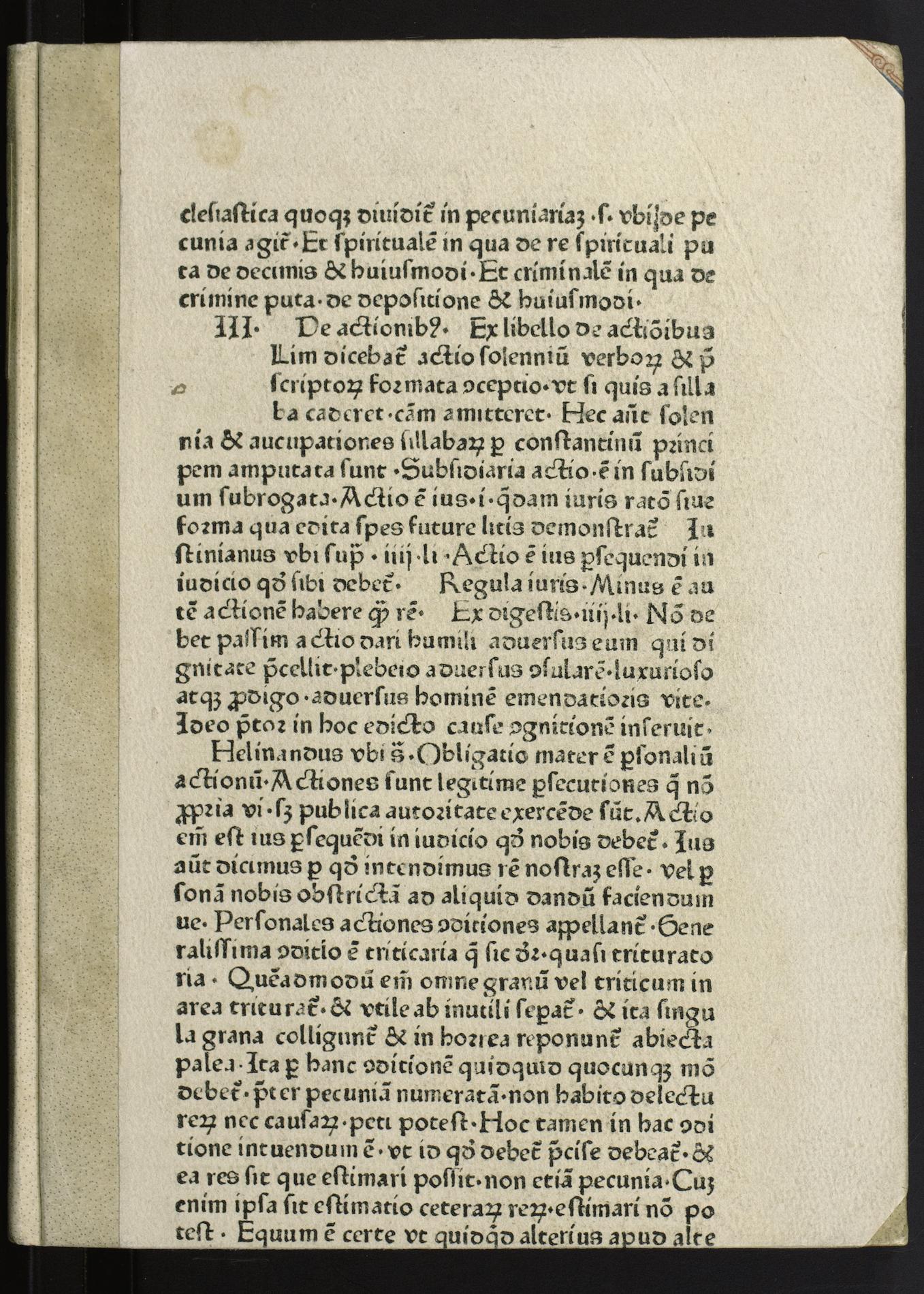
TextIoan. Eccii theologi Ingolstadii Procancellarij ... de materia iuramenti acutiss. decisio ad Georgium Kungspergium Augustanum
Eck, Johann, 1486-1543Summary: As professor of Logic and Rhetoric at Ingolstadt, Eck had the duty of writing the theses his students defended as part of the requirement for obtaining their doctorates. This one on oaths and vows was written and defended in 1516. M. Kretz was the respondent. This is a very early example of a printed dissertation.Summary: As professor of Logic and Rhetoric at Ingolstadt, Eck had the duty of writing the theses his students defended as part of the requirement for obtaining their doctorates. This one on oaths and vows was written and defended in 1516. M. Kretz was the respondent. This is a very early example of a printed dissertation. -
![The digital edition of an introduction to and translation of Johan Tetzel's "Vorlegung gemacht von Bruder Johan Tetzel Prediger Orde[n]s Ketzermeister : wyder eynen vormessen Sermon von tzwentzig irrige[n] Artickeln Bebstlichen Ablas vn[d] Gnade belange[n]de allen cristglaubige[n] Mensche[n] tzuwissen von Notten," originally published by Melchior Lotter in Leipzig, Germany, in 1518, including facsimile reproductions. The original text is the first attack on Luther's "Sermon von dem Ablass und Gnade" (Sermon on indulgences and grace) by Johan Tetzel, a refutation of Luther's position.](https://s3.us-west-2.amazonaws.com/omekacloud-main/large/P_CSTA005_BD002_300000422352/P_CSTA005_BD002_2012_300000422352_KRAMER.jpg) Text
TextJohann Tetzel's Rebuttal against Luther's Sermon on Indulgences and Grace
Tetzel, Johann, 1460-1519The digital edition of an introduction to and translation of Johan Tetzel's "Vorlegung gemacht von Bruder Johan Tetzel Prediger Orde[n]s Ketzermeister : wyder eynen vormessen Sermon von tzwentzig irrige[n] Artickeln Bebstlichen Ablas vn[d] Gnade belange[n]de allen cristglaubige[n] Mensche[n] tzuwissen von Notten," originally published by Melchior Lotter in Leipzig, Germany, in 1518, including facsimile reproductions.The digital edition of an introduction to and translation of Johan Tetzel's "Vorlegung gemacht von Bruder Johan Tetzel Prediger Orde[n]s Ketzermeister : wyder eynen vormessen Sermon von tzwentzig irrige[n] Artickeln Bebstlichen Ablas vn[d] Gnade belange[n]de allen cristglaubige[n] Mensche[n] tzuwissen von Notten," originally published by Melchior Lotter in Leipzig, Germany, in 1518, including facsimile reproductions. -
 Still image
Printer's Device of Johann Rhau-Grünenberg
A woodcut of the printer's device (or mark) of Johann Rhau-Grunenberg, featuring his initials, "IG," and a small hill decorated with a number of different plants. The printer's mark is placed just below the colophon.A woodcut of the printer's device (or mark) of Johann Rhau-Grunenberg, featuring his initials, "IG," and a small hill decorated with a number of different plants. The printer's mark is placed just below the colophon. -
 Text
TextR.P. Fratris Siluestri Prieratis ordinis praedicatorum et sacre Theologie p[ro]fessoris celeberrimi sacriq[ue] palatij apostolici magistri: in p[re]sumptuosas Martini Luther co[n]clusio[n]es de p[otes]tate pape dialog[us]
Mazzolini, Silvestro, da Prierio, 1456?-1527?Summary: S. Mazzolini was Master of the Sacred Palace (Vatican) in Rome, censor of books, and one of the first Catholic literary opponents of Luther. This is an early printing of the first work issued in opposition to Luther. Where the printing fits in bibliographically is still a matter of dispute. The work is in dialogue form and contains a refutation of Luther's 95 theses.Summary: S. Mazzolini was Master of the Sacred Palace (Vatican) in Rome, censor of books, and one of the first Catholic literary opponents of Luther. This is an early printing of the first work issued in opposition to Luther. Where the printing fits in bibliographically is still a matter of dispute. The work is in dialogue form and contains a refutation of Luther's 95 theses. -
 Text
TextVorlegung gemacht von Bruder Johan Tetzel Prediger Orde[n]s Ketzermeister : wyder eynen vormessen Sermon von tzwentzig irrige[n] Artickeln Bebstlichen Ablas vn[d] Gnade belange[n]de allen cristglaubige[n] Mensche[n] tzuwissen von Notten
Tetzel, Johann, 1460-1519Summary: First attack on Luther's "Sermon von dem Ablass und Gnade" (Sermon on indulgences and grace) by Johan Tetzel, a refutation of Luther's position.Summary: First attack on Luther's "Sermon von dem Ablass und Gnade" (Sermon on indulgences and grace) by Johan Tetzel, a refutation of Luther's position.