Search
51 resources
51 items
Date
1519
-
 Text
TextAd Johannem Ecciu[m]
Luther, Martin, 1483-1546Summary: A unique printing of an answer by Luther to the attacks of one his earliest opponents, Johann Eck.Summary: A unique printing of an answer by Luther to the attacks of one his earliest opponents, Johann Eck. -
 Text
TextAd aegocerotem Emserianum
Luther, Martin, 1483-1546Summary: First edition of Luther's response to Hieronymus Emser's report of the Leipzig Disputation between Martin Luther, Andreas Bodenstein Karlstadt and Johann Eck. Emser, who had been initially sympathetic to Luther's position had accompanied Eck to Leipzig, where he broke with the reformer. In his report, he tried to associate Luther with the Bohemian reformer Jan Hus, who had been burnt at the stake during the Council of Constance in 1415.Summary: First edition of Luther's response to Hieronymus Emser's report of the Leipzig Disputation between Martin Luther, Andreas Bodenstein Karlstadt and Johann Eck. Emser, who had been initially sympathetic to Luther's position had accompanied Eck to Leipzig, where he broke with the reformer. In his report, he tried to associate Luther with the Bohemian reformer Jan Hus, who had been burnt at the stake during the Council of Constance in 1415. -
 Still image
Adam and Eve after eating from the Tree of Knowledge
A woodcut depicting Adam and Eve eating from the Tree of Knowledge as God looks on from Heaven. To the right, they are expelled from Eden by an angel wielding a sword. A set of four decorative woodcuts create a border around the main image and depict plants and birds.A woodcut depicting Adam and Eve eating from the Tree of Knowledge as God looks on from Heaven. To the right, they are expelled from Eden by an angel wielding a sword. A set of four decorative woodcuts create a border around the main image and depict plants and birds. -
 Still image
Architectural historiated title page of Philippi Melanchthonis Sermo habitus apud iuuentute[m] Academiae Vuittenberg. ; De corrigendis adulescentiae studijs. Rodolphus Agricola Phrisius de studiorum omnium colluuie, uidelicet Iuris, Medicinae, Physices, & Theologicae
An architectural historiated woodcut border on the title page of the second printing of Philip Melanchthon's inagural address to the Wittenberg faculty. The border features the printer's device of Johann Froben, a shield with a caduceus, surrounded by a wreath. At the bottom is a scene of Salome requesting, and recieving, the head of John the Baptist.An architectural historiated woodcut border on the title page of the second printing of Philip Melanchthon's inagural address to the Wittenberg faculty. The border features the printer's device of Johann Froben, a shield with a caduceus, surrounded by a wreath. At the bottom is a scene of Salome requesting, and recieving, the head of John the Baptist. -
 Text
TextAuszlegung vnnd Lewterung etzlicher heyligenn Geschrifften : So dem Menschen dienstlich vnd erschieszlich seint zu Christlichem Lebe[n] : kurtzlich berurth vnd angetzeich[n]et in den Figurn vnd Schrifften der Wagen : In Sonderheit, des Creutzes, tzu welchem vnser Goth vnd Herr, den Menschen berufft. Bediengung vnd Vorwort...
Karlstadt, Andreas Rudolff-Bodenstein von, 1486-1541Summary: Only edition of an early work by Karlstadt addressing questions of what constitutes a Christian life.Summary: Only edition of an early work by Karlstadt addressing questions of what constitutes a Christian life. -
 Still image
Ciborium
A woodcut depicting an elaborate ciborium featuring several decorative spires and a crucifix at the top.A woodcut depicting an elaborate ciborium featuring several decorative spires and a crucifix at the top. -
 Text
TextDe disputatio[n]e Lipsicensi : quantum ad Boemos obiter deflexa est
Emser, Hieronymus, 1478-1527Summary: A letter by Hieronymus Emser, early opponent of Luther concerning the Leipzig Disputation of 1519, describing Luther's debate with Johann Eck, and Luther's admitting that councils could err.Summary: A letter by Hieronymus Emser, early opponent of Luther concerning the Leipzig Disputation of 1519, describing Luther's debate with Johann Eck, and Luther's admitting that councils could err. -
 Text
TextDe donatione Constantini quid ueri habeat, eruditorum quorundam iudicium, ut in uersa pagella uidebis
Summary: The Donation of Constantine was a work that told of how the Emperor Constantine I gave secular domination over Italy to the Bishops of Rome. Although purported to have been written in the fourth century, the humanist scholar Lorenzo Valla proved the work, long suspect to be an eighth century forgery. Vall's treatise was one of the first important works of comparative philology, a method invaluable to later biblical scholars and translators.Summary: The Donation of Constantine was a work that told of how the Emperor Constantine I gave secular domination over Italy to the Bishops of Rome. Although purported to have been written in the fourth century, the humanist scholar Lorenzo Valla proved the work, long suspect to be an eighth century forgery. Vall's treatise was one of the first important works of comparative philology, a method invaluable to later biblical scholars and translators. -
 Text
TextDer Himelwagen : in welchem angezeygt wird das gleich als der wagen auff vier redern geet. Also wirt auch mit bequemer temperatur oder proportion Alles Vernünfftigliche Natürliche Sitliche Cristenliche wesen des me[n]schen hinbracht auff widerstreydt der vier widerreden eleme[n]t vn[d] qualitet affection Begnadu[n]g Christi
Summary: Popular piety and "modern" science here make mutual if unusual companions. Science is used to teach piety and piety reinforces a scientific perspective. The smile is that just as a wagon goes on four wheels, so philosophy and human thought proceed on their "fourfold paths"---logic, physics (medicine), ethics and theology.Summary: Popular piety and "modern" science here make mutual if unusual companions. Science is used to teach piety and piety reinforces a scientific perspective. The smile is that just as a wagon goes on four wheels, so philosophy and human thought proceed on their "fourfold paths"---logic, physics (medicine), ethics and theology. -
 Text
TextDisputatio domini Johannis Eccij et P. Martini Luther in Studio Lipsiensi futura
Luther, Martin, 1483-1546Summary: This is Luther's first public attack on Johannes Eck. Included in this volume are Eck's letter of Dec. 24, 1518 in which he records his theological differences with Karlstadt, and Eck's own 12 theses with Luther's response.Summary: This is Luther's first public attack on Johannes Eck. Included in this volume are Eck's letter of Dec. 24, 1518 in which he records his theological differences with Karlstadt, and Eck's own 12 theses with Luther's response. -
 Text
TextDisputatio et excusatio
Luther, Martin, 1483-1546Summary: A response by Luther to the accusations leveled at him at the Leipzig Disputation by his opponent, Johann Eck.Summary: A response by Luther to the accusations leveled at him at the Leipzig Disputation by his opponent, Johann Eck. -
 Text
TextDisputatio inter Egregios & praelatus virus ac doctores, Joannem Ecci[um] & Martinum Lutherum in p[rae]sentia notariorum habita
Luther, Martin, 1483-1546Summary: Unique printing of the original notarial protocol of the Leipzig Disputation between Andreas Karlstadt and Martin Luther on the one hand, and Johann Eck, on the other. Includes fully two thirds of the several day debate, and all of the famous "duel" between Luther and Eck on authority in the church. The debates were copied by two notaries, and, at the end of each day's sessions, were verified by two witnesses.Summary: Unique printing of the original notarial protocol of the Leipzig Disputation between Andreas Karlstadt and Martin Luther on the one hand, and Johann Eck, on the other. Includes fully two thirds of the several day debate, and all of the famous "duel" between Luther and Eck on authority in the church. The debates were copied by two notaries, and, at the end of each day's sessions, were verified by two witnesses. -
 Text
TextDoctor Martinus Luther Augustiners Vnterricht auff etlich Artickell die im vonn seynen Abgūrnern auff gelegt vn[d] zu gemessen werden
Luther, Martin, 1483-1546Summary: Luther was persuaded by Karl von Miltitz to write this public statement as a response to certain charges brought against him by his opponents, in particular Mazzolini da Prierio. In this tract, Luther still supports the invocation of the saints, an idea which he abandoned only shortly after.Summary: Luther was persuaded by Karl von Miltitz to write this public statement as a response to certain charges brought against him by his opponents, in particular Mazzolini da Prierio. In this tract, Luther still supports the invocation of the saints, an idea which he abandoned only shortly after. -
 Text
TextEin Predig von de[m] eelichen Stand
Luther, Martin, 1483-1546Summary: One of several printings of Luther's own revision of a sermon on the subject of marriage, printed without his approval earlier the same year.Summary: One of several printings of Luther's own revision of a sermon on the subject of marriage, printed without his approval earlier the same year. -
 Text
TextEin Sermon geprediget tzu Leipssgk [sic] vffm Schloss am tag Petri vn[d] Pauli im xviiij. Jar
Luther, Martin, 1483-1546Summary: This is the first printing of Luther's sermon preached June 29th, 1519, at the Leipzig Disputation, on text: Matthew 16: 13-19 (Peter's Great Confession, and the presentation of the Keys). The woodcut on the title page is the earliest known portrait of Luther.Summary: This is the first printing of Luther's sermon preached June 29th, 1519, at the Leipzig Disputation, on text: Matthew 16: 13-19 (Peter's Great Confession, and the presentation of the Keys). The woodcut on the title page is the earliest known portrait of Luther. -
 Text
TextEin Sermon geprediget tzu Leipssgk vffm Schloss am tag Petri vn[d] pauli ym .xviiij. Jar
Luther, Martin, 1483-1546Summary: Sermon preached June 29, 1519, on text: Matthew XVI, 13-19.Summary: Sermon preached June 29, 1519, on text: Matthew XVI, 13-19. -
 Text
TextEncomiu[m] Rubij Longipolii apud Lipsim : in errores quos pueriliter co[m]misit adversus Vuittenbergen[ses] : Nemo potest quicquid toto gestatur in orbe rumpere liuores omnia Nemo potest
Montanus, Jacobus, active 1486-1534Summary: It is not certain who wrote this tract on the Leipzig Disputation but J. Montanus or J. Cellarius appear to be the most likely candidates. Montanus became the first Protestant preacher in Westphalia, while Cellarius or Kellner, became the first Protestant Superintendent of Dresden.Summary: It is not certain who wrote this tract on the Leipzig Disputation but J. Montanus or J. Cellarius appear to be the most likely candidates. Montanus became the first Protestant preacher in Westphalia, while Cellarius or Kellner, became the first Protestant Superintendent of Dresden. -
 Text
TextEpistola D. Martini Luther ad Georgium Spalatinum &c. de disputatione sua : Eiusdem super Tredecim Proposit[i]o[n]ibus Lipsi[a]e disputatis resolutiones
Luther, Martin, 1483-1546Summary: The Leipzig disputation was a debate between Martin Luther and Andreas Karlstadt on the one hand and Johann Eck on the other. While Karlstadt and Eck found some grounds for agreement on the question of free will, Luther and Eck disagreed vehemently over the question of the pope's authority to establish new articles of faith. This work publishes a letter Luther wrote to his friend Georg Spalatin, as well as 13 theses by Luther refuting Eck's position on the primacy of the pope and the authority of councils.Summary: The Leipzig disputation was a debate between Martin Luther and Andreas Karlstadt on the one hand and Johann Eck on the other. While Karlstadt and Eck found some grounds for agreement on the question of free will, Luther and Eck disagreed vehemently over the question of the pope's authority to establish new articles of faith. This work publishes a letter Luther wrote to his friend Georg Spalatin, as well as 13 theses by Luther refuting Eck's position on the primacy of the pope and the authority of councils. -
 Text
TextEpistola de Lipsica disputatione
Melanchthon, Philipp, 1497-1560Summary: A report on the Leipzig Disputation of 1519, ostensibly between Karlstadt and Johann Eck, but with the active participation of Luther both in preparation and in delivery. It was at this formal disputation that Eck was successful in pushing Luther to admit that not only popes, but councils, as well, had erred. This was an important point in Eck's favor, since Luther had, up to this point, appealed from the authority of the Pope to that of an ecumenical council.Summary: A report on the Leipzig Disputation of 1519, ostensibly between Karlstadt and Johann Eck, but with the active participation of Luther both in preparation and in delivery. It was at this formal disputation that Eck was successful in pushing Luther to admit that not only popes, but councils, as well, had erred. This was an important point in Eck's favor, since Luther had, up to this point, appealed from the authority of the Pope to that of an ecumenical council. -
 Text
TextEyn Sermon von dem hochwirdigen Sacrament des heyligen waren Leychnamss Christi : Vnd von den Bruderschafften
Luther, Martin, 1483-1546Summary: Second of eleven printings, and the second of two Wittenberg printings with t.p. in red and black, of a sermon by Luther on the Lord's Supper.Summary: Second of eleven printings, and the second of two Wittenberg printings with t.p. in red and black, of a sermon by Luther on the Lord's Supper. -
 Text
TextEyn Sermon von dem sacrament der pusz
Luther, Martin, 1483-1546Summary: Fifth (and first outside Wittenberg) printing of an early sermon on the Sacrament of Penance by Luther.Summary: Fifth (and first outside Wittenberg) printing of an early sermon on the Sacrament of Penance by Luther. -
 Text
TextEyn sermon geprediget zu Leyptzigk auff dem Schloss am tag Petri vnnd Pauli im .xix. Jar
Luther, Martin, 1483-1546Summary: Sermon preached June 29, 1519, on text: Matthew XVI, 13-19.Summary: Sermon preached June 29, 1519, on text: Matthew XVI, 13-19. -
 Still image
Hieronymus Emser's Coat of Arms
A woodcut depicting Hieronymus Emser's coat of arms which features a shield emblazoned with a goat's head and a helmet crowned with a goat's head. A label to the side of the crest reads "ARMA HIERONYMI EMSER".A woodcut depicting Hieronymus Emser's coat of arms which features a shield emblazoned with a goat's head and a helmet crowned with a goat's head. A label to the side of the crest reads "ARMA HIERONYMI EMSER". -
 Still image
Hieronymus Emser's Coat of Arms
A woodcut depicting Hieronymus Emser's coat of arms which features a shield emblazoned with a goat's head and a helmet crowned with a goat's head. A label to the side of the crest reads "ARMA HIERONYMI EMSER".A woodcut depicting Hieronymus Emser's coat of arms which features a shield emblazoned with a goat's head and a helmet crowned with a goat's head. A label to the side of the crest reads "ARMA HIERONYMI EMSER". -
![A woodcut border on the title page to Luther's Ad Johannem Ecciu[m] printed in 1519. The border depicts a variety of plants and animals, including a crane or heron and a squirrel.](https://s3.us-west-2.amazonaws.com/omekacloud-main/large/P_300000072446_P005/P_300000072446_P005_PROD.jpg) Still image
Still imageHistoriated title page of Luther's Ad Johannem Ecciu[m]
A woodcut border on the title page to Luther's Ad Johannem Ecciu[m] printed in 1519. The border depicts a variety of plants and animals, including a crane or heron and a squirrel.A woodcut border on the title page to Luther's Ad Johannem Ecciu[m] printed in 1519. The border depicts a variety of plants and animals, including a crane or heron and a squirrel. -
 Still image
Historiated title page of Luther's Disputatio domini Johannis Eccij et P. Martini Luther in Studio Lipsiensi futura
A woodcut border and central illustration on the title page toLuther's Disputatio domini Johannis Eccij et P. Martini Luther in Studio Lipsiensi futura printed in 1519. The border is composed of four separate decorative woodcuts: the left and top ones featuring plants and flowers, the right one depicting a stick with a ribbon coiled around it and stars in the background, and the bottom one depicting a monkey amidst floral ornaments. At the center of the page is a separate woodcut depicting John the Baptist carrying the Lamb of God.A woodcut border and central illustration on the title page toLuther's Disputatio domini Johannis Eccij et P. Martini Luther in Studio Lipsiensi futura printed in 1519. The border is composed of four separate decorative woodcuts: the left and top ones featuring plants and flowers, the right one depicting a stick with a ribbon coiled around it and stars in the background, and the bottom one depicting a monkey amidst floral ornaments. At the center of the page is a separate woodcut depicting John the Baptist carrying the Lamb of God. -
 Still image
Historiated title page of Luther's Disputatio et excusatio
A woodcut border and central illustration on the title page to Luther's Disputatio et excusatio printed in 1519. The border is composed of four separate decorative woodcuts: the left and top ones featuring plants and flowers, the right one depicting a stick with a ribbon coiled around it and stars in the background, and the bottom one depicting a monkey amidst floral ornaments. At the center of the page is a separate woodcut depicting a bishop, carrying a staff and book.A woodcut border and central illustration on the title page to Luther's Disputatio et excusatio printed in 1519. The border is composed of four separate decorative woodcuts: the left and top ones featuring plants and flowers, the right one depicting a stick with a ribbon coiled around it and stars in the background, and the bottom one depicting a monkey amidst floral ornaments. At the center of the page is a separate woodcut depicting a bishop, carrying a staff and book. -
 Still image
Historiated title page of Luther's Sermo de penitentia
A woodcut border on the title page of Luther's Sermo de penitentia printed in 1519. Along the bottom margin, the border features three portraits, one of the Virgin Mary holding Jesus, one of a saint holding a spear and a book (possibly Saint Longinus), and one of a pope. Along both side margins are a series of decorative elements, including a cherub, two men chasing each other around a column, a pair of cats, a goose, and a trio of women. At the top of the page, there is a scene of two women with fish tails for legs (possibly a reference to Scylla) flanking a running boy and bird.A woodcut border on the title page of Luther's Sermo de penitentia printed in 1519. Along the bottom margin, the border features three portraits, one of the Virgin Mary holding Jesus, one of a saint holding a spear and a book (possibly Saint Longinus), and one of a pope. Along both side margins are a series of decorative elements, including a cherub, two men chasing each other around a column, a pair of cats, a goose, and a trio of women. At the top of the page, there is a scene of two women with fish tails for legs (possibly a reference to Scylla) flanking a running boy and bird. -
 Still image
Historiated title page of Luther's Sermon von dem ehelichen Stand
A woodcut border on the title page to Luther's Sermon von dem ehelichen Stand printed in 1519. The border depicts a series of cherubs, including two carrying another on a ram's pelt litter while it plays a horn and carries a standard.A woodcut border on the title page to Luther's Sermon von dem ehelichen Stand printed in 1519. The border depicts a series of cherubs, including two carrying another on a ram's pelt litter while it plays a horn and carries a standard. -
 Still image
Historiated title page of Luther's defense of his thirteenth proposition on the power of the Pope
Cranach, Lucas, 1472-1553A woodcut border on the title page of Luther's defense of his thirteenth proposition on the power of the Pope printed in 1519. The border depicts philosophers gathered around the Castalian spring, where historically the Delphi priestesses bathed before announcing their oracles, with the twin peaks of Mount Parnassus in the background. Along the sides and top of the border are a series of musicians playing flutes, harps, bagpipes, lutes, horns, and violins.A woodcut border on the title page of Luther's defense of his thirteenth proposition on the power of the Pope printed in 1519. The border depicts philosophers gathered around the Castalian spring, where historically the Delphi priestesses bathed before announcing their oracles, with the twin peaks of Mount Parnassus in the background. Along the sides and top of the border are a series of musicians playing flutes, harps, bagpipes, lutes, horns, and violins. -
 Still image
Historiated title page to Johann Eck's pamphlet in support of Hieronymus Emser
A woodcut border on the title page of Johann Eck's pamphlet in support of Hieronymus Emser printed in 1519. The entire border is created using four different woodcuts on each side. The bottom woodcut features a pair of cherubs holding up the coat of arms of Chemintz (possibly a reversed coat of arms of Leipzig). The left hand woodcut includes a cherub holding up a decorative stand upon which is a man battling a boar. The right hand woodcut includes a bent over cherub supporting a decorative stand on top of which stands a drummer.A woodcut border on the title page of Johann Eck's pamphlet in support of Hieronymus Emser printed in 1519. The entire border is created using four different woodcuts on each side. The bottom woodcut features a pair of cherubs holding up the coat of arms of Chemintz (possibly a reversed coat of arms of Leipzig). The left hand woodcut includes a cherub holding up a decorative stand upon which is a man battling a boar. The right hand woodcut includes a bent over cherub supporting a decorative stand on top of which stands a drummer. -
 Still image
Historiated title page to Johann Lange's Oratio
A woodcut border on the title page of Johann Lange's Oratio published in 1519. The border is comprised of one complete woodcut and depicts a group of angels playing music as the Virgin Mary, Jesus, and several other saints watch. Additional scenes of cherubs picking fruit and climbing trees appear in the left and right border sections.A woodcut border on the title page of Johann Lange's Oratio published in 1519. The border is comprised of one complete woodcut and depicts a group of angels playing music as the Virgin Mary, Jesus, and several other saints watch. Additional scenes of cherubs picking fruit and climbing trees appear in the left and right border sections. -
 Still image
Historiated title page to Luther's In epistolam Pauli ad Galatas commentarius
Cranach, Lucas, 1472-1553A woodcut border on the title page of Luther's In epistolam Pauli ad Galatas commentarius printed in 1519. The border depicts philosophers gathered around the Castalian spring, where historically the Delphi priestesses bathed before announcing their oracles, with the twin peaks of Mount Parnassus in the background. Along the sides and top of the border are a series of musicians playing flutes, harps, bagpipes, lutes, horns, and violins.A woodcut border on the title page of Luther's In epistolam Pauli ad Galatas commentarius printed in 1519. The border depicts philosophers gathered around the Castalian spring, where historically the Delphi priestesses bathed before announcing their oracles, with the twin peaks of Mount Parnassus in the background. Along the sides and top of the border are a series of musicians playing flutes, harps, bagpipes, lutes, horns, and violins. -
 Still image
Historiated title page to Luther's In epistolam Pauli ad Galatas commentarius
Cranach, Lucas, 1472-1553A woodcut border on the title page of Luther's In epistolam Pauli ad Galatas commentarius printed in 1519. The border depicts philosophers gathered around the Castalian spring, where historically the Delphi priestesses bathed before announcing their oracles, with the twin peaks of Mount Parnassus in the background. Along the sides and top of the border are a series of musicians playing flutes, harps, bagpipes, lutes, horns, and violins.A woodcut border on the title page of Luther's In epistolam Pauli ad Galatas commentarius printed in 1519. The border depicts philosophers gathered around the Castalian spring, where historically the Delphi priestesses bathed before announcing their oracles, with the twin peaks of Mount Parnassus in the background. Along the sides and top of the border are a series of musicians playing flutes, harps, bagpipes, lutes, horns, and violins. -
 Still image
Historiated title page to Luther's Resolutiones Lutherianae super propositionibus suis Lipsiae disputatis
A woodcut border on the title page of Luther's Resolutiones Lutherianae super propositionibus suis Lipsiae disputatis printed in 1519. The border depicts a fox chasing a bird (bottom), three boars (one holding a sword, one stirring a pot, and one wearing a crown and holding a scepter; right), a man with a comb (?) (top), and two men (one with a bucket and the other working a printing press; left).A woodcut border on the title page of Luther's Resolutiones Lutherianae super propositionibus suis Lipsiae disputatis printed in 1519. The border depicts a fox chasing a bird (bottom), three boars (one holding a sword, one stirring a pot, and one wearing a crown and holding a scepter; right), a man with a comb (?) (top), and two men (one with a bucket and the other working a printing press; left). -
 Still image
Historiated title page to Luther's sermon on the Sacrament of Penance
Cranach, Lucas, 1472-1553A woodcut border on the title page of the fifth printing of Luther's sermon on the sacrament of penance. The border depicts philosophers gathered around the Castalian spring, where historically the Delphi priestesses bathed before announcing their oracles, with the twin peaks of Mount Parnassus in the background. Along the sides and top of the border are a series of musicians playing flutes, harps, bagpipes, lutes, horns, and violins.A woodcut border on the title page of the fifth printing of Luther's sermon on the sacrament of penance. The border depicts philosophers gathered around the Castalian spring, where historically the Delphi priestesses bathed before announcing their oracles, with the twin peaks of Mount Parnassus in the background. Along the sides and top of the border are a series of musicians playing flutes, harps, bagpipes, lutes, horns, and violins. -
 Text
TextIn Epistolam Pauli ad Galatas, F. Martini Lutheri Augustiniani, commentarius ..
Luther, Martin, 1483-1546Summary: One of six 1519 printings of Luther's lectures on Paul's letter to the Galatians, first held in 1516. Galatians was Luther's favorite biblical book, which had a profound infulence on the formation of his theological thought and his understanding of law and grace.Summary: One of six 1519 printings of Luther's lectures on Paul's letter to the Galatians, first held in 1516. Galatians was Luther's favorite biblical book, which had a profound infulence on the formation of his theological thought and his understanding of law and grace. -
 Still image
Man of Sorrows
A woodcut depicting Jesus as the "man of sorrows" (Isaiah 53:3), surrounded by the instruments of his suffering and death, including a spear, cross, hammer, scourge, and crown of thorns, as three die sit stacked at his feet. The phrase "Ecce homo" appears behind the form of Jesus.A woodcut depicting Jesus as the "man of sorrows" (Isaiah 53:3), surrounded by the instruments of his suffering and death, including a spear, cross, hammer, scourge, and crown of thorns, as three die sit stacked at his feet. The phrase "Ecce homo" appears behind the form of Jesus. -
 Still image
Martin Luther as an Augustinian Monk
A woodcut depicting Martin Luther in the garb of an Augustinian Monk. Below Luther is a traditional Luther rose. Surrounding the portrait is an inscription, mirrored as the image was printed in reverse, reading "DOCTOR MARTINUS LUTTER AUGUSTINER: WITTENB:". This is purported to be the earliest depiction of Luther.A woodcut depicting Martin Luther in the garb of an Augustinian Monk. Below Luther is a traditional Luther rose. Surrounding the portrait is an inscription, mirrored as the image was printed in reverse, reading "DOCTOR MARTINUS LUTTER AUGUSTINER: WITTENB:". This is purported to be the earliest depiction of Luther. -
 Still image
Martin Luther as an Augustinian Monk
A woodcut depicting Martin Luther in the garb of an Augustinian Monk. Below Luther is a traditional Luther rose. Surrounding the portrait is an inscription, mirrored as the image was printed in reverse, reading "DOCTOR MARTINUS LUTTER AUGUSTINER: WITTENB:". This is purported to be the earliest depiction of Luther.A woodcut depicting Martin Luther in the garb of an Augustinian Monk. Below Luther is a traditional Luther rose. Surrounding the portrait is an inscription, mirrored as the image was printed in reverse, reading "DOCTOR MARTINUS LUTTER AUGUSTINER: WITTENB:". This is purported to be the earliest depiction of Luther. -
 Still image
Monstrance
A woodcut depicting an elaborate monstrance, or an ostensorium, somewhat in the shape of a cathedral with a crucefix on top.A woodcut depicting an elaborate monstrance, or an ostensorium, somewhat in the shape of a cathedral with a crucefix on top. -
 Still image
Possible Printer's Device of Wolfgang Stöckel
A woodcut depicting Saint Jerome in prototypical fashion, kneeling before a crucifix and smiting himself on the chest with a stone. It also includes two of the other 'attributes' that typically occur in his portraits: the lion and the cardinal’s hat. The printer, Wolfgang Stöckel may have used it as a kind of printer's device, and some have characterized it as a loose copy of the work of Wolf Traut.A woodcut depicting Saint Jerome in prototypical fashion, kneeling before a crucifix and smiting himself on the chest with a stone. It also includes two of the other 'attributes' that typically occur in his portraits: the lion and the cardinal’s hat. The printer, Wolfgang Stöckel may have used it as a kind of printer's device, and some have characterized it as a loose copy of the work of Wolf Traut. -
 Still image
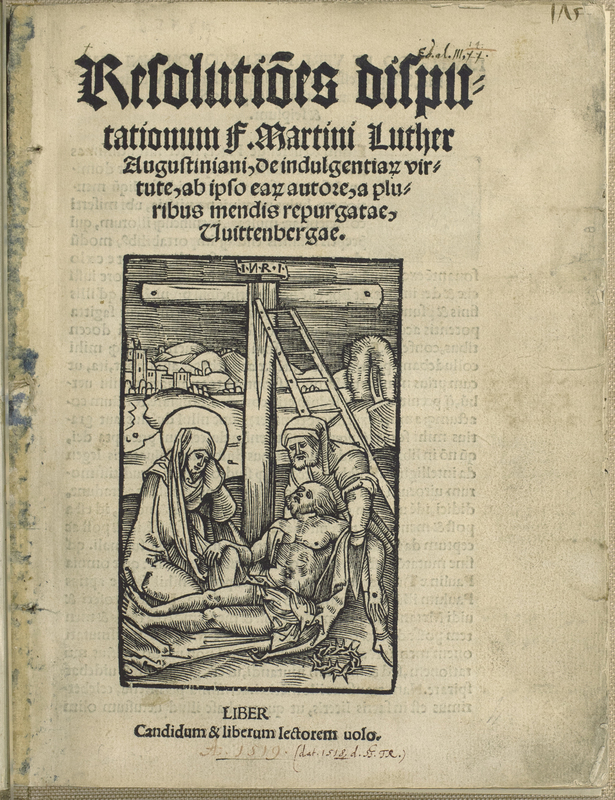
Removal of Jesus from the Cross
A woodcut depicting Mary and Joseph of Arimathea taking the body of Jesus down from the cross. The crown of thorns lies on the ground beside Jesus and the inscription "INRI" appears above the cross.A woodcut depicting Mary and Joseph of Arimathea taking the body of Jesus down from the cross. The crown of thorns lies on the ground beside Jesus and the inscription "INRI" appears above the cross. -
 Text
TextResolutio Lutheriana super propositione sua tercia decima de potestate papae
Luther, Martin, 1483-1546Summary: This is the fifth printing of Luther's defense of his thirteenth proposition, on the power of the Pope, prepared for the Leipzig Disputation.Summary: This is the fifth printing of Luther's defense of his thirteenth proposition, on the power of the Pope, prepared for the Leipzig Disputation. -
 Text
TextResolutio lutheriana [sic] super propositione deci[m]a tertia: de potestate pape
Luther, Martin, 1483-1546Summary: One of the thorniest issues raised in the Leipzig Disputation was the historical precedence of papal authority. Eck argued that from earliest times, the authority of the bishop of Rome was accepted by the other bishops. Luther's thirteenth proposition argued that only much later did the church in Rome claim precedence over the other churches.Summary: One of the thorniest issues raised in the Leipzig Disputation was the historical precedence of papal authority. Eck argued that from earliest times, the authority of the bishop of Rome was accepted by the other bishops. Luther's thirteenth proposition argued that only much later did the church in Rome claim precedence over the other churches. -
 Text
TextResolutio[n]es disputationum
Luther, Martin, 1483-1546Summary: This is Luther's final authorized edition of his Ninety-five Theses in book form with his own commentaries. The edition published by Rhau-Grunemberg had been so full of errors, that Luther gave the printing of this edition to Melchior Lotter in Leipzig.Summary: This is Luther's final authorized edition of his Ninety-five Theses in book form with his own commentaries. The edition published by Rhau-Grunemberg had been so full of errors, that Luther gave the printing of this edition to Melchior Lotter in Leipzig. -
 Text
TextResolutiones Lutherianae super propositionibus suis Lipsiae disputatis
Luther, Martin, 1483-1546Summary: A clarification of Luther's position regarding the Leipzig disputation, a public debate between the Catholic Johann Eck on the one side and Luther and Andreas Karlstadt on the other. The work is preceded by a long letter to Spalatin, dated 15 Aug., 1519.Summary: A clarification of Luther's position regarding the Leipzig disputation, a public debate between the Catholic Johann Eck on the one side and Luther and Andreas Karlstadt on the other. The work is preceded by a long letter to Spalatin, dated 15 Aug., 1519. -
 Text
TextResolutiones Lutheriane super propositio[n]ibus suis Lipsie disputatis
Luther, Martin, 1483-1546Summary: An analysis by Luther of the propositions debated by him, his colleague, Andreas Karlstadt, and Johann Eck at the Leipzig Debate of 1519.Summary: An analysis by Luther of the propositions debated by him, his colleague, Andreas Karlstadt, and Johann Eck at the Leipzig Debate of 1519. -
 Text
TextSermo de penitentia
Luther, Martin, 1483-1546Summary: This sermon on penance was written and preached before Easter, 1518. It is a natural sequel to the sermon on Indulgences and grace, although this sermon was preached first. This is the seventh printing of the sermon.Summary: This sermon on penance was written and preached before Easter, 1518. It is a natural sequel to the sermon on Indulgences and grace, although this sermon was preached first. This is the seventh printing of the sermon. -
 Text
TextVszlegung dütsch des Vatter vnser für die einfeltigen leyen
Luther, Martin, 1483-1546Summary: This exposition of the Lord's Prayer had its origins in a series of sermons preached by Luther during Lent, 1517. J. Agricola published his transcripts of these sermons. Luther was dissatisfied with Agricola's edition, however, and re-edited the work. This example is from the seventh printing of Luther's edition.Summary: This exposition of the Lord's Prayer had its origins in a series of sermons preached by Luther during Lent, 1517. J. Agricola published his transcripts of these sermons. Luther was dissatisfied with Agricola's edition, however, and re-edited the work. This example is from the seventh printing of Luther's edition. -
 Still image
Wild Man with the Coat of Arms of Leipzig
A woodcut depicting a "Wild Man", or hair-covered man with a crown of plants and carrying a club, with the coat of arms of Leipzig.A woodcut depicting a "Wild Man", or hair-covered man with a crown of plants and carrying a club, with the coat of arms of Leipzig.