Summary: Third edition of Alciatus in France, "with new woodcuts superior to those of the 'Augsburg' editions" (Landwehr). The emblems are attributed to Mercure Jollat. "It is the Paris edition which set the standard for the popular field of emblem literature (Mortimer, French, no. 13, p. 13). Alciatus was not happy with the two earlier Augsburg editions; but the expanded Wechel edition which appeared in Paris in 1534 with entirely new woodcuts by Jollat set a new standard.
Summary: Third edition of Alciatus in France, "with new woodcuts superior to those of the 'Augsburg' editions" (Landwehr). The emblems are attributed to Mercure Jollat. "It is the Paris edition which set the standard for the popular field of emblem literature (Mortimer, French, no. 13, p. 13). Alciatus was not happy with the two earlier Augsburg editions; but the expanded Wechel edition which appeared in Paris in 1534 with entirely new woodcuts by Jollat set a new standard.
Summary: Rhegius was a Reformer, active throughout Germany promoting Lutheran unity in the Holy Roman Empire. In 1530 at the Diet of Augsburg he was befriended by Ernest I, Duke of Brunswick-Luneburg, under whose patronage he returned to Brunswick where he wrote the present work for Ernest's son, Francis Otto (1530-1559). Like many 16th c. catechisms, Rhegius' is in the form of a dialogue, in this instance between the teacher and the pupil (paedagogus et discipulus).
Summary: Rhegius was a Reformer, active throughout Germany promoting Lutheran unity in the Holy Roman Empire. In 1530 at the Diet of Augsburg he was befriended by Ernest I, Duke of Brunswick-Luneburg, under whose patronage he returned to Brunswick where he wrote the present work for Ernest's son, Francis Otto (1530-1559). Like many 16th c. catechisms, Rhegius' is in the form of a dialogue, in this instance between the teacher and the pupil (paedagogus et discipulus).
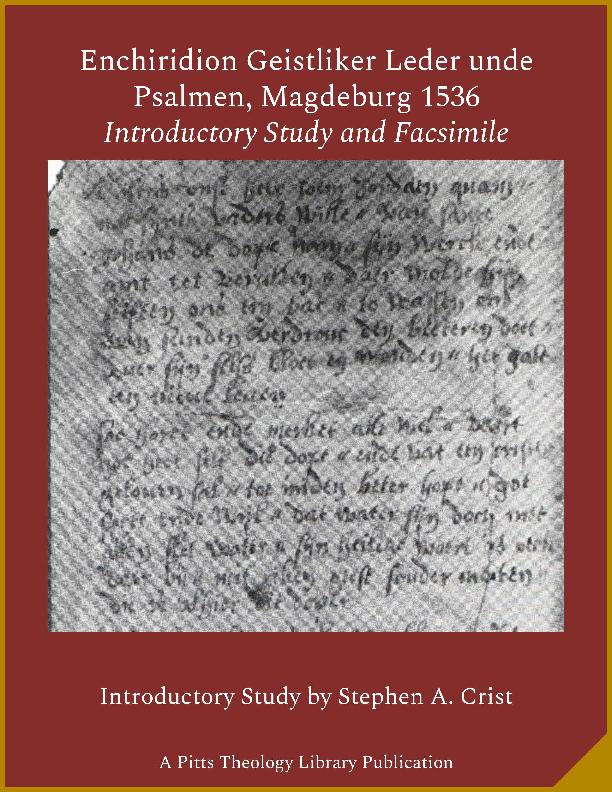
The digital edition of an introductory study of the "Enchiridion geistliker leder unde Psalmen," originally published by Melchior Lotter in Magdeburg, Germany, in 1536, including facsimile reproductions. The original text includes hymns in part with melodies in Low German.
The digital edition of an introductory study of the "Enchiridion geistliker leder unde Psalmen," originally published by Melchior Lotter in Magdeburg, Germany, in 1536, including facsimile reproductions. The original text includes hymns in part with melodies in Low German.
The title page of Johan Eck's Vmb den grossen sig Kaiserlicher Maiestat, in Thunis verlihen, Got zu dancken, zwů predig ... features the coat of arms of the Holy Roman Emperor Charles V, featuring the two-headed eagle representing the Holy Roman Empire surrounded by the collar of the chivalric Order of the Golden Fleece and flanked by a pair of crowned columns representing the Pillars of Hercules. Above the coat of arms is the Charles V's motto, "Plus Ultra," translating to "Further Beyond."
The title page of Johan Eck's Vmb den grossen sig Kaiserlicher Maiestat, in Thunis verlihen, Got zu dancken, zwů predig ... features the coat of arms of the Holy Roman Emperor Charles V, featuring the two-headed eagle representing the Holy Roman Empire surrounded by the collar of the chivalric Order of the Golden Fleece and flanked by a pair of crowned columns representing the Pillars of Hercules. Above the coat of arms is the Charles V's motto, "Plus Ultra," translating to "Further Beyond."
A map depicting the Levant region, including Syria, Coele-Syria, Sophene, Ammon, and the regions of five of the twelve tribes fo Israel (Naphtali, Zebulun, Isaschar, Aser, and Gesuri [Manasseh]).
A map depicting the Levant region, including Syria, Coele-Syria, Sophene, Ammon, and the regions of five of the twelve tribes fo Israel (Naphtali, Zebulun, Isaschar, Aser, and Gesuri [Manasseh]).
Summary: Latin text of the Papal Bull Ad Dominici gregis curam, issued June 4, 1536, for the Council of Mantua which was never held (council eventually took place in Trent).
Summary: Latin text of the Papal Bull Ad Dominici gregis curam, issued June 4, 1536, for the Council of Mantua which was never held (council eventually took place in Trent).
 Text
Text Text
Text Still image
 Text
Text Still image
![A map depicting the Levant region, including Syria, Coele-Syria, Sophene, Ammon, and the regions of five of the twelve tribes fo Israel (Naphtali, Zebulun, Isaschar, Aser, and Gesuri [Manasseh]).](https://s3.us-west-2.amazonaws.com/omekacloud-main/large/P_300000076744_P004x/1536ZIEG_300000076744_P004x.jpg) Still image
Still image Still image
 Text
Text