Search
184 resources
184 items
Subject
Death
-
 Still image
18 Personnes brulées à Saltzbourg, A. 1528
Luiken, Jan, 1649-1712An engraving depicting the burning of eighteen Anabaptists. The image shows the victims bound to burning stakes and praying as a pair of men stoke the fires.An engraving depicting the burning of eighteen Anabaptists. The image shows the victims bound to burning stakes and praying as a pair of men stoke the fires. -
 Still image
180 Persones brulées sous le nom d'Albigois comme des héretiques, A. 1210
Luiken, Jan, 1649-1712An engraving depicting the burning of 180 people from the Cathar sect who had been labeled heretics by the Pope. The image shows a massive bonfire with numerous people being thrown onto it while a crowd watches.An engraving depicting the burning of 180 people from the Cathar sect who had been labeled heretics by the Pope. The image shows a massive bonfire with numerous people being thrown onto it while a crowd watches. -
 Still image
224 Vaudois brulez prés de Thoulouse, A. 1243
Luiken, Jan, 1649-1712An engraving depicting the burning of 224 Waldensians outside of Toulouse. The image shows a large number of stakes with people tied to them being set ablaze as a crowd watches.An engraving depicting the burning of 224 Waldensians outside of Toulouse. The image shows a large number of stakes with people tied to them being set ablaze as a crowd watches. -
 Text
TextA Discourse on the Passion of our Lord J.C.; no verse
Archer, James, 1751-1834This sermon cautions against questioning the decisions of God based on the limited knowledge and reason of humanity, specifically in regards to the Passion and Crucifixion of Jesus Christ.This sermon cautions against questioning the decisions of God based on the limited knowledge and reason of humanity, specifically in regards to the Passion and Crucifixion of Jesus Christ. -
 Text
TextAin sermon vo[n] der Beraitung tzüm sterbe[n]
Luther, Martin, 1483-1546Summary: Early sermon of Luther's on preparing for death. One of twenty-two German printings to appear in six years.Summary: Early sermon of Luther's on preparing for death. One of twenty-two German printings to appear in six years. -
 Still image
Algerius, Etudiant de Padoue, brulé à Rome, A. 1557
Luiken, Jan, 1649-1712An engraving depicting the execution of Algerius, a student from Padua. The image shows Algerius being drenched in boiling oil as he stands before a prepared stake and pyre while a monk attempts to convince him to repent.An engraving depicting the execution of Algerius, a student from Padua. The image shows Algerius being drenched in boiling oil as he stands before a prepared stake and pyre while a monk attempts to convince him to repent. -
 Still image
Anne Hendriks, brulée à Amsterdam, A. 1571
Luiken, Jan, 1649-1712An engraving depicting the execution of Anne Hendricks. The image shows Hendricks, bound to a ladder, being lifted towards a bonfire as a crowd watches.An engraving depicting the execution of Anne Hendricks. The image shows Hendricks, bound to a ladder, being lifted towards a bonfire as a crowd watches. -
 Still image
Anne Ians, noyée à Rotterdam, A. 1539
Luiken, Jan, 1649-1712An engraving depicting the execution of Anne Ians. The image shows Anne being led away as she reaches back to deliver her final testament of faith to her son.An engraving depicting the execution of Anne Ians. The image shows Anne being led away as she reaches back to deliver her final testament of faith to her son. -
 Still image
Anne vande Hoven, enterrée toute vive à Bruxelles, A. 1597
Luiken, Jan, 1649-1712An engraving depicting the execution of Anne van den Hove. The image shows van den Hove buried up to her neck while priests attempt to convince her to recant.An engraving depicting the execution of Anne van den Hove. The image shows van den Hove buried up to her neck while priests attempt to convince her to recant. -
 Still image
Antipas, brulé vif dans un Taureau d'airain environ l'an 95
Luiken, Jan, 1649-1712An engraving depicting the martyrdom of Antipas of Pergamum. The image shows a hollow bull statue set above a blazing fire.An engraving depicting the martyrdom of Antipas of Pergamum. The image shows a hollow bull statue set above a blazing fire. -
 Still image
Antoine Ysbaarts, brulé à Tielt en Flandres, A. 1573
Luiken, Jan, 1649-1712An engraving depicting the execution of Anthonie Ysbaarts. The image shows Ysbaarts bound to a stake as a man attempts to stop the executioner from lighting the pyre.An engraving depicting the execution of Anthonie Ysbaarts. The image shows Ysbaarts bound to a stake as a man attempts to stop the executioner from lighting the pyre. -
 Still image
Arnaldus, Lecteur à Brixen, brulé comme héretique à Rome, A. 1145
Luiken, Jan, 1649-1712An engraving depicting the body of Arnaldo of Brescia, who was burned at the stake for heresy. The image shows two men using tongs to push the Arnoldo's remaining bones into the flames as a monk and the pope watch.An engraving depicting the body of Arnaldo of Brescia, who was burned at the stake for heresy. The image shows two men using tongs to push the Arnoldo's remaining bones into the flames as a monk and the pope watch. -
 Still image
Beaucoup de Chrétiens de la lombardie executez à mort, A. 566
Luiken, Jan, 1649-1712An engraving depicting the martyrdom of the 440 Martyrs killed by the Lombards. The image shows figures being beheaded (left) while a man kneels before an altar with a goat's head.An engraving depicting the martyrdom of the 440 Martyrs killed by the Lombards. The image shows figures being beheaded (left) while a man kneels before an altar with a goat's head. -
 Still image
Blandine, rotie à demi sur un gril, et ensuite iettée aux bétes sauvages, A. 172
Luiken, Jan, 1649-1712An engraving depicting the martyrdom of Saint Blandina. The image shows Blandina being tossed by a bull towards a second bull's oncoming charge, while in the background there is a burning grill where she had previously been severely burned.An engraving depicting the martyrdom of Saint Blandina. The image shows Blandina being tossed by a bull towards a second bull's oncoming charge, while in the background there is a burning grill where she had previously been severely burned. -
 Still image
Cassien, Maitre d'école Chretien, tué à coups de stilets par ses Ecoliers Payens à Imola, A. 302
Luiken, Jan, 1649-1712An engraving depicting the martyrdom of Saint Cassian of Imola. The image shows Cassian bound and stabbed with styli (writing implements used with wax tablets) by his students.An engraving depicting the martyrdom of Saint Cassian of Imola. The image shows Cassian bound and stabbed with styli (writing implements used with wax tablets) by his students. -
 Still image
Christien Langedul et trois autres brulez à Anvers, A. 1567
Luiken, Jan, 1649-1712An engraving depicting the execution of Christian Langedul and three others. The image shows the four bound men being led inside a straw lean-to and chained to posts within while a brazier sits to the side ready to light the lean-to on fire.An engraving depicting the execution of Christian Langedul and three others. The image shows the four bound men being led inside a straw lean-to and chained to posts within while a brazier sits to the side ready to light the lean-to on fire. -
 Still image
Clement, Ecossois, brulé comme héreticus, A. 750
Luiken, Jan, 1649-1712An engraving depicting the death of Clement of Scotland, who was accused of heresy by Saint Boniface and burned at the stake.An engraving depicting the death of Clement of Scotland, who was accused of heresy by Saint Boniface and burned at the stake. -
 Still image
Cointha, martirisée à Alexandrie, A. 252
Luiken, Jan, 1649-1712An engraving depicting Saint Cointha before her martyrdom. The image shows Cointha rejecting the altar of a Roman god as two men bring rope (right) with which to tie her by her feet to a horse to be dragged through the streets.An engraving depicting Saint Cointha before her martyrdom. The image shows Cointha rejecting the altar of a Roman god as two men bring rope (right) with which to tie her by her feet to a horse to be dragged through the streets. -
 Text
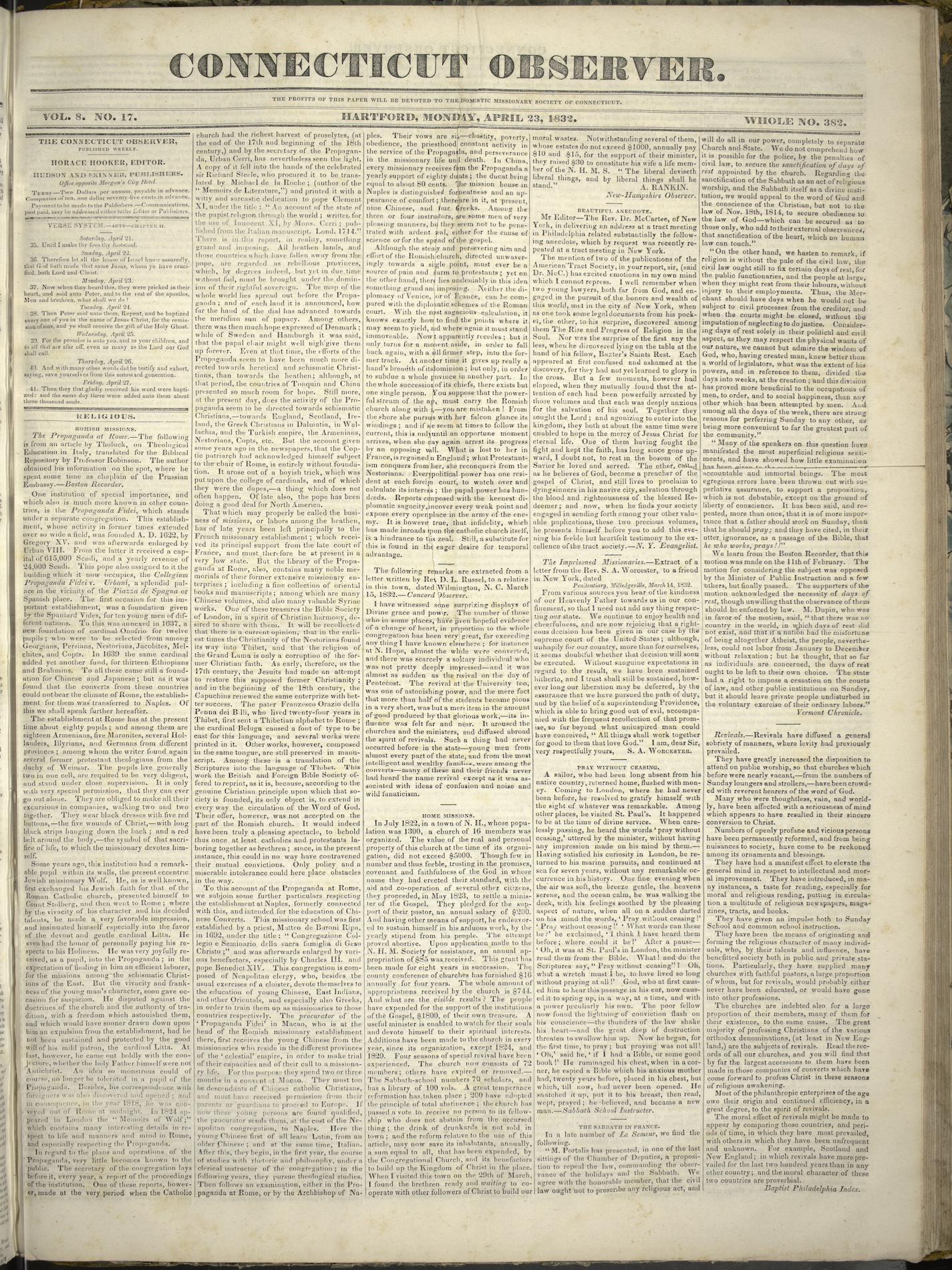
TextConnecticut Observer, Hartford, Monday, April 23, 1832
Summary: The Connecticut Observer issued on Monday, April 23, 1832. Includes a list of daily Bible verses, articles on religious news, reports on sunday schools, reports on mission work, excerpts of sermons, poetry, marriage and death notices, community event notices, advertisements, letters to the editor, and excerpts from other newspapers.Summary: The Connecticut Observer issued on Monday, April 23, 1832. Includes a list of daily Bible verses, articles on religious news, reports on sunday schools, reports on mission work, excerpts of sermons, poetry, marriage and death notices, community event notices, advertisements, letters to the editor, and excerpts from other newspapers. -
 Still image
Cruaictez horibles exercées contre les Chrétiens, sous Diocletien et Maximien, A. 301
Luiken, Jan, 1649-1712An engraving depicting various tortures and executions of Christians during the persecutions ordered under Emperors Diocletian and Maximian. The image shows five different methods of crucifixion (right), people being burned at the stake (center, background), a man being beaten (center), a figure being attacked by dogs (bottom left), and a figure being stabbed, covered in oil, and burned (left), all while the Emperors watch (top left, background).An engraving depicting various tortures and executions of Christians during the persecutions ordered under Emperors Diocletian and Maximian. The image shows five different methods of crucifixion (right), people being burned at the stake (center, background), a man being beaten (center), a figure being attacked by dogs (bottom left), and a figure being stabbed, covered in oil, and burned (left), all while the Emperors watch (top left, background). -
 Text
TextD. Erasmi Roterodami De praeparatione ad mortem liber : cum primis pius, nunc primum & conscriptus & editus
Erasmus, Desiderius, -1536Summary: Composed by Erasmus of Rotterdam, at the latest, in 1533, this tract on preparing for death first appeared in printed form in Basel at the beginning of 1534. This printing was followed by the Cologne printing in April. It is dedicated to Thomas Boleyn, Earl of Wiltshire and Ormond (1477-1539), the father of Henry VIII's second wife, Anne Boleyn.Summary: Composed by Erasmus of Rotterdam, at the latest, in 1533, this tract on preparing for death first appeared in printed form in Basel at the beginning of 1534. This printing was followed by the Cologne printing in April. It is dedicated to Thomas Boleyn, Earl of Wiltshire and Ormond (1477-1539), the father of Henry VIII's second wife, Anne Boleyn. -
 Still image
David et Levina etranglez et brulez à Gand, A. 1554
Luiken, Jan, 1649-1712An engraving depicting the execution of David and Levina. The image shows Levina and David having been strangled and burned at the stake, and a man stabbing David to make sure he is dead.An engraving depicting the execution of David and Levina. The image shows Levina and David having been strangled and burned at the stake, and a man stabbing David to make sure he is dead. -
 Still image
Death in the Cemetery
Holbein, Hans, 1497-1543A woodcut depicting a band of skeletons playing musical instruments in a cemetery. The woodcut is accompanied by verses from Revelations 8 and Genesis 7 translated into French (top) and then reformatted into verse (bottom).A woodcut depicting a band of skeletons playing musical instruments in a cemetery. The woodcut is accompanied by verses from Revelations 8 and Genesis 7 translated into French (top) and then reformatted into verse (bottom). -
 Text
TextDer Todt ein Endt, aller Yrdischen ding
Sachs, Hans, 1494-1576Summary: In this "New Year's Wish," Hans Sachs considers the problem of a man facing death. He calls first upon his physical attributes--youth, beauty, strenght, etc,--but finds they cannot help him. It is the spiritual factors of Sorrow, Confession, Pepentance, Hope, Faith and above all Love, that give him good counsel and rouse him from the dream of Death. This is the second printing of the revised version.Summary: In this "New Year's Wish," Hans Sachs considers the problem of a man facing death. He calls first upon his physical attributes--youth, beauty, strenght, etc,--but finds they cannot help him. It is the spiritual factors of Sorrow, Confession, Pepentance, Hope, Faith and above all Love, that give him good counsel and rouse him from the dream of Death. This is the second printing of the revised version. -
 Still image
Deux Jeunes Filles tuées dans l'Evêché de Bamberg environ l'An 1550
Luiken, Jan, 1649-1712An engraving depicting the execution of two young women. The image shows the young women, with crowns of straw on their heads, being led towards a stake being prepared in the background.An engraving depicting the execution of two young women. The image shows the young women, with crowns of straw on their heads, being led towards a stake being prepared in the background. -
 Still image
Douze persones decapitées et brulées à Deventer, A. 1571
Luiken, Jan, 1649-1712An engraving depicting the public execution of a dozen people. The image shows a card of people being brought to an execution platforms where several have already been bound to stakes which are being prepared to be burned.An engraving depicting the public execution of a dozen people. The image shows a card of people being brought to an execution platforms where several have already been bound to stakes which are being prepared to be burned. -
 Still image
Dulcin avec sa femme déchurez par piéces et brulez à Novare, A. 1308
Luiken, Jan, 1649-1712An engraving depicting the execution of Fra. Dolcino and his wife (co-preacher or concubine), Margaret of Trent. The image shows Dolcino being cut to pieces by two men while another two grab at Margaret and a fire is prepared in the background.An engraving depicting the execution of Fra. Dolcino and his wife (co-preacher or concubine), Margaret of Trent. The image shows Dolcino being cut to pieces by two men while another two grab at Margaret and a fire is prepared in the background. -
 Text
TextEin nützlich vnd fast tröstlich predig, oder vnderrichtung, : wie sich ein Christen mensch mit freüdenn bereyten sol zü sterbenn
Luther, Martin, 1483-1546Summary: Sermon prepared at the request of Spalatin for M. Schart on worthy preparation for death, but never preached.Summary: Sermon prepared at the request of Spalatin for M. Schart on worthy preparation for death, but never preached. -
 Still image
Environ 350 Personnes tuées près d'Altzey par par ordre de l'Empereur, A. 1529
Luiken, Jan, 1649-1712An engraving depicting the execution and torture of some 350 people in Alzey on the orders of the Holy Roman Emperor. The image shows a man having his fingers removed with a chisel (right), a man being blindfolded in preparation for beheading (center), and a bound man with a cross burned onto his forehead (left).An engraving depicting the execution and torture of some 350 people in Alzey on the orders of the Holy Roman Emperor. The image shows a man having his fingers removed with a chisel (right), a man being blindfolded in preparation for beheading (center), and a bound man with a cross burned onto his forehead (left). -
 Still image
Environ 80 Vaudois brulez à Strasbourg, A. 1215
Luiken, Jan, 1649-1712An engraving depicting the burning of eighty Waldensians in Strasbourg. The image shows a number of individuals already tied to stakes (right) while others are being prepared to be led to the pyres (left).An engraving depicting the burning of eighty Waldensians in Strasbourg. The image shows a number of individuals already tied to stakes (right) while others are being prepared to be led to the pyres (left). -
 Text
TextEpitaph on Dr. Dodd by John Wesley
An epitaph written for Dr. Dodd by John Wesley.An epitaph written for Dr. Dodd by John Wesley. -
 Still image
Expulsion from the Garden of Eden
Holbein, Hans, 1497-1543A woodcut depicting Adam and Eve being driven from the garden of Eden by an angel. The woodcut is accompanied by a verse from Genesis 3 translated into French (top) and then reformatted into verse (bottom).A woodcut depicting Adam and Eve being driven from the garden of Eden by an angel. The woodcut is accompanied by a verse from Genesis 3 translated into French (top) and then reformatted into verse (bottom). -
 Still image
Felicitas, de Tuburbi en Mauritanie, mise, à mort A. 201
Luiken, Jan, 1649-1712An engraving depicting the martyrdom of Saint Felicity. The image shows Felicity being approached by a guard holding a set of keys, her hands clasped in prayer and chained to the prison wall by her neck. According to tradition, Felicity was martyred alongside Saint Perpetua, was an enslaved woman, and was pregnant at the time.An engraving depicting the martyrdom of Saint Felicity. The image shows Felicity being approached by a guard holding a set of keys, her hands clasped in prayer and chained to the prison wall by her neck. According to tradition, Felicity was martyred alongside Saint Perpetua, was an enslaved woman, and was pregnant at the time. -
 Still image
Felicitas, mise à mort avec ses 7 fils à Rome, A. 164
Luiken, Jan, 1649-1712An engraving depicting the martyrdom of Saint Felicitas and her seven sons. The image shows five of the seven sons already dead, with one beheaded and another kneeling as the executioner prepares to behead him (left). On the right, Felicitas watches with her final son bound behind her (left).An engraving depicting the martyrdom of Saint Felicitas and her seven sons. The image shows five of the seven sons already dead, with one beheaded and another kneeling as the executioner prepares to behead him (left). On the right, Felicitas watches with her final son bound behind her (left). -
 Still image
Four Horsemen of the Apocalypse
Cranach, Lucas, 1472-1553A woodcut depicting the Four Horsemen of the Apocalypse: the first, a conquerer with a crown and bow, the second, with a sword, tasked with taking peace from the earth, the third holding scales, and the fourth, Death itself. The image appears in the September Testament, Martin Luther's first printing of his German New Testament.A woodcut depicting the Four Horsemen of the Apocalypse: the first, a conquerer with a crown and bow, the second, with a sword, tasked with taking peace from the earth, the third holding scales, and the fourth, Death itself. The image appears in the September Testament, Martin Luther's first printing of his German New Testament. -
 Still image
Grand nombre de Chrétiens brulez sous le nom de Publicains en France et en Angleterre, A. 1182
Luiken, Jan, 1649-1712An engraving depicting a number of Waldensians and Albigenses, called "Publicans," being burned. The image shows a bound man being pushed into a bonfire, where several others have already been thrown, as a bishop and priest watch.An engraving depicting a number of Waldensians and Albigenses, called "Publicans," being burned. The image shows a bound man being pushed into a bonfire, where several others have already been thrown, as a bishop and priest watch. -
 Still image
Guillaume Iansz, de Durgerdam, brulé à Amsterdam, A. 1569
Luiken, Jan, 1649-1712An engraving depicting the execution of Willem Janss. The image shows Janss stepping up onto a bundle of wood beside a post as a monk and crowd watch.An engraving depicting the execution of Willem Janss. The image shows Janss stepping up onto a bundle of wood beside a post as a monk and crowd watch. -
 Still image
Guillaume White, Prêtre en Angleterre brulé comme héretique à Nordwich, A. 1428
Luiken, Jan, 1649-1712An engraving depicting the execution of William White, a preacher and accused heretic. The image shows william standing before the stake he is to be burned at, while a bishop oversees the proceedings.An engraving depicting the execution of William White, a preacher and accused heretic. The image shows william standing before the stake he is to be burned at, while a bishop oversees the proceedings. -
 Still image
Henri Eemkens, brulé à Utrecht, A. 1562
Luiken, Jan, 1649-1712An engraving depicting the execution of Heyndrick Eemkens. The image shows Eemkens bound by his neck to a post (right) and his executioner holding out a burning bundle of straw laced with gunpowder towards him.An engraving depicting the execution of Heyndrick Eemkens. The image shows Eemkens bound by his neck to a post (right) and his executioner holding out a burning bundle of straw laced with gunpowder towards him. -
 Still image
Henri Pruyt, garotté dans son bateau, et brulé avec lui hors de Worcom, A. 1574
Luiken, Jan, 1649-1712An engraving depicting the execution of Hendrick Pruyt. The image shows Pruyt siting in his boat which has been set aflame.An engraving depicting the execution of Hendrick Pruyt. The image shows Pruyt siting in his boat which has been set aflame. -
 Still image
Henri Sumer et Iacob Mandel noyez à Baden, A. 1582
Luiken, Jan, 1649-1712An engraving depicting the executin of Hendrick Sumer and Jacob Mandel. The image shows Mandel's body laid out before Sumer in an attempt to convince him to recant.An engraving depicting the executin of Hendrick Sumer and Jacob Mandel. The image shows Mandel's body laid out before Sumer in an attempt to convince him to recant. -
 Still image
Historiated title page of De Biblie
Altdorfer, Erhard, approximately 1480-approximately 1570The title page of Martin Luther's Low German translation of the Bible featuring a collection of biblical scenes and symbols based on Lucas Cranach the Elder's painting, "Law and Gospel" (or "Sin and Redemption"). On the left of the image are scenes representing Law/Sin, including: a dead tree, Moses receiving the Ten Commandments, Adam and Eve, the brazen serpent, and a corpse lying atop a tomb.The title page of Martin Luther's Low German translation of the Bible featuring a collection of biblical scenes and symbols based on Lucas Cranach the Elder's painting, "Law and Gospel" (or "Sin and Redemption"). On the left of the image are scenes representing Law/Sin, including: a dead tree, Moses receiving the Ten Commandments, Adam and Eve, the brazen serpent, and a corpse lying atop a tomb. -
 Still image
Historiated title page of Theatre des Martyrs
Luiken, Jan, 1649-1712An engraved title page to Jean Luiken's Theatre des Martyrs. In the center, there is a depiction of several martyrdoms, including being boiled, being spun on a wheel across spikes, and burning at the stake, under which is the phrase, "per angusta ad augusta" (from crisis to glory). Forming a border around the title information is a collection of weapons and instruments of torture which are related to various martyrdoms, including: swords, maces, spears, arrows, axes, clubs, halberds, flails, saws, knives, chains, manacles, torches, mallets, anchors, and a crown of thorns.An engraved title page to Jean Luiken's Theatre des Martyrs. In the center, there is a depiction of several martyrdoms, including being boiled, being spun on a wheel across spikes, and burning at the stake, under which is the phrase, "per angusta ad augusta" (from crisis to glory). Forming a border around the title information is a collection of weapons and instruments of torture which are related to various martyrdoms, including: swords, maces, spears, arrows, axes, clubs, halberds, flails, saws, knives, chains, manacles, torches, mallets, anchors, and a crown of thorns. -
 Still image
Honorïcus, Roi des Vandales, persecuteur des Chretiens, est ronge des vers et des pous, A. 477
Luiken, Jan, 1649-1712An engraving depicting the death of the Vandal king, Huneric, by "worms and pus," as punishment for persecuting the Christians. The image shows Huneric lying on a bed, his left hand and foot fallen off, while his gathered attendants cover their faces against the smell.An engraving depicting the death of the Vandal king, Huneric, by "worms and pus," as punishment for persecuting the Christians. The image shows Huneric lying on a bed, his left hand and foot fallen off, while his gathered attendants cover their faces against the smell. -
 Still image
Iacob Dirksz brulé avec ses deux fils à Anvers, A. 1568
Luiken, Jan, 1649-1712An engraving depicting the execution of Jacob Dircks and his two older sons. The image shows Dircks and his older sons being led towards a trio of posts where they are to be burned while Dircks' youngest son wraps his arms around his father's neck.An engraving depicting the execution of Jacob Dircks and his two older sons. The image shows Dircks and his older sons being led towards a trio of posts where they are to be burned while Dircks' youngest son wraps his arms around his father's neck. -
 Still image
Iean Bosch, brulé à Mastricht, A. 1559
Luiken, Jan, 1649-1712An engraving depicting the execution of Jan Bosch. The image shows Bosch praying within a burning straw frame as an executioner watches.An engraving depicting the execution of Jan Bosch. The image shows Bosch praying within a burning straw frame as an executioner watches. -
 Still image
Iean Hus
Picart, Bernard, 1673-1733An engraving depicting a portrait of Jan Hus, framed in laurels, with a depiction of his execution by burning at the stake below the portrait.An engraving depicting a portrait of Jan Hus, framed in laurels, with a depiction of his execution by burning at the stake below the portrait. -
 Still image
Iean Koch et Léonard Meyster, tueez à Ausbourg, A. 1524
Luiken, Jan, 1649-1712An engraving depicting the execution of Hans Koch and Leonhard Meister. The image shows Koch and Meister with hands held in prayer as they are directed towards an executioner's platform.An engraving depicting the execution of Hans Koch and Leonhard Meister. The image shows Koch and Meister with hands held in prayer as they are directed towards an executioner's platform. -
 Still image
Iean Misel, decapité à Warthausen, A. 1571
Luiken, Jan, 1649-1712An engraving depicting the execution of Hans Misel. The image shows Misel kneeling with blood spurting from his neck as his head lays on the ground beside him, his executioner moving to kick is body over as a crowd watches.An engraving depicting the execution of Hans Misel. The image shows Misel kneeling with blood spurting from his neck as his head lays on the ground beside him, his executioner moving to kick is body over as a crowd watches. -
 Still image
Iean Smit, pendu hors de Harlem, A. 1572
Luiken, Jan, 1649-1712An engraving depicting the execution of Jan Smit. The image shows Smit hung by the ankle from a gallows outside of Haarlem.An engraving depicting the execution of Jan Smit. The image shows Smit hung by the ankle from a gallows outside of Haarlem. -
 Still image
Iean Woutersz, de Kuyk et Adrienne Ians de Molenaarsgraaf brulez a Dordrecht, A. 1572
Luiken, Jan, 1649-1712An engraving depicting the execution of Jan Wouterss van Kuyck and Adriaen Jans of Molenaersgraef. The image shows Jans being bound to a post atop an execution platform while Wouterss addresses the crowd.An engraving depicting the execution of Jan Wouterss van Kuyck and Adriaen Jans of Molenaersgraef. The image shows Jans being bound to a post atop an execution platform while Wouterss addresses the crowd. -
 Still image
Iean, marchand à Cordoue mis à reculons sur un àne, et en suite brulé, A. 850
Luiken, Jan, 1649-1712An engraving depicting the martyrdom of John, a merchant of Cordoba. The image shows John bound and sitting backwards on a donkey being led by a Muslim (evidinced by the star and moon symbols on their clothes).An engraving depicting the martyrdom of John, a merchant of Cordoba. The image shows John bound and sitting backwards on a donkey being led by a Muslim (evidinced by the star and moon symbols on their clothes). -
 Still image
Ierôme de Prague
Picart, Bernard, 1673-1733An engraving depicting a portrait of Jerome of Prague with a fire built below the portrait, the flames catching along the sides and frame in reference to his execution by burning at the stake.An engraving depicting a portrait of Jerome of Prague with a fire built below the portrait, the flames catching along the sides and frame in reference to his execution by burning at the stake. -
 Still image
Ioris Wippe, noyé dans un tonneau à Dordrecht, A. 1558
Luiken, Jan, 1649-1712An engraving depicting the execution of Ioris Wippe. The image shows Wippe bound and standing backwards in front of a wine barrel in a dungeon as another man pushes him backwards towards the filled barrel.An engraving depicting the execution of Ioris Wippe. The image shows Wippe bound and standing backwards in front of a wine barrel in a dungeon as another man pushes him backwards towards the filled barrel. -
 Still image
Iulitta, fauetée à Tarse, te mise a mort avec ses enfaris, A. 304
Luiken, Jan, 1649-1712An engraving depicting the martyrdom of Julitta and her child, Cyricus. The image shows Julitta tied to a post and being whipped (left), a hook for torture on the ground beside her, and the governor of Tarsus holding Julitta's child, Cyricus, by the legs, preparing to throw him down a staircase (right).An engraving depicting the martyrdom of Julitta and her child, Cyricus. The image shows Julitta tied to a post and being whipped (left), a hook for torture on the ground beside her, and the governor of Tarsus holding Julitta's child, Cyricus, by the legs, preparing to throw him down a staircase (right). -
 Still image
Iuriaan Simons, Clement Dirksz, et Marie Ioris brulez à Harlem, A. 1557
Luiken, Jan, 1649-1712An engraving depicting the execution of Joriaen Simons, Clement Dirks, and Marie Joris. The image shows the two figures being burnt at the stake (left) and a crowd of people rescuing books, which had belonged to Simons, from a fire.An engraving depicting the execution of Joriaen Simons, Clement Dirks, and Marie Joris. The image shows the two figures being burnt at the stake (left) and a crowd of people rescuing books, which had belonged to Simons, from a fire. -
 Still image
Jean Knel brulé à Londres, A. 1550
Luiken, Jan, 1649-1712An engraving depicting the execution of Johan Knel (or possibly Büchner). The image shows Knel being bound to a stake with bundles of wood placed beneath as a monk attempts to plead with him.An engraving depicting the execution of Johan Knel (or possibly Büchner). The image shows Knel being bound to a stake with bundles of wood placed beneath as a monk attempts to plead with him. -
 Text
TextJohn Wesley's tomb inscription
A manuscript copy of the inscription found on John Wesley's tomb.A manuscript copy of the inscription found on John Wesley's tomb. -
 Still image
L'Apotre S. Philippe martirisé a Hierapolis en Phrygie, A. 54
Luiken, Jan, 1649-1712An engraving depicting the martyrdom of Saint Phillip the Apostle. The image shows Philip standing against a pillar with hands raised in prayer as he looks away from the crowd which is stoning him to death.An engraving depicting the martyrdom of Saint Phillip the Apostle. The image shows Philip standing against a pillar with hands raised in prayer as he looks away from the crowd which is stoning him to death. -
 Still image
L'Empereur Maximin fait bruler un grand nombre de Chrétiens, environ l'An 237
Luiken, Jan, 1649-1712An engraving depicting the burning of a building full of Christians by order of Emperor Maximinus I.An engraving depicting the burning of a building full of Christians by order of Emperor Maximinus I. -
 Still image
L'Exposition du Corps à la Porte du Logis et L'Ôfrande de Pain et du Vin à la Mese des Morts
Picart, Bernard, 1673-1733A pair of engravings depicting the display of the body within a coffin before the house of the deceased or their family (top) and the offering of the Eucherist during a mass of requiem for the dead (bottom).A pair of engravings depicting the display of the body within a coffin before the house of the deceased or their family (top) and the offering of the Eucherist during a mass of requiem for the dead (bottom). -
 Still image
La Communion et le Viatique
Picart, Bernard, 1673-1733A pair of engravings depicting parishioners taking Communion (top) and a priest delivering the Eucharist as part of the last rites (bottom).A pair of engravings depicting parishioners taking Communion (top) and a priest delivering the Eucharist as part of the last rites (bottom). -
 Still image
La Confession et Extreme Onction
Picart, Bernard, 1673-1733A pair of engravings depicting penitents stepping into the confessional to confess their sins to a priest (top) and a priest anointing a dying man as part of the last rites (bottom).A pair of engravings depicting penitents stepping into the confessional to confess their sins to a priest (top) and a priest anointing a dying man as part of the last rites (bottom). -
 Still image
Laurens Iansz Nooddruft, de Delft, brulé à Anvers, A. 1577
Luiken, Jan, 1649-1712An engraving depicting Lauwerens Janss Noodtdruft being led to execution. The image shows Noodtdruft bound and flanked by guards and a monk.An engraving depicting Lauwerens Janss Noodtdruft being led to execution. The image shows Noodtdruft bound and flanked by guards and a monk. -
 Still image
Les Chretiens en Pologne persecuté par leur Roi Sigismond, l'an 1617
Luiken, Jan, 1649-1712An engraving depicting the persecution of Protestants under King Sigismund in Poland. The image shows two clergymen overseeing the beating and murder of people in the streets and the burning of a building.An engraving depicting the persecution of Protestants under King Sigismund in Poland. The image shows two clergymen overseeing the beating and murder of people in the streets and the burning of a building. -
 Still image
Les cruautez du Duc d'Albe dans les Pais-bas, l'an 1567
Luiken, Jan, 1649-1712An engraving depicting the torture of Anabaptists in the Netherlands under the rule of the Duke of Alba. The image shows torturers afixing vises to the tongues of two men and heating them with iron (left and right) and a number of individuals being burned at the stake (background).An engraving depicting the torture of Anabaptists in the Netherlands under the rule of the Duke of Alba. The image shows torturers afixing vises to the tongues of two men and heating them with iron (left and right) and a number of individuals being burned at the stake (background). -
 Text
TextLetter from Holland McTyeire (Nashville, Tennessee) to Robert Paine - December 24, 1877
McTyeire, Holland Nimmons, 1824-1889A letter from Holland Nimmons McTyeire to Robert Paine discussing actions he has taken after of the death of Bishop Enoch Mather Marvin to address concerns in Marvin's former Episcopal district, asking if Paine would like McTyeire to manage Marvin's districts until May, and sharing that there seems to be some unrest brewing in the St. Louis Conference following Marvin's death.A letter from Holland Nimmons McTyeire to Robert Paine discussing actions he has taken after of the death of Bishop Enoch Mather Marvin to address concerns in Marvin's former Episcopal district, asking if Paine would like McTyeire to manage Marvin's districts until May, and sharing that there seems to be some unrest brewing in the St. Louis Conference following Marvin's death. -
 Text
TextLetter from John Early (Lynchburg, Virginia) to Robert Paine (Aberdeen, Mississippi) - January 15, 1858
Early, John, 1786-1873A letter from John Early to Robert Paine reporting that he is recovering his health, sharing that his son has left after the death of Early's wife, expressing his intention to request that James Temple be transferred to Natchez, asking for an explanation about the transfer of John P. Dickinson and James B. Smith to the Alabama and Florida Conferences respectively, requesting a preacher be found to be transferred to Abingdon in Virginia, and asking after Paine's family and the late Bishop McKendree's wife.A letter from John Early to Robert Paine reporting that he is recovering his health, sharing that his son has left after the death of Early's wife, expressing his intention to request that James Temple be transferred to Natchez, asking for an explanation about the transfer of John P. Dickinson and James B. Smith to the Alabama and Florida Conferences respectively, requesting a preacher be found to be transferred to Abingdon in Virginia, and asking after Paine's family and the late Bishop McKendree's wife. -
 Text
TextLetter from John Wesley to "Peggy" Margaret (Dale) Avision, London
Wesley, John, 1703-1791A letter from John Wesley to "Peggy" Margaret (Dale) Avision asking why she believes she will not live past the age of 23.A letter from John Wesley to "Peggy" Margaret (Dale) Avision asking why she believes she will not live past the age of 23. -
 Text
TextLetter from John Wesley to Charles Wesley, London
Wesley, John, 1703-1791A letter from John Wesley to his brother, Charles, concerning testimony and judgement; urging his brother to heed his advice.A letter from John Wesley to his brother, Charles, concerning testimony and judgement; urging his brother to heed his advice. -
 Text
TextLetter from John Wesley to Charles Wesley, London
Wesley, John, 1703-1791A letter from John Wesley to Charles Wesley asking for his opinion on a formal petition, relaying the conditions of various people, and requesting translations of biblical and Greek verses.A letter from John Wesley to Charles Wesley asking for his opinion on a formal petition, relaying the conditions of various people, and requesting translations of biblical and Greek verses. -
 Text
TextLetter from John Wesley to Elizabeth (Harvey) Woodhouse, London
Wesley, John, 1703-1791A letter from John Wesley to Elizabeth Woodhouse consoling her concerning her father's passing, giving advice on accepting, but not relying on visions from God for guidance, and advising her to take comfort in God's work.A letter from John Wesley to Elizabeth Woodhouse consoling her concerning her father's passing, giving advice on accepting, but not relying on visions from God for guidance, and advising her to take comfort in God's work. -
 Text
TextLetter from John Wesley to Sarah (Gwynne) Wesley, Manchester
Wesley, John, 1703-1791A letter from John Wesley to Sarah (Gwynne) Wesley thanking her for sending him news of his brother, Charles', death and comforting her at the loss of her husband.A letter from John Wesley to Sarah (Gwynne) Wesley thanking her for sending him news of his brother, Charles', death and comforting her at the loss of her husband. -
 Text
TextLetter from John Wesley to Sarah Wesley, Blackburn
Wesley, John, 1703-1791A letter from John Wesley to Sarah Wesley thanking her for sending an account of his brother, Charles', last words and encouraging her to keep her faith strong.A letter from John Wesley to Sarah Wesley thanking her for sending an account of his brother, Charles', last words and encouraging her to keep her faith strong. -
 Text
TextLetter from John Wesley to Sarah Wesley, Manchester
Wesley, John, 1703-1791A letter from John Wesley to Sarah Wesley thanking her for her accounnt of his brother, Charles', death and comforting her at the loss of her father.A letter from John Wesley to Sarah Wesley thanking her for her accounnt of his brother, Charles', death and comforting her at the loss of her father. -
 Text
TextLetter from Joshua Soule (Lebanon, Ohio) to Robert Paine - October 28, 1851
Soule, Joshua, 1781-1867A letter from Joshua Soule to Robert Paine giving an update on his wife's health, sharing that it is unlikely that he will be able to make it to the Tennessee Conference due to health and weather reasons, assuring Paine of his intention to attend the Memphis Conference, asking if Paine would cover Soule's financial obligations at the Tennessee Conference (to be repaid upon Soule's next return to Nashville), confirming he has received the appointments for the Missouri Conference, asking after Bishop Capers' appointments, and mentioning the sudden death of Brother Lanius.A letter from Joshua Soule to Robert Paine giving an update on his wife's health, sharing that it is unlikely that he will be able to make it to the Tennessee Conference due to health and weather reasons, assuring Paine of his intention to attend the Memphis Conference, asking if Paine would cover Soule's financial obligations at the Tennessee Conference (to be repaid upon Soule's next return to Nashville), confirming he has received the appointments for the Missouri Conference, asking after Bishop Capers' appointments, and mentioning the sudden death of Brother Lanius. -
 Text
TextLetter from O. P. Fitzgerald (Nashville, Tennessee) to Mary Eliza (Millwater) Paine - May 1, 1882
Fitzgerald, O. P. (Oscar Penn), 1829-1911A letter from O. P. Fitzgerald, an editor at the Christian Advocate, to Mary Eliza Paine (née Millwater), offering his condolences on the death of her husband, Bishop Paine, asking if she is in possession of his drafts for the final installment of a series entitled "Notes of Life," and discussing the need to begin work on a biography of Bishop Paine.A letter from O. P. Fitzgerald, an editor at the Christian Advocate, to Mary Eliza Paine (née Millwater), offering his condolences on the death of her husband, Bishop Paine, asking if she is in possession of his drafts for the final installment of a series entitled "Notes of Life," and discussing the need to begin work on a biography of Bishop Paine. -
 Text
TextLetter from Sarah (Gwynne) Wesley to Sarah Wesley
Wesley, Sarah Gwynne, 1726-1822A letter from Sarah (Gwynne) Wesley to her daughter, Sarah, expressing concern over her daughter's health, reporting on several visits from various acquaintances, discussing a visit by Lord and Lady Andrews to hear her son, Charles, play, sharing the news of Mrs. Dyer's passing, and sending along news and well-wishes from friends.A letter from Sarah (Gwynne) Wesley to her daughter, Sarah, expressing concern over her daughter's health, reporting on several visits from various acquaintances, discussing a visit by Lord and Lady Andrews to hear her son, Charles, play, sharing the news of Mrs. Dyer's passing, and sending along news and well-wishes from friends. -
 Text
TextLetter from Sarah Wesley to Sarah (Gwynne) Wesley
Wesley, Sarah 1760-1828A letter from Sarah Wesley to her mother, Sarah (Gwynne) Wesley, declaring her intent to return to Marylebone soon, describing the financial hardships of her cousins, praising the hospitality of the Staffords, relating the struggles of Miss Jones who has had to care for two dying brothers, sending her well wishes to the family of Mrs. Dyer, updating her mother on her father's plans to return and of his preaching in honor of the late Mr. Fletcher, asking about having a straw hat enlarged, and reporting on the status of several acquaintances.A letter from Sarah Wesley to her mother, Sarah (Gwynne) Wesley, declaring her intent to return to Marylebone soon, describing the financial hardships of her cousins, praising the hospitality of the Staffords, relating the struggles of Miss Jones who has had to care for two dying brothers, sending her well wishes to the family of Mrs. Dyer, updating her mother on her father's plans to return and of his preaching in honor of the late Mr. Fletcher, asking about having a straw hat enlarged, and reporting on the status of several acquaintances. -
 Text
TextLetter from Sarah Wesley to Sarah (Gwynne) Wesley, Ramsgate
Wesley, Sarah 1760-1828A letter from Sarah Wesley to her mother, Sarah (Gwynne) Wesley, thanking her mother for news of her aunt and asking for more news as it becomes available, offering comfort to her mother in the wake of her father's death, expressing her wish that her mother join her in Ramsgate, and insisting that if she cannot come to Ramsgate, Sarah will watch the house when she returns to London and send her mother to Guildford.A letter from Sarah Wesley to her mother, Sarah (Gwynne) Wesley, thanking her mother for news of her aunt and asking for more news as it becomes available, offering comfort to her mother in the wake of her father's death, expressing her wish that her mother join her in Ramsgate, and insisting that if she cannot come to Ramsgate, Sarah will watch the house when she returns to London and send her mother to Guildford. -
 Text
TextLetter from Selina Hastings Huntingdon to Sarah (Gwynne) Wesley, Spa-Fields, March 2, 1791
Huntingdon, Selina Hastings, Countess of, 1707-1791A letter from Selina Hastings Huntingdon to Sarah Wesley thanking her for news of her parents, Sarah Gwynne and Charles Wesley, and asking for more information on the death of John Wesley.A letter from Selina Hastings Huntingdon to Sarah Wesley thanking her for news of her parents, Sarah Gwynne and Charles Wesley, and asking for more information on the death of John Wesley. -
 Text
TextLetter from an unidentified person to Thomas L. Douglass
A letter to Thomas L. Douglass from an unknown author, possibly Robert Paine, describing the death of Sterling C. Brown in Lebanon, Tennessee, including an account of a conversation the author had with Brown confirming Brown's faith just before his death.A letter to Thomas L. Douglass from an unknown author, possibly Robert Paine, describing the death of Sterling C. Brown in Lebanon, Tennessee, including an account of a conversation the author had with Brown confirming Brown's faith just before his death. -
 Still image
Life and Duties of a Catholic Bishop
Picart, Bernard, 1673-1733A series of six engravings depicting scenes in the life of a Roman Catholic bishop, including his blessing of holy oil (top right), a procession of holy oil (top left) , his encouragement of a parish (middle right), his visit to his diocese (middle left), a parishioner kissing his hand (bottom left), and the public display of his body after death (bottom right).A series of six engravings depicting scenes in the life of a Roman Catholic bishop, including his blessing of holy oil (top right), a procession of holy oil (top left) , his encouragement of a parish (middle right), his visit to his diocese (middle left), a parishioner kissing his hand (bottom left), and the public display of his body after death (bottom right). -
 Still image
Lisamante Kills Mélédin
Chauveau, François, 1613-1676An engraving depicting a scene from the thirteenth book of the epic poem, Saint Louys, in which Lisamante, having been taken prisoner by the Saracens, is urged by a vision of Judith to kill Sultan Mélédin, who had intended to marry Lisamante.An engraving depicting a scene from the thirteenth book of the epic poem, Saint Louys, in which Lisamante, having been taken prisoner by the Saracens, is urged by a vision of Judith to kill Sultan Mélédin, who had intended to marry Lisamante. -
 Text
TextLois Augusta Robinson to Donald and Elsie Lerch, August 2, 1958
Robinson, Lois AugustaA letter from Lois to her parents, Donald and Elsie, sending her condolences for the passing of Mr. Orcutt and Mr. Daniels, sharing that Morrell's mother has been caring for his father who's health has been deteriorating, giving an update on the family, reporting briefly on the clinic, describing the new stove that they recently got, and mentioning that the new couple have settled in Guayabo and that Gerado's replacement has arrived.A letter from Lois to her parents, Donald and Elsie, sending her condolences for the passing of Mr. Orcutt and Mr. Daniels, sharing that Morrell's mother has been caring for his father who's health has been deteriorating, giving an update on the family, reporting briefly on the clinic, describing the new stove that they recently got, and mentioning that the new couple have settled in Guayabo and that Gerado's replacement has arrived. -
 Text
TextLois Augusta Robinson to Donald and Elsie Lerch, November 11, 1958
Robinson, Lois AugustaA letter from Lois to her parents, Donald and Elsie, asking them for more details of their trip, describing the slightly improved situation in town and with the clinic, mentioning that they had a nice visit with the Nesman family, expressing some concern about running out of gas for cooking, informing them that Morrell's father passed away, reflecting on the current conflict and mentioning that the family has means of leaving if things get too dangerous, noting that no fighting has occured in Mayari and that both sides of the conflict seem to be trying to minimize any civilian involvementA letter from Lois to her parents, Donald and Elsie, asking them for more details of their trip, describing the slightly improved situation in town and with the clinic, mentioning that they had a nice visit with the Nesman family, expressing some concern about running out of gas for cooking, informing them that Morrell's father passed away, reflecting on the current conflict and mentioning that the family has means of leaving if things get too dangerous, noting that no fighting has occured in Mayari and that both sides of the conflict seem to be trying to minimize any civilian involvement -
 Text
TextLois Augusta Robinson to Donald and Elsie Lerch, November 4, 1956
Robinson, Lois AugustaA letter from Lois to her parents, Donald and Elsie, discussing the rainy weather which made it difficult for Morrell to travel to Nicaro to preach, giving a short update on Steed and Esther, expressing her desire to start back working at the clinic, discussing taking Esther with her to a nice afternoon tea with friends, mentioning that Morrell has been enjoying playing golf, updating them on their dog (Jack), and mentioning that Sammie and Sonny's mother-in-law is dying of cancer and that they are going to stay with their father.A letter from Lois to her parents, Donald and Elsie, discussing the rainy weather which made it difficult for Morrell to travel to Nicaro to preach, giving a short update on Steed and Esther, expressing her desire to start back working at the clinic, discussing taking Esther with her to a nice afternoon tea with friends, mentioning that Morrell has been enjoying playing golf, updating them on their dog (Jack), and mentioning that Sammie and Sonny's mother-in-law is dying of cancer and that they are going to stay with their father. -
 Text
TextLois Augusta Robinson to Elsie Lerch, January 17, 1959
Robinson, Lois AugustaA letter from Lois to her mother, Elsie, describing the process of reading through all of their delayed mail, discussing how life in Mayari is returning to normal and everyone is taking advantage of being able to travel freely and safely to visit, mentioning that Marta Gomez is back to help in the clinic and with the children once the baby comes, sharing that Morrell wrote to his mother and suggested that she come visit when the baby is born and that if Elsie could come as well that would be welcome, sending her condolences at the news of Bishop Branscomb's death, reporting that theA letter from Lois to her mother, Elsie, describing the process of reading through all of their delayed mail, discussing how life in Mayari is returning to normal and everyone is taking advantage of being able to travel freely and safely to visit, mentioning that Marta Gomez is back to help in the clinic and with the children once the baby comes, sharing that Morrell wrote to his mother and suggested that she come visit when the baby is born and that if Elsie could come as well that would be welcome, sending her condolences at the news of Bishop Branscomb's death, reporting that the -
 Text
TextLuctus et testimonia ecclesiae quae est in Comitatu Mansfeldensi de obitu reuerendi viri Matthaei Judicis : adiecta sunt, epitaphia Sanctae Matronae Annae, Vxoris: viri D. Til : Heshusii
Summary: Funeral sermons and tributes for the Lutheran theologian Matthaeus Richter (also known as Matthaeus Judex). Also included are epitaphs for Anna von Bert (1533–1564), wife of the theologian Tilemann Heshusius.Summary: Funeral sermons and tributes for the Lutheran theologian Matthaeus Richter (also known as Matthaeus Judex). Also included are epitaphs for Anna von Bert (1533–1564), wife of the theologian Tilemann Heshusius. -
 Still image
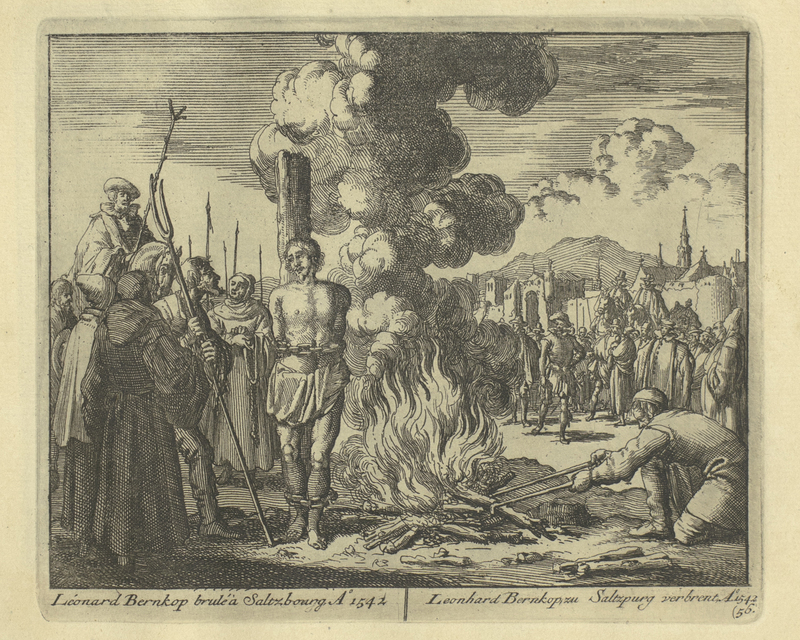
Léonard Bernkop brulé à Saltzbourg, A. 1542
Luiken, Jan, 1649-1712An engraving depicting the execution of Leonhard Bernkopff. The image shows Bernkopff bound to a stake while a man stokes a fire beside him.An engraving depicting the execution of Leonhard Bernkopff. The image shows Bernkopff bound to a stake while a man stokes a fire beside him. -
 Still image
Léonard Keyser, Pretre, brulé comme héretique à Schardingen, A. 1527
Luiken, Jan, 1649-1712An engraving depicting the execution of Leonhard Kaiser, a Lutheran martyr. The image shows Kaiser reaching down to pick a flower as he is carted towards a large bonfire in the background.An engraving depicting the execution of Leonhard Kaiser, a Lutheran martyr. The image shows Kaiser reaching down to pick a flower as he is carted towards a large bonfire in the background. -
 Still image
Léonard Plovier, Ieanne et Marie van Aken, noyez à Anvers, A. 1560
Luiken, Jan, 1649-1712An engraving depicting the execution of Lanaert Plovier, Jenne van Aken, and Marie van Aken. The image shows Plovier praying as he is placed in a sack (left), one of the van Aken's lying on the ground already bound in a sack (bottom), and the other van Aken (also bound in a sack) being placed head-first in a barrel of water.An engraving depicting the execution of Lanaert Plovier, Jenne van Aken, and Marie van Aken. The image shows Plovier praying as he is placed in a sack (left), one of the van Aken's lying on the ground already bound in a sack (bottom), and the other van Aken (also bound in a sack) being placed head-first in a barrel of water. -
 Text
TextMany deaths were reported: a memorial service held at Clifton Springs by the MIssionary Union
A report on the 1906 meeting of the International Missionary Union at Clifton Springs, New York, published in a newspaper. The article outlines the opening sessions, listing the members who passed away in the past year with notes on their contributions, and notes on the closing remarks.A report on the 1906 meeting of the International Missionary Union at Clifton Springs, New York, published in a newspaper. The article outlines the opening sessions, listing the members who passed away in the past year with notes on their contributions, and notes on the closing remarks. -
 Still image
Marie Wens étant brulée la bouche fermée avec une vis, son fils vient chercher cette vis pour en garder le souvenir, A. 1573
Luiken, Jan, 1649-1712An engraving depicting the aftermath of the execution of Marie Wens. The image shows Wens' sons searching through the ashes of their mother's pyre for something to remember her.An engraving depicting the aftermath of the execution of Marie Wens. The image shows Wens' sons searching through the ashes of their mother's pyre for something to remember her. -
 Still image
Marie, noyée à Monjou, A. 1552
Luiken, Jan, 1649-1712An engraving depicting the execution of a woman, Maria. The image shows Maria being bound at the edge of a dock, and as she removes her own outer garments, a monk attempts to encourage her to renounce her faith.An engraving depicting the execution of a woman, Maria. The image shows Maria being bound at the edge of a dock, and as she removes her own outer garments, a monk attempts to encourage her to renounce her faith. -
 Still image
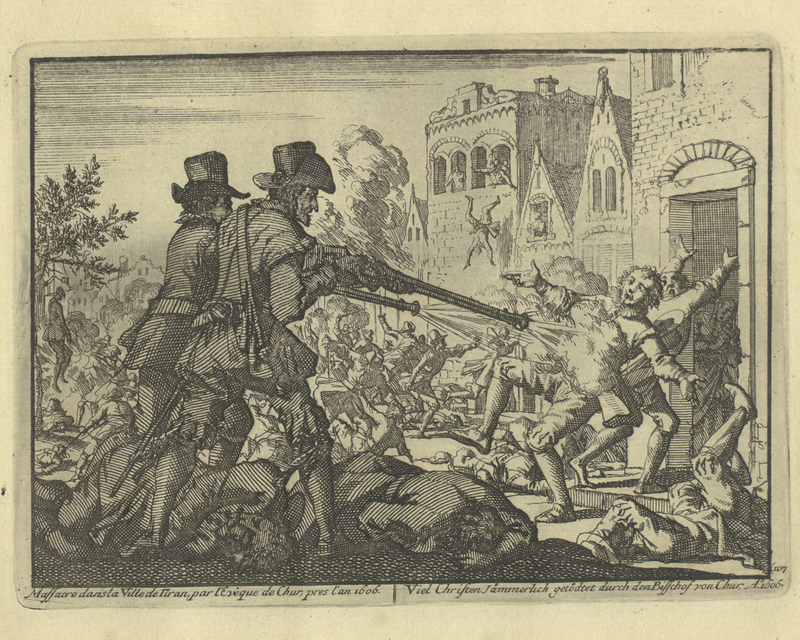
Massacre dans la Ville de Tiran, par l'Evêque de Chur, pres l'an 1606
Luiken, Jan, 1649-1712An engraving depicting the massacre of Anabaptists under the orders of the Bishop of Chur. The image shows two men shooting a third with rifles while standing over two bodies (foreground), people being thrown from windows (background, center), and people being hanged (background left).An engraving depicting the massacre of Anabaptists under the orders of the Bishop of Chur. The image shows two men shooting a third with rifles while standing over two bodies (foreground), people being thrown from windows (background, center), and people being hanged (background left). -
 Still image
Matthieu Mair, noyé à Wier, A. 1592
Luiken, Jan, 1649-1712An engraving depicting the execution of Mattheus Mair. The image shows Mair, bound, being lowered into a river as a crowd watches.An engraving depicting the execution of Mattheus Mair. The image shows Mair, bound, being lowered into a river as a crowd watches. -
 Still image
Matthieu Servaas, decapité à Cologne, A. 1565
Luiken, Jan, 1649-1712An engraving depicting the execution of Matthias Servaes. The image shows Servaes being led towards the execution site with hands held in prayer (right) while a young man (left) and woman (right) who had wished to speak with him and were apprehended are ordered to be releasted by a nobleman (right, on horse).An engraving depicting the execution of Matthias Servaes. The image shows Servaes being led towards the execution site with hands held in prayer (right) while a young man (left) and woman (right) who had wished to speak with him and were apprehended are ordered to be releasted by a nobleman (right, on horse). -
 Still image
Noah's Ark surviving the flood
Cranach, Lucas, 1472-1553A woodcut depicting Noah's Ark (Der Kaste Noe) safe and afloat amidst the torential rains (center). At the bottom of the image there is a field of fallen trees and dead people and animals left behind by the receeding waters. in the top left of the image there is a dove carrying an olive branch, signalling the receeding of the waters.A woodcut depicting Noah's Ark (Der Kaste Noe) safe and afloat amidst the torential rains (center). At the bottom of the image there is a field of fallen trees and dead people and animals left behind by the receeding waters. in the top left of the image there is a dove carrying an olive branch, signalling the receeding of the waters. -
 Text
TextOb man fur dem Sterben fliehen muge
Luther, Martin, 1483-1546Summary: The Black Death ravaged Europe from the fourteenth century onward. Dr. Johann Hess, a pastor from Breslau, asked Luther in 1527 whether it was permissible for a person to flee from plague-infested areas. Luther replied that it was, and then added some public health advice for town and city government officials in plague-ravaged areas. He advocated fumigation of this, the seventh printing of the work.Summary: The Black Death ravaged Europe from the fourteenth century onward. Dr. Johann Hess, a pastor from Breslau, asked Luther in 1527 whether it was permissible for a person to flee from plague-infested areas. Luther replied that it was, and then added some public health advice for town and city government officials in plague-ravaged areas. He advocated fumigation of this, the seventh printing of the work. -
 Text
TextOb man fur dem sterben fliehen muge
Luther, Martin, 1483-1546Summary: The Black Death ravaged Europe from the fourteenth century onward. Dr. Johann Hess, a pastor from Breslau, asked Luther in 1527 whether it was permissible for a person to flee from plague-infested areas. Luther replied that it was, and then added some public health advice for town and city government officials in plague-ravaged areas.Summary: The Black Death ravaged Europe from the fourteenth century onward. Dr. Johann Hess, a pastor from Breslau, asked Luther in 1527 whether it was permissible for a person to flee from plague-infested areas. Luther replied that it was, and then added some public health advice for town and city government officials in plague-ravaged areas. -
 Still image
Papal Funeral
Picart, Bernard, 1673-1733A series of six engravings depicting papal funeral rituals including the recognition of the pope’s body (top left), the procession of the body to Saint Peter’s basilica (second row), the body lying in state for three days at Saint Peter’s (third row left), the pope’s catafalque (a raised bier used to support the coffin) (third row right) and the funeral procession (bottom).A series of six engravings depicting papal funeral rituals including the recognition of the pope’s body (top left), the procession of the body to Saint Peter’s basilica (second row), the body lying in state for three days at Saint Peter’s (third row left), the pope’s catafalque (a raised bier used to support the coffin) (third row right) and the funeral procession (bottom). -
 Still image
Pelage, àgé de 13 ans, avant èu les bras et les piés coupez est brulé à Cordue, A. 925
Luiken, Jan, 1649-1712An engraving depicting the martyrdom of Pelagius of Córdoba. The image shows Pelagius being held up as his arms are cut off and the torturer prepares to cut off his feet.An engraving depicting the martyrdom of Pelagius of Córdoba. The image shows Pelagius being held up as his arms are cut off and the torturer prepares to cut off his feet. -
 Still image
Phocas, Evêque dans le Pont, mis dans unfour à chaux et Jetté dans l'eau bouillante à Sinope, environ l'An 118
Luiken, Jan, 1649-1712An engraving depicting the martyrdom of Phocas, the Bishop of Sinope. The image shows Phocas being tossed into a large, boiling bath (left) while a soldier (right) directs an old man's attention to the event. In the background a steaming lime kiln can be seen (right).An engraving depicting the martyrdom of Phocas, the Bishop of Sinope. The image shows Phocas being tossed into a large, boiling bath (left) while a soldier (right) directs an old man's attention to the event. In the background a steaming lime kiln can be seen (right). -
 Still image
Plan du Conclave et Description des Solomnités, qui s'observent à Rome aprés la mort d'un Pape, et pour l'Election d'un Successeur
Engraved title vignette, and other engravings.Engraved title vignette, and other engravings. -
 Still image
Polycarpe, cueque de Smyrne, mis à mort par le feu et par le fer, A. 168
Luiken, Jan, 1649-1712An engraving depicting the martyrdom of Saint Polycarp. The image shows Polycarp sitting on a blazing fire with eyes turned towards heaven as a man stabs him with a sword.An engraving depicting the martyrdom of Saint Polycarp. The image shows Polycarp sitting on a blazing fire with eyes turned towards heaven as a man stabs him with a sword. -
 Still image
Quatorze personnes brulées comme héretiques à Orleans, A. 1022
Luiken, Jan, 1649-1712An engraving depicting the burning of forty individuals accused of heresy by the Council of Orleans. The image depicts bound figures being lead to a massive bonfire.An engraving depicting the burning of forty individuals accused of heresy by the Council of Orleans. The image depicts bound figures being lead to a massive bonfire. -
 Still image
Rites upon the Death of a Bishop
A woodcut depicting funeral rites performed upon the death of a bishop. The body of the deceased bishop is laid on an ornate bier while five presiding bishops stand at each corner of the bier and at the head, offering prayers. The scene is flanked by a pair of cherubs holding rings and kneeling atop helmets. The woodcut is reused throughout the work.A woodcut depicting funeral rites performed upon the death of a bishop. The body of the deceased bishop is laid on an ornate bier while five presiding bishops stand at each corner of the bier and at the head, offering prayers. The scene is flanked by a pair of cherubs holding rings and kneeling atop helmets. The woodcut is reused throughout the work. -
 Still image
S. André Apotre, crucifié à Patras en Achaïe, environ L'An 70
Luiken, Jan, 1649-1712An engraving depicting the martyrdom of Saint Andrew the Apostle. The image shows Andrew bound with rope to an X-shaped cross while a crowd watches.An engraving depicting the martyrdom of Saint Andrew the Apostle. The image shows Andrew bound with rope to an X-shaped cross while a crowd watches. -
 Still image
S. Barnabé brulé a Salamine, en Cypre, A. 64
Luiken, Jan, 1649-1712An engraving depicting the martyrdom of Saint Barnabas. The image shows Barnabas being dragged by a rope around his neck towards a fire which is being built in the background.An engraving depicting the martyrdom of Saint Barnabas. The image shows Barnabas being dragged by a rope around his neck towards a fire which is being built in the background. -
 Still image
S. Barthelemi Apotre, écorché tout vif, et ensuite decapité en Arménie, A. 70
Luiken, Jan, 1649-1712An engraving depicting the martyrdom of Saint Bartholomew the Apostle. The image shows Bartholomew tied upsidedown to an X-shaped cross while two men flay him with knives before a crowd of onlookers, while in the foreground, a headsman's ax sits ready to behead him.An engraving depicting the martyrdom of Saint Bartholomew the Apostle. The image shows Bartholomew tied upsidedown to an X-shaped cross while two men flay him with knives before a crowd of onlookers, while in the foreground, a headsman's ax sits ready to behead him. -
 Still image
S. Etiené martirisé hors de Jerusalem, A. 34
Luiken, Jan, 1649-1712An engraving depicting the martyrdom of St. Stephan. The image shows Stephen kneeling outside the gates of Jerusalem as a crowd stones him to death.An engraving depicting the martyrdom of St. Stephan. The image shows Stephen kneeling outside the gates of Jerusalem as a crowd stones him to death. -
 Still image
S. Ignace, disciple S. Jean, devore par les betes farouches à Rome, A. 111
Luiken, Jan, 1649-1712An engraving depicting the martyrdom of Saint Ignatius of Antioch. The image shows Ignatius standing alone in an arena and facing an oncoming lion with open arms as a crowd watches.An engraving depicting the martyrdom of Saint Ignatius of Antioch. The image shows Ignatius standing alone in an arena and facing an oncoming lion with open arms as a crowd watches. -
 Still image
S. Jaques le Majeur; Apotre, decapité a Jerusalem, A. 45
Luiken, Jan, 1649-1712An engraving depicting the martyrdom of Saint James the Greater. The image shows James kneeling, blindfolded and with hands held in prayer, as a soldier prepares to decapitate him.An engraving depicting the martyrdom of Saint James the Greater. The image shows James kneeling, blindfolded and with hands held in prayer, as a soldier prepares to decapitate him. -
 Still image
S. Jaques le mineur, Apotre, martirisé et tué d'un coup de levier, a Jerusalem, A. 63
Luiken, Jan, 1649-1712An engraving depicting the martyrdom of Saint James the Less. The image shows James kneeling with hands raised in prayer as a crowd stones and beats him.An engraving depicting the martyrdom of Saint James the Less. The image shows James kneeling with hands raised in prayer as a crowd stones and beats him. -
 Still image
S. Jean Baptiste decapiti, l'An de Christ 32
Luiken, Jan, 1649-1712An engraving depicting the decapitation of John the Baptist. The scene shows a guard holding the bindings around the arms of John, whose body lays on the floor of the dungeon bleeding from the neck as the executioner walks towards the guarded door with John's head on a platter.An engraving depicting the decapitation of John the Baptist. The scene shows a guard holding the bindings around the arms of John, whose body lays on the floor of the dungeon bleeding from the neck as the executioner walks towards the guarded door with John's head on a platter. -
 Still image
S. Luc Evangeliste, pendii à uri olivier dans la Gréce environ L'An 93
Luiken, Jan, 1649-1712An engraving depicting the martyrdom of Saint Luke the Evangelist. The image shows Luke having been hanged before a crowd from an olive tree.An engraving depicting the martyrdom of Saint Luke the Evangelist. The image shows Luke having been hanged before a crowd from an olive tree. -
 Still image
S. Marc L'Evangeliste, trainé á Alexandrie pour être brulé, meurt en chemin, A. 64
Luiken, Jan, 1649-1712An engraving depicting the martyrdom of Saint Mark the Evangelist. The image shows Marc being dragged with ropes and hooks.An engraving depicting the martyrdom of Saint Mark the Evangelist. The image shows Marc being dragged with ropes and hooks. -
 Still image
S. Matthias Apotre crucifié lapidé et ensuite decapité A. 70
Luiken, Jan, 1649-1712An engraving depicting the martyrdom of Saint Matthias the Apostle. The image shows Matthias bound to a cross and stoned by a crowd while an ax sits ready (bottom right) to behead him.An engraving depicting the martyrdom of Saint Matthias the Apostle. The image shows Matthias bound to a cross and stoned by a crowd while an ax sits ready (bottom right) to behead him. -
 Still image
S. Matthieu Apotre, et Evangeliste, Cloué à la terre et decapité à Nadavar en Ethiopié, A. 70
Luiken, Jan, 1649-1712An engraving depicting the martyrdom of Saint Matthew the Apostle and Evangelist. The image shows Matthew nailed to the ground by both his hands and feet as an executioner stands above him wielding an axe and preparing to behead him.An engraving depicting the martyrdom of Saint Matthew the Apostle and Evangelist. The image shows Matthew nailed to the ground by both his hands and feet as an executioner stands above him wielding an axe and preparing to behead him. -
 Still image
S. Paul Apotre, decapité á Rome sous Neron, A. 69
Luiken, Jan, 1649-1712An engraving depicting the martyrdom of Saint Paul the Apostle. The image shows Paul kneeling and blindfolded with hands together in prayer as the executioner unsheathes his sword and looks back towards Emperor Nero, who stands atop a wall in the background (upper left).An engraving depicting the martyrdom of Saint Paul the Apostle. The image shows Paul kneeling and blindfolded with hands together in prayer as the executioner unsheathes his sword and looks back towards Emperor Nero, who stands atop a wall in the background (upper left). -
 Still image
S. Pierre Apotre, crucifié la tête en bas á Rome sous Neron, A. 69
Luiken, Jan, 1649-1712An engraving depicting the martyrdom of Saint Peter the Apostle. The image shows Peter crucified upsidedown as Emperor Nero watches from horseback in the background.An engraving depicting the martyrdom of Saint Peter the Apostle. The image shows Peter crucified upsidedown as Emperor Nero watches from horseback in the background. -
 Still image
S. Simon le Zelatier; crucifié en Syrie, A. 70
Luiken, Jan, 1649-1712An engraving depicting the martyrdom of Saint Simon the Zealot. The image shows Simon being led towards a prepared cross, the spikes to be used to nail him down prepared in a basket in the foreground.An engraving depicting the martyrdom of Saint Simon the Zealot. The image shows Simon being led towards a prepared cross, the spikes to be used to nail him down prepared in a basket in the foreground. -
 Still image
S. Tomas, missur des plaques ardantes, jetté dans la fournaise, et percé decoups de lance à Calamine, environ l'An 70
Luiken, Jan, 1649-1712An engraving depicting the martyrdom of Saint Thomas the Apostle. The image shows Thomas led towards a large furnace by a groupof four spearmen as a king looks on from the back of an elephant.An engraving depicting the martyrdom of Saint Thomas the Apostle. The image shows Thomas led towards a large furnace by a groupof four spearmen as a king looks on from the back of an elephant. -
 Still image
Sept fréres decapitez à Gemunde en Souabe, A. 1529
Luiken, Jan, 1649-1712An engraving depicting the execution of seven Anabaptists. The image shows the prisioners facing a man on a horse and (presumably) professing their faith whiel an executioner prepares to behead them.An engraving depicting the execution of seven Anabaptists. The image shows the prisioners facing a man on a horse and (presumably) professing their faith whiel an executioner prepares to behead them. -
 Text
TextSermon for the 24th Sunday after Pentecost; Matthew 24:15
Archer, James, 1751-1834This sermon examines sin, describing the variety of kinds of sins, being corporal or spiritual, and the effects of sin on our bodies and on our soul.This sermon examines sin, describing the variety of kinds of sins, being corporal or spiritual, and the effects of sin on our bodies and on our soul. -
 Still image
Six fréres et deux soeurs brulées à Amsterdam, A. 1549
Luiken, Jan, 1649-1712An engraving depicting the execution of six men and two women. The image shows the victims bound to stakes and being burned as various clergymen watch.An engraving depicting the execution of six men and two women. The image shows the victims bound to stakes and being burned as various clergymen watch. -
 Still image
Tharacus, Probus et Andronious Jettez aux betes sauvages, et ensuite parcez de coups, A. 290
Luiken, Jan, 1649-1712An engraving depicting the martyrdom of Saints Tarachus, Probus, and Andronicus. The image shows the three men lying in an arena, praying and appealing to heaven as they are surrounded by a lion and bear which refuse to attack them.An engraving depicting the martyrdom of Saints Tarachus, Probus, and Andronicus. The image shows the three men lying in an arena, praying and appealing to heaven as they are surrounded by a lion and bear which refuse to attack them. -
 Still image
The Abbess
Holbein, Hans, 1497-1543A woodcut depicting a skeleton (= Death) leading an abbess away. The abbess holds a rosary in her hands and a crosier underneath her arm. In the bottom left-hand corner is an hourglass representing human mortality. The woodcut is accompanied by a verse from Ecclesiastes 4 translated into French (top) and then reformatted into verse (bottom).A woodcut depicting a skeleton (= Death) leading an abbess away. The abbess holds a rosary in her hands and a crosier underneath her arm. In the bottom left-hand corner is an hourglass representing human mortality. The woodcut is accompanied by a verse from Ecclesiastes 4 translated into French (top) and then reformatted into verse (bottom). -
 Still image
The Abbot
Holbein, Hans, 1497-1543A woodcut depicting a skeleton dressed as a bishop with a mitre and crosier, and representing death, taking the cloak of an abbot who holds a prayer book. In the tree is an hourglass representing human mortality. The woodcut is accompanied by a verse from Proverbs 5 translated into French (top) and then reformatted into verse (bottom).A woodcut depicting a skeleton dressed as a bishop with a mitre and crosier, and representing death, taking the cloak of an abbot who holds a prayer book. In the tree is an hourglass representing human mortality. The woodcut is accompanied by a verse from Proverbs 5 translated into French (top) and then reformatted into verse (bottom). -
 Still image
The Advocate
Holbein, Hans, 1497-1543A woodcut depicting a skeleton (= Death) holding an hourglass representing mortality above an advocate as he takes payment from another man. The woodcut is accompanied by a verse from Proverbs 22 translated into French (top) and then reformatted into verse (bottom).A woodcut depicting a skeleton (= Death) holding an hourglass representing mortality above an advocate as he takes payment from another man. The woodcut is accompanied by a verse from Proverbs 22 translated into French (top) and then reformatted into verse (bottom). -
 Still image
The Astrologer
Holbein, Hans, 1497-1543A woodcut depicting a skeleton (= Death) inspecting a skull as an astrologer studies a globe. The woodcut is accompanied by a verse from Job 38 translated into French (top) and then reformatted into verse (bottom).A woodcut depicting a skeleton (= Death) inspecting a skull as an astrologer studies a globe. The woodcut is accompanied by a verse from Job 38 translated into French (top) and then reformatted into verse (bottom). -
 Still image
The Bishop
Holbein, Hans, 1497-1543A woodcut depicting a skeleton (= Death) taking a bishop by the hand and leading him from his pasture and flock. The Bishop holds a crosier, while an hourglass rests in the bottom left corner. The woodcut is accompanied by verses from Matthew 26 and Mark 14 translated into French (top) and then reformatted into verse (bottom).A woodcut depicting a skeleton (= Death) taking a bishop by the hand and leading him from his pasture and flock. The Bishop holds a crosier, while an hourglass rests in the bottom left corner. The woodcut is accompanied by verses from Matthew 26 and Mark 14 translated into French (top) and then reformatted into verse (bottom). -
 Still image
The Blind Man
Holbein, Hans, 1497-1543A woodcut depicting a skeleton (= Death) leading a blind man by his cane. The woodcut is accompanied by a verse from Matthew 15 translated into French (top) and then reformatted into verse (bottom).A woodcut depicting a skeleton (= Death) leading a blind man by his cane. The woodcut is accompanied by a verse from Matthew 15 translated into French (top) and then reformatted into verse (bottom). -
 Still image
The Canon
Holbein, Hans, 1497-1543A woodcut depicting a canon holding an hourglass as he is led into a building by a skeleton, representing Death. The woodcut is accompanied by a verse from Matthew 26 translated into French (top) and then reformatted into verse (bottom).A woodcut depicting a canon holding an hourglass as he is led into a building by a skeleton, representing Death. The woodcut is accompanied by a verse from Matthew 26 translated into French (top) and then reformatted into verse (bottom). -
 Still image
The Cardinal
Holbein, Hans, 1497-1543A woodcut depicting a cardinal talking to a lay person amidst a vinyard while a skeleton reaches for the cardinal's hat. The woodcut is accompanied by a verse from Isaiah 5:7 translated into French (top) and then reformatted into verse (bottom).A woodcut depicting a cardinal talking to a lay person amidst a vinyard while a skeleton reaches for the cardinal's hat. The woodcut is accompanied by a verse from Isaiah 5:7 translated into French (top) and then reformatted into verse (bottom). -
 Still image
The Cardinal Camerlengo retrieving the Ring of the Fisherman and the Destruction of the Papal Seal
A pair of woodcuts with captions depicting the Cardinal Camerlengo retrieving the Ring of the Fisherman from the body of the deceased Pope (top) and the sealing of the Papal office and destruction of the deceased Pope's seal (bottom).A pair of woodcuts with captions depicting the Cardinal Camerlengo retrieving the Ring of the Fisherman from the body of the deceased Pope (top) and the sealing of the Papal office and destruction of the deceased Pope's seal (bottom). -
 Still image
The Consequences of the Fall
Holbein, Hans, 1497-1543A woodcut depicting Adam laboring beside a skeleton (representing Death) while Eve feeds their child in the background. The woodcut is accompanied by a verse from Genesis 2 translated into French (top) and then reformatted into verse (bottom).A woodcut depicting Adam laboring beside a skeleton (representing Death) while Eve feeds their child in the background. The woodcut is accompanied by a verse from Genesis 2 translated into French (top) and then reformatted into verse (bottom). -
 Still image
The Councillor
Holbein, Hans, 1497-1543A woodcut depicting a skeleton (= Death) kneeling below a councillor holding an hourglass, as a beggar approaches the councillor and a demon blows air in the councillor’s ear. The woodcut is accompanied by a verse from Proverbs 21 translated into French (top) and then reformatted into verse (bottom).A woodcut depicting a skeleton (= Death) kneeling below a councillor holding an hourglass, as a beggar approaches the councillor and a demon blows air in the councillor’s ear. The woodcut is accompanied by a verse from Proverbs 21 translated into French (top) and then reformatted into verse (bottom). -
 Still image
The Count
Holbein, Hans, 1497-1543A woodcut depicting a skeleton (= Death) dressed as a laborer preparing to hit a count with the symbol of his authority: his family coat of arms. The objects and ornaments of his coat of arms are seen scattered on the ground. The woodcut is accompanied by a verse from Psalms 48 translated into French (top) and then reformatted into verse (bottom).A woodcut depicting a skeleton (= Death) dressed as a laborer preparing to hit a count with the symbol of his authority: his family coat of arms. The objects and ornaments of his coat of arms are seen scattered on the ground. The woodcut is accompanied by a verse from Psalms 48 translated into French (top) and then reformatted into verse (bottom). -
 Still image
The Countess
Holbein, Hans, 1497-1543A woodcut depicting a skeleton (= Death) placing a necklace of bones around the neck of a countess. An hour-glass, representing time, sits on her table. The woodcut is accompanied by a verse from Job 21 translated into French (top) and then reformatted into verse (bottom).A woodcut depicting a skeleton (= Death) placing a necklace of bones around the neck of a countess. An hour-glass, representing time, sits on her table. The woodcut is accompanied by a verse from Job 21 translated into French (top) and then reformatted into verse (bottom). -
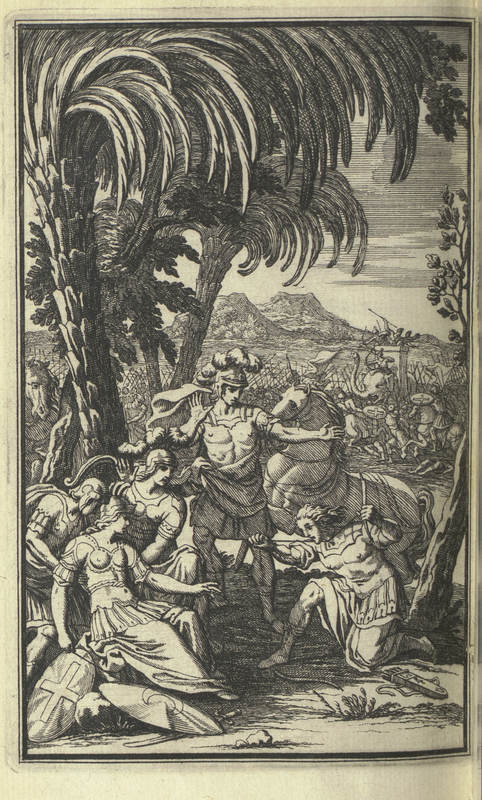 Still image
The Death of Alfasel
Chauveau, François, 1613-1676An engraving depicting a scene from the fifteenth book of the epic poem, Saint Louys, in which Alfasel (bottom right), who had accidentally wounded Zahide (bottom left) with a poisoned arrow while aiming for Lisamante, commits suicide. Meanwhile, Zahide is taken prisioner while in the background, the battle between the crusaders and the Saracens continues.An engraving depicting a scene from the fifteenth book of the epic poem, Saint Louys, in which Alfasel (bottom right), who had accidentally wounded Zahide (bottom left) with a poisoned arrow while aiming for Lisamante, commits suicide. Meanwhile, Zahide is taken prisioner while in the background, the battle between the crusaders and the Saracens continues. -
 Still image
The Death of Prince Muratan
Chauveau, François, 1613-1676An engraving depicting a scene from the sixth book of the epic poem, Saint Louys, in which Sultan Mélédin (left), who had been preparing to sacrifice his daughter, Zahide (left, kneeling), watches as his son, Prince Muratan (center), stabs himself so that he can be sacrificed in his sister's place. The ene takes place on an altar beside the Nile river, where the Sultan and his children are joined by Mirème, the sorcerer, and a young woman holding a plate (possibly Almasonte, who later saves Zahide when she and her brother fall in the river).An engraving depicting a scene from the sixth book of the epic poem, Saint Louys, in which Sultan Mélédin (left), who had been preparing to sacrifice his daughter, Zahide (left, kneeling), watches as his son, Prince Muratan (center), stabs himself so that he can be sacrificed in his sister's place. The ene takes place on an altar beside the Nile river, where the Sultan and his children are joined by Mirème, the sorcerer, and a young woman holding a plate (possibly Almasonte, who later saves Zahide when she and her brother fall in the river). -
 Still image
The Deaths of Mélédor, Almasonte, and Alzir
Chauveau, François, 1613-1676An engraving depicting a scene from the eleventh book of the epic poem, Saint Louys, in which, while in disguse as crusaders, Mélédor and Alzir infiltrate the French camp to rescue Almasonte and Zahide, who they then unknowingly duel, resulting in Zahide killing Mélédor (bottom right), and Alzir killing Almasonte and then committing suicide (center left).An engraving depicting a scene from the eleventh book of the epic poem, Saint Louys, in which, while in disguse as crusaders, Mélédor and Alzir infiltrate the French camp to rescue Almasonte and Zahide, who they then unknowingly duel, resulting in Zahide killing Mélédor (bottom right), and Alzir killing Almasonte and then committing suicide (center left). -
 Still image
The Drunkards
Holbein, Hans, 1497-1543A woodcut depicting a skeleton (= Death) pouring wine into the mouth of one of a group of revelers as one of his companions vomits over the side of the table. The woodcut is accompanied by a verse from Ephesians 5 translated into French (top) and then reformatted into verse (bottom).A woodcut depicting a skeleton (= Death) pouring wine into the mouth of one of a group of revelers as one of his companions vomits over the side of the table. The woodcut is accompanied by a verse from Ephesians 5 translated into French (top) and then reformatted into verse (bottom). -
 Still image
The Duchess
Holbein, Hans, 1497-1543A woodcut depicting two skeletons (= Death) appearing before a duchess in her bed. One skeleton plays the violin, while the other pulls at her bed sheets. The woodcut is accompanied by a verse from 2 Kings 1 translated into French (top) and then reformatted into verse (bottom).A woodcut depicting two skeletons (= Death) appearing before a duchess in her bed. One skeleton plays the violin, while the other pulls at her bed sheets. The woodcut is accompanied by a verse from 2 Kings 1 translated into French (top) and then reformatted into verse (bottom). -
 Still image
The Duke
Holbein, Hans, 1497-1543A woodcut depicting a skeleton (= Death) reaching for a duke, while a woman pleads before him over her child. In the upper left-hand corner is an hourglass representing human mortality. The woodcut is accompanied by a verse from Ezekiel 7 translated into French (top) and then reformatted into verse (bottom).A woodcut depicting a skeleton (= Death) reaching for a duke, while a woman pleads before him over her child. In the upper left-hand corner is an hourglass representing human mortality. The woodcut is accompanied by a verse from Ezekiel 7 translated into French (top) and then reformatted into verse (bottom). -
 Still image
The Emperor
Holbein, Hans, 1497-1543A woodcut depicting an emperor listening to the petition of one of his subjects. A skeleton, representing death, holds the crown on the emperor’s head, as the emperor holds a broken sword. An orb, a scepter, and an hourglass sit on the ground at his feet. The emperor is also wearing the collar of the Order of the Golden Fleece. The woodcut is accompanied by verses from Isaiah 38 and 22 translated into French (top) and then reformatted into verse (bottom).A woodcut depicting an emperor listening to the petition of one of his subjects. A skeleton, representing death, holds the crown on the emperor’s head, as the emperor holds a broken sword. An orb, a scepter, and an hourglass sit on the ground at his feet. The emperor is also wearing the collar of the Order of the Golden Fleece. The woodcut is accompanied by verses from Isaiah 38 and 22 translated into French (top) and then reformatted into verse (bottom). -
 Still image
The Empress
Holbein, Hans, 1497-1543A woodcut depicting Death escorting an empress as she and her court enjoy a walk outside the palace, and pointing out a nearby grave to display the limits of the empress' dominion. The woodcut is accompanied by a verse from Daniel 4 translated into French (top) and then reformatted into verse (bottom).A woodcut depicting Death escorting an empress as she and her court enjoy a walk outside the palace, and pointing out a nearby grave to display the limits of the empress' dominion. The woodcut is accompanied by a verse from Daniel 4 translated into French (top) and then reformatted into verse (bottom). -
 Still image
The Execution of Death
Holbein, Hans, 1497-1543A woodcut depicting a skeleton (= Death) being executed as a man and woman look on. In the center is an hourglass, the reminder of human mortality. The woodcut is accompanied by a verse from Ecclesiastes 7 translated into French (top) and then reformatted into verse (bottom).A woodcut depicting a skeleton (= Death) being executed as a man and woman look on. In the center is an hourglass, the reminder of human mortality. The woodcut is accompanied by a verse from Ecclesiastes 7 translated into French (top) and then reformatted into verse (bottom). -
 Still image
The Fifth Commandment
A woodcut depicting a man murdering two individuals with an axe, thereby representing a violation of the Fifth Commandment (in the Lutheran tradition), "Thou shalt not murder."A woodcut depicting a man murdering two individuals with an axe, thereby representing a violation of the Fifth Commandment (in the Lutheran tradition), "Thou shalt not murder." -
 Still image
The Fool
Holbein, Hans, 1497-1543A woodcut depicting a skeleton (= Death) playing the bagpipes as he pulls a fool down the road. The woodcut is accompanied by a verse from Proverbs 7 translated into French (top) and then reformatted into verse (bottom).A woodcut depicting a skeleton (= Death) playing the bagpipes as he pulls a fool down the road. The woodcut is accompanied by a verse from Proverbs 7 translated into French (top) and then reformatted into verse (bottom). -
 Still image
The Funeral Procession of Pope Clement XI
A woodcut depicting the stages of the funeral procession of Pope Clement XI, showing the route of the procession and the elements of the procession.A woodcut depicting the stages of the funeral procession of Pope Clement XI, showing the route of the procession and the elements of the procession. -
 Still image
The Gamblers
Holbein, Hans, 1497-1543A woodcut depicting a skeleton (= Death) fighting a demon over one of three gamblers at a table. The woodcut is accompanied by a verse from Matthew 16 translated into French (top) and then reformatted into verse (bottom).A woodcut depicting a skeleton (= Death) fighting a demon over one of three gamblers at a table. The woodcut is accompanied by a verse from Matthew 16 translated into French (top) and then reformatted into verse (bottom). -
 Still image
The Judge
Holbein, Hans, 1497-1543A woodcut depicting a skeleton (= Death) looking over a judge sitting in a chair as it tries to take the rod which symbolizes his authority. Two men stand before the judge: one is seen reaching into his purse to offer a bribe (which the judge appears eager to accept), while the other awaits his sentence. On the floor an hourglass, the reminder of human mortality, has been knocked over. The woodcut is accompanied by a verse from Amos 2 translated into French (top) and then reformatted into verse (bottom).A woodcut depicting a skeleton (= Death) looking over a judge sitting in a chair as it tries to take the rod which symbolizes his authority. Two men stand before the judge: one is seen reaching into his purse to offer a bribe (which the judge appears eager to accept), while the other awaits his sentence. On the floor an hourglass, the reminder of human mortality, has been knocked over. The woodcut is accompanied by a verse from Amos 2 translated into French (top) and then reformatted into verse (bottom). -
 Still image
The King
Holbein, Hans, 1497-1543A woodcut depicting a king resting at a banquet as a skeleton (= Death) pours him something to drink. The hourglass on the table reminds the viewer of human mortality. The woodcut is accompanied by a verse from Ecclesiastes 10 translated into French (top) and then reformatted into verse (bottom).A woodcut depicting a king resting at a banquet as a skeleton (= Death) pours him something to drink. The hourglass on the table reminds the viewer of human mortality. The woodcut is accompanied by a verse from Ecclesiastes 10 translated into French (top) and then reformatted into verse (bottom). -
 Still image
The Knight
Holbein, Hans, 1497-1543A woodcut depicting a skeleton (= Death) runing a lance through a knight wearing armor. An hourglass, the reminder of human mortality, lies overturned at their feet. The woodcut is accompanied by a verse from Job 34 translated into French (top) and then reformatted into verse (bottom).A woodcut depicting a skeleton (= Death) runing a lance through a knight wearing armor. An hourglass, the reminder of human mortality, lies overturned at their feet. The woodcut is accompanied by a verse from Job 34 translated into French (top) and then reformatted into verse (bottom). -
 Still image
The Martyrdom of Robert d'Artois
Chauveau, François, 1613-1676An engraving depicting a scene from the fourteenth book of the epic poem, Saint Louys, in which the body of the martyred Robert d'Artois, the brother of Saint Louis who fell in battle during the siege of Mansourah, is laid to rest in a tomb decorated with scenes of battle by a group of angels.An engraving depicting a scene from the fourteenth book of the epic poem, Saint Louys, in which the body of the martyred Robert d'Artois, the brother of Saint Louis who fell in battle during the siege of Mansourah, is laid to rest in a tomb decorated with scenes of battle by a group of angels. -
 Still image
The Merchant
Holbein, Hans, 1497-1543A woodcut depicting a skeleton (= Death) pulling on the coat of a merchant selling his wares on a wharf. The woodcut is accompanied by a verse from Proverbs 21 translated into French (top) and then reformatted into verse (bottom).A woodcut depicting a skeleton (= Death) pulling on the coat of a merchant selling his wares on a wharf. The woodcut is accompanied by a verse from Proverbs 21 translated into French (top) and then reformatted into verse (bottom). -
 Still image
The Monk
Holbein, Hans, 1497-1543A woodcut depicting a monk fleeing from a skeleton (= Death). In the lower left corner, an hourglass sits on the ground as a representation of mortality. The woodcut is accompanied by a verse from Psalms 106 translated into French (top) and then reformatted into verse (bottom).A woodcut depicting a monk fleeing from a skeleton (= Death). In the lower left corner, an hourglass sits on the ground as a representation of mortality. The woodcut is accompanied by a verse from Psalms 106 translated into French (top) and then reformatted into verse (bottom). -
 Still image
The Nobleman
Holbein, Hans, 1497-1543A woodcut depicting a nobleman fighting with a skeleton which represents Death. Behind the nobleman is an hourglass representing human mortality. The woodcut is accompanied by a verse from Psalms 88 translated into French (top) and then reformatted into verse (bottom).A woodcut depicting a nobleman fighting with a skeleton which represents Death. Behind the nobleman is an hourglass representing human mortality. The woodcut is accompanied by a verse from Psalms 88 translated into French (top) and then reformatted into verse (bottom). -
 Still image
The Noblewoman
Holbein, Hans, 1497-1543A woodcut depicting a skeleton (= Death) beating a drum in front of a noble lady and her admirer. An hourglass, the reminder of human mortality, is in the bottom right corner. The woodcut is accompanied by a verse from Ruth 1 translated into French (top) and then reformatted into verse (bottom).A woodcut depicting a skeleton (= Death) beating a drum in front of a noble lady and her admirer. An hourglass, the reminder of human mortality, is in the bottom right corner. The woodcut is accompanied by a verse from Ruth 1 translated into French (top) and then reformatted into verse (bottom). -
 Still image
The Nun
Holbein, Hans, 1497-1543A woodcut depicting a nun kneeling at an altar to pray as a skeleton (= Death) puts out the candles. The nun is distracted from her prayers by a young man sitting on the bed playing a lute. The woodcut is accompanied by a verse from Proverbs 14 translated into French (top) and then reformatted into verse (bottom).A woodcut depicting a nun kneeling at an altar to pray as a skeleton (= Death) puts out the candles. The nun is distracted from her prayers by a young man sitting on the bed playing a lute. The woodcut is accompanied by a verse from Proverbs 14 translated into French (top) and then reformatted into verse (bottom). -
 Still image
The Old Man
Holbein, Hans, 1497-1543A woodcut depicting a skeleton (= Death) leading an old man by the hand into an open grave, while playing an instrument. An hourglass, the reminder of human mortality, is behind them. The woodcut is accompanied by a verse from Job 17 translated into French (top) and then reformatted into verse (bottom).A woodcut depicting a skeleton (= Death) leading an old man by the hand into an open grave, while playing an instrument. An hourglass, the reminder of human mortality, is behind them. The woodcut is accompanied by a verse from Job 17 translated into French (top) and then reformatted into verse (bottom). -
 Still image
The Old Woman
Holbein, Hans, 1497-1543A woodcut depicting two skeletons, representing death, dancing around an old woman. A broken hourglass, representing time, sits on the ground in the lower left-hand corner. The woodcut is accompanied by a verse from Ecclesiastes 30 translated into French (top) and then reformatted into verse (bottom).A woodcut depicting two skeletons, representing death, dancing around an old woman. A broken hourglass, representing time, sits on the ground in the lower left-hand corner. The woodcut is accompanied by a verse from Ecclesiastes 30 translated into French (top) and then reformatted into verse (bottom). -
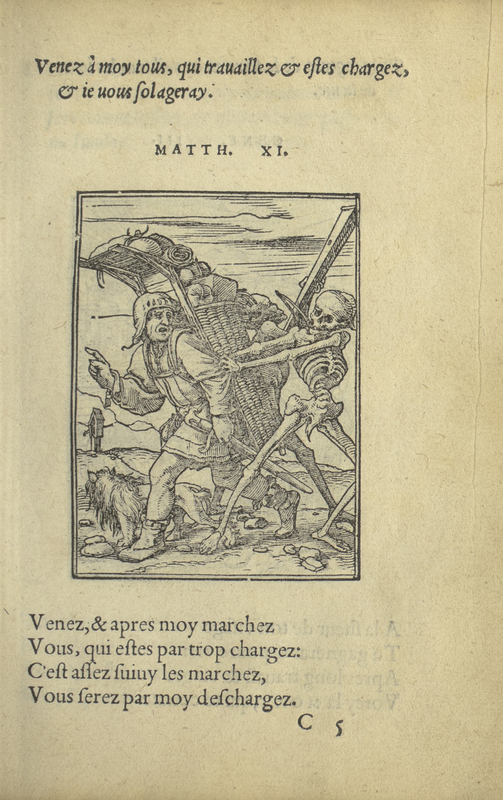 Still image
The Peddler
Holbein, Hans, 1497-1543A woodcut depicting a skeleton (= Death) tugging at a fleeing peddler. A lion stands at the feet of the peddler, looking away. The woodcut is accompanied by a verse from Matthew 11 translated into French (top) and then reformatted into verse (bottom).A woodcut depicting a skeleton (= Death) tugging at a fleeing peddler. A lion stands at the feet of the peddler, looking away. The woodcut is accompanied by a verse from Matthew 11 translated into French (top) and then reformatted into verse (bottom). -
 Still image
The Physician
Holbein, Hans, 1497-1543A woodcut depicting a skeleton (= Death) visiting a physician and holding out a flask, while holding the hand of an old man with a cane. The woodcut is accompanied by a verse from Luke 4 translated into French (top) and then reformatted into verse (bottom).A woodcut depicting a skeleton (= Death) visiting a physician and holding out a flask, while holding the hand of an old man with a cane. The woodcut is accompanied by a verse from Luke 4 translated into French (top) and then reformatted into verse (bottom). -
 Still image
The Ploughman
Holbein, Hans, 1497-1543A woodcut depicting a skeleton (= Death) driving the team of a ploughman. An hour-glass, representing time, hangs from the skeleton’s neck. The woodcut is accompanied by a verse from Genesis 3 translated into French (top) and then reformatted into verse (bottom).A woodcut depicting a skeleton (= Death) driving the team of a ploughman. An hour-glass, representing time, hangs from the skeleton’s neck. The woodcut is accompanied by a verse from Genesis 3 translated into French (top) and then reformatted into verse (bottom). -
 Still image
The Pope
Holbein, Hans, 1497-1543A woodcut depicting the Pope wearing the papal triple tiara, crowns a king (the globus cruciger on the ground before him), as cardinals, bishops, skeletons (representing death; one in cardinal's garb), and two flying demons (one with papal decree in hand) look on. The woodcut is accompanied by verses from Joshua 20 and Psalms 108 translated into French (top) and then reformatted into verse (bottom).A woodcut depicting the Pope wearing the papal triple tiara, crowns a king (the globus cruciger on the ground before him), as cardinals, bishops, skeletons (representing death; one in cardinal's garb), and two flying demons (one with papal decree in hand) look on. The woodcut is accompanied by verses from Joshua 20 and Psalms 108 translated into French (top) and then reformatted into verse (bottom). -
 Still image
The Pope Lying in State and the Novemdiales
A pair of woodcuts with captions depicting the body of the Pope lying in state (top) and a depiction of the delivery of a eulogy during the nine official days of mourning following interment, called the Novemdiales (bottom).A pair of woodcuts with captions depicting the body of the Pope lying in state (top) and a depiction of the delivery of a eulogy during the nine official days of mourning following interment, called the Novemdiales (bottom). -
 Still image
The Preacher
Holbein, Hans, 1497-1543A woodcut depicting a preacher speaking to his congregation as a skeleton (= Death) taps on his shoulder holding an hourglass. The woodcut is accompanied by a verse from Isaiah 5 translated into French (top) and then reformatted into verse (bottom).A woodcut depicting a preacher speaking to his congregation as a skeleton (= Death) taps on his shoulder holding an hourglass. The woodcut is accompanied by a verse from Isaiah 5 translated into French (top) and then reformatted into verse (bottom). -
 Still image
The Queen
Holbein, Hans, 1497-1543A woodcut depicting Death, wearing a jester's cap and holding an hourglass, seizing a queen while her attendants struggle to free her from his grip. The woodcut is accompanied by a verse from Isaiah 32 translated into French (top) and then reformatted into verse (bottom).A woodcut depicting Death, wearing a jester's cap and holding an hourglass, seizing a queen while her attendants struggle to free her from his grip. The woodcut is accompanied by a verse from Isaiah 32 translated into French (top) and then reformatted into verse (bottom). -
 Still image
The Rich Man
Holbein, Hans, 1497-1543A woodcut depicting a skeleton (= Death) filling a basket with coins from a pile on a table surrounded by chests and sacks as a man attempts to send the skeleton away. The woodcut is accompanied by a verse from Luke 7 translated into French (top) and then reformatted into verse (bottom).A woodcut depicting a skeleton (= Death) filling a basket with coins from a pile on a table surrounded by chests and sacks as a man attempts to send the skeleton away. The woodcut is accompanied by a verse from Luke 7 translated into French (top) and then reformatted into verse (bottom). -
 Still image
The Robber
Holbein, Hans, 1497-1543A woodcut depicting a skeleton (= Death) taking hold of a man who is in the proess of robbing a woman who is carrying a basket of goods. The woodcut is accompanied by a verse from Isaiah 38 translated into French (top) and then reformatted into verse (bottom).A woodcut depicting a skeleton (= Death) taking hold of a man who is in the proess of robbing a woman who is carrying a basket of goods. The woodcut is accompanied by a verse from Isaiah 38 translated into French (top) and then reformatted into verse (bottom). -
 Still image
The Sailor
Holbein, Hans, 1497-1543A woodcut depicting a skeleton (= Death) breaking the mast of a ship in a storm as the crew look on in fright. The woodcut is accompanied by a verse from 1 Timothy 6 translated into French (top) and then reformatted into verse (bottom).A woodcut depicting a skeleton (= Death) breaking the mast of a ship in a storm as the crew look on in fright. The woodcut is accompanied by a verse from 1 Timothy 6 translated into French (top) and then reformatted into verse (bottom). -
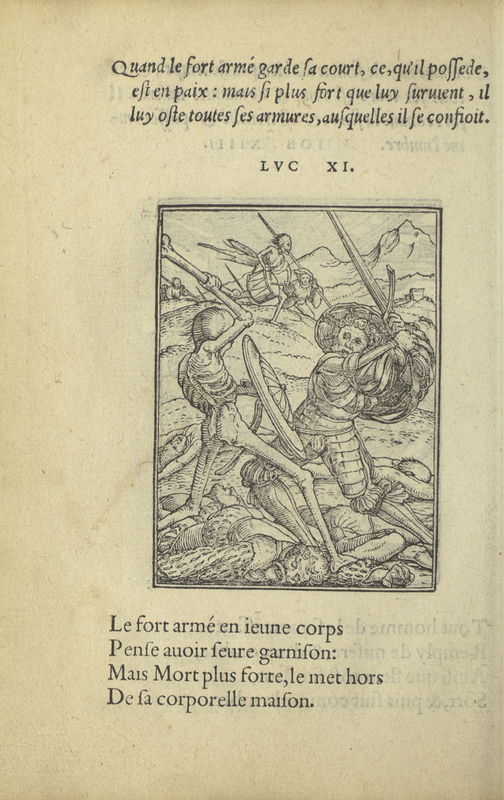 Still image
The Soldier
Holbein, Hans, 1497-1543A woodcut depicting a skeleton (= Death) dueling a soldier on a battlefields as another skeleton plays a drum in the background. The woodcut is accompanied by a verse from Luke 11 translated into French (top) and then reformatted into verse (bottom).A woodcut depicting a skeleton (= Death) dueling a soldier on a battlefields as another skeleton plays a drum in the background. The woodcut is accompanied by a verse from Luke 11 translated into French (top) and then reformatted into verse (bottom). -
 Still image
The Vicar
Holbein, Hans, 1497-1543A woodcut depicting a skeleton (= Death) leading a procession with a vicar holding the host in a monstrance. The skeleton rings a bell in his left hand and holds a lantern in his right, while holding an hourglass underneath his arm. The woodcut is accompanied by a verse from Wisdom of Solomon 7 translated into French (top) and then reformatted into verse (bottom).A woodcut depicting a skeleton (= Death) leading a procession with a vicar holding the host in a monstrance. The skeleton rings a bell in his left hand and holds a lantern in his right, while holding an hourglass underneath his arm. The woodcut is accompanied by a verse from Wisdom of Solomon 7 translated into French (top) and then reformatted into verse (bottom). -
 Still image
The Waggoner
Holbein, Hans, 1497-1543A woodcut depicting two skeletons (= Death) destroy a wagon full of wine barrels while the waggoner looks on in distress. The woodcut is accompanied by a verse from 1 Samuel 9 translated into French (top) and then reformatted into verse (bottom).A woodcut depicting two skeletons (= Death) destroy a wagon full of wine barrels while the waggoner looks on in distress. The woodcut is accompanied by a verse from 1 Samuel 9 translated into French (top) and then reformatted into verse (bottom). -
 Still image
The Young Child
Holbein, Hans, 1497-1543A woodcut depicting a skeleton (= Death) taking a child from their home as their mother is in the process of preparing a meal and another child cries after them. An hourglass, the reminder of human mortality, rests on the floor. The woodcut is accompanied by a verse from Job 14 translated into French (top) and then reformatted into verse (bottom).A woodcut depicting a skeleton (= Death) taking a child from their home as their mother is in the process of preparing a meal and another child cries after them. An hourglass, the reminder of human mortality, rests on the floor. The woodcut is accompanied by a verse from Job 14 translated into French (top) and then reformatted into verse (bottom). -
 Text
TextUntitled; Hebrews 9:27
Archer, James, 1751-1834This sermon cautions against waiting too long to turn to God, warning that there is no chance to have such a change of faith on your deathbed, rather that a life of dedication is the only way to find salvation after death.This sermon cautions against waiting too long to turn to God, warning that there is no chance to have such a change of faith on your deathbed, rather that a life of dedication is the only way to find salvation after death. -
 Still image
Vitalus enterré vif à Ravenne environ l'An 99
Luiken, Jan, 1649-1712An engraving depicting the martyrdom of Saint Vitalis of Milan. The image shows Vitalis being buried alive as a crowd watches.An engraving depicting the martyrdom of Saint Vitalis of Milan. The image shows Vitalis being buried alive as a crowd watches. -
 Still image
Volfgang Pinder, decapité à Schardingen, A. 1571
Luiken, Jan, 1649-1712An engraving depicting the execution of Wolfgang Pinder. The image shows Pinder bound and on the ground as his executioner cuts at his neck with a sword while a crowd watches.An engraving depicting the execution of Wolfgang Pinder. The image shows Pinder bound and on the ground as his executioner cuts at his neck with a sword while a crowd watches. -
 Text
TextZwo Predig über der Leiche des Kurfürsten Hertzog Johans zu[o] Sachssen
Luther, Martin, 1483-1546Summary: Two funeral sermons by Martin Luther on the occasion of John the Steadfast, Elector of Saxony, who had founded and headed the Smalcaldic League. John was succeeded by his son Johann Friedrich I.Summary: Two funeral sermons by Martin Luther on the occasion of John the Steadfast, Elector of Saxony, who had founded and headed the Smalcaldic League. John was succeeded by his son Johann Friedrich I.
