Search
39 resources
39 items
Subject
Monsters
-
 Text
TextA discourse concerning prodigie : wherein the vanity of presages by them is reprehended, and their true and proper ends asserted and vindicated
Spencer, John, 1630-1693Summary: A repudiation of the understanding of "prodigies," monstrous births in humans or animals, as signs from God.Summary: A repudiation of the understanding of "prodigies," monstrous births in humans or animals, as signs from God. -
 Still image
Archambaut de Bourbon Defeates Mirème
Chauveau, François, 1613-1676An engraving depicting a scene from the sixteenth book of the epic poem, Saint Louys, in which Archambaut de Bourbon battles and defeats the sorcerer, Mirème, who has created demonic illusions and traps to keep the cruasders from accessing the Matariya Fountain and curing Saint Louis of his poisoned arrow wound.An engraving depicting a scene from the sixteenth book of the epic poem, Saint Louys, in which Archambaut de Bourbon battles and defeats the sorcerer, Mirème, who has created demonic illusions and traps to keep the cruasders from accessing the Matariya Fountain and curing Saint Louis of his poisoned arrow wound. -
 Still image
Bishop Fish
A woodcut depicting a monstrous fish purportedly pulled from the sea in Poland, which had the appearance of a Roman Catholic bishop.A woodcut depicting a monstrous fish purportedly pulled from the sea in Poland, which had the appearance of a Roman Catholic bishop. -
 Still image
Daniel's Vision of the Four Beasts
A woodcut of the four beasts which appeared to Daniel in a vision. Each beast represented a different kingdom.A woodcut of the four beasts which appeared to Daniel in a vision. Each beast represented a different kingdom. -
 Still image
Daniel's Vision of the Four Beasts
An engraving of the four beasts which appeared to Daniel in a vision. Each beast represented a different kingdom and is labeled from left to right: Roma (Rome), Grecia (Greece), Persia, and Asyria.An engraving of the four beasts which appeared to Daniel in a vision. Each beast represented a different kingdom and is labeled from left to right: Roma (Rome), Grecia (Greece), Persia, and Asyria. -
 Still image
Das Munchkalb zu Freyberg
A woodcut depicting the Monk-Calf of Freyberg, which was born with a tonsure-like irregularity on its head, resembling the common hairstyle of a Catholic monk.A woodcut depicting the Monk-Calf of Freyberg, which was born with a tonsure-like irregularity on its head, resembling the common hairstyle of a Catholic monk. -
 Still image
Das erst general - inhaltend die beschzeibung [und] den [circtel] des gantzen erdtreichs und m[o]rcs.
A map of the world including latitude and longitude markers. Personifications of the winds are depicted withing croulds surrounding the map and various monstrous creatures are depicted within the oceans.A map of the world including latitude and longitude markers. Personifications of the winds are depicted withing croulds surrounding the map and various monstrous creatures are depicted within the oceans. -
 Still image
Der Bapstesel zu Rom
A woodcut depicting the "Papal Ass," a monster purported to have been pulled from the Tiber in Rome as a portent of the corruption of the Roman Catholic Church.A woodcut depicting the "Papal Ass," a monster purported to have been pulled from the Tiber in Rome as a portent of the corruption of the Roman Catholic Church. -
 Still image
Die eigentliche warhafftige gestalt der Erden und des [...]
A map of the world including Europe, Africa ("Der schwarzen Moren Land"), Asia (Major), America ("Die Newe Welt"), and India Meridionalis (a so called "phantom" peninsula that was often depicted in Medieval and Rennaissance maps). A number of monstrous sea creatures are depicted in the various oceans and seas.A map of the world including Europe, Africa ("Der schwarzen Moren Land"), Asia (Major), America ("Die Newe Welt"), and India Meridionalis (a so called "phantom" peninsula that was often depicted in Medieval and Rennaissance maps). A number of monstrous sea creatures are depicted in the various oceans and seas. -
 Still image
Die ganze Welt in einem [K]leberblat Welches [...] meines lieben Vaterlandes [W]apen
A map of the world including Europe, Africa, and Asia as three leaf or petal shaped continents with America ("Die Newe Welt") draw in the bottom left corner. A ship and numerous sea creatures are depicted in the oceans.A map of the world including Europe, Africa, and Asia as three leaf or petal shaped continents with America ("Die Newe Welt") draw in the bottom left corner. A ship and numerous sea creatures are depicted in the oceans. -
 Still image
Effigies Danielis
Ganière, Pierre, 1663-1721An engraving of Daniel, flanked by a lion and lioness, the four beasts from his vision depicted in the sky on either side of his head.An engraving of Daniel, flanked by a lion and lioness, the four beasts from his vision depicted in the sky on either side of his head. -
 Still image
Four Horsemen of the Apocalypse
Cranach, Lucas, 1472-1553A woodcut depicting the Four Horsemen of the Apocalypse: the first, a conquerer with a crown and bow, the second, with a sword, tasked with taking peace from the earth, the third holding scales, and the fourth, Death itself. The image appears in the September Testament, Martin Luther's first printing of his German New Testament.A woodcut depicting the Four Horsemen of the Apocalypse: the first, a conquerer with a crown and bow, the second, with a sword, tasked with taking peace from the earth, the third holding scales, and the fourth, Death itself. The image appears in the September Testament, Martin Luther's first printing of his German New Testament. -
 Still image
Gespängst der bösen geist
A woodcut depicting a hairy, bipedal beast, labeled as the "spook of the evil ghost," which is found in a vast desert beyond India in the land of Cathay. This type of ghost is said to lead travellers astray by mimicking the voices of their travelling companions.A woodcut depicting a hairy, bipedal beast, labeled as the "spook of the evil ghost," which is found in a vast desert beyond India in the land of Cathay. This type of ghost is said to lead travellers astray by mimicking the voices of their travelling companions. -
 Still image
Map of the Four Beasts from Daniel's Vision
A woodcut depicting the four beasts described in Daniel's vision placed on a map, one each in Europe and Africa, and two in Asia. The beasts are placed in such a way that they surround the holy land.A woodcut depicting the four beasts described in Daniel's vision placed on a map, one each in Europe and Africa, and two in Asia. The beasts are placed in such a way that they surround the holy land. -
![A woodcut depicting Martin Luther as a seven-headed monster, critiquing his deviation from Catholicism. Each head is labeled (from left to right): Doctor, Martinus, Luther, Ecclesiast, Schwirmer [Schwärmer], Visitieter, and Barrabas. This was a classic piece of Catholic propaganda, portraying Luther not only as a Doctor and Churchman, but as a Turk, a wild enthusiast (Schwarmer) and "Barrabas."](https://s3.us-west-2.amazonaws.com/omekacloud-main/large/P_000015280452_P005/P_000015280452_P005_PROD.jpg) Still image
Still imageMartinus Luther Sieben Kopff
A woodcut depicting Martin Luther as a seven-headed monster, critiquing his deviation from Catholicism. Each head is labeled (from left to right): Doctor, Martinus, Luther, Ecclesiast, Schwirmer [Schwärmer], Visitieter, and Barrabas. This was a classic piece of Catholic propaganda, portraying Luther not only as a Doctor and Churchman, but as a Turk, a wild enthusiast (Schwarmer) and "Barrabas."A woodcut depicting Martin Luther as a seven-headed monster, critiquing his deviation from Catholicism. Each head is labeled (from left to right): Doctor, Martinus, Luther, Ecclesiast, Schwirmer [Schwärmer], Visitieter, and Barrabas. This was a classic piece of Catholic propaganda, portraying Luther not only as a Doctor and Churchman, but as a Turk, a wild enthusiast (Schwarmer) and "Barrabas." -
 Still image
Martinus Lutherus Septiceps
A woodcut depicting Martin Luther as a seven-headed monster, critiquing his deviation from Catholicism. Each head is labeled (from left to right): Doctor, Martinus, Lutherus, Ecclesiastes, Suermerus, Visitactor, and Barrabas. This was a classic piece of Catholic propaganda, portraying Luther not only as a Doctor and Churchman, but as a Turk, a wild enthusiast (Suermerus) and "Barrabas."A woodcut depicting Martin Luther as a seven-headed monster, critiquing his deviation from Catholicism. Each head is labeled (from left to right): Doctor, Martinus, Lutherus, Ecclesiastes, Suermerus, Visitactor, and Barrabas. This was a classic piece of Catholic propaganda, portraying Luther not only as a Doctor and Churchman, but as a Turk, a wild enthusiast (Suermerus) and "Barrabas." -
 Still image
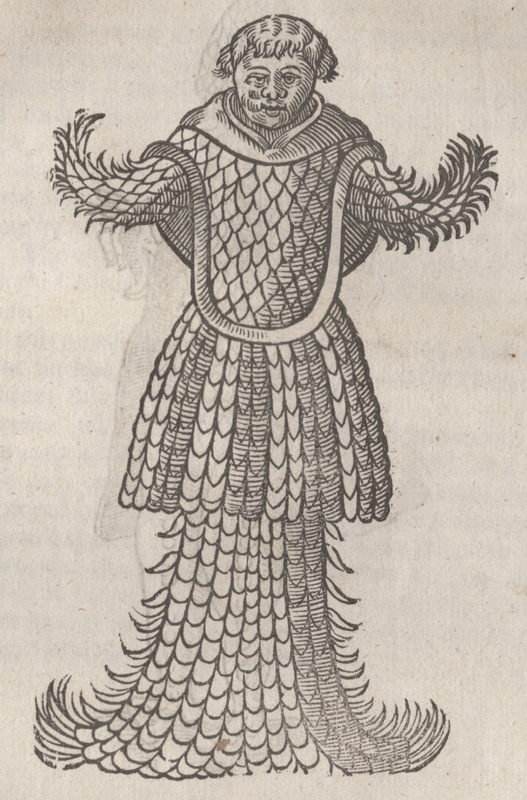
Monk Fish
A woodcut depicting a monstrous fish purportedly pulled from the sea in Poland, which had the appearance of a Catholic monk.A woodcut depicting a monstrous fish purportedly pulled from the sea in Poland, which had the appearance of a Catholic monk. -
![A woodcut depicting two boys, one born with four [feet] and one born without hands or eyes and the lower body of a fish. These beings are described in the text as being portents of the coming of Islam, implying that Islam was a danger to Christians.](https://s3.us-west-2.amazonaws.com/omekacloud-main/large/P_3000000205074_P3xx/P_300000205074_P3xx-cr_PROD.jpg) Still image
Still imageMonstrous Portents of Islam
A woodcut depicting two boys, one born with four [feet] and one born without hands or eyes and the lower body of a fish. These beings are described in the text as being portents of the coming of Islam, implying that Islam was a danger to Christians.A woodcut depicting two boys, one born with four [feet] and one born without hands or eyes and the lower body of a fish. These beings are described in the text as being portents of the coming of Islam, implying that Islam was a danger to Christians. -
 Still image
Salamandra
A woodcut of a creature labeled as "Salamandra" (Salamander), which is described as preferring to live in fire and can be found on a mountain in the land of Chinchital in the New World.A woodcut of a creature labeled as "Salamandra" (Salamander), which is described as preferring to live in fire and can be found on a mountain in the land of Chinchital in the New World. -
![A woodcut depicting Martin Luther as a seven-headed monster, critiquing his deviation from Catholicism. Each head is labeled (from left to right): Doctor, Martinus, Luther, Ecclesiast, Schwirmer [Schwärmer], Visitieter, and Barrabas. This was a classic piece of Catholic propaganda, portraying Luther not only as a Doctor and Churchman, but as a Turk, a wild enthusiast (Schwarmer) and "Barrabas."](https://s3.us-west-2.amazonaws.com/omekacloud-main/large/P_300000132224_P005/P_300000132224_P005-cr_PROD.jpg) Still image
Still imageSieben Köpffe Martini Luthers vom hochwirdigen Sacrament des Altars
A woodcut depicting Martin Luther as a seven-headed monster, critiquing his deviation from Catholicism. Each head is labeled (from left to right): Doctor, Martinus, Luther, Ecclesiast, Schwirmer [Schwärmer], Visitieter, and Barrabas. This was a classic piece of Catholic propaganda, portraying Luther not only as a Doctor and Churchman, but as a Turk, a wild enthusiast (Schwarmer) and "Barrabas."A woodcut depicting Martin Luther as a seven-headed monster, critiquing his deviation from Catholicism. Each head is labeled (from left to right): Doctor, Martinus, Luther, Ecclesiast, Schwirmer [Schwärmer], Visitieter, and Barrabas. This was a classic piece of Catholic propaganda, portraying Luther not only as a Doctor and Churchman, but as a Turk, a wild enthusiast (Schwarmer) and "Barrabas." -
 Still image
The Armies of Heaven and Doom for the Beast
Cranach, Lucas, 1472-1553A woodcut depicting the victorious armies of Heaven (top right) routing the opposing forces as the beast is cast into a lake of fire and brimstone. The image appears in the September Testament, Martin Luther's first printing of his German New Testament.A woodcut depicting the victorious armies of Heaven (top right) routing the opposing forces as the beast is cast into a lake of fire and brimstone. The image appears in the September Testament, Martin Luther's first printing of his German New Testament. -
 Still image
The Beast from the Sea
A woodcut of the first Beast mentioned in Revelations, which emerged from the sea. It has seven heads and ten horns.A woodcut of the first Beast mentioned in Revelations, which emerged from the sea. It has seven heads and ten horns. -
 Still image
The Beasts from the Sea and Earth
A woodcut of the two beasts mentioned in Revelations. On the right, is the seven-headed beast from the sea. On the hill in the background is the "lamb-horned" beast from the earth.A woodcut of the two beasts mentioned in Revelations. On the right, is the seven-headed beast from the sea. On the hill in the background is the "lamb-horned" beast from the earth. -
 Still image
The Beasts from the Sea and Earth
An engraving of the two beasts mentioned in Revelations. On the left, is the seven-headed beast from the sea. On the hill to the right is the "lamb-horned" beast from the earth.An engraving of the two beasts mentioned in Revelations. On the left, is the seven-headed beast from the sea. On the hill to the right is the "lamb-horned" beast from the earth. -
 Still image
The Dragon Thrown into the Bottomless Pit
Cranach, Lucas, 1472-1553A woodcut depicting an angel locking the dragon, which represents Satan, into a bottomless pit to be bound for a thousand years. The image appears in the September Testament, Martin Luther's first printing of his German New Testament.A woodcut depicting an angel locking the dragon, which represents Satan, into a bottomless pit to be bound for a thousand years. The image appears in the September Testament, Martin Luther's first printing of his German New Testament. -
 Still image
The Lamb on Mount Zion, the New Song, and the Three Angels
Cranach, Lucas, 1472-1553A woodcut depicting the Lamb of God atop Mount Zion (top) framed by the four beasts described in Ezekiel 1, harpers, and angels holding a book, while below them the city of Babylon is destroyed (bottom). The image appears in the September Testament, Martin Luther's first printing of his German New Testament.A woodcut depicting the Lamb of God atop Mount Zion (top) framed by the four beasts described in Ezekiel 1, harpers, and angels holding a book, while below them the city of Babylon is destroyed (bottom). The image appears in the September Testament, Martin Luther's first printing of his German New Testament. -
 Still image
The Seven Last Plagues
Cranach, Lucas, 1472-1553A woodcut depicting angels pouring out the Seven Plagues, including a plague upon the sun, the air, the rivers and fountains, the earth, the sea, the Euphrates, and the seat of the beast, which is sprewing unclean spirits in the form of frogs. The image appears in the September Testament, Martin Luther's first printing of his German New Testament.A woodcut depicting angels pouring out the Seven Plagues, including a plague upon the sun, the air, the rivers and fountains, the earth, the sea, the Euphrates, and the seat of the beast, which is sprewing unclean spirits in the form of frogs. The image appears in the September Testament, Martin Luther's first printing of his German New Testament. -
 Still image
The Temple and the Two Witnesses
Cranach, Lucas, 1472-1553A woodcut depicting Saint John the Apostle measuring the temple of God as two witnesses named by an angel face a snarling beast. The image appears in the September Testament, Martin Luther's first printing of his German New Testament.A woodcut depicting Saint John the Apostle measuring the temple of God as two witnesses named by an angel face a snarling beast. The image appears in the September Testament, Martin Luther's first printing of his German New Testament. -
 Still image
The Two Beasts
Cranach, Lucas, 1472-1553A woodcut depicting two beasts, the first with seven crowned heads and ten horns rising from the sea, and the second in the shape of a lamb with two horns which is accompanied by flames raining from the skies. The image appears in the September Testament, Martin Luther's first printing of his German New Testament.A woodcut depicting two beasts, the first with seven crowned heads and ten horns rising from the sea, and the second in the shape of a lamb with two horns which is accompanied by flames raining from the skies. The image appears in the September Testament, Martin Luther's first printing of his German New Testament. -
 Still image
The Vision of the Four Beasts
Doré, Gustave, 1832-1883An engraving of the four beasts which appeared to Daniel in a vision rising from the sea.An engraving of the four beasts which appeared to Daniel in a vision rising from the sea. -
 Still image
The Whore of Babylon
The Whore of Babylon riding atop a seven-headed beast and holding a chalice aloft. She is depicted wearing the papal crown.The Whore of Babylon riding atop a seven-headed beast and holding a chalice aloft. She is depicted wearing the papal crown. -
 Still image
The Woman and the Beast in the Wilderness
Cranach, Lucas, 1472-1553A woodcut depicting the Whore (Harlot) of Babylon atop the red dragon, a golden cup in hand and a Papal crown upon her head. The image appears in the September Testament, Martin Luther's first printing of his German New Testament.A woodcut depicting the Whore (Harlot) of Babylon atop the red dragon, a golden cup in hand and a Papal crown upon her head. The image appears in the September Testament, Martin Luther's first printing of his German New Testament. -
 Still image
The Woman and the Great Red Dragon
Cranach, Lucas, 1472-1553A woodcut depicting a woman crowned in stars facing down a dragon with ten horns and seven crowns while above her a child is carried to the throne of God by angels. The image appears in the September Testament, Martin Luther's first printing of his German New Testament.A woodcut depicting a woman crowned in stars facing down a dragon with ten horns and seven crowns while above her a child is carried to the throne of God by angels. The image appears in the September Testament, Martin Luther's first printing of his German New Testament. -
 Still image
Three-headed portent of Marcomirus
A woodcut depicting a being with three heads: a frog representing France, an eagle representing Rome, and a lion representing Germany. This creature preceeded the arrival of Marcomirus, a Sicambrian king who took control of a region of Gaul after moving from the Danube region into the low countries (Gelders and Holland).A woodcut depicting a being with three heads: a frog representing France, an eagle representing Rome, and a lion representing Germany. This creature preceeded the arrival of Marcomirus, a Sicambrian king who took control of a region of Gaul after moving from the Danube region into the low countries (Gelders and Holland). -
 Still image
Vincior hac Vincoque
Chauveau, François, 1613-1676An engraved headpiece to the fourth, tenth, and sixteenth books of Moyne's epic, "Saint Louys," depicting a royal crown decorated with a crown of thorns, sitting atop a cushion on a table decorated with fleur-de-lis. Four monsters with human faces, lion's paws, snake's tails, and wings flank the crown and above the scene is a banner with the Latin motto, "Vincior hac Vincoque" (that which is bound here also conquers).An engraved headpiece to the fourth, tenth, and sixteenth books of Moyne's epic, "Saint Louys," depicting a royal crown decorated with a crown of thorns, sitting atop a cushion on a table decorated with fleur-de-lis. Four monsters with human faces, lion's paws, snake's tails, and wings flank the crown and above the scene is a banner with the Latin motto, "Vincior hac Vincoque" (that which is bound here also conquers). -
 Still image
Vision of God's Throne
Cranach, Lucas, 1472-1553A woodcut depicting Saint John the Apostle kneeling before a scene where God, seated on a throne and flanked by the four beasts described in Ezekiel 1, hands a book to the Lamb of God as a number of angels surround them and a group of elders kneel, crowns removed with harps and incense in hand. The image appears in the September Testament, Martin Luther's first printing of his German New Testament.A woodcut depicting Saint John the Apostle kneeling before a scene where God, seated on a throne and flanked by the four beasts described in Ezekiel 1, hands a book to the Lamb of God as a number of angels surround them and a group of elders kneel, crowns removed with harps and incense in hand. The image appears in the September Testament, Martin Luther's first printing of his German New Testament. -
 Still image
Vision que Saint Iean eut du Dragon
Le Clerc, Sébastien, 1637-1714An engraving of the dragon mentioned in Revelations, which granted power and authority to the Beast from the Sea and the Beast from the Earth.An engraving of the dragon mentioned in Revelations, which granted power and authority to the Beast from the Sea and the Beast from the Earth. -
 Still image
Visions de Daniel touchant les quatre Monarchies, des Assyriens, des Perses, des Grecs, & des Romains
Le Clerc, Sébastien, 1637-1714An engraving of Daniel sleeping (left) as his vision of the four beasts (right) appear, each beast labeled with the kingdom they represent: Roma (Rome), Grecia (Greece), Persia, and Assyria.An engraving of Daniel sleeping (left) as his vision of the four beasts (right) appear, each beast labeled with the kingdom they represent: Roma (Rome), Grecia (Greece), Persia, and Assyria. -
 Still image
Von wunderbarlichen dingen so in Morlande gefunden werden
A woodcut depicting a group of monstrous beings purported to be found in Africa, including a dog-headed being (cynocephalus) and a cyclops, both likely drawn from classical influences. This woodcut is also used to depict the same creatures in the section on India, where the purportedly also reside.A woodcut depicting a group of monstrous beings purported to be found in Africa, including a dog-headed being (cynocephalus) and a cyclops, both likely drawn from classical influences. This woodcut is also used to depict the same creatures in the section on India, where the purportedly also reside.