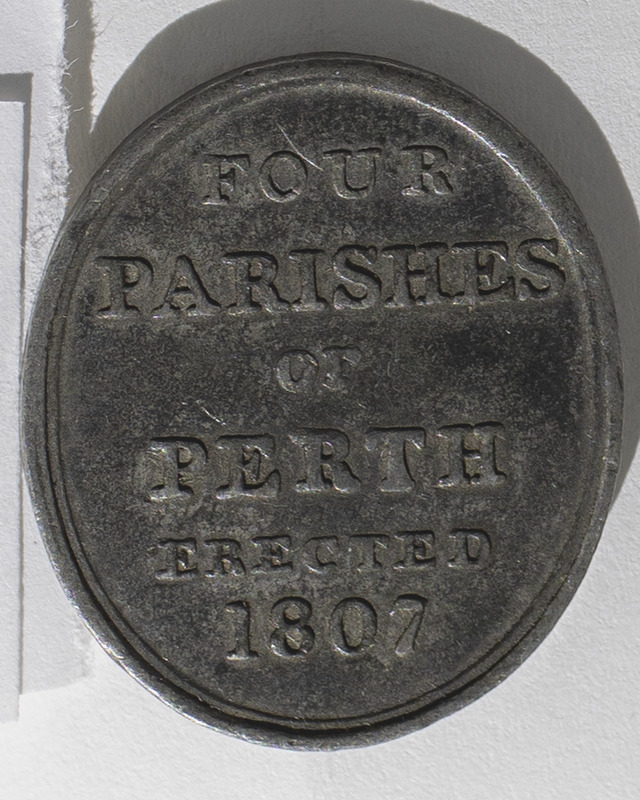
A communion token from the Four Parishes of Perth in Perth, Perthshire, Scotland. The token is oval in shape with inscriptions on the obverse, "Pro Rege Lege et Grege" with the Perth coat of arms, and reverse, "Four Parishes of Perth Erected 1807".
A communion token from the Four Parishes of Perth in Perth, Perthshire, Scotland. The token is oval in shape with inscriptions on the obverse, "Pro Rege Lege et Grege" with the Perth coat of arms, and reverse, "Four Parishes of Perth Erected 1807".
The dedication page of Diego de Saavedra Fajardo's Obras de Don Diego de Saauedra Faxardo Cavallero del Orden de S. Iago, del Consejo de su Magestad en el Supremo de las Indias, y su Embajador plenipotençiario en los treze cantones, &c. : en dos tomos divididas, el primero contiene I. Idea de un principe politico christiano, representada en cien Empresas, honoring Aubertus van den Eede, the Bishop of Antwerp. The bishop's coat of arms is included at the top of the page, featuring a quartered crest and topped with a galero.
The dedication page of Diego de Saavedra Fajardo's Obras de Don Diego de Saauedra Faxardo Cavallero del Orden de S. Iago, del Consejo de su Magestad en el Supremo de las Indias, y su Embajador plenipotençiario en los treze cantones, &c. : en dos tomos divididas, el primero contiene I. Idea de un principe politico christiano, representada en cien Empresas, honoring Aubertus van den Eede, the Bishop of Antwerp. The bishop's coat of arms is included at the top of the page, featuring a quartered crest and topped with a galero.
The title page of Georg Sabinus' Electio et coronatio Caroli .V. Imp. Aug, featuring the coat of arms of Holy Roman Emperor Charles V, which features the two-headed eagle of the Holy Roman Empire, bearing a quartered shield representing the regions he rules.
The title page of Georg Sabinus' Electio et coronatio Caroli .V. Imp. Aug, featuring the coat of arms of Holy Roman Emperor Charles V, which features the two-headed eagle of the Holy Roman Empire, bearing a quartered shield representing the regions he rules.
The title page of Johan Eck's Vmb den grossen sig Kaiserlicher Maiestat, in Thunis verlihen, Got zu dancken, zwů predig ... features the coat of arms of the Holy Roman Emperor Charles V, featuring the two-headed eagle representing the Holy Roman Empire surrounded by the collar of the chivalric Order of the Golden Fleece and flanked by a pair of crowned columns representing the Pillars of Hercules. Above the coat of arms is the Charles V's motto, "Plus Ultra," translating to "Further Beyond."
The title page of Johan Eck's Vmb den grossen sig Kaiserlicher Maiestat, in Thunis verlihen, Got zu dancken, zwů predig ... features the coat of arms of the Holy Roman Emperor Charles V, featuring the two-headed eagle representing the Holy Roman Empire surrounded by the collar of the chivalric Order of the Golden Fleece and flanked by a pair of crowned columns representing the Pillars of Hercules. Above the coat of arms is the Charles V's motto, "Plus Ultra," translating to "Further Beyond."
The title page of Hans Baumann's Wie, vnd inn wölcher gestalt, der Eömischer [i.e. Römischer] Kayserlichen Mayestat, Landtgraff Philips von Hessen, auff dem neüntzehenden tag Junij, zuo Hall in Sachsen den fuossfall gethon. M.D.XLVII featuring the coat of arms of Holy Roman Emperor Charles V, which features the two-headed eagle of the Holy Roman Empire, bearing a quartered shield representing the regions he rules. The eagle is flanked by a pair of columns representing the Pillars of Hercules and his motto, "Plus Oultre," translated as "Further Beyond."
The title page of Hans Baumann's Wie, vnd inn wölcher gestalt, der Eömischer [i.e. Römischer] Kayserlichen Mayestat, Landtgraff Philips von Hessen, auff dem neüntzehenden tag Junij, zuo Hall in Sachsen den fuossfall gethon. M.D.XLVII featuring the coat of arms of Holy Roman Emperor Charles V, which features the two-headed eagle of the Holy Roman Empire, bearing a quartered shield representing the regions he rules. The eagle is flanked by a pair of columns representing the Pillars of Hercules and his motto, "Plus Oultre," translated as "Further Beyond."
 Artifact
 Still image
 Still image
 Still image
![The title page of Hans Baumann's Wie, vnd inn wölcher gestalt, der Eömischer [i.e. Römischer] Kayserlichen Mayestat, Landtgraff Philips von Hessen, auff dem neüntzehenden tag Junij, zuo Hall in Sachsen den fuossfall gethon. M.D.XLVII featuring the coat of arms of Holy Roman Emperor Charles V, which features the two-headed eagle of the Holy Roman Empire, bearing a quartered shield representing the regions he rules. The eagle is flanked by a pair of columns representing the Pillars of Hercules and his motto, "Plus Oultre," translated as "Further Beyond."](https://s3.us-west-2.amazonaws.com/omekacloud-main/large/P_000015270780_P00X/1547BAUM_000015270780_P00X.jpg) Still image
Still image