Richard C. Kessler Reformation Collection
The Richard C. Kessler Reformation Collection was established in 1987, when Richard and Martha Kessler donated their private collection of Reformation imprints and manuscripts to Emory University. These materials were combined with Reformation holdings at the Pitts Theology Library, and an effort was launched to enlarge and sustain this collection in the years to come. An advisory committee of Lutheran laypersons and clergy and of Candler School of Theology faculty and administrators oversees the nurture of the collection and its programs. The Reformation Notes newsletter provides semiannual updates on the growth of the collection, and the Reformation Day at Emory program of music and lectures each October celebrates the collection and its contributions to music, history, and theology.
In the sixteenth century the social and theological movements of central Europe, known collectively as the Reformation, critically shaped religion, law, education and other institutions in the West, and their long shadow has extended even to the present. The purpose of the Kessler Collection is to document these changes by collecting print and manuscript materials down to 1570 by Martin Luther (1483-1546) and those whom he influenced or engaged in debate. In this way historians and theologians will be able to hear the full range of voices that were raised in this dynamic period.
The holdings of the collection now exceed 4,000 items, a mark approximated by only two other libraries in North America; no American library approaches the Kessler Collection's 1,000+ publications by Luther himself.
-
 Still image
Der Bapstesel zu Rom
A woodcut depicting the "Papal Ass," a monster purported to have been pulled from the Tiber in Rome as a portent of the corruption of the Roman Catholic Church.A woodcut depicting the "Papal Ass," a monster purported to have been pulled from the Tiber in Rome as a portent of the corruption of the Roman Catholic Church. -
 Text
TextPsalmi seu cantica ex sacris literis, : in ecclesia cantari solita, cum hymnis et collectis, veu orationibus pijs, in vsum ecclesiarum & iuuentutis scholasticae
Summary: Choir book, edited by the Lutheran theologian Georg Major (Meier). The work opens with biblical canticles and Psalms of praise, followed by various hymns, prayers and litanies.Summary: Choir book, edited by the Lutheran theologian Georg Major (Meier). The work opens with biblical canticles and Psalms of praise, followed by various hymns, prayers and litanies. -
 Text
TextDecem praecepta Witte[n]berge[n]si praedicata populo
Luther, Martin, 1483-1546Summary: The sermons on which this commentary on the Ten Commandments is based were delivered in Wittenberg in 1516-1517. This is the first work of Luther's to be translated into a modern European language. This is the first printing of the work.Summary: The sermons on which this commentary on the Ten Commandments is based were delivered in Wittenberg in 1516-1517. This is the first work of Luther's to be translated into a modern European language. This is the first printing of the work. -
 Text
TextIndulgencia Plenaria
Catholic Church. Pope (1513-1521 : Leo X)A Papal plenary indulgence, issued in the name of Pope Leo X to raise fund for work on the construction of a church and Carmelite convent (Santa Maria) on the island of Gorgona off the Tuscan coast. It was the sale of indulgences that had prompted Martin Luther to post his 95 Theses, which is generally seen as the beginning of the Protestant Reformation. Giacomo Mazzocchi, the printer of this indulgence used the same types in 1520 for the printing of Pope Leo's bull "Exsurge Domine," which called on Luther to retract 41 of his 95 theses or face excommunication.A Papal plenary indulgence, issued in the name of Pope Leo X to raise fund for work on the construction of a church and Carmelite convent (Santa Maria) on the island of Gorgona off the Tuscan coast. It was the sale of indulgences that had prompted Martin Luther to post his 95 Theses, which is generally seen as the beginning of the Protestant Reformation. Giacomo Mazzocchi, the printer of this indulgence used the same types in 1520 for the printing of Pope Leo's bull "Exsurge Domine," which called on Luther to retract 41 of his 95 theses or face excommunication. -
 Still image
Christ is carrying his cross
Graf, Urs, approximately 1485-approximately 1527A woodcut by Urs Graf depicting Christ carrying the Cross. The image was taken from a 1506 harmony of the Gospel texts of the Passion, edited by Matthias Ringmann, translated by Geiler von Keysersberg and printed by Johann Knobloch in Strasbourg.A woodcut by Urs Graf depicting Christ carrying the Cross. The image was taken from a 1506 harmony of the Gospel texts of the Passion, edited by Matthias Ringmann, translated by Geiler von Keysersberg and printed by Johann Knobloch in Strasbourg. -
 Still image
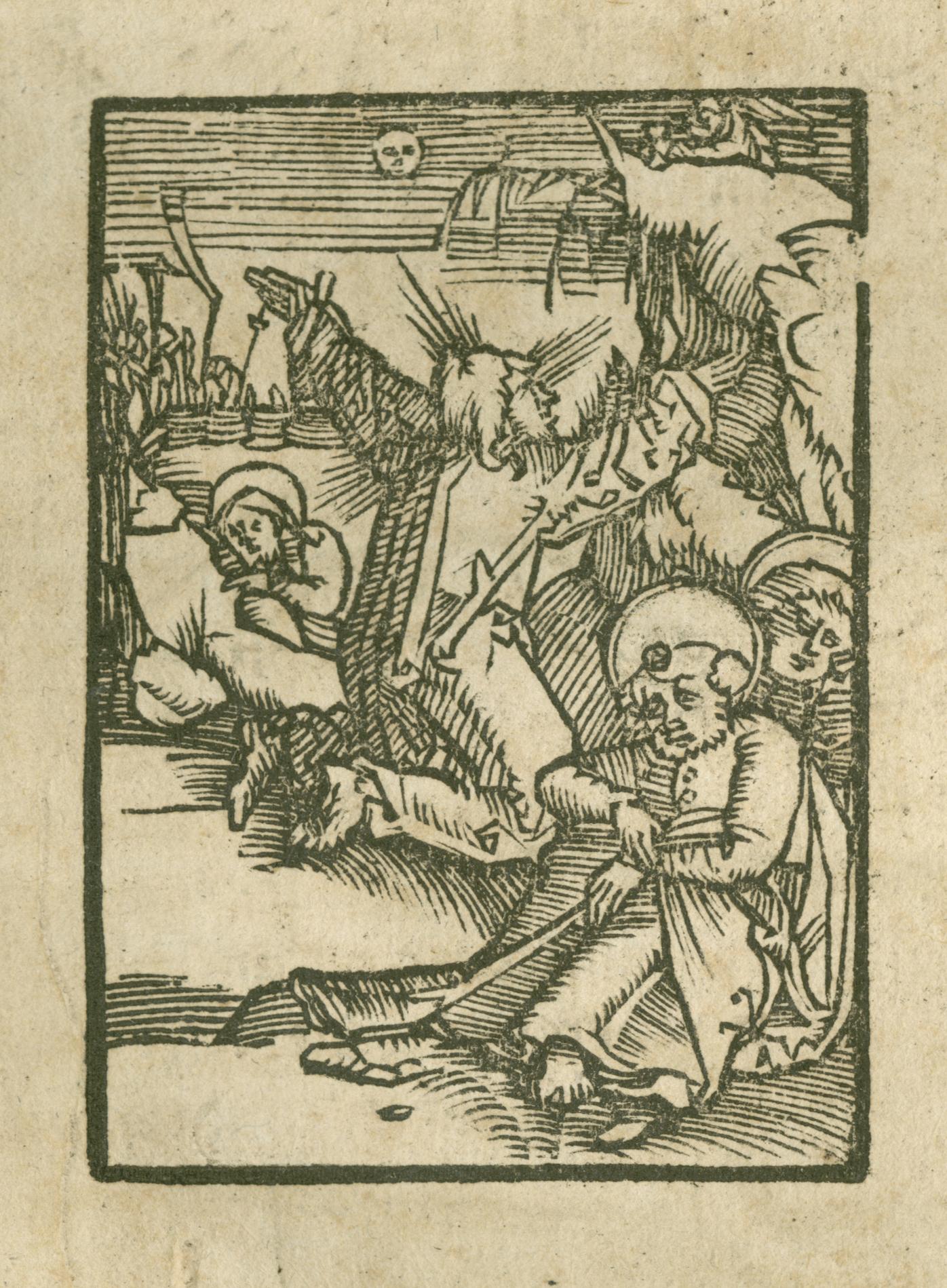
Christ in the garden of Gethsemane
Graf, Urs, approximately 1485-approximately 1527A woodcut by Urs Graf depicting Christ in the garden of Gethsemane. The image was taken from a 1506 harmony of the Gospel texts of the Passion, edited by Matthias Ringmann, translated by Geiler von Keysersberg and printed by Johann Knobloch in Strasbourg.A woodcut by Urs Graf depicting Christ in the garden of Gethsemane. The image was taken from a 1506 harmony of the Gospel texts of the Passion, edited by Matthias Ringmann, translated by Geiler von Keysersberg and printed by Johann Knobloch in Strasbourg. -
 Still image
Des Ehrwirdigen Herrn Doctoris Martini Lutheri, gottseligen, Triumph, und Verantwortung, wider die gottlosen Schmehschrifft, der newen Münch, der Jesuiter, welche sie vnter dem Titel, Anatomia Lutheri, ausgesprenget haben
Single sheet woodcut depicting Pope Leo X on a throne that is about to topple. Behind him are priests and monks and below them a group of Jesuits, who are trying to support the toppling throne. Leo's key, the symbol of the Petrine office is crumbling in the pope's hands. Facing Leo is Martin Luther holding an open Bible. Below him is a group of reformers led by Philipp Melanchthon, each holding a book (Bible). In the center below Leo is Friedrich Staphylus depicted as Judas Iscariot. Staphylus was a student of Philipp Melanchthon's, who rejoined the Catholic Church in 1553.Single sheet woodcut depicting Pope Leo X on a throne that is about to topple. Behind him are priests and monks and below them a group of Jesuits, who are trying to support the toppling throne. Leo's key, the symbol of the Petrine office is crumbling in the pope's hands. Facing Leo is Martin Luther holding an open Bible. Below him is a group of reformers led by Philipp Melanchthon, each holding a book (Bible). In the center below Leo is Friedrich Staphylus depicted as Judas Iscariot. Staphylus was a student of Philipp Melanchthon's, who rejoined the Catholic Church in 1553. -
 Still image
Elector Joachim II of Brandenburg Kneeling before a Crucifix
Friedrich, Franz, approximately 1520-1584A woodcut containing a portrait of Elector Joachim II of Brandenburg kneeling before a crucifix. This woodcut likekly originated as a broadsheet since there are no signs of letterpress on the back. The same woodcut appeared in Grabriel Schnellboltz' Wahrhafftige Bildnisse etlicher Fuersten (Wittenberg, 1562) and the Augspurgische Confession (Frankfurt an der Oder:, Eichorn, 1572).A woodcut containing a portrait of Elector Joachim II of Brandenburg kneeling before a crucifix. This woodcut likekly originated as a broadsheet since there are no signs of letterpress on the back. The same woodcut appeared in Grabriel Schnellboltz' Wahrhafftige Bildnisse etlicher Fuersten (Wittenberg, 1562) and the Augspurgische Confession (Frankfurt an der Oder:, Eichorn, 1572). -
![A woodcut containing a portrait of John Frederick (Johann Friedrich) reading a book and praying before a crucifix. Frederick was a leader of the Schmalkaldic League and fought for Luther's cause against the Imperial troops. The league was defeated in the Battle of Muehlberg in April of 1547. Frederick was wounded by a slash across his left cheek, captured, condemned to death, but ultimately pardoned and reinstated as duke in Weimar. After 1547, however, the Electoral power had fallen to the rivalling Albertininian line of the dynasty residing in Dresden. The print depicts Frederick with the scar on his cheek. The book contains the words, "Hilf Got[t]" (help me God). Cranach marked the woodcut plate with his device and dated it to 1552, but the broadsheet in its current manifestation was printed in 1557.](https://digital.pitts.emory.edu/files/large/P_MSS400_B001_F005_I001/P_MSS400_B001_F005_I001_P001_PROD.jpg) Still image
Still imageElector John Frederick the Magnanimous with Book and Crucifix
Cranach, Lucas, 1515-1586A woodcut containing a portrait of John Frederick (Johann Friedrich) reading a book and praying before a crucifix. Frederick was a leader of the Schmalkaldic League and fought for Luther's cause against the Imperial troops. The league was defeated in the Battle of Muehlberg in April of 1547. Frederick was wounded by a slash across his left cheek, captured, condemned to death, but ultimately pardoned and reinstated as duke in Weimar. After 1547, however, the Electoral power had fallen to the rivalling Albertininian line of the dynasty residing in Dresden.A woodcut containing a portrait of John Frederick (Johann Friedrich) reading a book and praying before a crucifix. Frederick was a leader of the Schmalkaldic League and fought for Luther's cause against the Imperial troops. The league was defeated in the Battle of Muehlberg in April of 1547. Frederick was wounded by a slash across his left cheek, captured, condemned to death, but ultimately pardoned and reinstated as duke in Weimar. After 1547, however, the Electoral power had fallen to the rivalling Albertininian line of the dynasty residing in Dresden. -
 Still image
Wittenberg in Obern Sachsen
A woodcut containing a view of Wittenberg in Saxony-Anhalt. The woodcut was excerpted from from the German edition of Sebastian Münster's Cosmographia (Basel: Heinrich Petri, 1572). The reverse side depicts a jousting battle scene.A woodcut containing a view of Wittenberg in Saxony-Anhalt. The woodcut was excerpted from from the German edition of Sebastian Münster's Cosmographia (Basel: Heinrich Petri, 1572). The reverse side depicts a jousting battle scene. -
![Map of Jerusalem taken from Sebastian Münster's Cosmographia (Basel: Heinrich Petri, 1544), YY4-5 (pages [1015]-1018).](https://digital.pitts.emory.edu/files/large/P_MSS400_B001_F003_I001/P_MSS400_B001_F003_I001_P001_PROD.jpg) Still image
Still imageIerusalem ciuitas sancta, olim metropolis regni Iudaici, hodie uero colonia Turcae
Map of Jerusalem taken from Sebastian Münster's Cosmographia (Basel: Heinrich Petri, 1544), YY4-5 (pages [1015]-1018).Map of Jerusalem taken from Sebastian Münster's Cosmographia (Basel: Heinrich Petri, 1544), YY4-5 (pages [1015]-1018). -
 Still image
The Scourging of Christ
Schäufelein, Hans, approximately 1480-approximately 1539A colorized woodcut by Hans Schäufelein taken from a 16th century devotional work, "Speculum passionis Domini Nostri Ihesu Christi," by the Nuremberg doctor and publisher Ulrich Pinder (1507 PIND), which depicts the scourging of Christ.A colorized woodcut by Hans Schäufelein taken from a 16th century devotional work, "Speculum passionis Domini Nostri Ihesu Christi," by the Nuremberg doctor and publisher Ulrich Pinder (1507 PIND), which depicts the scourging of Christ. -
 Text
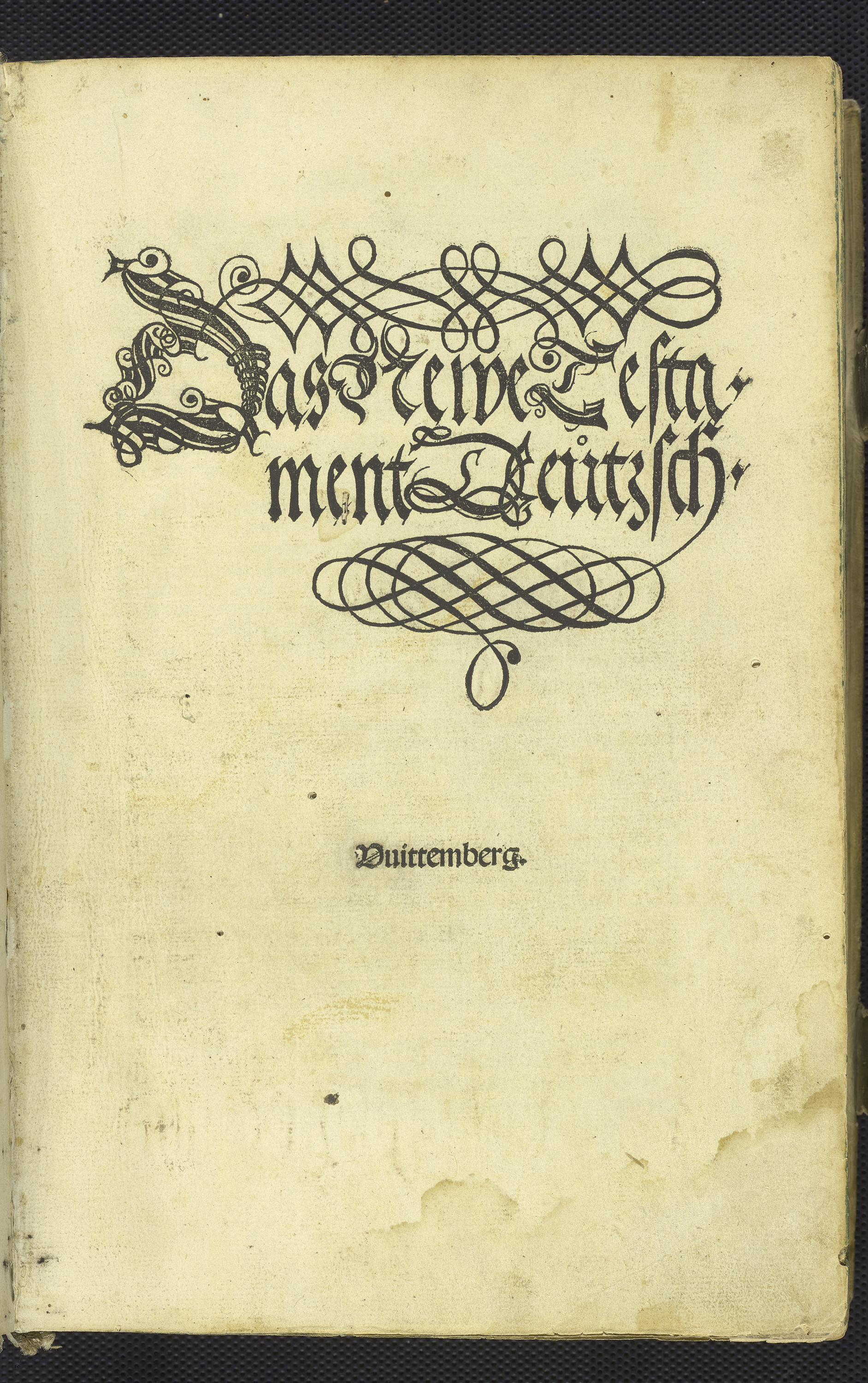
TextDas Newe Testament Deůtzsch
Summary: Luther's translation from the original Greek of the New Testament is a landmark in the history of the German language. His forceful style ensured that his Thuringian-Saxon dialect would provide the standard for High German in years to come. From a religious standpoint, Luther's decision to refer to the original Greek rather than merely to translate the Vulgate ensured that the German New Testament would be much more faithful to the original. Erasmus' New Testament provided the basis for the translation.Summary: Luther's translation from the original Greek of the New Testament is a landmark in the history of the German language. His forceful style ensured that his Thuringian-Saxon dialect would provide the standard for High German in years to come. From a religious standpoint, Luther's decision to refer to the original Greek rather than merely to translate the Vulgate ensured that the German New Testament would be much more faithful to the original. Erasmus' New Testament provided the basis for the translation. -
 Text
TextHistoria de uita et actis reuerendissimi uiri D. Martini Lutheri, uerae theologiae doctoris
Melanchthon, Philipp, 1497-1560Summary: Philipp Melanchthon's biography of Martin Luther was first printed in 1548 and reissued numerous times. Included are Melanchthon's obituary of Martin Luther as well as his funeral sermon. The work was edited by Johannes Pollicarius who added some Latin and Greek poetry on Luther's "Here I stand" statement.Summary: Philipp Melanchthon's biography of Martin Luther was first printed in 1548 and reissued numerous times. Included are Melanchthon's obituary of Martin Luther as well as his funeral sermon. The work was edited by Johannes Pollicarius who added some Latin and Greek poetry on Luther's "Here I stand" statement. -
 Text
TextDisputatio D. Iohannis Eccij et P. Martini Luther in Studio Lipsensi. futura
Luther, Martin, 1483-1546Summary: Response by Luther to the theses of Johann Eck, who had previously been in debate with Luther's colleague, Karlstadt. The face to face clash would come some six months later at the end of June, 1519.Summary: Response by Luther to the theses of Johann Eck, who had previously been in debate with Luther's colleague, Karlstadt. The face to face clash would come some six months later at the end of June, 1519. -
 Text
TextDisputatio domini Johannis Eccij et P. Martini Luther in Studio Lipsiensi futura
Luther, Martin, 1483-1546Summary: This is Luther's first public attack on Johannes Eck. Included in this volume are Eck's letter of Dec. 24, 1518 in which he records his theological differences with Karlstadt, and Eck's own 12 theses with Luther's response.Summary: This is Luther's first public attack on Johannes Eck. Included in this volume are Eck's letter of Dec. 24, 1518 in which he records his theological differences with Karlstadt, and Eck's own 12 theses with Luther's response. -
 Text
TextVerba dei : quanto candore & [que] syncere praedicari, quanta[que] solicitudine uniuersi debeant addiscere
Karlstadt, Andreas Rudolff-Bodenstein von,1486-1541.Summary: Only printing of a pamphlet by Karlstadt attacking Johann Eck on issues that emerged during their disputation at Leipzig 1519, in particular the interpretation of scripture and the question of free will and its relation to the grace of God.Summary: Only printing of a pamphlet by Karlstadt attacking Johann Eck on issues that emerged during their disputation at Leipzig 1519, in particular the interpretation of scripture and the question of free will and its relation to the grace of God. -
 Text
TextEpistola D. Martini Luther ad Georgium Spalatinum &c. de disputatione sua : Eiusdem super Tredecim Proposit[i]o[n]ibus Lipsi[a]e disputatis resolutiones
Luther, Martin, 1483-1546Summary: The Leipzig disputation was a debate between Martin Luther and Andreas Karlstadt on the one hand and Johann Eck on the other. While Karlstadt and Eck found some grounds for agreement on the question of free will, Luther and Eck disagreed vehemently over the question of the pope's authority to establish new articles of faith. This work publishes a letter Luther wrote to his friend Georg Spalatin, as well as 13 theses by Luther refuting Eck's position on the primacy of the pope and the authority of councils.Summary: The Leipzig disputation was a debate between Martin Luther and Andreas Karlstadt on the one hand and Johann Eck on the other. While Karlstadt and Eck found some grounds for agreement on the question of free will, Luther and Eck disagreed vehemently over the question of the pope's authority to establish new articles of faith. This work publishes a letter Luther wrote to his friend Georg Spalatin, as well as 13 theses by Luther refuting Eck's position on the primacy of the pope and the authority of councils. -
 Text
TextDe donatione Constantini quid ueri habeat, eruditorum quorundam iudicium, ut in uersa pagella uidebis
Summary: The Donation of Constantine was a work that told of how the Emperor Constantine I gave secular domination over Italy to the Bishops of Rome. Although purported to have been written in the fourth century, the humanist scholar Lorenzo Valla proved the work, long suspect to be an eighth century forgery. Vall's treatise was one of the first important works of comparative philology, a method invaluable to later biblical scholars and translators.Summary: The Donation of Constantine was a work that told of how the Emperor Constantine I gave secular domination over Italy to the Bishops of Rome. Although purported to have been written in the fourth century, the humanist scholar Lorenzo Valla proved the work, long suspect to be an eighth century forgery. Vall's treatise was one of the first important works of comparative philology, a method invaluable to later biblical scholars and translators. -
 Text
TextDeclaration entiere des fondemens de la doctrine Chrestiene. faicte sur l'Epistre de S. Paul aux Galatie[n]s : en laquele est co[n]tenue vne vraye & parfaicte exposition de la iustification qui est par la foy en Iesus Christ.
Luther, Martin, 1483-1546Summary: Rare first French printing of Luther's lectures on Galatians.Summary: Rare first French printing of Luther's lectures on Galatians. -
 Text
TextIn Epistolam Pauli Ad Galatas, F. Martini Lutheri Augustiniani, commentarius
Luther, Martin, 1483-1546Summary: A commentary on Paul's letter to the Galatians.Summary: A commentary on Paul's letter to the Galatians.

