Richard C. Kessler Reformation Collection
The Richard C. Kessler Reformation Collection was established in 1987, when Richard and Martha Kessler donated their private collection of Reformation imprints and manuscripts to Emory University. These materials were combined with Reformation holdings at the Pitts Theology Library, and an effort was launched to enlarge and sustain this collection in the years to come. An advisory committee of Lutheran laypersons and clergy and of Candler School of Theology faculty and administrators oversees the nurture of the collection and its programs. The Reformation Notes newsletter provides semiannual updates on the growth of the collection, and the Reformation Day at Emory program of music and lectures each October celebrates the collection and its contributions to music, history, and theology.
In the sixteenth century the social and theological movements of central Europe, known collectively as the Reformation, critically shaped religion, law, education and other institutions in the West, and their long shadow has extended even to the present. The purpose of the Kessler Collection is to document these changes by collecting print and manuscript materials down to 1570 by Martin Luther (1483-1546) and those whom he influenced or engaged in debate. In this way historians and theologians will be able to hear the full range of voices that were raised in this dynamic period.
The holdings of the collection now exceed 4,000 items, a mark approximated by only two other libraries in North America; no American library approaches the Kessler Collection's 1,000+ publications by Luther himself.
-
 Text
TextDas Elltern die Kinder zuo der Ee nicht zwinge[n] noch hindern : Vnd die Kinder on der Elltern willen sich nicht verloben sollen
Luther, Martin, 1483-1546Open letter to Hans Schott, Knight, by Luther on the subject of filial piety in marriage, i.e. to what extent the wishes of the parent must be taken into account in the choice of a life partner. Parental consent was an issue during the Reformation. Catholic orthodoxy demanded parental consent of the bridal couple as it impacted property. Luther saw value in both sides, arguing that while parents ought not to be able to compel children to marry or prevent weddings, the children ought to seek their parents' consent.Open letter to Hans Schott, Knight, by Luther on the subject of filial piety in marriage, i.e. to what extent the wishes of the parent must be taken into account in the choice of a life partner. Parental consent was an issue during the Reformation. Catholic orthodoxy demanded parental consent of the bridal couple as it impacted property. Luther saw value in both sides, arguing that while parents ought not to be able to compel children to marry or prevent weddings, the children ought to seek their parents' consent. -
 Text
TextDas Elltern die Kinder zur Ehe nicht zwingen noch hyndern : Vnd die kinder on der elltern willen sich nicht verloben sollen
Luther, Martin, 1483-1546Parental consent was an issue during the Reformation. Catholic orthodoxy demanded parental consent of the bridal couple as it impacted property. Luther saw value in both sides, arguing that while parents ought not to be able to compel children to marry or prevent weddings, the children ought to seek their parents' consent.Parental consent was an issue during the Reformation. Catholic orthodoxy demanded parental consent of the bridal couple as it impacted property. Luther saw value in both sides, arguing that while parents ought not to be able to compel children to marry or prevent weddings, the children ought to seek their parents' consent. -
 Text
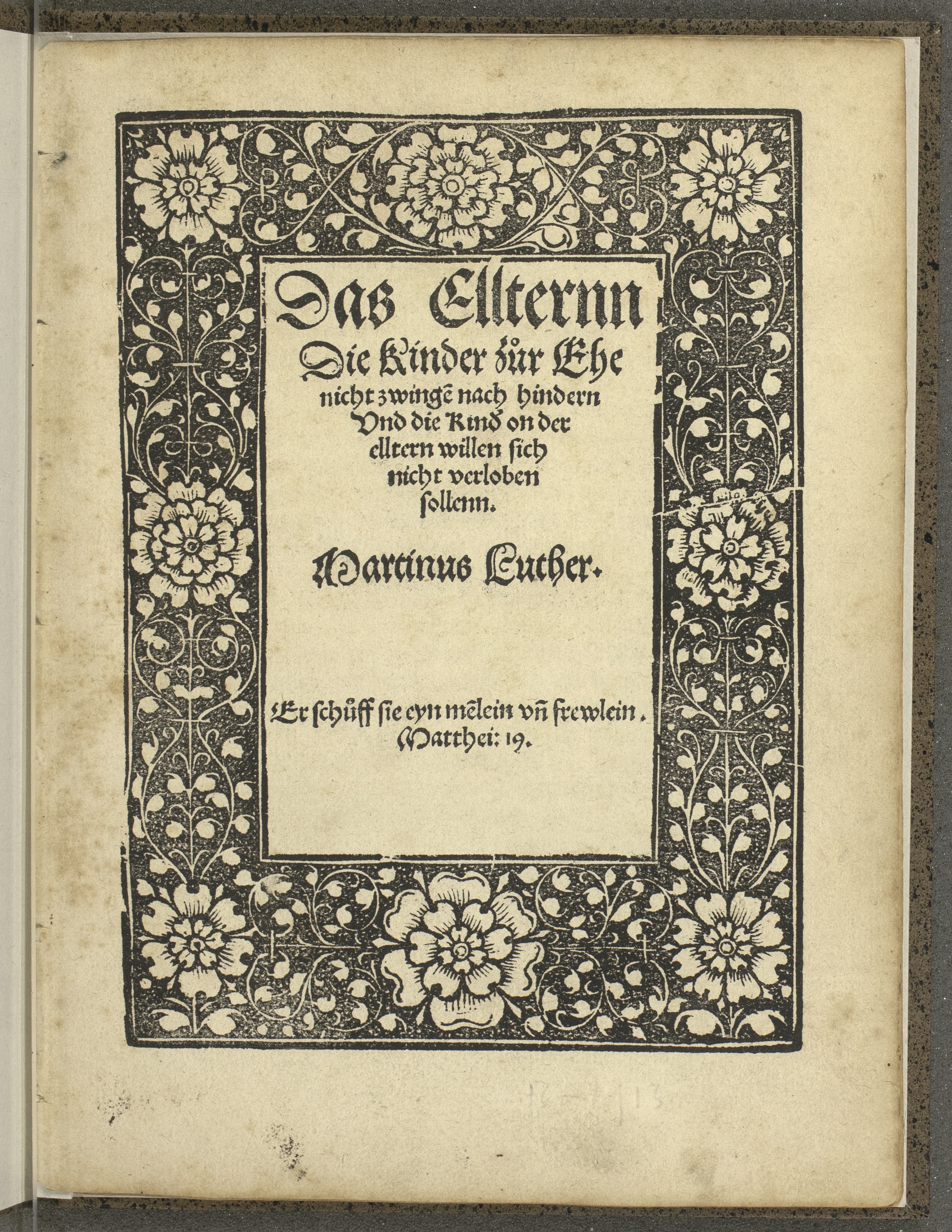
TextDas Ellternn die Kinder zůr Ehe nicht zwinge[n] nach hindern vnd die Kinder on der Elltern willen sich nicht verloben sollenn
Luther, Martin, 1483-1546Summary: Parental consent was an issue during the Reformation. Catholic orthodoxy demanded parental consent of the bridal couple as it impacted property. Luther saw value in both sides, arguing that while parents ought not to be able to compel children to marry or prevent weddings, the children ought to seek their parents' consent.Summary: Parental consent was an issue during the Reformation. Catholic orthodoxy demanded parental consent of the bridal couple as it impacted property. Luther saw value in both sides, arguing that while parents ought not to be able to compel children to marry or prevent weddings, the children ought to seek their parents' consent. -
 Text
TextWie syben Weyber vber jhre vngeratene Menner klagen
Sachs, Hans, 1494-1576Satirical poem by the Nuremberg Meistersinger and cobbler about seven women complaining about their wayward husbands. The piece was originally published as a broadside in 1531 (cf. Erdmann) and is the counterpart to another poem by Sachs about seven men complaining about their wives.Satirical poem by the Nuremberg Meistersinger and cobbler about seven women complaining about their wayward husbands. The piece was originally published as a broadside in 1531 (cf. Erdmann) and is the counterpart to another poem by Sachs about seven men complaining about their wives. -
 Text
TextEine Schrifft, wie die Pfarherrn an den Örtern, da man die Papisterey widerumb auffricht, die Euangelisch Lehr, welche sie Lutherisch nennen, verloben vnd verschweren müssen
Summary: An anonymous pamphlet, containing an oath German pastors had to swear to renounce the "Evangelical doctrine, which is called Lutheran" in order to be readmitted to the Roman Catholic Church. The copy of the oath is preceded by two satirical poems regarding the oath, the first one representing the opinion of a wise man, the second one the answer of an unwise man. On the titlepage are two verses from Matthew 10 against the taking of oaths. The work is published by Christian Rödinger, a printer who put his press in service of the Reformation.Summary: An anonymous pamphlet, containing an oath German pastors had to swear to renounce the "Evangelical doctrine, which is called Lutheran" in order to be readmitted to the Roman Catholic Church. The copy of the oath is preceded by two satirical poems regarding the oath, the first one representing the opinion of a wise man, the second one the answer of an unwise man. On the titlepage are two verses from Matthew 10 against the taking of oaths. The work is published by Christian Rödinger, a printer who put his press in service of the Reformation. -
 Text
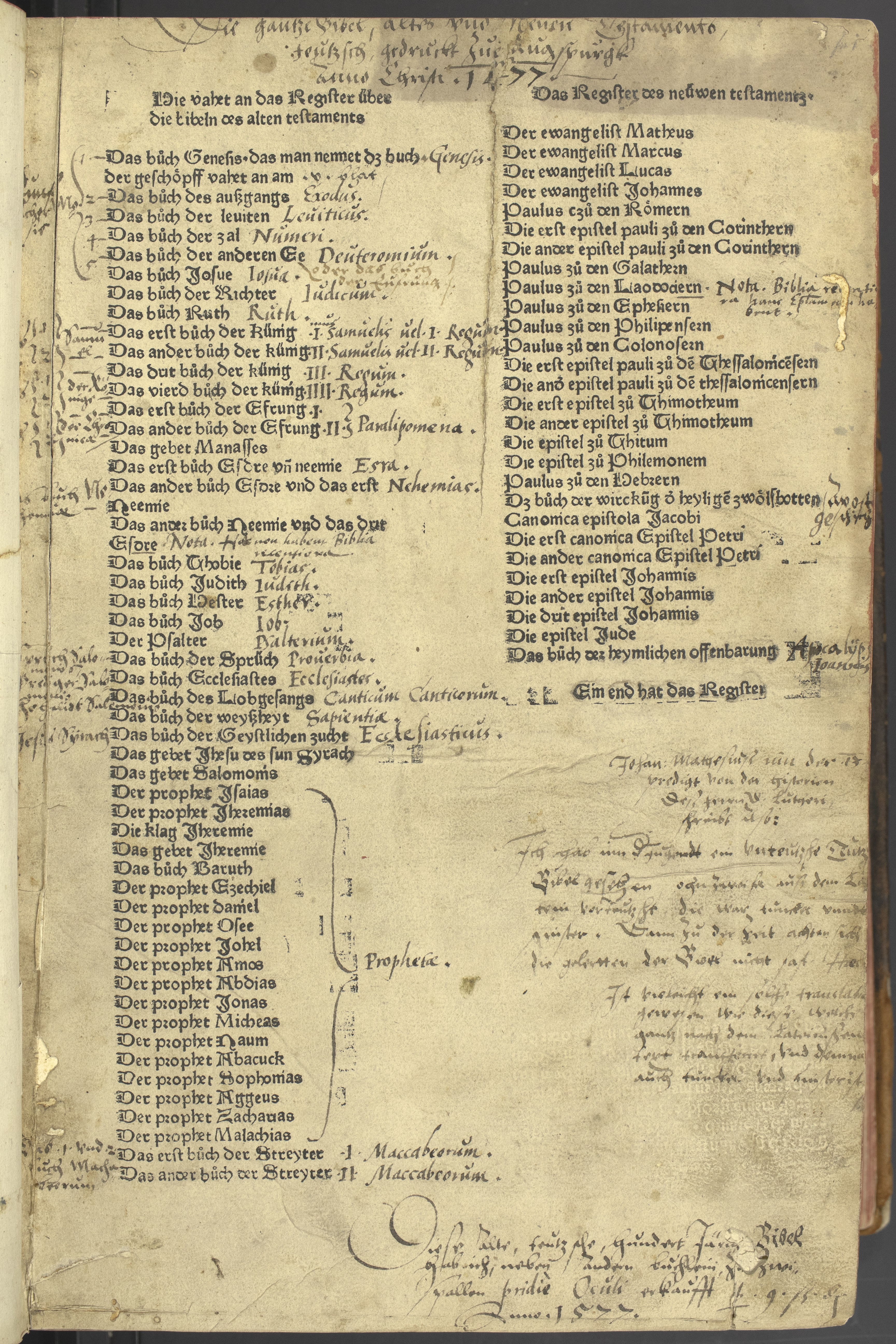
TextHie vahet an das Register über die bibeln des alten testaments
Summary: There were 18 printings of the whole Bible in German before Luther's September Testament of 1522. These were all translated from the Latin vulgate. They are today chiefly remembered as giving the lie to the often expressed assertion that the Catholic Church discouraged the circulation of the Bible in the vernacular. Many church authorities were not pleased to admit that it was necessary to circulate it in German. But they realized that a certain lack of education coupled with the people's desire to know their religious heritage made it necessary to print in German.Summary: There were 18 printings of the whole Bible in German before Luther's September Testament of 1522. These were all translated from the Latin vulgate. They are today chiefly remembered as giving the lie to the often expressed assertion that the Catholic Church discouraged the circulation of the Bible in the vernacular. Many church authorities were not pleased to admit that it was necessary to circulate it in German. But they realized that a certain lack of education coupled with the people's desire to know their religious heritage made it necessary to print in German. -
 Text
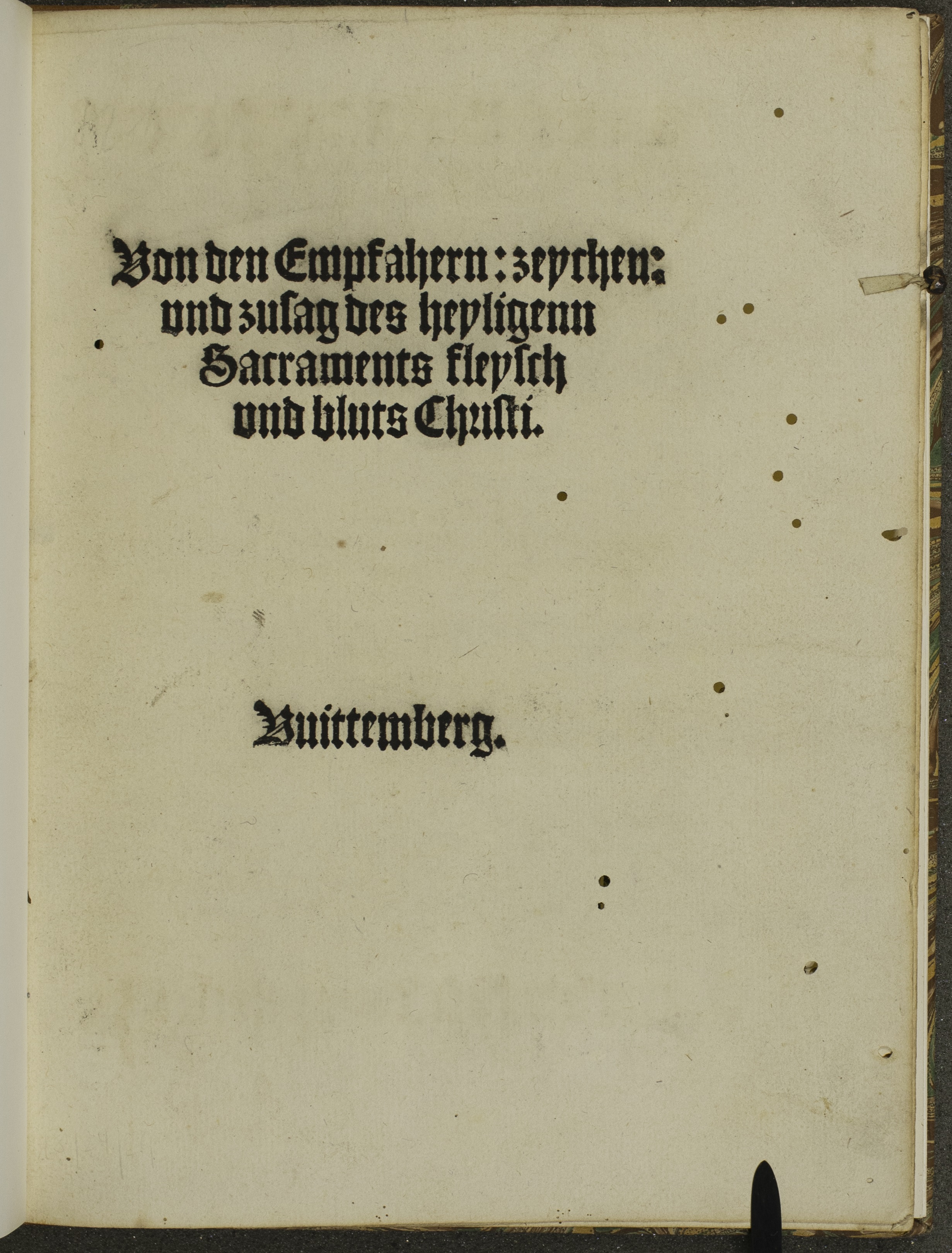
TextVon den Empfahern, zeychen, vnd zusag des heyligenn Sacraments fleysch vnd bluts Christi
Karlstadt, Andreas Rudolff-Bodenstein von, 1486-1541Summary: Karlstadt wrote numerous tracts on the reception of the sacrament in both kinds. This tract deals especially with those who receive the sacrament, what the signs of the sacrament signify, and what promises are given to those who partake.Summary: Karlstadt wrote numerous tracts on the reception of the sacrament in both kinds. This tract deals especially with those who receive the sacrament, what the signs of the sacrament signify, and what promises are given to those who partake. -
 Text
TextDoctoris Martini Luthers kurtz schlussrede von den gelöbten vnd geistlichen leben der klöster
Luther, Martin, 1483-1546Summary: Luther's "Theses on Monasticisms" came about as a partial response to Melanchthon's essay in Loci Communes. Melanchthon revised this section of the Loci to take Luther's criticism into account. Luther's work was translated into German by at least three translators none of whom can be named with certainty.Summary: Luther's "Theses on Monasticisms" came about as a partial response to Melanchthon's essay in Loci Communes. Melanchthon revised this section of the Loci to take Luther's criticism into account. Luther's work was translated into German by at least three translators none of whom can be named with certainty. -
 Text
TextAin Sermon
Luther, Martin, 1483-1546Summary: Sermon preached August 10, 1522, on Matthew 7:15-23 (Beware of False Prophets).Summary: Sermon preached August 10, 1522, on Matthew 7:15-23 (Beware of False Prophets). -
 Text
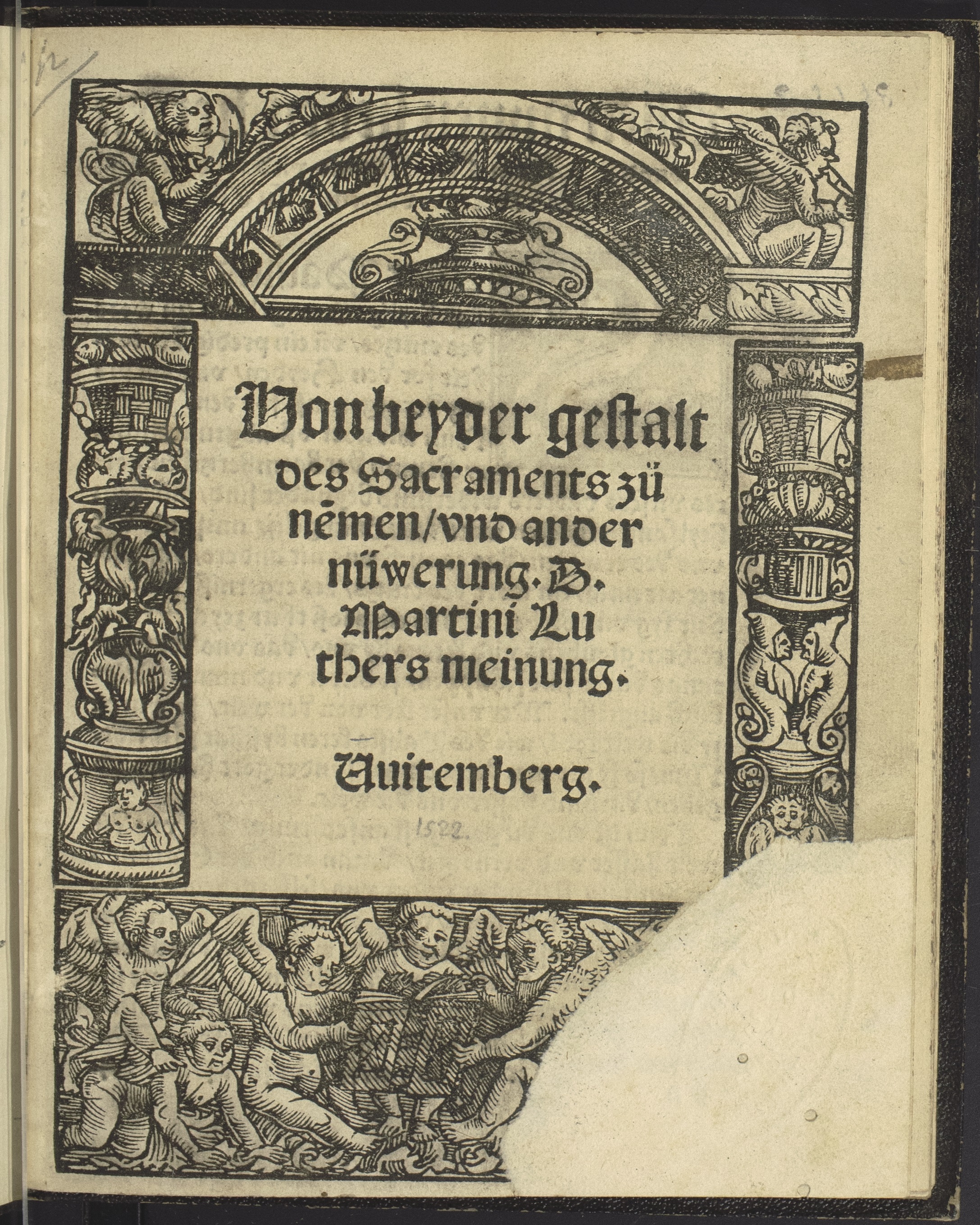
TextVon beyder gestalt des Sacraments zü nem[m]en : vnd ander nüwerung
Luther, Martin, 1483-1546When Luther returned from Wartburg Castle, he preached a series of Eight Sermons in an attempt to restore order in Wittenberg. This tract epitomizes the contents of these sermons.When Luther returned from Wartburg Castle, he preached a series of Eight Sermons in an attempt to restore order in Wittenberg. This tract epitomizes the contents of these sermons. -
 Text
TextDer Zehen Gebot ein nützliche Erklärung
Luther, Martin, 1483-1546This is a 1523 printing of Martin Luther's popular sermon on the Ten Commandments and the Seven Deadly Sins, first printed in 1520 and reprinted numerous times. The work was originally composed in Latin and was translated into German by the cartographer and Christian Hebraist Sebastian Münster.This is a 1523 printing of Martin Luther's popular sermon on the Ten Commandments and the Seven Deadly Sins, first printed in 1520 and reprinted numerous times. The work was originally composed in Latin and was translated into German by the cartographer and Christian Hebraist Sebastian Münster. -
 Text
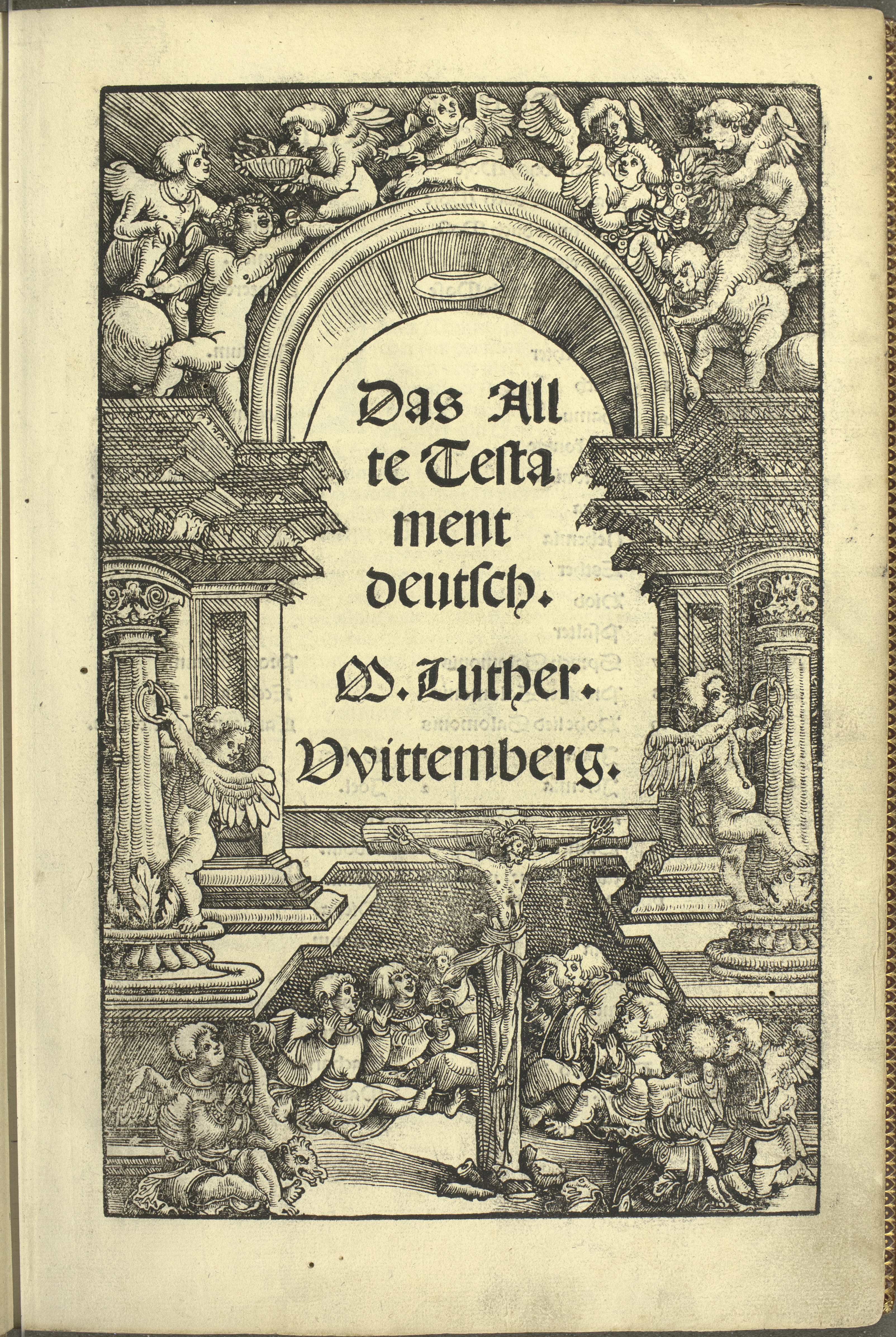
TextDas Allte Testament deutsch
Summary: This is the first printing of the first part of Luther's translation of the Old Testament into idiomatic German. It comprises the Pentateuch, or the five Books of Moses. Scholars long believed that this edition had been destroyed by Luther's friends because of its many printing errors. This printing contains 11 full-page and six initial-figure woodcuts. The volume has been heavily annotated in an early to mid-sixteenth century hand.Summary: This is the first printing of the first part of Luther's translation of the Old Testament into idiomatic German. It comprises the Pentateuch, or the five Books of Moses. Scholars long believed that this edition had been destroyed by Luther's friends because of its many printing errors. This printing contains 11 full-page and six initial-figure woodcuts. The volume has been heavily annotated in an early to mid-sixteenth century hand. -
 Text
TextNew deudsch Psalter
Summary: Luther's first major revision of his translation of the Hebrew book of Psalms. Luther and his translation committee worked diligently on the German Bible throughout Luther's life. Every word came under repeated scrutiny; the translators never felt completely satisfied. The Psalter was revised repeatedly, always with the aim of seeking clarity of expression. This is the first revision of the work. This copy is annotated, dated 5 February, 1541, by A. Blarer, a Swabian reformer who was deeply influenced by Luther.Summary: Luther's first major revision of his translation of the Hebrew book of Psalms. Luther and his translation committee worked diligently on the German Bible throughout Luther's life. Every word came under repeated scrutiny; the translators never felt completely satisfied. The Psalter was revised repeatedly, always with the aim of seeking clarity of expression. This is the first revision of the work. This copy is annotated, dated 5 February, 1541, by A. Blarer, a Swabian reformer who was deeply influenced by Luther. -
 Text
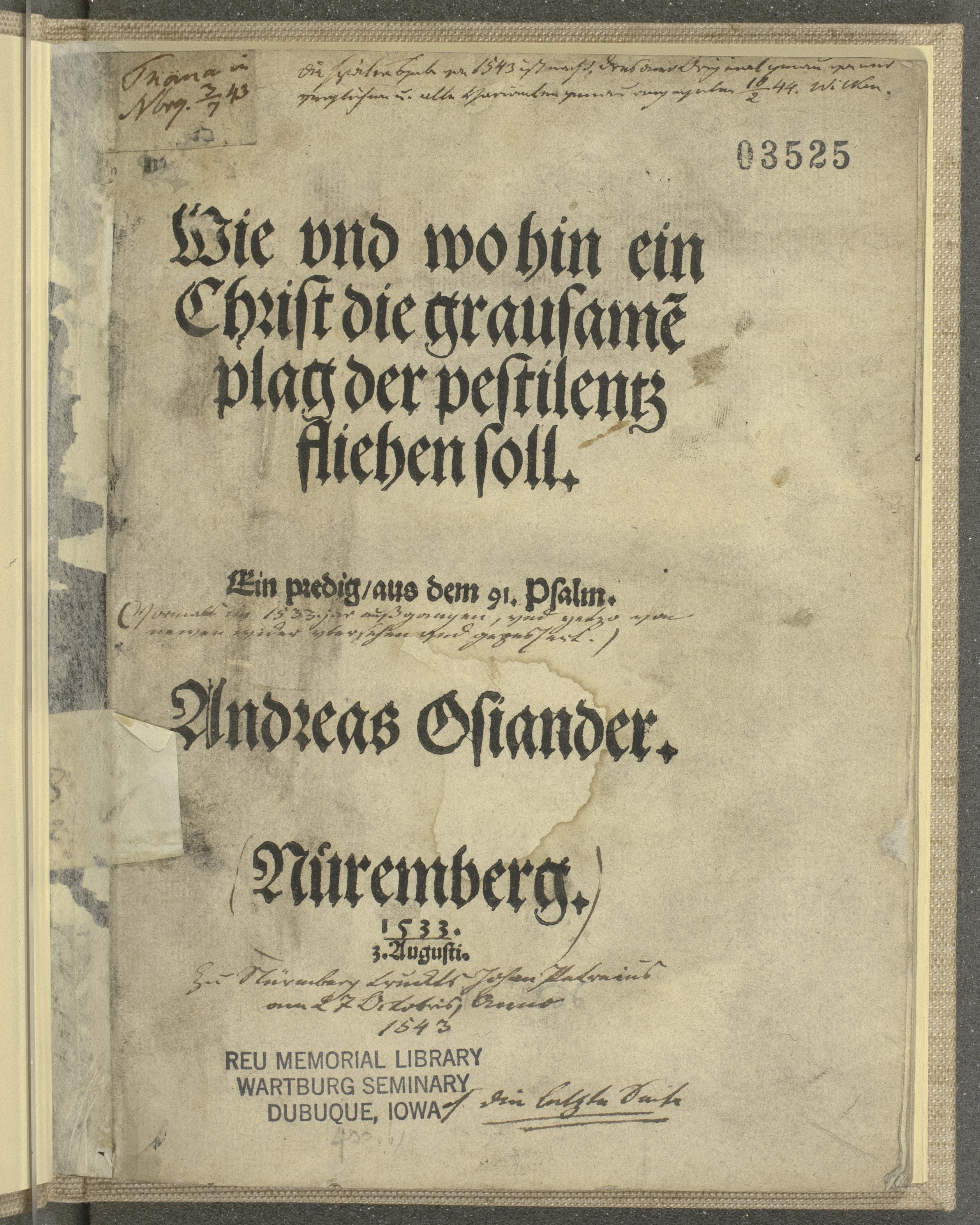
TextWie vnd wo hin ein Christ die grausame[n] Plag der Pestilentz fliehen soll : Ein Predig, aus dem 91. Psalm
Osiander, Andreas, 1498-1552Summary: Andreas Osiander, reformer of Nuremberg, in this sermon counsels Christians on where their hope lies in facing the scourge of plague.Summary: Andreas Osiander, reformer of Nuremberg, in this sermon counsels Christians on where their hope lies in facing the scourge of plague. -
 Text
TextDefensio D. Petri Martyris Vermilii ...
Vermigli, Pietro Martire, 1499-1562Summary: Response by Pietro Martire Vermigli, Italian Visitor General of the Augustinian Order, who fled to Switzerland rather than face charges of heresy, to the books of English Catholic, Richard Smith, on celibacy and monastic vows.Summary: Response by Pietro Martire Vermigli, Italian Visitor General of the Augustinian Order, who fled to Switzerland rather than face charges of heresy, to the books of English Catholic, Richard Smith, on celibacy and monastic vows. -
 Text
TextDe legis litera, siue carne, & spiritu
Karlstadt, Andreas Rudolff-Bodenstein von, 1486-1541Summary: One of two printings of Karlstadt's treatise on the dichotomy of law and grace.Summary: One of two printings of Karlstadt's treatise on the dichotomy of law and grace. -
 Text
TextUom eelichen Leben
Luther, Martin, 1483-1546Summary: This sermon on marriage is an elaboration of an earlier work no longer extant. In its present form there is no set Bible text, nor is the sermon designed for a particular place in the Church year.Summary: This sermon on marriage is an elaboration of an earlier work no longer extant. In its present form there is no set Bible text, nor is the sermon designed for a particular place in the Church year. -
 Text
TextChrysopassus
Eck, Johann, 1486-1543Summary: A significant treatise on predestination. Johann Eck expounds a view of free will and merit, which was soon to come under attack by Martin Luther and other Protestants.Summary: A significant treatise on predestination. Johann Eck expounds a view of free will and merit, which was soon to come under attack by Martin Luther and other Protestants. -
 Text
TextUon denn geystlichen vnd kloster gelubden
Luther, Martin, 1483-1546Summary: One of three 1522 printings of an essay on monastic vows written by Luther during his stay at the Wartburg Castle after the Diet of Worms. It is addressed to monks, whose conscience is troubled by the conflict between their vows and their desire to leave the monastic life. Luther frequently referred to this piece throughout his career, and it became one of his most influential works.Summary: One of three 1522 printings of an essay on monastic vows written by Luther during his stay at the Wartburg Castle after the Diet of Worms. It is addressed to monks, whose conscience is troubled by the conflict between their vows and their desire to leave the monastic life. Luther frequently referred to this piece throughout his career, and it became one of his most influential works. -
 Text
TextSpeculum passionis domini nostri Ihesu Christi : in quo reluce[n]t hec omnia singulariter vere & absolute, puta omnis [per]fectio yerarchie, Omniu[m] fidelium beatitudo, Omnes virtutes, dona, fructus, et spiritualiu[m] bonoru[m] omnium efficacia, quod in fine prime partis huius speculi manifestissime co[m]probat[um]
Pinder, Ulrich, -1510 or 1519Summary: First edition of Ulrich Pinder's Passion narrative richly illustrated with 77 woodcut images (39 full page). Pinder was medical doctor, who had served as the court physician of the Elector Frederick the Wise of Saxony. After 1493 he was the town physician for the city of Nuremberg, where he also wrote several medical tracts and published a variety of books with the printer Friedrich Peypus. For this work, Pinder employed the services of the engravers Hans Schaufelein, who contributed 39 woodcuts, and Hans Baldung Grien, who contributed 21 woodcuts.Summary: First edition of Ulrich Pinder's Passion narrative richly illustrated with 77 woodcut images (39 full page). Pinder was medical doctor, who had served as the court physician of the Elector Frederick the Wise of Saxony. After 1493 he was the town physician for the city of Nuremberg, where he also wrote several medical tracts and published a variety of books with the printer Friedrich Peypus. For this work, Pinder employed the services of the engravers Hans Schaufelein, who contributed 39 woodcuts, and Hans Baldung Grien, who contributed 21 woodcuts. -
 Text
TextAd Serenissimu[m] Principem [et] D[omi]n[u]m Do. Carolum V. : Rho. Caes. Impe. Aug. Hispaniarum rc̄. Rege[m]. Archiducem Austrie rc̄
Luther, Martin, 1483-1546Summary: Fredrick the Wise asked Luther to write to Emperor Charles V after the publication of his Open letter to the Christian Nobility in order to express his loyalty. Spalatin convinced Luther to write this letter of submission and edited it for publication.Summary: Fredrick the Wise asked Luther to write to Emperor Charles V after the publication of his Open letter to the Christian Nobility in order to express his loyalty. Spalatin convinced Luther to write this letter of submission and edited it for publication.

