Search
12 resources
12 items
1524
-
 Text
TextAmbrosii Catharini olim La[n]cinoti co[n]tra Martinu[m] Lutherum super his verbis, Tu es Petrus [et cetera], Et tibi dabo claues regni celorum [et cetera], Mathei xvi. : Dialogus [i?]n minus disertus qua[m] elegans et festiuus : Roffensis Episcopi loca qu[a]edam quibus predicta[m] auctoritate[m] cu[m] duabus alijs Matthei scz xviij. & Ioa[n]nis xx. eiusdem monet[a]e, sed no[n] eiusdem valoris comparat, & discrimen earu[m] euidenti scripturaru[m] testimonio declarat.
Ambrosius Catharinus, Archbishop of Conza, 1484-1553Summary: A selection of criticisms of Luther's views on the spiritual origins of the Papacy by one of his early opponents, Ambrosius Catharinus, edited by another of his early opponents, Hieronymus Emser, and dedicated by Emser to a third Luther opponent, Paul Bachmann, Abbot of Altenzelle.Summary: A selection of criticisms of Luther's views on the spiritual origins of the Papacy by one of his early opponents, Ambrosius Catharinus, edited by another of his early opponents, Hieronymus Emser, and dedicated by Emser to a third Luther opponent, Paul Bachmann, Abbot of Altenzelle. -
 Text
TextD. Sebastian Meyers, etwan Predicanten zun Barfussern zu Strassburg, Widerrüffung an eyn löblich Freystat Strassburg. Anno M.D.XXiiij
Meyer, Sebastian, 1465-1545?Summary: Public renunciation of his monastic vows and earlier teachings by Sebastian Meyer, a preacher in the city of Strassburg and an early follower of Martin Luther.Summary: Public renunciation of his monastic vows and earlier teachings by Sebastian Meyer, a preacher in the city of Strassburg and an early follower of Martin Luther. -
 Text
TextDas Elltern die Kinder zuo der Ee nicht zwinge[n] noch hindern : Vnd die Kinder on der Elltern willen sich nicht verloben sollen
Luther, Martin, 1483-1546Open letter to Hans Schott, Knight, by Luther on the subject of filial piety in marriage, i.e. to what extent the wishes of the parent must be taken into account in the choice of a life partner. Parental consent was an issue during the Reformation. Catholic orthodoxy demanded parental consent of the bridal couple as it impacted property. Luther saw value in both sides, arguing that while parents ought not to be able to compel children to marry or prevent weddings, the children ought to seek their parents' consent.Open letter to Hans Schott, Knight, by Luther on the subject of filial piety in marriage, i.e. to what extent the wishes of the parent must be taken into account in the choice of a life partner. Parental consent was an issue during the Reformation. Catholic orthodoxy demanded parental consent of the bridal couple as it impacted property. Luther saw value in both sides, arguing that while parents ought not to be able to compel children to marry or prevent weddings, the children ought to seek their parents' consent. -
 Text
TextDas Elltern die Kinder zur Ehe nicht zwingen noch hyndern : Vnd die kinder on der elltern willen sich nicht verloben sollen
Luther, Martin, 1483-1546Parental consent was an issue during the Reformation. Catholic orthodoxy demanded parental consent of the bridal couple as it impacted property. Luther saw value in both sides, arguing that while parents ought not to be able to compel children to marry or prevent weddings, the children ought to seek their parents' consent.Parental consent was an issue during the Reformation. Catholic orthodoxy demanded parental consent of the bridal couple as it impacted property. Luther saw value in both sides, arguing that while parents ought not to be able to compel children to marry or prevent weddings, the children ought to seek their parents' consent. -
 Text
TextDas Ellternn die Kinder zůr Ehe nicht zwinge[n] nach hindern vnd die Kinder on der Elltern willen sich nicht verloben sollenn
Luther, Martin, 1483-1546Summary: Parental consent was an issue during the Reformation. Catholic orthodoxy demanded parental consent of the bridal couple as it impacted property. Luther saw value in both sides, arguing that while parents ought not to be able to compel children to marry or prevent weddings, the children ought to seek their parents' consent.Summary: Parental consent was an issue during the Reformation. Catholic orthodoxy demanded parental consent of the bridal couple as it impacted property. Luther saw value in both sides, arguing that while parents ought not to be able to compel children to marry or prevent weddings, the children ought to seek their parents' consent. -
 Text
TextDas Eltern die kinder zuo der Ehe nicht zwinge[n] noch hindern, : Vnd die kinder on der elltern willen sich nicht verloben solle[n]
Luther, Martin, 1483-1546Summary: Parental consent was an issue during the Reformation. Catholic orthodoxy demanded parental consent of the bridal couple as it impacted property. Luther saw value in both sides, arguing that while parents ought not to be able to compel children to marry or prevent weddings, the children ought to seek their parents' consent.Summary: Parental consent was an issue during the Reformation. Catholic orthodoxy demanded parental consent of the bridal couple as it impacted property. Luther saw value in both sides, arguing that while parents ought not to be able to compel children to marry or prevent weddings, the children ought to seek their parents' consent. -
 Text
TextDer hundert vnnd siben vnd zwaintzigest Psalm, aussgelegt, an die Christen zuo Rigen in Liffland
Luther, Martin, 1483-1546Summary:Summary: -
 Text
TextDoctor Johan. dietenberger. [sic] Widerlegung des Lutherischen büchlins, da er schreibt von menschen leren zü meiden rc.
Dietenberger, Johann, approximately 1475-1537Summary: Johannes Dietenberger was a preaching monk who later became the grand inquisitor in the dioceses of Mainz and Cologne. He is best known for his German translation of the Bible, published in 1534. This work is an answer to Luther's writings on human doctrines and traditions in the Church.Summary: Johannes Dietenberger was a preaching monk who later became the grand inquisitor in the dioceses of Mainz and Cologne. He is best known for his German translation of the Bible, published in 1534. This work is an answer to Luther's writings on human doctrines and traditions in the Church. -
 Text
TextEyn Gesprech vo[n] de[n] Scheinwercke[n] der Gaistlichen, und yhren gelubde[n] : damit sie zuverlesterung des bluts Christi vermaynen selig zu werden
Sachs, Hans, 1494-1576Summary: One of nine 1524 printings of this short anti-monastic tract by the Nuremberg cobbler and playright Hans Sachs.Summary: One of nine 1524 printings of this short anti-monastic tract by the Nuremberg cobbler and playright Hans Sachs. -
 Text
TextEyn geschicht wie Got eyner Erbarn kloster Jungfrawe[n] ausgeholffen hat
Luther, Martin, 1483-1546Summary: First printing of F. von Oberweimar's narrative of her escape from the convent of New-Helfta. She came to Luther in Wittenberg in 1524, and he published her explanation of her actions.Summary: First printing of F. von Oberweimar's narrative of her escape from the convent of New-Helfta. She came to Luther in Wittenberg in 1524, and he published her explanation of her actions. -
 Text
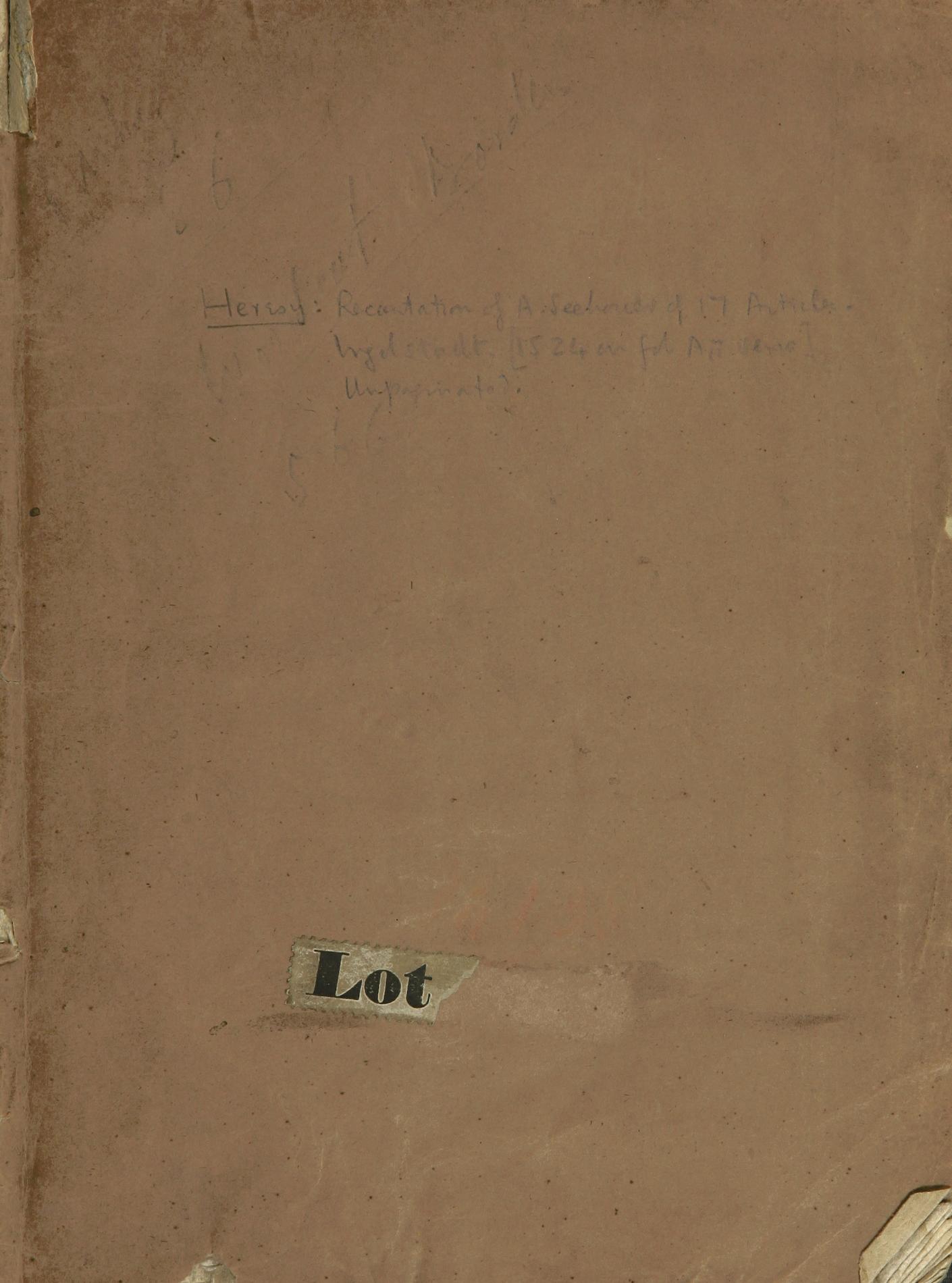
TextIngolstadii XI. Aprilis anni pr[a]esentis vicesimiquarti, publica disputatione per sacr[a]e theologi[a]e professores, examinabuntur : Septemdecim articuli per M. Arsatium Seehouer nuper reuocati : centum conclusiones per D. Leonardum Marstaller Nurnberge.
Universität IngolstadtSummary: A. Seehofer had been a student of Melanchthon. He taught at Ingolstadt until the authorities became cognizant of his heretical Protestant views. His books and papers were seized and he was forced to recant. This pamphlet includes his heretical theses as well as the refutations by L. Marstaller and N. Apell, both members of the university faculty. A German note at the end of the pamphlet warns against the spreading of false rumors and lies about these matters.Summary: A. Seehofer had been a student of Melanchthon. He taught at Ingolstadt until the authorities became cognizant of his heretical Protestant views. His books and papers were seized and he was forced to recant. This pamphlet includes his heretical theses as well as the refutations by L. Marstaller and N. Apell, both members of the university faculty. A German note at the end of the pamphlet warns against the spreading of false rumors and lies about these matters. -
 Text
TextWyder den Wittenbergischen Abtgot Martin Luther
Alveldt, Augustin von, active 16th centurySummary: The Franciscan Augustine of Alveldt wrote this polemical tract in response to Luther's pamphlet "Widder den newen Abgott und alten Teuffel" which criticized the recent canonization of Bishop Benno of Mainz.Summary: The Franciscan Augustine of Alveldt wrote this polemical tract in response to Luther's pamphlet "Widder den newen Abgott und alten Teuffel" which criticized the recent canonization of Bishop Benno of Mainz.