Richard C. Kessler Reformation Collection
The Richard C. Kessler Reformation Collection was established in 1987, when Richard and Martha Kessler donated their private collection of Reformation imprints and manuscripts to Emory University. These materials were combined with Reformation holdings at the Pitts Theology Library, and an effort was launched to enlarge and sustain this collection in the years to come. An advisory committee of Lutheran laypersons and clergy and of Candler School of Theology faculty and administrators oversees the nurture of the collection and its programs. The Reformation Notes newsletter provides semiannual updates on the growth of the collection, and the Reformation Day at Emory program of music and lectures each October celebrates the collection and its contributions to music, history, and theology.
In the sixteenth century the social and theological movements of central Europe, known collectively as the Reformation, critically shaped religion, law, education and other institutions in the West, and their long shadow has extended even to the present. The purpose of the Kessler Collection is to document these changes by collecting print and manuscript materials down to 1570 by Martin Luther (1483-1546) and those whom he influenced or engaged in debate. In this way historians and theologians will be able to hear the full range of voices that were raised in this dynamic period.
The holdings of the collection now exceed 4,000 items, a mark approximated by only two other libraries in North America; no American library approaches the Kessler Collection's 1,000+ publications by Luther himself.
-
 Text
TextAuslegu[n]g der Evangelienn, von Ostern biss auffs Advent
Luther, Martin, 1483-1546Summary: This is the summer Section of Luther's postils, as edited by S. Roth. Luther was not at all pleased with Roth's slip-shod editing. Roth took sermons from whatever sources were available, including from other people (notably Bugenhagen) when copies of Luther sermons could not be found. He also conflicted some sermons, condensed others, and rewrote several.Summary: This is the summer Section of Luther's postils, as edited by S. Roth. Luther was not at all pleased with Roth's slip-shod editing. Roth took sermons from whatever sources were available, including from other people (notably Bugenhagen) when copies of Luther sermons could not be found. He also conflicted some sermons, condensed others, and rewrote several. -
 Text
TextAuff das Vermeint Keiserlich Edict : Ausgangen jm 1531 jare nach dem Reichs tage des 1530 Jars. Glosa
Luther, Martin, 1483-1546Summary: In response to an ultimatum to the Lutheran princes and cities from Emperor Charles V to return to the pre-Reformation status quo within six months, Luther here issues some of his strongest polemic.Summary: In response to an ultimatum to the Lutheran princes and cities from Emperor Charles V to return to the pre-Reformation status quo within six months, Luther here issues some of his strongest polemic. -
 Text
TextAnalectus siue libellus collectaneorum, continens tres tractatus de praecipuis capitibus doctrinae Christianae, quae à Papistis corrumpuntur, & oppugnantur
Selneccer, Nicolaus, 1530-1592Summary: Compilation of three anti-Catholic tracts by the Lutheran theologians and composer of hymns Nicolaus Selneccer.Summary: Compilation of three anti-Catholic tracts by the Lutheran theologians and composer of hymns Nicolaus Selneccer. -
 Text
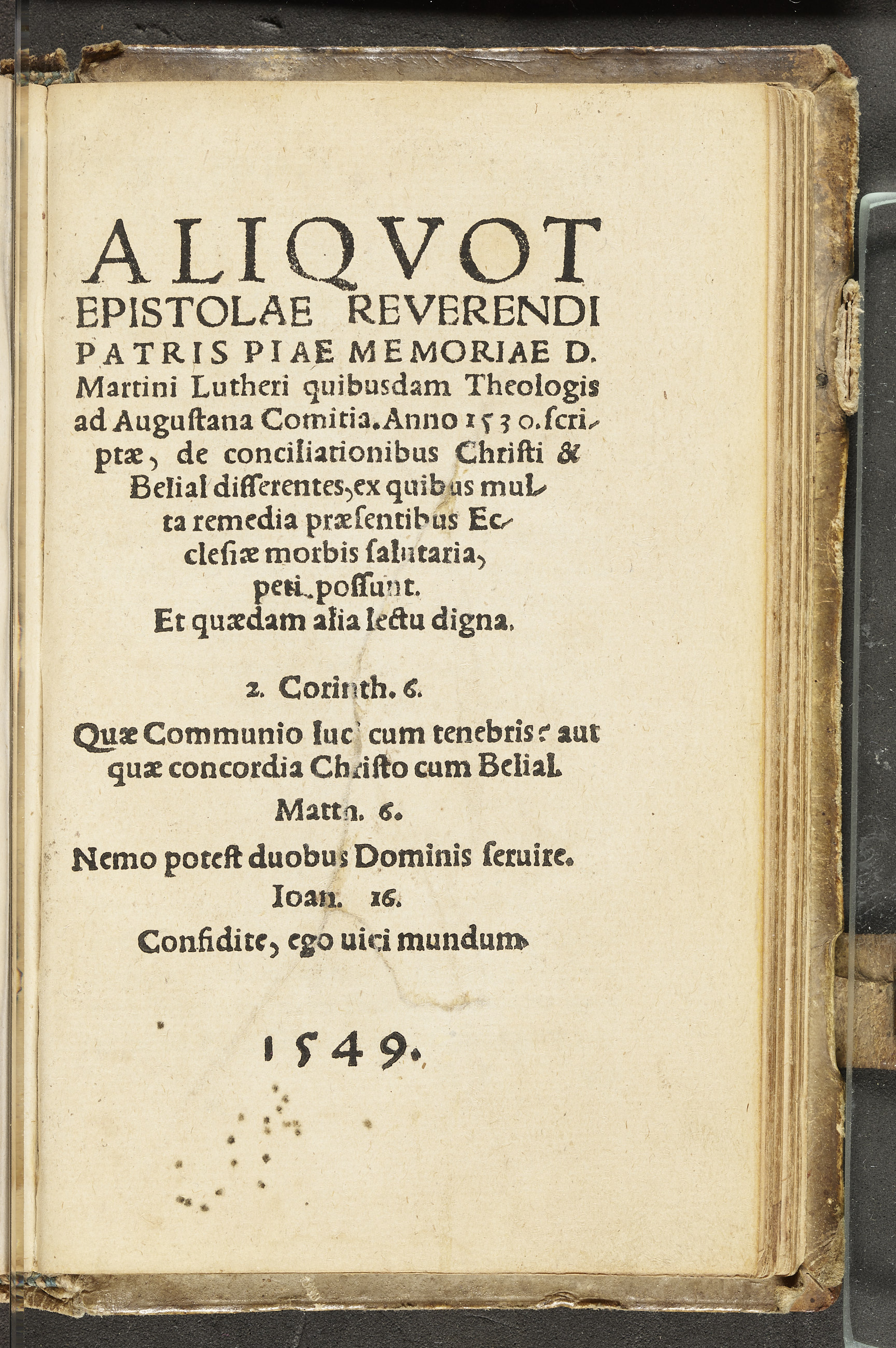
TextAliquot epistolae
Luther, Martin, 1483-1546Summary: M. Flacius Illyricus issued this edition of Luther's letters from Coburg Castle to the theologians at the Diet of Augsburg in an attempt to strengthen the Protestant resolve during the Interim. Intended for the widest possible distribution, both German and Latin versions were provided.Summary: M. Flacius Illyricus issued this edition of Luther's letters from Coburg Castle to the theologians at the Diet of Augsburg in an attempt to strengthen the Protestant resolve during the Interim. Intended for the widest possible distribution, both German and Latin versions were provided. -
 Text
TextAdami Siberi Psalterii, seu, Carminum Dauidicorum libri V
Summary: Poetic paraphrases of the Psalms by the humanist and reformer Adam Siber.Summary: Poetic paraphrases of the Psalms by the humanist and reformer Adam Siber. -
 Still image
Joel's Vision and the Holy Spirit's Descent on Pentecost
Brosamer, Hans, approximately 1500-approximately 1554A woodcut depicting Joel sharing his vision (left) and the fulfillment of that vision in the form of the Holy Spirit descending on the day of Pentecost (right).A woodcut depicting Joel sharing his vision (left) and the fulfillment of that vision in the form of the Holy Spirit descending on the day of Pentecost (right). -
 Still image
Obadiah Receives a Vision from an Angel
A woodcut depicting Obadiah receiving his vision from an angel. The text of the first verse of Obadiah is printed above.A woodcut depicting Obadiah receiving his vision from an angel. The text of the first verse of Obadiah is printed above. -
 Still image
Hosea with his Wife and Children
Beham, Hans Sebald, 1500-1550A woodcut depicting Hosea, his wife, Gomer, and their first two children, Jezreel and Lo-Ruhamah. The first verse of the book of Hosea is printed above.A woodcut depicting Hosea, his wife, Gomer, and their first two children, Jezreel and Lo-Ruhamah. The first verse of the book of Hosea is printed above. -
 Still image
Hosea with his Wife and Children
A woodcut depicting Hosea, his wife, Gomer, and their three children, Jezreel, Lo-Ruhamah, and Lo-Ammi. The first verse of the book of Hosea is printed above.A woodcut depicting Hosea, his wife, Gomer, and their three children, Jezreel, Lo-Ruhamah, and Lo-Ammi. The first verse of the book of Hosea is printed above. -
 Text
TextDas Magnificat Vorteutschet vnd auszgelegt
Luther, Martin, 1483-1546Summary: Luther wrote this exposition of the Magnificent (Luke 1:46-55) in March 1521. He dedicated it to Duke Johann Frederich of Saxony as a token of his thanks to the Duke for his support and encouragement after Luther's condemnation by Pope Leo X. Text in German includes Luther's German translation of the Magnificat from the N.T. Greek of St. Luke's Gospel.Summary: Luther wrote this exposition of the Magnificent (Luke 1:46-55) in March 1521. He dedicated it to Duke Johann Frederich of Saxony as a token of his thanks to the Duke for his support and encouragement after Luther's condemnation by Pope Leo X. Text in German includes Luther's German translation of the Magnificat from the N.T. Greek of St. Luke's Gospel. -
 Text
TextDie Sieben puszpsalm mit deutscher auszlegu[n]g nach dem schrifttlichen synne tzu Christi vn[d] gottis gnaden, neben seyns selben. ware erkentniss gru[n]dlich gerichtet.. 1517
Luther, Martin, 1483-1546Summary: The first edition of Martin Luther's first book, this is Luther's commentary on the seven penitential Psalms (Psalms 6, 32, 38, 51, 102, 130, and 143) based on his lectures at the University of Wittenberg and published in March1517, six months before his 95 Theses. The Reformer's understanding of repentance, penance and grace, influenced by the medieval mystic Johannes Tauler, became central to his theology and underlies his later critique of indulgences. Luther revised this commentary in 1525.Summary: The first edition of Martin Luther's first book, this is Luther's commentary on the seven penitential Psalms (Psalms 6, 32, 38, 51, 102, 130, and 143) based on his lectures at the University of Wittenberg and published in March1517, six months before his 95 Theses. The Reformer's understanding of repentance, penance and grace, influenced by the medieval mystic Johannes Tauler, became central to his theology and underlies his later critique of indulgences. Luther revised this commentary in 1525. -
 Still image
Initial Letter R
An initial letter "R" featuring an angel pulling a soul up out of the fires of Hell.An initial letter "R" featuring an angel pulling a soul up out of the fires of Hell. -
 Still image
Initial Letter S
An initial letter "S" featuring the Vigin Mary holding the infant Jesus Christ with a bird in the upper left corner.An initial letter "S" featuring the Vigin Mary holding the infant Jesus Christ with a bird in the upper left corner. -
 Still image
Initial Letter E
An initial letter "E" printed in red ink.An initial letter "E" printed in red ink. -
 Still image
Initial Letter G
An initial letter "G" featuring the Virgin Mary being crowned by Christ enthroned.An initial letter "G" featuring the Virgin Mary being crowned by Christ enthroned. -
 Still image
Initial Letter G
An initial letter "G" featuring the Virgin Mary being crowned by Christ enthroned.An initial letter "G" featuring the Virgin Mary being crowned by Christ enthroned. -
 Still image
Initial Letter G
An initial letter "G" featuring the Virgin Mary being crowned by Christ enthroned.An initial letter "G" featuring the Virgin Mary being crowned by Christ enthroned. -
 Still image
Initial Letter S
An initial letter "S" featuring the Vigin Mary supporting the infant Jesus Christ atop an altar while another figure approaches. This is possibly a depiction of the circumcision of Jesus. A lion (upper left) and pelican (lower right) are depicted in the margins outside the initial.An initial letter "S" featuring the Vigin Mary supporting the infant Jesus Christ atop an altar while another figure approaches. This is possibly a depiction of the circumcision of Jesus. A lion (upper left) and pelican (lower right) are depicted in the margins outside the initial. -
 Still image
Initial Letter M
An initial letter "M" printed in red ink.An initial letter "M" printed in red ink. -
 Still image
Agnus Dei
A medallion featuring the Agnus Dei (Lamb of God) with a cross banner.A medallion featuring the Agnus Dei (Lamb of God) with a cross banner. -
 Still image
Initial Letter T
An initial letter "T" featuring an angel halting Abraham's blade as he prepares to sacrifice his son, Isaac, upon an altar as a ram watches.An initial letter "T" featuring an angel halting Abraham's blade as he prepares to sacrifice his son, Isaac, upon an altar as a ram watches.

