Search
81 resources
81 items
Date
1522
-
 Still image
The Temple and the Two Witnesses
Cranach, Lucas, 1472-1553A woodcut depicting Saint John the Apostle measuring the temple of God as two witnesses named by an angel face a snarling beast. The image appears in the September Testament, Martin Luther's first printing of his German New Testament.A woodcut depicting Saint John the Apostle measuring the temple of God as two witnesses named by an angel face a snarling beast. The image appears in the September Testament, Martin Luther's first printing of his German New Testament. -
 Still image
The Two Beasts
Cranach, Lucas, 1472-1553A woodcut depicting two beasts, the first with seven crowned heads and ten horns rising from the sea, and the second in the shape of a lamb with two horns which is accompanied by flames raining from the skies. The image appears in the September Testament, Martin Luther's first printing of his German New Testament.A woodcut depicting two beasts, the first with seven crowned heads and ten horns rising from the sea, and the second in the shape of a lamb with two horns which is accompanied by flames raining from the skies. The image appears in the September Testament, Martin Luther's first printing of his German New Testament. -
 Still image
The Woman and the Beast in the Wilderness
Cranach, Lucas, 1472-1553A woodcut depicting the Whore (Harlot) of Babylon atop the red dragon, a golden cup in hand and a Papal crown upon her head. The image appears in the September Testament, Martin Luther's first printing of his German New Testament.A woodcut depicting the Whore (Harlot) of Babylon atop the red dragon, a golden cup in hand and a Papal crown upon her head. The image appears in the September Testament, Martin Luther's first printing of his German New Testament. -
 Still image
The Woman and the Great Red Dragon
Cranach, Lucas, 1472-1553A woodcut depicting a woman crowned in stars facing down a dragon with ten horns and seven crowns while above her a child is carried to the throne of God by angels. The image appears in the September Testament, Martin Luther's first printing of his German New Testament.A woodcut depicting a woman crowned in stars facing down a dragon with ten horns and seven crowns while above her a child is carried to the throne of God by angels. The image appears in the September Testament, Martin Luther's first printing of his German New Testament. -
 Still image
The crucifixion of Christ
A woodcut depicting the crucifixion of Jesus Christ, including a crowd of onlookers surrounding the Virgin Mary.A woodcut depicting the crucifixion of Jesus Christ, including a crowd of onlookers surrounding the Virgin Mary. -
 Still image
The crucifixion of Christ
Burgkmair, Hans, 1473-1531A woodcut depicting the crucifixion of Jesus Christ, with the Virgin Mary baring a breast on the left and God (or possibly Moses) on the right holding the tablets bearing the Ten Commandments.A woodcut depicting the crucifixion of Jesus Christ, with the Virgin Mary baring a breast on the left and God (or possibly Moses) on the right holding the tablets bearing the Ten Commandments. -
 Still image
Three Weddings
A woodcut depicting the wedding ceremonies of three clergy members with musicians (top) playing accompaniment.A woodcut depicting the wedding ceremonies of three clergy members with musicians (top) playing accompaniment. -
 Text
TextUom Missbrauch der Messen
Luther, Martin, 1483-1546Summary: Written in Latin in the fall of 1521 under the title De abroganda missa privata, this is the third printing of the first German edition of Martin Luther's important tract on the celebration of private masses. Luther opposed any celebration of the Eucharist that was not accessible to or provided for the congregation at large and felt so strongly about this material that he translated it into German himself.Summary: Written in Latin in the fall of 1521 under the title De abroganda missa privata, this is the third printing of the first German edition of Martin Luther's important tract on the celebration of private masses. Luther opposed any celebration of the Eucharist that was not accessible to or provided for the congregation at large and felt so strongly about this material that he translated it into German himself. -
 Text
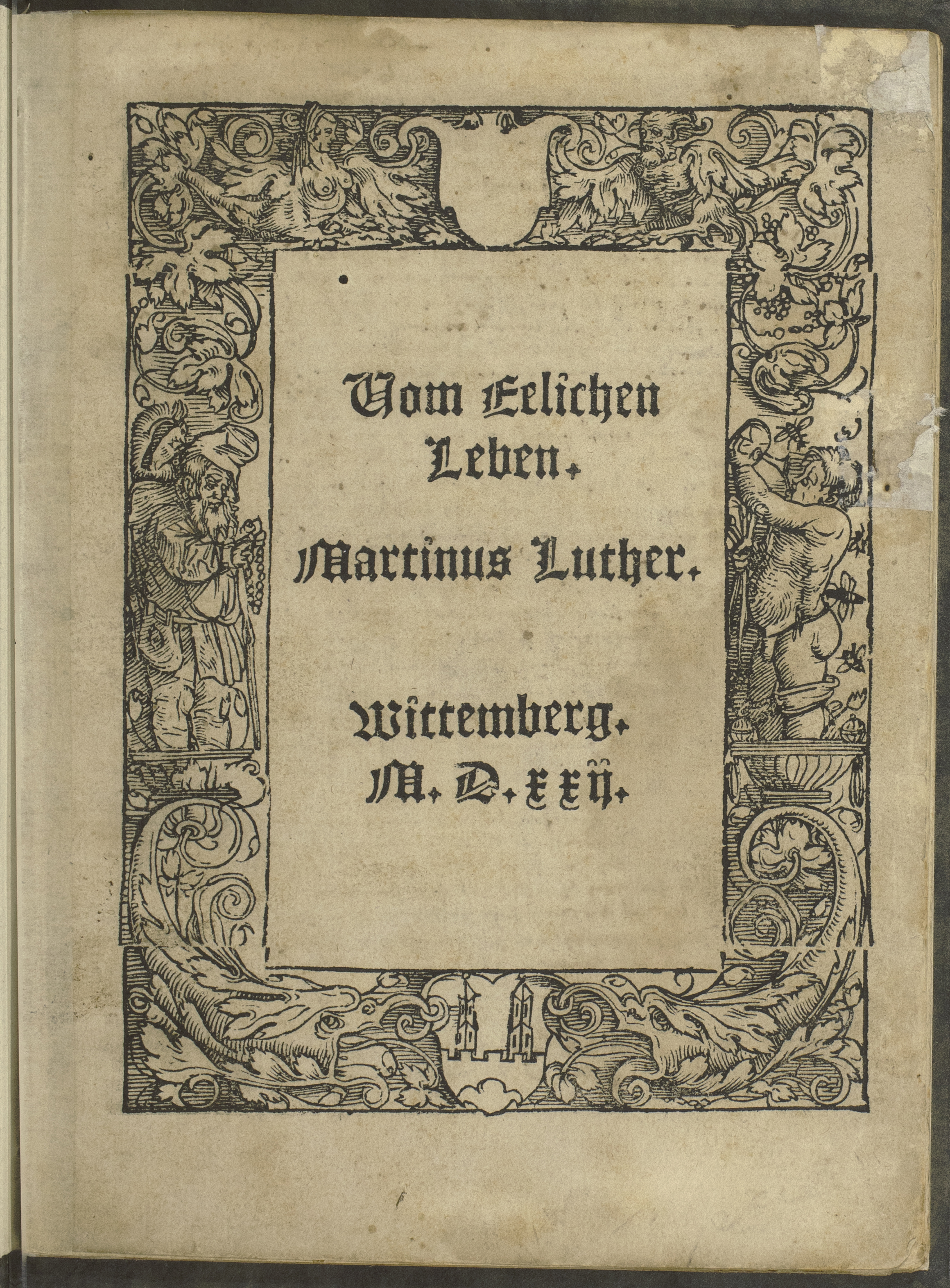
TextUom eelichen Leben
Luther, Martin, 1483-1546Summary: This sermon on marriage is an elaboration of an earlier work no longer extant. In its present form there is no set Bible text, nor is the sermon designed for a particular place in the Church year.Summary: This sermon on marriage is an elaboration of an earlier work no longer extant. In its present form there is no set Bible text, nor is the sermon designed for a particular place in the Church year. -
 Text
TextUom miszbrauch der Messen
Luther, Martin, 1483-1546Summary: Luther always felt a special fondness for this work. Nearly two decades after writing it, he remembered it as being especially powerful. It elicited response from Catholic opponents five years hence. Luther felt so strongly about this material that he translated it into German himself. The abuse of the title refers to the masses sung by chantry priests for individuals. Luther opposed any celebration of the Eucharist that was not accessible to or provided for the congregation at large.Summary: Luther always felt a special fondness for this work. Nearly two decades after writing it, he remembered it as being especially powerful. It elicited response from Catholic opponents five years hence. Luther felt so strongly about this material that he translated it into German himself. The abuse of the title refers to the masses sung by chantry priests for individuals. Luther opposed any celebration of the Eucharist that was not accessible to or provided for the congregation at large. -
 Text
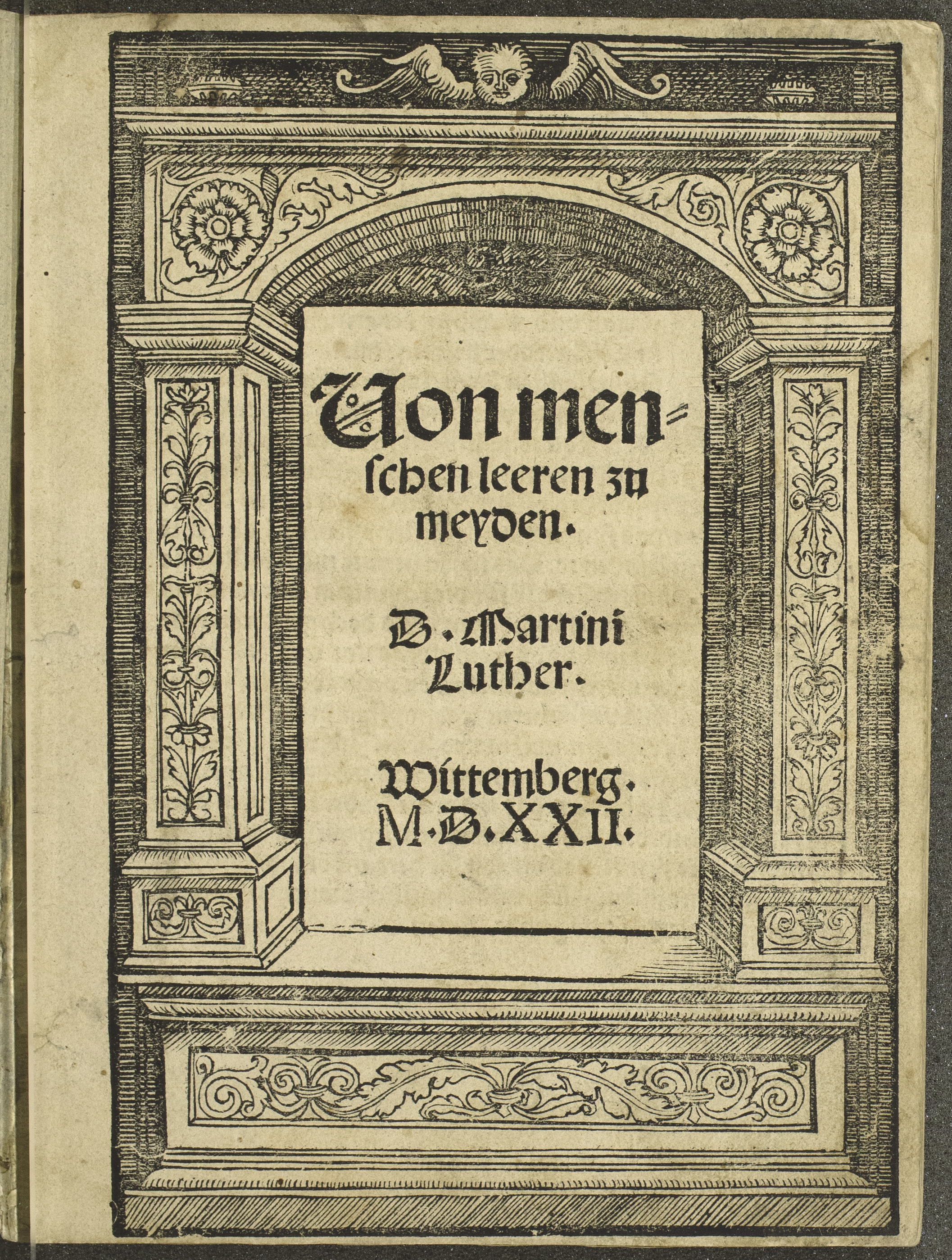
TextUon Menschen leeren zu meyden
Luther, Martin, 1483-1546Summary: First published earlier the same year, Luther's pamphlet Defense of the doctrines of men was one of Luther's most widely read writings with approximately twenty editions appearing in the years 1522 and 1523. Written in honor of Hans von Belepsch who had hosted Luther at the Wartburg as the reformer translated the New Testament. Luther argues that church teachings that have no basis in the Bible, in particular fasting and celibacy, are illegitimate and are to be avoided.Summary: First published earlier the same year, Luther's pamphlet Defense of the doctrines of men was one of Luther's most widely read writings with approximately twenty editions appearing in the years 1522 and 1523. Written in honor of Hans von Belepsch who had hosted Luther at the Wartburg as the reformer translated the New Testament. Luther argues that church teachings that have no basis in the Bible, in particular fasting and celibacy, are illegitimate and are to be avoided. -
 Text
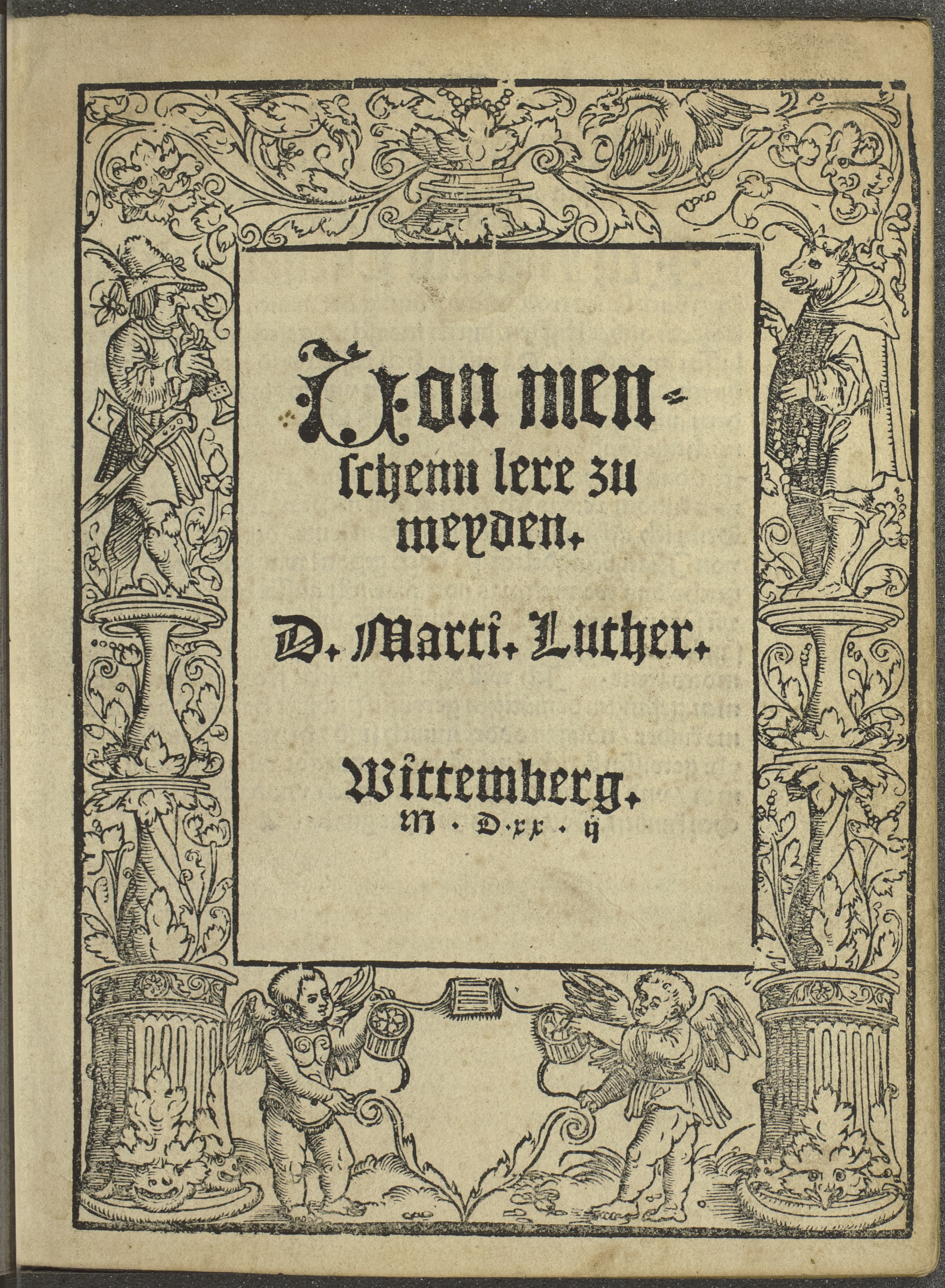
TextUon Menschenn Lere zu meyden
Luther, Martin, 1483-1546Summary: A treatise by Luther on the relationship of belief and practice, intended for those "poor consciences, that lie captive to human laws in cloisters and monastic foundations", as he puts it in his preface. It is also noteworthy that Luther assumes his audience includes both those who could read his writings directly, and those who heard them read by others, when he dedicates his pamphlet "to all who read or hear this little book".Summary: A treatise by Luther on the relationship of belief and practice, intended for those "poor consciences, that lie captive to human laws in cloisters and monastic foundations", as he puts it in his preface. It is also noteworthy that Luther assumes his audience includes both those who could read his writings directly, and those who heard them read by others, when he dedicates his pamphlet "to all who read or hear this little book". -
 Text
TextUon beyder gestalt des Sacraments zu nehmen vnd ander newerung
Luther, Martin, 1483-1546Summary: After Luther published his "Eight Sermons" of 1522, he decided that there was needed a shorter, more concise statement of these sermons' arguments. This is the third printing of the resulting précis.Summary: After Luther published his "Eight Sermons" of 1522, he decided that there was needed a shorter, more concise statement of these sermons' arguments. This is the third printing of the resulting précis. -
 Still image
Vision of God's Throne
Cranach, Lucas, 1472-1553A woodcut depicting Saint John the Apostle kneeling before a scene where God, seated on a throne and flanked by the four beasts described in Ezekiel 1, hands a book to the Lamb of God as a number of angels surround them and a group of elders kneel, crowns removed with harps and incense in hand. The image appears in the September Testament, Martin Luther's first printing of his German New Testament.A woodcut depicting Saint John the Apostle kneeling before a scene where God, seated on a throne and flanked by the four beasts described in Ezekiel 1, hands a book to the Lamb of God as a number of angels surround them and a group of elders kneel, crowns removed with harps and incense in hand. The image appears in the September Testament, Martin Luther's first printing of his German New Testament. -
 Text
TextVon Mensche[n] Leren zu[o] meiden
Luther, Martin, 1483-1546Summary: Luther addresses the monastic rules of fasting, obedience and celibacy, arguing that they have no foundation in scripture and that a transgression of these rules is therefore no sin. At the same time, Luther warns that a transgression of monastic rules in itself is by no means a sign of faith or internalized piety.Summary: Luther addresses the monastic rules of fasting, obedience and celibacy, arguing that they have no foundation in scripture and that a transgression of these rules is therefore no sin. At the same time, Luther warns that a transgression of monastic rules in itself is by no means a sign of faith or internalized piety. -
 Text
TextVon der Beycht, ob die der Bapst macht habe zuo gebieten
Luther, Martin, 1483-1546Summary: Second Basel printing of an early Luther treatise on Penance, together with a translation and exposition of Psalm 118.Summary: Second Basel printing of an early Luther treatise on Penance, together with a translation and exposition of Psalm 118. -
 Text
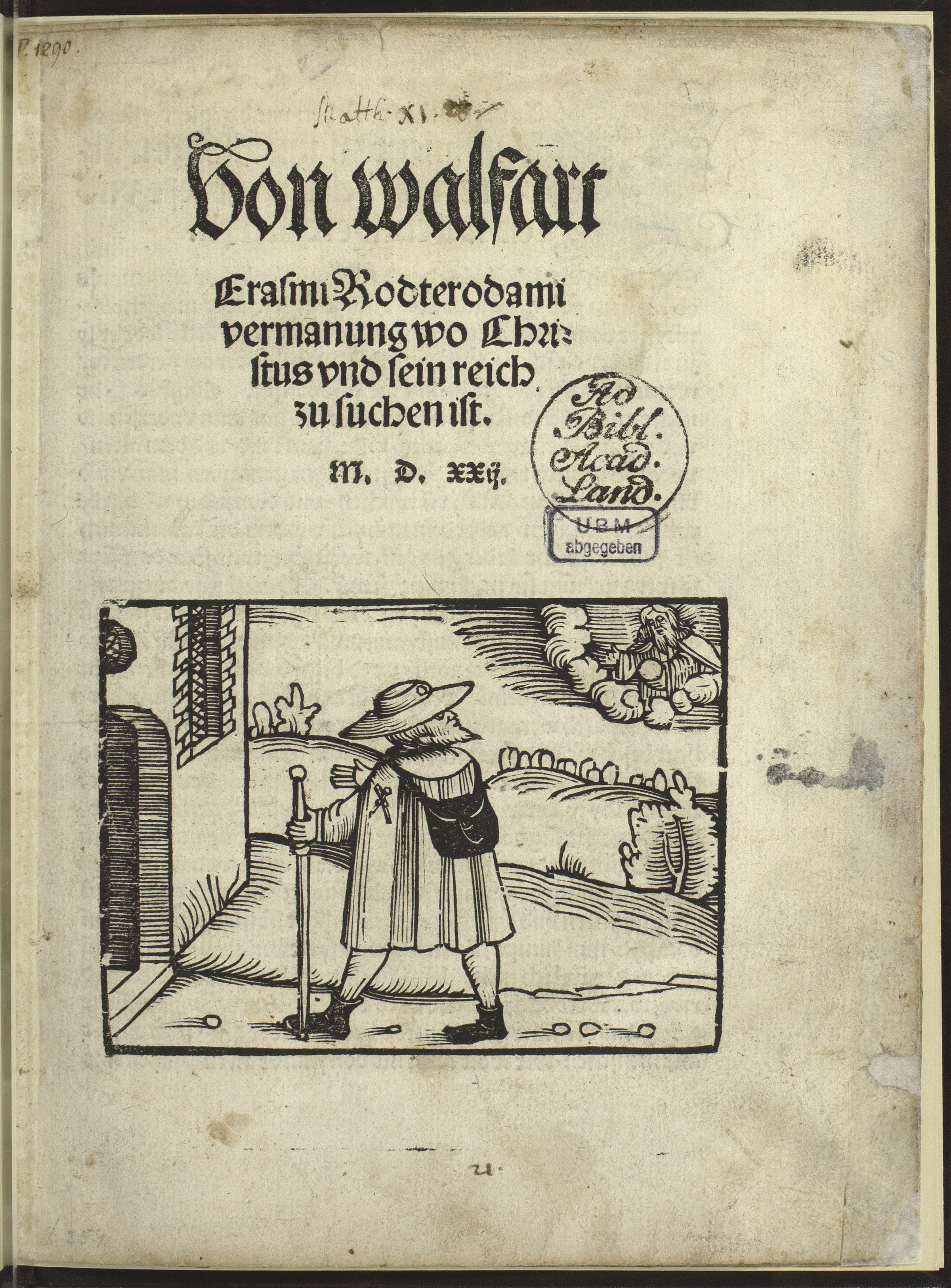
TextVon walfart
Erasmus, Desiderius, -1536Summary: Interpretive pamphlet by Erasmus on the true nature of pilgrimage, as espoused by Jesus in Matthew XI, 28. Erasmus says that true pilgrimage is undertaken with spiritual, and not with physical feet, and, that Jesus receives all sincere pilgrims equally, whether they be clergy or lay, rich or poor, etc.Summary: Interpretive pamphlet by Erasmus on the true nature of pilgrimage, as espoused by Jesus in Matthew XI, 28. Erasmus says that true pilgrimage is undertaken with spiritual, and not with physical feet, and, that Jesus receives all sincere pilgrims equally, whether they be clergy or lay, rich or poor, etc. -
 Text
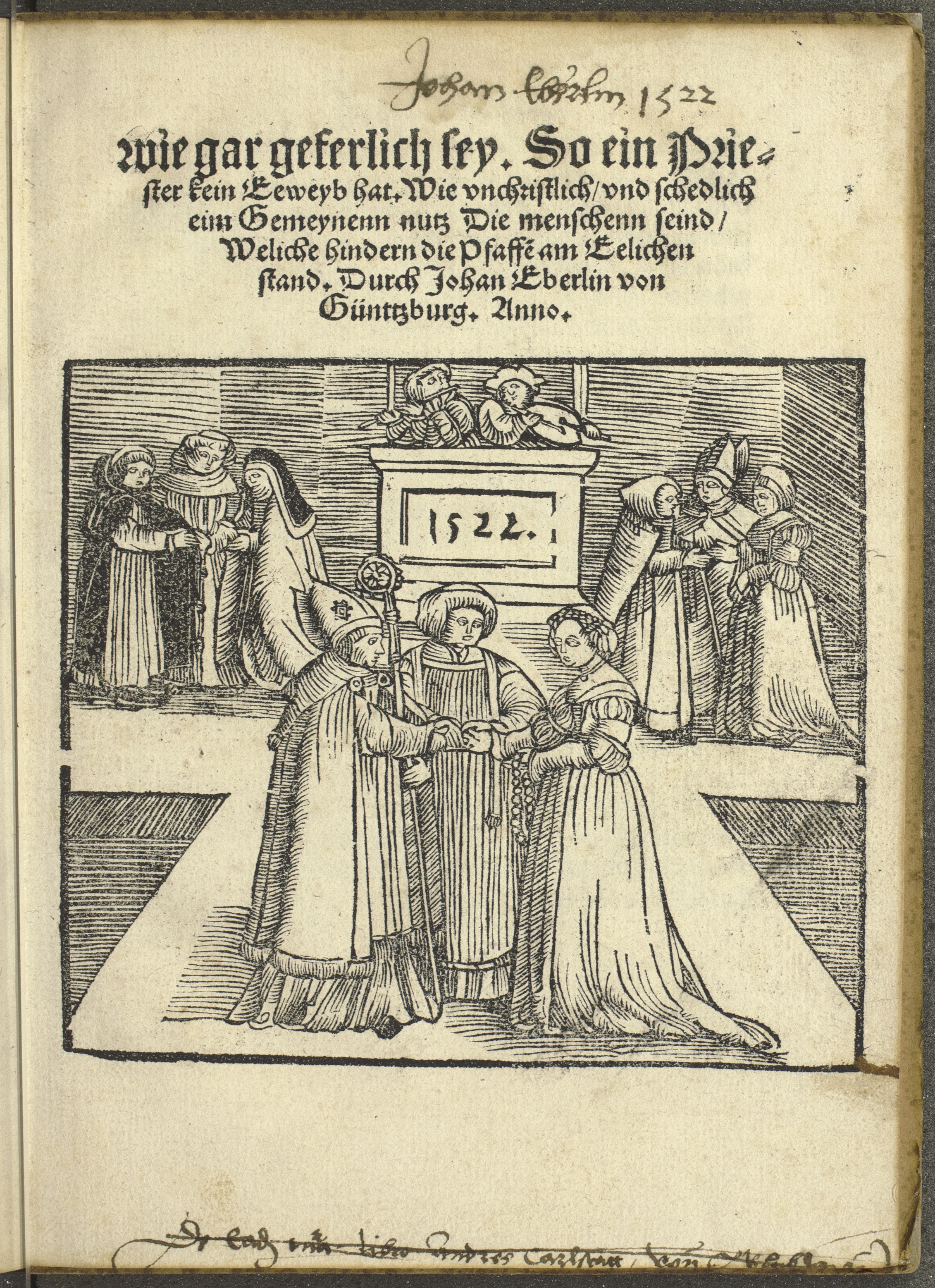
TextWie gar geferlich sey. So ein Priester kein Eeweyb hat : Wie unchristlich, und schedlich eim Gemeynenn nutz die menschenn seind, weliche hindern die Pfaffẽ am Eelichen stand.
Eberlin von Günzburg, Johann, approximately 1470-1533Summary: Johann Eberlin von Günzburg was a former Franciscan who had left the order and joined the Lutheran Reformation in 1521. This is the second edition of his tract on the dangers of priestly celibacy. He himself was married in 1524 and had four children. The title page woodcut shows the wedding of three different priests, including one to a nun.Summary: Johann Eberlin von Günzburg was a former Franciscan who had left the order and joined the Lutheran Reformation in 1521. This is the second edition of his tract on the dangers of priestly celibacy. He himself was married in 1524 and had four children. The title page woodcut shows the wedding of three different priests, including one to a nun.