Search
135 resources
135 items
Medium
pamphlets
-
 Text
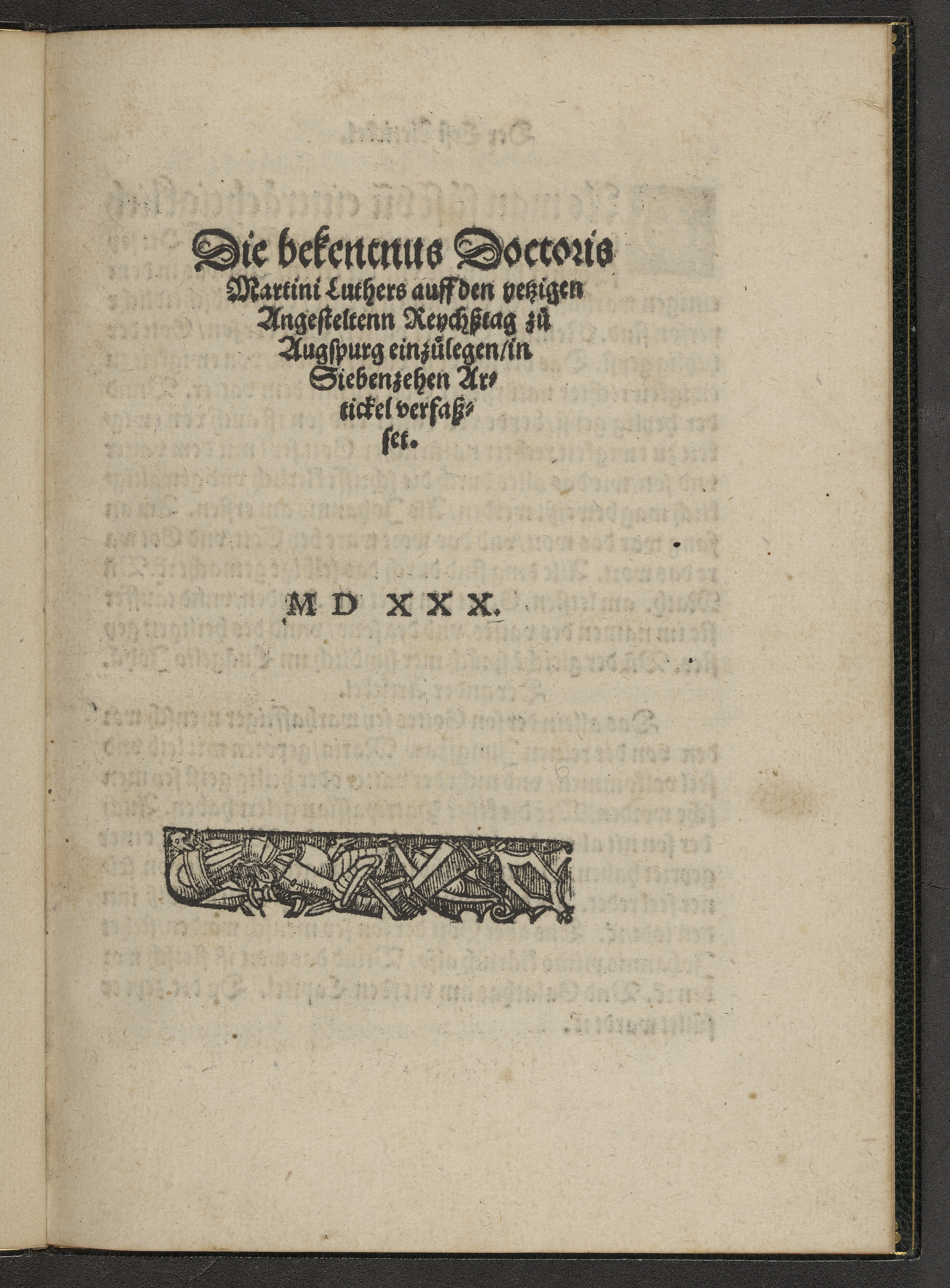
TextDie bekentnus Doctoris Martini Luthers auff den yetzigen Angesteltenn Reychstag zu Augspurg einzuolegen : in Siebenzehen Artickel verfasset
Luther, Martin, 1483-1546Summary: One of at least 11 printings produced in 1530 of the Schwabach Articles, 17 articles of faith composed by Luther 1529 in Schwabach. It became one of the foundational documents for the Augsburg Confession.Bound in modern dark green morocco, bordered, blind- and gilt-tooled, with inside dentelles, gold spine title, and gilt edges. Upper board scratched.Summary: One of at least 11 printings produced in 1530 of the Schwabach Articles, 17 articles of faith composed by Luther 1529 in Schwabach. It became one of the foundational documents for the Augsburg Confession.Bound in modern dark green morocco, bordered, blind- and gilt-tooled, with inside dentelles, gold spine title, and gilt edges. Upper board scratched. -
 Text
TextDispensario Infantil Churchwell pamphlet
A pamphlet for the Dispensario Infantil Churchwell clinic for children's health.A pamphlet for the Dispensario Infantil Churchwell clinic for children's health. -
 Text
TextDisputaciones circulatim expediendae
Luther, Martin, 1483-1546Summary: This disputation centered around the question of whether the German princes could offer armed resistance to the Emperor, and whether they ought to support him in his war against the Turks. Luther came to believe that any support of the Emperor when he was acting in a religious capacity (in league with the pope) was wrong, because the pope was acting contrary to the Gospel. This is the first (and only) printing of this revised version of these theses. It contains 91 theses, whereas the first version (written before the Emperor and princes had come to terms) contained only 70 theses.Summary: This disputation centered around the question of whether the German princes could offer armed resistance to the Emperor, and whether they ought to support him in his war against the Turks. Luther came to believe that any support of the Emperor when he was acting in a religious capacity (in league with the pope) was wrong, because the pope was acting contrary to the Gospel. This is the first (and only) printing of this revised version of these theses. It contains 91 theses, whereas the first version (written before the Emperor and princes had come to terms) contained only 70 theses. -
 Text
TextDisputatio D. Iohannis Eccij et P. Martini Luther in Studio Lipsensi. futura
Luther, Martin, 1483-1546Summary: Response by Luther to the theses of Johann Eck, who had previously been in debate with Luther's colleague, Karlstadt. The face to face clash would come some six months later at the end of June, 1519.Summary: Response by Luther to the theses of Johann Eck, who had previously been in debate with Luther's colleague, Karlstadt. The face to face clash would come some six months later at the end of June, 1519. -
 Text
TextDisputatio domini Johannis Eccij et P. Martini Luther in Studio Lipsiensi futura
Luther, Martin, 1483-1546Summary: This is Luther's first public attack on Johannes Eck. Included in this volume are Eck's letter of Dec. 24, 1518 in which he records his theological differences with Karlstadt, and Eck's own 12 theses with Luther's response.Summary: This is Luther's first public attack on Johannes Eck. Included in this volume are Eck's letter of Dec. 24, 1518 in which he records his theological differences with Karlstadt, and Eck's own 12 theses with Luther's response. -
 Text
TextDisputatio. Secundum, & Octauum Decalogi praecepta, thesibus theologicis explicata, : quae publicè ad disputandum proponentur, pridiè idus Septemb. Quando reuerentia, dignitate, & eruditione praestanti uiro, D. Ioanni Schauppio Eckio, liberalium disciplinarum magistro, et ss. theologiae Licentiato, Officiali Passauiensi, etc. Supremus in professione theologica gradus decernetur.
Theander, Georg, 1508-1570Summary: An academic disputation presented Georg Theander, professor at the University of Ingolstadt, and defended by Sebastian Haydlauff, priest at the church of St. Moritz in Ingolstadt. The disputation was based on 30 theses on the 2nd and 8th commandments.Summary: An academic disputation presented Georg Theander, professor at the University of Ingolstadt, and defended by Sebastian Haydlauff, priest at the church of St. Moritz in Ingolstadt. The disputation was based on 30 theses on the 2nd and 8th commandments. -
 Text
TextDiss ist ain Anzayg: ainem meinem, etwann vertrawten Gesellen, über seyne harte Widerpart, des Sacrament vnd annders betreffend
Langenmantel, Eitelhans, -1528Summary: Since the city of Augsburg was fairly evenly divided between Catholic and Protestant in the early 1520s, several Anabaptists hoped that their movement might benefit from this stalemate. Eitelhans Langenmantel attacks both Catholics and Lutherans, whom he called neo-Papists. His critique in this pamphlet focuses on the eucharist, which Langenmantel views in Zwinglian terms as a symbolic commemoration of the Last Supper. Like many other Anabaptists in Augsburg, Langenmantel was arrested and executed in 1527.Summary: Since the city of Augsburg was fairly evenly divided between Catholic and Protestant in the early 1520s, several Anabaptists hoped that their movement might benefit from this stalemate. Eitelhans Langenmantel attacks both Catholics and Lutherans, whom he called neo-Papists. His critique in this pamphlet focuses on the eucharist, which Langenmantel views in Zwinglian terms as a symbolic commemoration of the Last Supper. Like many other Anabaptists in Augsburg, Langenmantel was arrested and executed in 1527. -
 Text
TextDoctor Johan. dietenberger. [sic] Widerlegung des Lutherischen büchlins, da er schreibt von menschen leren zü meiden rc.
Dietenberger, Johann, approximately 1475-1537Summary: Johannes Dietenberger was a preaching monk who later became the grand inquisitor in the dioceses of Mainz and Cologne. He is best known for his German translation of the Bible, published in 1534. This work is an answer to Luther's writings on human doctrines and traditions in the Church.Summary: Johannes Dietenberger was a preaching monk who later became the grand inquisitor in the dioceses of Mainz and Cologne. He is best known for his German translation of the Bible, published in 1534. This work is an answer to Luther's writings on human doctrines and traditions in the Church. -
 Text
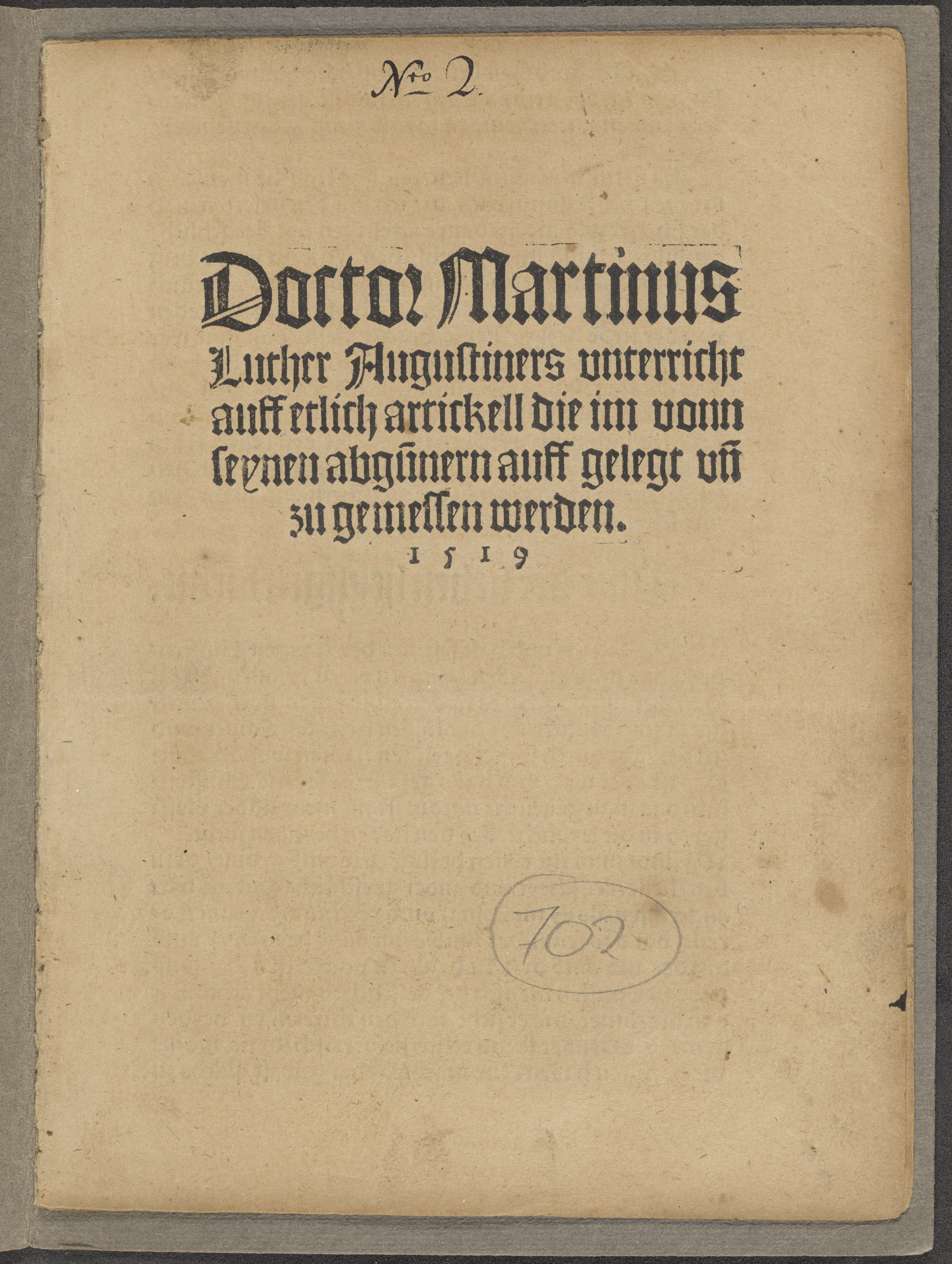
TextDoctor Martinus Luther Augustiners Vnterricht auff etlich Artickell die im vonn seynen Abgūrnern auff gelegt vn[d] zu gemessen werden
Luther, Martin, 1483-1546Summary: Luther was persuaded by Karl von Miltitz to write this public statement as a response to certain charges brought against him by his opponents, in particular Mazzolini da Prierio. In this tract, Luther still supports the invocation of the saints, an idea which he abandoned only shortly after.Summary: Luther was persuaded by Karl von Miltitz to write this public statement as a response to certain charges brought against him by his opponents, in particular Mazzolini da Prierio. In this tract, Luther still supports the invocation of the saints, an idea which he abandoned only shortly after. -
 Text
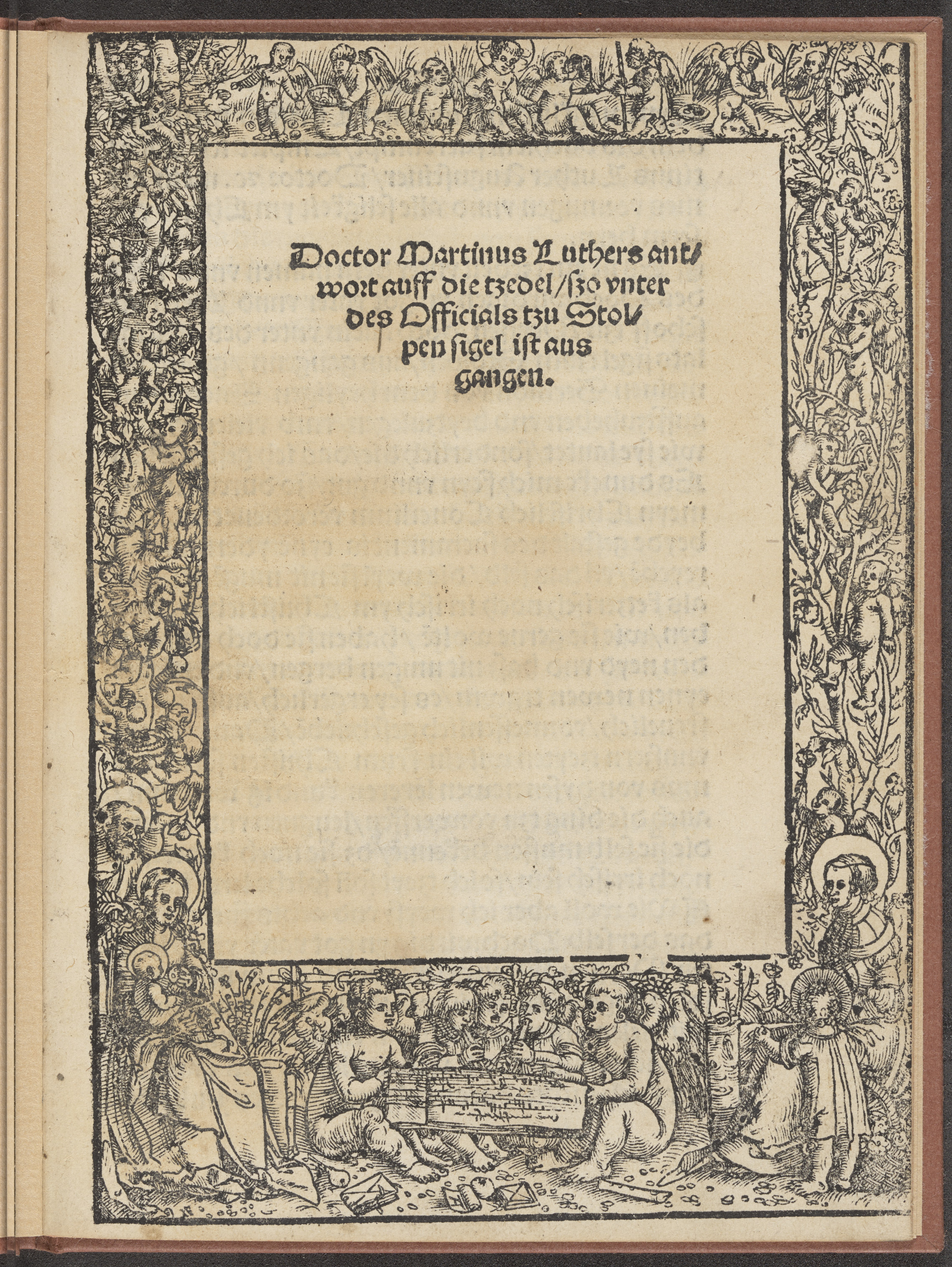
TextDoctor Martinus Luthers antwort auff die tzedel : szo vnter des Officials tzu Stolpen sigel ist ausgangen
Luther, Martin, 1483-1546Summary: The first of five printings in 1520 of an answer to an attack on Luther issued under the seal and authority of Albert, Archbishop of Mainz.Summary: The first of five printings in 1520 of an answer to an attack on Luther issued under the seal and authority of Albert, Archbishop of Mainz. -
 Text
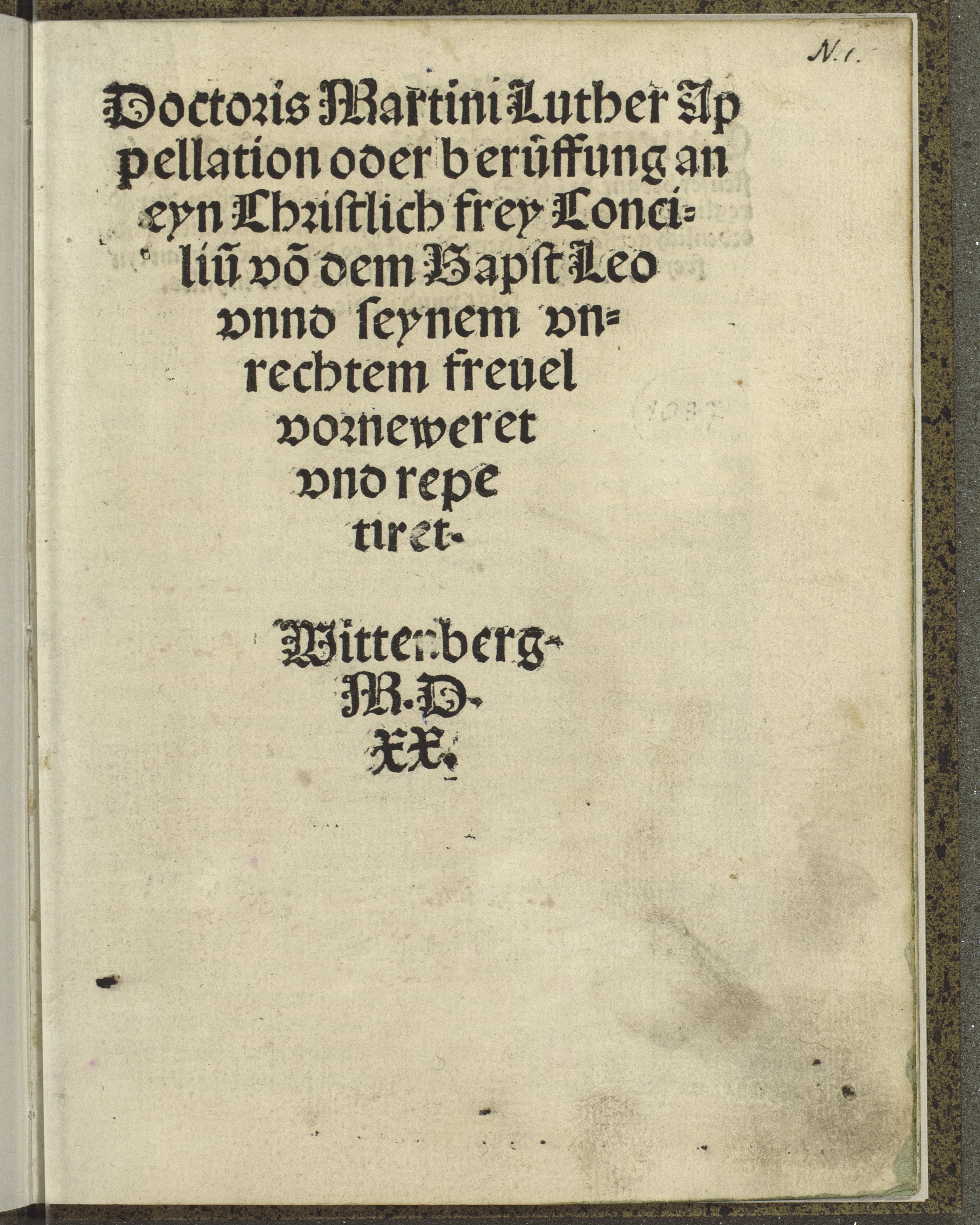
TextDoctoris Martini Luther Appellation oder Berüffung an eyn christlich frey Conciliu[m] vo[n] dem Bapst Leo vnnd seynem vnrechtm Freuel vorneweret vnd repetiret
Luther, Martin, 1483-1546Summary: Despite his lack of success in appealing to the Pope for an Ecumenical Council in 1518, Luther repeats his call in this pamphlet, combining it with a special appeal to the emperor and to the German princes. This is the first printing of this work, produced outside the city of Wittenberg.Summary: Despite his lack of success in appealing to the Pope for an Ecumenical Council in 1518, Luther repeats his call in this pamphlet, combining it with a special appeal to the emperor and to the German princes. This is the first printing of this work, produced outside the city of Wittenberg. -
 Text
TextEechte ware vnd christliche Auslegung vber die Wort des Herrn Johannis am 16 : Jch geh zu meinem Vater, vnd ir sehet mich fort nicht mehr. Wider die newen Ketzerey, die, die göttlichen Gerechtigkeit, vnsers Herrn Jhesu Christi verwirfft, vnd verlestert, als sey sie nicht, durch den Glauben vnser, vn[d] jn vns
Osiander, Andreas, 1498-1552Summary: Short tract by Andreas Osiander about John 16 (Jesus going to the Father) and the doctrine of justification.Summary: Short tract by Andreas Osiander about John 16 (Jesus going to the Father) and the doctrine of justification. -
 Text
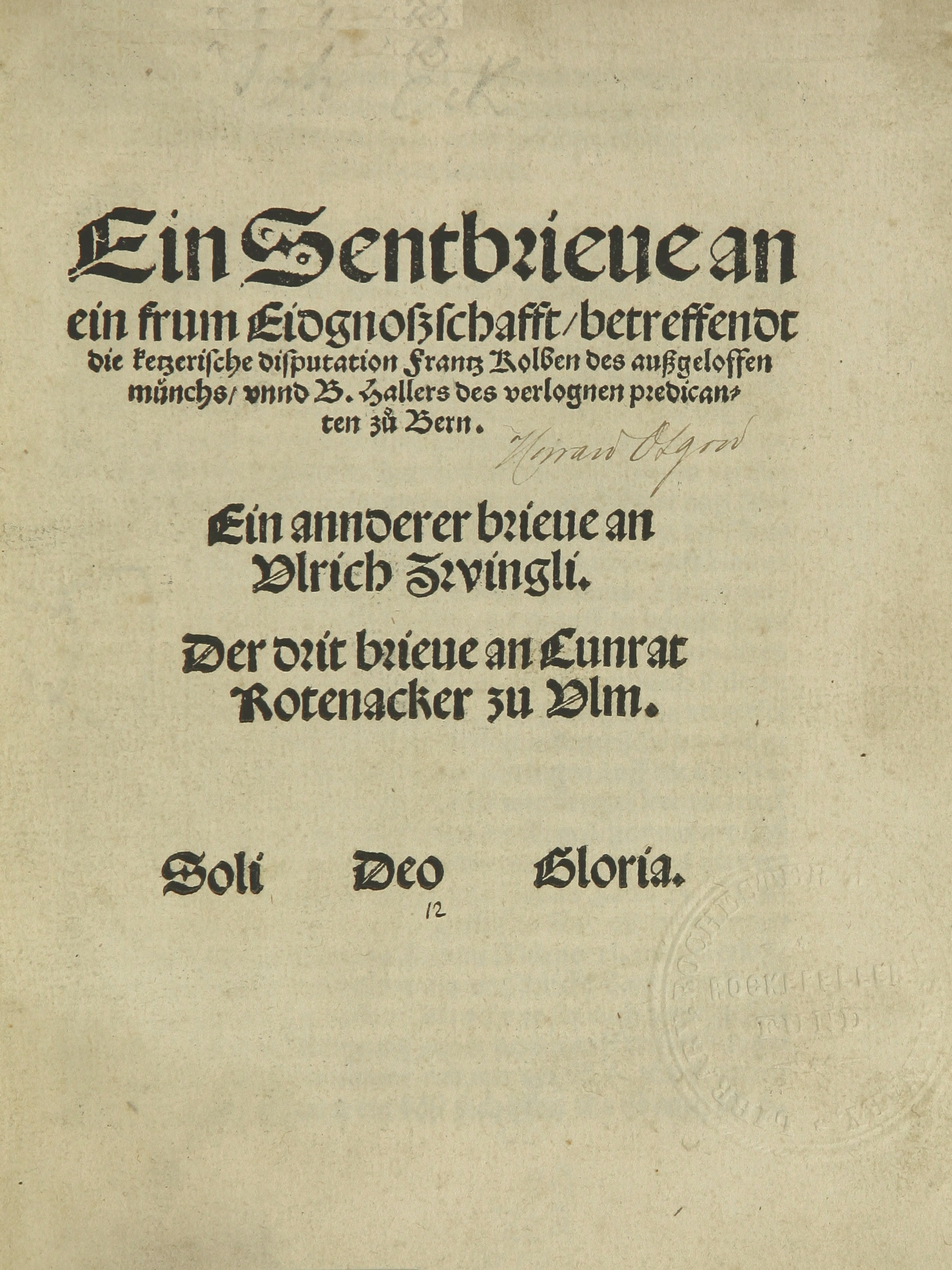
TextEin Sentbreiue an ein frum Eidgnossschafft : betreffendt die ketzerische Disputation Frantz Kolben des aussgeloffen Münchs, vnnd B. Hallers des verlognen Predicanten zu[o] Bern; Ein annderer brieue an Vlrich Zwingli; Der drit brieue an Cunrat Rotenacker zu Vlm; Soli Deo gloria.
Eck, Johann, 1486-1543Summary: First edition of three public letters by Johann Eck. The letters refer to an invitation sent to Eck by Zwingli, Haller and Kolbe, all of them evangelical preachers, to participate in a religious disputation scheduled to take place in Bern. The first letter, addressed to the confederation, explains courteously enough that he, Eck, does not intend to follow the call of the three proven heretics individually, a call not issued by the civic authorities. Not that he is afraid of their arguments; but he insists on an authoritative invitation and presence.Summary: First edition of three public letters by Johann Eck. The letters refer to an invitation sent to Eck by Zwingli, Haller and Kolbe, all of them evangelical preachers, to participate in a religious disputation scheduled to take place in Bern. The first letter, addressed to the confederation, explains courteously enough that he, Eck, does not intend to follow the call of the three proven heretics individually, a call not issued by the civic authorities. Not that he is afraid of their arguments; but he insists on an authoritative invitation and presence. -
 Text
TextEin Sermon
Alveldt, Augustin von, active 16th centurySummary: Augustinus Alveldt, a Franciscan teacher, and later provincial head of the order, here responds to Luther's tract, "Von dem Papsttum zu Rom," in which Luther explains his views on the Papacy.Summary: Augustinus Alveldt, a Franciscan teacher, and later provincial head of the order, here responds to Luther's tract, "Von dem Papsttum zu Rom," in which Luther explains his views on the Papacy. -
 Text
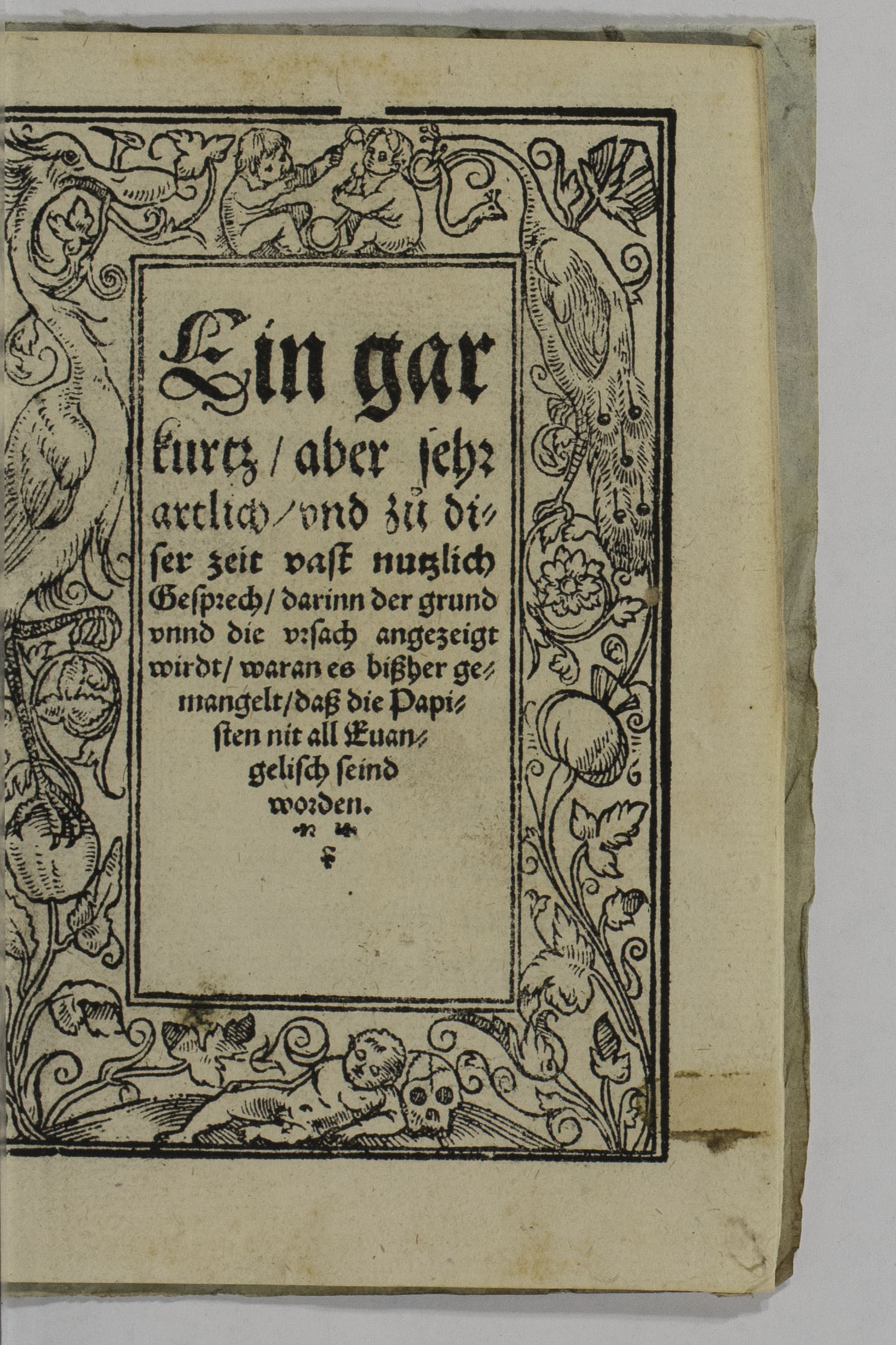
TextEin gar kurtz aber sehr artlich vnd zů diser zeit vast nutzlich Gesprech, darinn der grund vnnd die vrsach angezeigt wirdt waran es bissher gemangelt dass die Papisten nit all Euangelisch seind worden.
Walasser, Adam, -1581Summary: A fictitious dialogue between a Catholic and a Protestant, written by the Catholic theologian Adam Walasser. The discussion includes topics like the authority of tradition outside of Scripture or prayer to the Saints and the Protestant position is presented as reasonable, albeit incorrect by Walasser.Summary: A fictitious dialogue between a Catholic and a Protestant, written by the Catholic theologian Adam Walasser. The discussion includes topics like the authority of tradition outside of Scripture or prayer to the Saints and the Protestant position is presented as reasonable, albeit incorrect by Walasser. -
 Text
TextEin kurtze vnterricht, den Pfarherrn vnd Predigern Inn meiner gnedigen Herrn der Marggraffen zu Branndenburg. [et]c. Fürstenthumen vn[d] Landen, hieniden in Francken vnd auff dem Gebirg verordent : wes sie das volck wider etliche verfürische lere, der widertauffer, an den Feyertägen auff der Canntzel zum getreulichsten vnd besten auss Götlicher schrifft vermanen, vnd vnterrichten sollen
Georg, Margrave of Brandenburg-Ansbach, 1484-1543Summary: A decree against the Anabaptists by the Lutheran prince, Georg, Margrave of Brandenburg-Ansbach, to be read from the pulpits of his territory.Summary: A decree against the Anabaptists by the Lutheran prince, Georg, Margrave of Brandenburg-Ansbach, to be read from the pulpits of his territory. -
 Text
TextEin lüstig gesprech der Teuffel vnd etlicher Kriegsleute : Von der flucht des grossen Scharrhansen H. Heinrichs von Braunschweig
Summary: While Henry, the Younger, Duke of Brunswick-Wolfenbüttel, openly identified with the Roman Catholic Church in its struggle against the Reformation, his religious principles were often dictated by political expediency. He is, in fact, said to have permitted Lutheran influences in a variety of instances in his duchy. Defeated by the Lutheran princes of the Schmalkald League, he was driven from his territories, returning after their defeat at the hands of the Imperial army. This dialogue between the devil and some soldiers satyrizes Henry.Summary: While Henry, the Younger, Duke of Brunswick-Wolfenbüttel, openly identified with the Roman Catholic Church in its struggle against the Reformation, his religious principles were often dictated by political expediency. He is, in fact, said to have permitted Lutheran influences in a variety of instances in his duchy. Defeated by the Lutheran princes of the Schmalkald League, he was driven from his territories, returning after their defeat at the hands of the Imperial army. This dialogue between the devil and some soldiers satyrizes Henry. -
 Text
TextEin schöner spruch darinn deren von Costantz seltzame Renckh und Abentheür, damit Sy vmbgon begriffen syen.
Treger, Konrad, approximately 1480-1542Summary: Anti-Reformation poem directed at the city of Konstanz. Tregor, an Augustinian Prior, was a leading defender of Catholicism in Switzerland.Summary: Anti-Reformation poem directed at the city of Konstanz. Tregor, an Augustinian Prior, was a leading defender of Catholicism in Switzerland. -
 Text
TextEpistola D. Martini Luther ad Georgium Spalatinum &c. de disputatione sua : Eiusdem super Tredecim Proposit[i]o[n]ibus Lipsi[a]e disputatis resolutiones
Luther, Martin, 1483-1546Summary: The Leipzig disputation was a debate between Martin Luther and Andreas Karlstadt on the one hand and Johann Eck on the other. While Karlstadt and Eck found some grounds for agreement on the question of free will, Luther and Eck disagreed vehemently over the question of the pope's authority to establish new articles of faith. This work publishes a letter Luther wrote to his friend Georg Spalatin, as well as 13 theses by Luther refuting Eck's position on the primacy of the pope and the authority of councils.Summary: The Leipzig disputation was a debate between Martin Luther and Andreas Karlstadt on the one hand and Johann Eck on the other. While Karlstadt and Eck found some grounds for agreement on the question of free will, Luther and Eck disagreed vehemently over the question of the pope's authority to establish new articles of faith. This work publishes a letter Luther wrote to his friend Georg Spalatin, as well as 13 theses by Luther refuting Eck's position on the primacy of the pope and the authority of councils. -
 Text
TextEpistolae duae
Haner, Johannes, active 1524-1544Summary: This pamphlet contains two letters on Lutheranism by converts to Catholicism. Witzel's publication of Haner's letter led to the latter's expulsion from the city of Nuremberg.Summary: This pamphlet contains two letters on Lutheranism by converts to Catholicism. Witzel's publication of Haner's letter led to the latter's expulsion from the city of Nuremberg. -
 Text
TextErmanunge zum fride auff die zwelff artickel der Bawerschafft yn Schwaben
Luther, Martin, 1483-1546Summary: When Luther wrote this reply to the Swabian peasant' "Twelve Articles and Institution of the Peasants, he was still in hopes that reason might prevail and that bloodshed might be avoided.Summary: When Luther wrote this reply to the Swabian peasant' "Twelve Articles and Institution of the Peasants, he was still in hopes that reason might prevail and that bloodshed might be avoided.