Search
190 resources
190 items
Subject
Early works to 1800
-
 Text
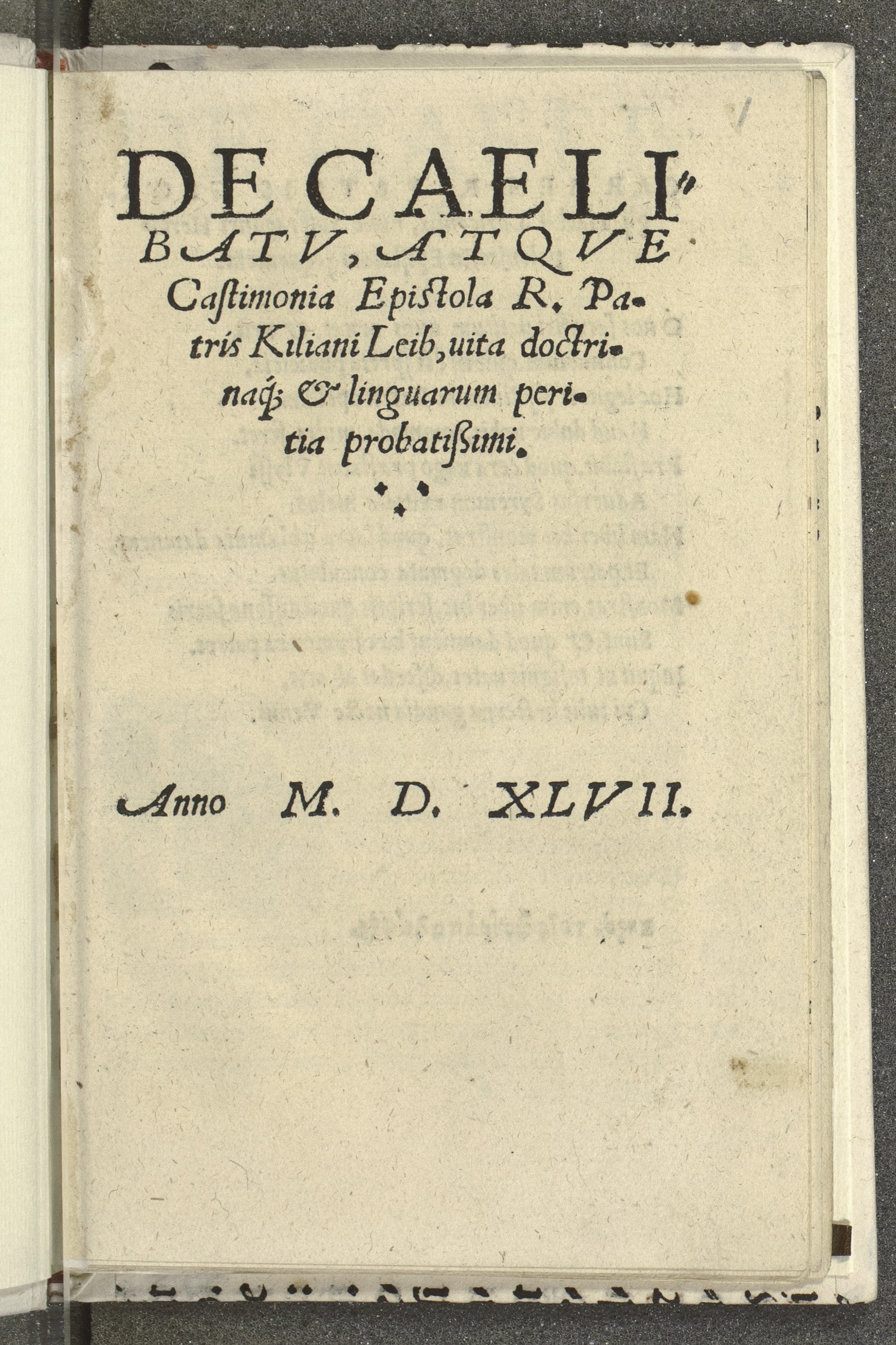
TextDe caelibatu, atque castimonia epistola
Leib, Kilian, 1471-1553Summary: Kilian Leib was the prior of the Augustinian monastery at Rebdorf near Ingolstadt. He was a vehement opponent of the Lutheran movement and was involved in the drafting of the Confutatio Augustana. In this tract he defends priestly celibacy and chastity.Summary: Kilian Leib was the prior of the Augustinian monastery at Rebdorf near Ingolstadt. He was a vehement opponent of the Lutheran movement and was involved in the drafting of the Confutatio Augustana. In this tract he defends priestly celibacy and chastity. -
 Text
TextDe disputatio[n]e Lipsicensi : quantum ad Boemos obiter deflexa est
Emser, Hieronymus, 1478-1527Summary: A letter by Hieronymus Emser, early opponent of Luther concerning the Leipzig Disputation of 1519, describing Luther's debate with Johann Eck, and Luther's admitting that councils could err.Summary: A letter by Hieronymus Emser, early opponent of Luther concerning the Leipzig Disputation of 1519, describing Luther's debate with Johann Eck, and Luther's admitting that councils could err. -
 Text
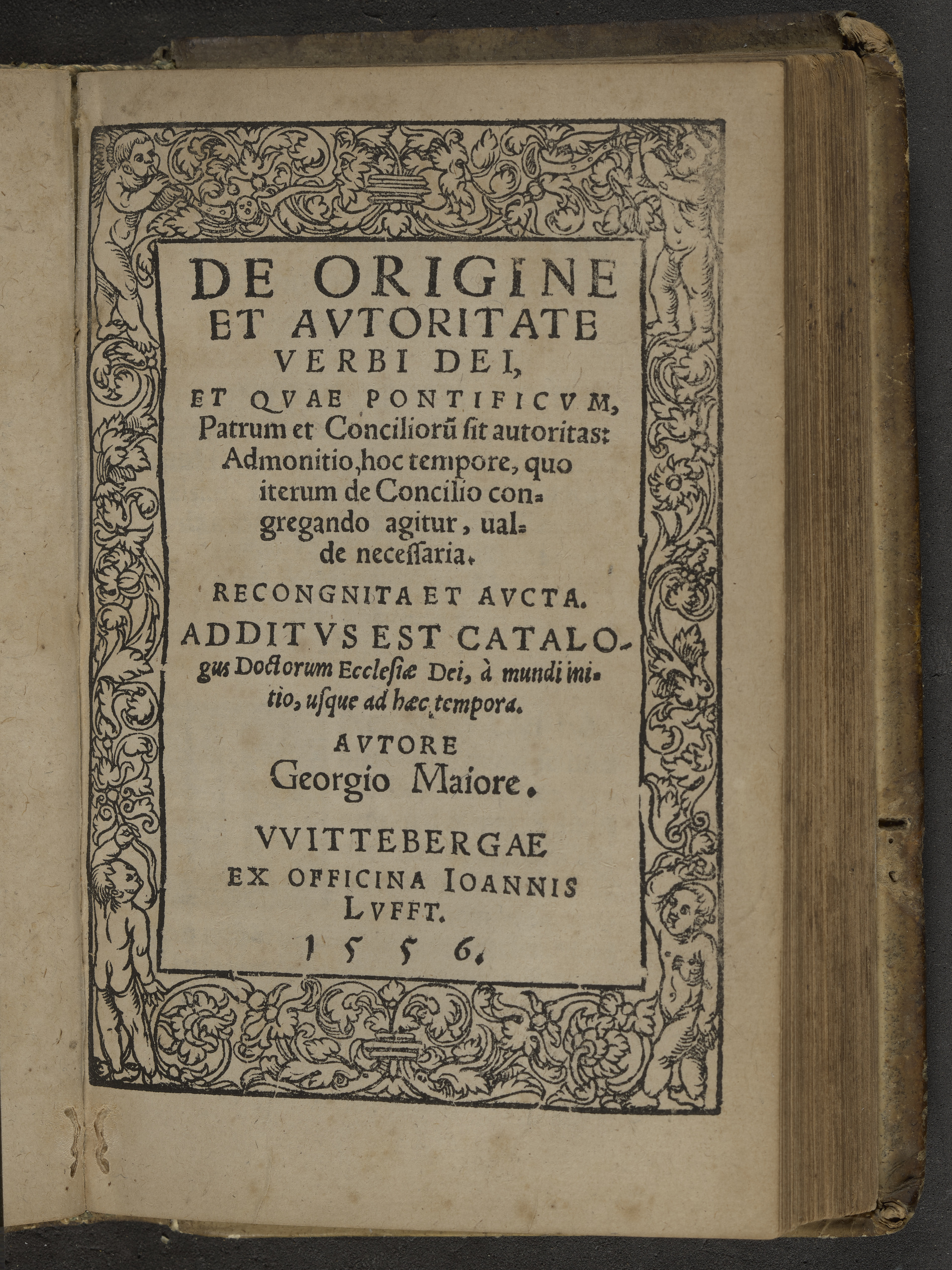
TextDe origine et autoritate Verbi Dei, et quae pontificum, patrum, et concilioru[m] sit autoritas admonitio, hoc tempore, quo iterum de concilio congregando agitur, ualde necessaria : recongnita [sic] et aucta additus est catalogus doctorum ecclesiae Dei, à mundi initio, usque ad haec tempora
Major, Georg, 1502-1574Summary: Tract on the history of Divine Revelation, tracing the teachers of the church from the Creation to the author's own time, by Georg Major, a student of Luther and Melanchthon, and professor at Wittenberg from 1536, with a few brief interruptions, until his death.Summary: Tract on the history of Divine Revelation, tracing the teachers of the church from the Creation to the author's own time, by Georg Major, a student of Luther and Melanchthon, and professor at Wittenberg from 1536, with a few brief interruptions, until his death. -
 Text
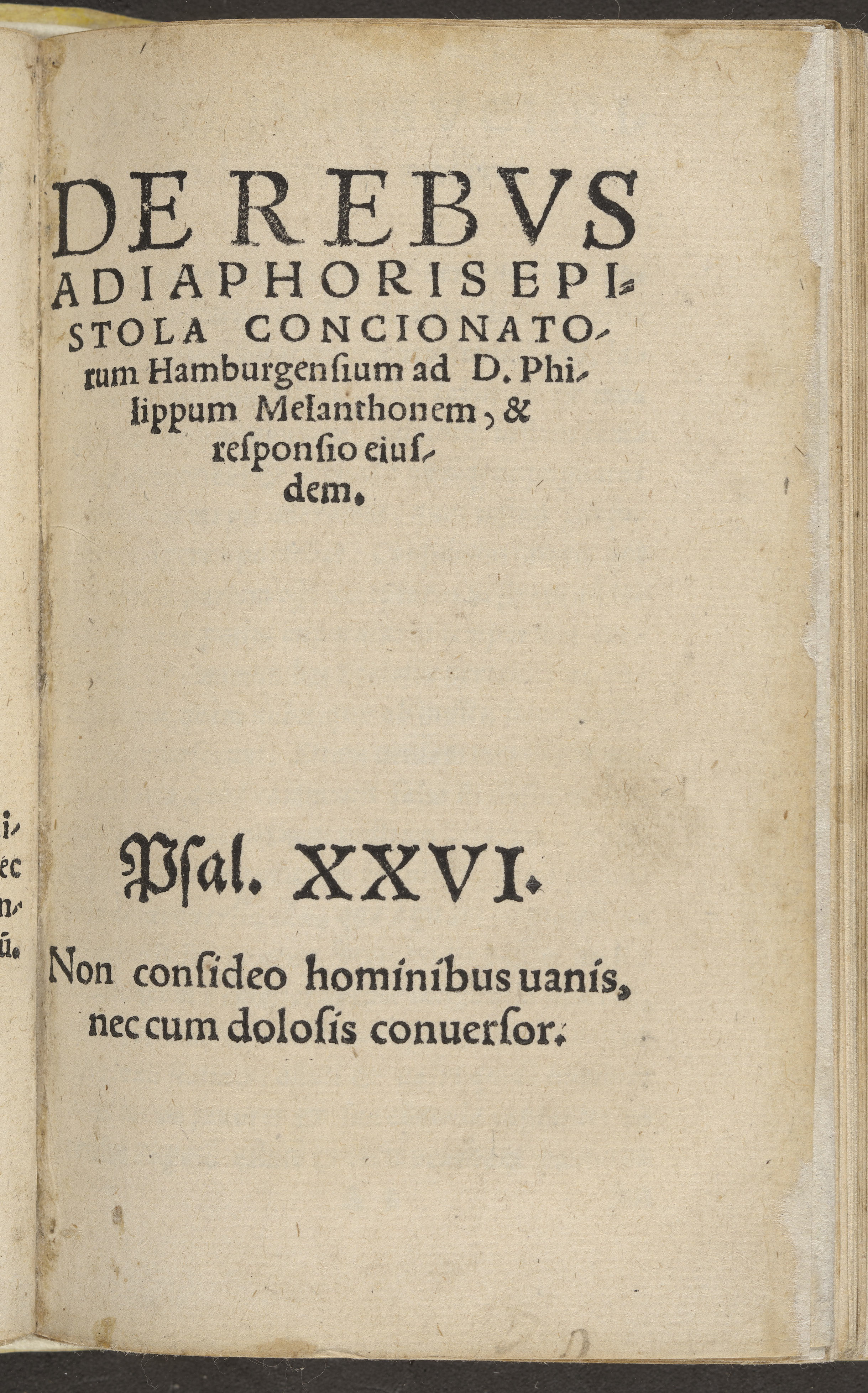
TextDe rebus adiaphoris epistola concionatorum Hamburgensium ad D. Philippum Melanthonem, & responsio eiusdem
Summary: Letter by a counsel of preachers in the city of Hamburg to Philipp Melanchthon regarding the adiaphoristic controversy regarding the re-introduction of some Catholic elements into the liturgy, which Melanchthon viewed as harmless and permissible. Melanchthon's reply is also included in this short booklet.Summary: Letter by a counsel of preachers in the city of Hamburg to Philipp Melanchthon regarding the adiaphoristic controversy regarding the re-introduction of some Catholic elements into the liturgy, which Melanchthon viewed as harmless and permissible. Melanchthon's reply is also included in this short booklet. -
 Text
TextDe servo arbitrio
Luther, Martin, 1483-1546Summary: An important treatise on human free will by Martin Luther, responding to Erasmus' work De libero arbitrio.Summary: An important treatise on human free will by Martin Luther, responding to Erasmus' work De libero arbitrio. -
 Text
TextDe servo arbitrio Martini Lutheri, ad Desiderium Erasmum Roterodamu[m]
Luther, Martin, 1483-1546Summary: "De servo arbitrio (Concerning the Enslaved Will)" is considered one of Martin Luther' greatest literary productions, and among the most important writings of the Reformation. In it, he defends the idea of the complete inability of the human being to please God, apart from Divine grace. His tract is a response to Desiderius Erasmus', "De libero arbitrio (Concerning Free Will)." Erasmus defends the view that salvation is by Divine grace, but wants to leave some room for a person's moral motivation.Summary: "De servo arbitrio (Concerning the Enslaved Will)" is considered one of Martin Luther' greatest literary productions, and among the most important writings of the Reformation. In it, he defends the idea of the complete inability of the human being to please God, apart from Divine grace. His tract is a response to Desiderius Erasmus', "De libero arbitrio (Concerning Free Will)." Erasmus defends the view that salvation is by Divine grace, but wants to leave some room for a person's moral motivation. -
 Text
TextDe werken en vergelding der barmhertigheid, en onbarmhertigheid
Spinniker, Adriaan, 1676-1754Summary:Summary: -
 Text
TextDecades rerum Venetarum
Sabellico, 1436?-1506Summary: A history of Venice.Summary: A history of Venice. -
 Text
TextDefensio D. Petri Martyris Vermilii ...
Vermigli, Pietro Martire, 1499-1562Summary: Response by Pietro Martire Vermigli, Italian Visitor General of the Augustinian Order, who fled to Switzerland rather than face charges of heresy, to the books of English Catholic, Richard Smith, on celibacy and monastic vows.Summary: Response by Pietro Martire Vermigli, Italian Visitor General of the Augustinian Order, who fled to Switzerland rather than face charges of heresy, to the books of English Catholic, Richard Smith, on celibacy and monastic vows. -
 Text
TextDemonstrationes evidentissimae XXX. praesentiae, distributionisq[ue] corporis ac sanguinis Christi in sacra coena, hactenus multis minus cognitae
Flacius Illyricus, Matthias, 1520-1575Summary: A tract by Matthias Flacius asserting the real presence of Christ in the eucharist.Summary: A tract by Matthias Flacius asserting the real presence of Christ in the eucharist. -
 Text
TextDer Zehen Gebot ein nützliche Erklärung
Luther, Martin, 1483-1546This is a 1523 printing of Martin Luther's popular sermon on the Ten Commandments and the Seven Deadly Sins, first printed in 1520 and reprinted numerous times. The work was originally composed in Latin and was translated into German by the cartographer and Christian Hebraist Sebastian Münster.This is a 1523 printing of Martin Luther's popular sermon on the Ten Commandments and the Seven Deadly Sins, first printed in 1520 and reprinted numerous times. The work was originally composed in Latin and was translated into German by the cartographer and Christian Hebraist Sebastian Münster. -
 Text
TextDie Sieben puszpsalm mit deutscher auszlegu[n]g nach dem schrifttlichen synne tzu Christi vn[d] gottis gnaden, neben seyns selben. ware erkentniss gru[n]dlich gerichtet.. 1517
Luther, Martin, 1483-1546Summary: The first edition of Martin Luther's first book, this is Luther's commentary on the seven penitential Psalms (Psalms 6, 32, 38, 51, 102, 130, and 143) based on his lectures at the University of Wittenberg and published in March1517, six months before his 95 Theses. The Reformer's understanding of repentance, penance and grace, influenced by the medieval mystic Johannes Tauler, became central to his theology and underlies his later critique of indulgences. Luther revised this commentary in 1525.Summary: The first edition of Martin Luther's first book, this is Luther's commentary on the seven penitential Psalms (Psalms 6, 32, 38, 51, 102, 130, and 143) based on his lectures at the University of Wittenberg and published in March1517, six months before his 95 Theses. The Reformer's understanding of repentance, penance and grace, influenced by the medieval mystic Johannes Tauler, became central to his theology and underlies his later critique of indulgences. Luther revised this commentary in 1525. -
 Still image
Die neuwen Inseln - so hinder Hispanien gegen Orient bey dem land Indic ligen.
A map of the western hemisphere, identified as the New World, and the western coast of Asia. A spanish style galleon ship is depicted sailing in the Pacific ocean, and a rough shelter built of sticks featureing a dismembered leg is depicted in the general region of Brazil with the label, "Canibali".A map of the western hemisphere, identified as the New World, and the western coast of Asia. A spanish style galleon ship is depicted sailing in the Pacific ocean, and a rough shelter built of sticks featureing a dismembered leg is depicted in the general region of Brazil with the label, "Canibali". -
 Text
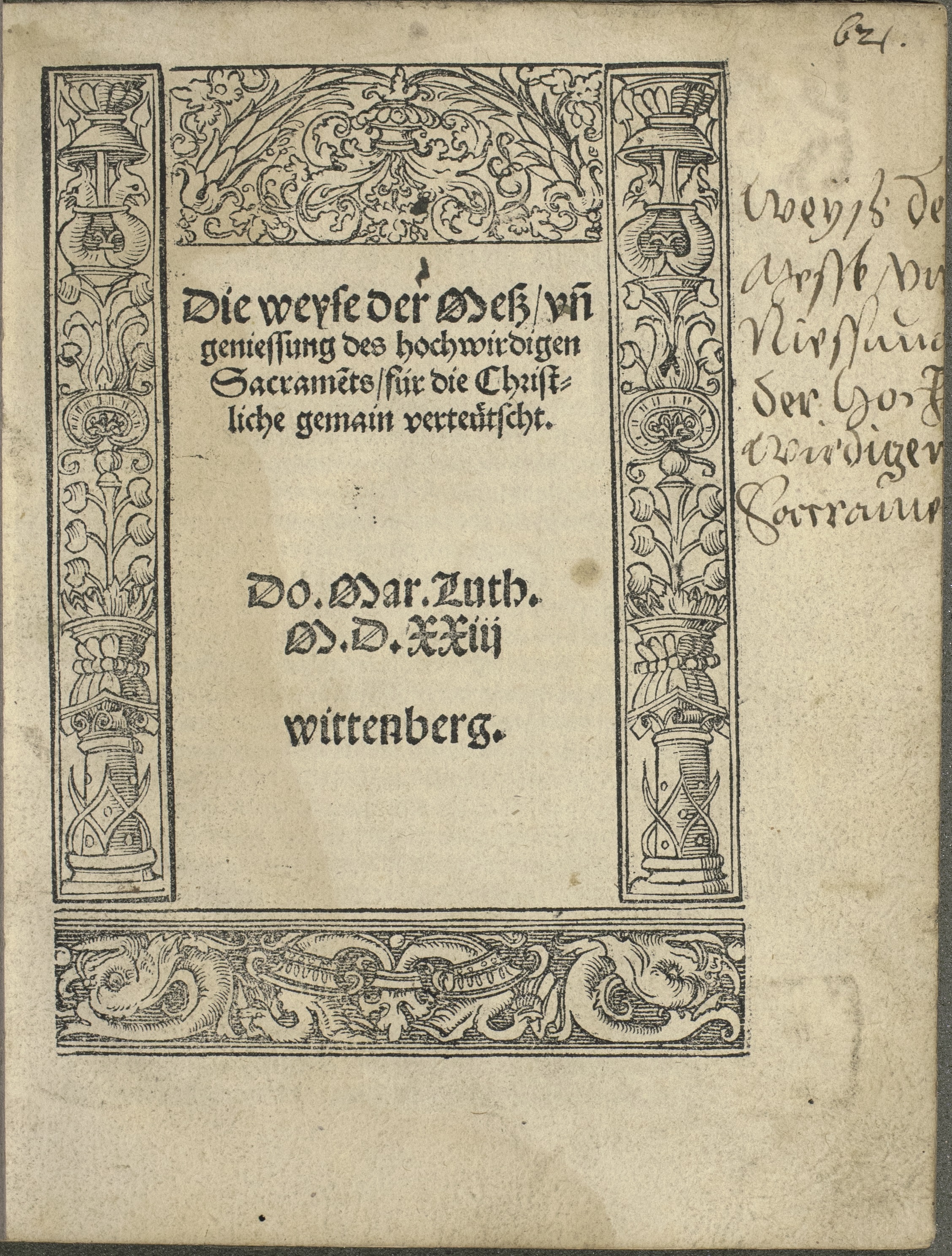
TextDie weyse der Mess, vn[d] geniessung des hochwirdigen Sacrame[n]ts, für die Christliche gemain verteütscht
Luther, Martin, 1483-1546Summary: First published in Latin in 1523, Luther defines in this tract the order of the Sunday worship service and the distribution of communion. This pamphlet is an important forerunner of Luther's "Deutsche Messe" (German Mass) published in 1526.Summary: First published in Latin in 1523, Luther defines in this tract the order of the Sunday worship service and the distribution of communion. This pamphlet is an important forerunner of Luther's "Deutsche Messe" (German Mass) published in 1526. -
 Text
TextDisputaciones circulatim expediendae
Luther, Martin, 1483-1546Summary: This disputation centered around the question of whether the German princes could offer armed resistance to the Emperor, and whether they ought to support him in his war against the Turks. Luther came to believe that any support of the Emperor when he was acting in a religious capacity (in league with the pope) was wrong, because the pope was acting contrary to the Gospel. This is the first (and only) printing of this revised version of these theses. It contains 91 theses, whereas the first version (written before the Emperor and princes had come to terms) contained only 70 theses.Summary: This disputation centered around the question of whether the German princes could offer armed resistance to the Emperor, and whether they ought to support him in his war against the Turks. Luther came to believe that any support of the Emperor when he was acting in a religious capacity (in league with the pope) was wrong, because the pope was acting contrary to the Gospel. This is the first (and only) printing of this revised version of these theses. It contains 91 theses, whereas the first version (written before the Emperor and princes had come to terms) contained only 70 theses. -
 Text
TextDisputatio et excusatio
Luther, Martin, 1483-1546Summary: A response by Luther to the accusations leveled at him at the Leipzig Disputation by his opponent, Johann Eck.Summary: A response by Luther to the accusations leveled at him at the Leipzig Disputation by his opponent, Johann Eck. -
 Text
TextDisputatio inter Egregios & praelatus virus ac doctores, Joannem Ecci[um] & Martinum Lutherum in p[rae]sentia notariorum habita
Luther, Martin, 1483-1546Summary: Unique printing of the original notarial protocol of the Leipzig Disputation between Andreas Karlstadt and Martin Luther on the one hand, and Johann Eck, on the other. Includes fully two thirds of the several day debate, and all of the famous "duel" between Luther and Eck on authority in the church. The debates were copied by two notaries, and, at the end of each day's sessions, were verified by two witnesses.Summary: Unique printing of the original notarial protocol of the Leipzig Disputation between Andreas Karlstadt and Martin Luther on the one hand, and Johann Eck, on the other. Includes fully two thirds of the several day debate, and all of the famous "duel" between Luther and Eck on authority in the church. The debates were copied by two notaries, and, at the end of each day's sessions, were verified by two witnesses. -
 Text
TextDiss ist ain Anzayg: ainem meinem, etwann vertrawten Gesellen, über seyne harte Widerpart, des Sacrament vnd annders betreffend
Langenmantel, Eitelhans, -1528Summary: Since the city of Augsburg was fairly evenly divided between Catholic and Protestant in the early 1520s, several Anabaptists hoped that their movement might benefit from this stalemate. Eitelhans Langenmantel attacks both Catholics and Lutherans, whom he called neo-Papists. His critique in this pamphlet focuses on the eucharist, which Langenmantel views in Zwinglian terms as a symbolic commemoration of the Last Supper. Like many other Anabaptists in Augsburg, Langenmantel was arrested and executed in 1527.Summary: Since the city of Augsburg was fairly evenly divided between Catholic and Protestant in the early 1520s, several Anabaptists hoped that their movement might benefit from this stalemate. Eitelhans Langenmantel attacks both Catholics and Lutherans, whom he called neo-Papists. His critique in this pamphlet focuses on the eucharist, which Langenmantel views in Zwinglian terms as a symbolic commemoration of the Last Supper. Like many other Anabaptists in Augsburg, Langenmantel was arrested and executed in 1527. -
 Text
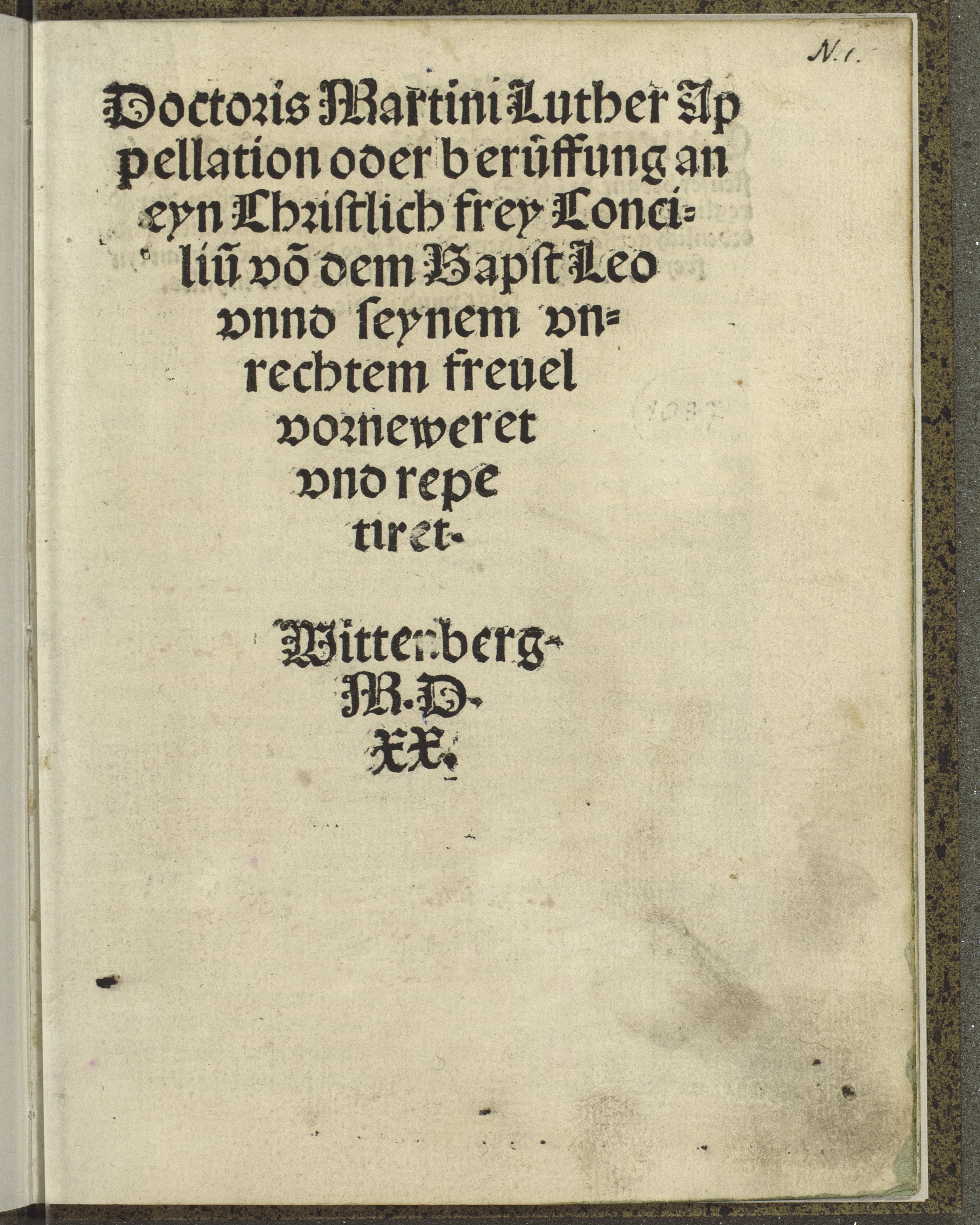
TextDoctoris Martini Luther Appellation oder Berüffung an eyn christlich frey Conciliu[m] vo[n] dem Bapst Leo vnnd seynem vnrechtm Freuel vorneweret vnd repetiret
Luther, Martin, 1483-1546Summary: Despite his lack of success in appealing to the Pope for an Ecumenical Council in 1518, Luther repeats his call in this pamphlet, combining it with a special appeal to the emperor and to the German princes. This is the first printing of this work, produced outside the city of Wittenberg.Summary: Despite his lack of success in appealing to the Pope for an Ecumenical Council in 1518, Luther repeats his call in this pamphlet, combining it with a special appeal to the emperor and to the German princes. This is the first printing of this work, produced outside the city of Wittenberg. -
 Text
TextDoctoris Martini Luthers kurtz schlussrede von den gelöbten vnd geistlichen leben der klöster
Luther, Martin, 1483-1546Summary: Luther's "Theses on Monasticisms" came about as a partial response to Melanchthon's essay in Loci Communes. Melanchthon revised this section of the Loci to take Luther's criticism into account. Luther's work was translated into German by at least three translators none of whom can be named with certainty.Summary: Luther's "Theses on Monasticisms" came about as a partial response to Melanchthon's essay in Loci Communes. Melanchthon revised this section of the Loci to take Luther's criticism into account. Luther's work was translated into German by at least three translators none of whom can be named with certainty.
