Summary: A significant treatise on predestination. Johann Eck expounds a view of free will and merit, which was soon to come under attack by Martin Luther and other Protestants.
Summary: A significant treatise on predestination. Johann Eck expounds a view of free will and merit, which was soon to come under attack by Martin Luther and other Protestants.
Summary: German translation by Martin Luther's colleague, Justus Jonas, of "De servo arbitrio". "De servo arbitrio (Concerning the Enslaved Will)" is considered one of Luther's greatest literary productions, and among the most important writings of the Reformation. In it, he defends the idea of the complete inability of the human being to please God, apart from Divine grace.
Summary: German translation by Martin Luther's colleague, Justus Jonas, of "De servo arbitrio". "De servo arbitrio (Concerning the Enslaved Will)" is considered one of Luther's greatest literary productions, and among the most important writings of the Reformation. In it, he defends the idea of the complete inability of the human being to please God, apart from Divine grace.
Summary: "De servo arbitrio (Concerning the Enslaved Will)" is considered one of Martin Luther' greatest literary productions, and among the most important writings of the Reformation. In it, he defends the idea of the complete inability of the human being to please God, apart from Divine grace. His tract is a response to Desiderius Erasmus', "De libero arbitrio (Concerning Free Will)." Erasmus defends the view that salvation is by Divine grace, but wants to leave some room for a person's moral motivation.
Summary: "De servo arbitrio (Concerning the Enslaved Will)" is considered one of Martin Luther' greatest literary productions, and among the most important writings of the Reformation. In it, he defends the idea of the complete inability of the human being to please God, apart from Divine grace. His tract is a response to Desiderius Erasmus', "De libero arbitrio (Concerning Free Will)." Erasmus defends the view that salvation is by Divine grace, but wants to leave some room for a person's moral motivation.
Summary: The Leipzig disputation was a debate between Martin Luther and Andreas Karlstadt on the one hand and Johann Eck on the other. While Karlstadt and Eck found some grounds for agreement on the question of free will, Luther and Eck disagreed vehemently over the question of the pope's authority to establish new articles of faith. This work publishes a letter Luther wrote to his friend Georg Spalatin, as well as 13 theses by Luther refuting Eck's position on the primacy of the pope and the authority of councils.
Summary: The Leipzig disputation was a debate between Martin Luther and Andreas Karlstadt on the one hand and Johann Eck on the other. While Karlstadt and Eck found some grounds for agreement on the question of free will, Luther and Eck disagreed vehemently over the question of the pope's authority to establish new articles of faith. This work publishes a letter Luther wrote to his friend Georg Spalatin, as well as 13 theses by Luther refuting Eck's position on the primacy of the pope and the authority of councils.
Karlstadt, Andreas Rudolff-Bodenstein von,1486-1541.
Summary: Only printing of a pamphlet by Karlstadt attacking Johann Eck on issues that emerged during their disputation at Leipzig 1519, in particular the interpretation of scripture and the question of free will and its relation to the grace of God.
Summary: Only printing of a pamphlet by Karlstadt attacking Johann Eck on issues that emerged during their disputation at Leipzig 1519, in particular the interpretation of scripture and the question of free will and its relation to the grace of God.
Summary: This is the third of Luther's three great reformation tracts of 1520. Addressed to Pope Leo X, this work is a discourse on the freedom of the will, turning on the paradox: A Christian is free, lord over all things, subject to no one. A Christian is a bounden servant of all, and subject to everyone. This is the fourth printing of Luther's own German translation.
Summary: This is the third of Luther's three great reformation tracts of 1520. Addressed to Pope Leo X, this work is a discourse on the freedom of the will, turning on the paradox: A Christian is free, lord over all things, subject to no one. A Christian is a bounden servant of all, and subject to everyone. This is the fourth printing of Luther's own German translation.
 Text
Text Text
Text Text
Text Text
Text Text
Text Text
Text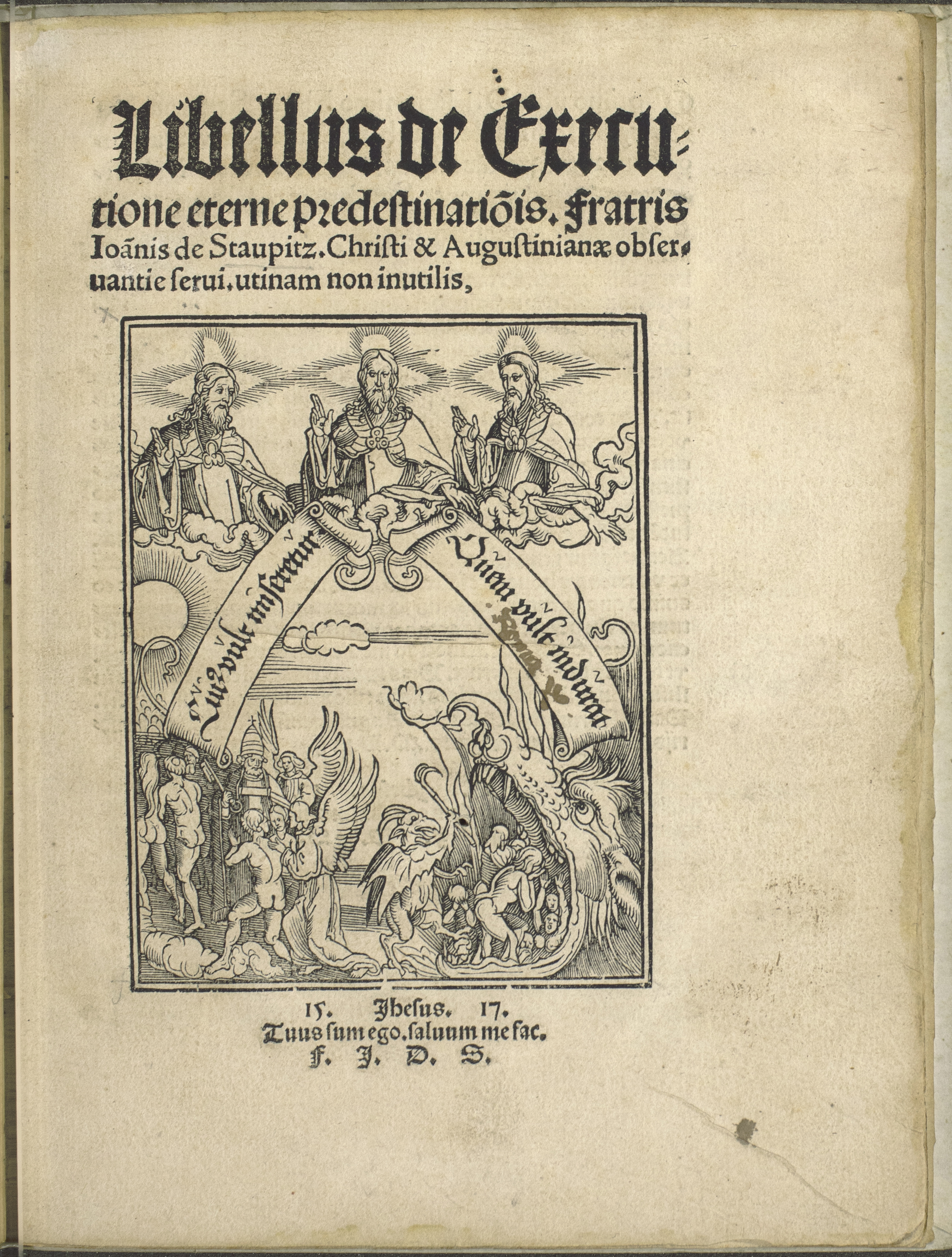 Text
Text Text
Text Text
Text