Search
75 resources
75 items
Subject
Reformation
-
 Still image
Des Ehrwirdigen Herrn Doctoris Martini Lutheri, gottseligen, Triumph, und Verantwortung, wider die gottlosen Schmehschrifft, der newen Münch, der Jesuiter, welche sie vnter dem Titel, Anatomia Lutheri, ausgesprenget haben
Single sheet woodcut depicting Pope Leo X on a throne that is about to topple. Behind him are priests and monks and below them a group of Jesuits, who are trying to support the toppling throne. Leo's key, the symbol of the Petrine office is crumbling in the pope's hands. Facing Leo is Martin Luther holding an open Bible. Below him is a group of reformers led by Philipp Melanchthon, each holding a book (Bible). In the center below Leo is Friedrich Staphylus depicted as Judas Iscariot. Staphylus was a student of Philipp Melanchthon's, who rejoined the Catholic Church in 1553.Single sheet woodcut depicting Pope Leo X on a throne that is about to topple. Behind him are priests and monks and below them a group of Jesuits, who are trying to support the toppling throne. Leo's key, the symbol of the Petrine office is crumbling in the pope's hands. Facing Leo is Martin Luther holding an open Bible. Below him is a group of reformers led by Philipp Melanchthon, each holding a book (Bible). In the center below Leo is Friedrich Staphylus depicted as Judas Iscariot. Staphylus was a student of Philipp Melanchthon's, who rejoined the Catholic Church in 1553. -
 Text
TextDisputatio inter Egregios & praelatus virus ac doctores, Joannem Ecci[um] & Martinum Lutherum in p[rae]sentia notariorum habita
Luther, Martin, 1483-1546Summary: Unique printing of the original notarial protocol of the Leipzig Disputation between Andreas Karlstadt and Martin Luther on the one hand, and Johann Eck, on the other. Includes fully two thirds of the several day debate, and all of the famous "duel" between Luther and Eck on authority in the church. The debates were copied by two notaries, and, at the end of each day's sessions, were verified by two witnesses.Summary: Unique printing of the original notarial protocol of the Leipzig Disputation between Andreas Karlstadt and Martin Luther on the one hand, and Johann Eck, on the other. Includes fully two thirds of the several day debate, and all of the famous "duel" between Luther and Eck on authority in the church. The debates were copied by two notaries, and, at the end of each day's sessions, were verified by two witnesses. -
 Text
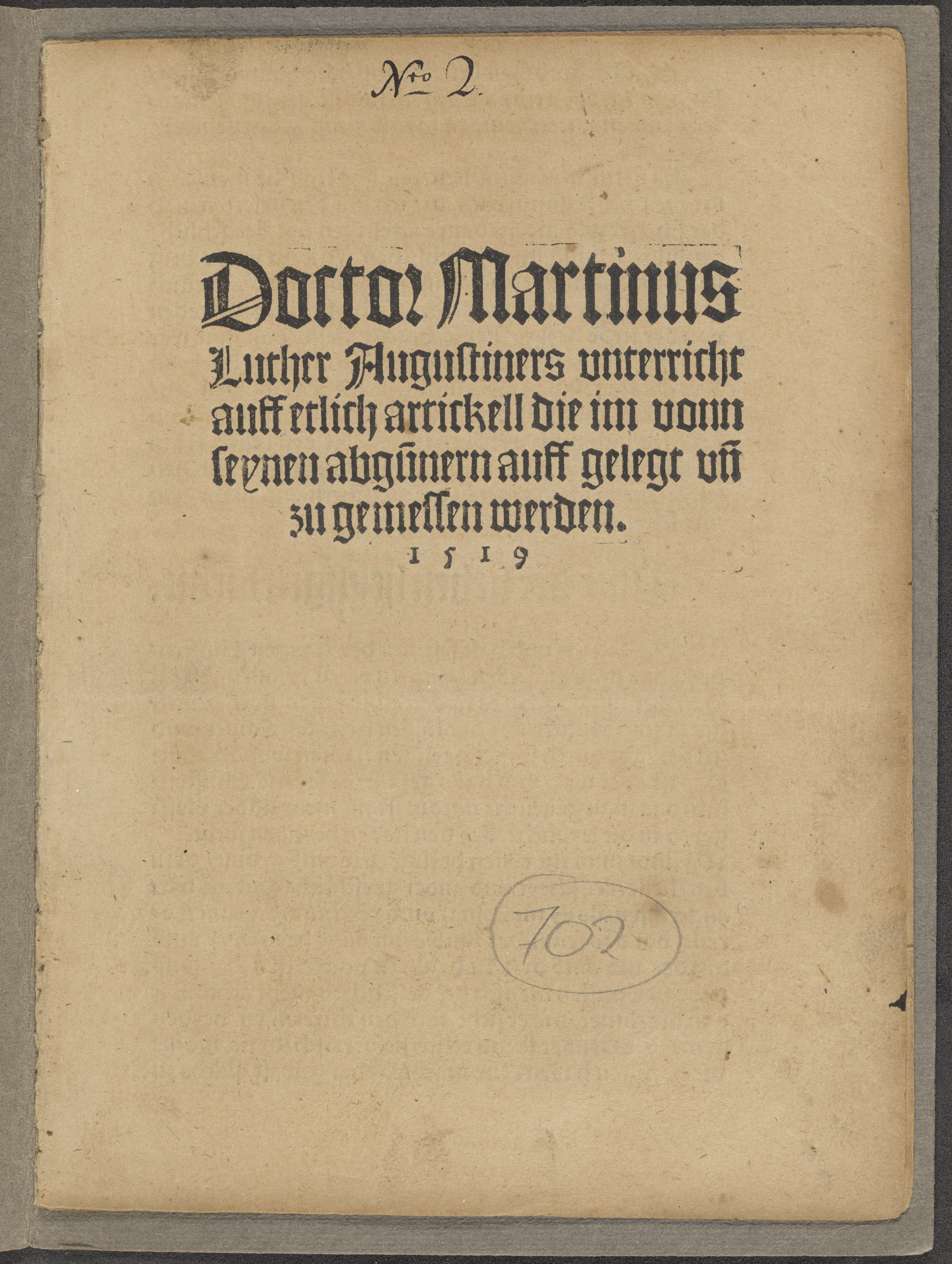
TextDoctor Martinus Luther Augustiners Vnterricht auff etlich Artickell die im vonn seynen Abgūrnern auff gelegt vn[d] zu gemessen werden
Luther, Martin, 1483-1546Summary: Luther was persuaded by Karl von Miltitz to write this public statement as a response to certain charges brought against him by his opponents, in particular Mazzolini da Prierio. In this tract, Luther still supports the invocation of the saints, an idea which he abandoned only shortly after.Summary: Luther was persuaded by Karl von Miltitz to write this public statement as a response to certain charges brought against him by his opponents, in particular Mazzolini da Prierio. In this tract, Luther still supports the invocation of the saints, an idea which he abandoned only shortly after. -
 Text
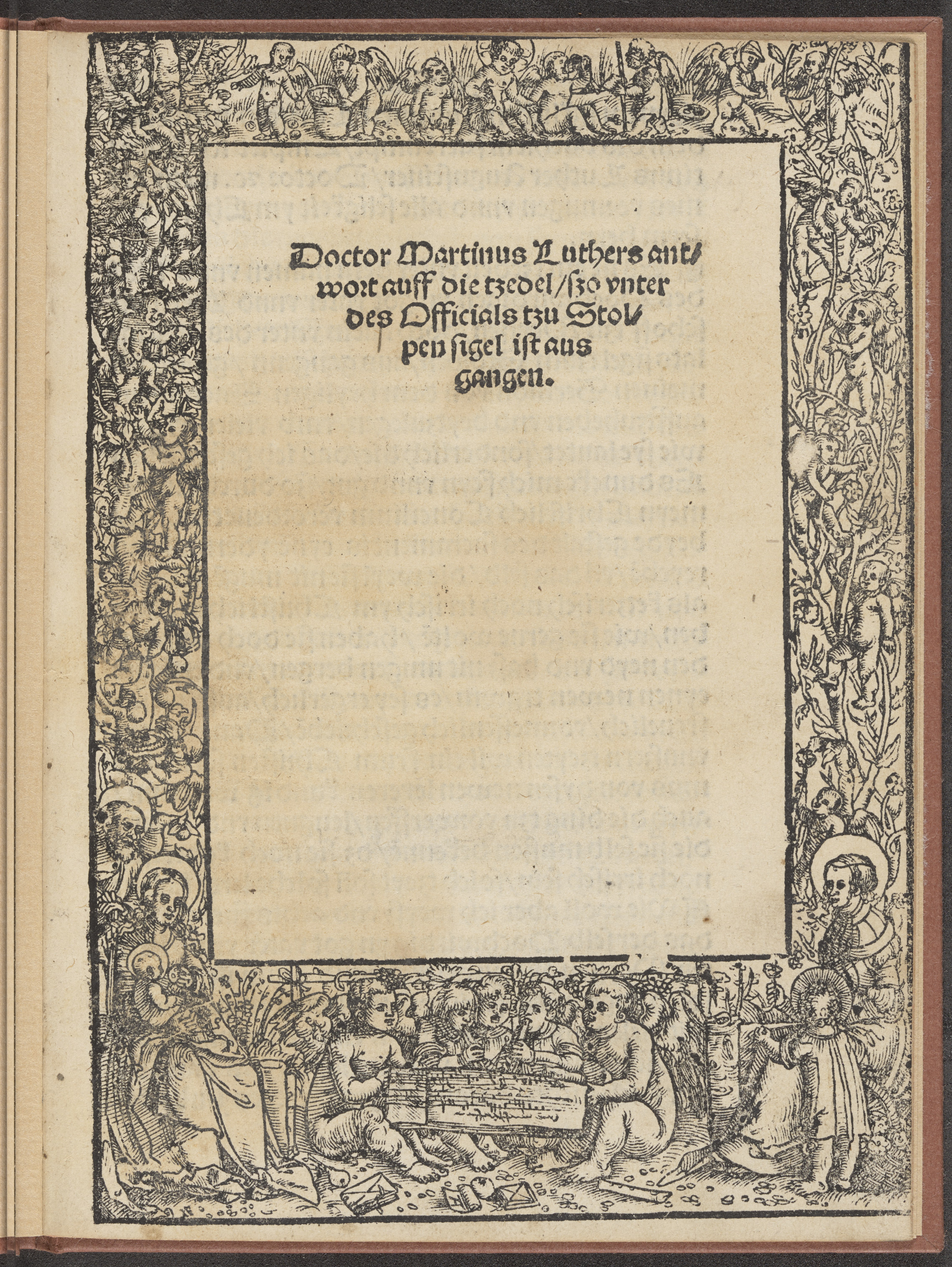
TextDoctor Martinus Luthers antwort auff die tzedel : szo vnter des Officials tzu Stolpen sigel ist ausgangen
Luther, Martin, 1483-1546Summary: The first of five printings in 1520 of an answer to an attack on Luther issued under the seal and authority of Albert, Archbishop of Mainz.Summary: The first of five printings in 1520 of an answer to an attack on Luther issued under the seal and authority of Albert, Archbishop of Mainz. -
 Text
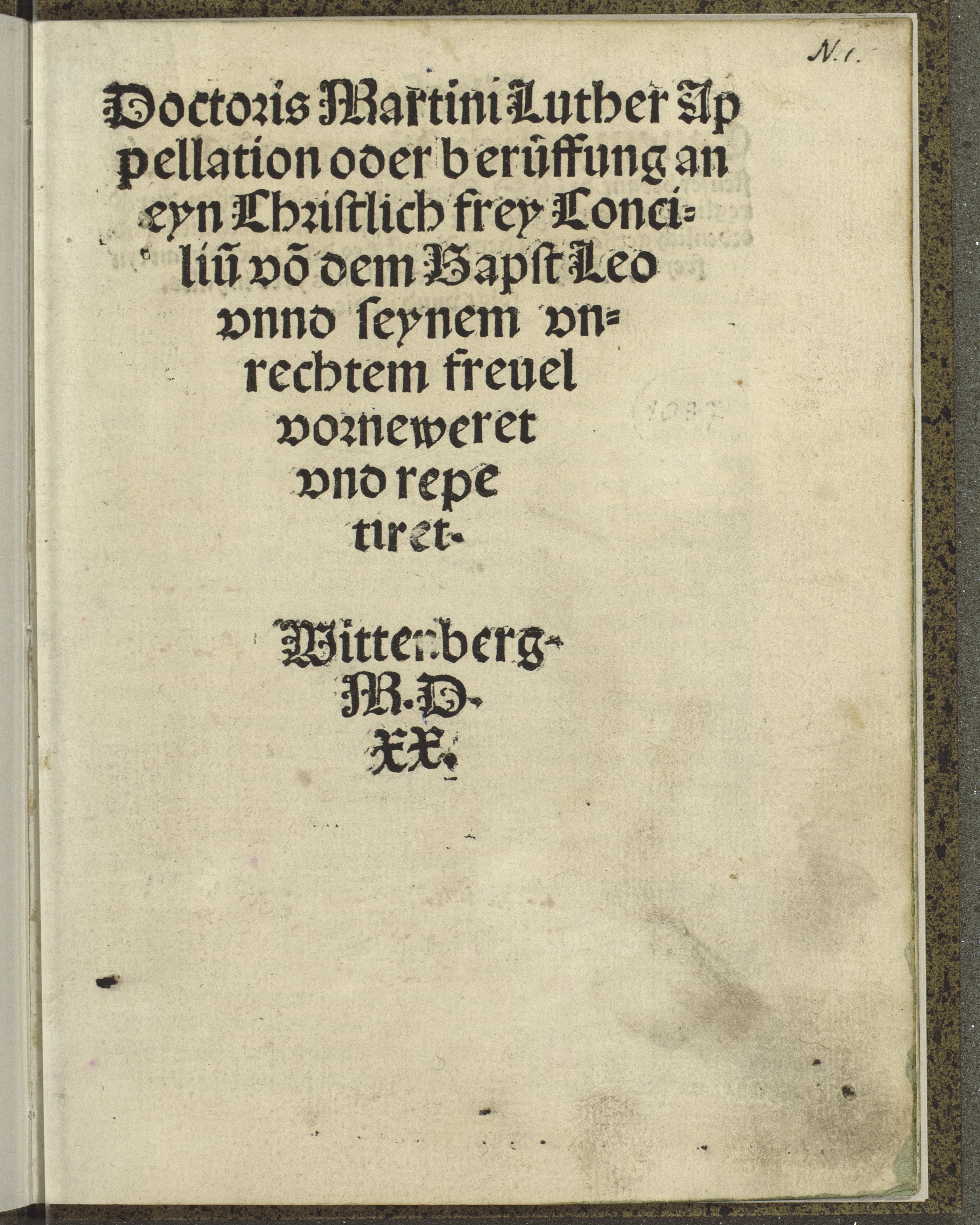
TextDoctoris Martini Luther Appellation oder Berüffung an eyn christlich frey Conciliu[m] vo[n] dem Bapst Leo vnnd seynem vnrechtm Freuel vorneweret vnd repetiret
Luther, Martin, 1483-1546Summary: Despite his lack of success in appealing to the Pope for an Ecumenical Council in 1518, Luther repeats his call in this pamphlet, combining it with a special appeal to the emperor and to the German princes. This is the first printing of this work, produced outside the city of Wittenberg.Summary: Despite his lack of success in appealing to the Pope for an Ecumenical Council in 1518, Luther repeats his call in this pamphlet, combining it with a special appeal to the emperor and to the German princes. This is the first printing of this work, produced outside the city of Wittenberg. -
 Text
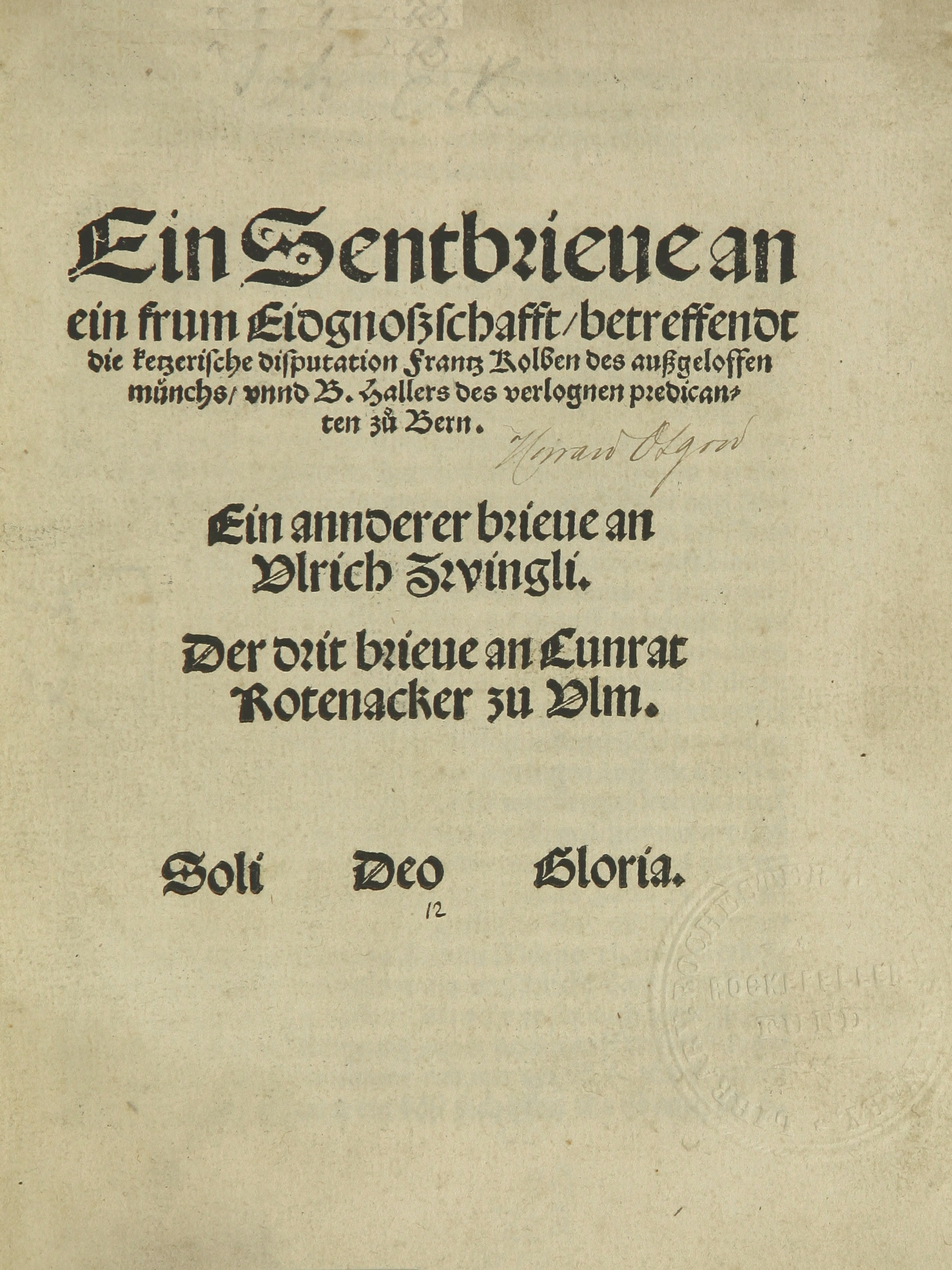
TextEin Sentbreiue an ein frum Eidgnossschafft : betreffendt die ketzerische Disputation Frantz Kolben des aussgeloffen Münchs, vnnd B. Hallers des verlognen Predicanten zu[o] Bern; Ein annderer brieue an Vlrich Zwingli; Der drit brieue an Cunrat Rotenacker zu Vlm; Soli Deo gloria.
Eck, Johann, 1486-1543Summary: First edition of three public letters by Johann Eck. The letters refer to an invitation sent to Eck by Zwingli, Haller and Kolbe, all of them evangelical preachers, to participate in a religious disputation scheduled to take place in Bern. The first letter, addressed to the confederation, explains courteously enough that he, Eck, does not intend to follow the call of the three proven heretics individually, a call not issued by the civic authorities. Not that he is afraid of their arguments; but he insists on an authoritative invitation and presence.Summary: First edition of three public letters by Johann Eck. The letters refer to an invitation sent to Eck by Zwingli, Haller and Kolbe, all of them evangelical preachers, to participate in a religious disputation scheduled to take place in Bern. The first letter, addressed to the confederation, explains courteously enough that he, Eck, does not intend to follow the call of the three proven heretics individually, a call not issued by the civic authorities. Not that he is afraid of their arguments; but he insists on an authoritative invitation and presence. -
 Text
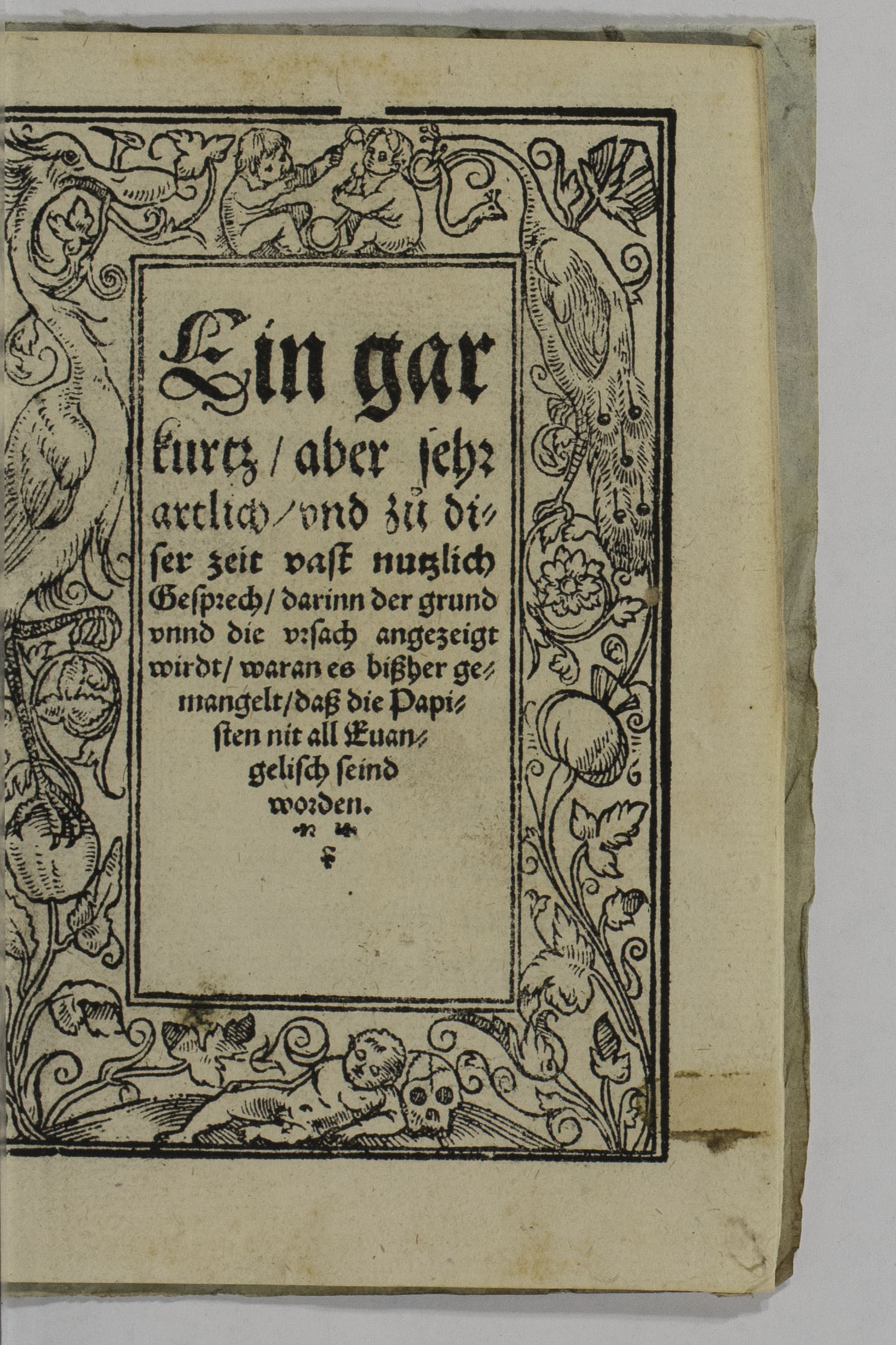
TextEin gar kurtz aber sehr artlich vnd zů diser zeit vast nutzlich Gesprech, darinn der grund vnnd die vrsach angezeigt wirdt waran es bissher gemangelt dass die Papisten nit all Euangelisch seind worden.
Walasser, Adam, -1581Summary: A fictitious dialogue between a Catholic and a Protestant, written by the Catholic theologian Adam Walasser. The discussion includes topics like the authority of tradition outside of Scripture or prayer to the Saints and the Protestant position is presented as reasonable, albeit incorrect by Walasser.Summary: A fictitious dialogue between a Catholic and a Protestant, written by the Catholic theologian Adam Walasser. The discussion includes topics like the authority of tradition outside of Scripture or prayer to the Saints and the Protestant position is presented as reasonable, albeit incorrect by Walasser. -
 Text
TextEin schöner spruch darinn deren von Costantz seltzame Renckh und Abentheür, damit Sy vmbgon begriffen syen.
Treger, Konrad, approximately 1480-1542Summary: Anti-Reformation poem directed at the city of Konstanz. Tregor, an Augustinian Prior, was a leading defender of Catholicism in Switzerland.Summary: Anti-Reformation poem directed at the city of Konstanz. Tregor, an Augustinian Prior, was a leading defender of Catholicism in Switzerland. -
 Text
TextEine Schrifft, wie die Pfarherrn an den Örtern, da man die Papisterey widerumb auffricht, die Euangelisch Lehr, welche sie Lutherisch nennen, verloben vnd verschweren müssen
Summary: An anonymous pamphlet, containing an oath German pastors had to swear to renounce the "Evangelical doctrine, which is called Lutheran" in order to be readmitted to the Roman Catholic Church. The copy of the oath is preceded by two satirical poems regarding the oath, the first one representing the opinion of a wise man, the second one the answer of an unwise man. On the titlepage are two verses from Matthew 10 against the taking of oaths. The work is published by Christian Rödinger, a printer who put his press in service of the Reformation.Summary: An anonymous pamphlet, containing an oath German pastors had to swear to renounce the "Evangelical doctrine, which is called Lutheran" in order to be readmitted to the Roman Catholic Church. The copy of the oath is preceded by two satirical poems regarding the oath, the first one representing the opinion of a wise man, the second one the answer of an unwise man. On the titlepage are two verses from Matthew 10 against the taking of oaths. The work is published by Christian Rödinger, a printer who put his press in service of the Reformation. -
 Text
TextElisabeth Creutziger, the Magdeburg Enchiridion, 1536 and Reformation Theology
Leaver, Robin A.The digital edition of lecture on Elisabeth Creutziger in relation to the Magdeburg Enchiridion (1536) and the broader theology of the Reformation, delivered at the seventh annual fall concert celebrating the Richard C. Kessler Reformation Collection in the Pitts Theology Library at the Candler School of Theology, Emory University, October 18, 1994.The digital edition of lecture on Elisabeth Creutziger in relation to the Magdeburg Enchiridion (1536) and the broader theology of the Reformation, delivered at the seventh annual fall concert celebrating the Richard C. Kessler Reformation Collection in the Pitts Theology Library at the Candler School of Theology, Emory University, October 18, 1994. -
 Text
TextEncomiu[m] Rubij Longipolii apud Lipsim : in errores quos pueriliter co[m]misit adversus Vuittenbergen[ses] : Nemo potest quicquid toto gestatur in orbe rumpere liuores omnia Nemo potest
Montanus, Jacobus, active 1486-1534Summary: It is not certain who wrote this tract on the Leipzig Disputation but J. Montanus or J. Cellarius appear to be the most likely candidates. Montanus became the first Protestant preacher in Westphalia, while Cellarius or Kellner, became the first Protestant Superintendent of Dresden.Summary: It is not certain who wrote this tract on the Leipzig Disputation but J. Montanus or J. Cellarius appear to be the most likely candidates. Montanus became the first Protestant preacher in Westphalia, while Cellarius or Kellner, became the first Protestant Superintendent of Dresden. -
 Text
TextEpistola apologetica Matthiae Flacij Illyrici ad quendam Pastorem : Item Duo Somnia Philippi
Flacius Illyricus, Matthias, 1520-1575Summary: Open letter to an anonymous pastor justifying Matthias Flacius' opposition to the Leipzig interim, and Melanchthon's willingness to compromise with the Catholic Church on matters of liturgy.Summary: Open letter to an anonymous pastor justifying Matthias Flacius' opposition to the Leipzig interim, and Melanchthon's willingness to compromise with the Catholic Church on matters of liturgy. -
 Text
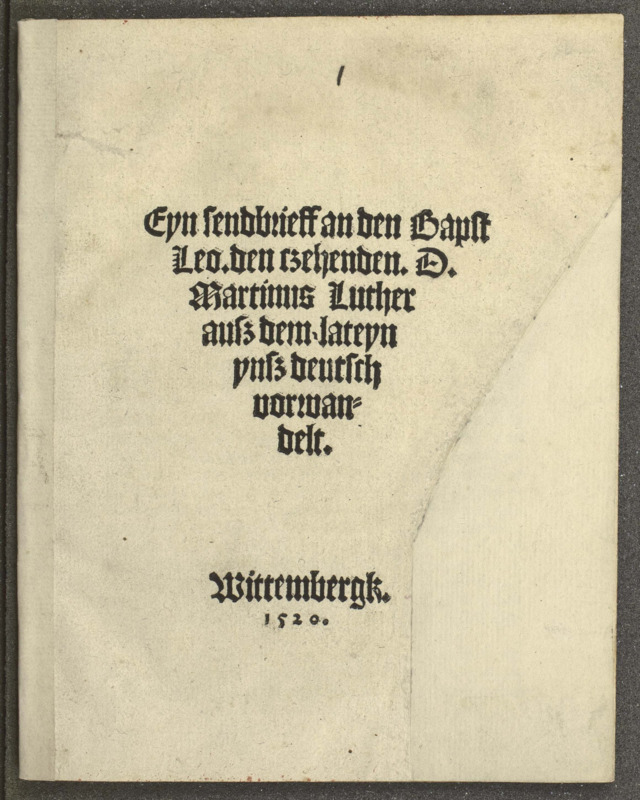
TextEyn Sendbrieff an den Bapst Leo den Czehenden
Luther, Martin, 1483-1546Summary: A letter by Luther to Pope Leo X. Leo had issued his famous bull 'Exsurge Domine' on June 15 1520, demanding that Luther recant his teachings of face excommunication. Luther responded with this letter in September, seeking to explain his position, calling for the church to reform, while emphasizing that his critiques have been directed against abuses within the church, not against the person or office of the pope.Summary: A letter by Luther to Pope Leo X. Leo had issued his famous bull 'Exsurge Domine' on June 15 1520, demanding that Luther recant his teachings of face excommunication. Luther responded with this letter in September, seeking to explain his position, calling for the church to reform, while emphasizing that his critiques have been directed against abuses within the church, not against the person or office of the pope. -
 Text
TextEyn unuberwindtlich Beschirm Buchleyn von Haubt Artickeln, vn[d] furnemlichen Puncten der götlichen Geschrifft, : auss dem Alten vnd Newen Testament, mit Beschlussreden, eynem yden rechten Christe[n] Me[n]schenn zu Handhabung der göttlichen Warheyt, wyder die Verfolger der selben, gar nützlich tzu brauchen
Gretzinger, BenedictSummary: Benedict Gretzinger was a city scribe in the town of Reutlingen. In his only known work, which was however published 17 times between 1523 and 1528, he lists 10 fundamental articles of faith, each with short references to the Bible and explanatory notes. The text is close to the children's catechisms by the Bohemian Brethren, published in 1522, which may itself have been influenced by Martin Luther's "Short form of the 10 commandments".Summary: Benedict Gretzinger was a city scribe in the town of Reutlingen. In his only known work, which was however published 17 times between 1523 and 1528, he lists 10 fundamental articles of faith, each with short references to the Bible and explanatory notes. The text is close to the children's catechisms by the Bohemian Brethren, published in 1522, which may itself have been influenced by Martin Luther's "Short form of the 10 commandments". -
 Text
TextForma Inquisitionis Hispanicae instituta in inferiori Germania anno 1550
Summary: Instructions for inquisitors in the Netherlands (Lower Germany), published by the Lutheran reformer Matthias Flacius to call attention to the persecution of Protestants. Flacius intended this report to underscore his opposition to any compromises with the Catholic Church, even in liturgical matters, as permitted by the Augsburg Interim of 1548.Summary: Instructions for inquisitors in the Netherlands (Lower Germany), published by the Lutheran reformer Matthias Flacius to call attention to the persecution of Protestants. Flacius intended this report to underscore his opposition to any compromises with the Catholic Church, even in liturgical matters, as permitted by the Augsburg Interim of 1548. -
 Text
TextGirolamo [Hieronomo] Aleandro letter to Raffaele de' Medici, June 1, 1521
Aleandro, Girolamo, 1480-1542A letter from Girolamo Aleandro to his patron, Raffaele de' Medici, concerning the work done at the Diet, including the condemnation and arguments made against Luther. Aleandro discusses the drafting of an offical Imperial decree against Luther and discusses political tensions between the Holy Roman Empire and France.A letter from Girolamo Aleandro to his patron, Raffaele de' Medici, concerning the work done at the Diet, including the condemnation and arguments made against Luther. Aleandro discusses the drafting of an offical Imperial decree against Luther and discusses political tensions between the Holy Roman Empire and France. -
 Text
TextGirolamo [Hieronomo] Aleandro letter to Raffaele de' Medici, May 5, 1520
Aleandro, Girolamo, 1480-1542A letter from Girolamo Aleandro to his patron, Raffaele de' Medici, mentioning Luther's presence in Worms and commending himself further to Raffaele.A letter from Girolamo Aleandro to his patron, Raffaele de' Medici, mentioning Luther's presence in Worms and commending himself further to Raffaele. -
 Text
TextGründtliche anzaygung vnd bericht, ausz was vrsachen (deren fürnemlich siben seind) so mancherley, vnnd vilfaltige Ketzereyen, zwispaltung vnnd jtzthumb in Christlicher Religion, vnd der hailigen Catholischen Kirchen, von anfang biss auff dise zeit erwachsen seind, vnd jren grund genommen haben
Leib, Kilian, 1471-1553Summary: Second printing of a an anti-Protestant tract by Kilian Leib, prior of the Augustinian monastery at Rebdorf. Leib was a Catholic theologian in the humanist tradition who was a firm opponent of Martin Luther's reforms. In 1530 he had participated in drafting the Catholic response to the Augsburg Confession. In this work, Leib outlines 7 causes for the Lutheran heresy, which include among others an unfavorable constellation of the stars, ordained by God to punish humanity.Summary: Second printing of a an anti-Protestant tract by Kilian Leib, prior of the Augustinian monastery at Rebdorf. Leib was a Catholic theologian in the humanist tradition who was a firm opponent of Martin Luther's reforms. In 1530 he had participated in drafting the Catholic response to the Augsburg Confession. In this work, Leib outlines 7 causes for the Lutheran heresy, which include among others an unfavorable constellation of the stars, ordained by God to punish humanity. -
 Text
TextHenry de Lesomet letter to Raffaele de' Medici, April 29, 1521
Lesomet, Henry deA letter from Henry de Lesomet to Raffaele de' Medici concerning correspondence with a Monsieur de Hoochstrate as well as mentioning Luther's departure from Worms and Lesomet's disdain for Luther's opinionsA letter from Henry de Lesomet to Raffaele de' Medici concerning correspondence with a Monsieur de Hoochstrate as well as mentioning Luther's departure from Worms and Lesomet's disdain for Luther's opinions -
![The digital edition of an introduction to and translation of Ulrich Zwingli's "Actio[n] oder Brauch des Nachtmals, Gedechtnus, oder Dancksagung Christi wie sy auff Osteren zu[o] Zürich angehebt wirt, jm Jar alls man zalt M.D. XXV," originally published by Hans Hager in Zürich, Switzerland in 1525. The original text is one of two edition published in 1525 of Zwingli's reform of the mass on the basis of a "biblically based" liturgy.](https://digital.pitts.emory.edu/files/large/P_CSTA005_BD002_300000449107/P_CSTA005_BD002_2016_300000449107_WEST.jpg) Text
TextHuldrych Zwingli: The Implementation of the Lord's Supper
Zwingli, Ulrich, 1484-1531The digital edition of an introduction to and translation of Ulrich Zwingli's "Actio[n] oder Brauch des Nachtmals, Gedechtnus, oder Dancksagung Christi wie sy auff Osteren zu[o] Zürich angehebt wirt, jm Jar alls man zalt M.D. XXV," originally published by Hans Hager in Zürich, Switzerland in 1525. The original text is one of two edition published in 1525 of Zwingli's reform of the mass on the basis of a "biblically based" liturgy.The digital edition of an introduction to and translation of Ulrich Zwingli's "Actio[n] oder Brauch des Nachtmals, Gedechtnus, oder Dancksagung Christi wie sy auff Osteren zu[o] Zürich angehebt wirt, jm Jar alls man zalt M.D. XXV," originally published by Hans Hager in Zürich, Switzerland in 1525. The original text is one of two edition published in 1525 of Zwingli's reform of the mass on the basis of a "biblically based" liturgy. -
![Summary: This is an early Italian response to Martin Luther, attacking the schismatic monk on his own terms, in the vernacular for the benefit of laymen or simplici, as advertised on the title-page. The work is quite broad in its criticism and aims to refute not only Luther and his followers, but all heretics and even Jews. On the final leaf of text, following the colophon the list of errata, we find a curious addition perhaps intended to be removed from the book and used separately: a "song" satirically composed by "several of Luther's friends in praise of him" [Alcuni amici de Martin Luthero in laude sua cantano], beginning "Te Lutherum damnamus". Evidently a parody of the Te Deum, Fano's hymn condemning Luther to Hell was in fact subsequently set to music by a certain Maistre Jhan (ca. 1485-1538).](https://digital.pitts.emory.edu/files/large/P_300000491804/P_300000491804_P001.jpg) Text
TextIesus Maria Opera vtilissima uulgare co[n]tra le pernitiosissime heresie Lutherane p[er] li simplici
Giovanni, fra., active approximately 1513-1523Summary: This is an early Italian response to Martin Luther, attacking the schismatic monk on his own terms, in the vernacular for the benefit of laymen or simplici, as advertised on the title-page. The work is quite broad in its criticism and aims to refute not only Luther and his followers, but all heretics and even Jews.Summary: This is an early Italian response to Martin Luther, attacking the schismatic monk on his own terms, in the vernacular for the benefit of laymen or simplici, as advertised on the title-page. The work is quite broad in its criticism and aims to refute not only Luther and his followers, but all heretics and even Jews.