Search
75 resources
75 items
Subject
Reformation
-
![The digital edition of an introduction to and translation of Johan Tetzel's "Vorlegung gemacht von Bruder Johan Tetzel Prediger Orde[n]s Ketzermeister : wyder eynen vormessen Sermon von tzwentzig irrige[n] Artickeln Bebstlichen Ablas vn[d] Gnade belange[n]de allen cristglaubige[n] Mensche[n] tzuwissen von Notten," originally published by Melchior Lotter in Leipzig, Germany, in 1518, including facsimile reproductions. The original text is the first attack on Luther's "Sermon von dem Ablass und Gnade" (Sermon on indulgences and grace) by Johan Tetzel, a refutation of Luther's position.](https://digital.pitts.emory.edu/files/large/P_CSTA005_BD002_300000422352/P_CSTA005_BD002_2012_300000422352_KRAMER.jpg) Text
TextJohann Tetzel's Rebuttal against Luther's Sermon on Indulgences and Grace
Tetzel, Johann, 1460-1519The digital edition of an introduction to and translation of Johan Tetzel's "Vorlegung gemacht von Bruder Johan Tetzel Prediger Orde[n]s Ketzermeister : wyder eynen vormessen Sermon von tzwentzig irrige[n] Artickeln Bebstlichen Ablas vn[d] Gnade belange[n]de allen cristglaubige[n] Mensche[n] tzuwissen von Notten," originally published by Melchior Lotter in Leipzig, Germany, in 1518, including facsimile reproductions.The digital edition of an introduction to and translation of Johan Tetzel's "Vorlegung gemacht von Bruder Johan Tetzel Prediger Orde[n]s Ketzermeister : wyder eynen vormessen Sermon von tzwentzig irrige[n] Artickeln Bebstlichen Ablas vn[d] Gnade belange[n]de allen cristglaubige[n] Mensche[n] tzuwissen von Notten," originally published by Melchior Lotter in Leipzig, Germany, in 1518, including facsimile reproductions. -
 Text
TextLetter from Georg Spalatin to Duke Magnus III of Mecklenburg, May 3, 1534
Spalatin, Georg, 1484-1545A cover letter, dated May 3, 1534, for a manuscript which Spalatin had promised to Duke Magnus III of Mecklenburg regarding the justification used by Henry VIII for his divorce from Catherine of Aragon, which was never recognized by Rome. Henry had married Anne Boleyn in January of 1533 and on May 23 1534, Pope Clement VII invalidated Henry's divorce and remarriage, which led to England's final break with Rome and the foundingn of the Anglican Church.A cover letter, dated May 3, 1534, for a manuscript which Spalatin had promised to Duke Magnus III of Mecklenburg regarding the justification used by Henry VIII for his divorce from Catherine of Aragon, which was never recognized by Rome. Henry had married Anne Boleyn in January of 1533 and on May 23 1534, Pope Clement VII invalidated Henry's divorce and remarriage, which led to England's final break with Rome and the foundingn of the Anglican Church. -
 Text
TextLetter from Georg Spalatin to Heinrich von Einsiedel, January 9, 1536
Spalatin, Georg, 1484-1545A letter written to Heinrich von Einsiedel and an enclosed with a copy of a sermon by Philipp Melanchthon. Within the body of the letter, Spalatin entreats Einsiedel to "exert your goodwill on the work's behalf". The letter is dated 1536.A letter written to Heinrich von Einsiedel and an enclosed with a copy of a sermon by Philipp Melanchthon. Within the body of the letter, Spalatin entreats Einsiedel to "exert your goodwill on the work's behalf". The letter is dated 1536. -
![A letter written to the "Noble and Right worthy Heinrich von Einsiedel" in Gnansteyn. The matter being addressed is the refusal of Brosius Berger to take an oath, thus hindering Katharina Gockritz from getting married. Mention of consultation with Doctor Martin [Luther] is in the letter. With the exception of the upper right corner which is missing, the paper is in good condition. The date "1528" appears in the upper left corner in a different ink.](https://digital.pitts.emory.edu/files/large/P-MSS122_B001_F001_I001/P-MSS122_B001_F001_I001_P001_PROD.jpg) Text
TextLetter from Georg Spalatin to Heinrich von Einsiedel, October 7, 1528
Spalatin, Georg, 1484-1545A letter written to the "Noble and Right worthy Heinrich von Einsiedel" in Gnansteyn. The matter being addressed is the refusal of Brosius Berger to take an oath, thus hindering Katharina Gockritz from getting married. Mention of consultation with Doctor Martin [Luther] is in the letter. With the exception of the upper right corner which is missing, the paper is in good condition. The date "1528" appears in the upper left corner in a different ink.A letter written to the "Noble and Right worthy Heinrich von Einsiedel" in Gnansteyn. The matter being addressed is the refusal of Brosius Berger to take an oath, thus hindering Katharina Gockritz from getting married. Mention of consultation with Doctor Martin [Luther] is in the letter. With the exception of the upper right corner which is missing, the paper is in good condition. The date "1528" appears in the upper left corner in a different ink. -
 Text
TextLetter from Johannes Cochlaeus to Julius von Pflug
Cochlaeus, Johannes, 1479-1552This letter was written by Cochlaeus on June 6, 1547 to Julius von Pflug, the last Prince Bishop of Naumburg. Cochlaeus congratulates von Pflug on his reinstatemnnt into his office following the defeat and capture of Elector John Frederick of Saxony in the Schmalkald War. The letter also contains a reference by Cochlaus to the transfer to Bologna of the meetings that became known as the Council of Trent.This letter was written by Cochlaeus on June 6, 1547 to Julius von Pflug, the last Prince Bishop of Naumburg. Cochlaeus congratulates von Pflug on his reinstatemnnt into his office following the defeat and capture of Elector John Frederick of Saxony in the Schmalkald War. The letter also contains a reference by Cochlaus to the transfer to Bologna of the meetings that became known as the Council of Trent. -
 Text
TextLetter from John, Elector of Saxony, to Duke Albrecht of Bavaria
John, Elector of Saxony, 1468-1532A signed (letter contains notation in his own hand), handwritten letter, in German, on paper. The letter addresses John's unwillingness to provide aid in a dispute against his relative, Duke Albrecht of Bavaria.A signed (letter contains notation in his own hand), handwritten letter, in German, on paper. The letter addresses John's unwillingness to provide aid in a dispute against his relative, Duke Albrecht of Bavaria. -
 Text
TextLetter from Kaspar Cruciger to Viet Dietrich, July 8, 1544
Cruciger, Kaspar, 1504-1548This letter was written by Cruciger on July 8, 1544 to Veit Dietrich, pastor of St. Sebald’s Church at Nuremberg. In the letter Cruciger discussed personal matters related to himself, Dietrich, Martin Luther, and Philipp Melanchthon. He also writes about the collection of Luther’s sermons he and Dietrich were to publish together in the following year.This letter was written by Cruciger on July 8, 1544 to Veit Dietrich, pastor of St. Sebald’s Church at Nuremberg. In the letter Cruciger discussed personal matters related to himself, Dietrich, Martin Luther, and Philipp Melanchthon. He also writes about the collection of Luther’s sermons he and Dietrich were to publish together in the following year. -
 Text
TextLetter to Frederick III, Elector of Saxony, ca. 1512
A handwritten letter, in German, addressed to Samsons Schoffler zu Seyda and Mathes Pustewald, concerning the parish of Neuerdorff, and the death of the Rev. Wust.A handwritten letter, in German, addressed to Samsons Schoffler zu Seyda and Mathes Pustewald, concerning the parish of Neuerdorff, and the death of the Rev. Wust. -
 Text
TextLuther, Bach, and the Early Reformation Chorale
Marshall, Robert LewisThe digital edition of a lecture on the relationship between Luther, Bach, and early Reformation chorale music, delivered at the eighth annual fall concert celebrating the Richard C. Kessler Reformation Collection in the Pitts Theology Library at the Candler School of Theology, Emory University on October 17, 1995.The digital edition of a lecture on the relationship between Luther, Bach, and early Reformation chorale music, delivered at the eighth annual fall concert celebrating the Richard C. Kessler Reformation Collection in the Pitts Theology Library at the Candler School of Theology, Emory University on October 17, 1995. -
 Text
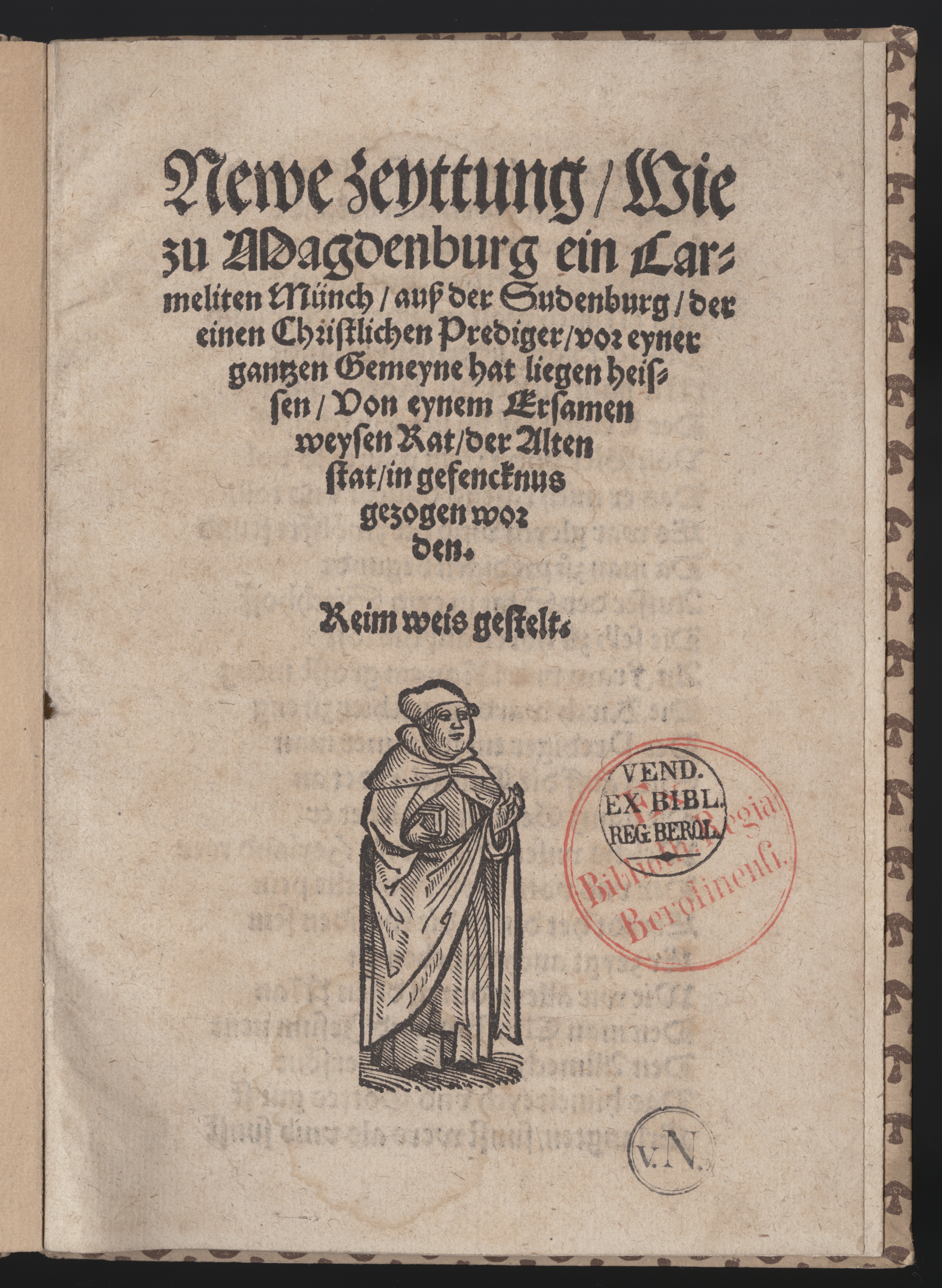
TextNewe zeyttung, Wie zu Magdenburg ein Carmeliten Münch, auss der Sudenburg, der einen Christlichen Prediger, vor eyner gantzen Gemeyne hat liegen heissen, Von eynem Ersamen weysen Rat, der Alten stat, in gefencknus gezogen worden. : Reim weis gestelt.
Summary: Polemic ballad with a total of 142 rhymed lines, relating the story of a drunk Carmelite monk who attends a sermon preached outside the city by a righteous (Lutheran) pastor and who interrupts the preacher, accusing him of lying and misrepresenting Scripture. The people in response rise up and begin to beat him, almost killing him, but the monk is taken away and brought before the city council and the mayor who calls for calm and instructs that the monk should be locked up to await the executioner and thus be placed under God's justice rather than the mob's anger.Summary: Polemic ballad with a total of 142 rhymed lines, relating the story of a drunk Carmelite monk who attends a sermon preached outside the city by a righteous (Lutheran) pastor and who interrupts the preacher, accusing him of lying and misrepresenting Scripture. The people in response rise up and begin to beat him, almost killing him, but the monk is taken away and brought before the city council and the mayor who calls for calm and instructs that the monk should be locked up to await the executioner and thus be placed under God's justice rather than the mob's anger. -
 Text
TextOriginal letters relative to the English Reformation : written during the reigns of King Henry VIII., King Edward VI., and Queen Mary: chiefly from the achives of Zurich
Summary: This volume forms the third series of the Zurich letters, and includes letters from 1531 to 1558.Summary: This volume forms the third series of the Zurich letters, and includes letters from 1531 to 1558. -
Text
Original letters relative to the English Reformation : written during the reigns of King Henry VIII., King Edward VI., and Queen Mary: chiefly from the achives of Zurich
Summary: This volume forms the third series of the Zurich letters, and includes letters from 1531 to 1558.Summary: This volume forms the third series of the Zurich letters, and includes letters from 1531 to 1558. -
 Text
TextProtestatio facta in Dieta Augustana 1550 circa conciliu[m] p[er] oratores electoris Ducis Mauritij saxonici, Augsburg
Maurice, Elector of Saxony, 1521-1553A contemporary report of a remonstration against the Imperial policy of Charles V for participation in the recently convened ecumenical Council of Trent on terms proposed by the new Pope Julius III (del Monte). The Elector Maurice, of the Ernestine branch of the Wettin family of the duchies of Saxony, was one of the great and enigmatic figures of German history in the mid 16th century.A contemporary report of a remonstration against the Imperial policy of Charles V for participation in the recently convened ecumenical Council of Trent on terms proposed by the new Pope Julius III (del Monte). The Elector Maurice, of the Ernestine branch of the Wettin family of the duchies of Saxony, was one of the great and enigmatic figures of German history in the mid 16th century. -
 Text
TextQuaedam scripta theologorum VVirtembergicorum & Victorini Strigelij unde liquet, quid illi de ipsius papistica synergia sentiant
Strigel, Victorinus, 1524-1569Summary: Collection of documents issued by theologians in the Duchy of Württemberg and Victorinus Strigel concerning Strigel's Psalms commentary and his position in the synergistic controversy. Strigel supported the Philippist position that human will contributes to salvation, an idea that was rejected by the gnesio-Lutherans and by most of the theologians in Württemberg.Summary: Collection of documents issued by theologians in the Duchy of Württemberg and Victorinus Strigel concerning Strigel's Psalms commentary and his position in the synergistic controversy. Strigel supported the Philippist position that human will contributes to salvation, an idea that was rejected by the gnesio-Lutherans and by most of the theologians in Württemberg. -
 Text
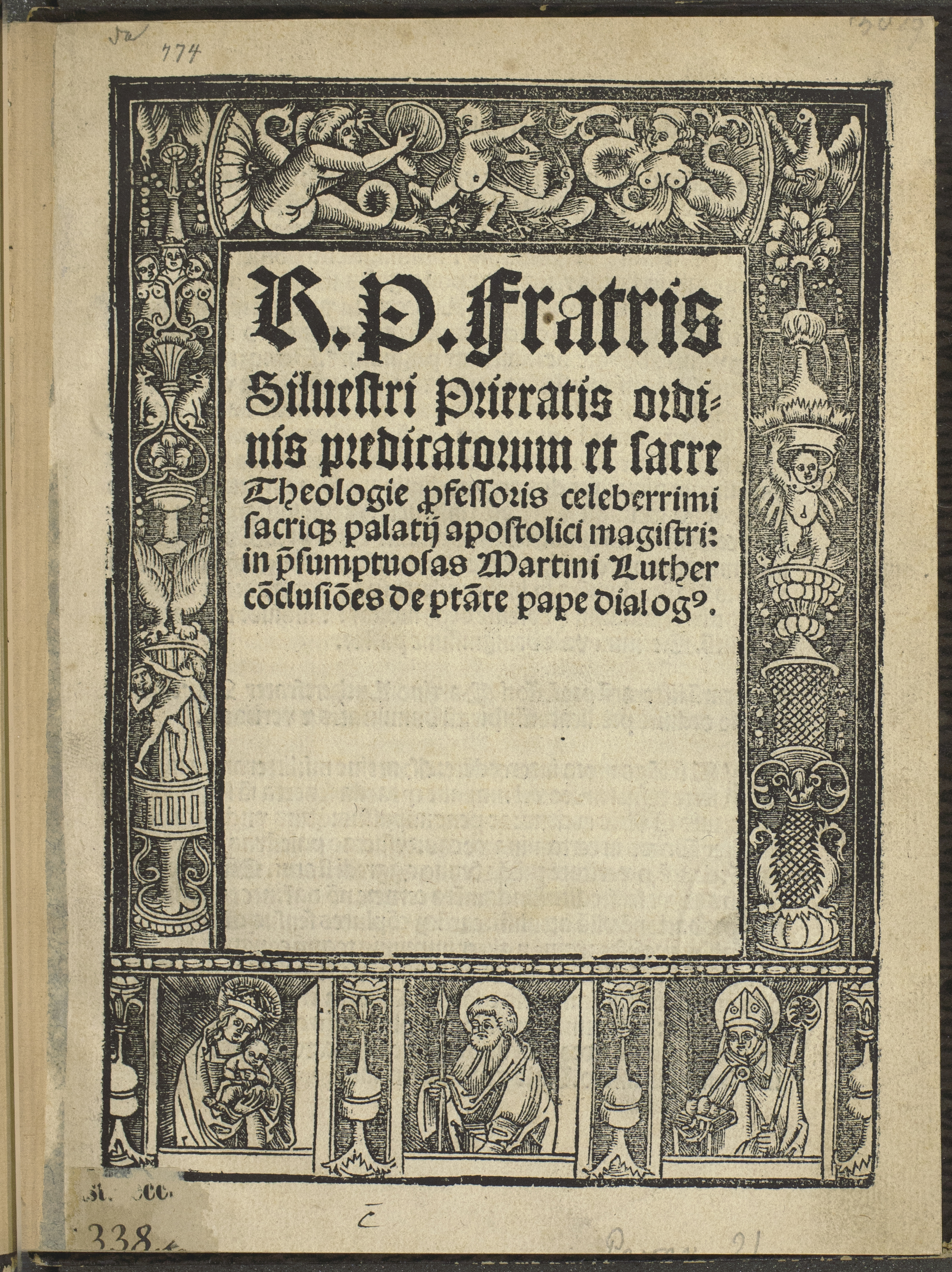
TextR.P. Fratris Siluestri Prieratis ordinis praedicatorum et sacre Theologie p[ro]fessoris celeberrimi sacriq[ue] palatij apostolici magistri: in p[re]sumptuosas Martini Luther co[n]clusio[n]es de p[otes]tate pape dialog[us]
Mazzolini, Silvestro, da Prierio, 1456?-1527?Summary: S. Mazzolini was Master of the Sacred Palace (Vatican) in Rome, censor of books, and one of the first Catholic literary opponents of Luther. This is an early printing of the first work issued in opposition to Luther. Where the printing fits in bibliographically is still a matter of dispute. The work is in dialogue form and contains a refutation of Luther's 95 theses.Summary: S. Mazzolini was Master of the Sacred Palace (Vatican) in Rome, censor of books, and one of the first Catholic literary opponents of Luther. This is an early printing of the first work issued in opposition to Luther. Where the printing fits in bibliographically is still a matter of dispute. The work is in dialogue form and contains a refutation of Luther's 95 theses. -
 Text
TextReceipt for 20 Gulden salary to Jonas Justus from the City Council of Erfurt
Jonas, Justus, 1493-1555This collection consists of a single receipt, on paper, for 20 Gulden which Jonas received as salary from the City Council of Erfurt. Our research has so far been unable to determine just why Jonas was being paid by the City Council. The fact that he uses the word "Zinse" (interest income, or, income from a benefice) suggests that it was for services rendered as a preacher in that City. It is also known that he was considering returning to Erfurt as a preacher after the debacle at Halle. The receipt is signed by Justus Jonas and is dated the 2nd February 1549.This collection consists of a single receipt, on paper, for 20 Gulden which Jonas received as salary from the City Council of Erfurt. Our research has so far been unable to determine just why Jonas was being paid by the City Council. The fact that he uses the word "Zinse" (interest income, or, income from a benefice) suggests that it was for services rendered as a preacher in that City. It is also known that he was considering returning to Erfurt as a preacher after the debacle at Halle. The receipt is signed by Justus Jonas and is dated the 2nd February 1549. -
 Text
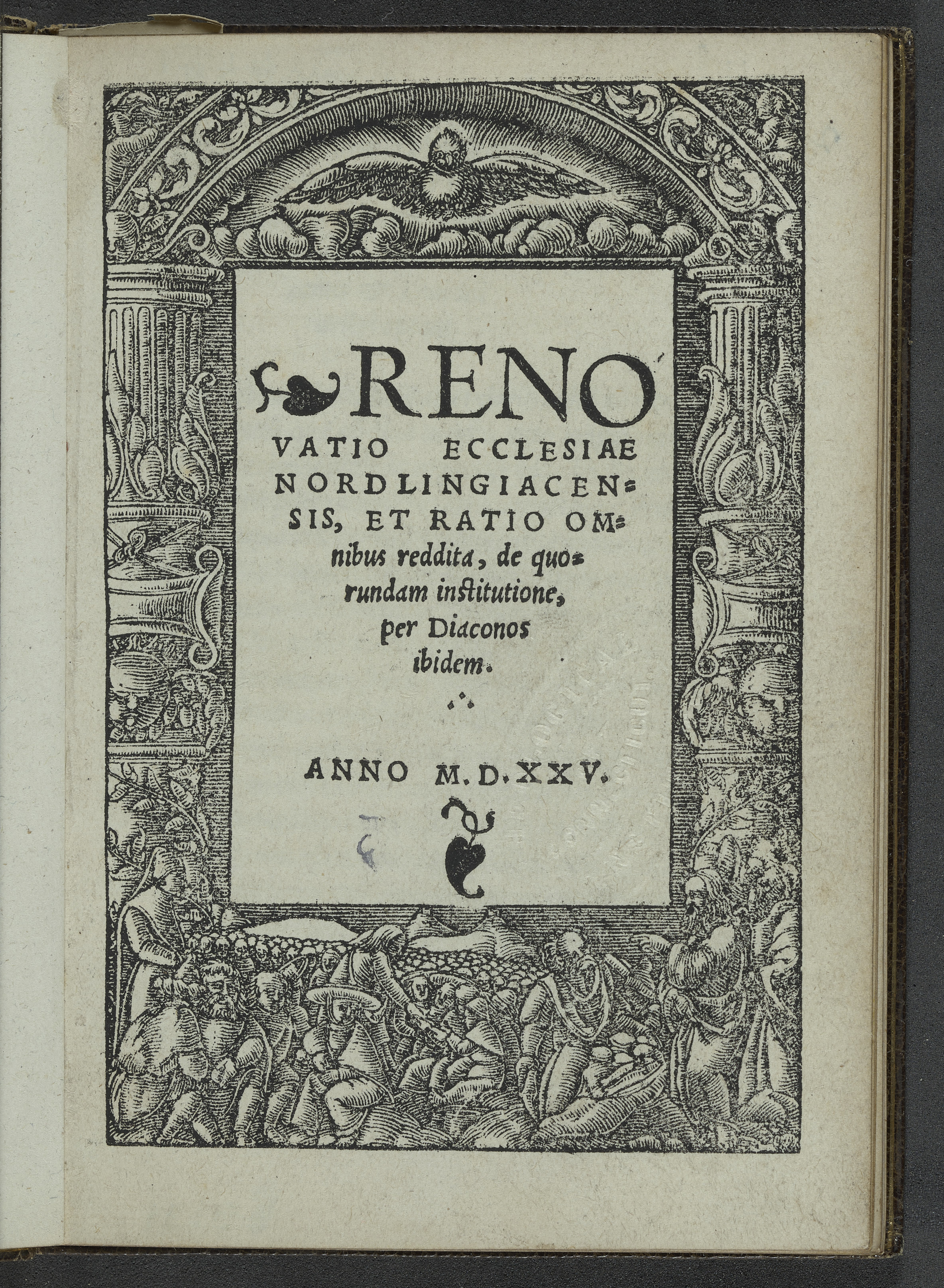
TextRenouatio Ecclesiae Nordlingiacensis, et ratio omnibus reddita, de quorundam institutione
Billican, Theobald, approximately 1490-1554Summary: Theobald Billican was educated at Heidelberg where he became a close friend of Melanchthon. He was drawn to Luther in 1518 when Luther disputed on scholasticism at the University of Heidelberg. This tract on the reformation in Nordlingen attempts to prove that the old "abuses" had been corrected and replaced with "purified" doctrines. Billican consciously constructs his discourse more along Erasmian lines than according to strictly Lutheran models.Summary: Theobald Billican was educated at Heidelberg where he became a close friend of Melanchthon. He was drawn to Luther in 1518 when Luther disputed on scholasticism at the University of Heidelberg. This tract on the reformation in Nordlingen attempts to prove that the old "abuses" had been corrected and replaced with "purified" doctrines. Billican consciously constructs his discourse more along Erasmian lines than according to strictly Lutheran models. -
 Text
TextResolutiones Lutherianae super propositionibus suis Lipsiae disputatis
Luther, Martin, 1483-1546Summary: A clarification of Luther's position regarding the Leipzig disputation, a public debate between the Catholic Johann Eck on the one side and Luther and Andreas Karlstadt on the other. The work is preceded by a long letter to Spalatin, dated 15 Aug., 1519.Summary: A clarification of Luther's position regarding the Leipzig disputation, a public debate between the Catholic Johann Eck on the one side and Luther and Andreas Karlstadt on the other. The work is preceded by a long letter to Spalatin, dated 15 Aug., 1519. -
Text
The Zurich letters : comprising the correspondance of several English bishops and others, with some of the Helvetian reformers, during the early part of the reign of Queen Elizabeth
Robinson, Hastings, 1792?-1866Summary:Summary: -
Text
The Zurich letters : comprising the correspondance of several English bishops and others, with some of the Helvetian reformers, during the early part of the reign of Queen Elizabeth
Robinson, Hastings, 1792?-1866Summary:Summary: -
 Text
TextUrsach vnd anttwortt das iungkfrawe[n] kloster gottlich v[er]lassen muge[n]
Luther, Martin, 1483-1546Summary: The catalyst for this famous Luther letter was the removal by stealth of nine nuns from the cloister of Nimbschen bei Grimma at Easter in the year 1523. Luther names the nine, which include a sister of Johann Staupitz, Luther's father confessor, and Katharina von Bora, who was to become Luther's wife.Summary: The catalyst for this famous Luther letter was the removal by stealth of nine nuns from the cloister of Nimbschen bei Grimma at Easter in the year 1523. Luther names the nine, which include a sister of Johann Staupitz, Luther's father confessor, and Katharina von Bora, who was to become Luther's wife.