Search
932 resources
932 items
Time Period
Sixteenth century
-
 Text
TextEine kurtze schöne christliche Prediget, vom hochwirdigen Sacrament des Abentmals vnsers Herrn Jhesu Christi : Sampt einer Predigt, Wie ein Christ hie auff Erden seliglich reisen vnd wandeln sol, Vnd was jm jn solcher Reise hindern mag, gestellet auff die Wort S. Paulus, Ephe. v. Seid Gottes nach Folger, als die lieben Kinder. Mit einer Kurtzen Auslegung des ersten Psalmen
Spangenberg, JohannSummary: Two sermons by the Lutheran preacher Johann Spangenberg on the sacrament of the eucharist and on Christian life, based on Ephesians 5, as well as a short exegesis of Psalm 1.Summary: Two sermons by the Lutheran preacher Johann Spangenberg on the sacrament of the eucharist and on Christian life, based on Ephesians 5, as well as a short exegesis of Psalm 1. -
 Text
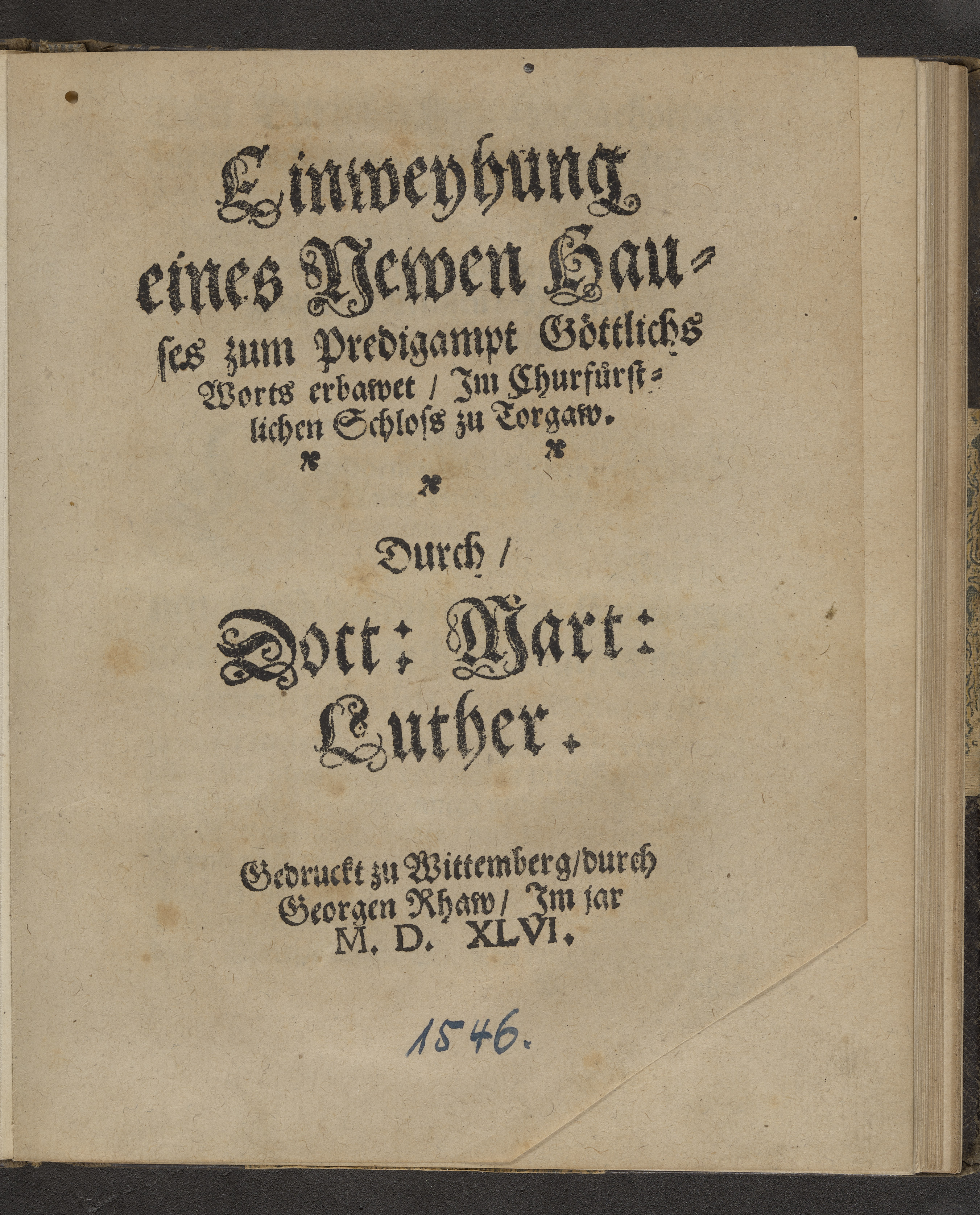
TextEinweyhung eines newen Hauses zum Predigampt Göttlichs Worts erbawet, Im Churfůrstlichen Schloss zu Torgaw
Luther, Martin, 1483-1546Summary: Second edition of a sermon preached on October 5, 1544 on Luke 14 (Healing of the man with dropsy on the Sabbath day). The sermon was preached in Torgau at the dedication of a new chapel in the Elector's Castle and the text was edited by Caspar Creutziger.Summary: Second edition of a sermon preached on October 5, 1544 on Luke 14 (Healing of the man with dropsy on the Sabbath day). The sermon was preached in Torgau at the dedication of a new chapel in the Elector's Castle and the text was edited by Caspar Creutziger. -
 Still image
Elector Joachim II of Brandenburg Kneeling before a Crucifix
Friedrich, Franz, approximately 1520-1584A woodcut containing a portrait of Elector Joachim II of Brandenburg kneeling before a crucifix. This woodcut likekly originated as a broadsheet since there are no signs of letterpress on the back. The same woodcut appeared in Grabriel Schnellboltz' Wahrhafftige Bildnisse etlicher Fuersten (Wittenberg, 1562) and the Augspurgische Confession (Frankfurt an der Oder:, Eichorn, 1572).A woodcut containing a portrait of Elector Joachim II of Brandenburg kneeling before a crucifix. This woodcut likekly originated as a broadsheet since there are no signs of letterpress on the back. The same woodcut appeared in Grabriel Schnellboltz' Wahrhafftige Bildnisse etlicher Fuersten (Wittenberg, 1562) and the Augspurgische Confession (Frankfurt an der Oder:, Eichorn, 1572). -
![A woodcut containing a portrait of John Frederick (Johann Friedrich) reading a book and praying before a crucifix. Frederick was a leader of the Schmalkaldic League and fought for Luther's cause against the Imperial troops. The league was defeated in the Battle of Muehlberg in April of 1547. Frederick was wounded by a slash across his left cheek, captured, condemned to death, but ultimately pardoned and reinstated as duke in Weimar. After 1547, however, the Electoral power had fallen to the rivalling Albertininian line of the dynasty residing in Dresden. The print depicts Frederick with the scar on his cheek. The book contains the words, "Hilf Got[t]" (help me God). Cranach marked the woodcut plate with his device and dated it to 1552, but the broadsheet in its current manifestation was printed in 1557.](https://digital.pitts.emory.edu/files/large/P_MSS400_B001_F005_I001/P_MSS400_B001_F005_I001_P001_PROD.jpg) Still image
Still imageElector John Frederick the Magnanimous with Book and Crucifix
Cranach, Lucas, 1515-1586A woodcut containing a portrait of John Frederick (Johann Friedrich) reading a book and praying before a crucifix. Frederick was a leader of the Schmalkaldic League and fought for Luther's cause against the Imperial troops. The league was defeated in the Battle of Muehlberg in April of 1547. Frederick was wounded by a slash across his left cheek, captured, condemned to death, but ultimately pardoned and reinstated as duke in Weimar. After 1547, however, the Electoral power had fallen to the rivalling Albertininian line of the dynasty residing in Dresden.A woodcut containing a portrait of John Frederick (Johann Friedrich) reading a book and praying before a crucifix. Frederick was a leader of the Schmalkaldic League and fought for Luther's cause against the Imperial troops. The league was defeated in the Battle of Muehlberg in April of 1547. Frederick was wounded by a slash across his left cheek, captured, condemned to death, but ultimately pardoned and reinstated as duke in Weimar. After 1547, however, the Electoral power had fallen to the rivalling Albertininian line of the dynasty residing in Dresden. -
 Text
TextElementorum rhetorices libri duo. : His adiectae sunt epistolae contrariae, Pici & Hermolai Barbari. Vnà cum dispositione Phil. Mel. accessit demum index & rerum & uerborum locupletissimus
Melanchthon, Philipp, 1497-1560Summary: A 1558 printing of a work on rhetoric by Philipp Melanchthon. The work includes correspondence on the subject by two late-15th century Italian humanists.Summary: A 1558 printing of a work on rhetoric by Philipp Melanchthon. The work includes correspondence on the subject by two late-15th century Italian humanists. -
 Text
TextElisabeth Creutziger, the Magdeburg Enchiridion, 1536 and Reformation Theology
Leaver, Robin A.The digital edition of lecture on Elisabeth Creutziger in relation to the Magdeburg Enchiridion (1536) and the broader theology of the Reformation, delivered at the seventh annual fall concert celebrating the Richard C. Kessler Reformation Collection in the Pitts Theology Library at the Candler School of Theology, Emory University, October 18, 1994.The digital edition of lecture on Elisabeth Creutziger in relation to the Magdeburg Enchiridion (1536) and the broader theology of the Reformation, delivered at the seventh annual fall concert celebrating the Richard C. Kessler Reformation Collection in the Pitts Theology Library at the Candler School of Theology, Emory University, October 18, 1994. -
 Text
TextEnarratio Psalmi Sexagesimi octavi, Exvrgat Deus & dissipentur inimici eius &c.
Major, Georg, 1502-1574Summary: Interpretation of Psalm 68 by Georg Major, a student of Luther and Melanchthon, and professor at Wittenberg from 1536, with a few brief interruptions, until his death.Summary: Interpretation of Psalm 68 by Georg Major, a student of Luther and Melanchthon, and professor at Wittenberg from 1536, with a few brief interruptions, until his death. -
 Text
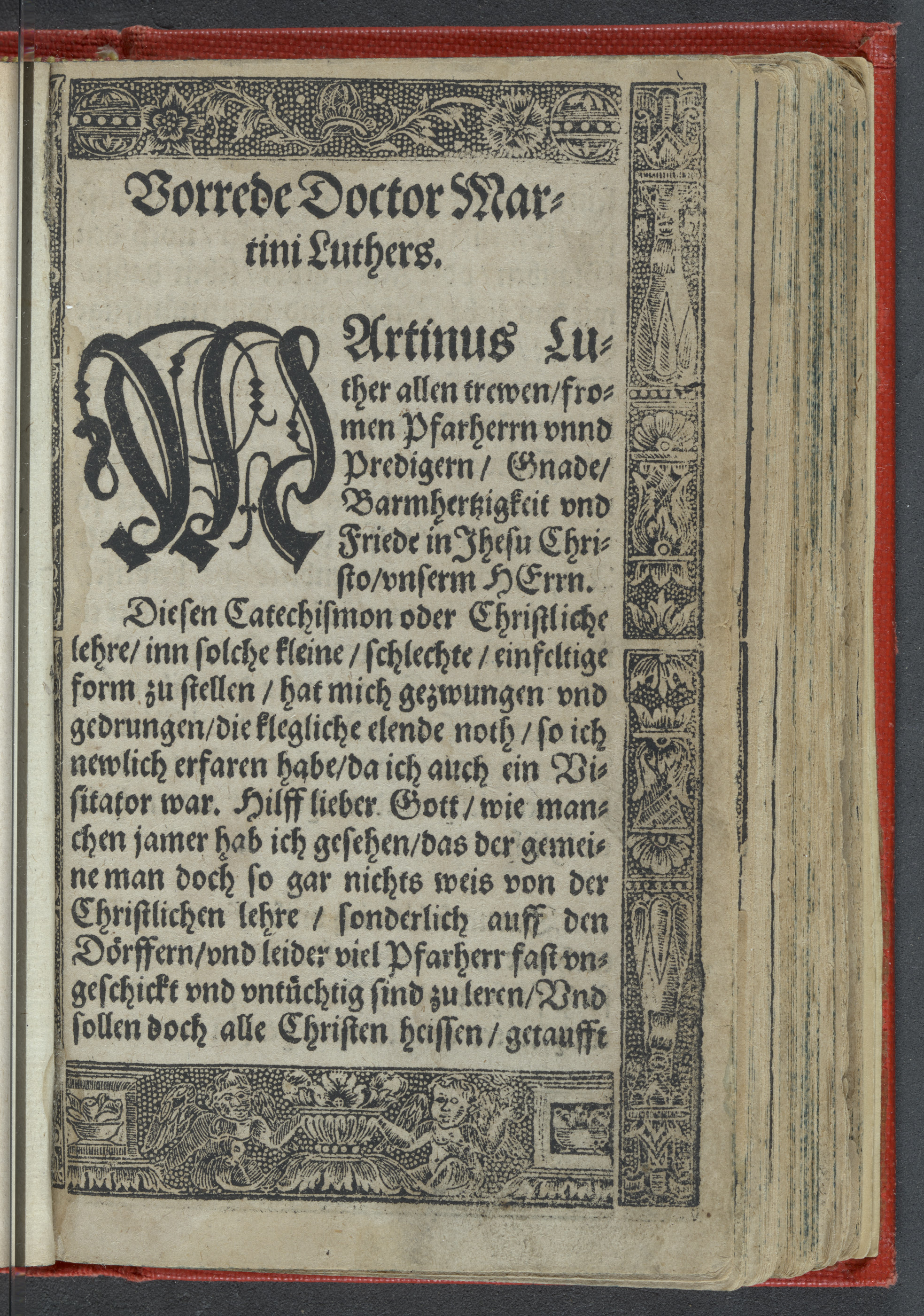
TextEnchiridion : Der kleine Catechismus : Für die gemeine Pfarherr vnd Prediger
Luther, Martin, 1483-1546Summary: A 1565 printing of Luther's Small Catechism.Summary: A 1565 printing of Luther's Small Catechism. -
 Text
TextEnchiridion : Der kleine Catechismus für die gemeine Pfarherr vnd Prediger
Luther, Martin, 1483-1546Summary: Second illustrated edition of Valentin Babst's publication of Luther's small catechism.Summary: Second illustrated edition of Valentin Babst's publication of Luther's small catechism. -
 Text
TextEnchiridion Geistliker Leder unde Psalmen, Magdeburg 1536
The digital edition of an introductory study of the "Enchiridion geistliker leder unde Psalmen," originally published by Melchior Lotter in Magdeburg, Germany, in 1536, including facsimile reproductions. The original text includes hymns in part with melodies in Low German.The digital edition of an introductory study of the "Enchiridion geistliker leder unde Psalmen," originally published by Melchior Lotter in Magdeburg, Germany, in 1536, including facsimile reproductions. The original text includes hymns in part with melodies in Low German. -
 Text
TextEnchiridion geistliker leder unde Psalmen
Summary: A collection of hymns, in part with melodies.Summary: A collection of hymns, in part with melodies. -
 Text
TextEnchiridion locorum communium aduersus Lutheranos
Eck, Johann, 1486-1543Summary: In 1521, Melanchthon wrote the first Protestant dogmatics, the "Loci Communes." Eck countered in 1525 with his "handbook on Theological Topics". Possibly the most widely reprinted Catholic critique of Lutheran doctrine (Metzler lists 91 contemporary editions). Eck uses the same topical procedure and cites the Bible, Church Fathers, Councils, and Popes heavily in the presentation of his arguments.Summary: In 1521, Melanchthon wrote the first Protestant dogmatics, the "Loci Communes." Eck countered in 1525 with his "handbook on Theological Topics". Possibly the most widely reprinted Catholic critique of Lutheran doctrine (Metzler lists 91 contemporary editions). Eck uses the same topical procedure and cites the Bible, Church Fathers, Councils, and Popes heavily in the presentation of his arguments. -
 Text
TextEncomiu[m] Rubij Longipolii apud Lipsim : in errores quos pueriliter co[m]misit adversus Vuittenbergen[ses] : Nemo potest quicquid toto gestatur in orbe rumpere liuores omnia Nemo potest
Montanus, Jacobus, active 1486-1534Summary: It is not certain who wrote this tract on the Leipzig Disputation but J. Montanus or J. Cellarius appear to be the most likely candidates. Montanus became the first Protestant preacher in Westphalia, while Cellarius or Kellner, became the first Protestant Superintendent of Dresden.Summary: It is not certain who wrote this tract on the Leipzig Disputation but J. Montanus or J. Cellarius appear to be the most likely candidates. Montanus became the first Protestant preacher in Westphalia, while Cellarius or Kellner, became the first Protestant Superintendent of Dresden. -
 Text
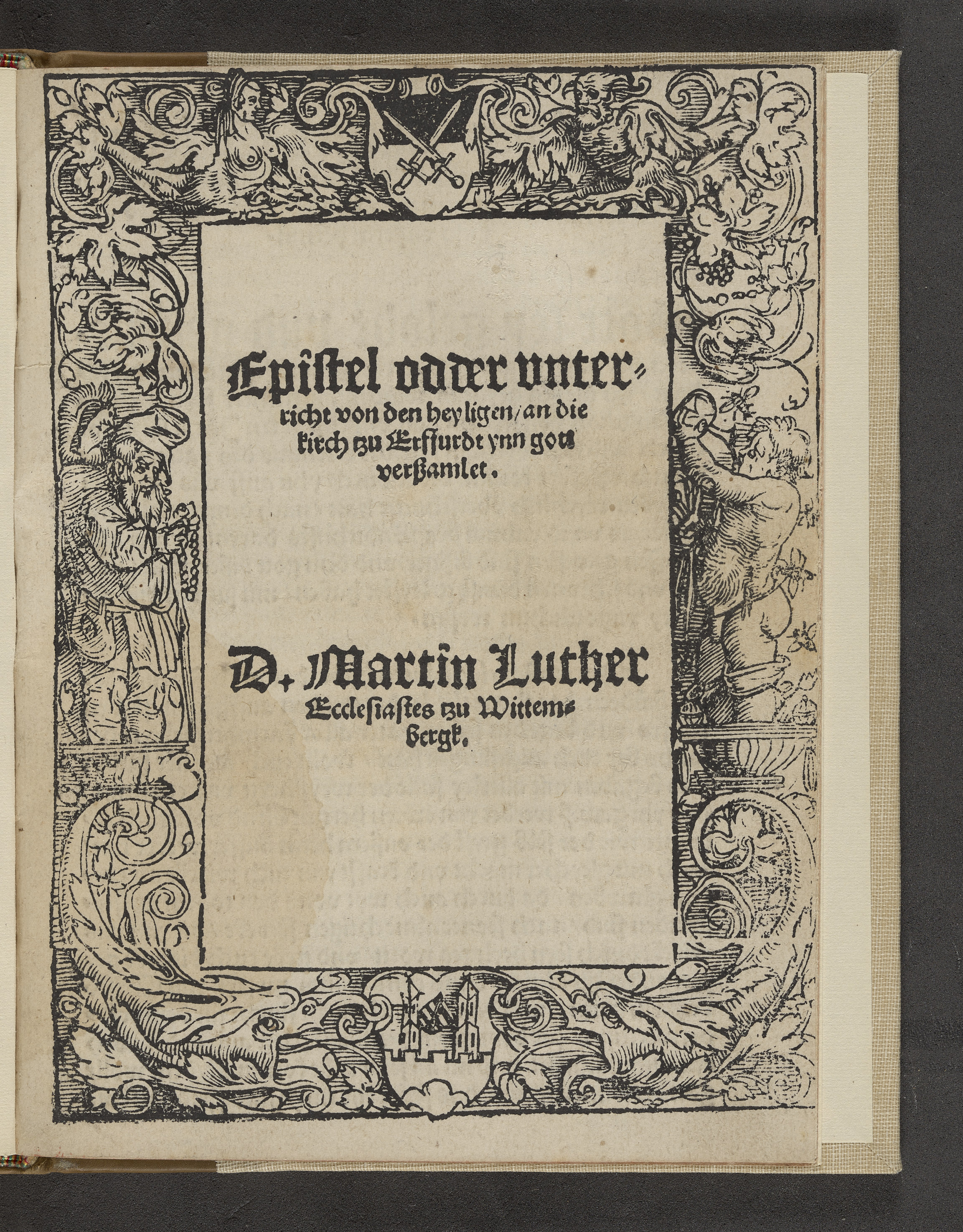
TextEpistel odder vnterricht von den heyligen : an die kirch zu Erfurdt ynn gott verszamelt
Luther, Martin, 1483-1546Summary: First printing of an open letter by Luther to the church of Erfurt on the subject of prayers to the saints.Summary: First printing of an open letter by Luther to the church of Erfurt on the subject of prayers to the saints. -
 Text
TextEpistola D. Martini Luther ad Georgium Spalatinum &c. de disputatione sua : Eiusdem super Tredecim Proposit[i]o[n]ibus Lipsi[a]e disputatis resolutiones
Luther, Martin, 1483-1546Summary: The Leipzig disputation was a debate between Martin Luther and Andreas Karlstadt on the one hand and Johann Eck on the other. While Karlstadt and Eck found some grounds for agreement on the question of free will, Luther and Eck disagreed vehemently over the question of the pope's authority to establish new articles of faith. This work publishes a letter Luther wrote to his friend Georg Spalatin, as well as 13 theses by Luther refuting Eck's position on the primacy of the pope and the authority of councils.Summary: The Leipzig disputation was a debate between Martin Luther and Andreas Karlstadt on the one hand and Johann Eck on the other. While Karlstadt and Eck found some grounds for agreement on the question of free will, Luther and Eck disagreed vehemently over the question of the pope's authority to establish new articles of faith. This work publishes a letter Luther wrote to his friend Georg Spalatin, as well as 13 theses by Luther refuting Eck's position on the primacy of the pope and the authority of councils. -
 Text
TextEpistola apologetica Matthiae Flacij Illyrici ad quendam Pastorem : Item Duo Somnia Philippi
Flacius Illyricus, Matthias, 1520-1575Summary: Open letter to an anonymous pastor justifying Matthias Flacius' opposition to the Leipzig interim, and Melanchthon's willingness to compromise with the Catholic Church on matters of liturgy.Summary: Open letter to an anonymous pastor justifying Matthias Flacius' opposition to the Leipzig interim, and Melanchthon's willingness to compromise with the Catholic Church on matters of liturgy. -
 Text
TextEpistola de Lipsica disputatione
Melanchthon, Philipp, 1497-1560Summary: A report on the Leipzig Disputation of 1519, ostensibly between Karlstadt and Johann Eck, but with the active participation of Luther both in preparation and in delivery. It was at this formal disputation that Eck was successful in pushing Luther to admit that not only popes, but councils, as well, had erred. This was an important point in Eck's favor, since Luther had, up to this point, appealed from the authority of the Pope to that of an ecumenical council.Summary: A report on the Leipzig Disputation of 1519, ostensibly between Karlstadt and Johann Eck, but with the active participation of Luther both in preparation and in delivery. It was at this formal disputation that Eck was successful in pushing Luther to admit that not only popes, but councils, as well, had erred. This was an important point in Eck's favor, since Luther had, up to this point, appealed from the authority of the Pope to that of an ecumenical council. -
 Text
TextEpistolae duae
Haner, Johannes, active 1524-1544Summary: This pamphlet contains two letters on Lutheranism by converts to Catholicism. Witzel's publication of Haner's letter led to the latter's expulsion from the city of Nuremberg.Summary: This pamphlet contains two letters on Lutheranism by converts to Catholicism. Witzel's publication of Haner's letter led to the latter's expulsion from the city of Nuremberg. -
 Text
TextEpistolary: Matthew 27
A leaf from an epistolary featuring musical annotation and the text of Matthew 27:60-64.A leaf from an epistolary featuring musical annotation and the text of Matthew 27:60-64. -
 Text
TextEpitome colloquij inter illustrissimorum Principum D. Friderici Palantini Electoris, & D. Christophori Ducis Wirtengergensis theologos, de maiestate hominis Christi, de[ni]q[ue] vera eius in eucharistia praesentia, Maulbrunnae instituti
Colloquy of Maulbronn (1564)Summary: Summary of the transactions of teh Colloquy of Maulbronn, a council involving theologians from Lutheran Würtemberg and the Reformed (Zwinglian) Palatinate. The main point of debate was the presence of Christ in the Eucharist.Summary: Summary of the transactions of teh Colloquy of Maulbronn, a council involving theologians from Lutheran Würtemberg and the Reformed (Zwinglian) Palatinate. The main point of debate was the presence of Christ in the Eucharist. -
 Text
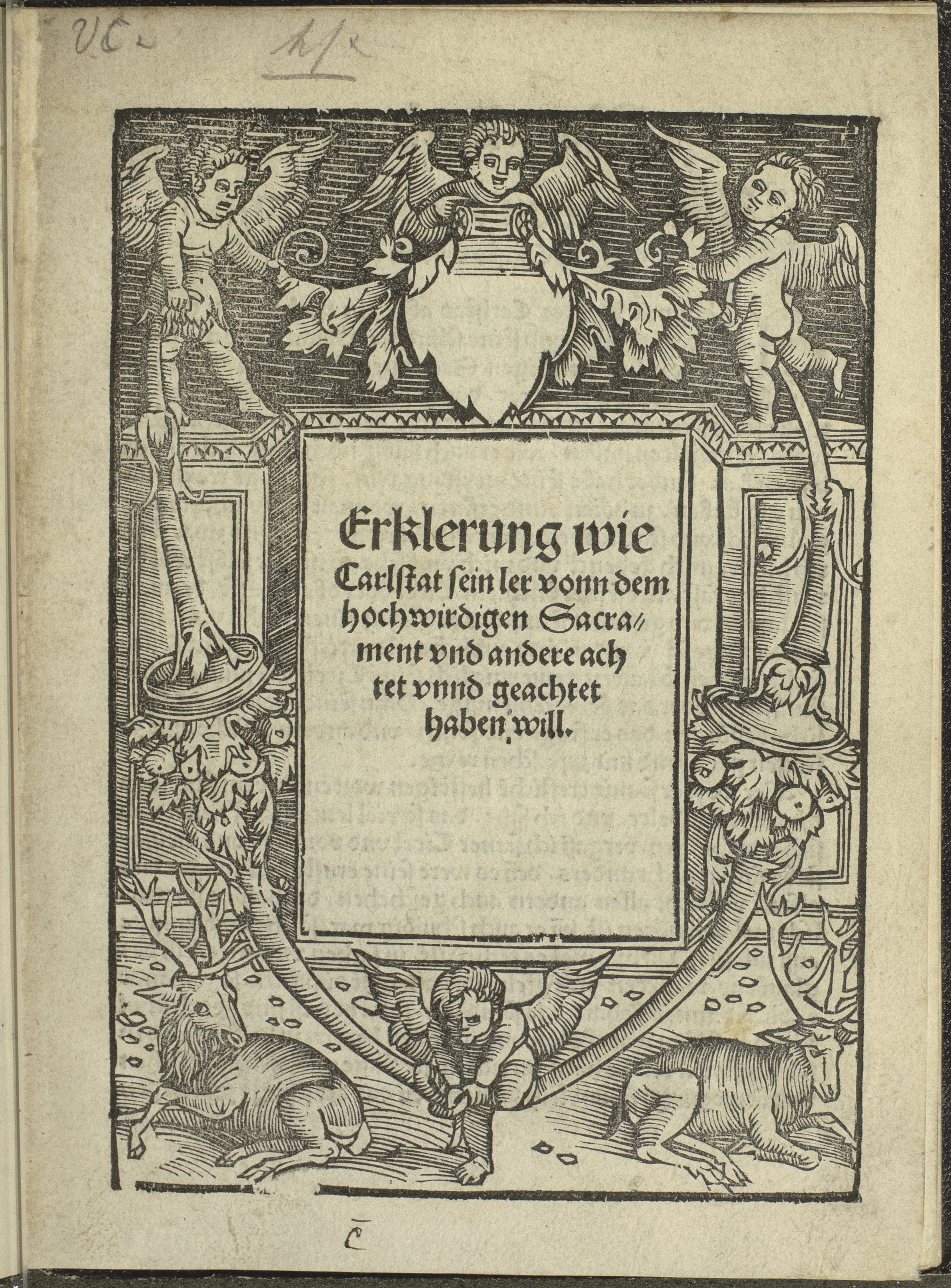
TextErklerung wie Carlstat sein ler vonn dem hochwirdigen Sacrament : vnd andere achtet vnnd geachtet haben will
Karlstadt, Andreas Rudolff-Bodenstein von, 1486-1541Summary: After Karlstadt had been driven out of Saxony, he sought refuge in South Germany. When this proved impossible, he returned to Wittenberg. Karlstadt publish a retraction of his former opinions and then publish nothing else without prior approval. This is the retraction with Luther's preface. Needless to say, Karlstadt did not find these conditions at all acceptable and he was soon on the move again. He came to settle in Switzerland, first in Zurich and finally in Basel, where he died on Christmas Eve, 1541.Summary: After Karlstadt had been driven out of Saxony, he sought refuge in South Germany. When this proved impossible, he returned to Wittenberg. Karlstadt publish a retraction of his former opinions and then publish nothing else without prior approval. This is the retraction with Luther's preface. Needless to say, Karlstadt did not find these conditions at all acceptable and he was soon on the move again. He came to settle in Switzerland, first in Zurich and finally in Basel, where he died on Christmas Eve, 1541.