Search
741 resources
741 items
Collection
Richard C. Kessler Reformation Collection
-
 Text
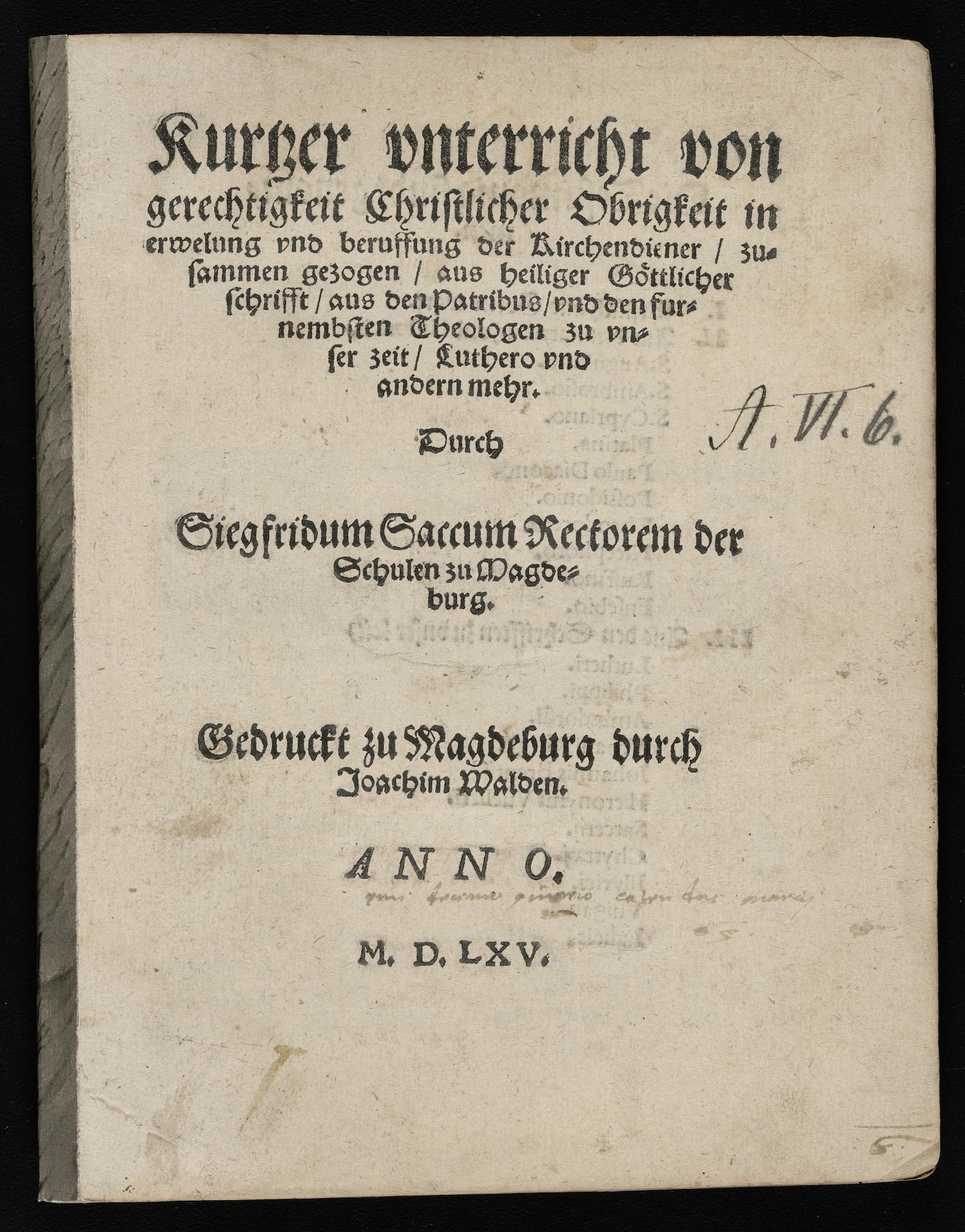
TextKurtzer vnterricht von gerechtigkeit Christlicher Obrigkeit in erwelung vnd beruffung der Kirchendiener : zusammen gezogen, aus heiliger Göttlicher schrifft, aus den Patribus, vnd den furnembsten Theologen zu vnser zeit, Luthero vnd andern mehr
Saccus, Siegfried, 1527-1596Summary: Formal opinion of Siegfried Saccus, schoolmaster at Magdeburg and later its first Lutheran cathedral preacher, concerning the right of the city government to appoint clergy. As a follower of the strict Lutheran Nicholas von Amsdorff, he steered a careful path between the views of the local Catholic hierarchy on the one hand, and those of the Münster Anabaptists, on the other. Although Magdeburg became a refuge of the strict Lutheran party following the Schmalkald War, the city council was late in making an official decision for or against the Reformation.Summary: Formal opinion of Siegfried Saccus, schoolmaster at Magdeburg and later its first Lutheran cathedral preacher, concerning the right of the city government to appoint clergy. As a follower of the strict Lutheran Nicholas von Amsdorff, he steered a careful path between the views of the local Catholic hierarchy on the one hand, and those of the Münster Anabaptists, on the other. Although Magdeburg became a refuge of the strict Lutheran party following the Schmalkald War, the city council was late in making an official decision for or against the Reformation. -
 Still image
Lampstand and Table with Bread of Presence
Cranach, Lucas, 1472-1553A woodcut depicting the lampstand, table, and bread of presence surrounded by plates, jugs, and bowls.A woodcut depicting the lampstand, table, and bread of presence surrounded by plates, jugs, and bowls. -
 Still image
Lazarus and the Rich Man
A woodcut image depicting the assumption of Lazarus and the damnation of the rich man as told in Luke 16. Lazarus appears held in the arms of God/Christ in the sky as the rich man sinks into a hole filled with flames.A woodcut image depicting the assumption of Lazarus and the damnation of the rich man as told in Luke 16. Lazarus appears held in the arms of God/Christ in the sky as the rich man sinks into a hole filled with flames. -
 Text
TextLes Images de la mort [de H. Holbein] : avx quelles sont adioustées douze figures ... La medecine de l'ame. La consolation des malades. Vn sermon de mortalité, par sainct Cyprian. Vn sermon de patience, par sainct Iehan Chrysostome ...
Summary: Third French edition of Hans Holbein's Totentanz (Dance of Death), the first with 12 new images. The woodcuts were executed by Hans Lützelburger.Summary: Third French edition of Hans Holbein's Totentanz (Dance of Death), the first with 12 new images. The woodcuts were executed by Hans Lützelburger. -
 Still image
Les enfans sont trebuchez sur le bois
Holbein, Hans, 1497-1543A woodcut depicting a group of putti (cherubs) returning from a hunt. The woodcut is accompanied by a verse from Lamentations 5 translated into French (top) and then reformatted into verse (bottom).A woodcut depicting a group of putti (cherubs) returning from a hunt. The woodcut is accompanied by a verse from Lamentations 5 translated into French (top) and then reformatted into verse (bottom). -
 Text
TextLetter from Albert of Brandenburg to Julius Plug, July 30, 1540
Albrecht, of Brandenburg, Archbishop and Elector of Mainz, Cardinal, 1490-1545A signed letter in German from Albert of Brandenburg to Julius Plug, dated 30th July 1540. The letter is a request to translate from Latin into German some articles on religion by Luther.A signed letter in German from Albert of Brandenburg to Julius Plug, dated 30th July 1540. The letter is a request to translate from Latin into German some articles on religion by Luther. -
 Text
TextLetter from Georg Spalatin to Duke Magnus III of Mecklenburg, May 3, 1534
Spalatin, Georg, 1484-1545A cover letter, dated May 3, 1534, for a manuscript which Spalatin had promised to Duke Magnus III of Mecklenburg regarding the justification used by Henry VIII for his divorce from Catherine of Aragon, which was never recognized by Rome. Henry had married Anne Boleyn in January of 1533 and on May 23 1534, Pope Clement VII invalidated Henry's divorce and remarriage, which led to England's final break with Rome and the foundingn of the Anglican Church.A cover letter, dated May 3, 1534, for a manuscript which Spalatin had promised to Duke Magnus III of Mecklenburg regarding the justification used by Henry VIII for his divorce from Catherine of Aragon, which was never recognized by Rome. Henry had married Anne Boleyn in January of 1533 and on May 23 1534, Pope Clement VII invalidated Henry's divorce and remarriage, which led to England's final break with Rome and the foundingn of the Anglican Church. -
 Text
TextLetter from Georg Spalatin to Heinrich von Einsiedel, January 9, 1536
Spalatin, Georg, 1484-1545A letter written to Heinrich von Einsiedel and an enclosed with a copy of a sermon by Philipp Melanchthon. Within the body of the letter, Spalatin entreats Einsiedel to "exert your goodwill on the work's behalf". The letter is dated 1536.A letter written to Heinrich von Einsiedel and an enclosed with a copy of a sermon by Philipp Melanchthon. Within the body of the letter, Spalatin entreats Einsiedel to "exert your goodwill on the work's behalf". The letter is dated 1536. -
![A letter written to the "Noble and Right worthy Heinrich von Einsiedel" in Gnansteyn. The matter being addressed is the refusal of Brosius Berger to take an oath, thus hindering Katharina Gockritz from getting married. Mention of consultation with Doctor Martin [Luther] is in the letter. With the exception of the upper right corner which is missing, the paper is in good condition. The date "1528" appears in the upper left corner in a different ink.](https://digital.pitts.emory.edu/files/large/P-MSS122_B001_F001_I001/P-MSS122_B001_F001_I001_P001_PROD.jpg) Text
TextLetter from Georg Spalatin to Heinrich von Einsiedel, October 7, 1528
Spalatin, Georg, 1484-1545A letter written to the "Noble and Right worthy Heinrich von Einsiedel" in Gnansteyn. The matter being addressed is the refusal of Brosius Berger to take an oath, thus hindering Katharina Gockritz from getting married. Mention of consultation with Doctor Martin [Luther] is in the letter. With the exception of the upper right corner which is missing, the paper is in good condition. The date "1528" appears in the upper left corner in a different ink.A letter written to the "Noble and Right worthy Heinrich von Einsiedel" in Gnansteyn. The matter being addressed is the refusal of Brosius Berger to take an oath, thus hindering Katharina Gockritz from getting married. Mention of consultation with Doctor Martin [Luther] is in the letter. With the exception of the upper right corner which is missing, the paper is in good condition. The date "1528" appears in the upper left corner in a different ink. -
 Text
TextLetter from Johannes Cochlaeus to Julius von Pflug
Cochlaeus, Johannes, 1479-1552This letter was written by Cochlaeus on June 6, 1547 to Julius von Pflug, the last Prince Bishop of Naumburg. Cochlaeus congratulates von Pflug on his reinstatemnnt into his office following the defeat and capture of Elector John Frederick of Saxony in the Schmalkald War. The letter also contains a reference by Cochlaus to the transfer to Bologna of the meetings that became known as the Council of Trent.This letter was written by Cochlaeus on June 6, 1547 to Julius von Pflug, the last Prince Bishop of Naumburg. Cochlaeus congratulates von Pflug on his reinstatemnnt into his office following the defeat and capture of Elector John Frederick of Saxony in the Schmalkald War. The letter also contains a reference by Cochlaus to the transfer to Bologna of the meetings that became known as the Council of Trent. -
 Text
TextLetter from John, Elector of Saxony, to Duke Albrecht of Bavaria
John, Elector of Saxony, 1468-1532A signed (letter contains notation in his own hand), handwritten letter, in German, on paper. The letter addresses John's unwillingness to provide aid in a dispute against his relative, Duke Albrecht of Bavaria.A signed (letter contains notation in his own hand), handwritten letter, in German, on paper. The letter addresses John's unwillingness to provide aid in a dispute against his relative, Duke Albrecht of Bavaria. -
 Text
TextLetter from Kaspar Cruciger to Viet Dietrich, July 8, 1544
Cruciger, Kaspar, 1504-1548This letter was written by Cruciger on July 8, 1544 to Veit Dietrich, pastor of St. Sebald’s Church at Nuremberg. In the letter Cruciger discussed personal matters related to himself, Dietrich, Martin Luther, and Philipp Melanchthon. He also writes about the collection of Luther’s sermons he and Dietrich were to publish together in the following year.This letter was written by Cruciger on July 8, 1544 to Veit Dietrich, pastor of St. Sebald’s Church at Nuremberg. In the letter Cruciger discussed personal matters related to himself, Dietrich, Martin Luther, and Philipp Melanchthon. He also writes about the collection of Luther’s sermons he and Dietrich were to publish together in the following year. -
 Text
TextLetter to Frederick III, Elector of Saxony, ca. 1512
A handwritten letter, in German, addressed to Samsons Schoffler zu Seyda and Mathes Pustewald, concerning the parish of Neuerdorff, and the death of the Rev. Wust.A handwritten letter, in German, addressed to Samsons Schoffler zu Seyda and Mathes Pustewald, concerning the parish of Neuerdorff, and the death of the Rev. Wust. -
 Text
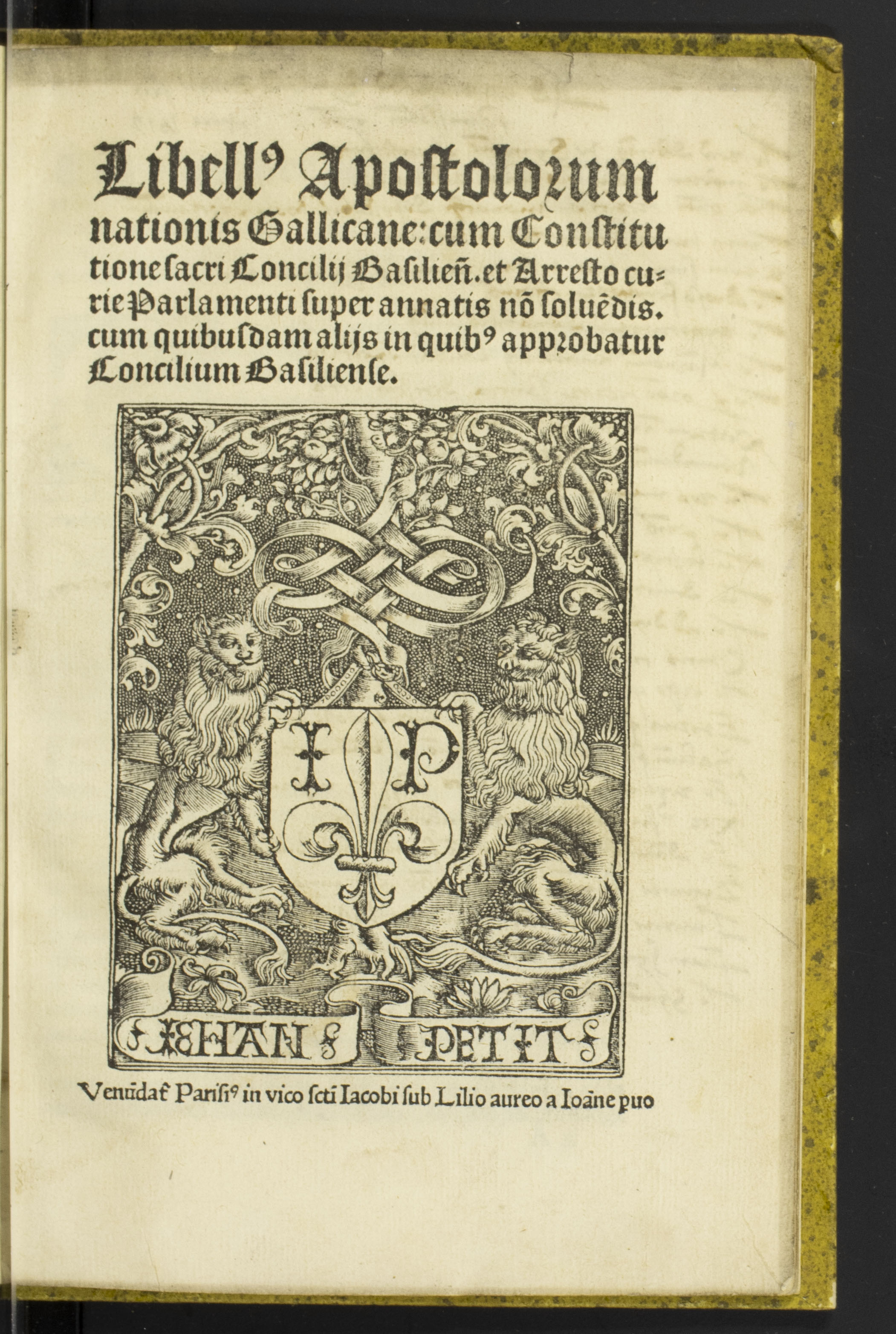
TextLibell[us] Apostolorum nationis Gallicane: cum Constitutione Sacri Concilij Basilien[sis] et arresto curie parlamenti supper annatis no[n] solve[n]dis, cum quibusdam alijs in quib[us] approbatur Concilium Basiliense.
Summary: The Second Council of Pisa (1511-1512), also known as the Conciliabulum of Pisa, was a French initiative to limit the power of Pope Julius II and to strengthen the power of the conciliarists. Pope Julius II condemned the meeting and in response convoked the Fifth Lateran Council, which secured papal authority over conciliarism. This is the first edition of a record of the council published by Jean Petit for a French readership.Summary: The Second Council of Pisa (1511-1512), also known as the Conciliabulum of Pisa, was a French initiative to limit the power of Pope Julius II and to strengthen the power of the conciliarists. Pope Julius II condemned the meeting and in response convoked the Fifth Lateran Council, which secured papal authority over conciliarism. This is the first edition of a record of the council published by Jean Petit for a French readership. -
 Text
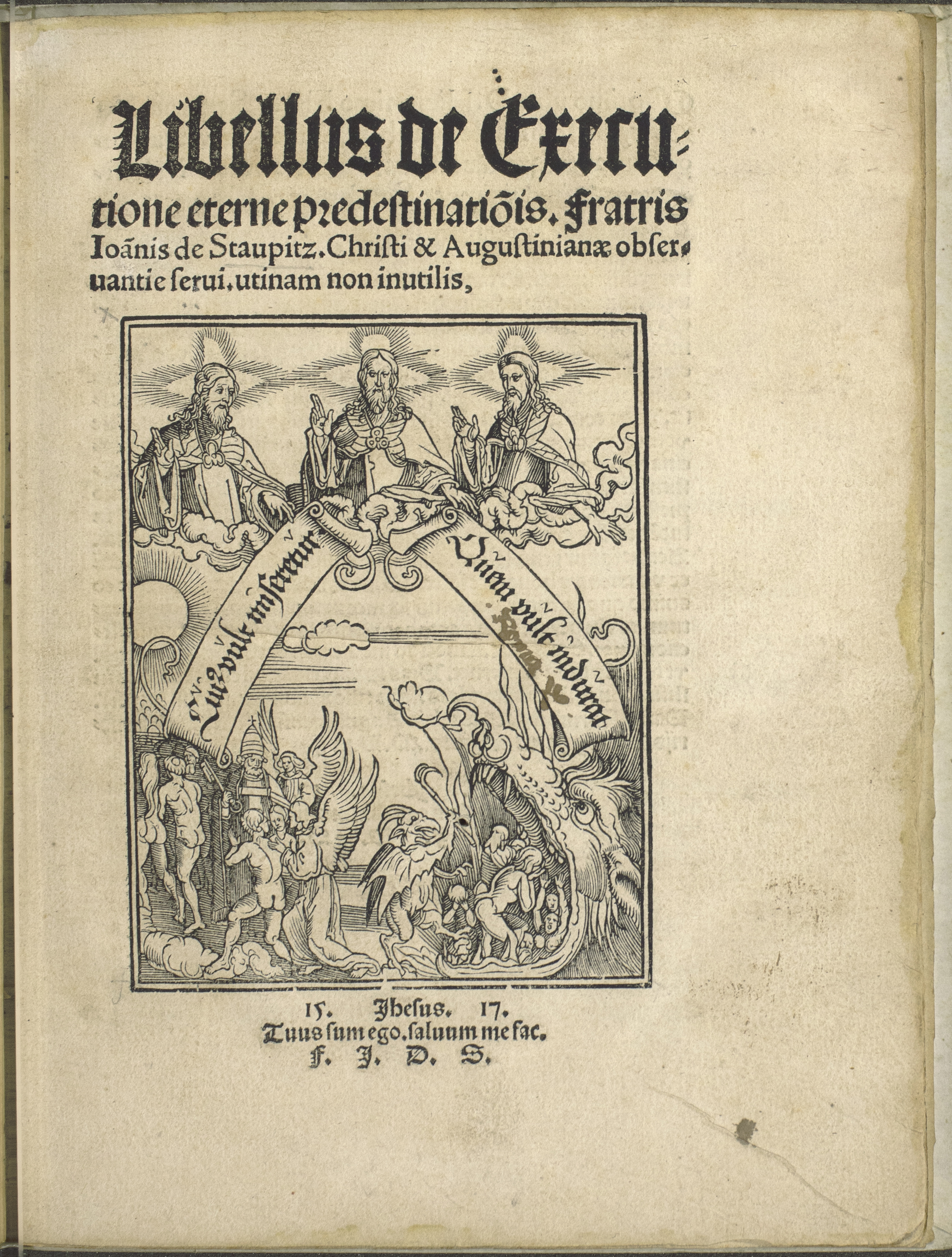
TextLibellus de executione etern[a]e predestinatio[n]is
Staupitz, Johann von, -1524Summary: This is a short work by Staupitz on predestination.Summary: This is a short work by Staupitz on predestination. -
 Text
TextLiber
Sacro Bosco, Joannes de, active 1230Summary: J. de Sacro Bosco was an English mathematician who taught in Paris after 1230. This work on astronomy was only the second by a Western scholar based on Arabic researches to be printed (1472). The book was frequently reprinted as here with a commentary by a famous modern scholar, in this case Melanchthon. Melanchthon's interest in astrology is well known, so it was natural for him to edit this material.Summary: J. de Sacro Bosco was an English mathematician who taught in Paris after 1230. This work on astronomy was only the second by a Western scholar based on Arabic researches to be printed (1472). The book was frequently reprinted as here with a commentary by a famous modern scholar, in this case Melanchthon. Melanchthon's interest in astrology is well known, so it was natural for him to edit this material. -
 Text
TextLoci communes seu hypotyposes theologicae
Melanchthon, Philipp, 1497-1560Summary: A 1525 printing of this most famous of all Melanchthon's theological works, first published in Wittenberg in 1521. The Loci Communes represent the most comrehensive systematic theology of the Lutheran reformation. Melanchthon continued to revise this work throughout his life.Summary: A 1525 printing of this most famous of all Melanchthon's theological works, first published in Wittenberg in 1521. The Loci Communes represent the most comrehensive systematic theology of the Lutheran reformation. Melanchthon continued to revise this work throughout his life. -
 Text
TextLuctus et testimonia ecclesiae quae est in Comitatu Mansfeldensi de obitu reuerendi viri Matthaei Judicis : adiecta sunt, epitaphia Sanctae Matronae Annae, Vxoris: viri D. Til : Heshusii
Summary: Funeral sermons and tributes for the Lutheran theologian Matthaeus Richter (also known as Matthaeus Judex). Also included are epitaphs for Anna von Bert (1533–1564), wife of the theologian Tilemann Heshusius.Summary: Funeral sermons and tributes for the Lutheran theologian Matthaeus Richter (also known as Matthaeus Judex). Also included are epitaphs for Anna von Bert (1533–1564), wife of the theologian Tilemann Heshusius. -
 Still image
Luther in debate with Cathoic clergy
A woodcut depicting Martin Luther, in the garb of an Augustinian monk, debating a gathering of Catholic clergy members, including the Pope, a cardinal, a bishop, and a monk. This woodcut appears on the title page of a popular anonymous account of Luther's debate before the Diet of Worms in 1521.A woodcut depicting Martin Luther, in the garb of an Augustinian monk, debating a gathering of Catholic clergy members, including the Pope, a cardinal, a bishop, and a monk. This woodcut appears on the title page of a popular anonymous account of Luther's debate before the Diet of Worms in 1521. -
 Text
TextLutheri, Melanch. Carolostadii &c. Propositiones, Wittembergae uiua uoce tractatae, in hocq[ue] pleraeq[ue] aeditae ab auctoribus, ut uel nos absentes cum ipsis agamus, uel certe ut ueritatis, et seductionum admonea[n]tur boni.
Luther, Martin, 1483-1546Summary: It was the practice at Wittenberg for the students to sharpen their logical and debating skills by responding to a set of theses proposed by the professor in the discipline in which they were working. These theses were often collected into book form for the use of the students and for the study of the topics by interested non-students. This group is from the early years of the Reformation, 1521-1522. Theses proposed in the Universität Wittenberg for the granting of doctoral degrees. In most cases the "respondents" are not indicated.Summary: It was the practice at Wittenberg for the students to sharpen their logical and debating skills by responding to a set of theses proposed by the professor in the discipline in which they were working. These theses were often collected into book form for the use of the students and for the study of the topics by interested non-students. This group is from the early years of the Reformation, 1521-1522. Theses proposed in the Universität Wittenberg for the granting of doctoral degrees. In most cases the "respondents" are not indicated. -
 Text
TextMagnencij Rabani Mauri de laudi[bus] Sancte Crucis opus. : erudicione versu posa[que] mirificum
Rabanus Maurus, Archbishop of Mainz, 784?-856Summary: De laudibus sanctae crucis (On the praise of the Holy Cross) is a collection of poems and figures, including geometric shapes, letters, drawings and even complex miniatures produced in the early 9th century in the scriptorium of the Abbey at Fulda under the direction of Hrabanus Maurus, archbishop of Mainz, who also provided the commentary found in the work. The book is an important testimony to Carolingian book art.Summary: De laudibus sanctae crucis (On the praise of the Holy Cross) is a collection of poems and figures, including geometric shapes, letters, drawings and even complex miniatures produced in the early 9th century in the scriptorium of the Abbey at Fulda under the direction of Hrabanus Maurus, archbishop of Mainz, who also provided the commentary found in the work. The book is an important testimony to Carolingian book art.