Search
741 resources
741 items
Collection
Richard C. Kessler Reformation Collection
-
 Text
TextPsalterium Dauidis : carmine redditum
Hessus, Helius Eobanus, 1488-1540Summary: This is a later (1548) printing of H.E. Hessus' poetic paraphrases in Latin of the books of Psalms and Ecclesiastes.Summary: This is a later (1548) printing of H.E. Hessus' poetic paraphrases in Latin of the books of Psalms and Ecclesiastes. -
 Still image
Ptolemaisch general [catel] - [...] greiffend die halbe fugel der weldt.
A map of the world with latitude and longitude markers as it was known during the Ptolemaic period, including mountain ranges and rivers and spanning from Europe, to central Africa, and over to India. Personifications of the winds are depicted within the clouds surrounding the map.A map of the world with latitude and longitude markers as it was known during the Ptolemaic period, including mountain ranges and rivers and spanning from Europe, to central Africa, and over to India. Personifications of the winds are depicted within the clouds surrounding the map. -
 Text
TextQuaedam scripta theologorum VVirtembergicorum & Victorini Strigelij unde liquet, quid illi de ipsius papistica synergia sentiant
Strigel, Victorinus, 1524-1569Summary: Collection of documents issued by theologians in the Duchy of Württemberg and Victorinus Strigel concerning Strigel's Psalms commentary and his position in the synergistic controversy. Strigel supported the Philippist position that human will contributes to salvation, an idea that was rejected by the gnesio-Lutherans and by most of the theologians in Württemberg.Summary: Collection of documents issued by theologians in the Duchy of Württemberg and Victorinus Strigel concerning Strigel's Psalms commentary and his position in the synergistic controversy. Strigel supported the Philippist position that human will contributes to salvation, an idea that was rejected by the gnesio-Lutherans and by most of the theologians in Württemberg. -
 Text
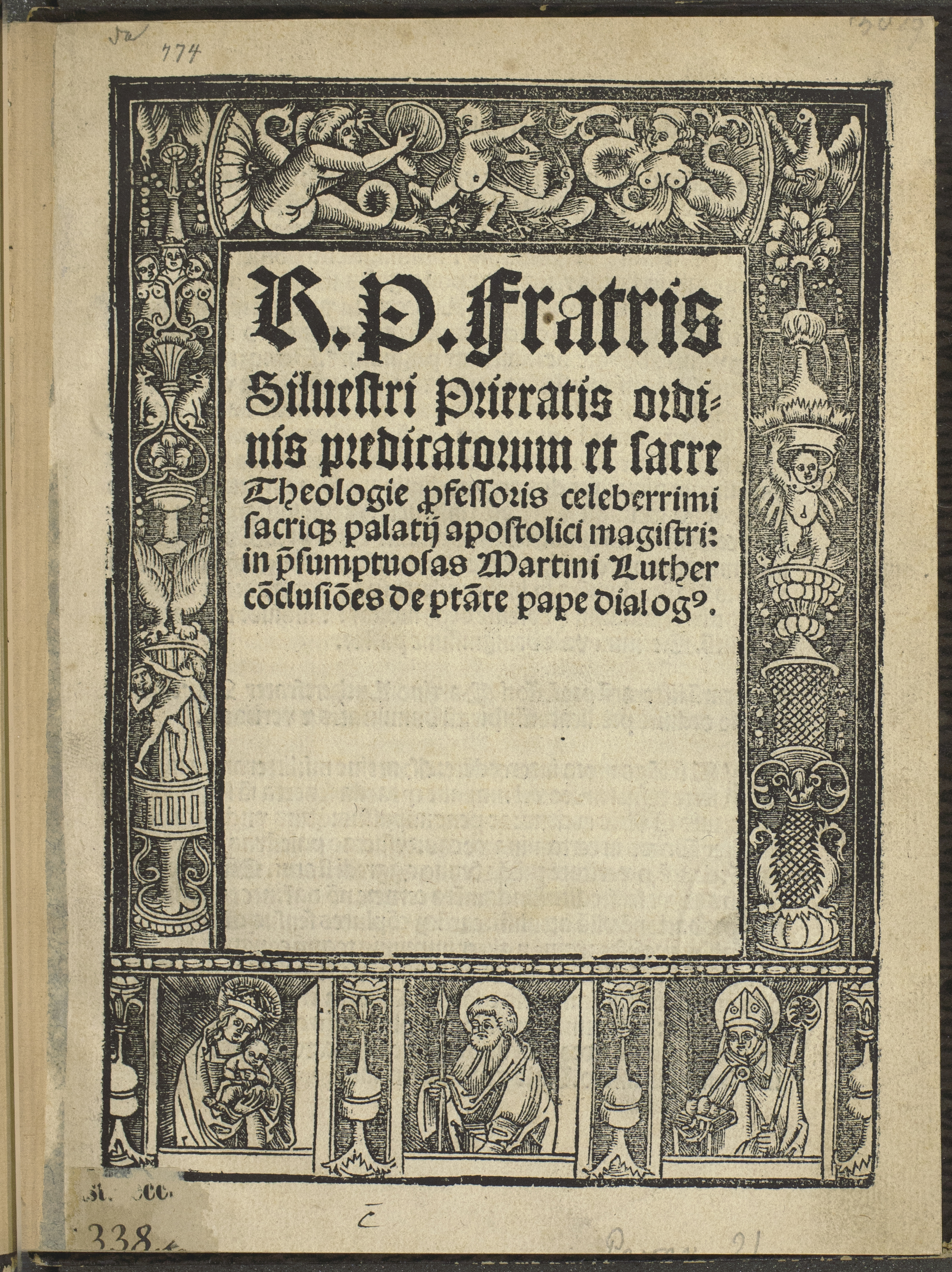
TextR.P. Fratris Siluestri Prieratis ordinis praedicatorum et sacre Theologie p[ro]fessoris celeberrimi sacriq[ue] palatij apostolici magistri: in p[re]sumptuosas Martini Luther co[n]clusio[n]es de p[otes]tate pape dialog[us]
Mazzolini, Silvestro, da Prierio, 1456?-1527?Summary: S. Mazzolini was Master of the Sacred Palace (Vatican) in Rome, censor of books, and one of the first Catholic literary opponents of Luther. This is an early printing of the first work issued in opposition to Luther. Where the printing fits in bibliographically is still a matter of dispute. The work is in dialogue form and contains a refutation of Luther's 95 theses.Summary: S. Mazzolini was Master of the Sacred Palace (Vatican) in Rome, censor of books, and one of the first Catholic literary opponents of Luther. This is an early printing of the first work issued in opposition to Luther. Where the printing fits in bibliographically is still a matter of dispute. The work is in dialogue form and contains a refutation of Luther's 95 theses. -
 Still image
Rabbit or Hare Decorative Accent
A decorative woodcut accent featuring a rabbit or hare amongst flowers.A decorative woodcut accent featuring a rabbit or hare amongst flowers. -
 Text
TextRatio, cur synodus illa, quam Paulus Ro. Pontifex eius nominis III, Mantuae celebrandam, parum candide indicit, & se habiturum esse significat, neque aequa inderi possit, neq[ue] utilis Ecclesiae, unde & ab ijs, qui sacrosanctum Euangelium ineffabili Dei
Summary: When Pope Paul III called for a reform council at Mantua in 1536, the Protestants were faced with a dilemma. If they attended the council they would be recognizing the Pope's authority in such matters. If they refused, then it might appear that their calls for a general council had been insincere. The sticky task of responding to the pope's call fell upon Melanchthon. This is an edition of his response.Summary: When Pope Paul III called for a reform council at Mantua in 1536, the Protestants were faced with a dilemma. If they attended the council they would be recognizing the Pope's authority in such matters. If they refused, then it might appear that their calls for a general council had been insincere. The sticky task of responding to the pope's call fell upon Melanchthon. This is an edition of his response. -
 Text
TextReceipt for 20 Gulden salary to Jonas Justus from the City Council of Erfurt
Jonas, Justus, 1493-1555This collection consists of a single receipt, on paper, for 20 Gulden which Jonas received as salary from the City Council of Erfurt. Our research has so far been unable to determine just why Jonas was being paid by the City Council. The fact that he uses the word "Zinse" (interest income, or, income from a benefice) suggests that it was for services rendered as a preacher in that City. It is also known that he was considering returning to Erfurt as a preacher after the debacle at Halle. The receipt is signed by Justus Jonas and is dated the 2nd February 1549.This collection consists of a single receipt, on paper, for 20 Gulden which Jonas received as salary from the City Council of Erfurt. Our research has so far been unable to determine just why Jonas was being paid by the City Council. The fact that he uses the word "Zinse" (interest income, or, income from a benefice) suggests that it was for services rendered as a preacher in that City. It is also known that he was considering returning to Erfurt as a preacher after the debacle at Halle. The receipt is signed by Justus Jonas and is dated the 2nd February 1549. -
 Still image
Removal of Jesus from the Cross
A woodcut depicting Mary and Joseph of Arimathea taking the body of Jesus down from the cross. The crown of thorns lies on the ground beside Jesus and the inscription "INRI" appears above the cross.A woodcut depicting Mary and Joseph of Arimathea taking the body of Jesus down from the cross. The crown of thorns lies on the ground beside Jesus and the inscription "INRI" appears above the cross. -
 Text
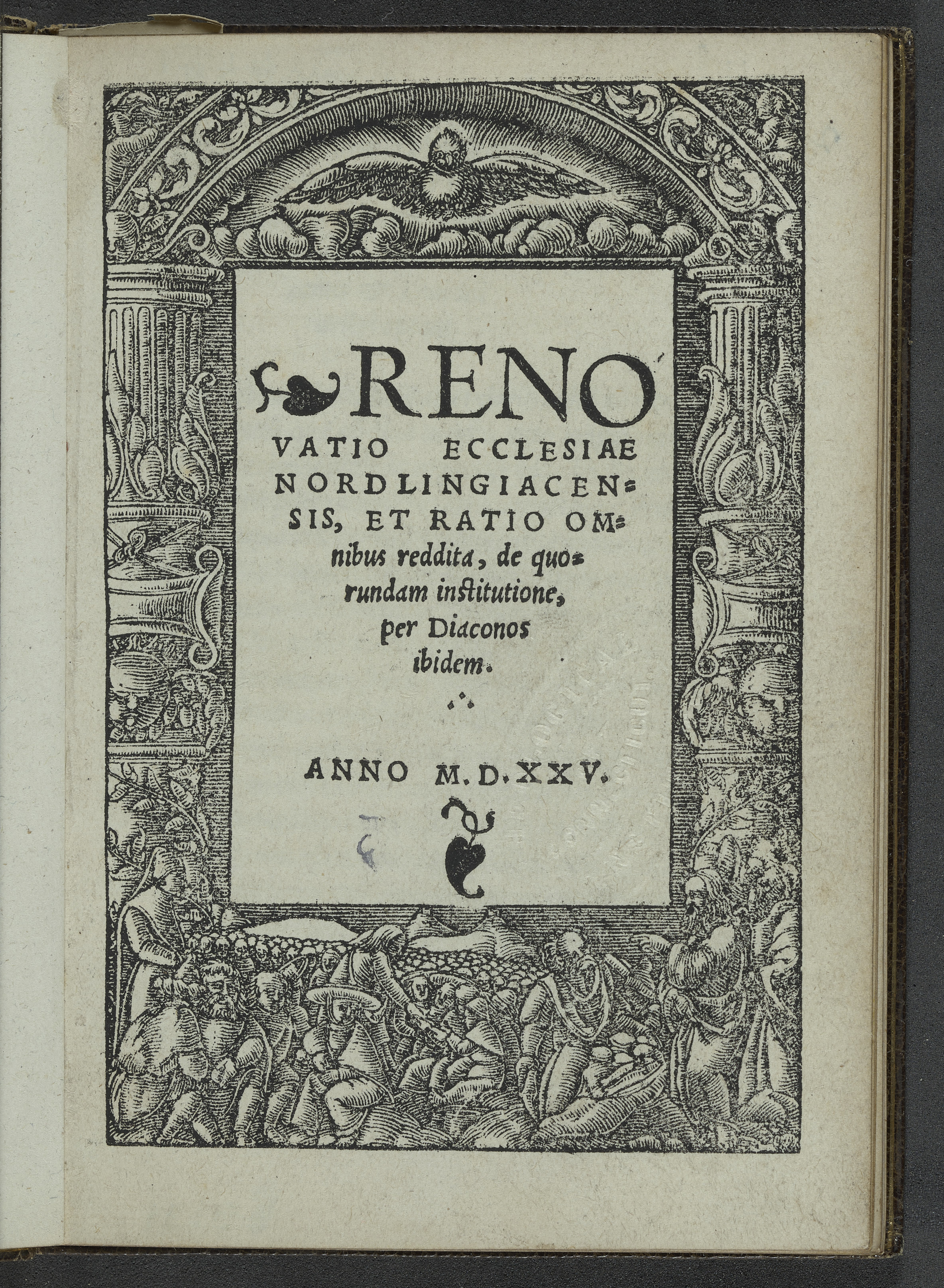
TextRenouatio Ecclesiae Nordlingiacensis, et ratio omnibus reddita, de quorundam institutione
Billican, Theobald, approximately 1490-1554Summary: Theobald Billican was educated at Heidelberg where he became a close friend of Melanchthon. He was drawn to Luther in 1518 when Luther disputed on scholasticism at the University of Heidelberg. This tract on the reformation in Nordlingen attempts to prove that the old "abuses" had been corrected and replaced with "purified" doctrines. Billican consciously constructs his discourse more along Erasmian lines than according to strictly Lutheran models.Summary: Theobald Billican was educated at Heidelberg where he became a close friend of Melanchthon. He was drawn to Luther in 1518 when Luther disputed on scholasticism at the University of Heidelberg. This tract on the reformation in Nordlingen attempts to prove that the old "abuses" had been corrected and replaced with "purified" doctrines. Billican consciously constructs his discourse more along Erasmian lines than according to strictly Lutheran models. -
 Text
TextReplica F. Sylvestri Prieriat[is] : sacri Palatii Apostolici Magistri, ad F. Martinum Luther Ordinis Eremitaru[m] ; Martinus Luther, optimo lectori salutem ...
Mazzolini, Silvestro, da Prierio, 1456?-1527?Summary: When Luther received the replies of S. Mazzolini, the first man to take up the cudgels against Luther, he found the best course of reply to be a reprinting with notes of Mazzolini's inept rejoinders. Even the Catholics had to admit that Mazzolini's answers simply did not meet Luther's objections. This is the second printing of the work.Summary: When Luther received the replies of S. Mazzolini, the first man to take up the cudgels against Luther, he found the best course of reply to be a reprinting with notes of Mazzolini's inept rejoinders. Even the Catholics had to admit that Mazzolini's answers simply did not meet Luther's objections. This is the second printing of the work. -
 Text
TextReplica contra periculosa scripta post Scrutinium diuine scripture iam pride[m] emissum emanata. ...
Schatzgeyer, Kaspar, 1463 or 1464-1527Summary: Casper Schatzgeyer, or Sasgerus, was a Franciscan friar who became provincial of the Province of Strasbourg in 1517. He wrote about 23 books on theological topics and against members of other orders and sects, notably J. von Staupitz and A. Osiander. This book, however, criticizes two of Luther's tracts: On Monastic Vows and On the Abolition of the Private Mass. Luther persuaded Johann Briessmann to reply, and Schatzgeyer replied to Briessmann. This is the work's first printing.Summary: Casper Schatzgeyer, or Sasgerus, was a Franciscan friar who became provincial of the Province of Strasbourg in 1517. He wrote about 23 books on theological topics and against members of other orders and sects, notably J. von Staupitz and A. Osiander. This book, however, criticizes two of Luther's tracts: On Monastic Vows and On the Abolition of the Private Mass. Luther persuaded Johann Briessmann to reply, and Schatzgeyer replied to Briessmann. This is the work's first printing. -
 Text
TextResolutio Lutheriana super propositione sua tercia decima de potestate papae
Luther, Martin, 1483-1546Summary: This is the fifth printing of Luther's defense of his thirteenth proposition, on the power of the Pope, prepared for the Leipzig Disputation.Summary: This is the fifth printing of Luther's defense of his thirteenth proposition, on the power of the Pope, prepared for the Leipzig Disputation. -
 Text
TextResolutio lutheriana [sic] super propositione deci[m]a tertia: de potestate pape
Luther, Martin, 1483-1546Summary: One of the thorniest issues raised in the Leipzig Disputation was the historical precedence of papal authority. Eck argued that from earliest times, the authority of the bishop of Rome was accepted by the other bishops. Luther's thirteenth proposition argued that only much later did the church in Rome claim precedence over the other churches.Summary: One of the thorniest issues raised in the Leipzig Disputation was the historical precedence of papal authority. Eck argued that from earliest times, the authority of the bishop of Rome was accepted by the other bishops. Luther's thirteenth proposition argued that only much later did the church in Rome claim precedence over the other churches. -
 Text
TextResolutio[n]es disputationum
Luther, Martin, 1483-1546Summary: This is Luther's final authorized edition of his Ninety-five Theses in book form with his own commentaries. The edition published by Rhau-Grunemberg had been so full of errors, that Luther gave the printing of this edition to Melchior Lotter in Leipzig.Summary: This is Luther's final authorized edition of his Ninety-five Theses in book form with his own commentaries. The edition published by Rhau-Grunemberg had been so full of errors, that Luther gave the printing of this edition to Melchior Lotter in Leipzig. -
 Text
TextResolutiones Lutherianae super propositionibus suis Lipsiae disputatis
Luther, Martin, 1483-1546Summary: A clarification of Luther's position regarding the Leipzig disputation, a public debate between the Catholic Johann Eck on the one side and Luther and Andreas Karlstadt on the other. The work is preceded by a long letter to Spalatin, dated 15 Aug., 1519.Summary: A clarification of Luther's position regarding the Leipzig disputation, a public debate between the Catholic Johann Eck on the one side and Luther and Andreas Karlstadt on the other. The work is preceded by a long letter to Spalatin, dated 15 Aug., 1519. -
 Text
TextResolutiones Lutheriane super propositio[n]ibus suis Lipsie disputatis
Luther, Martin, 1483-1546Summary: An analysis by Luther of the propositions debated by him, his colleague, Andreas Karlstadt, and Johann Eck at the Leipzig Debate of 1519.Summary: An analysis by Luther of the propositions debated by him, his colleague, Andreas Karlstadt, and Johann Eck at the Leipzig Debate of 1519. -
 Text
TextResponsio Exulum Turingicorum Ad Inuectiuam D. Iohannis Stosselii : Quam Mense Octobri M.D.LXV. Emisit
Summary: Response singed by 30 gnesio-Luther theologians, who had been expelled from the city of Jena.Summary: Response singed by 30 gnesio-Luther theologians, who had been expelled from the city of Jena. -
 Text
TextRhetorica ad Caium Herennium lib. IIII
Pseudo-CiceroSummary: Eight-line note on rhetorical terms in 16th century Latin mss. on inside front cover; book plate and stamp of former owner Camille Aboussouan on inside front cover and verso of front flyleaf respectively; three Latin distichs identifying former owner as "Joannes Kenerus"; "Freht dich und gnad dir Gott": in ms. surrounds prrinter's device on title page; first few leaves with contemporary manuscript marginalia; "Statua Martis" in 16th century Latin mss. surrounds printer's device on last verso.Summary: Eight-line note on rhetorical terms in 16th century Latin mss. on inside front cover; book plate and stamp of former owner Camille Aboussouan on inside front cover and verso of front flyleaf respectively; three Latin distichs identifying former owner as "Joannes Kenerus"; "Freht dich und gnad dir Gott": in ms. surrounds prrinter's device on title page; first few leaves with contemporary manuscript marginalia; "Statua Martis" in 16th century Latin mss. surrounds printer's device on last verso. -
 Text
TextS.D.n.D. Pauli diuina prouidentia p.p. III : Bullla indictionis sacro sancti generalis concilii
Catholic Church. Pope (1534-1549 : Paul III)Summary: Latin text of the Papal Bull Ad Dominici gregis curam, issued June 4, 1536, for the Council of Mantua which was never held (council eventually took place in Trent).Summary: Latin text of the Papal Bull Ad Dominici gregis curam, issued June 4, 1536, for the Council of Mantua which was never held (council eventually took place in Trent). -
 Still image
Sacrifice of Isaac
Cranach, Lucas, 1472-1553A woodcut depicting Abraham preparing to sacrifice his son, Isaac, as a show of faith to God and being stopped by an angel, who provides a ram (center left) for sacrifice in Isaac's place.A woodcut depicting Abraham preparing to sacrifice his son, Isaac, as a show of faith to God and being stopped by an angel, who provides a ram (center left) for sacrifice in Isaac's place.