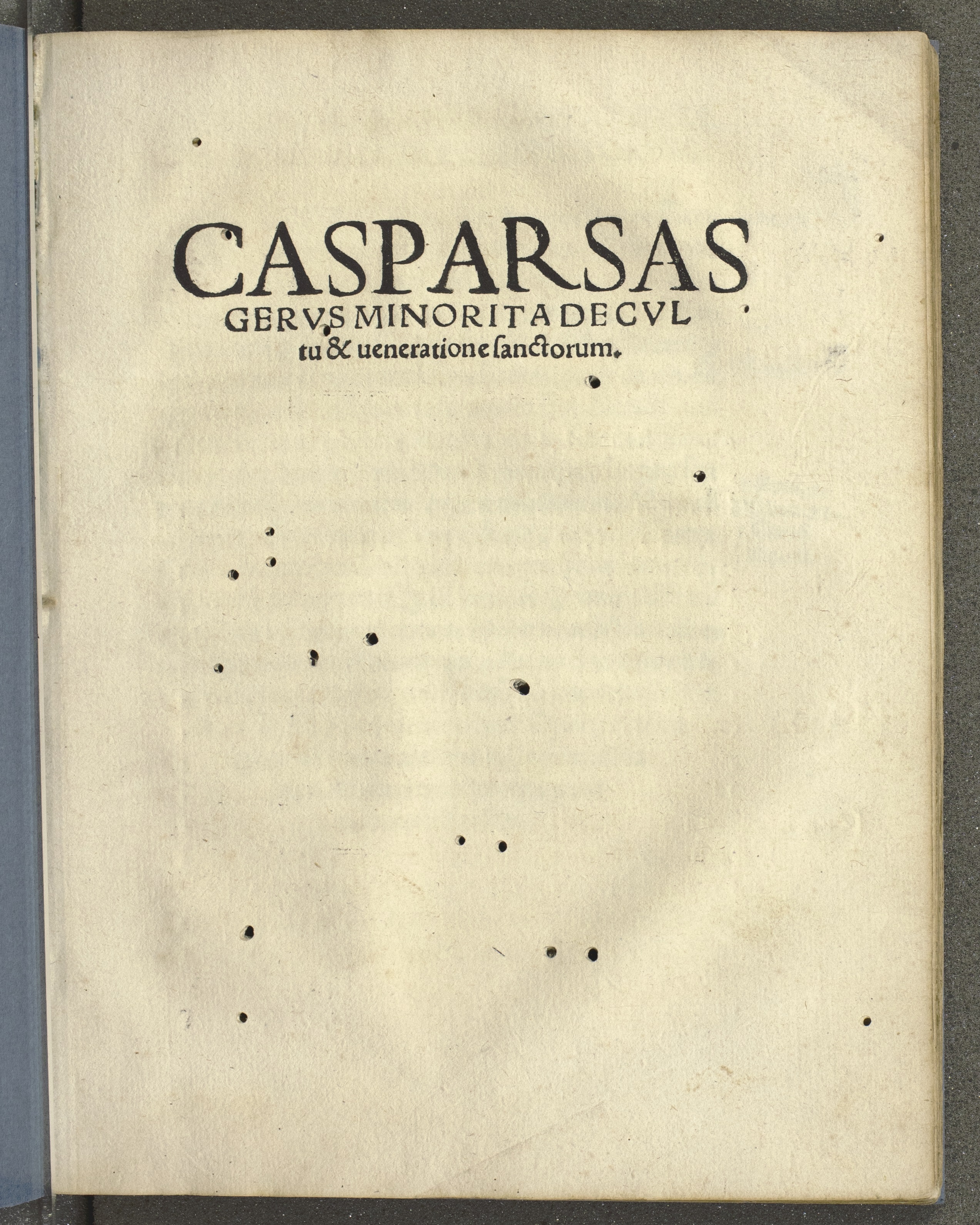
Summary: C. Schatzgeyer here writes on the veneration of the saints, the "friends of God". Catholic theology makes a sharp distinction between paying honor to saints (dulia) and worship of God (latria). This is the first printing of this work. No one knows for sure when it was written and printed.
Summary: C. Schatzgeyer here writes on the veneration of the saints, the "friends of God". Catholic theology makes a sharp distinction between paying honor to saints (dulia) and worship of God (latria). This is the first printing of this work. No one knows for sure when it was written and printed.
Eberlin von Günzburg, Johann, approximately 1470-1533
Summary: One of the problems that led to the Reformation was the sad state of ecclesiastical finance that forced many priests to change fees for the sacraments and other services. Von Gunzburg subjects such practices to sharp sanitization in the form of "praise of priests."
Summary: One of the problems that led to the Reformation was the sad state of ecclesiastical finance that forced many priests to change fees for the sacraments and other services. Von Gunzburg subjects such practices to sharp sanitization in the form of "praise of priests."
Summary: As professor of Logic and Rhetoric at Ingolstadt, Eck had the duty of writing the theses his students defended as part of the requirement for obtaining their doctorates. This one on oaths and vows was written and defended in 1516. M. Kretz was the respondent. This is a very early example of a printed dissertation.
Summary: As professor of Logic and Rhetoric at Ingolstadt, Eck had the duty of writing the theses his students defended as part of the requirement for obtaining their doctorates. This one on oaths and vows was written and defended in 1516. M. Kretz was the respondent. This is a very early example of a printed dissertation.
A woodcut portrait of Martin Luther dressed in the traditional garb of an Augustinian monk and holding a book, likely a Bible, and flanked by two decorated pillars. Appears to be done after the woodcut portrait by Hans Baldung.
A woodcut portrait of Martin Luther dressed in the traditional garb of an Augustinian monk and holding a book, likely a Bible, and flanked by two decorated pillars. Appears to be done after the woodcut portrait by Hans Baldung.
Summary: Casper Schatzgeyer, or Sasgerus, was a Franciscan friar who became provincial of the Province of Strasbourg in 1517. He wrote about 23 books on theological topics and against members of other orders and sects, notably J. von Staupitz and A. Osiander. This book, however, criticizes two of Luther's tracts: On Monastic Vows and On the Abolition of the Private Mass. Luther persuaded Johann Briessmann to reply, and Schatzgeyer replied to Briessmann. This is the work's first printing.
Summary: Casper Schatzgeyer, or Sasgerus, was a Franciscan friar who became provincial of the Province of Strasbourg in 1517. He wrote about 23 books on theological topics and against members of other orders and sects, notably J. von Staupitz and A. Osiander. This book, however, criticizes two of Luther's tracts: On Monastic Vows and On the Abolition of the Private Mass. Luther persuaded Johann Briessmann to reply, and Schatzgeyer replied to Briessmann. This is the work's first printing.
Summary: This is Luther's tract on auricular confession. The sacrament of penance was the focus of Luther's most vehement criticisms. Not only was the sacrament the course of numerous abuses, indulgence selling among them, but attacks on the efficacy of priestly absolution called into question the sacramental authority of all priests, the pope included.
Summary: This is Luther's tract on auricular confession. The sacrament of penance was the focus of Luther's most vehement criticisms. Not only was the sacrament the course of numerous abuses, indulgence selling among them, but attacks on the efficacy of priestly absolution called into question the sacramental authority of all priests, the pope included.
 Text
Text Text
Text Text
Text Still image
 Text
Text Text
Text